Skip to content

Posts from the ‘comment’ Category

Little Addis

I spent part of Sunday at a flatwarming party at the Maboneng precinct in the Joburg CBD. Maboneng – which means ‘place of light’ – is a development funded and directed by the entrepreneur Jonathan Liebmann who, in 2008, began buying up disused factory space in the eastern part of central Johannesburg. The area now comprises boutiques, restaurants, art galleries, a cinema, flats and offices, and a market every Sunday morning.

Maboneng, with its hipsters and street art, has been accused – and justifiably, to some extent – of being an island of cool, gentrified prosperity in the middle of a sea of incredible poverty. Some of the buildings bought up by Liebmann were populated by squatters, and there has been some concern over how they were removed from their homes. It is, in the view of some, a middle-class take-over of part of the inner city.

That said, it is a place that I enjoy visiting: the cinema is wonderful, and the market is one of the most fun places in Joburg on a Sunday morning. The area is one of the most socially diverse I’ve been to, and it has an energy which is infectious. In truth, I don’t really know what to think of it.

DSCN0207

But I am pleased that it has given a space to one of the best restaurants in the city: Little Addis Café on Fox Street. It began life as a stall at the Sunday market, and proved so popular that it soon became a permanent fixture at Maboneng. Consisting of four tables, a fridge full of soft drinks, and a tiny kitchen, Little Addis serves delicious platters of Ethiopian food. (I recommend the vegan special in particular – it’s truly spectacular.)

I’ve no idea, though, if what it serves bears any resemblance to food eaten in Ethiopia. It’s certainly similar to – and better than – Ethiopian food I’ve had in Cape Town and London. In fact, Ethiopian cooking is unique among African cuisines for the way that it’s spread around the world: as pizza is practically ubiquitous (although adapted to local tastes), increasingly it’s possible to find plates of injera bread with a selection of meat and vegetable stews, in most major cities.

As in the case of Italy, the idea of a single Ethiopian style of cooking – one which is held up as somehow representative of the Ethiopian nation – is the product of social and political change. For many centuries, the basic Ethiopian diet reflected what was available to eat: endemic crops (teff, and some kinds of wheat, barley, and millet), and ingredients acquired through trade: lentils, pulses, and spices. James C. McCann explains:

From a culinary point of view, the diet of Ethiopia’s ‘people of the plough’ consisted of particular core elements: fermented teff bread (injera) and stews (wet) made with a base of shallots (shinkurt), dry-fried or sautéed in oil or spiced butter, added late; and some combination of legumes (split or powdered), meat, or vegetables, usually collard greens.

This cuisine changed over time. From around the fifteenth century, peppers, potatoes, maize and other foods arrived from the New World, supplementing spices traded across the Indian Ocean. There were also regional, and class differences, and dishes for fasting and feasting.

However, by the end of the nineteenth century, the Ethiopian court served a cuisine which it described as representing the nation – at a time when a national identity, and the idea of an Ethiopian state, were being forged. It was a cuisine that largely excluded food from the country’s mainly Muslim areas – with the exception of coffee – and tended to reflect those dishes usually prepared in elite households. The meals served at banquets took on the status as properly ‘Ethiopian’, and many of these were adopted by the cafes and restaurants which began to emerge around the country, particularly in Addis Ababa, during the early twentieth century. The first self-consciously ‘Ethiopian’ restaurants serving ‘national’ food – effectively the food of the country’s upper classes – opened in the 1960s.

Ethiopian cuisine was globalised as a result of the 1974 revolution. Immigrants fleeing the country established Ethiopian restaurants cooking the kind of ‘national’ dishes that foreign diners are familiar with today, wherever they settled. However, they adjusted their menus to overseas tastes, as McCann notes:

Pressures for market conformity have, however, brought changes to the menus of Ethiopian restaurants. Some of these, like fasting food from the Orthodox Christian fast renamed as ‘vegetarian’ are market-savvy innovations. Others suggest transgression against the basic rules of the historical cuisine in the structures of taste, meaning, and processing of food.

Most menus now include pudding (sweet foods are usually understood as snacks and not as being part of the meal), raw vegetables in salads, and boneless meat.

Ethiopian tea and coffee for sale at the Arts on Main market.

Ethiopian tea and coffee for sale at the Arts on Main market.

What we think of as being a single, unified cuisine is, then, one that has been constructed at various times and places as being uniquely Ethiopian – whether in the household of Empress Taytu in the 1870s or in a hole-in-the-wall joint in Washington DC in 2014 – and which has changed over time.

In a sense, it’s particularly fitting, then, that Maboneng should have an Ethiopian restaurant. This site of Johannesburg’s reinvention includes a cuisine which has been constantly remade to reflect shifting ideas of what it means to be Ethiopian.

Sources

James C. McCann, Stirring the Pot: A History of African Cuisine (Athens, OH.: Ohio University Press, 2009).

Shannon Walsh, ‘“We won’t move”: The Suburbs Take Back the Centre in Urban Johannesburg,’ City, vol. 17, no. 3 (2013), pp. 400-408.

Creative Commons License
Tangerine and Cinnamon by Sarah Duff is licensed under a Creative Commons Attribution-ShareAlike 3.0 Unported License.

Fragments

On Sunday I went on a guided tour of Sophiatown, presented by the area’s cultural and heritage centre. It was the 59th anniversary – to the day – that police entered the suburb to clear it of its residents. Sophiatown tends to represent two things to South Africans: on the one hand, the vibrancy of life in multiracial and multicultural suburbs in early twentieth-century South Africa. Sophiatown attracted writers, musicians, and activists to a socially mixed suburb – one where Dr AB Xuma, President of the ANC during the 1940s, could buy a grand, wooden floored and high ceilinged house with ample garden, but where poor families squeezed into dank, dirty, and often crime ridden slums.

At the Sophiatown Heritage and Cultural Centre

At the Sophiatown Heritage and Cultural Centre

And on the other, it represents the forced removal of people partly as a result of the Group Areas Act (1950), which segregated all residential areas according to race. As a ‘mixed’ suburb, Sophiatown – alongside District Six in Cape Town, for instance – was deemed to be in contravention of this legislation. Over the course of eight years, Sophiatown’s residents were moved to areas on the edges of Johannesburg: Africans to Meadowlands, Asians to Lenasia, and coloured people to Eldorado Park. The area itself was bulldozed, rebuilt, and rezoned as white. It was renamed Triomf (or ‘triumph’). (And was the subject of a harrowing and damning 1994 novel by Marlene van Niekerk.)

In 2006, the Johannesburg City Council restored the suburb’s name to Sophiatown, and there have been several attempts to excavate the area’s complex – even hidden – past. The Sophiatown Heritage and Cultural Centre has an exhibition of photographs of Sophiatown before the bulldozers arrived, and attempts to provide some sense of what it was like to live there. One of its most successful exhibits is a large, rectangular Perspex box filled with sand and what appears to be, on first glance, rubbish.
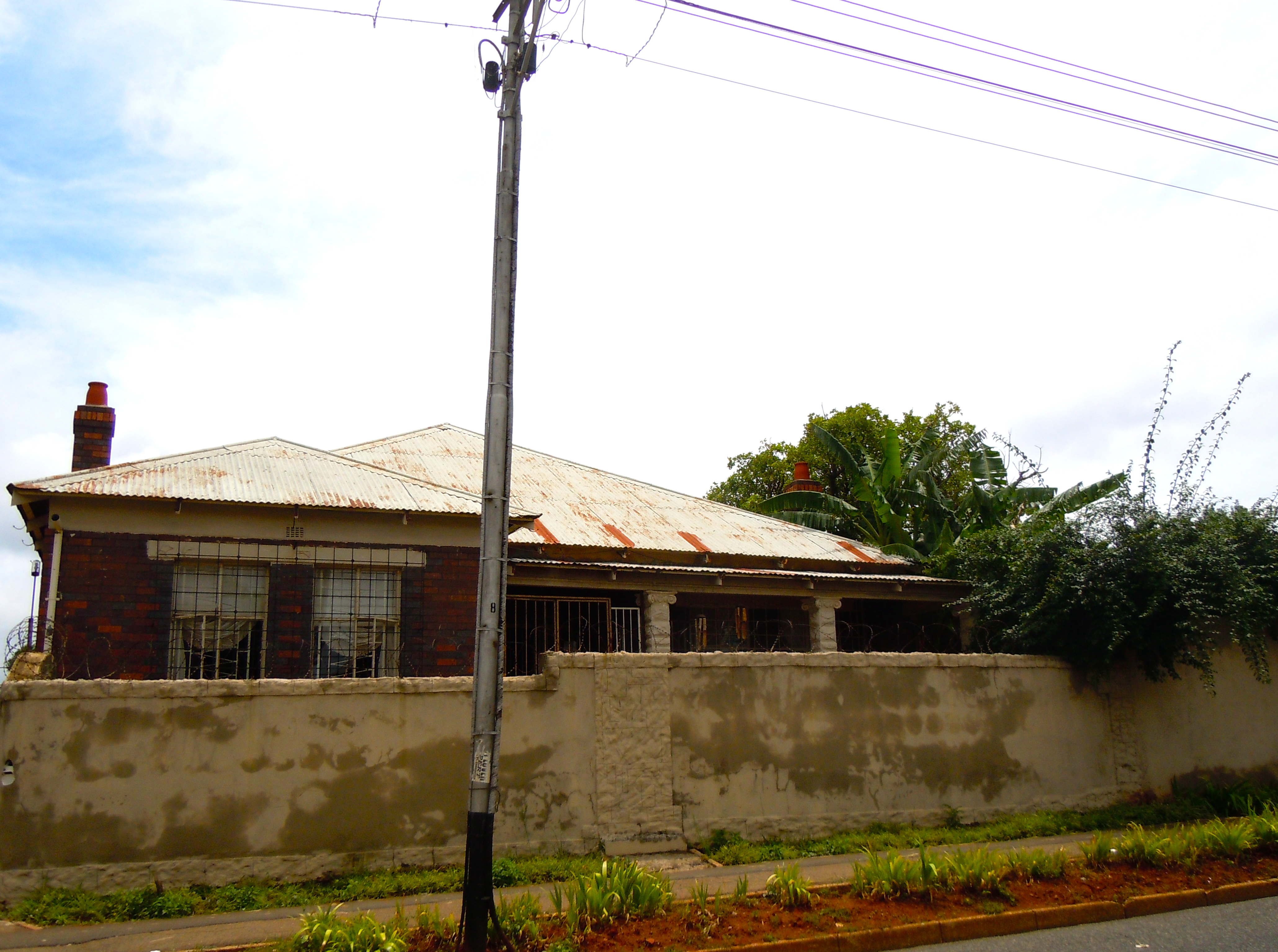
The 'ghost house' - one of the three buildings to survive the bulldozing of Sophiatown.

The ‘ghost house’ – one of the three buildings to survive the bulldozing of Sophiatown.

But the objects partially hidden by brown dirt are things dug up by Sophiatown’s new residents – those who moved into Triomf – since the early 1960s: frying pans, children’s toys, cutlery, combs, and even sewing machines which families had to leave behind in the chaos of forced removal. What makes the display so poignant – other than the way it demonstrates how apartheid legislation was worked out on a domestic, personal level – is that it connects the suburb’s past and present residents in a shared remembrance of a profoundly violent episode.

It also resonates during the Centre’s guided walk around Sophiatown. Only three buildings survived the bulldozing: Xuma’s house (currently the site of the Centre), a decrepit building now renamed the ‘ghost house’, and the Church of Christ the King – in some ways the epicentre of resistance to the removals. The tour moves between these buildings, making detours to the remains of the oak tree in Bertha Street, and to part of a wall – once part of the Odin Cinema – which miraculously was not torn down during the late 1950s.
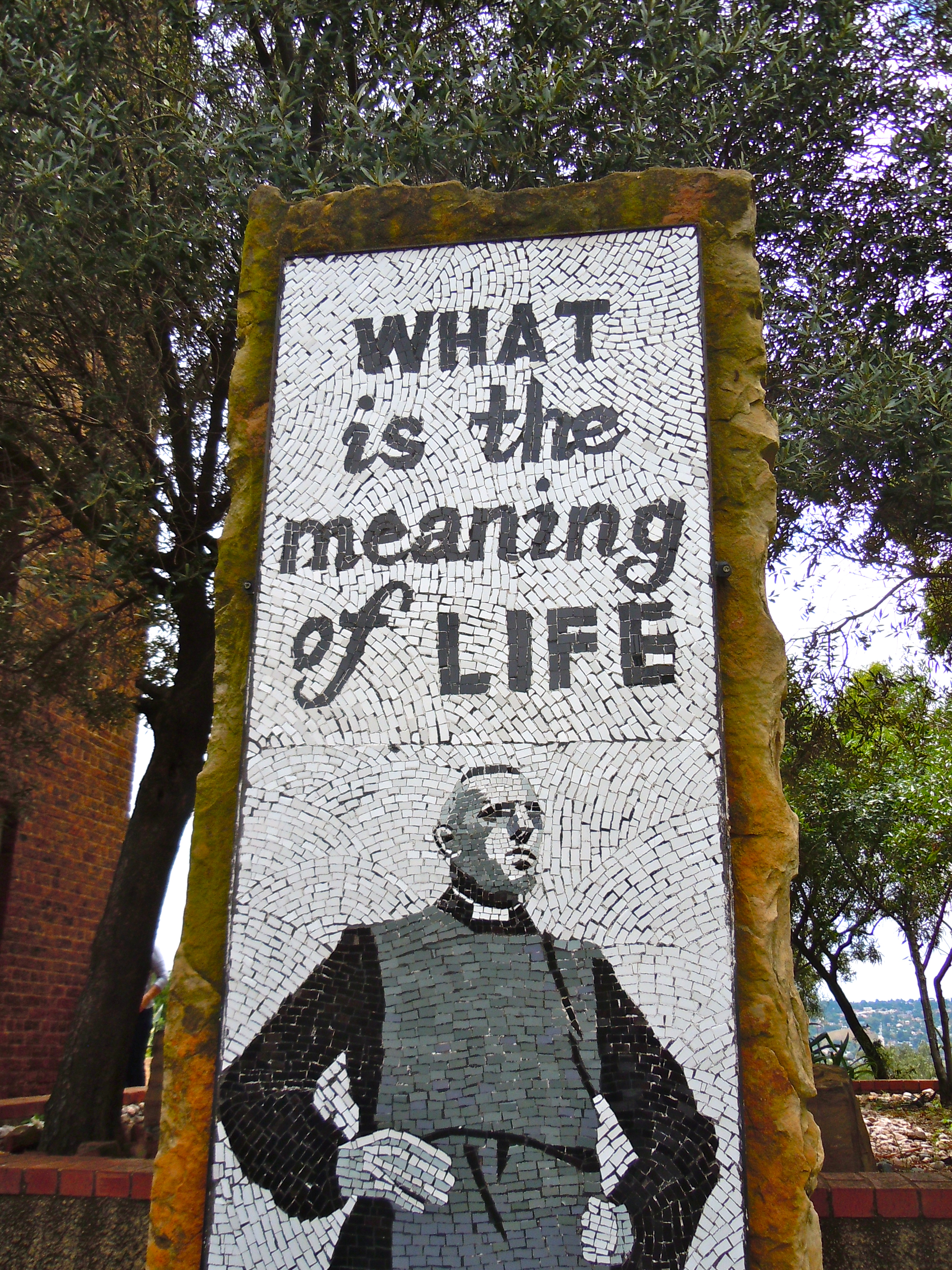
The memorial to Father Trevor Huddleston.

The memorial to Father Trevor Huddleston.

Today, Sophiatown looks much the same as any working-class South African suburb, and, despite the valiant efforts of the tour guide, it was difficult to imagine how bustling and full of people – and energy – it must once have been. What did help was the presence two former residents, both of them anti-apartheid activists, whose memories were able to evoke the suburb before and during its destruction.

Over the course of the afternoon, I was reminded powerfully of Antoinette Burton’s remarks about the archive, and historians’ relationship with the archive:

The history of the archive is a history of loss…. I would argue … that it is the archive itself which should be subject to continuous suspicion and radical doubt, serving as it often does to normalise, through classification and re-representation, what are invariably ‘fragmented, fractured and disassembled’ strands of historical evidence and experience. If we fail to recognise how historical practice (or, indeed, any practice of looking) is in danger of reassembling and recalcifying what counts as evidence … we miss a valuable opportunity to interrogate our own investments in those domains.

The few fragments that remain of Sophiatown – the objects unearthed in residents’ gardens, the two houses, the wall, the tree, the church, photographs, newsreels, and people’s memories – draw attention to the incomplete, piecemeal nature of the archive. We have access to the past only through the bits and pieces – the papers, objects – which have managed to survive bulldozers, fire, water, decay, and archivists’ best intentions.

As a result of this, argues Burton, historians need to be acutely aware of how they assemble these fragments into portraits – interpretations, narratives – of the past. There has been a tendency to romanticise Sophiatown in its heyday, not only to ignore the crime and poverty endemic to the suburb, but also to erase histories of anti-apartheid groups other than the ANC which were active in the area. Writing a more complicated, nuanced social history of Sophiatown is a useful way of demonstrating how historians, themselves, are complicit in remaking the past, and that the past is being constantly remade and reinterpreted.

Sources

Antoinette Burton, ‘Thinking beyond the Boundaries: Empire, Feminism and the Domains of History,’ Social History, vol. 26, no. 1 (Jan., 2001), pp. 60-71.

Creative Commons License
Tangerine and Cinnamon by Sarah Duff is licensed under a Creative Commons Attribution-ShareAlike 3.0 Unported License.

Troubled Waters

In April last year I went to a public meeting convened by the NGO Equal Education in Cape Town’s best bookshop, the Book Lounge. I have been to dozens of launches and readings and comic book swaps at the Book Lounge, but none of them was as packed as this. There were people squeezed on the floor in between chairs; the crowd was four-people deep in standing room-only areas; people on the pavement outside listened in through the open doors. I climbed up part of a bookshelf to see what was going on. It was so hot and damp with more than a hundred bodies crammed tightly together, that it felt that the shop had developed its own tropical ecosystem.

It says a great deal about the state of South Africa’s education system that a panel discussion about schools in the Eastern Cape – one of the country’s least effectively run provinces – could draw such a large and enthusiastic crowd. Equal Education had recently sent a group of South African luminaries – including constitutional law professor Pierre de Vos, writers Zakes Mda and Njabulo Ndbele, Archbishop Thabo Makgoba, and activists Elinor Sisulu and Sindiwe Magona – on a Solidarity Visit to draw attention to the appalling state of school infrastructure.

They described collapsing mudwalled classrooms; inadequate supplies of books and stationery; children without desks; and, most memorably, the disgusting state of school toilets. Children complained of contracting diseases from filthy, broken latrines, and many of them chose rather not to use them at all – either risking their health or relieving themselves in the veldt. It was the toilets that seemed to many to sum up the Department of Basic Education’s lack of respect for the children it is supposed to educate.

It’s been difficult not to think about the Solidarity Visit and its report fairly recently. Last week, a little boy was killed when he fell into a pit toilet at a primary school in Chebeng, a village in Limpopo Province. Referring to a 2011 survey, Equal Education noted:

Of the 24 793 public ordinary schools, 11 450 schools are still using pit latrine toilets and 2 402 schools have no water supply, while a further 2 611 schools have an unreliable water supply.

This death coincided with a series of protests in the Madibeng municipality in the North West, over water shortages, which led to the deaths of three protestors. After an outcry over both alleged police brutality, as well as revelations as to the mismanagement of the municipality, the mayor resigned and water was restored. Residents say, though, that the water remains too dirty to use.

These protests are nothing new. Residents of this and other municipalities in the North West have been demanding a clean, reliable water supply – and it’s worth emphasising that they’re billed for water regardless of whether it flows or not – since at least 2011. As even ANC stalwart Trevor Manuel has admitted, the problem in Madibeng is that a dysfunctional, corrupt local government cannot provide basic services. In 2010, the municipality was placed under administration:

In June 2011, newspapers exposed the fact that the new executive mayor was renting a BMW at the cost of R2,025 per day. In April last year, it was reported that R1 billion of assets, supposedly owned by the municipality, were missing.

The violence of these protests has drawn attention to crises not only in policing (and it would seem that some of the police who were present at the Marikana massacre were at Madibeng too), but also in the regular provision of clean water to South Africans. As both Eyewitness News and an Africa Check have demonstrated, the Department of Water and Environment Affairs’ claim that 94% of South Africans have access to safe drinking water doesn’t, well, hold any water. A 2011 general household survey published by Statistics South Africa reports that:

89.5% of South African households had access to piped water. Breaking that number down, 43.3% had piped water in their homes, 28.6% had access to water in their yards, 2.7% had the use of a neighbour’s tap and 14.9% had to make use of communal taps.

Moreover, South Africans have reported declining satisfaction with the quality of water provided, complaining that in some municipalities it is not clean enough to drink and cook with.

DSC06680

A protestor holds aloft a copy of the constitution. Taken at the Right2Know campaign’s march to Parliament, October 2010.

It is not difficult to understand why communities living in rural areas and informal settlements – those usually with the least access to basic services – protest poor and irregular water supplies with such anger. Usually described as ‘service delivery protests,’ demonstrations over poor municipal governance have, over the past few years, become ever more frequent and violent. But they are more than protests over bad service delivery.

The idea of water as a public good dates from around the mid-nineteenth century, when local governments became interested in ensuring clean water supplies as a way of combating the spread of disease. South Africa is one of the few countries in the world which enshrines the right to access clean, safe water in its constitution. Citizenship is, then, closely connected to being able to fill a pot with clean water from a kitchen tap; to take a shower in a bathroom; and to flush a porcelain toilet. In a country where access to water was, under apartheid, determined by a racist urban planning system, these current service delivery protests are a revolt around the denial of citizenship.

Creative Commons License
Tangerine and Cinnamon by Sarah Duff is licensed under a Creative Commons Attribution-ShareAlike 3.0 Unported License.

Things that happened in Joburg this week

What happened in Johannesburg – city of prophets and miracles – this week.

A man tried to buy an overpriced rocket launcher in the CBD.

DSCN8676

Sanral, which administers the unpopular e-tolls system on the city’s highways, received envelopes containing white powder. The building was evacuated twice.

DSCN8651

On Sunday two people dressed as cows cycled down Emmarentia Avenue.

DSCN9384

A community newspaper reports that two men have claimed an empty coffin found abandoned in Linden. They say they plan to use it as a TV stand.

DSCN9305

Creative Commons License
Tangerine and Cinnamon by Sarah Duff is licensed under a Creative Commons Attribution-ShareAlike 3.0 Unported License.
Readymade

Every summer my mother and I make preserves. We have two staples – Christmas chutney and red pepper relish – which, occasionally, we’ve augmented with piccalilli, boerenjongens (currants in brandy), and pickled pears. When we started this more than a decade ago, chutney- and jam-making was seen as the sort of thing that grandmothers did, and this despite the long tradition of preserving and pickling in South Africa’s fruit growing regions.

More recently, though, preserving has become fashionable. Recipes for chutneys abound on hipster blogs and cooler recipe sites; Punk Domestics has an enormous following; and even Girls features a maker of ‘artisanal mustard’ (Charlie’s profoundly irritating girlfriend, Audrey). This, though, is part of a wider trend: a rediscovery of domesticity, particularly – although not exclusively – among young women in their 20s and 30s. The existence of a café specialising in crafts – Drink, Shop, Do – in London’s Kings Cross, points to the numbers of people who are part of this trend.

DSCN9575

Their enthusiasm for cooking-from-scratch, sewing, knitting, gardening, and other domestic activities is the product of a range of factors (many of them explored in Emily Matchar’s Homeward Bound: Why Women are Embracing the New Domesticity (2013)). These include the evolution of feminism to reclaim work once dismissed as feminine and, thus, unimportant; a shift in values as Generation Y attempts to carve out new, meaningful forms of employment; and the 2008 financial crash. Austerity has played out culturally: in a new interest in mending and making-do.

Most obviously, a willingness to make ketchup and bread and mayonnaise is part of a backlash against Big Food: as revelations around, among other things, food contamination, the exploitation of workers, and cruelty to animals continue to emerge, there has been a gradual turning-away from processed food. This, though, is nothing new (there was a similar whole food movement in the 1970s), nor particularly prevalent beyond the affluent middle classes.

Unsurprisingly, this backlash against the readymade has been accompanied by a fascination for the post-war cooking which relied heavily on processed food. The Internet abounds with lists of appalling recipes containing instant jelly, fizzy soft drinks, and canned meat. Nigella Lawson devoted a section to ‘trashy’ food in Nigella Bites, explaining that she defines ‘trashy’ as any food relying on at least one readymade ingredient: Maryland cookies in her chocolate and lime cheesecake, for instance.

DSCN9578

There is some justification for this ridicule – so many of these dishes range from the bizarre to the mildly pornographic. Adding lime jelly to tinned tuna, or turning Vienna sausages into fondue, suggests that some home economists employed by food companies in the 1950s and 1960s really did have cloth palates.

But it’s worth taking enthusiasm for the readymade seriously. In his excellent – and deeply funny – blog Caker Cooking, Brian Francis cooks his way through the community, school, and church recipe books constituted of the kind of everyday dishes made by, largely, middle-class families. (And although his blog is Canadian, I’ve encountered similar pamphlets and recipes in South Africa and Australia.) This is his definition of caker cooking (and he is being satirical, so his third point is not meant to offend):

1. A ‘magic’ ingredient. We cakers love to think we’ve discovered some sort of short cut. Usually, this short cut requires a can opener.
2. Ease. The recipe has to have as few steps and as few ingredients as possible.
3. Frugality. There’s nothing more wasteful than spending good money on food.

Indeed, it is for these reasons that processed food held such appeal to women – many of them entering the workplace in greater numbers – from the middle of the twentieth century to the present: that this food is quick and easy to prepare, and it’s cheap. It’s difficult to imagine, now, the amount of labour that used to go into the preparation of food. And, as the food writer and anti-poverty campaigner Jack Monroe has noted over and over again, tinned food is considerably cheaper than fresh.

Calvin Trillin is one of the few food writers who recognises that the only way of describing honestly about how people eat is to acknowledge that processed food is integral to the way most of us cook. (Try cooking through a winter without tinned tomatoes.) That cream of mushroom soup is a vital ingredient in so many distinctive regional dishes; that Texas barbeque is served with cheap, white processed bread and that’s ok.

My point is that however wonderful it is that there has been a rediscovery and re-embrace of old-fashioned forms of cookery – and as one who makes her own granola, bakes her own bread, and who has dried her own tomatoes, I am part of this too – this movement is small, and one limited to those who have the time and resources to spend hours making pickles or fruit leather. Instead of arguing for a wholesale rejection of all forms of processed food, what we should focus on is ensuring that it is better: that it is healthier, properly labelled, and produced in humane, fair conditions.

Creative Commons License
Tangerine and Cinnamon by Sarah Duff is licensed under a Creative Commons Attribution-ShareAlike 3.0 Unported License.

Orientalism

Just before Christmas, the Mount NelsonCape Town’s grandest hotel – caused a minor kerfuffle on social media after posting a photograph of its latest confection: a corrugated iron shack made out of gingerbread. When several people pointed out that this was, at best, a stunningly insensitive gesture, the hotel’s representative replied that its purpose was partly ‘educational’: that it was to ‘raise awareness’ among hotel guests, most of whom are foreign, of the Mount Nelson’s ‘township projects’. As the uproar grew, the hotel deleted the photograph, then denied deleting the photograph (arguing that it was trying to ‘control’ the outcry), and finally apologised – blaming the gingerbread house on a ‘staff initiative’.

BcLwLMmCEAEMvLL.jpg_large

This is not the first – and will certainly not be the last – example of crass, thoughtless behaviour in the food world. A couple of years ago I attended part of a conference-cum-festival in the Cape Town City Hall where an installation attempted to impress on punters how many South Africans are illiterate, use latrines, are HIV positive, and are unemployed through the medium of cake decorations. (The same event included a talk on Nelson Mandela’s life understood through food, during which members of the audience were served versions of the meals that he ate at key moments…supplied by posh supermarket Woolworths.)

Earlier this year, a group of Hackney hipsters were forced to defend their decision to open an advice centre-themed café on the former site of the Asian Women’s Advisory Service. The Advisory – as it is called – seemed to many to crystallise all the worst aspects of the gentrification of one of London’s poorest boroughs.

The Advisory and that Cape Town food conference are the products of an industry dominated by the privileged. The Mount Nelson’s defence of its gingerbread house could only, I imagine, be made by someone who had never had to think too deeply about the circumstances which force people to live in informal settlements.

So far, so obvious. But I think it’s worth paying attention to the Mount Nelson debacle, in particular, because it draws our attention to the problematic ways in which the food industry – or the collective writers, broadcasters, restaurateurs and others involved in the food world – deals with race.

Recently, and most noticeably since Time’s disgraceful male-only list of the world’s top chefs, there has been a lot of excellent discussion about why women’s contribution to the food industry goes unnoticed. But we have to ask another question just as urgently: why is it that the majority of people usually listed as ‘top chefs’ (whatever we may mean by that) are white? Why is it that someone like David Chang is a notable exception in a long parade of white men?

It certainly isn’t the case that kitchens don’t employ black people. The report Fast Food, Poverty Wages: The Public Cost of Low Wage Jobs in the Fast Food Industry (2013), demonstrates not only that Americans employed in fast food jobs are more likely to live in poverty, but also that ‘[m]ore than two out of five front-line fast-food workers are African American (23 per cent) or Latino (20 per cent)’. More generally, the majority of people employed in low-paid, but essential, jobs over the extent of the food chain – from agricultural and abattoir work, to shelf packing and restaurant serving – and in the US and elsewhere, are people of colour.

The invisibility of this workforce in most food writing is indicative, I think, of the, often problematic, ways in which food writers deal with race. Food writing is one of the few genres where it’s still possible to describe Middle Eastern or south Asian food in terms which would keep the average eighteenth- or nineteenth-century orientalist happy.  This post on how to write about African food – inspired by Binyavanga Wainaina’s essay ‘How to Write about Africa’ – nails this:

It is best practice to include the word ‘Africa; plus a positive descriptor in your headline. If you must be more specific, whole regions like West Africa, Southern Africa, East Africa, West Africa or Central Africa will do. Always keep the headline of your article broad, even when writing about the food of a specific country.

Remind the reader that Africa is not a country, but still do not offer specifics.

Introduce the owner of the restaurant. If male, he moved to the country 10 years ago and learned to cook by working in the restaurant of a hotel. Another option is that he had no idea how to cook upon arrival and taught himself everything he knew after a bout of severe homesickness. His name is Chuck.

If female, she is a motherly figure who walks round greeting customers as if they were family. Think Mother Africa. She has a twinkle in her eye. She is plump. Everyone calls her Mama O.

Ask Chuck or Mama O why they chose to open a restaurant. Ask about the name of the restaurant and what it means.

Discuss the menu and gloss over the regular dishes… Focus on the most exotic-sounding foods.

Point out that Mama O brought out a knife and fork for you, but you endeavored to go ahead and eat with your hands. Mention that you cleared your plate. Don’t offer criticism.

My point is that the kind of bad food writing this post parodies, is indicative of a set of deeply concerning attitudes towards race: that Africans (or Asians, or South Americans…) conform to a set of exotic stereotypes that render them less fully human than the white, western writers who encounter them.  One of the effects of this writing – which has a tendency to describe all non-western food as ‘ethnic’, as if whiteness absolves one of ethnicity – is to draw attention away from the material circumstances in which Ethiopians, Iranians, and Mexicans, for example, actually go about producing food, either for themselves, or as immigrants in other societies.

Put another way, this food orientalism serves to depoliticise writing on food, and to distract from the inequalities and exploitation which occurs along the length of the food chain.

Creative Commons License
Tangerine and Cinnamon by Sarah Duff is licensed under a Creative Commons Attribution-ShareAlike 3.0 Unported License.

Rain

On late Thursday afternoon I drove through pouring rain to Wits University’s memorial service for Nelson Mandela. The rain fell in sheets across the road and hailstones pinged off my car’s bonnet. When I arrived on campus, I had to navigate paths and walkways which had become ankle-deep, swiftly running streams. I had to wring the water out of the pair of ballet flats I was wearing.

The storm was not particularly unusual for early December. Johannesburg receives most of its annual rainfall during the summer, transforming the city’s dusty, brown winter ugliness into a riot of purple and green leaves and flowers in October and November. But in some ways this week’s rain has been remarkable.

On Tuesday, it rained steadily for almost twenty-four hours. This would be entirely normal in Cape Town in the depths of winter, but is almost unheard-of in a Johannesburg nearing midsummer. While some suggested that the heavens were weeping for Madiba, others, like Cyril Ramaphosa at the official memorial service in Soweto, argued that the rain signalled the afterlife’s preparation for Mandela’s arrival. As a shop assistant at my local Pick ‘n Pay remarked, if this was true, then we should expect floods on Sunday.

The rain was not the only unplanned, ungovernable feature of Tuesday’s service: chaotic public transport; world leaders taking selfies at inappropriate moments; a bizarre, and apparently criminal, sign language interpreter; and an audience who booed the State President. As Ramaphosa and, later, Archbishop Tutu tried to threaten and cajole the audience into silence, the pouring, soaking rain seemed to re-emphasise the futility of their efforts: as they could not stop the clouds, so they could not stop the South Africans assembled in FNB stadium.

Tributes at Mandela's home in Houghton.

Tributes at Mandela’s home in Houghton.

Several writers have pointed out that the official events organised to mourn Mandela’s death have been at odds to the ways in which South Africans have been celebrating his life. The long speeches and tedium of Tuesday’s events contrasted with the singing and dancing at Mandela’s homes in Houghton and Soweto. The time allowed to celebrities – like Bono – to mourn at Mandela’s coffin as he lay in state at the Union Buildings was deeply resented by the many thousands who were denied access because of overcrowding.

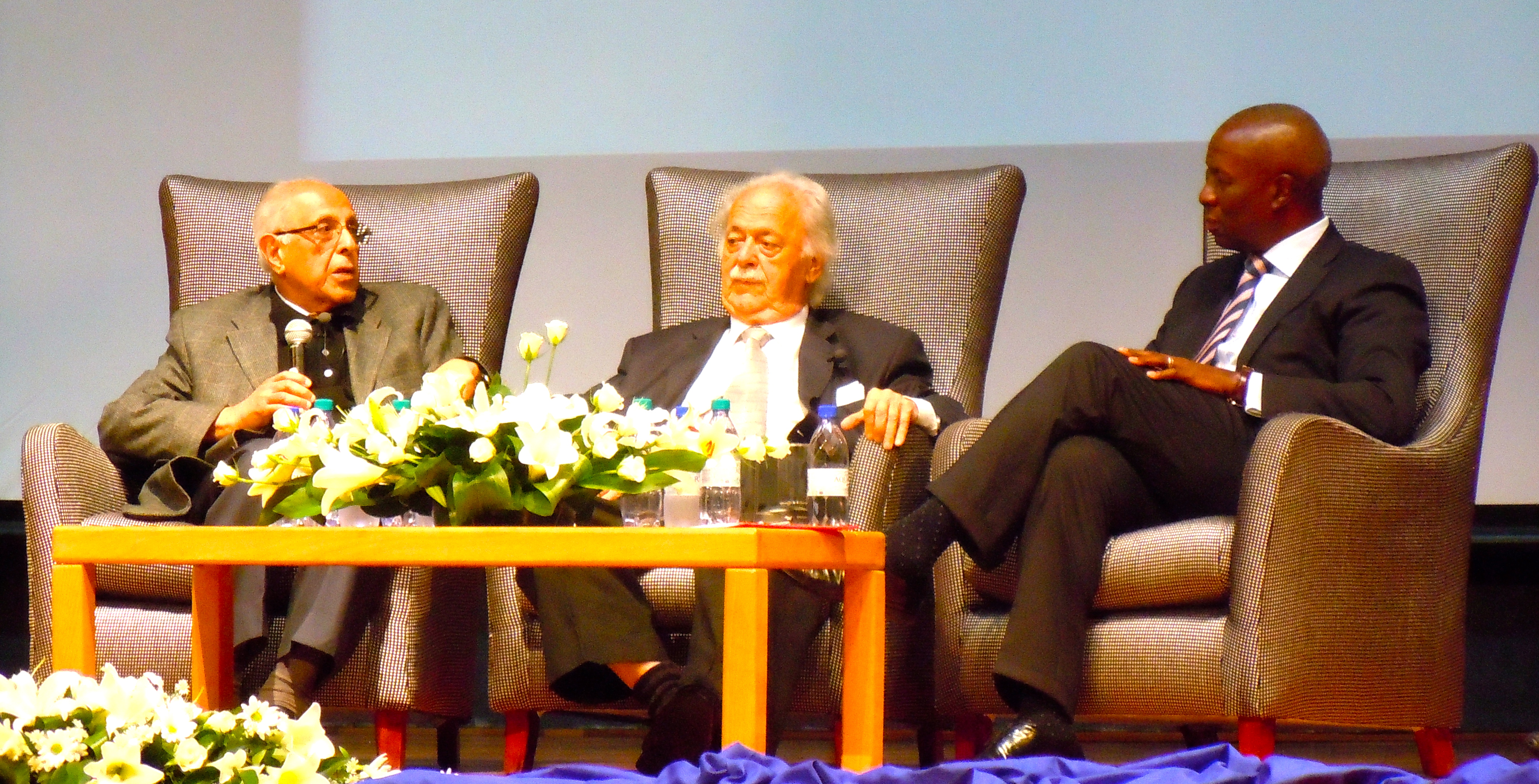
Although delayed by the storm, the Wits memorial managed a balance of song and joy, of commemoration, and pointed discussion of how Mandela’s own commitment to public service – his decision not to run for a second term as president – contrasts with the venal, corrupt behaviour of many present office bearers in his own party. Its centrepiece was a conversation between Ahmed Kathrada, George Bizos, and Dikgang Moseneke. It was a reminder of the degree of the suffering that these – and many others – endured during the struggle.

Ahmed Kathrada, George Bizos, and Dikgang Moseneke.

Ahmed Kathrada, George Bizos, and Dikgang Moseneke.

It demonstrated that the official memorialising of Mandela has profoundly missed the point: that the best way of paying tribute to Mandela and his generation is to work hard at making South Africa more free. And to think more carefully about what it means to be free. Lira, who performed at the end of the service, put this particularly eloquently: ‘My generation was taught to survive the struggle,’ she said. ‘But we were not taught to be free. We had to work that out for ourselves.’

I think it was partly this tension between differing definitions of freedom – which understand Mandela and his legacy in occasionally divergent ways – which contributed to the standoff between citizenry and state on Tuesday. Thinking about this past week, I realise that my most significant moments of reflection on, and commemoration of, Mandela’s legacy have been far away from official acts of remembrance: with throngs of people outside his Houghton home; lighting prayer lanterns with friends in Melville, late at night and after a long dinner; at tea with colleagues to celebrate the end of the year; listening to three struggle heroes discuss the future of the country.

Houghton.

Houghton.

These acts made sense to my understanding of what it means to be free in post-apartheid South Africa. That nearly twenty years after the transition to democracy, we’re still arguing and debating what it is to be free – and any attempt to silence this is like trying to stop the rain.

Creative Commons License
Tangerine and Cinnamon by Sarah Duff is licensed under a Creative Commons Attribution-ShareAlike 3.0 Unported License.

Luck

A while ago my friend Nafisa lent me Secret Ingredients: The New Yorker Book of Food and Drink. I was particularly taken by an essay by Jane Kramer called ‘The Reporter’s Kitchen.’ She describes exactly the connection between cooking and writing: how baking biscuits or, more usually in my case, bread can be fitted into the writing of an essay. How following recipes follows the same process of unfolding as constructing an argument. How cooking food can both distract from difficult writing, as well as address the causes of writers’ block:

[I] tried madeleines again, and discovered that, for me, they were just another cookie – which is to say, not the kind of cookie that belonged in the ritual that for years has kept me commuting between my study and my stove, stirring or beating or chopping or sifting my way through false starts and strained transitions and sticky sentences.

During times of stress, she turns both to writing and to cooking. I tend to do the same, but this week I’ve not been able to write. I was mugged in the Johannesburg CBD on Friday evening, and, at almost exactly the same time the following Monday, a man drove into the back of my car as I was on my way home.

I’ve hesitated about mentioning these events because they seem to confirm some of the worst stereotypes about Johannesburg, and, although annoying and stress making, they’re by far not the most important things that have happened in the past few weeks.

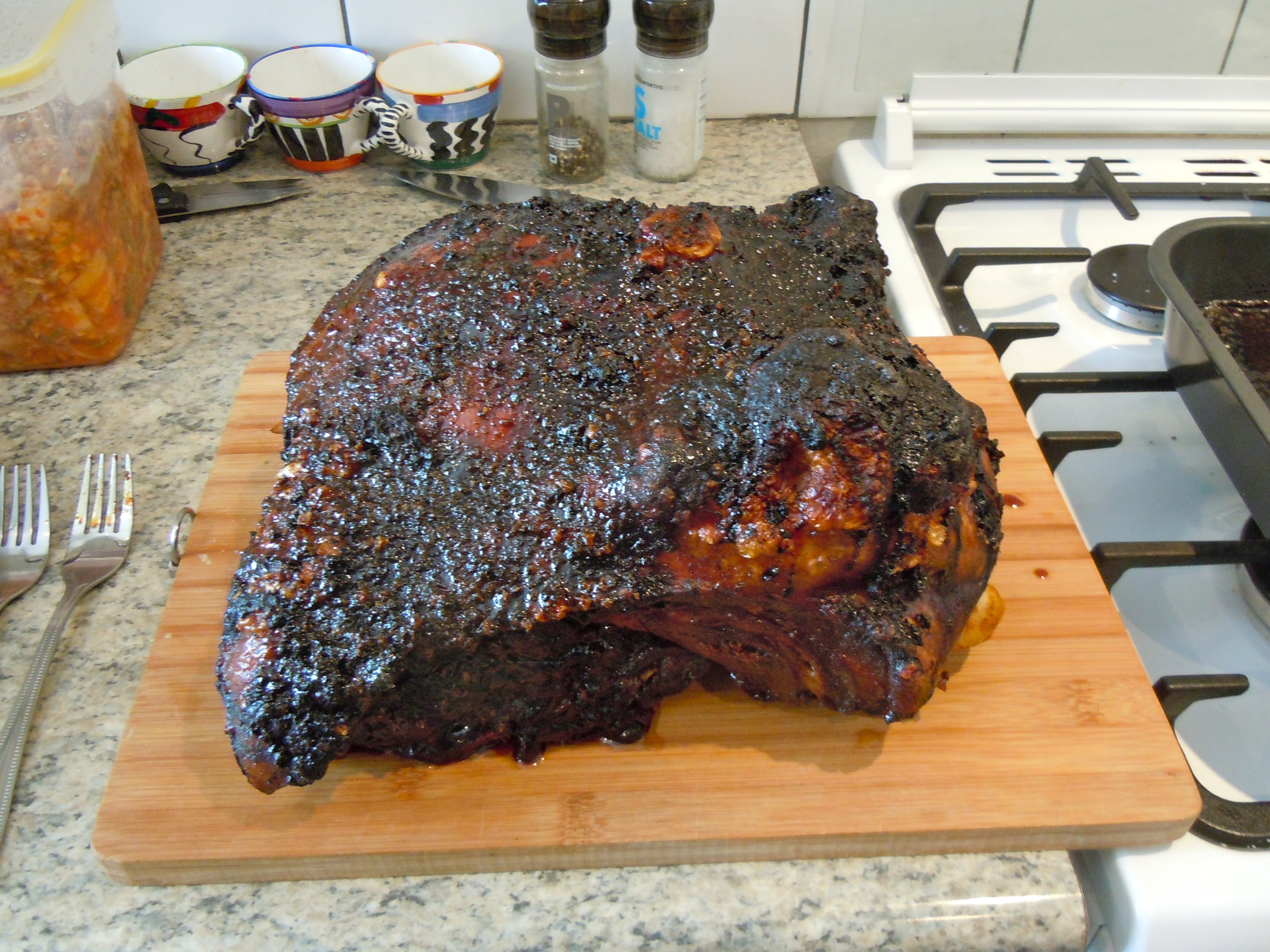
Instead of writing, I have spent quite a lot of time in my kitchen. I have a weakness for epic cooking, and over the weekend we made David Chang’s version of bo ssam, or Korean slow-roasted pork, a process which involved marinating, slow roasting, and long resting.

The pork shoulder, before roasting.

The pork shoulder, before roasting.

Bo ssam.

Bo ssam.

On the night of the car accident I made for us Marcella Hazan’s tomato pasta sauce:

800g tinned plum tomatoes

1 onion, peeled and halved

5 Tblsp butter

salt and pepper

1. Place all the ingredients in a wide, deep saucepan. Bring to the boil, and then simmer for 45 minutes, stirring every fifteen or so, until thick and glossy. Discard the onion halves.

2. I like to stir some torn-up basil through this. Serve with spaghetti.

On Wednesday, having seen the doctor about my sore neck, I made granola (loosely based on this recipe), the basic proportions of which are:

3 cups oats

½ cup desiccated coconut (unsweetened)

½ cup brazil nuts, chopped

½ cup whole, raw almonds

2 Tblsp vegetable oil

6 Tblsp honey

½ cup dried fruit

1. Place all the dry ingredients, except the fruit, into a large bowl and stir to combine.

2. Heat together the oil and honey and pour over the oats mixture. Mix thoroughly, and bake in a roasting tin for about twenty minutes at 150°C, stirring halfway. I vary this recipe with flaked coconut, sunflower and pumpkin seeds, and maple syrup instead of honey.

I have wondered, though, if I’ve been at the receiving end of some kind of elaborate cosmic joke,* and if it would be worth devoting myself to the preparation of lucky food.

So many societies eat coin-shaped and sweet things at New Year, for instance: from rice cake soup in Korea to lentil dishes in Italy and black-eyed peas in the southern states of the US. Pomegranates in the Mediterranean world, cabbage and pigs in Germany, and long noodles in Japan symbolise prosperity and longevity.  We stir Christmas pudding batter for good luck.

We can understand the social meanings of food particularly well through religion – the taboos which surround pork or beef, for example – and ritual. When Catholic monks insisted upon wheat communion wafers in colonial Mexico they did so because they associated maize with the ‘uncivilisation’ of the indigenous people to whom they evangelised. Ingesting maize wafers would have implied some kind of acceptance – a swallowing – of the customs and traditions of pre-colonial central America.

The significance of ‘lucky’ foods is that they are part of rituals: that they mark particular moments of time; that they call for pause and contemplation. In a way, they slow down time – as does cooking. I don’t want to make any grand claims for the healing powers of cooking, but being forced to focus and to work systematically and repetitively, offers one way out of panic and anxiety.

And, anyway, I can write now.

* Not really.

Creative Commons License
Tangerine and Cinnamon by Sarah Duff is licensed under a Creative Commons Attribution-ShareAlike 3.0 Unported License.

Fairytales

I have an odd enthusiasm for Iceland. I think it stems partly from the fact that in Brave New World, troublesome and insubordinate academics are exiled there. Although when Aldous Huxley published the novel in 1932, the Iceland he imagined was one of the least technologically advanced nations in Europe – and not the socially and politically progressive place it is imagined to be today. In fact, much of the current interest in Iceland stems from its response to the 2008 crash: Icelanders did what so many in the West wanted to do. Laurie Penny writes:

What most of the world appears to believe is that, some time between 2008 and 2009, the country refused to bail out its banks when the global economy crashed and that instead it jailed all of its bankers, overthrew the government, wrote a new constitution on the internet and elected a lesbian prime minister who solved all the nation’s problems with a flick of her magic wand.

Iceland became, seemingly, a Guardian reader’s paradise. But the reality is more complex, and, possibly, less attractive:

Although it is true that the three largest banks – Glitnir, Kaupthing and Landsbanki – were allowed to go bust in 2008, this was hardly a political choice: Iceland could do nothing else, because their debts were ten times the size of its GDP.

Popular protest did force the writing of a new constitution, but this has never been implemented. Earlier this year – for all the promise of Iceland being lead by a Pirate Party – Icelanders re-elected the centre-right coalition which was in power before the recession. And Iceland is no feminist paradise either.

But it remains a compellingly fascinating place. I think Penny sums this up particularly well:

Iceland has always been a land self-authored in myth and legend. Its lava fields and glacial plains are supposedly populated by elves, trolls and huldufólk – hidden folk – in whom 80 per cent of the population believes. At least, that’s what the PR for Icelandair wants you to think… In fact, it turns out that only 30 per cent of the population believes that fairies exist, although that third is prepared to agitate for roads to be diverted around their supposed homes. This is remarkable enough that one wonders why the tourist board bothered to exaggerate.

A few months ago, while visiting another city on the same latitude as Scandinavia – Edinburgh – I bought a copy of Sarah Moss’s memoir Names for the Sea: Strangers in Iceland (2012). It’s an account of a British family’s year in Reykjavik, during which Moss taught English literature at the University of Iceland.

Interested in histories of eating and cooking, some of Moss’s most evocative passages are concerned with how she comes to terms with Iceland through food. The availability of a variety of – occasionally rotting, often seriously under-ripe – exceptionally expensive fresh produce imported from all over the world, suggested the enthusiasm with which Icelanders embraced consumerism during the boom. (Another potent example of this was the stigma attached to buying second-hand goods and clothes. Her efforts to buy a used washing machine were greeted with appalled horror by many of her colleagues and friends.) In fact, she and her family packed with them the foods of home – ‘the manifestations of English metropolitan middle-class identity’:

We have five litres of olive oil, a dozen tins of anchovies and a dozen jars of capers, miso paste, pomegranate syrup, cocoa nibs, seeds for growing coriander, basil and mint. Smoked chillies, sumac, allspice, dried dill, cumin. Preserved lemons, three kinds of paprika, dried lime leaves.

On a quick trip back to Kent, they bought and smuggled into Iceland

two whole salamis, a wheel of Kentish cheese … approximately three kilogrammes of chocolate, from Cadbury to Valrhona, two Christmas cakes and a stollen, half a dozen russet apples, a bag of unwaxed lemons and a couple of dozen tins of anchovies, capers and vine leaves.

Anxious about being caught by immigration officials, she hurries her husband and children through the airport. Max, her eldest son, ‘looks anxiously into [her] face. He’d make a lousy chorizo mule.’

namesforthesea

Moss is not unaware of the irony of importing what are, essentially, the ingredients of Mediterranean peasant food to Iceland, a nation apparently with a close relationship with the natural world. However, she sympathises with the taste that Icelanders’ developed for imported food, given the relative monotony of diets until, at least, the mid-twentieth century. These were heavy in smoked and dried fish, and meat often preserved in whey, blood pudding and liver sausage, potatoes, and plenty of dairy products. Grains and green vegetables were a luxury.

These high-fat diets seemed, though, to sustain farmers through long winters. Matthew, a colleague also from Britain, remembered his introduction to rural cuisine in the 1960s:

the worst imaginable kind of food I could ever think of was put on the table, steaming salted fish with a terrifying smell to it, and hot sheep fat, and potatoes. That’s all there was. And I knew I was going to be there for six weeks, and I would have to eat it or starve. I told myself, you wanted to come to Iceland, you wanted to find out what it’s like here, you bloody well eat their food, and I forced myself to eat it. And it was delicious, absolutely glorious. It’s one of my favourite dishes today.

Matthew’s answer to why they didn’t fall ill – in the absence of fruit and vegetables – was that they ate a lot of fish:

And Iceland moss, swede, and white cabbage. A lot of white cabbage. … And of course a lot of milk, and skyr [curd cheese].

Why didn’t they get scurvy?

People drank a lot of Iceland moss tea, and they were probably using many more grasses and herbs than is recorded. That knowledge has gone.

I think his point about forgetting what people used to eat is an important one. I was reminded of Moss’s book a little while ago when – for various reasons – I attended a lecture presented by Tim Noakes. Once best known for his deep knowledge of sports science, Noakes has recently developed a reputation for his almost evangelical faith in the carbohydrate-free, meat-heavy Paleo diet.

I was struck by Noakes’s use of eighteenth- and nineteenth-century texts which recommended excluding carbohydrates from diets, to bolster his arguments. And by his insistence that because people – like Icelanders – in the past were able to live healthily off diets consisting mainly of red meat and animal fat we should attempt to replicate them in the twenty-first century.

There are many problems with Noakes’s arguments – not least his dubious methodology in a recent paper – but I’d like to focus on his use of history to argue for a return to what our ancestors (allegedly) ate. As Moss’s friend Matthew makes the point, our knowledge of how eating habits changed over time is patchy, at best. Peasants did not painstakingly record every slurp of nettle tea. Also (and this is taken from a satirical piece, but it’s accurate):

You simply do not see specific, trans-regional trends in human subsistence in the archaeological record. People can live off everything from whale blubber to seeds and grasses. You want to know what the ideal human diet consists of? Everything. Humans can and will eat everything, and we are remarkably successful not in spite of this fact, but because of it. Our adaptability is the hallmark of the human species. We’re not called omnivores for nothing.

Noakes’s reliance on an idealised vision of the past is a significant weakness in his argument. It ignores the fact that we have a tendency to eat as wide a variety of foods as possible: when vegetables and fruit became more easily available, Icelanders happily included them in their diets.

The current obesity ‘crisis’ cannot, in other words, be fixed by returning to the mythical diets of the past. It is caused by such a myriad range of factors – ranging from poverty to urban planning – that to blame a taste for carbohydrates is to demonstrate a very narrow understanding of the problem.

Creative Commons License
Tangerine and Cinnamon by Sarah Duff is licensed under a Creative Commons Attribution-ShareAlike 3.0 Unported License.

Ice Cream in Mandela Square

This morning I went to re-register in time for next year’s elections. My voting station is at the Ridge School, an elite primary school for boys perched at the top of the startlingly rich suburb of Westcliff. It is one of the oldest parts of Johannesburg, with its Arts and Crafts mansions and streets lined with old, well-established trees. It is where industrialists, whose fortunes were made on the mines, settled to live in the comfort that a city with cheap land and even cheaper labour could provide.

In some ways, it feels that Westcliff has changed very little since the early twentieth century. There were two black domestic workers, in uniforms and aprons, waiting to check if they were registered to vote. And there was a huddle of affluent white people gathered around the stall operated by the opposition Democratic Alliance. Unsurprisingly, the ANC was nowhere to be seen.

Old is a relative term, though, and particularly for Johannesburg, a city founded only in the mid-1880s. For all that its northern suburbs give the appearance of static, solid, prosperity, it is a city which continues to evolve at a frantic pace: it grows, is torn down and rebuilt, has been run down, and is being gentrified. In fact, the urban forest of Joburg’s affluent areas is a pointed example of the constructedness of this city: planted to provide timber to the city’s mines, the canopy of green and purple which covers old Johannesburg in the summer has created a new ecosystem, replacing the original grassland of the Highveld.

A while ago, some lovely friends took me to dinner and pudding in two parts of the city which also show particularly well how South Africa’s shifting demographics – its growing middle class, in particular – are helping to change the city.

One of the oddest spaces to contemplate this transformation is Mandela Square in Sandton, a suburb in the north of the city which has, since the 1990s and especially after the Johannesburg Stock Exchange moved there in 2000, become an alternative city centre to the old CBD. The middle of Sandton is dominated by shiny corporate headquarters and a collection of high-end shopping malls – one of which is Nelson Mandela Square. Known until 2004 as Sandton Square, the mall was renamed after the installation of a massive, six-metre statue of Nelson Mandela.

The statue – which is slightly out of proportion – is to one side of the piazza at the centre of the mall, and overlooks a fountain. To its left and right are restaurants, some of them branches of popular, but pricier, franchises. We had excellent ice creams at an Italian place, and watched as tourists posed in front of Madiba, and took photographs of the water feature.

Mandela Square – and, indeed, Sandton – is often held up as an example of the crass materialism which has accompanied – and has been produced by – South Africa’s transition to democracy after 1994. Uncomfortably, and ridiculously, it links a depoliticised Mandela – Madiba-as-friendly-giant – to a celebration of post-apartheid consumerism. It is true that Sandton is, to some extent, an unpleasant example of the city-as-anodyne shopping mall. Architecturally, Mandela Square – and Sandton City, and the Sandton Convention Centre, and Michelangelo Towers, and the Da Vinci Hotel – could be just about anywhere, and that, really, is part of the point.

My friends and I began our evening, though, at a wonderful, and in some ways equally incongruous, Thai restaurant in Edenvale, a suburb on the border of Johannesburg and the East Rand. It is one of a collection of towns and settlements established to the east of Joburg as result of mining (for gold and coal) and manufacturing. Recently, though, its low property prices and new malls have drawn the city’s new middle classes. It is, in some ways, the epitome of big city suburbia. And yet, down a not-particularly-lovely street, is a place which serves delicious Thai food.

In some ways, the South African taste for Thai has been driven by the fact that Thailand is one of the few countries to which South Africans may travel without visas, and, even with the current weakness of the Rand, remains relatively inexpensive. Thai restaurants – some of them part of the Wang Thai chain – have popped up in middle-class suburbs, alongside pubs and steak ranches.

Rising above the noise and bustle of Johannesburg – and with a clear view of the Sandton skyscrapers – Westcliff, secure in its incredible wealth, seems to be immune from the change happening around it. But Westcliff is as entangled in Johannesburg’s making as are Sandton and Edenvale: it was shaped and produced by the mineral revolution at the end of the nineteenth century. It was modelled on similar, upper middle-class suburbs in Britain. It is as much a construct as Sandton and Edenvale.

Creative Commons License
Tangerine and Cinnamon by Sarah Duff is licensed under a Creative Commons Attribution-ShareAlike 3.0 Unported License.