
Dude Food
A couple of weeks ago Tamar Adler, former chef and editor of Harper’s Magazine, wrote an article for the New Yorker in which she politely and neatly eviscerates Anthony Bourdain for leaving ‘a crude hickey’ on America’s ‘food culture’. Although he is probably now better known – at least in the US – for his food-and-travel television series, Bourdain rose to fame, or notoriety, for his memoir Kitchen Confidential: Adventures in the Culinary Underbelly (2000).
It is a deeply entertaining, amusing, and often instructive guide to the strange world of restaurants and professional cooking. It explores the ‘personal and institutional perversity that runs fast through the veins of restaurants’. Bourdain details the astonishingly crude language and behaviour of badly paid, sleep deprived chefs in the hot, tiny restaurant kitchens he worked in and, later, oversaw. But it is also an excellent introduction to the mechanics and the politics of how kitchens function.
Although Bourdain and his crew do some pretty repellent things, all this is balanced by the fact that, as Adler notes, Bourdain does ‘not prescribe that life, or condone it.’ Indeed, he devotes a whole chapter to kitchens which don’t run the risk of collapsing into anarchy and violence if the chef for one moment ceases swearing at the staff. He admits:
It is no coincidence that all my kitchens over time come to resemble one another and are reminiscent of the kitchens I grew up in: noisy, debauched and overloaded with faux testosterone – an effective kitchen, but a family affair, and a dysfunctional one, at that. I coddle my hooligans when I’m not bullying them. I’m visibly charmed by their extra-curricular excesses and their anti-social tendencies. My love for chaos, conspiracy and the dark side of human nature colours the behaviour of my charges, most of whom are already living near the fringes of acceptable conduct.
He adds:
Not all kitchens are the press-gang-crewed pressure cookers I’m used to. There are islands of reason and calm, where the pace is steady, where quality always takes precedence over the demands of volume, and where it’s not always about dick dick dick.
And that is the issue with Bourdain’s description of the food world: it is overwhelmingly, completely male. The women chefs whom he respects are those who are ‘tough-as-nails, foul-mouthed, trash-talking’ – the ones who go out of their way to fit in to ‘the testosterone-heavy’ world of restaurant kitchens. But, at least in Kitchen Confidential, he acknowledges that there are kitchens where women aren’t expected to put up with being groped, or with their colleagues festooning their stations with pornography. Visiting Scott Bryan’s restaurant Veritas he notices
A tiny young woman working at a corner station, and I made the immediate Neanderthal assumption as I first took in the crew: ‘Extern, maybe from Peter Krump or French Culinary, having a learning experience dishing out veggies.’ I passed right over her as I swept my eyes down the line looking for the heavy hitters. In time I began, peripherally, to become aware of her movements. I looked again, closer this time, and saw that she was plating fish, cooking risotto, emulsifying sauces, taking on three, then four, then five orders at a time – all the whole never changing expression or showing any visible signs of frustration or exasperation (as I would have under similar circumstances).
She was, in other words, ‘generally holding down her end like an ass-kicking, name-taking mercenary of the old school, only cleaner and better.’ It turned out that she’d been trained by Alain Ducasse.
The problem is that Bourdain loses much of this self-reflection in his later books and series. As he became better known ‘he confused what he’d written about once with the world itself.’ Adler explains:
What Anthony Bourdain does is to bathe everything, even if it’s naturally quiet and normal, in brutishness. It is the difference between not pulling punches and indiscriminately punching. Bourdain now travels round the world, with a camera crew trailing, to eat food in other countries. On his stops at noodle shops, he turns his anxious libido on his bowl of food: ‘Take me to that place where everything is beautiful.’ ‘This is fucking driving me out of my mind. I’m fucking quivering with desire here.’ ‘I would jerk a rusty butter knife over my best friend’s throat just for this,’ he says to the camera while waiting for soup. ‘Come to papa,’ he wheedles.
His relationship with – and views on – food have become centred around his masculinity:
He has managed to insert, through performance of the great feat of eating Vietnamese or Tunisian or Parisian food, the neurotic notion that eating is best understood as a competition or conquest – man versus food. Why choose to merely ingest, he asks, when you can vanquish?
Although I agree with Adler’s point that it’s a pity that he feels the need to dress up his opinions on food in a kind of gung-ho machismo because much of what he says is worth listening to, it was time that someone called out Bourdain for his casual sexism. Bourdain seems to insist that good cooking can only be produced by kitchens overseen by obsessive, potentially murderous alpha males caught up in a kind of adolescent, On the Road-like existential struggle with the meaning of existence. Women – unless they behave like men – are to be viewed with suspicion, as is the food which he associates with them:
Few chefs can really and truly bake. Most chefs, like me, harbour deep suspicions of their precise, overly fussy, somehow feminine, presentation-obsessed counterparts in the pastry section. All that sweet, sticky, messy, goopy, delicate stuff. Pastry, where everything must be carefully measured in exact measurements – and made the same way every single time – is diametically opposed to what most chefs live and breathe, the freedom to improvise, to throw a little of this and a little of that any damn place they want.
It’s no coincidence that most pastry chefs are women. Bourdain implies that pastry, like women, is difficult, too sweet, boring, and unimaginative: real chefs are men – wild, creative genuises – who cook ‘Flintsone-sized lengths of veal shank,’ understand the value of bones, and who carry long, sharp knives.
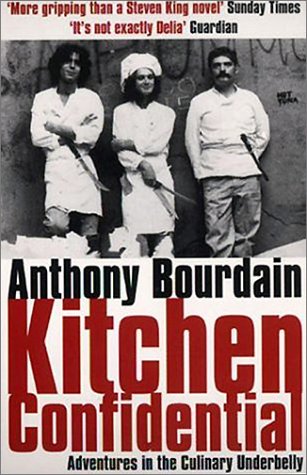
For an industry with a reputation for not dealing adequately with charges of ingrained discrimination against women, Bourdain’s attitudes towards food and cooking certainly don’t help. But it’s worth noting that for all the excitement that surrounded the publication of Kitchen Confidential – when it was hailed as a fresh and unconventional take on America’s restaurant world, which it was, to some extent – Bourdain’s views on the relationship between masculinity and food are neither particularly new, nor limited to himself.
There has long been an association between meat-eating and manliness. Until the late eighteenth century, when eating in moderation and a slim physique were connected, increasingly, with the ideal Enlightenment male, a healthy appetite for wine and meat indicated strength and vitality. In England, a taste for roast beef was, as Roy Porter notes, linked to a patriotism which associated roast meat with English vigour and virility. Even a century later, Victorians argued that men’s strong, machine-like bodies needed meaty fuel in order to function efficiently.
Men, in other words, needed to eat ‘man food’ – spicy, strong-flavoured, and rich in protein. This was taken to a logical – or an illogical, depending on your point of view – extreme by the Italian Futurists and Mussolini-enthusiasts FT Marinetti and Luigi Colombo in their 1930 Manifesto of Futurist Cooking. Of course, the document is completely mad – like just about everything Marinetti did – but it’s a useful window on to the ways in which fascists of the 1930s understood gender. As the Italian state recast women as mothers – and only mothers – of the nation, so men were urged to become its warrior-protectors.
Marinetti and Colombo write:
We also feel that we must stop the Italian male from becoming a solid leaden block of blind and opaque density. … Let us make our Italian bodies agile, ready for the featherweight aluminium trains which will replace the present heavy ones of wood iron steel.
Italians should do this, they argue, by giving up pasta:
A highly intelligent Neapolitan Professor, Signorelli, writes: ‘In contrast to bread and rice, pasta is a food which is swallowed, not masticated. Such starchy food should mainly be digested in the mouth by the saliva but in this case the task of transformation is carried out by the pancreas and the liver. This leads to an interrupted equilibrium in these organs. From such disturbances derive lassitude, pessimism, nostalgic inactivity and neutralism.’
They suggest that rice take the place of pasta. But this is only the first of several ideas for the remaking of food for a faster, more efficient future. Their most significant point was that science should ‘take on the task of providing the body with its necessary calories through equivalent nutrients provided free by the State, in powder or pills, albumoid compounds, synthetic fats and vitamins.’ Not only would this make Italians better-fuelled and more efficient workers, but it would reduce the amount of food they ate.
Those few meals which they would then eat would be, as they write, ‘perfect’. Given the role of Italian women in feeding their families, what Marinetti and Colombo advocate is a kind of man-made food: the dishes they describe for their ‘perfect meals’ – like the Woodcock Mount Rose with Venus sauce – are invented by chefs.
Although their remaining ideas are increasingly ludicrous – ‘The rapid presentation, between courses, under the eyes and nostrils of the guests, of some dishes they will eat and others they will not, to increase their curiosity, surprise and imagination’ and ‘The creation of simultaneous and changing canapés which contain ten, twenty flavours to be tasted in a few seconds’ – their association of ‘perfect’ cooking with men, and homely, everyday cooking with women, was – and is – hardly unusual.
A great deal has been written about the irony that while most of the world’s ‘top chefs’ – whatever we may mean by that – are male, the overwhelming majority of people who cook to feed their families are female. I think that this distinction is something of an oversimplification: while it is certainly true that the most Michelin-starry chefs are still male, this is changing, albeit slowly. More importantly, the chefs and cooks who have had the greatest impact on the way we all cook in the twentieth and twenty-first centuries have, arguably, been women: Constance Spry, Marguerite Patten, Delia Smith, and Madhur Jaffrey in Britain; Julia Child and Martha Stewart in the US; Nitza Villapol in Cuba; Stephanie Alexander and Maggie Beer in Australia; and Ina Paarman, Ina de Villiers, and Lynn Bedford Hall in South Africa.
Moreover, there has been a recent and relatively widespread decrease in tolerance for the antics of bullying, super-macho male chefs. Gordon Ramsay’s spectacular fall from grace – the collapse of his business empire, the decline in quality of his restaurants – is a particularly good example of this. Adler’s take-down of Bourdain is part of this trend – and it’s particularly telling that Bourdain devotes his highest praise to Ramsay (‘England’s greatest chef’) in A Cook’s Tour: In Search of the Perfect Meal (2001), excusing and celebrating Ramsay’s reputation as a bully on the grounds of gender:
He’s doing what everyone told him growing up that only women should do. … You better have balls the size of jack-fruits if you want to cook at a high level, where an acute sense for flavour and design, as much as brutality and vigilance, is a virtue. And be fully prepared to bulldoze any miserable cocksucker who gets in your way.
This kind of macho chest-beating now feels distinctly passe. The male celebrity chefs of the late 2000s and early 2010s are an altogther nicer, kinder group of chaps: from earth-warrior Hugh Fearnley-Whittingstall and home-cooking dad Jamie Oliver, to shambling Valentine Warner and lovely Nigel Slater. We have cerebral, thoughtful Fergus Henderson and Heston Blumenthal.
I’m not absolutely sure what this shift in public taste suggests – and it’s certainly part of a wider, cultural change, which has seen Ryan Gosling and James Franco replace Sylvester Stallone and Steven Segal as male icons. It’s also occurred at the same time as the emergence of a food trend which can only really be described as ‘dude food’ – food made to appeal to men. Craft beer, the wild enthusiasm for bacon, even the recent rediscovery of the burger, are, I think, driven partly by a belief – held by magazine editors, television producers, and some food writers – that food needs to be made ‘manly’ to appeal to men. Tellingly, most of this is pretty meaty food.
What I find so interesting about dude food is that it’s directed at a generation of young men – my contemporaries and younger – for whom cooking is not necessarily seen as being, as Bourdain noted earlier, something that only women do. Unless I have the good fortune only to have dated, and to be friends with, peculiarly enlightened men, it seems to me that Generation Y men don’t seem to feel that cooking and baking undermine their masculinity. After all, not only were all three finalists on the last series of Great British Bake Off men, but two of them were fairly young. So is dude food a kind of ironic embrace of the manly, meaty food associated with being male since, at least, the seventeenth century – much in the same way that contemporary feminists have reclaimed baking and, crucially, the cupcake – or is it something else altogether? Either way, I can’t imagine that Marinetti would be all that pleased.
Sources
Anthony Bourdain, A Cook’s Tour: In Search of the Perfect Meal (London: Bloomsbury, 2001).
Anthony Bourdain, Kitchen Confidential: Adventures in the Culinary Underbelly (London: Bloomsbury 2000).
Roy Porter, Flesh in the Age of Reason: How the Enlightenment Transformed the Way We See Our Bodies and Souls (London: Penguin, 2003).

Tangerine and Cinnamon by Sarah Duff is licensed under a Creative Commons Attribution-ShareAlike 3.0 Unported License.







 Tangerine and Cinnamon
Nov 15
Publish or Perish
The latest edition of the New Statesman includes an article by David Priestland on the state of popular history in Britain. He argues that, increasingly, television series presented by the likes of Andrew Marr as well as popular science, economics, and history books – particularly those written by right-wing historians, most notably Andrew Roberts and Niall Ferguson – are grounded in a Whiggish belief in the inevitably of the triumph of liberalism. (We take the term ‘Whiggish’ from Herbert Butterfield’s The Whig Interpretation of History (1931) which argues against writing history as a glorification of the present, and as a slow, progressive evolution towards parliamentary democracy.) Priestland writes:
There are several problems with understanding history as a relentless march towards liberal perfection, not least because it’s wrong. Historians are interested in accounting for change over time and we recognise that change itself simply happens: it’s neither objectively good, nor bad. This Whiggery attaches a moral value to change, and simplifies its causes:
Priestland lays the blame for the ‘complacent liberalism’ of popular history firmly at historians’ feet. He suggests that because academic historians have largely abandoned the writing of history on a grand scale – the best example of which is Eric Hobsbawm’s series on the history of the modern world – choosing, rather, to specialise in fairly narrow areas of expertise, they ‘have ceded the political high ground.’ Right-wing historians and journalists have stepped into the space left by the guild.
I do have a few reservations about Priestland’s argument (although I do urge you to read the full article, as I’ve oversimplified it a little here). He fails to take into account academic historians’ growing interest in global history, as well as the motivations and aims of the BBC and other organisations which commission public history. (Do they really want academic historians to present television series, when Andrew Marr is guaranteed to draw a crowd?) But I agree with his point that historians should do more to engage with the public.
While historians and academics in the UK, US, and elsewhere are – increasingly – working harder to make those outside of academia aware of their research, this impulse has not really been felt to any great extent in South Africa. It’s certainly true that a few history departments and historians have worked with communities to write local histories – like the University of Johannesburg’s Sophiatown Project – but these are not enough. The School of Advanced Study at the University of London has put all of the papers presented at the Societies of Southern Africa in the Nineteenth and Twentieth Century seminar series, online. But this, also, isn’t enough.
When not suggesting that criticism of President Zuma be made illegal, Blade Nzimande, the Minister of Higher Education, turns his mind to historians and the writing of history. Speaking at the announcement of the SA History Online student internship programme last month, the Minister commented:
I agree that much of South Africa’s past remains to be researched, but the Minister ignores the vast and really brilliant scholarship produced by historians of South Africa since, at least, the 1970s, which focuses precisely on histories of colonisation, segregation, apartheid, shifting attitudes towards race and gender, labour, industrialisation, nationalisms, and anti-government protest.
Later on in the speech, Nzimande does mention the revisionist historians – people like Shula Marks, Stanley Trapido, Belinda Bozzoli, Martin Legassick, and Charles van Onselen – who helped to transform the profession in the 1970s and 1980s. I don’t understand, then, why he seems to believe that historians are producing a kind of conservative interpretation of the past which ignores the experience of the majority of South Africans. They really, really are not.
He does, though, make one important point:
South Africans are astonishingly ignorant about their country’s history – and this includes well educated South Africans too. Earlier this year, Peter Bruce, then editor of Business Day, wrote an unbelievably ill-informed column in which he complained that South African historians had entirely ignored ‘black history’. A couple of weeks ago, the Mail and Guardian published an opinion piece that alleged that South Africa’s ‘past has until recently, been the subject of very few and dominant narratives told from the perspective of the proverbial victors even if theirs was a guise of colonialism and apartheid.’ This just isn’t true. (I’m also not entirely sure what it means.)
This lack of knowledge is partly the fault of our failing education system. Books in South Africa are ruinously expensive. The first volume of the new Cambridge history of South Africa costs £84 – more than R1,000. South Africa also lacks the platforms to allow historians and academics to communicate with the public. There is no South African History & Policy. We have no version of the Guardian – which has created blogs for historians to write about histories of science of technology, for instance. Our disastrous public broadcaster has no equivalent of In Our Time, the incredibly popular Radio 4 series which focusses on the history of ideas.
And academics here – as abroad – are unbelievably busy, over-worked, and very badly paid. But historians should take some of the blame for the fact that even fairly well educated South Africans have such little understanding of the vast scholarship on South African history. I didn’t spot a single angry op-ed by any senior historian attacking Nzimande’s speech in October. (But please tell me if I’m being unfair – who knows what I may have missed.) I – a very junior academic – took Peter Bruce to task, but no one else did.
So why should we care? Firstly, governments construct versions of the past to justify their policies in the present. In order for South Africans to function effectively as citizens, they need to be able to evaluate and criticise the government’s use of the past. As Priestland make the point, if we don’t talk to the public, others – less qualified and with potentially damaging agendas – will.
Secondly, the narratives we create to understand the past influence how we respond to crises in the present. Writing about the unexamined liberal politics of British popular history, Priestland explains:
By far the best analysis of the current crisis in South Africa’s mining industry which I read was the brilliant Keith Breckenridge’s post on History Workshop Online. But where are the articles which unpack Mac Maharaj’s bizarre views on the term ‘compound’? Where are the histories of farm work in the Cape, in the light of the strike now occurring in the fruit and wine industries? Indeed, I’m not the only one who’s calling for this. As my friend and colleague Stephen Sparks notes, Breckenridge has called on policymakers to speak to historians – and a recent workshop at the Wits Institute of Social and Economic Research floated the idea of a South African version of History & Policy.
Finally, as Nzimande admitted in his speech, the South African state does not view the funding of the humanities as a priority. We know that humanities departments are often the first to go when academic funding is cut. As the crisis in our national archives – the memory of the nation – demonstrates, the current government’s interest in history is pretty minimal.
So if you’re wondering when I’m going to mention cupcakes in this post, I’m writing this to point out to my fellow historians that unless we make the case for having a thorough, nuanced understanding of South Africa’s past, no one else will. Writing a blog really isn’t difficult, people. It doesn’t solve anything, but it’s a beginning.
Postscript: Andrew MacDonald’s astonishingly wonderful review of the new Cambridge History of South Africa appeared in this week’s Mail and Guardian. As an overview of the development of the discipline in South Africa, it is unparalleled.
Tangerine and Cinnamon by Sarah Duff is licensed under a Creative Commons Attribution-ShareAlike 3.0 Unported License.