
Not in my trolley
This has not been a particularly edifying week for white South Africans. After an angry blog post about Woolworths’s hiring policies went viral, a surprisingly large group of white people have threatened to boycott the supermarket. Woolies – an upmarket food-and-clothing store similar to Marks and Spencer in the UK – notes in some of its job advertisements that certain positions are available only to black candidates.
Pierre de Vos, Professor of constitutional law, points out that this is ‘neither illegal nor unconstitutional.’ The purpose of the measure is to address the absence of black South Africans in particular categories of jobs. The company has not introduced a moratorium on hiring whites, and whites may still apply for jobs advertised as being aimed specifically at black candidates.
In a magnificent riposte to the white loons threatening never to shop again at Woolworths – in the strange belief that other supermarkets don’t have similar hiring policies (they do) – Ferial Haffajee, editor of the City Press, explained:
Without affirmative action, I would likely be a retrenched clothing factory worker or a low-level banking clerk. That was the expected, the planned outcome for people like me. The system was called apartheid. We needed help to escape our destiny and millions of South Africans still need that help.
It is not reverse racism, but a Constitutional imperative to fix our society. …those of you who spammed the Woolies CEO for applying the law are wrong. You discount, completely, the role of inter-generational privilege in your life.
To make a good future society demands we have make-right policies for the old one. It doesn’t fix itself.
I doubt that the boycott will have any effect on Woolies’ sales this year. The satirical site Hayibo summed up middle-class South Africans’ relationship with the store particularly well:
‘I will never shop at Woolies again, until later this afternoon when I will go and get salmon and malva pudding,’ said one irate shopper.
Indeed.
As this was a lost opportunity to have a constructive discussion about affirmative action and economic empowerment in post-apartheid South Africa – two issues always worth thinking about – this also represents a moment to think about the nature and effects of consumer boycotts.
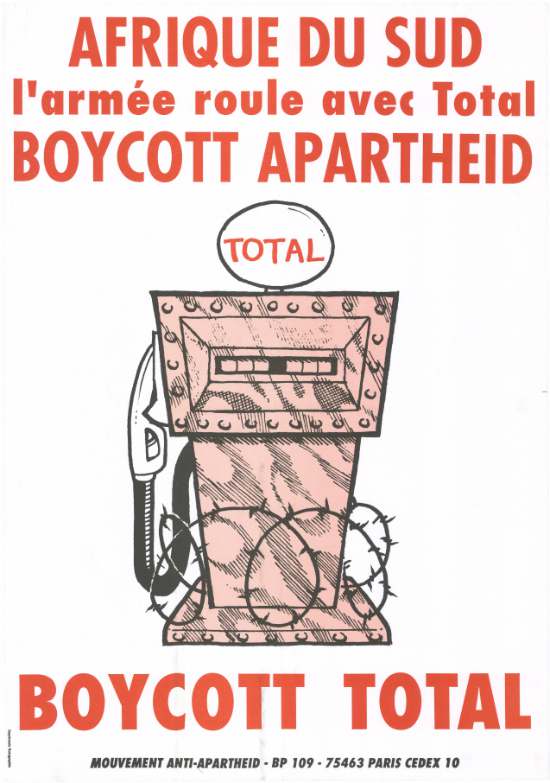
I was particularly amused by this threatened whites-only boycott because of the impact that international boycotts had on apartheid South Africa. The country’s economy was brought to its knees after the 1986 Comprehensive Anti-Apartheid Act became law in the US, preventing American businesses and banks from exporting and importing some commodities to and from South Africa, and investing in, and extending loans to, the country. Sport and cultural boycotts accompanied these sanctions.
The Anti-Apartheid Movement in Britain originated as a boycott campaign against South African produce in 1959. It organised boycotts of Cape Fruit, Outspan oranges, and a range of other products, as well as of businesses like Barclays and Total which operated in South Africa. Even if this campaign – and others around the world – didn’t pose as much as a threat to the apartheid state as the sanctions of the 1980s, what they achieved was to make ordinary people aware of apartheid by appealing to them not to support the South African economy.

There seems to have been an increase in this kind of political consumer boycott since the 1980s, and probably as a result of a heightened awareness of the connection between the exercise of political power and the emergence of global corporations. One of the best – and most successful – examples of these was the Nestle Boycott organised by War on Want and other groups in 1977, to draw attention to the link between the marketing of infant formula and high rates of child mortality in the developing world.
But political consumerism and consumer boycotts have existed long before then. In fact, the abolitionist movement has been described as one of the first examples of concerted consumer activism in support of a political cause. Not only could early opponents to slavery buy abolitionist-themed crockery from Wedgwood, but, particularly during the nineteenth century, abolitionists all over the world refused to buy American sugar or cotton.
Lawrence B. Glickman writes:
consumer activism – the attempt to mobilise consumers for political purposes – has been important to American political culture at least since the Boston Tea Party. Indeed…American national identity was forged in no small part through collective acts of consumption. Central to African American claims for political and economic inclusion have been demands for…‘consumer entitlement,’ ranging from boycotting Jim Crow street cars to taking advantage of the ‘autonomy and anonymity’ of catalogue shopping as a way of avoiding mistreatment by merchants, to boycotting tourism in South Carolina as a way of protesting the Confederate flag that until recently flew over the state house. Similarly…among many women in the Progressive Era ‘consumer consciousness built political consciousness’ as they boycotted unsafe and costly food and campaigned for minimum wages and decent labour standards for those who produced what they bought.
It’s striking how frequently consumer boycotts have been used by those who are politically and socially marginalised, to demand equal treatment and an end to discrimination. They were a key strategy in the American Civil Rights movement, and featured to some extent in the Defiance Campaign against apartheid legislation in the early 1950s, and, later, during the township rebellion in the 1980s.
Some of the earliest consumer boycotts in the United States and Britain were organised by women, and usually in response to sudden increases in the price of staple foods. For instance, in 1902, immigrant Jewish women in New York organised a boycott after the price of Kosher beef increased by half. By withdrawing their support from local butchers – and, admittedly, rioting in lower Manhattan – they managed to reduce prices.
In 1924 and 1933, Jewish women in Toronto – many of them members of communist groups – also organised boycotts of Kosher butchers to protest rising prices of meat. On both occasions, significant numbers of women were mobilised not only to stop shopping for meat, but to picket butchers.
Indeed, there were widespread boycotts organised by women during the Great Depression. These ‘housewives’ protests’ were part of a broader movement in which women sought to mitigate the effects of the Depression by lobbying government, planting community gardens, establishing bartering systems for food and other goods, and even engaging in acts of civil disobedience. In Cleveland, for instance, black mothers protested a power company’s decision to switch off electricity as a result of non-payment of bills, by hanging wet washing over the power lines. The electricity was switched on the next day.
In 1946, the Washington Committee for Consumer Protection was formed by a group of women – including some who had been active in union politics during the 1930s – to organise boycotts of red meat and other products to protest the increase in food prices at the end of the Second World War. (The American government had kept them artificially low during the conflict.) Other committees organised boycotts of milk and dairy products for similar reasons.
Boycotts demonstrate particularly well that buying power – and the exercise or withholding of this power – seems to function as a replacement of real access to political power for those who are socially marginalised.
I don’t want to suggest for a moment that there’s an equivalence between the heroic housewives of 1930s America and the white nitwits who are trying – and probably failing – to organise a boycott of Woolworths. But I do think that the rage which has propelled this boycott suggests that there is a section of South Africa’s white population which feels – with some justification – that its interests are not being represented by mainstream political parties. And this is worth taking seriously.
Further Reading
Monroe Friedman, ‘American Consumer Boycotts in Response to Rising Food Prices: Housewives’ Protests at the Grassroots Level,’ Journal of Consumer Policy, vol. 18 (1995), pp. 55-72.
Lawrence B. Glickman, ‘“Buy for the Sake of the Slave”: Abolitionism and the Origins of American Consumer Activism,’ American Quarterly, vol. 56, no. 4 (Dec., 2004), pp. 889-912.
Lawrence B. Glickman, ‘The Strike in the Temple of Consumption: Consumer Activism and Twentieth-Century American Political Culture,’ The Journal of American History, vol. 88, no. 1 (Jun., 2001), pp. 99-128.
Matthew Hilton, ‘The Female Consumer and the Politics of Consumption in Twentieth-Century Britain,’ The Historical Journal, vol. 45, no. 1 (Mar., 2002), pp. 103-128.
Stacy Kinlock Sewell, ‘The “Not-Buying Power” of the Black Community: Urban Boycotts and Equal Employment Opportunity, 1960-1964,’ The Journal of African American History, vol. 89, no. 2, African Americans and the Urban Landscape (Spring, 2004), pp. 135-151.
Annelise Orleck, ‘“We Are That Mythical Thing Called the Public”: Militant Housewives during the Great Depression,’ Feminist Studies, vol. 19, no. 1 (Spring, 1993), pp. 147-172.
Kathleen C. Schwartzman, ‘Can International Boycotts Transform Political Systems? The Cases of Cuba and South Africa,’ Latin American Politics and Society, vol. 43, no. 2 (Summer, 2001), pp. 115-146.
Andor Skotnes, ‘“Buy Where You Can Work”: Boycotting for Jobs in African-American Baltimore, 1933-1934,’ Journal of Social History, vol. 27, no. 4 (Summer, 1994), pp. 735-761.
Dietlind Stolle, Marc Hooghe, and Michele Micheletti, ‘Politics in the Supermarket: Political Consumerism as a Form of Political Participation,’ International Political Science Review, vol. 26, no. 3 (Jul., 2005), pp. 245-269.
Lynne Taylor, ‘Food Riots Revisited,’ Journal of Social History, vol. 30, no. 2 (Winter, 1996), pp. 483-496.

Tangerine and Cinnamon by Sarah Duff is licensed under a Creative Commons Attribution-ShareAlike 3.0 Unported License.








 Tangerine and Cinnamon
Sep 16
African Rice
I’ve recently finished lecturing an undergraduate course on African history up until 1914. It’s one of my favourite areas to teach, partly because students – even South African ones – tend to have very little knowledge about the continent’s past.
In fact, it’s often quite difficult to persuade them that there is a pre-colonial African history to study and teach. Now, most people would be horrified by the racism which underpinned Hugh Trevor-Roper’s 1963 assertion that
But there’s still a relatively widespread belief that not only were African societies not subject to change over time – that their ways of life remained static over the course of several centuries – but that only anthropologists have the requisite skills to study Africans and their past.
This is all nonsense, of course. Since the early 1960s, an extraordinarily rich and varied body of work on African history has been produced by scholars working all over the world. More recently, and particularly as global history has emerged as a popular field, historians have begun to examine the links between the continent and other parts of the world.
Far from being isolated until the arrival of Portuguese traders in the fifteenth century, Africans have long had contact with foreigners. For instance, the trade in gold and salt across the Sahara from around the second and third centuries onwards, connected African kingdoms in the Sahel with the Islamic world.
Too often accounts of, particularly European, contact with Africa describe this trade as benefitting only one side of the exchange: that a plundering of Africa’s natural resources in exchange for beads, alcohol, or muskets deliberately bamboozled Africans into giving up incredibly precious ivory or gold for objects of considerably lesser value.
This was not entirely the case. One of the best ways to understand the complex history of exchange between Africans and traders and other visitors from Europe and Asia is – naturally, dear readers – through food.
Since the second and third centuries AD, the east coast of Africa was part of an international trading network which extended around the Indian Ocean. As Africans came into contact with Arab traders, goods, languages, ideas, and people arrived and left this long coastline over the course of nearly a millennium. During this period, African crops – including millet, sorghum, okra, and watermelon – were taken to the Middle East, India, and beyond. In return, coconut palms, sugarcane, and bananas were introduced to the continent.
Coffee from Ethiopia probably reached Yemen – via the port of Mocha – during the sixth century. Here, Yemenis roasted, rather than fermented, coffee beans, and the drink spread slowly around the Middle East, Turkey, and North Africa. When Europeans discovered that it could be made more palatable with the addition of milk and sugar, it became popular in Europe in the fifteenth and sixteenth centuries. Coffee plantations established in Dutch and French colonies in southeast Asia and the Caribbean during the seventeenth and eighteenth centuries helped to fuel the growth of these European economies.
Sometime between the eighth and twelfth centuries, Oryza sativa, or Asian rice, was introduced to east Africa from India. Muslim traders were probably responsible for the earliest cultivation of rice in Kenya, and migrants from Malaysia and Indonesia brought rice to Madagascar.
All this occurred long before 1492, the year of Christopher Columbus’s crossing of the Atlantic to the Americas, and the beginning of the Columbian exchange. Although there was a significant circulation of crops around the Indian Ocean and Mediterranean worlds, the Columbian Exchange holds a particular significance in histories of food and medicine: it describes the introduction of livestock, European and Asian crops – predominantly wheat – and diseases like syphilis and smallpox to the Americas, and the gradual cultivation of New World staples – maize, potatoes, tomatoes, squash, beans – in Europe, Asia, and Africa.
Judith A. Carney writes:
By the time that the transatlantic slave trade reached its height during the eighteenth century, maize cultivation was widespread throughout west Africa, and was a staple for slaves shipped across to the Americas.
Slaves took with them not only their own languages, cultural practises, and social structures – but also their knowledge of agricultural production. African rice, Oryza glaberrima, had been grown in west Africa since long before the arrival of Asian rice on the east coast of the continent. Carney explains:
It was slaves taken from these regions who used their expertise in rice production in the Americas, and particularly successfully in South Carolina. The cultivation of rice had begun there in the 1690s, and by the eighteenth century, was the source of significant revenue for the colony. There is compelling evidence to suggest that African slaves used the same irrigation and planting systems that they had in west Africa, in South Carolina. Far from being only the labour which worked the plantations in the Americas, they were also responsible for establishing a successful system of rice cultivation.
Labourers on a rice plantation, South Carolina, 1895 (http://www.niu.edu/~rfeurer/labor/chronological.html)
African slaves also pioneered the cultivation of a range of other crops, including black-eyed peas, okra, yams, and watermelons. Perhaps the best example of the circulation of crops around the Atlantic world was the peanut: introduced to west Africa from South America by the 1560s, it was taken to North America by African slaves during the eighteenth century.
What all of this demonstrates is not only that Africa and Africans have participated in global trading networks for centuries, but that they shaped food production in the Americas.
One of the many narratives peddled by foreign coverage of Africa is that the continent’s salvation – whatever we may mean by that – lies in outside intervention: in Nicholas Kristof’s ‘bridge characters’ (foreign aid workers, volunteers), or in elaborate packages created by the IMF or other international organisations.
This narrative is predicated on the wholly incorrect belief that Africans have, historically, been acted upon – have had change thrust upon them – rather than being actors themselves. As an understanding of the transfer of agricultural knowledge and produce across the Atlantic from the seventeenth century onwards demonstrates, this could not have been further from the truth.
Sources
Judith A. Carney, ‘African Rice in the Columbian Exchange,’ Journal of African History, vol. 42, no. 3 (2001), pp. 377-396.
Judith A. Carney, ‘From Hands to Tutors: African Expertise in the South Carolina Rice Economy,’ Agricultural History, vol. 67, no. 3 (Summer 1993), pp. 1-30.
Judith A. Carney, ‘The Role of African Rice and Slaves in the History of Rice Cultivation in the Americas,’ Human Ecology, vol. 26, no. 4 (Dec. 1998), pp. 525-545.
Tangerine and Cinnamon by Sarah Duff is licensed under a Creative Commons Attribution-ShareAlike 3.0 Unported License.