
A world in your coffee cup
My friend Elizabeth and I have breakfast together every Friday morning. For the past month or so, we’ve managed to eat at a different cafe each week – our only criteria being that they’re in central Cape Town and open early. This week we went to The Power and the Glory, a restaurant and club now irredeemably associated with the city’s burgeoning population of hipsters. But it serves an excellent breakfast. (More evidence that hipsters can serve breakfast well.) And it is – inadvertently – immensely entertaining. As I sat at a window, waiting for Elizabeth to arrive, a hipster customer arrived to buy a take-away coffee.
The scene was almost a parody of hipster-ness: hipster customer was wearing a high-waisted print skirt, brogues, and an elaborate tattoo; hipster waitress behind the serving counter was in a red vintage frock with a tousled pixie hairdo. Both were very pale, and very skinny. (I think we need a term to describe the extreme thinness of hipsters.) Hipster customer removed her hipster shades and asked for a cappuccino.
An awkward silence fell.
Hipster cafes don’t sell cappuccinos. They sell flat whites. Asking for a flat white is as much an indicator of hipster membership as a subscription to The Gentlewoman.
This left hipster waitress in a difficult position. Should she forgo her hipster principles for a moment, ignore the faux pas and order her customer a flat white? Or should she correct her? Was the hipster customer an influential hipster, and not worth insulting? Or was this the time to establish which of the pair was the real hipster?
The barrista, a beefy non-hipster who’d been watching this with some amusement, stepped in. ‘I think you mean a flat white,’ he said.
‘I do!’ said hipster customer.
And all was resolved.
Even if this hilarious moment of hipster awkwardness was so much of its time and place – it was at once typically Capetonian and typical of a particular sub-culture – the fact that it happened over a coffee, gives it almost a timeless quality.
Coffee is unusual in that it has managed to remain fashionable since its arrival in Europe at the beginning of the seventeenth century. Flat whites are only the most recent manifestation of cool coffee. They seem to have originated in Auckland in the late 80s, and differ from cappuccinos or lattes – the more familiar, Italianate forms of hot coffee-and-milk – in that the milk is heated until it’s thick and warm, rather than only frothy.
Flat whites arrived in London four or five years ago, with the opening of a series of small coffee shops in the cooler parts of east and central London by Kiwi expats. Chains like Costa and Starbucks have since added flat whites to their menus, but – as hipsters know – a flat white is defined as much as the cafe and person who makes it, as it is by its ratio of coffee to milk.
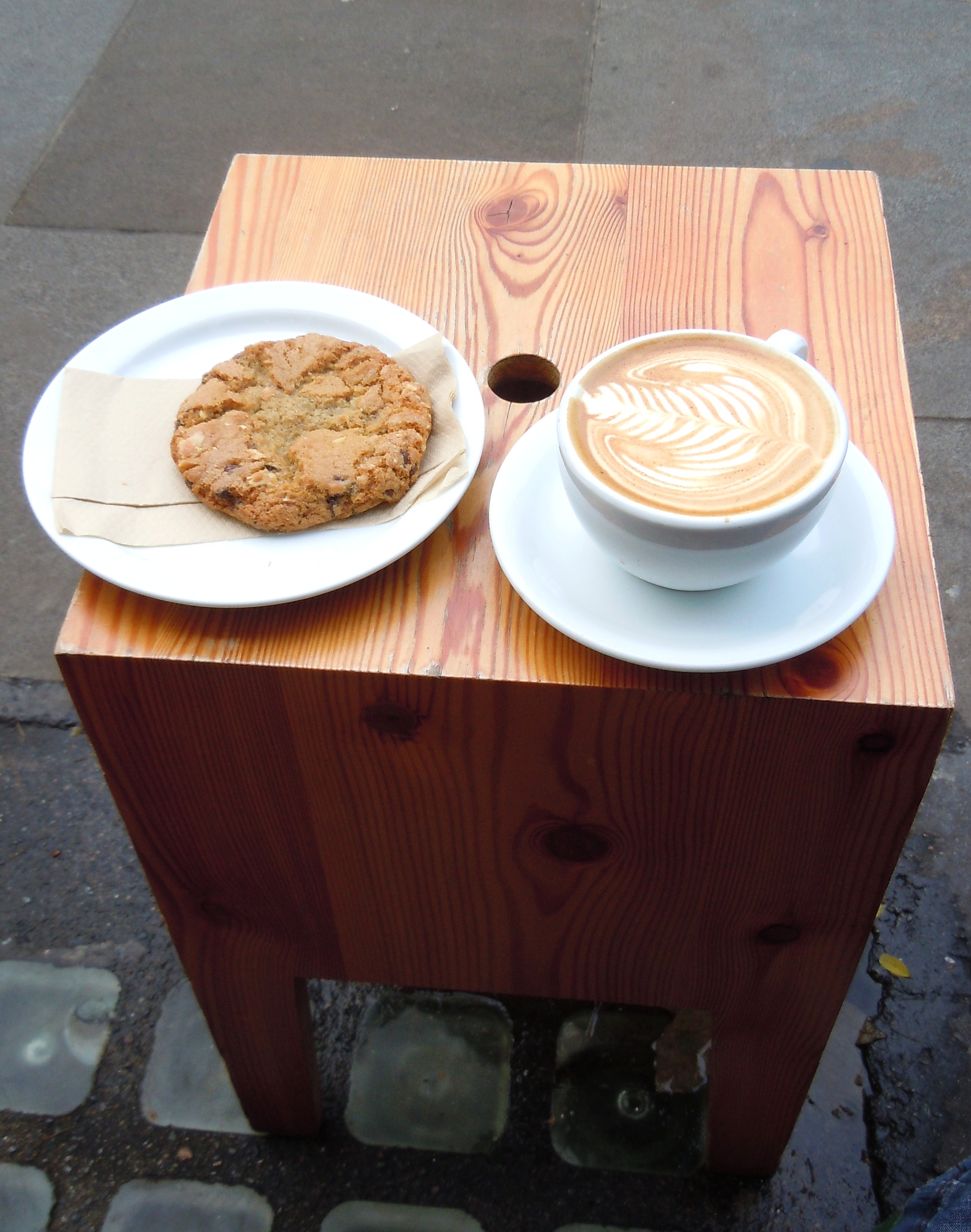
And that is the issue. Coffee is coffee, but we’ve come to associate particular meanings with the ways in which we prepare it: between someone who buys their coffee from Origin or Truth in Cape Town and another who only drinks instant, chicory-flavoured Ricoffy with UHT milk. (Which is, incidentally, my idea of culinary hell.) Both are forms of coffee, but they are socially and culturally miles apart. Studying shifting patterns in coffee fashion is fascinating in itself, but they become more interesting when we think of them within the complex networks of trade and finance which allow us to buy coffee at restaurants and in supermarkets.
The coffee craze in Europe in the seventeenth and eighteenth centuries contributed to a boom in the coffee trade. Coffee had been available since early 1600s, having been imported to Europe from Turkey via Venice. Mixed with milk and sugar, it became popular with the new European middle classes. It was associated with exotic sophistication – and also became a marker of intellectual adventurousness. It’s difficult to underestimate the extent to which drinking coffee and the culture and politics of the Enlightenment were entangled, as Anne EC McCants writes:
The expression ‘to break bread together’ now has an archaic feel to it. A proximate contemporary substitute, albeit devoid of the powerful religious significance of bread, is to ‘go out for a cup of coffee’, which is at least as much about conversation as it is about nourishment per se. Historians associate this total reorientation of the culture of food and drink with the substitution of coffeehouses for taverns; the wider dissemination of public news; trading on the stock exchange; new table etiquette and table wares; new arrangements of domestic and public space; the ability to sustain new industrial work schedules despite their tedium….
One of the best depictions of the appeal of the new, middle-class coffee culture is JS Bach’s Coffee Cantata (1732-1735), in which a ‘disobedient’ and ‘obstinate’ young woman’s addiction to coffee so annoys her father that he threatens not to allow her to marry, unless she gives up coffee. In the end she agrees, but – without her father knowing – resolves to include her clause in her marriage contract which stipulates that she must have a steady supply of coffee.
The first coffee house opened in Britain in 1650, and within a decade there were around 3,000 of them in London. These were places where men could meet to talk in relative freedom. In 1675, Charles II tried to close them in fear that coffee house patrons were plotting to overthrow him. (Given his father’s sticky end, a paranoia about the middle classes was always inevitable.) Monarchical and official suspicion of coffee houses never really ended, though. These were places where the free exchange of information allowed for the dissemination of the Enlightenment ideas that transformed the eighteenth-century world.
But trade was also changing this world. When the Dutch managed to get hold of coffee plants from Arab traders in 1690, they established plantations in Java, where they already cultivated a range of spices. The French began to grow coffee in the West Indies at the beginning of the eighteenth century, and over the course of the next hundred years or so, coffee was planted in West Africa and parts of Latin America.
The plantation system – in many ways the origins of modern capitalism – was dependent on slave labour. Europe’s taste for coffee was satisfied by slavery. But even after the abolition of slavery in the early and middle of the nineteenth century, European demand for coffee shaped the economies of countries very far away.
The domestication of coffee consumption in the nineteenth century – when women began to drink coffee, and more of it was served at home – caused demand to spike. Improvements in transport meant that coffee could be shipped over longer distances far quicker and in greater quantities than ever before. During the 1820s and 1830s, coffee cultivation became a way of linking the economies of newly-independent nations in Latin America, to global trade. Coffee production in Guatemala, Nicaragua, Costa Rica, and El Salvador increased exponentially, and governments introduced measures to facilitate the industry: new transport infrastructure, tax breaks for landowners, low or no export duties, and legislation to lower the cost of labour.
Plentiful land and cheap labour were secured by progressively disenfranchising Indian populations, whose right to own property and to work where they pleased was eroded by pro-plantation legislation. Uprisings against governments and landowners were stamped out – usually with the help of the military. The argument for increased coffee production just seemed so compelling. By the end of the nineteenth century, ninety per cent of the world’s coffee came from South America.
Brazil was the largest single Latin American supplier of coffee, and from 1906 onwards was the controller of the international coffee trade. The Brazilian government bought up beans, stockpiled them, and then released them into the market, thereby regulating the coffee price. European and North American countries encouraged African countries to begin cultivating coffee on a grander scale too.
African producers tended to grow Robusta coffee varieties, which are generally hardier, but less tasty, than the Arabica coffee produced in Latin America. This meant that when demand for instant coffee grew in the 1950s, coffee production in postcolonial African states, whose governments subsidised coffee farmers and facilitated the free movement of labour, flourished. The entry of African coffee growers into the world market meant that the price began to plummet – and the Kennedy administration in the US realised that this was an ideal opportunity for some Cold War quiet diplomacy.
The 1962 International Coffee Agreement was meant to stabilise Latin American economies and to immunise them against potential Soviet-backed revolutions by introducing production quotas for every major coffee producing nation. Even if the ICA did include African producers, it favoured the US and Brazil, effectively giving them veto rights on any policy decisions.
The collapse of the Agreement in the late eighties – partly as a result of the increased production of non-signatories, like Vietnam – caused a major decline in the price of coffee. For consumers and cafe owners, this was distinctly good thing: good coffee was cheaper than ever before. Coffee shops in the US, in particular, fuelled a demand for good, ‘real’, coffee.
But for Rwanda, the collapse of the international coffee price and the end of regulation had disastrous implications. In 1986 and 1987, Rwanda’s annual coffee sales more than halved. The government was bankrupted and increasingly dependent aid from international institutions including the World Bank, which demanded the privatisation of state enterprises, cuts in government spending, and trade liberalisation. (Hmmm – sound familiar?) The government could no longer fund social services and schools and hospitals closed. This exacerbated existing political tensions, and created a large unemployed population, many of whom became volunteers for the paramilitary groups which carried out the genocide in 1994.
It’s supremely ironic that Rwanda has turned – again – to coffee to pull itself out of the disaster of the nineties. This time, though, coffee is being produced in ways which are meant to be more sustainable – both ecologically and economically. There, though, problems with this. Isaac A. Kamola writes:
However, widely lauded ‘fair-trade’ coffee is not without its own contradictions. First, fair-trade coffee is an equally volatile market, with much of the additional price paid to growers dependent upon goodwill consumption. Such consumption patterns are highly vulnerable to economic fluctuations, changes in cultural and ethical patterns, education campaigns, and individual commitment. Furthermore, fair-trade coffee also faces an oversupply problem, with more fair-trade coffee being produced than there are consumers of it.
In Mexico, for instance, the current instability in the global food prices – caused partly by food speculation – is placing incredible pressure on small farmers who cultivate coffee: the fluctuating coffee price has shrunk their incomes at a time when maize has never been so expensive. And even prosperity brings problems. Kenyan coffee is of particularly good quality, and the increase in the coffee price has benefitted local farmers. It has also brought an increase in crime, as gangs steal coffee berries and smuggle them out of the country.
Demand abroad fuels coffee production in Africa, Latin America, and elsewhere. No other commodity demonstrates the connectedness of global patterns of consumption and production than coffee. As Kamola makes the point, we need to make this system fairer, but the fair-trade model still ensures that African farmers are dependent on demand abroad:
This does not mean that fair trade should be discouraged. It should be underscored, however, that reforms in First World consumption patterns are not alone sufficient to ensure the protection of people from the violent whims of neoliberal markets.
As much as coffee is associated with sophistication in the West – as much as it helped to facilitate the Enlightenment – it has also been the cause of incredible deprivation and suffering elsewhere. Invented in New Zealand, popularised in the UK, and made from Rwandan beans certified by the Fairtrade Foundation based in London, a flat white in Cape Town tells a global story.
Further Reading
Sources cited here:
Anne E.C. McCants, ‘Poor consumers as global consumers: the diffusion of tea and coffee drinking in the eighteenth century,’ Economic History Review, vol. 61, no. 1 (2008), pp. 172-200.
Isaac A. Kamola, ‘Coffee and Genocide,’ Transition, no. 99 (2008), pp. 54-72.
Dale Pendell, ‘Goatherds, Smugglers, and Revolutionaries: A History of Coffee,’ Whole Earth, (June 2002), pp.7-9.
Craig S. Revels, ‘Coffee in Nicaragua: Introduction and Expansion in the Nineteenth Century,’ Conference of Latin Americanist Geographers, vol. 26 (2000), pp. 17-28.
Other sources:
Joyce Appleby, The Relentless Revolution: A History of Capitalism (New York: WW Norton, [2010] 2011).
Merid W. Aregay, ‘The Early History of Ethiopia’s Coffee Trade and the Rise of Shawa,’ The Journal of African History, vol. 29, no. 1, Special Issue in Honour of Roland Oliver (1988), pp. 19-25.
Roy Love, ‘Coffee Crunch,’ Review of African Political Economy, vol. 26, no. 82, North Africa in Africa (Dec.,1999), pp. 503-508.
Sidney W. Mintz, Tasting Food, Tasting Freedom (Boston: Beacon Press, 1996).
Sidney W. Mintz, Sweetness and Power: The Place of Sugar in Modern History (New York: Penguin, 1985).
Stefano Ponte, ‘Behind the Coffee Crisis,’ Economic and Political Weekly, vol. 36, no. 46/47 (Nov. 24-30, 2001), pp. 4410-4417.
Wolfgang Schivelbusch, Tastes of Paradise: A Social History of Spices, Stimulants, and Intoxicants, trans. David Jacobson (New York: Random House, 1992).
James Walvin, Fruits of Empire: Exotic Produce and British Taste, 1660-1800 (Basingstoke and London: Macmillan, 1997).
 Tangerine and Cinnamon by Sarah Duff is licensed under a Creative Commons Attribution-ShareAlike 3.0 Unported License.







 Tangerine and Cinnamon
Feb 24
Brave New Food
The TV series which I most want to watch at the moment is Portlandia. Set in Portland, Oregon, it satirises and celebrates the city which originated the ur-hipster. It includes a scene in a restaurant – which I’ve watched only on youtube, alas – in which a couple questions their waitress about the provenance of the chicken on the menu. Assured that it’s free range, local, and organic – partly because their waitress provides them with its papers and name – they leave the restaurant to have a look at it:
This is hilarious because it so closely mimics reality: the menus which list the provenance of all the produce used in the restaurant; the farmers’ market stalls with photographs of happy animals pre-slaughter; the recipes which insist upon free-range, organic ingredients.
I laugh, but I’m as implicated in this hyper-sensitivity about where my food comes from, and how it was treated before it arrived on my plate. I don’t want to eat animals that suffered so that I can continue being an omnivore. I eat relatively little meat and am prepared to pay for free-range chicken, pork, and beef. (I’m not terribly fussed about it being ‘organic’ – whatever we may mean by that.)
It is a scandal how animals are treated in factory farms, and increasing demand for red meat is environmentally unsustainable. So how should we eat meat, without causing harm? If vegetarianism is as implicated in the meat economy – veal is a by-product of the dairy industry, for example – and veganism seems far too difficult, then one way out of this impasse is to consider synthetic alternatives.
I’ve been amused by the overwhelming response to reports about the apparent viability of lab-grown meat. ‘Eeew’ and ‘yuk’ seem to sum up how people feel about it. But lab-grown meat is only the most recent panacea to the world’s crisis produced by scientists – and our views on it say a great deal about our changing feelings about the relationship between food and technology.
The meat in question is being grown by Dr Mark Post at Maastricht University. He’s being funded by an anonymous donor who’s concerned about the greenhouse gas emissions produced by cattle farming. Using stem cells from cows, Post’s team have grown sheets of muscle between pieces of Velcro, which are shocked with an electric current to develop their texture and density:
Post hopes to produce a burger by October.
When I read the earliest reports about Post’s work, I thought immediately of a scene in Margaret Atwood’s Oryx and Crake, where the protagonist visits a lab which grows chicken breasts out of stem cells. This is a dystopian novel which plays on our suspicion of food grown in laboratories. It seems strange, now, for us to consider synthetic, artificial, man-made food to be superior to all that is ‘fresh’, ‘natural’ and ‘authentic’. But this is a relatively new way of thinking about food.
During the 1950s, a decade when science seemed to offer the possibility of a cleaner, healthier, and better organised world, there was a brief, but intense enthusiasm for Chlorella pyrenoidosa, a high-protein algae which grew rapidly and abundantly and was fed by sunlight and carbon dioxide.
The post-war baby boom gave rise to anxieties in the 1950s that the world would be unable to feed its growing population. Of course, we now know that innovations in agriculture during this period – including the wholesale mechanisation of farming, the increased use of pesticides, hormones, and antibiotics, and breeding high-yielding livestock – and the Green Revolution of the 1960s and 1970s produced the crops and farming methods which, at enormous environmental cost, still feed seven billion of us. But at the time, politicians worried that hungry nations would create a politically unstable world.
Algae looked like a sensible solution to the problem. Easy and cheap to grow, and apparently highly nutritious, this seemed to be the Brave New World of food production. Warren Belasco writes:
In today’s terms, chlorella was a superfood. Scientists fell over themselves in excitement: Scientific American and Science reported on it in glowing terms; the Rockefeller Foundation funded research into it; and some calculated that a plantation the size of Rhode Island was would be able to supply half the world’s daily protein requirements.
In the context of a mid-century enthusiasm for all that was efficient, systematic, and man-made, algae’s appeal was immediate: it was entirely usable and produced little or no waste; its farming was not dependent on variable weather and rainfall; it was clean and could be transformed into something that was optimally nutritious.
So why didn’t I have a chlorella burrito for supper?
Unfortunately, chlorella didn’t live up to the hype. Not only did the production of grains and soybeans increase exponentially during the 1950s, meaning that farmers were loath to switch to a new and untested crop, but further research revealed that chlorella production would be more complicated and expensive than initially envisaged. Growing chlorella in the quantities needed to be financially viable required expensive equipment, and it proved to be susceptible to changes in temperature. Harvesting and drying it was even more of headache.
On top of this, chlorella tasted terrible. There were some hopes that the American food industry might be able to transform bitter green chlorella into an enticing foodstuff – in much the same way they used additives and preservatives to manufacture the range of processed foods which bedecked the groaning supermarket shelves of 1950s America. Edible chlorella was not a world away from primula cheese.
Those who were less impressed by the food industry suggested that chlorella could be used to fortify bread and pasta – or even transformed into animal feed. But research demonstrated that heating chlorella destroyed most of its nutrients. Even one of its supporters called it ‘a nasty little green vegetable.’ By the 1960s, it was obvious that at $1,000 a ton, and inedible, chlorella was not going to be the food of the future.
All was not lost for chlorella, though. It proved to be surprisingly popular in Japan, where it is still sold as a nutritional supplement. The West’s enthusiasm for algae also hasn’t dimmed:
Ironically, the food that was supposed to feed the world is now the preserve of the wealthy, health-conscious middle classes – those who suffer most from the diseases of affluence – who can afford to buy small jars of powdered algae.
I hope that Post’s project manages to create a viable product which can be used to supplement people’s diets. I’m not particularly revolted by the idea of lab-grown meat, and if means that it reduces the numbers of factory farms, then that can only be a good thing.
What concerns me more are the potential motives of the businesses which would produce lab-grown meat. If it is taken up by the global food industry – which has patchy records on environmental sustainability and social responsibility – will we be able to trust them to provide us with meat which is healthy for us, and ethically produced?
Source
Warren Belasco, Meals to Come: A History of the Future of Food (Berkeley: University of California Press, 2006).