Skip to content

A Messy Business

Adventurous readers! Today’s post is over at the excellent Review 31. It’s a review of Jeffrey Pilcher’s new book, Planet Taco: A Global History of Mexican Food.

Back to normal service next week.

Foodie Pseudery (40)

A frankly bizarre interview with Nigella Lawson:

Nigella Lawson bites her bottom lip as she snatches a giant knife off the counter with the stealth of a schoolgirl up to no good. Swiftly, she lops a loop of fabric off her curve-hugging purple dress.

The blade nearly grazes her jugular.

“The microphone got caught in my dress,” she explains, batting her eyelashes coquettishly as if to make amends for doing something naughty.

“I took the impatient and slightly dangerous way out.”

Impatient. Certainly. Dangerous. Perhaps a bit. Add to that larger than life with star wattage that could light the fire under a rocket ship….

A hurricane of hips, boobs and hair, the British food babe tosses her head and unwraps her black wool coat. It slinks off her shoulders like a dressing gown, instantly transforming the culinary space into a boudoir and underscoring why she’s famous for making food sexy.

But before getting down to the whisking and sprinkling of cooking Mini Macaroni and Cheese All’Italiana, a recipe from Nigellissima, Lawson sets her famously ample bottom into a chair so a makeup artist can smooth the winter’s kink from her appearance.

Food Links, 10.04.2013

The Food and Agriculture Organisation must do more to promote food as a basic human right.

The feminisation of farming.

Processed meat is really not good for you.

Coke – a global product.

Food security cannot be left to the private sector.

The sugar hiding in everyday foods.

A history of eating horsemeat.

The fashion for horsemeat in Paris.

The rise of roadkill cuisine.

Silk teabags are made out of…plastic.

A software engineer has created Soylent (not out of people, though).

Coca Cola, the ‘healthful‘ choice.

A history of food photography.

How food ages in tins.

Kafka’s mushroom and potato soup.

The twenty most important restaurants in the US.

London food bloggers’ favourite food in London.

Vexing: Francois Hollande’s camel was eaten, accidentally.

The Cookbook of Unknown Ladies

The comment section for every article ever written on food allergies.

An ambient coffee shop noise generator.

A history of the pestle and mortar.

The kitchens of Havana.

The return of lard and schmaltz.

The wild popularity of Nutella at Columbia University.

Vintage menus.

The joy of garlic.

The return of the Irish Lumper. (Thanks, Feargal!)

Someone has stolen rather a lot of Nutella.

Using an iron to make a toasted cheese sandwich.

Making bourbon in New York.

The importance of umami.

Helpful kitchen tips from 1915.

Odd food jobs in New York.

How to photograph a tossed salad.

Mispronounced food.

Vegetable literacy.

It is the end times: the Milf Diet.

Appalling food ads.

Potato parties.

Just nipping out…

Kindly readers! I leave you for the briefest of sabbaticals over the next fortnight. It is the end of term and I am so tired that I added orange juice to my coffee this morning and took a good thirty seconds to work out why it tasted so odd.

So I am going to the seaside to regain both my sleep pattern and my sanity. I shall return with posts on the cult of authenticity, modernism, and what baked goods have to do with Afrikaner nationalism.

Here is a dancing pony:

This video comes courtesy of my friend Ester.

And here are some links to keep you going while I’m away:

What 2,000 calories look like.

A new culprit in China’s tainted milk saga.

What horsemeat and fish tell us about Europe.

Conflict over food at Guantanamo.

Horsemeat in…chicken nuggets.

In the US, the meat industry consumes four-fifths of antibiotics.

The truth about ‘organic‘.

The dangerous Lenape potato.

Kraft macaroni cheese is really very bad for you.

The language of food politics.

Digging up the buried beer at Hotel Timbuktu.

This is ridiculous: more than $1,500 for coq au vin.

The world is drink cheap, nasty coffee.

On Elizabeth David.

The new fashion for kale.

Forgotten Foods of New York City.

Five of the best bakeries in London.

Modernising Brazilian cuisine.

Korean fried chicken.

Coffee art.

Cake decorating made easy.

Why are French people drinking less wine?

A history of the measuring spoon.

A tea bag invented for use on airplanes.

Mexico City‘s wholesale market.

An all-cheese toasted cheese.

The moose cleanse.

Fuchsia Dunlop on papery dried shrimp.

South African whisky – surprisingly good.

See you soon xx

Foodie Pseudery (39)

The chocolate, it speaks:

‘”Alice knows chocolate. It speaks to her. We’re lucky to have her as a translator,” Lydon wrote to me. “Alice’s cocoa brownies changed my life.”‘

With grateful thanks to Sue Quinn. All submissions more than welcome.

Food Links, 20.03.2013

Barclays halts its involvement in food speculation.

The implications of the EU’s fish discards ban.

Big Macs and Europe’s economic recovery.

Jay Rayner on the horsemeat scandal and foodie machismo.

Sugary soft drinks may kill 184,000 people a year.

The meanings of ‘fresh‘ in food marketing.

A 1962 St Patrick’s day menu.

Elizabeth de Stadler on the tainted meat scandal in South Africa.

Simple tips for reducing food waste.

Pope Francis, foodie?

A kitchen utensil infographic.

A brief history of Pad Thai.

Gwyneth Paltrow on avocadoes.

Eating in Puerto Rico.

Polish poppy cheesecake.

The restaurant that levies fines for leftovers.

Pictures on ‘ethnic’ menus.

Lies told by waiters.

Trypophobia.

Can vinegar go off?

Buttered coffee.

The McCamembert burger.

Mark Bittman on baking bread.

Eating in Timbuktu during the eighteenth century.

Are you a ‘supertaster‘?

Pressure cooked eggs.

Pictures of hipsters taking pictures of food.

What is soy lecithin?

An ice cream seller in Constantinople, 1898.

Egg-inspired design.

One Nation?

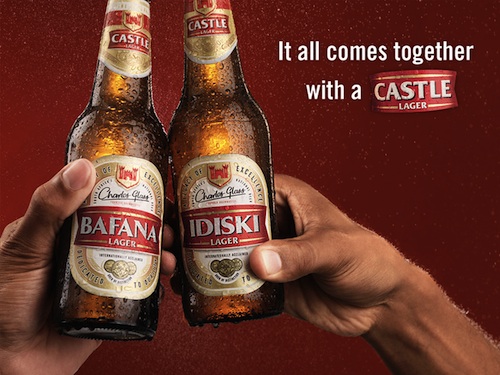
One of the oddest features of the transition from apartheid to democracy was the slew of beer advertisements, proclaiming the unity of the nation on the grounds of a shared enthusiasm for Castle Lager or Carling Black Label. There is a generation of South Africans who can chant South African Breweries’ slogan, ‘One Nation, One Soul, One Beer, One Goal,’ based entirely on having watched the 1998 Soccer World Cup on television.

This use of beer as a unifier which cut across boundaries of both race and class – although not, interestingly, gender (these advertisements celebrate a kind of hypermasculinity associated with the mining or construction industries) – was supremely ironic given the apartheid state’s attempts to control Africans’ consumption of alcohol, and particularly beer.

I’ve been thinking about the long, fraught politics of beer in South Africa as a furore has erupted over new attempts to limit alcohol sales, particularly in Gauteng and the Western Cape. Because municipalities and provinces control the terms according to which alcohol can be sold, rules around buying alcohol are complex. In the Western Cape, the new regulations will outlaw the sale of alcohol to be consumed offsite on Sundays and on all days after 18:00. No alcohol may be consumed at school functions, and in vehicles, and no person may buy or possess more than 150 litres of alcohol (that’s around 200 bottles of wine).

In Gauteng, draft legislation will make all sales of alcohol on Sundays illegal. Although these two provinces have received most attention from the media – partly because the country’s national newspapers and broadcasters are based in Cape Town and Johannesburg – there are attempts all over South Africa to limit how South Africans buy booze: the George municipality is considering outlawing the sale of all alcohol after 20:00 on Sundays; KwaZulu-Natal province may ban anyone under the age of eighteen from liquor aisles, and require supermarkets to devote a cashier specifically to alcohol sales. The Minister for Health, Aaron Motsoaledi, has even floated raising the legal age of drinking from eighteen to twenty-one.

This is all very confusing, and some shops have complained that this legislation hinders their business, and it’s doubtful that the police will be able to enforce these regulations. Many South Africans have questioned the efficacy of this legislation in reducing violent crime and road accidents – which is what these new regulations are intended to do. Although provincial governments and municipalities have cited studies which demonstrate the social and health benefits of limiting alcohol sales, there are, equally, others which suggest that higher liquor prices and taxes have little effect on the buying habits of heavy drinkers (meaning that they’re more likely to spend less on food or other essentials). Indeed, it’s probable that a black market may develop for illegal alcohol – causing drinkers inadvertently to consume poisonous liquor.
Beer

This impulse to control how much people drink in the name of preserving order and protecting the vulnerable is nothing new. The global temperance movement which emerged during the final decades of the nineteenth century, lobbied for limiting alcohol sales to men to reduce levels of domestic violence. The Cape Colony’s chapter of the Women’s Christian Temperance Union, established in Wellington, in the heart of the Cape winelands, in 1889, encouraged children, in particular, to take the temperance pledge, opened coffee shops to lure men away from canteens (or bars), and petitioned the colonial government to raise the price of liquor and reduce its availability. The WCTU distributed pamphlets, describing the apparently appalling consequences of the ‘demon drink’ for physical and mental health. People who drank had low morals, the ladies of the WCTU argued, and were at risk of falling into destitution. Members of the Myrtle branch, a temperance society for children in Wellington, were informed in 1896 ‘that strong drink leads to anger, debt, despair, destruction, and death’.

Although the WCTU encouraged middle-class men to become teetotal, its efforts were aimed overwhelmingly at men who were working-class and poor. These men – less ‘civilised’ then their middle-class betters – were characterised as uniquely prone to violence and, thus, in greater need of supervision.

Other than the fact that prohibition has never really stopped people from drinking, I think it’s worth thinking twice about limiting access to liquor because this has usually been the product of wider, social anxieties rather than of any real concern about the effects of alcohol on human bodies.

The 1928 Liquor Act was an attempt to shape how African men would consume alcohol. But, as Anne Mager explains, it was a nightmare to implement:

Exemptions to prohibition were granted in the Cape Province and Natal to African men deemed to have attained a certain ‘standard of civilization’. Permits were conditional on two years of good behaviour under the Liquor Act, a clean criminal record and permanent employment. African permit holders were limited to eight bottles of malt beer, four bottles of natural wine or two fortified wines and one bottle of spirits per month. Nevertheless, the privilege of education, property and professional status did not entitle exempted African men to enter bars and public houses frequented by whites or to drink in a friends’ home. Beyond the Cape and Natal, Africans were restricted to ‘kaffir beer’.

This was legislation driven by fear of ‘subjects perceived as immature and dangerously close to barbarism.’ However, they were also subjects from whom the state could profit. From 1937 onwards, a model of municipal beer production pioneered in Durban in 1908, was adopted around South Africa. Municipal beer halls, which had a monopoly on the sale of beer in these areas, with were established in townships and other informal settlements, providing intense competition for the existing shebeens. The profits raised by the halls went back to the municipality, and this was why so many towns and cities adopted this very lucrative scheme. It not only controlled African consumption of alcohol, but it made municipalities rather a lot of money. By the mid-1960s, more than sixty municipalities were operating beer halls.

These beer halls posed a significant threat to African brewers. CM Rogerson writes:

The introduction of municipal beer monopoly and beer halls occasioned considerable response from the community of shebeeners and home brewers, whose livelihood was threatened by the ending of prohibition and competition from municipal beer. Resistance towards municipal monopoly was manifested in various ways, including mass organised boycotts on new beer halls, rioting and the destruction of beer halls and the spreading of rumours by women shebeeners that municipal beer was making their menfolk sterile. For example, at Welkom in the Orange Free State the opening in 1956 of a municipal brewery and the withdrawal of home brewing permits sparked township rioting and attacks on the new beer hall.

As Rogerson implies, the people who had the most to lose from the municipal beer halls were African women, who controlled much of the production of beer in the ‘locations’ on the edge of towns and cities. Women were at the centre of beer production and selling. They tended to be unmarried, and could become relatively powerful. The figure of the ‘shebeen queen’ recurs in many of the novels depicting life in South African cities during the first half of the twentieth century.

It was women, too, who controlled the flourishing illegal production of alcohol. At the end of 1960, there were 30,000 illegal brewers in the Western Cape, and more than 10,000 shebeens in Soweto. But this was a business carried out in constant threat: women bore the brunt of police crackdowns on the trade. Unsurprisingly, then, women brewers and shebeen owners were often on the forefront of anti-government protest too. Most famously, they had a key role in the Cato Manor Beer Hall riots in 1959. Not only did these women berate men for drinking at municipal beer halls, but they resisted police raids on their shebeens.

Illegal beer brewing became, then, for African women both an act of political resistance, as well as a means of supporting themselves in a heavily patriarchal society.

All of this changed in 1962 when the apartheid state agreed – partly as a result of intense lobbying from industry – to open up sales of alcohol to Africans. However, this sale was still tightly controlled by the state, as Mager writes:

Since they were permitted to purchase but not consume liquor in town, Africans were effectively restricted to buying liquor at outlets (on- and off-consumption) run by the Bantu Areas Administration Boards (BAAB) in prescribed African townships. These outlets were built adjacent to the beer halls that supplied sorghum beer to working men. They comprised bars for women and men and ‘off-sales’ bottle stores. The consolidated infrastructure facilitated government monopoly in the distribution of European liquor. Local BAABs retained 20 per cent of the profits on liquor sales for the development of township amenities; 80 per cent went to the Department of Bantu Administration (BAD) head office for the financing of apartheid.

African alcohol consumption helped to fund the apartheid state. It also swelled the profits of South African Breweries, which supplied both state-run outlets as well as the illegal shebeens.

The sale of alcohol in South Africa has, then, a complex and fraught history. It is intertwined with anxieties about the control of black people in ‘white’ cities: by bringing alcohol provision within the ambit of the state, Africans’ consumption of alcohol could (in theory) be regulated, but they were, unwittingly, contributing to their own continued subordination by the apartheid regime.

Trying to manage people – either as a result of fear or out of a desire to eradicate social ills – through limiting the control of alcohol will never be fully successful. In fact, trying to stop people from drinking on Sundays or in the evenings just prevents them from drinking on Sundays or in the evenings – it doesn’t actually address the problems which cause people to drink in excess, or which cause men to beat up their wives and children.

Sources

Iain Edwards, ‘Shebeen Queens: Illicit Liquor and the Social Structure of Drinking Dens in Cato Manor,’ Agenda, no. 3 (1988), pp. 75-97.

Anne Mager, ‘“One Beer, One Goal, One Nation, One Soul”: South African Breweries, Heritage, Masculinity and Nationalism 1960-1999,’ Past and Present, no. 188 (Aug. 2005), pp. 163-194.

Anne Mager, ‘The First Decade of “European Beer” in Apartheid South Africa: The State, Brewers, and the Drinking Public, 1962-1972,’ Journal of African History, vol. 40 (1999), pp. 367-388.

Gary Minkley, ‘“I Shall Die Married to the Beer”: Gender, “Family” and Space in the East London Locations, c.1923-1952,’ Kronos, no. 23 (Nov. 1996), pp. 135-157.

CM Rogerson, ‘A Strange Case of Beer: The State and Sorghum Beer Manufacture in South Africa,’ Area, vol. 18, no. 1 (1986), pp. 15-24.

Creative Commons License
Tangerine and Cinnamon by Sarah Duff is licensed under a Creative Commons Attribution-ShareAlike 3.0 Unported License.

Food Links, 13.03.2013

The commodity with the sharpest price increase this year? Tea.

Two articles on the ethics around eating quinoa.

Man-made meat.

How Americans buy food.

Rum replaces champagne in Britain’s basket of goods used to calculate inflation.

Honey laundering in China.

America’s agriculture is less productive than Bangladesh’s.

Pret a Manger’s very bad employment policies.

Why we should worry about Tesco‘s ‘indie’ coffee chain.

The trouble with fructose.

Are all calories equal?

The argument for introducing bison to the British countryside.

Why the Paleo diet is daft.

Chicago‘s lion meat scandal.

Fiction for people interested in food.

A review of EC Spary’s amazing looking Eating the Enlightenment.

A day in the life of a hamburger.

Jeffrey Steingarten bakes perfect coconut cake.

My African Food Map.

Seventy-year-old lard.

A table of prohibited substances.

Seven diets in seven days.

Israeli doughnuts.

Part of Chez Panisse burns down; Noma poisons some of its customers.

A chart for making cinnamon buns.

Eleven facts about Guinness.

Edible bonsai.

The tyranny of dining out.

Milky coffee.

London’s first cat cafe is set to open. (Thanks, Isabelle!)

Why you should add vodka to your tomato sauce.

How to make your own buttermilk.

Oral Sadism and the Vegetarian Personality.

These are all courtesy of my Mum:

Are organic tomatoes more nutritious?

Bird-friendly farming.

Introducing Fairtrade products to African markets.

A Victory Garden featuring superheroes.

Sunny South Africanism

If South Africans were congratulating themselves in the wake of the contaminated meat scandal in Europe about the absence of horse – and, indeed, unlabelled pork – in their red meat, then their self-congratulation appeared misplaced. A couple of weeks ago, scientists at Stellenbosch University revealed that certain processed meat products contained donkey, water buffalo, goat, and even kangaroo meat.

It’s perfectly legal to sell these meats in South Africa, as long as they’re labelled correctly. But what is so disquieting about this local scandal is that it suggests a failure – even collapse – of South Africa’s food safety regulators: no South African abattoir is licensed to slaughter any of these animals, and it seems that this meat was trafficked into South Africa by criminal syndicates.

As I wrote last month, as the world’s food chain has been globalised since at least the beginning of the twentieth century, so this link between crime networks, poor regulation, and food adulteration is nothing new. I was also struck by the snobbery of so much of the response to the presence of horse and other meats in fast food and ready meals: that people who bought cheap, processed meat only had themselves to blame for inadvertently consuming horse, or other ‘taboo’ animals.

I have very little patience for the self-satisfied smuggery of middle-class foodies who advise eating less and more expensive meat to people who would never be able to afford even this shift in their eating habits. But I was amused by South African commentators who noted that nobody would notice if they had eaten water buffalo in their boerewors because, well, nobody really knows what goes into it in the first place.

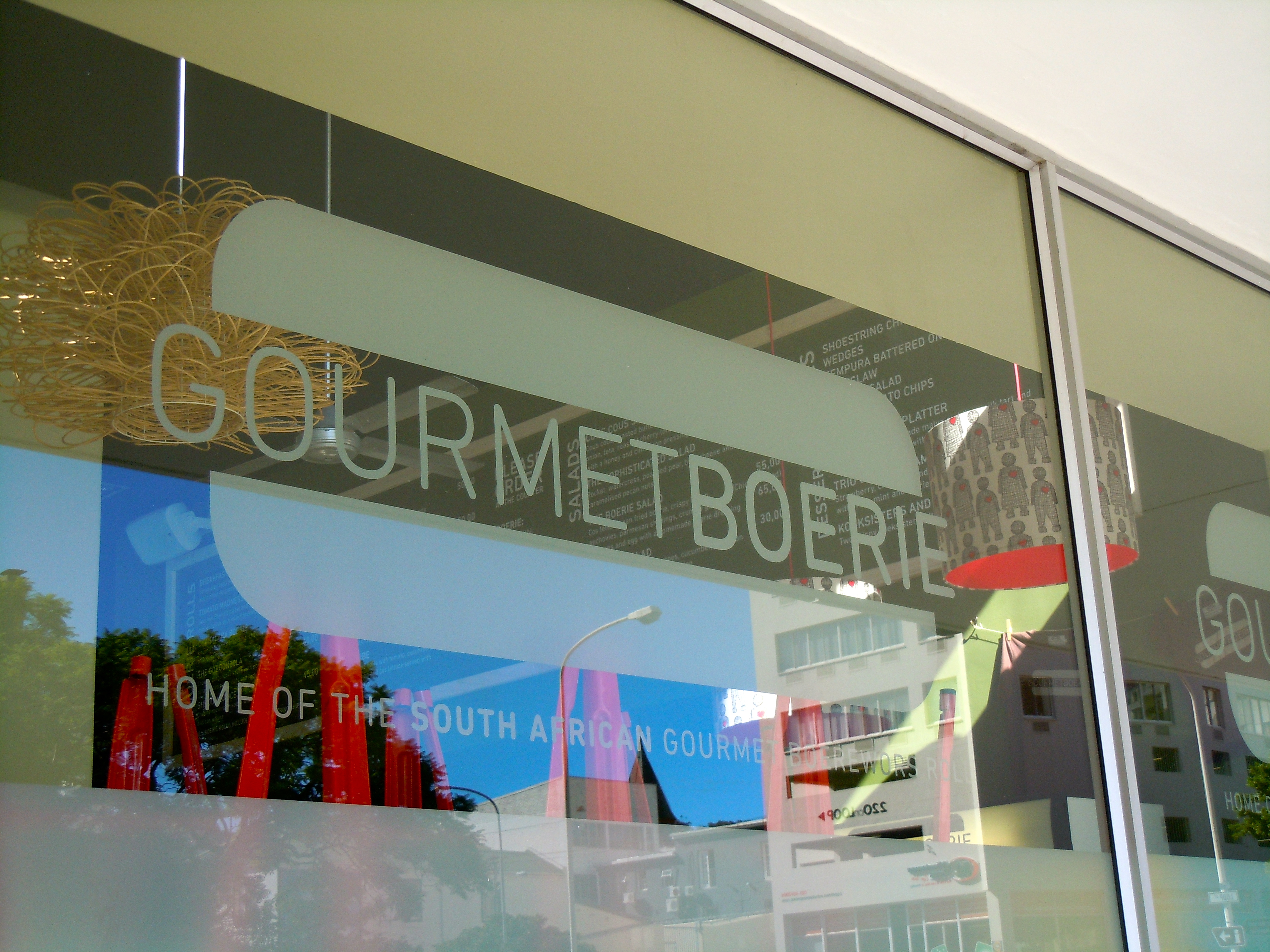
I was thinking about this recently because a few weeks ago I had supper at Gourmet Boerie, a new restaurant which has opened at the bottom of Kloof Street, in the hub of Capetonian cool. There is something profoundly oxymoronic about a gourmet boerewors roll – or boerie – restaurant. If there is one item of fast – or street – food which unites the vast majority of South Africans, it is the boerewors roll.

Boerewors – which translates, literally, as farmer’s sausage – is a kind of coarse, highly-spiced sausage, sold in coils similar to Cumberland sausage. Strongly flavoured with salt, cumin, cloves, allspice and, particularly, dried coriander, it’s usually barbecued over smouldering wood, and then served either in a hotdog roll with All Gold tomato sauce, for preference, or with maize meal porridge and a spicy tomato and onion relish, also known as chakalaka.

The aroma of barbecued boerewors is the smell of suburban summer evenings, but it’s to be found in townships, at weekend football matches, with their largely black crowds, and at mainly white cricket and rugby games. The boerewors roll stand is a fixture of church bazaars, school sports meetings, festivals, local supermarkets over weekends, and even political party rallies. It is the South African hotdog, but, I think, much more delicious.

It’s also reflective of the country’s own complex social and cultural history. Its flavouring is borrowed from the southeast Asian slaves brought to the Cape Colony between the late seventeenth century and 1807, when the slave trade was abolished. But the sausage itself is part of a northern European tradition of meat preservation and sausage making. Indeed, it can be eaten dried as well. (Many a dog has been trained on bits of droëwors.)

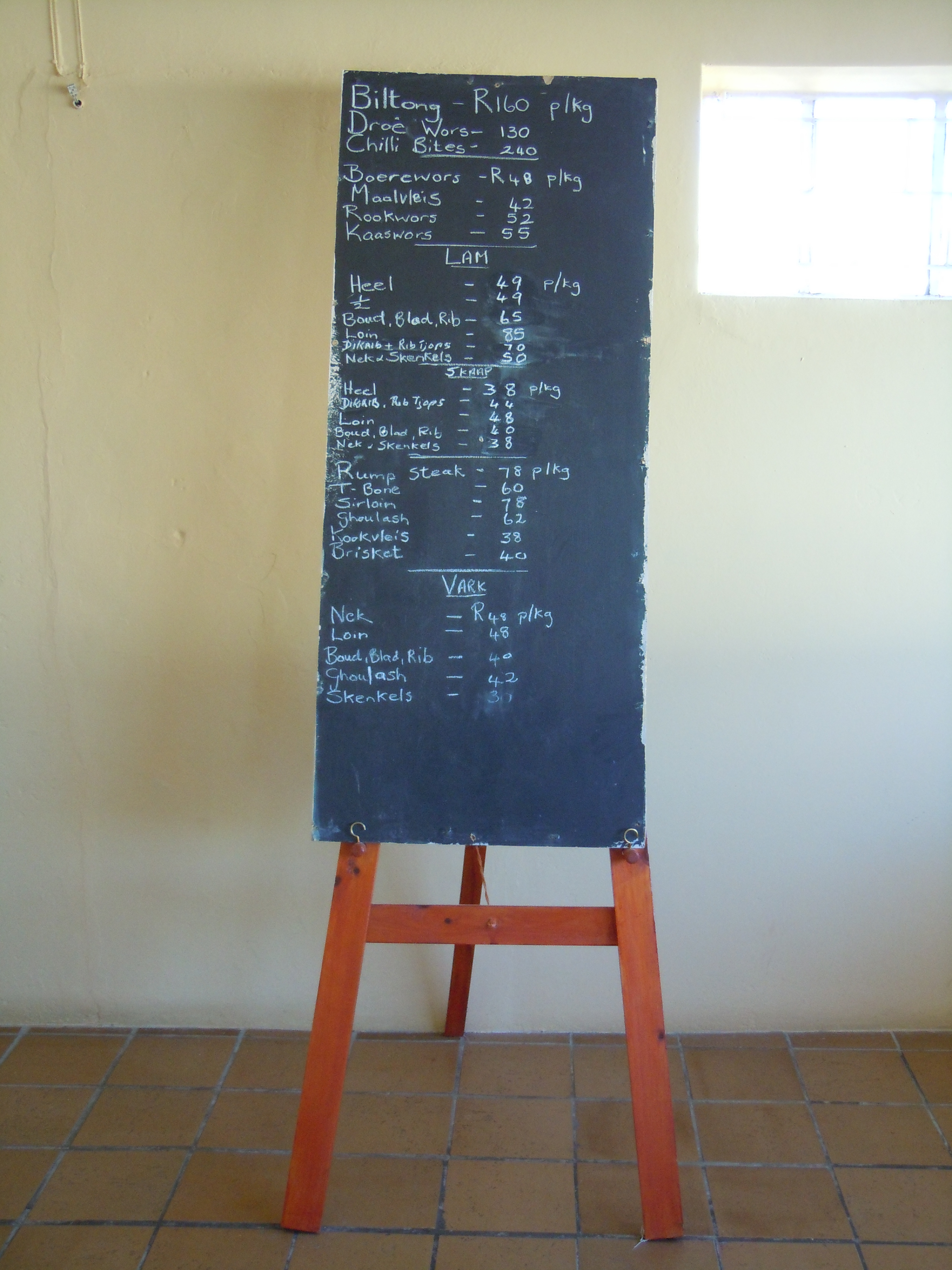
The butcher in Sutherland.

The butcher in Sutherland.

Today, it can be bought in every supermarket, but also at butchers around the countryside. Supermarkets will carry at least two or three different ranges of boerewors, and it also differs from from region to region – the most popular local version being the slightly milder Grabouw sausage. Some of the nicest boerewors I’ve had recently came from a butcher in the Karoo village of Sutherland – best known for its astronomical observatory – but my local Pick ‘n Pay sells perfectly good boerewors too.

And although supermarkets are required to list the ingredients of each pack, there’s always a chance that a local butcher may add fairly unorthodox meats to his particular – usually secret – blend. Curious about what the standard recipe for boerewors is, I turned, inevitably, to my copy of that Mrs Beeton of South African cooking, Kook en Geniet. The recipe recommends a mixture of beef and pork, at a ratio of 5:1. Having marinaded the meat in a mixture of salt, pepper, vinegar, and ground dried coriander, cloves, allspice, and nutmeg, it’s all minced together along with some cubed lard and then stuffed into sausage casings. This is not, admittedly, the most overwhelmingly healthy meal.

Mutton is a frequent addition, and the sausage can vary in thickness and spiciness. The overwhelming flavour, though, is of ground coriander. A few winters ago, I upset a butcher in a farmers’ market held in a Marylebone car park, when I pointed out that his approximation of boerewors was too finely minced and not particularly faithful to the original, being fragrant with cumin and fenugreek.

My point is that although boerewors may vary significantly from region to region, and even from shop to shop, it’s still recognisably the same product because its texture and flavour tend to remain broadly similar.

I was, then, deeply curious about what Gourmet Boerie would do to the boerewors roll to make it ‘gourmet’. I was lucky enough to take Jeffrey Pilcher and Donna Gabaccia – brilliant, US-based historians of food and immigration – with me, and we puzzled over the purpose of the restaurant.

I had the ‘classic’ roll, with traditional boerewors in a hotdog bun with caramelised onions. Despite a softer-than-usual bun, this didn’t differ substantially from similar rolls I have eaten at festivals and friends’ barbecues. In fact, I think I could have eaten as good a boerewors roll at a Boland cricket match.

Jeffrey, though, as befitting a specialist in the history and politics of food and cooking in Mexico, tried the Mexicano roll, which came with tomato salsa, guacamole, sour cream, jalapeños, and fresh coriander. It was interesting – and it’s in the variety of boerewors rolls that the restaurant seems to position its ‘gourmet’ status. Not only can punters choose between different kinds of sausage (traditional, mutton, even vegetarian) and rolls, but they come with a selection of toppings, ranging from a breakfast boerie with bacon and eggs, to a ‘sophistication’ with goats’ cheese and basil pesto.

So the rolls themselves are fine, but not astonishingly, eye-poppingly revelatory. What interested us more was in the way the restaurant reframes South African cooking and, indeed, ‘South African-ness.’ It sells local beers, and versions of traditional puddings. It has proteas arranged in jars on the tables. The lampshades and soft furnishings are covered in fabric designed by Cape Town-based Skinny LaMinx.

Gourmet Boerie in Kloof Street, Cape Town.

Gourmet Boerie in Kloof Street, Cape Town.

Clearly, the owners of Gourmet Boerie are part of an international trend which transforms street foodhamburgers, ramen, Chinese dumplings – into a ‘gourmet’ experience to be eaten in restaurants. There was even, I am told, an episode in the South African series of Masterchef which required contestants to transform the boerewors roll into fine dining. The irony implicit in this refashioning of what was, originally, cheap snacks meant to be cooked and consumed quickly, is that their gourmet incarnations insist upon their ‘authenticity’. That it is, somehow, possible to eat ‘authentic’ Japanese or American street food in a London or Melbourne restaurant.

But what Gourmet Boerie is doing, is not only the recreation of a South African street food into a kind of ‘authentic’ and ‘gourmet’ experience (whatever we may mean by ‘authentic’ and ‘gourmet’), but a refashioning of South Africa itself: Gourmet Boerie is as much about boerewors rolls as it is about being South African. And the South Africa that Gourmet Boerie touts is one which ignores the country’s fractured, contested past and present – it is cool, beautifully designed, and emphasises South Africa’s easily depoliticised natural landscape with the presence of so many indigenous flowers.

But with an overwhelmingly black cooking and serving staff overseen by a white manager, the inequalities of contemporary South African society really can’t be elided in this sunny vision of South Africa.

I don’t argue that Gourmet Boerie should rethink its representation of South Africa – of course not, it’s a restaurant and not a museum – but, rather, that we should pay attention to how it links a version of South African street food to an attempt to create a depoliticised South African-ness. And one that is equally palatable to both locals and the legions of foreign tourists who visit Cape Town every summer.

Creative Commons License
Tangerine and Cinnamon by Sarah Duff is licensed under a Creative Commons Attribution-ShareAlike 3.0 Unported License.
Foodie Pseudery (38)

From the New York Times. Again:

It is a sinister dish, this ziggurat of bread, steak and foie gras, cloaked in black like a treacherous peak on the road to Mordor. At the base is a hulking crouton, topped by filet mignon, both slaked in butter; then comes foie gras; and finally all is drenched by a slow-moving sauce of bordelaise, truffles, veal stock and Madeira, which lends a sweetness and tang akin to balsamic vinegar. It is heavy, hobbling, a prelude to gout, an anachronism and a thrill.

The restaurant is called Le Philosophe:

Afterward, there will be enormous profiteroles, shrouded in chocolate sauce, with a rubble of half-burned hazelnuts. … Better is the apple tarte Tatin, made with a wink at Jacques Derrida, with a round of pâte brise (which my table took for a shortbread cookie) in lieu of a proper crust, and caramelized apples and apple butter sloping down the plate, as if poised for a getaway.

One wall is covered with black-and-white photographs of French philosophers: Montaigne in his ruff, Simone de Beauvoir in her chignon. Name them all and Le Philosophe’s owners, Amadeus Broger and Jack Wu, will comp your meal.

Thus far no one, not even a visiting French philosopher, has succeeded.