Skip to content

Food Links, 15.08.2012

Food security in India.

The milk blockade and corporate greed.

Drought in the US may push up food prices.

The link between obesity and poverty in the US.

How to cook if you’re an amputee.

Do foodies care about workers?

The amazing Jeffrey Pilcher on the politics of tacos.

Murree Brewery, which makes beer in…Pakistan.

An end to food self-righteousness. (Thanks, David!)

What is Pad Thai?

Why do we consume mainly cows’ milk?

Could chicken be banned on television in Iran?

How Andy Warhol ate. (Thanks, Mum!)

Inside MAD Camp.

How to make your own mozzarella.

How to smoke salmon at home.

A new blog about cooking in a very, very small kitchen. (Thanks, Pamela!)

This is, really, the anti-restaurant review.

How ‘scientific’ are sports drinks?

What we eat in Ukraine.

Does Mexico have a national cuisine?

Food and sex.

The food and amazing produce of Brazil.

A great chicken scene.

Spag in a bag.

Marilyn Monroe’s recipe for stuffing.

A review of cycling cafes.

Mark Bittman on dairy.

Everything – everything – you’d ever want to know about canelés de Bordeaux.

Taste memory.

A brief history of sliced bread. (Thanks, Justin!)

Street food in Colombia.

On rooibos tea.

New ideas for identifying the ripeness of avocados.

A history of tequila in the Karoo.

A Hungry World

One of the best parts of teaching a course on African history is being able to introduce students to Binyavanga Wainaina’s amazing essay ‘How to Write about Africa’. In my first lecture, I wanted to emphasise the disconnect between the (powerful) narratives which have been developed about the continent – by travellers, politicians, journalists – and its history, societies, politics, and economics. Wainaina’s achievement is that he draws attention to a range of usually unchallenged assumptions about Africa, and shows them to be ridiculous:

Never have a picture of a well-adjusted African on the cover of your book, or in it, unless that African has won the Nobel Prize. An AK-47, prominent ribs, naked breasts: use these. If you must include an African, make sure you get one in Masai or Zulu or Dogon dress.

In your text, treat Africa as if it were one country. It is hot and dusty with rolling grasslands and huge herds of animals and tall, thin people who are starving. Or it is hot and steamy with very short people who eat primates. Don’t get bogged down with precise descriptions. Africa is big: fifty-four countries, 900 million people who are too busy starving and dying and warring and emigrating to read your book. …

Taboo subjects: ordinary domestic scenes, love between Africans (unless a death is involved), references to African writers or intellectuals, mention of school-going children who are not suffering from yaws or Ebola fever or female genital mutilation.

Recently, there has been a lot of discussion, particularly in the United States, about how the western media covers Africa. Laura Seay writes in an excellent article for Foreign Policy:

Western reporting on Africa is often fraught with factual errors, incomplete analysis, and stereotyping that would not pass editorial muster in coverage of China, Pakistan, France, or Mexico. A journalist who printed blatantly offensive stereotypes about German politicians or violated ethical norms regarding protection of child-abuse victims in Ohio would at the least be sanctioned and might even lose his or her job. When it comes to Africa, however, these problems are tolerated and, in some cases, celebrated. A quick search of the Google News archives for ‘Congo’ and ‘heart of darkness’ yields nearly 4,000 hits, the vast majority of which are not works of literary criticism, but are instead used to exoticise the Democratic Republic of the Congo while conjuring up stereotypes of race and savagery. Could we imagine a serious publication ever using similar terminology to describe the south side of Chicago, Baltimore, or another predominately African-American city?

Similarly, Jina Moore makes the point in the Boston Review that believing that journalists should only report incidents of violence or suffering, instead of other aspects of life on the continent, is

a false choice. We can write about suffering and we can write about the many other things there are to say about Congo. With a little faith in our readers, we can even write about both things – extraordinary violence and ordinary life – in the same story.

These narratives – these stories, these reports and articles about Africa – have a measurable impact on the ways in which the rest of the world interacts with the continent. Tracing a shift in American attitudes towards Africa from around 2000, when concern about the AIDS epidemic was at its height, Kathryn Mathers writes:

Suddenly there were no conversations about new democracies in Africa, or investment opportunities; the potential consumers were represented as too sick to labour, let alone to shop. This became the burden of caring Americans whose consumption practices can give a sick child in Africa ARVs or provide mosquito nets against the ravages of malaria.

To coincide with the final day of the 2012 Olympics, David Cameron and the Brazilian vice-president Michel Temer will host a summit on hunger and malnutrition in the developing world. It will be attended by officials from the US Department of Agriculture and the UK Department of International Development, as well as a clutch of celebrities. As an editorial in the Guardian puts it, ‘when tackling malnutrition involves photo-opportunities with icons such as Mo Farah and David Beckham, it’s hard not to be sceptical’ about the impact that this summit will have.

Although the summit was planned months ago, its timing is particularly apt: the world is facing another food crisis. Since the end of July, it’s become clear that the bumper harvest predicted, globally, for 2012 was not to be – in fact, maize and wheat yields are down. This year’s soybean crop is the third worst since 1964. Reading about this crisis, you’d be forgiven for thinking that it is exclusively the problem of poor nations: we know that Zimbabwe, the Sahel region, the Horn of Africa, and Yemen all face severe food shortages, and that the price of food is increasing in Egypt, Mexico, South Africa, and other middle-income nations.

However, the immediate cause of this food crisis lies far away from the regions worst affected by malnutrition and high food prices: in the United States, which is currently experiencing its worst drought in almost a century. More than half the country’s counties – 1,584 in 32 states, including Iowa, Indiana, Oklahoma, and Wyoming – have been declared disaster areas.

It’s difficult to underestimate just how devastating this drought has been (and is):

Wherever you look, the heat, the drought, and the fires stagger the imagination.  Now, it’s Oklahoma at the heart of the American firestorm, with ‘18 straight days of 100-plus degree temperatures and persistent drought’ and so many fires in neighbouring states that extra help is unavailable. It’s the summer of heat across the U.S., where the first six months of the year have been the hottest on record…. More than 52% of the country is now experiencing some level of drought, and drought conditions are actually intensifying in the Midwest; 66% of the Illinois corn crop is in ‘poor’ or ‘very poor’ shape, with similarly devastating percentages across the rest of the Midwest.  The average is 48% across the corn belt, and for soybeans 37% – and it looks as if next year’s corn crop may be endangered as well. …according to the Department of Agriculture, ‘three-quarters of the nation’s cattle acreage is now inside a drought-stricken area, as is about two-thirds of the country’s hay acreage.’

There are suggestions that the Midwest is in danger of experiencing a second Dust Bowl. But the drought is not limited to the US: unusually dry summers have reduced harvests in Russia, the Ukraine, and Kazakhstan. And the effects of these poor yields will be felt around the world. Even if, as the Financial Times reports, the drought will push up prices of beef, pork, and chicken in the United States and Europe, the countries most at risk of food shortages, and, indeed, of social unrest, are those which rely on food imports to feed their populations.

If rates of malnutrition are to be reduced and food shortages, addressed, then politicians will have to consider them in global context. They will have to rethink America’s energy policies, which have allowed for almost forty per cent of the country’s corn crop to be devoted to ethanol production. They will have to address the impact that financial speculation has on the price of food commodities. A report published by the New England Complex Systems Institute suggests that food price increases are likely to be exacerbated by the unregulated trade in staples like maize and wheat.

Even these measures will not be enough to ensure adequate access to food for all people: we need to find strategies to slow down and mitigate the effects of climate change; social and economic inequality in the developing world must be addressed; land grabs need to be halted; and agricultural policies in sub-Saharan Africa and elsewhere need to favour small farmers.

In the same month in which the tofu industry in Indonesia has threatened to down tools over rising soybean prices, the cost of maize meal is increasing in Mexico, and there were protests in Iran over price of chicken, the grain trader Cargill announced revenues of $134 billion. This state of affairs is not sustainable.

While it’s certainly the case that famine and malnutrition in parts of sub-Saharan Africa are the products of dysfunctional and corrupt governments, it’s also true that as part of a globalised food system, food insecurity in Africa – and the rest of the developing world – is connected to a set of problems which can only be solved on an international scale.

This is, then, a global crisis. But reporting has tended to disassociate its cause and effects: hunger in Africa is reported separately from the drought in the northern hemisphere and the spike in food prices. Cameron’s summit on malnutrition focuses exclusively on the developing world. I think that this is partly as a result of the narratives which inform reporting on these regions: America is an agricultural superpower, while Africa is a site of terminal decline and disaster. It’s worth noting that America’s poor harvest tends to be reported on in the environmental or financial sections of newspapers and websites, while hunger and malnutrition in sub-Saharan Africa and south Asia are relegated to the sections dealing with aid or development. Linking malnutrition in South Sudan to the maize harvest in Indiana would upset these ways of thinking about Africa and the United States.

Creative Commons License
Tangerine and Cinnamon by Sarah Duff is licensed under a Creative Commons Attribution-ShareAlike 3.0 Unported License.

Food Links, 08.08.2012

The corn harvested in the US for biofuel could feed 412 million people.

Raj Patel’s new project: Generation Food.

Americans drink more fizzy soft drinks than anyone else.

Why Britain’s food ‘traffic light‘ labels were never implemented.

The link between food and addiction.

Why does fast food love Mitt Romney?

The battle for London’s markets.

Cooking along with Elizabeth Ellicott Lea’s Domestic Cookery (1845).

Food at the Olympics.

Sean Brock, the tattooed chef who’s reinventing southern cuisine.

An interview with Michael Pollan.

How to explode a watermelon with rubber bands.

The UnFancy Food Show.

All about hummus.

Why do some restaurants fear the number thirteen?

Stick twist bread.

Darina Allen on collecting sea urchins.

Marion Cunningham’s baking powder biscuits (scones to the rest of us).

Freezing herbs in olive oil preserves them.

How to make your own creme de cassis.

Looking for loganberries.

Papercraft food.

Has the mania for bacon gone too far?

Eat more beetroot.

Maslow’s hierarchy of coffee chains.

Recipes for blueberries.

A tablecloth which turns the table into a fort.

An advertisement for coffee from the 1650s.

Henna-patterned spiced cream cheese.

An interview with James Ramsden.

Food t-shirts.

Photographs of meals in literature.

How to make perfect rice.

Cupcakes vs pie.

Dead celebrities reborn in food.

Free-From Food

Last week I visited the new health food shop in the shopping centre near my flat. I was in search of coconut flakes to add to granola – why yes, I do make my own granola (what else did you expect?) – but, instead, bought nearly my own body weight in almond meal, and came away, amazed by the incredible range of foodstuffs and supplements on sale. I was struck by how little the diet advocated by the makers of these food products tallied with my own idea of healthy eating. While I try to eat a little of everything, and always in moderation, both the health shop and its products seem to view most forms of food with profound suspicion.

In a recent edition of Radio 4’s Food Programme, Sheila Dillon charts the rise of the ‘free from’ food industry. As she makes the point, for all that these lactose-, gluten-, sugar-, and wheat-free snacks, bars, and drinks advertise themselves as the ‘healthy’ alternative, they are as heavily processed as ready meals in supermarkets. I think that one way of accounting for this odd paradox – that people who wouldn’t normally go anywhere near a box of supermarket lasagne are willing to buy heavily processed kale chips or carob bars – is to consider how ideas around what we define as ‘healthy’ food have changed.

When I was preparing lectures on food and the 1960s counterculture my father recommended a story in Tom’s Wolfe’s New Journalism (1975). Written unbelievably beautifully by Robert Christgau, now best known as a music journalist, the essay charts the slow decline of a young woman in the thrall of a fad diet. Titled ‘Beth Ann and Macrobioticism’ the piece begins in Greenwich Village in 1965.  Twenty-three year-old married couple Beth Ann and Charlie, were living as artists, and off money from Charlie’s father, in hippy New York. Discontented with the range of mind-expanding experiences offered to them by the collection of drugs and therapies they’d been taking, Charlie learned about the Zen macrobiotic diet from a friend.

Published in the United States in the mid-1960s, Zen Macrobiotics: The Art of Rejuvenation and Longevity by Georges Ohsawa, a Japanese philosopher and sometime medical doctor,

contends that all of the physical and spiritual diseases of modern man result from his consuming too much yin (basically, potassium…) or too much yang (sodium) – usually too much yin. … Most fruits (too yin) and all red meat (too yang) are shunned, as are chemicals (additives and drugs, almost all yin, as well as ‘unnatural’) and Western medicine. According to Ohsawa, the diet is not merely a sure means to perfect physical health. …it is also a path to spiritual health and enlightenment.

As Christgau makes the point, Ohsawa’s macrobiotic diet is ‘dangerously unsound’. It’s comprised of ten progressively restrictive stages, with the final including only water and brown rice. The American Medical Association denounced the diet on the grounds that those who followed Ohsawa’s directions religiously were at risk of scurvy, anaemia, malnutrition, and kidney failure.

Beth Ann and Charlie devoted themselves to macrobiotics with enthusiasm, quickly deciding on Diet no. 7, which consisted mainly of grain and tea. Unsurprisingly, they both lost weight quickly, and experienced a kind of hunger-induced euphoria:

They slept less than six hours a night. They…felt high on the diet, with spontaneous flashes that seemed purer and more enlightening than anything they had felt on drugs. … One joyous day, they threw out every useless palliative in the medicine cabinet and then transformed their empty refrigerator…into a piece of pop culture, with sea shells in the egg compartments and art supplies and various pieces of whimsy lining the shelves.

Shortly after this, both began to sicken. Beth Ann, in particular, displayed all the symptoms for scurvy. Despite a fellow macrobiotic enthusiast’s recommendation that she add raw vegetables to her diet, Beth Ann began to fast, for stretches of two weeks at a time. She wrote to Ohsawa, who told her to remain on the diet. Soon, she was bedridden, and moved in with her parents-in-law, who urged her to see a doctor. On the morning of her death – with a fever, and very weak – another letter arrived from Ohsawa, informing her that she had misunderstood the diet completely. But it was too late: she died a few hours later.

Beth Ann was not the only person taken in by Zen macrobiotics during the 1960s and 1970s. There were several cases of people who either died from, or were hospitalised for, malnutrition and salt poisoning as a result of a too-rigid adherence to the diet.

I don’t suggest for a moment that Cape Town’s health food hippies are in danger of starving themselves to death in an attempt to follow the teachings of a twentieth-century Japanese loon, but there are remarkable continuities between the 1960s enthusiasm for Zen macrobiotics and contemporary anxieties about food and nutrition.

On the extreme end of this scale of suspicion of food, are proponents of restricted-calorie diets who argue – with very little evidence – that those who eat less, will live significantly longer. Earlier this year, a Swiss woman starved herself to death after attempting to live only on sunshine. (Perhaps she thought she would photosynthesise?)

But on the other, more reasonable side, are the legions of women’s magazines which advise their readers what not to eat, rather than what they should be eating. These, and other publications, have variously branded sugar, saturated fat, and carbohydrates as the enemies of healthy diets, and, like Zen macrobiotics, advocate increasingly restricted diets. This advice is subject to change, though. For instance, a group of experts at the American Dietetic Association’s most recent Food and Nutrition Conference noted that there is no evidence to suggest that low-fat diets have any health benefits.

Where does this idea – that food is the source of ill-health, rather than the fuel which helps to keep sickness at bay – originate? There is a millennia-old tradition in Western and other cultures of associating deprivation with moral or spiritual superiority and purity.

But, more specifically, I think that this suspicion of food can be located during the eighteenth century. Indeed, contemporary mainstream macrobiotic diets are based on the writing of an Enlightenment German physician Christoph Wilhelm Hufeland (1762-1836), who is credited with coining the term ‘macrobiotics’. In The Art of Prolonging Human Life (1797), Hufeland argued that each person possesses a ‘life force’ which needs to be nurtured and protected through rest, exercise, and a carefully-calibrated diet.

Hufeland’s writing was part of a wider, Enlightenment questioning of what constituted a morally and physically healthy person. In his influential text The English Malady (1733), the Scottish physician George Cheyne (1671-1743) argued that corpulence and over-eating undermined both the health of the body as well as the mind. Roy Porter explains:

Cheyne’s books were extremely popular and many later medical thinkers echoed his calls to temperance, with added intensity. Moderation would overcome that classic Georgian disorder, the gout, proclaimed Dr William Cadogan. If the turn towards regulating the flesh was decidedly health-oriented, however, it also became part and parcel of a wider movement, expressive of preferred cultural ideals and personal identities.

The emergence of an ethical vegetarianism – vegetarianism by choice, rather than necessity – during this period was one of the best examples of this attempt to regulate excessive behaviour through moderate eating:

Joseph Ritson, for example, held that because dead meat itself was corrupt, it would stir violent passions, whereas greens, milk, seeds and water would temper the appetite and produce a better disciplined individual.

I think that there’s a continuum between this association of a restricted diet with being a better person, and contemporary notions of healthy eating. The Zen macrobiotic craze in the 1960s was an extreme example of this desire only to eat that which is ‘pure’ in order to be good – as is the relatively recent phenomenon of orthorexia:

Orthorexics commonly have rigid rules around eating. Refusing to touch sugar, salt, caffeine, alcohol, wheat, gluten, yeast, soya, corn and dairy foods is just the start of their diet restrictions. Any foods that have come into contact with pesticides, herbicides or contain artificial additives are also out.

To be clear, orthorexia does not refer to those people who are genuinely allergic to some kinds of food. Rather, it describes an obsession with eating healthily. Although this obsessiveness can be socially limiting, it’s also admired to some extent. Sticking rigidly to a needlessly restrictive, ‘free-from’ diet is seen, frequently, as a sign of self-control, and an even greater willingness to take full responsibility for maintaining one’s own health.

The emergence of orthorexia and even the growing popularity of free-from foods, are indicative of a wider belief that we should care more about what we don’t eat, rather than what we do – and that there’s a connection between eating ‘healthily’ (whatever we may mean by that), and being a good and virtuous person. In a time when it is ever-easier to eat cheap junk food, and when rates of obesity are soaring all over the world, surely, it makes better sense to emphasise the pleasures of good food – and not to suggest that the unhealthy or overweight are morally suspect?

Further Reading

Robert Christgau, ‘Beth Ann and Macrobioticism,’ in The New Journalism, ed. Tom Wolfe and EW Johnson (London: Picador, 1975), pp. 363-372.

Karlyn Crowley, ‘Gender on a Plate: The Calibration of Identity in American Macrobiotics,’ Gastronomica: The Journal of Food and Culture, vol. 2, no. 3 (Summer 2002), pp. 37- 48.

Roy Porter, Flesh in the Age of Reason: How the Enlightenment Transformed the Way We See Our Bodies and Souls (London: Penguin, 2003).

Victoria Rezash, ‘Can a Macrobiotic Diet Cure Cancer?’ Clinical Journal of Oncology Nursing, vol. 12, no. 5 (Oct. 2008), pp. 807-808.

Creative Commons License
Tangerine and Cinnamon by Sarah Duff is licensed under a Creative Commons Attribution-ShareAlike 3.0 Unported License.

Foodie Pseudery (27)

This isn’t so much foodie pseudery as bad research and poor writing (the article also claims that Bonnotte potatoes are harvested ‘rigorously’ by hand – I’d love to see that):

During the era of the conquering of the Americas, the potato was the principal food of the indigenous Andes people, who also worshiped them.

Now, how difficult is it to look up the Latin American Conquest and Incas on Wikipedia?

Food Links, 01.08.2012

Big Food battles over potential market share in the developing world.

Why doesn’t the USDA support Meatless Monday?

American meat consumption.

Food security is linked to the availability of water for irrigation.

Should food be banned from landfill?

Gareth Jones, the journalist who reported on famine in the USSR under Stalin.

Thoughts on preventing obesity.

Suggestions for taking a picnic to the Olympics.

An urban farm in Harlem, New York.

Why can some people eat as much as they like, and never put on weight?

British farmers are being urged to grow the ingredients for curry.

The favourite dishes of American presidents.

The rediscovery of traditional southern cooking in the US.

Jay Rayner praises Jamie Oliver.

America: understood in terms of beer and religion.

How to make your own sparkling wine.

The most interesting food trucks.

Everyday things, made out of food.

Desperate Chefs’ Wives. (No, really.)

Claudia Roden’s favourite London restaurants.

Sweden‘s rising culinary scene.

The pleasures of eating. (Thanks, Murray!)

A rant against knowing everything about where our food comes from.

David Mitchell on wine tasting.

A pulled pork…cupcake.

Songs about food. (With thanks to David Worth.)

The revival of interest in English food from the 20s and 30s.

The kebab combination generator.

Trace the journey of one dish of food.

How to make your own soft serve ice cream.

The mango nectarine.

Photographs of the 2012 Mad Camp.

Food in space.

How to make a cup of tea – as a poem.

On Edible Arrangements.

The world’s rudest chef.

What Michael Phelps eats for breakfast.

Popcorn with milk?

How to make a hedgehog.

Introducing Bandar Foods.

The world’s oldest wine.

All about choux.

A Sporting Chance

My expectations of the London Olympics’ opening ceremony were so low that, I suppose, I would have been impressed if it had featured Boris as Boudicca, driving a chariot over the prostate figures of the Locog committee. (Actually, now that I think about it, that would have been fairly entertaining.)

Appalled by the organising committee’s slavishly sycophantic attitude towards its sponsors and their ‘rights’ – which caused them to ban home knitted cushions from being distributed to the Olympic athletes, and to require shops and restaurants to remove Olympic-themed decorations and products – as well the rule that online articles and blog posts may not link to the official 2012 site if they’re critical of the games, the decision to make the official entrance of the Olympic site a shopping mall, and the creation of special lanes for VIP traffic, I wasn’t terribly impressed by the London Olympics.

But watching the opening ceremony last night, I was reduced to a pile of NHS-adoring, Tim Berners-Lee worshipping, British children’s literature-loving goo. Although a reference to the British Empire – other than the arrival of the Windrush – would have been nice, I think that Danny Boyle’s narrative of British history which emphasised the nation’s industrial heritage, its protest and trade union movements, and its pop culture, was fantastic.

As some commentators have noted, this was the opposite of the kind of kings-and-queens-and-great-men history curriculum which Michael Gove wishes schools would teach. Oh and the parachuting Queen and Daniel Craig were pretty damn amazing too.

There was even a fleeting, joking reference to the dire quality of British food during the third part of the ceremony. There was something both apt, but also deeply ironic about this. On the one hand, there has been extensive coverage of Locog’s ludicrous decision to allow manufacturers of junk food – Coke, Cadbury’s, McDonald’s – not only to be official sponsors of a sporting event, but to provide much of the catering. (McDonald’s even tried to ban other suppliers from selling chips on the Olympic site.)

But, on the other, Britain’s food scene has never been in better shape. It has excellent restaurants – and not only at the top end of the scale – and thriving and wonderful farmers’ markets and street food.

It’s this which makes the decision not to open up the catering of the event to London’s food trucks, restaurants, and caterers so tragic. It is true that meals for the athletes and officials staying in the Village have been locally sourced and made from ethically-produced ingredients, and this is really great. But why the rules and regulations which actually make it more difficult for fans and spectators to buy – or bring their own – healthy food?

Of course, the athletes themselves will all be eating carefully calibrated, optimally nutritious food. There’s been a lot of coverage of the difficulties of catering for so many people who eat such a variety of different things. The idea that athletes’ performance is enhanced by what they consume – supplements, food, and drugs (unfortunately) – has become commonplace.

Even my local gym’s café – an outpost of the Kauai health food chain – serves meals which are, apparently, suited for physically active people. I’ve never tried them, partly because the thought of me as an athlete is so utterly nuts. (I’m an enthusiastic, yet deeply appalling, swimmer.)

The notion that food and performance are linked in some way, has a long pedigree. In Ancient Greece, where diets were largely vegetarian, but supplemented occasionally with (usually goat) meat, evidence suggests that athletes at the early Olympics consumed more meat than usual to improve their performance. Ann C. Grandjean explains:

Perhaps the best accounts of athletic diet to survive from antiquity, however, relate to Milo of Croton, a wrestler whose feats of strength became legendary. He was an outstanding figure in the history of Greek athletics and won the wrestling event at five successive Olympics from 532 to 516 B.C. According to Athenaeus and Pausanius, his diet was 9 kg (20 pounds) of meat, 9 kg (20 pounds) of bread and 8.5 L (18 pints) of wine a day. The validity of these reports from antiquity, however, must be suspect. Although Milo was clearly a powerful, large man who possessed a prodigious appetite, basic estimations reveal that if he trained on such a volume of food, Milo would have consumed approximately 57,000 kcal (238,500 kJ) per day.

Eating more protein – although perhaps not quite as much as reported by Milo of Croton’s fans – helps to build muscle, and would have given athletes an advantage over other, leaner competitors.

Another ancient dietary supplement seems to have been alcohol. Trainers provided their athletes with alcoholic drinks before and after training – in much the same way that contemporary athletes may consume sports drinks. But some, more recent sportsmen seem to have gone a little overboard, as Grandjean notes:

as recently as the 1908 Olympics, marathon runners drank cognac to enhance performance, and at least one German 100-km walker reportedly consumed 22 glasses of beer and half a bottle of wine during competition.

Drunken, German walker: I salute you and your ability to walk in a straight line after that much beer.

The London Olympic Village is, though, dry. Even its pub only serves soft drinks. With the coming of the modern games – which coincided with the development of sport and exercise science in the early twentieth century – diets became the subject of scientific enquiry. The professionalization of sport – with athletes more reliant on doing well in order to make a living – only served to increase the significance of this research.

One of the first studies on the link between nutrition and the performance of Olympic athletes was conducted at the 1952 games in Helsinki. The scientist E. Jokl (about whom I know nothing – any help gratefully received) demonstrated that those athletes who consumed fewer carbohydrates tended to do worse than those who ate more. Grandjean comments:

His findings may have been the genesis of the oft-repeated statement that the only nutritional difference between athletes and nonathletes is the need for increased energy intake. Current knowledge of sports nutrition, however, would indicate a more complex relationship.

As research into athletes’ diets has progressed, so fashions for particular supplements and foods have emerged over the course of the twentieth century. Increasing consumption of protein and carbohydrates has become a common way of improving performance. Whereas during the 1950s and 1960s, athletes simply ate more meat, milk, bread, and pasta, since the 1970s, a growing selection of supplements has allowed sportsmen and –women to add more carefully calibrated and targeted forms of protein and carbohydrates to their diets.

Similarly, vitamin supplements have been part of athletes’ diets since the 1930s. Evidence from athletes competing at the 1972 games in Munich demonstrated widespread use of multivitamins, although now, participants tend to choose more carefully those vitamins which produce specific outcomes.

But this history of shifting ideas around athletes’ diets cannot be understood separately from the altogether more shadowy history of doping – of using illicit means of improving one’s performance. Even the ancient Greeks and Romans used stimulants – ranging from dried figs to animal testes – to suppress fatigue and boost performance.

More recently, some of the first examples of doping during the nineteenth century come from cycling (nice to see that some things don’t change), and, more specifically, from long-distance, week-long bicycle races which depended on cyclists’ reserves of strength and stamina. Richard IG Holt, Ioulietta Erotokritou-Mulligan, and Peter H. Sönksen explain:

A variety of performance enhancing mixtures were tried; there are reports of the French using mixtures with caffeine bases, the Belgians using sugar cubes dripped in ether, and others using alcohol-containing cordials, while the sprinters specialised in the use of nitroglycerine. As the race progressed, the athletes increased the amounts of strychnine and cocaine added to their caffeine mixtures. It is perhaps unsurprising that the first doping fatality occurred during such an event, when Arthur Linton, an English cyclist who is alleged to have overdosed on ‘tri-methyl’ (thought to be a compound containing either caffeine or ether), died in 1886 during a 600 km race between Bordeaux and Paris.

Before the introduction of doping regulations, the use of performance enhancing drugs was rife at the modern Olympics:

In 1904, Thomas Hicks, winner of the marathon, took strychnine and brandy several times during the race. At the Los Angeles Olympic Games in 1932, Japanese swimmers were said to be ‘pumped full of oxygen’. Anabolic steroids were referred to by the then editor of Track and Field News in 1969 as the ‘breakfast of champions’.

But regulation – the first anti-drugs tests were undertaken at the 1968 Mexico games – didn’t stop athletes from doping – the practice simply went underground. The USSR and East Germany allowed their representatives to take performance enhancing drugs, and an investigation undertaken after Ben Johnson was disqualified for doping at the Seoul games revealed that at least half of the athletes who competed at the 1988 Olympics had taken anabolic steroids. In 1996, some athletes called the summer Olympics in Atlanta the ‘Growth Hormone Games’ and the 2000 Olympics were dubbed the ‘Dirty Games’ after the disqualification of Marion Jones for doping.

At the heart of the issue of doping and the use of supplements, is distinguishing between legitimate and illegitimate means of enhancing performance. The idea that taking drugs to make athletes run, swim, or cycle faster, or jump further and higher, is unfair, is a relatively recent one. It’s worth noting that the World Anti-Doping Agency, which is responsible for establishing and maintaining standards for anti-doping work, was formed only in 1999.

What makes anabolic steroids different from consuming high doses of protein, amino acids, or vitamins? Why, indeed, was Caster Semenya deemed to have an unfair advantage at the 2009 IAAF World Championships, but the blade-running Oscar Pistorius is not?

I’m really pleased that both Semenya and Pistorius are participating in the 2012 games – I’m immensely proud that Semenya carried South Africa’s flag into the Olympic stadium – but their experiences, as well as the closely intertwined histories of food supplements and doping in sport, demonstrate that the idea of an ‘unfair advantage’ is a fairly nebulous one.

Further Reading

Elizabeth A. Applegate and Louis E. Grivetti, ‘Search for the Competitive Edge: A History of Dietary Fads and Supplements,’ The Journal of Nutrition, vol. 127, no. 5 (2007), pp. 869S-873S.

Ann C. Grandjean, ‘Diets of Elite Athletes: Has the Discipline of Sports Nutrition Made an Impact?’ The Journal of Nutrition, vol. 127, no. 5 (2007), pp. 874S-877S.

Richard IG Holt, Ioulietta Erotokritou-Mulligan, and Peter H. Sönksen, ‘The History of Doping and Growth Hormone Abuse in Sport,’ Growth Hormone & IGF Research, vol. 19 (2009), pp. 320-326.

Creative Commons License
Tangerine and Cinnamon by Sarah Duff is licensed under a Creative Commons Attribution-ShareAlike 3.0 Unported License.

Food Links, 25.07.2012

Demand for food parcels increases in Britain. And photographs of foodbanks – and should foodbanks be doing the work of the state?

On the difficulties of researching child obesity in Latin America.

The exploitation of workers in cheap chicken take-away restaurants in London.

The PLoS series on Big Food.

Climate change is contributing to shrinking crop yields.

The curious case of the poisoned cows.

Preserving potato biodiversity in the Andes.

Why we should all eat more mince.

The odd trend for brain-boosting drinks.

Interesting articles about airline food from my Dad: why airline food tastes so strange, and efforts to make it more tasty.

This is fascinating: the Junior League Cookbook and the making of Southern cuisine.

The Byzantine Omelette‘ by Saki.

Japanese designers and tea houses. (Thanks, Mum!)

What is the future of the cookbook?

Making dim sum in Hong Kong’s Tim Ho Wan restaurant.

We do we really mean by ‘artisanal‘ food?

How to barbecue without killing the planet.

This American Life on the recipe for Coca-Cola.

The ingredients in Danish rye bread.

An introduction to ‘umami‘.

The origins of southern cuisine in the US.

Vanilla yogurt gives mice glossier coats and larger testicles.

A blog on keeping chickens.

The origins, state, and future of the British breakfast.

How to make cold brew coffee.

A mathematically correct breakfast.

Street food in Palermo.

The art of coffee.

Cakes, cupcakes, and biscuits inspired by…Fifty Shades of Grey. (Truly, there is no hope for humanity.)

The long history of the espresso machine. (Thanks, Dan!)

Why organic wines still struggle to find an audience.

A milk map.

America’s affection for homegrown confectionery.

Molecular cooking to try at home.

An interview with Reuben Riffel.

How much calcium is too much?

It’s only cake

The television series which I most I want to watch at the moment is Girls. Written by and starring Lena Dunham, it follows the exploits of four young women in New York. Unlike Sex and the City, to which it is usually compared, its success is based partly on how truthful its depiction of the characters’ experience of living in New York is: that it is expensive, and not particularly glamorous. It portrays sex and relationships wincingly realistically.

I’m interested in Girls not only because it looks fantastically entertaining: it seems to me to be part of a new kind of feminism which has emerged over the past few years.

In a pair of articles for N+1, Molly Fischer has taken a look at the rise of the ‘ladyblog’ since the founding of sites like Jezebel and The Hairpin in 2007 and 2008. For many young women, these blogs – and others – have taken the place of women’s magazines. Considerably more intelligent and far better written, ladyblogs take aim at the ways in which women’s magazines create and play on women’s insecurities, as well as the values underpinning them.

But Fischer points out that ladyblogs also peddle femininities which are not always tolerant of dissent, and are often unwilling to engage in debate. She writes about the response to an earlier, more critical post:

When intimacy is your model of success, it becomes easy to assume that everyone is either a friend or a traitor. I had tried to approach the ladyblogs as an observer rather than a participant, but my writing about them in an apparently impersonal public voice, as a woman—which became a woman holding myself apart from their community of women—registered as unacceptable aggression. So, was I a spinster feminist, or just out to impress boys? This was the exact corner of the internet that seemed like it ought to know better.

I was particularly taken by her observation that the blogs’ and their readers’ tendency to refer to themselves as ‘ladies’, rather than ‘women’, signals a kind of discomfort with adult femininity. I think that this is worth exploring. In a review of Sheila Heti’s How Should a Person Be? Katie Roiphe criticises the book – a novel about a group of variously arty people in Toronto – on the grounds that Heti’s behaviour and thinking are not really befitting a thirty-five year-old woman:

One of the salient facts of Heti’s milieu…is the very young quality of the book’s philosophical speculations, the palpable feel of college students sitting on a roof marvelling at the universe and their own bon mots, though Heti herself is 35. …

The perpetual, piquant childishness, the fetishizing and prolonging of an early 20s conversation about the Meaning of Life is central to both the book’s appeal and its annoyingness. Heti’s character is working in a hair salon and thinking a lot about art and how to be ‘the ideal human’ while also hanging out with people so fascinating…that she is recording their every word for posterity.

How Should a Person Be?, Girls, even Whit Stillman’s new film Damsels in Distress, as well as the increasing number of overtly feminist blogs and publications for women, from Frankie and The Gentlewoman to The Vagenda and The Flick, are a manifestation of the new feminism of the 2010s. EJ Graff explains this particularly well:

Young women are mad as hell, and they’re not going to take it anymore.

These young women are irreverent and unashamed of talking openly about sex. They’re less focused on eliminating consumerism or beauty culture than was the Second Wave. They’re quicker to reach out across the social fault lines of race, sex, sexual orientation, disability, and other -isms. They love appropriating pop culture and wielding humour with sly commentaries like the blog Feminist Ryan Gosling or the video Shit White Girls Say to Black Girls. Their multimedia creations make Barbara Kruger’s 1980s sloganeering art (‘Your body is a battleground’) look hopelessly earnest, or earnestly hopeless.

I agree with Fischer’s argument that the use of ‘lady’ and ‘girl’ can signal a strange unwillingness to grow up – explicable, possibly, because it occurs within a wider cultural context which put enormous value on youth and youthfulness – but many of these blogs and other publications write for, and about, ‘girls’ and ‘ladies’ for other reasons. This is a deliberate reclaiming of terms which have been used to diminish, and to put down women.

As Graff makes the point, this most recent feminist wave has managed to negotiate itself out of the depoliticised impasse of third wave feminism, to a position where it expresses a genuine anger at the systematic marginalisation of women. Crucially, it is a feminism which is willing also to act and to protest – and it’s difficult to underestimate the significance of the internet in allowing these women to mobilise. Fischer refers to the emergence of an ‘online womanhood’, and I think that this is an important observation.

But as third-wave feminism was dismissed as ‘lipstick feminism’, this new wave has been dubbed ‘cupcake feminism’. On the one hand, celebrations of Women’s Day and other woman-centred events have been accused of taking the edge off campaigns for issues ranging from equal pay to increasing access to contraception and birth control, by transforming them into fun, cupcake-serving gatherings for ladies.

On the other, though, as ladyblogs have reclaimed the words lady and girl, so, arguably, have they reclaimed the cupcake. This isn’t to suggest, of course, that the popularity of cupcakes isn’t connected, at least to some extent, to a weird infantilisation of women’s food and eating habits. But one of the most interesting features of this new feminist wave is its attitude towards food and eating.

Jane Hu has written about the place of food in Girls:

if we’re looking for what’s truly universal in Dunham’s depiction of young, white, upper-middle-class life in New York City, then maybe the cupcake isn’t such a bad place to start. Eating is, after all, about as universal as it gets. … hunger, in all its manifestations, drives Girls.

The tentative title of Hannah’s memoir-in-progress is, after all, Midnight Snack. A title is supposed to be suggestive and representative of a body of work, but really all Hannah’s (unfinished) Midnight Snack indicates is that she still has not learned how or when to eat like an adult.

One of the clips from Girls makes this link between food, eating, and ladies, and girls, explicit:

This can be read in several different ways. I think that’s it’s worth noting how long the camera lingers on their ice cream-eating. How many series about women depict them eating – and enjoying it, without feeling guilty?

It’s striking how many ladyblogs feature food and recipes. The Flick has a section on food and drink, and Frankie includes at least one recipe per issue, and has several on its blog. Neither views food – as so many women’s magazines do – as something which needs to be limited and controlled. It is to be made and eaten with pleasure.

In a sense, this is a depoliticisation of food: these publications write about food because their readers are interested in it, and may enjoy cooking. It does not diminish them as feminists. They can have their cupcakes and eat them.

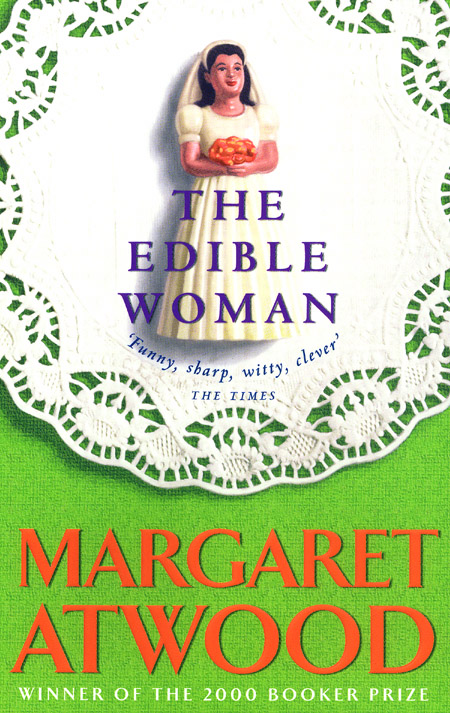
At the end of Margaret Atwood’s fantastically brilliant first novel The Edible Woman (1970), her protagonist Margaret McAlpin bakes a cake. Over the course of the book, Margaret – who has a degree, but works for a market-research company in Toronto, and who has a vague sense of dissatisfaction with the direction in which her life is going – becomes engaged to the eligible Peter. As she realises, slowly, that this engagement and marriage will subsume her identity in his – that she will be consumed by it (and by him) – she begins to lose her appetite: first for meat, and then, slowly, for fish, vegetables, bread, and noodles. By the end of the novel, she can’t eat anything. After a crisis, she breaks off her engagement.

She invites him to tea, to explain her decision, and serves him her cake, which she has made in the shape of a woman:

She went into the kitchen and returned, bearing the platter in front of her, carefully and with reverence, as though she was carrying something sacred in a procession, an icon or the crown on a cushion in a play. She knelt, setting the platter on the coffee-table in front of Peter.

‘You’ve been trying to destroy me, haven’t you,’ she said. ‘You’ve been trying to assimilate me. But I’ve made you a substitute, something you’ll like much better. This is what you really wanted all along, isn’t it? I’ll get you a fork,’ she added somewhat prosaically.

Peter stared from the cake to her face and back again. She wasn’t smiling.

His eyes widened in alarm. Apparently he didn’t find her silly.

When he had gone – and he went quite rapidly, they didn’t have much of a conversation after all, he seemed embarrassed and eager to leave and even refused a cup of tea – she stood looking down at the figure. So Peter hadn’t devoured it after all. As a symbol it had definitely failed. It looked up at her with its silvery eyes, enigmatic, mocking, succulent.

Suddenly she was hungry. Extremely hungry. The cake after all was only a cake. She picked up the platter, carried it to the kitchen table and located a fork. ‘I’ll start with the feet,’ she decided.

Later, her flatmate, Ainsley, reappears:

‘Marian, what have you got there?’ She walked over to see. ‘It’s a woman – a woman made of cake!’ She gave Marian a strange look.

Marian chewed and swallowed. ‘Have some,’ she said, ‘it’s really good. I made it this afternoon.’

Ainsley’s mouth opened and closed, fishlike, as though she was trying to gulp down the full implication of what she saw. ‘Marian!’ she exclaimed at last, with horror. ‘You’re rejecting your femininity!’

Marian looked back at her platter. The woman lay there, still smiling glassily, her legs gone. ‘Nonsense,’ she said. ‘It’s only a cake.’ She plunged her fork into the carcass, neatly severing the body from the head.

Yes. It’s only cake.

Creative Commons License
Tangerine and Cinnamon by Sarah Duff is licensed under a Creative Commons Attribution-ShareAlike 3.0 Unported License.

Foodie Pseudery (25)

The incredible profundity of making chocolate chip cookies:

Have you ever looked deeply into someone’s eyes and melted into their being, feeling as though your two bodies are too cumbersome, too tangible, keeping your essences apart, preventing you from becoming the one inextricable spirit of energy and love and sensuality you were always meant to be? Well, this is exactly how your flour mixture feels as it is slowly stirred into your butter mixture. Pour the flour little by little into the butter, stirring each time. Remember, this love is not a crash or an explosion. It’s a careful melding of beings.

This final moment is when I forget where I am, why I’m here, all the apprehension, all the obstacles, and I can do anything, be anyone: it’s just me and the chocolate chip cookie dough taste-test.