
Thirsty Knowledge
I’ve recently resuscitated my iTunes account, and I’ve been re-acquainting myself with the joys of the podcast. As a mad fan of Internet radio, having the most recent episodes of More or Less, the New York Times Book Review, the Guardian‘s Science Weekly, NPR’s Fresh Air, the Granta Podcast and, obviously, the Food Programme, arriving periodically is a glorious thing.
Relatively recently, I’ve become faintly obsessed with This American Life, and have relied on its extensive archive to keep me sane while writing lectures. I particularly enjoyed two, linked, episodes on Pennsylvania State University. The first, broadcast in December 2009, is an account of why Penn State has consistently been nominated as ‘America’s number one party school,’ and the second, from the end of last year, revisits the university’s reputation for heavy drinking in light of the recent scandal.
As you’d expect of This American Life, both episodes are thoughtful, intelligent accounts of life in State College, PA, where townsfolk have to put up with the antics of drunken students – from stealing traffic signs, to urinating in private gardens – and where the university’s various strategies for dealing with the campus’s drinking culture are impeded by a strong lobby from alumni and other donors.
A lot of what these episodes covered felt familiar. I grew up in a South African university town and now hold a fellowship at that university. The institution is based in the heart of the country’s wine-producing region, so alcohol is cheap and plentiful. As someone with a comically low tolerance of alcohol, I’ve never been a big drinker. I sailed through university as, usually, the only sober person at parties.
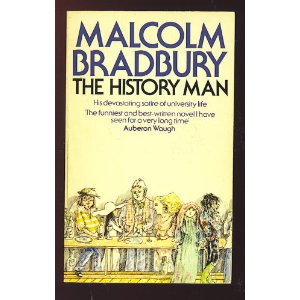
A while ago, I wrote a post about academia and the food at conferences, and one of the themes in the responses I received was that I needed to focus more on the booze. And that’s absolutely true: while we may be – justifiably – concerned about undergraduate binge drinking, there’s a stereotype that academics drink – in the same way that we dress badly, drive banged-up cars, and are chronically forgetful. As Malcolm Bradbury writes in The History Man (1975):
It has often been remarked, by Benita Pream, who services several such departmental meetings, that those in History are distinguished by their high rate of absenteeism, those in English by the amount of wine consumed afterwards, and those in Sociology by their contentiousness.
I think that many would suggest that Benita’s point about the wine could apply to all departmental meetings, regardless of the discipline involved.
Just about every decent campus novel contains at least one scene of drunken, academic embarrassment. Or, indeed, in Kingsley Amis’s Lucky Jim (1954), of success. Jim Dixon spends most of the novel either pursuing the pretty-but-dim Christine in a fairly desultory way, or trying – in post-war, still rationed Britain – to scrape together enough money to buy cigarettes and drink. In the famous, final scene, he gets completely hammered, delivers a speech which should get him fired, but which, instead, gets him both the girl and his dream job.

My two favourite campus novels, The History Man and Michael Chabon’s Wonder Boys (1995) – yes the one that was turned into the surprisingly fun movie – both feature heroes whose academic careers are linked to the – occasionally excessive – consumption of alcohol and various banned substances. Both novels have parties at key turning-points in the narrative. In The History Man the suave socialist sociologist Howard Kirk and his long-suffering wife, Barbara, host parties at the beginning and end of the novel – places where students and lecturers at a red brick, radical university mingle, discussing contraception, Hegel, revolution, and, of course, religion:
No sooner are the first arrivals in the living-room, with drinks, talking breastfeeding, when more guests arrive. The room fills. There are students in quantities; bearded Jesus youths in combat-wear, wet-look plastic, loon-pants, flared jeans, Afghan yak; girls, in caftans and big boots, with plum-coloured mouths. There are young faculty, serious, solemn examiners of matrimony and its radical alternatives…. Howard goes about, a big two-litre bottle hanging on the loop from his finger, the impresario of the event, feeling the buoyant pleasure of having these young people round him…. He poured wine, seeing the bubbles move inside the glass of the bottle in the changing lights of his rooms.
Howard maintains – and gains – his position of power within his department and on his campus by wielding wine at important moments.
The appropriately named Grady Tripp in Wonder Boys uses grass and a range of other drugs – legal and illegal – to cope with the collapse of his marriage, his career, and his reputation as a writer. He holds a position at a small liberal arts university in Pittsburgh, but can’t finish his novel, is having an affair with the Chancellor, and has been (deservedly) deserted by his wife. Over the course of the university’s annual Wordfest weekend, his life falls apart. As in The History Man, parties take place at pivotal moments – one of them in Grady’s house. He returns to discover
writers in the kitchen, making conversation that whip-sawed wildly between comely falsehood and foul-smelling truths, flicking their cigarette ash into the mouths of beer cans. There were half a dozen more of them stretched out on the floor of the television room, arranged in a worshipful manner around a small grocery bag filled with ragweed marijuana, watching Ghidorah take apart Tokyo.
But most academic drinking is done more decorously: over dinner, and after conferences and workshops. Some of the Oxford and Cambridge colleges have legendarily well-stocked cellars. Just about every seminar I attended in London ended with a trip to the pub. There’s even a Radio 4 series called The Philosopher’s Arms, where Matthew Sweet and a collection of philosophers discuss ideas and issues in a real pub:
Welcome to the Philosopher’s Arms, the only boozer in Britain where, if you ask the landlady whether there’s a happy hour, she’ll remind you of the words of John Stuart Mill: ‘Ask yourself whether you are happy, and you’ll cease to be so.’
The appeal of the pub is that it allows for the usually fairly byzantine rules which govern academic life to relax a little. Anxious postgrads get to talk to well-known, senior researchers, gossip is exchanged, and friendships and alliances formed. One very grand historian who used to convene a weekly seminar I attended, was transformed from an incisive and ruthless eviscerator of poorly-constructed arguments, to a jovial old cove as he nursed his half-pint of real ale.

It’s also true that pubs and drinking can be used to exclude those who don’t drink, for whatever reason, or those who don’t feel welcome in pubs or bars. As AS Byatt points out in an interview with the Paris Review, up until the mid-1960s, university departments could prevent their female staff from contributing to important decisions by conducting meetings in pubs, then an almost exclusively male preserve.
But I don’t think that it’s any coincidence that pubs, in particular, feature so strongly in a lot of the mythology surrounding significant moments in academia: in the discovery of the double helix structure of DNA, and in the meetings of the Inklings – the most famous members of which were CS Lewis and JRR Tolkien – at the Eagle and Child in Oxford, for instance. Pubs – and other, similarly festive occasions involving drinking – provide academics with a chance to talk and to think beyond the usual strictures of academia and, in doing so, to arrive at new and surprising ideas.

Tangerine and Cinnamon by Sarah Duff is licensed under a Creative Commons Attribution-ShareAlike 3.0 Unported License.





 Tangerine and Cinnamon
Nov 15
Publish or Perish
The latest edition of the New Statesman includes an article by David Priestland on the state of popular history in Britain. He argues that, increasingly, television series presented by the likes of Andrew Marr as well as popular science, economics, and history books – particularly those written by right-wing historians, most notably Andrew Roberts and Niall Ferguson – are grounded in a Whiggish belief in the inevitably of the triumph of liberalism. (We take the term ‘Whiggish’ from Herbert Butterfield’s The Whig Interpretation of History (1931) which argues against writing history as a glorification of the present, and as a slow, progressive evolution towards parliamentary democracy.) Priestland writes:
There are several problems with understanding history as a relentless march towards liberal perfection, not least because it’s wrong. Historians are interested in accounting for change over time and we recognise that change itself simply happens: it’s neither objectively good, nor bad. This Whiggery attaches a moral value to change, and simplifies its causes:
Priestland lays the blame for the ‘complacent liberalism’ of popular history firmly at historians’ feet. He suggests that because academic historians have largely abandoned the writing of history on a grand scale – the best example of which is Eric Hobsbawm’s series on the history of the modern world – choosing, rather, to specialise in fairly narrow areas of expertise, they ‘have ceded the political high ground.’ Right-wing historians and journalists have stepped into the space left by the guild.
I do have a few reservations about Priestland’s argument (although I do urge you to read the full article, as I’ve oversimplified it a little here). He fails to take into account academic historians’ growing interest in global history, as well as the motivations and aims of the BBC and other organisations which commission public history. (Do they really want academic historians to present television series, when Andrew Marr is guaranteed to draw a crowd?) But I agree with his point that historians should do more to engage with the public.
While historians and academics in the UK, US, and elsewhere are – increasingly – working harder to make those outside of academia aware of their research, this impulse has not really been felt to any great extent in South Africa. It’s certainly true that a few history departments and historians have worked with communities to write local histories – like the University of Johannesburg’s Sophiatown Project – but these are not enough. The School of Advanced Study at the University of London has put all of the papers presented at the Societies of Southern Africa in the Nineteenth and Twentieth Century seminar series, online. But this, also, isn’t enough.
When not suggesting that criticism of President Zuma be made illegal, Blade Nzimande, the Minister of Higher Education, turns his mind to historians and the writing of history. Speaking at the announcement of the SA History Online student internship programme last month, the Minister commented:
I agree that much of South Africa’s past remains to be researched, but the Minister ignores the vast and really brilliant scholarship produced by historians of South Africa since, at least, the 1970s, which focuses precisely on histories of colonisation, segregation, apartheid, shifting attitudes towards race and gender, labour, industrialisation, nationalisms, and anti-government protest.
Later on in the speech, Nzimande does mention the revisionist historians – people like Shula Marks, Stanley Trapido, Belinda Bozzoli, Martin Legassick, and Charles van Onselen – who helped to transform the profession in the 1970s and 1980s. I don’t understand, then, why he seems to believe that historians are producing a kind of conservative interpretation of the past which ignores the experience of the majority of South Africans. They really, really are not.
He does, though, make one important point:
South Africans are astonishingly ignorant about their country’s history – and this includes well educated South Africans too. Earlier this year, Peter Bruce, then editor of Business Day, wrote an unbelievably ill-informed column in which he complained that South African historians had entirely ignored ‘black history’. A couple of weeks ago, the Mail and Guardian published an opinion piece that alleged that South Africa’s ‘past has until recently, been the subject of very few and dominant narratives told from the perspective of the proverbial victors even if theirs was a guise of colonialism and apartheid.’ This just isn’t true. (I’m also not entirely sure what it means.)
This lack of knowledge is partly the fault of our failing education system. Books in South Africa are ruinously expensive. The first volume of the new Cambridge history of South Africa costs £84 – more than R1,000. South Africa also lacks the platforms to allow historians and academics to communicate with the public. There is no South African History & Policy. We have no version of the Guardian – which has created blogs for historians to write about histories of science of technology, for instance. Our disastrous public broadcaster has no equivalent of In Our Time, the incredibly popular Radio 4 series which focusses on the history of ideas.
And academics here – as abroad – are unbelievably busy, over-worked, and very badly paid. But historians should take some of the blame for the fact that even fairly well educated South Africans have such little understanding of the vast scholarship on South African history. I didn’t spot a single angry op-ed by any senior historian attacking Nzimande’s speech in October. (But please tell me if I’m being unfair – who knows what I may have missed.) I – a very junior academic – took Peter Bruce to task, but no one else did.
So why should we care? Firstly, governments construct versions of the past to justify their policies in the present. In order for South Africans to function effectively as citizens, they need to be able to evaluate and criticise the government’s use of the past. As Priestland make the point, if we don’t talk to the public, others – less qualified and with potentially damaging agendas – will.
Secondly, the narratives we create to understand the past influence how we respond to crises in the present. Writing about the unexamined liberal politics of British popular history, Priestland explains:
By far the best analysis of the current crisis in South Africa’s mining industry which I read was the brilliant Keith Breckenridge’s post on History Workshop Online. But where are the articles which unpack Mac Maharaj’s bizarre views on the term ‘compound’? Where are the histories of farm work in the Cape, in the light of the strike now occurring in the fruit and wine industries? Indeed, I’m not the only one who’s calling for this. As my friend and colleague Stephen Sparks notes, Breckenridge has called on policymakers to speak to historians – and a recent workshop at the Wits Institute of Social and Economic Research floated the idea of a South African version of History & Policy.
Finally, as Nzimande admitted in his speech, the South African state does not view the funding of the humanities as a priority. We know that humanities departments are often the first to go when academic funding is cut. As the crisis in our national archives – the memory of the nation – demonstrates, the current government’s interest in history is pretty minimal.
So if you’re wondering when I’m going to mention cupcakes in this post, I’m writing this to point out to my fellow historians that unless we make the case for having a thorough, nuanced understanding of South Africa’s past, no one else will. Writing a blog really isn’t difficult, people. It doesn’t solve anything, but it’s a beginning.
Postscript: Andrew MacDonald’s astonishingly wonderful review of the new Cambridge History of South Africa appeared in this week’s Mail and Guardian. As an overview of the development of the discipline in South Africa, it is unparalleled.
Tangerine and Cinnamon by Sarah Duff is licensed under a Creative Commons Attribution-ShareAlike 3.0 Unported License.