
London Meals
Like many people, I spent this week glued to the news, following the riots in Britain. I have friends who live in the parts of London which witnessed some of the worst violence, and I was stunned how areas of London I know and love – areas which I think of as home – were transformed by the rioting and looting. Even Bloomsbury was not left unscathed: Gay’s the Word in Marchmont Street, one of the most beloved bookstores in London, had its windows smashed, rather undermining claims that the looters tended to leave book shops alone. (And such a pity they missed Alain de Botton’s daft School of Life next door.)

So when I read on Twitter that Broadway Market was a potential target for the rioters, my heart sank. When I moved to London to begin my PhD, I remapped the city according to the destinations I most loved: book shops, art galleries (so that was central London, South Kensington, Pimlico, the south bank, Whitechapel, and Dulwich sorted), and places to eat. I did this because I have a comically bad sense of direction. During a holiday in Ireland a few years ago, my friend Carina realised quickly that the best way of discovering the correct direction to walk in, was to go in the opposite way I suggested. If I turned left, it was almost certainly the case that we should have gone right.
Guided partly by the London Farmers’ Markets website, I came to know London through its markets, delis, and kitchen and food shops. I walked all the way to Notting Hill from Bloomsbury once (map-reading has never been a strength) and, disappointed by that farmers’ market, spent the morning at Books for Cooks and discovered possibly the best culinary invention in the history of humanity at a local deli: glass jars containing crème de marrons and vanilla-flavoured yogurt. When Charles Saatchi (re-)opened his gallery in the Duke of York’s Building, it gave me another reason to visit that part of Sloaney London: Partridges also sells those crème de marrons-and-yogurt concoctions (admittedly for £1.50 each, but with all that yogurt they’re practically health food).

At Broadway Market
If I was feeling uninspired on Saturday mornings, I would walk to the inevitable Borough Market through the eerily silent City, and buy coffee from Monmouth and a bacon roll – easy on the mustard, heavy on the brown sauce – and watch the stall holders set up before the tourist hordes arrived.
But my favourite parts of the city were further east. Broadway Market, near London Fields, trades on a stretch of road which has been used by merchants and travellers for around a thousand years. It’s ancient and at the same time, emblematic of the regeneration of Hackney, London’s poorest borough, but also, arguably, its most socially diverse. On Sundays it was a long walk through Clerkenwell, Old Street, Shoreditch, and Bethnal Green for breakfast at Columbia Road Flower Market – with coffee bought from what must be the city’s smallest coffee shop – a splurge at the second hand bookshop, and an attempt not to knock over any plants (I once caused, accidentally, an avalanche of Christmas trees).
My other guide was sent to me by my mother: the fantastic London Review of Breakfasts. It’s a website which takes breakfast Very Seriously Indeed. Listing cafes, greasy spoons, and restaurants from all over London, it considers not only what these establishments serve and how they go about doing this, but why. What I like about it most – other than its understanding of the psychologically restorative nature of breakfast – is its anti-snobbery. Bermondsey’s Cat and Cucumber is given higher – and deserving – praise for its breakfast, than the branch of Whole Foods in Kensington:
It just doesn’t feel organic in the way I understand it. And frankly neither do any of the 26 varieties of killer tomatoes on sale, particularly the insipid orb that is part of my tepid, refectory-style ‘English Breakfast; on the first floor. The rest of this dry, fatty, Americanised assembly – grey-green scrambled eggs, semi-raw sausage, bacon jerky, white toast (‘no brown available’! In the temple of choice!) – requires five separate squirts of ketchup to render it edible. It is pathetic.

More of Broadway Market
No other collection of reviews is this relentlessly entertaining. My favourite remains of the Euphorium Bakery in Islington:
you started to tremble and had to content yourself with an egg mayonnaise sandwich on thick brown bread. It would have been an eggy, creamy delight, I think, if there had been any filling to delight in. But alas, a mere smear across the bread, a hint of a yolk and a whiff of white was all that was present. We wept. I craved a sympathetic glance from the staff. They were oblivious to our pain and announced that “that was how they made their sandwiches”. How they let themselves down. How they let us down. The pastries so perfect. The sandwiches so disappointing. My fan dropped to the floor, you rose from your chair, nearly careering into one of the many mothers with babies as you hastened to exit.
‘Pierre!’ I shouted, ‘Don’t leave me! I will make you an egg sandwich wearing nothing but a silk negligee whilst I recite passages from Voltaire!’
In short, the London Review of Breakfasts sets a standard not only for eating breakfast, but for living.

It’s particularly fitting that this website devoted to breakfast should be based in London. We know that mass urbanisation at the beginning of the nineteenth century caused changes in people’s behaviour. Quite simply, people lived and behaved differently in cities – where most of them were crammed into tenements and slums – than they did in the countryside. This change was caused overwhelmingly by the fact that the nature of work altered during the 1800s. Cities grew as a result of industrialisation. Factory employees, as well as the office workers who staffed the businesses that serviced these new industrial economies, worked longer and more regular hours than ever before.
In a predominantly agrarian society, work is determined by the weather and is seasonal – hours tend to be longer in summer than in winter, for example. In the factories and offices of Victorian Britain, the clock – and then laws governing how long people were allowed to work – ruled the working day, something Dickens satirised in Hard Times. Work began promptly at around seven or eight o’clock, and continued without stopping until the evening. Gas lamps and, later, electricity, meant that work could go on regardless of when the sun rose or set. Work was decoupled from nature.
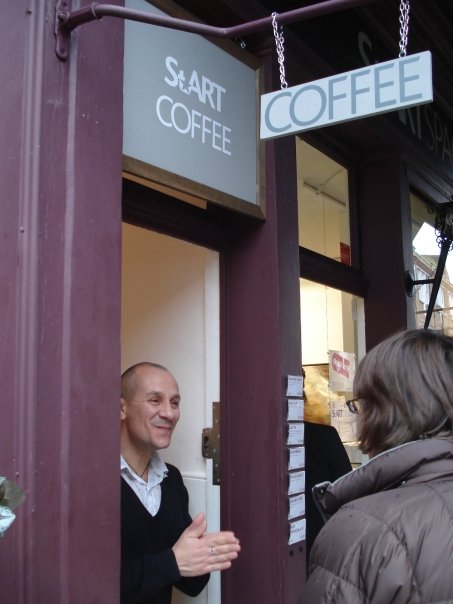
The tiny coffee shop at the Columbia Road Flower Market
One of the first aspects of people’s lives to change as a result of these new working patterns was how they ate. In Britain, up until the early nineteenth century, most people ate a substantial breakfast at around ten or eleven o’clock (what we’d now refer to as brunch), and then dinner, the main meal of the day, in the mid-afternoon. In the evening, before they went to bed, they’d have tea with biscuits or a light snack. Supper was a late, savoury meal eaten by the wealthy, and usually after an evening’s entertainment.
With the coming of industrialisation, mealtimes changed and particularly according to the kind of work people performed. For the urban middle classes, dinner moved later into the day, partly as an indicator of the fact that they were wealthy enough to afford candles, gas, or electricity to light the meal. Luncheon and afternoon tea, served with cake and sandwiches, emerged to fill the long gap between breakfast and dinner. Further down the social scale, tea, served at the end of the working day, frequently replaced dinner. This tea – referred to as ‘high tea’ or ‘meat tea’ – included protein, usually potted meat or smoked fish, to assuage the hunger pangs of tired labourers.
The strange British snobbery around the names of mealtimes emerges from this period: it’s upper- and middle-class to refer to breakfast, lunch, and dinner (or supper), and lower-middle- and working-class to say breakfast, dinner, and tea. Breakfast, though, changed in the same way for workers of all kinds: it was eaten earlier in the
day, but remained fairly substantial.

Flowers at the Columbia Road Flower Market
Our eating habits are still evolving – and they’ll continue doing so, particularly as urbanisation continues. It’s estimated that seventy per cent of the world’s population will live in cities by 2050, and we know that this will have massive implications for how we live: from the way in which we plan our cities, to how we eat. It’s not simply a case that our food systems will have to accommodate the fact that food will have to travel further – or will need to be grown in cities – to feed us all, but our working patterns will change too. What and how we eat cannot be disentangled from where we live.
 Tangerine and Cinnamon by Sarah Duff is licensed under a Creative Commons Attribution-ShareAlike 3.0 Unported License.


 Tangerine and Cinnamon
Nov 20
White Food
Public service announcement: The National Assembly is due to vote on the Protection of State Information Bill on Tuesday, 22 November. Please wear black to show your opposition to the Bill, and join the Right2Know Campaign’s protests against this Draconian piece of legislation. (If you’d like to know more about the Secrecy Bill, check out this post I wrote for FeministsSA.)
One of my favourite places in London is Exmouth Market. It was about a five-minute walk from my amazing hall of residence in Bloomsbury, and its street food – some of the best in the UK, apparently – made a pleasingly delicious lunch from time to time. Its book shop, Clerkenwell Tales, is also excellent.
I think, though, that Exmouth Market is best known as the sometime home of Brindisa, the Spanish delicatessen which is also based in Borough Market, and Moro, the restaurant which more-or-less introduced the cooking of Spain, North Africa, and the eastern Mediterranean to Britain. Having cooked from the first Moro recipe book, and having read a great deal about its founders, Sam and Sam Clark, I was curious about the restaurant itself, but I never went further than a detailed perusal of its menu: the place was simply far too pricey for my student budget.
Like so many of the young chefs who led the revolution in Britain’s eating habits during the 1990s and early 2000s, and this includes Jamie Oliver and Hugh Fearnley-Whittingstall, the Clarks had worked at the River Cafe. Founded by Ruth Rogers and Rose Gray, the restaurant was never intended to be more than a canteen for Rogers Stirk Harbour + Partners, the famous architectural firm run by Ruth’s husband, Richard Rogers. But it evolved into something more: into the first restaurant in Britain to emphasise the heavily regionalised and seasonal nature of Italian cuisine. The River Cafe imported Ligurian olive oil, cavolo nero, and Pecorino Romano to replicate the cooking of Italy in London.
It could be terribly precious and seemed to confuse eating ‘authentic’ Italian cuisine with some kind of food-based morality. The River Cafe recipe books exuded the restaurant’s self-righteousness, as Julian Barnes explains:
As many pointed out, the food served by the River Cafe, Moro, and others, is, essentially, peasant food. There is something deeply – and amusingly – ironic about the lefty middle classes (and the River Cafe had a deserved association with the rise of New Labour) paying through the nose to eat bread and cabbage soup, a range of cheap cuts of meat, and polenta.
Polenta is a staple of northern Italy and for all its association with the sophisticated eating of the 1990s, it’s really only cornmeal – or maize– or mielie meal, as we’d call it in South Africa. Partly because of the endless variety of the maize plant, cornmeal comes in both yellow and white and can be ground as finely or as coarsely as tastes demand. In fact, the difference between the yellow, medium-ground cornmeal used to produce polenta or the finer-textured yellow flour for cornbread from the American south, and the fine, white cornmeal favoured for mielie pap in South Africa is minimal.
People’s preferences for yellow or white cornmeal are, then, culturally determined. A recent article published by the magnificent Mail and Guardian explores South Africa’s taste for whiter, finer maize meal:
South Africa’s best-selling brand of maize meal is White Star, produced by Pioneer Foods. White Star is whiter and finer than other brands. Premier Foods and Tiger Brands, the country’s other two big producers of maize meal, have also invested in technology which produces this whiter maize meal.
Removing the germ from the maize meal means that it tastes blander and has a longer shelf life (the germ contains oil which goes off quickly). It also means that the meal is considerably less nutritious – even though South African millers do fortify maize meal and wheat flour with vitamins A, B1, B2, and B6, as well as niacin, folic acid, iron, and zinc. And what happens to the discarded germ? It goes into cattle feed, rendering animal feed more nutritious than human food.
This demand for white food is neither particular to South Africa – there is a similar trend in Mexico, for instance – nor is it a recent phenomenon. Historically, food that is white – white bread, white sugar, white rice, or white maize meal – is more expensive to produce because it needs to be processed in order to rid it of those impurities or elements which cause it to be darker in colour. white food is associated with wealth and luxury.
The coming of industrialised food production caused an increase in the scale of the adulteration of food to make it go further or seem more appealing. As a result of this, whiteness was associated increasingly with purity. Ironically, though, food producers used poisonous additives like caustic lime to make bread and other products whiter.
The production of food in factories also reduced its price, and this was particularly noticeable for highly processed products like white sugar and white flour. Now produced on a mass scale, even the very poor could afford to drink white sugar in their tea. Indeed, white bread and sugar came to be seen as ‘affordable luxuries’ from the end of the nineteenth century and into the twentieth. These were comforting, ‘special’ items which could make an already meagre diet seem more luxurious. George Orwell wrote in The Road to Wigan Pier (1937):
In the same way, in the midst of rising food prices and a stagnating job market, South Africa’s poor buy white, fine maize meal.
However, there does seem to be a surprising shift in bread sales, as lower-income consumers appear to be buying more brown bread – as opposed to the white bread they usually favour. This, though, is probably due to the fact that brown bread costs less because it’s exempted from value-added tax. This is a change caused by necessity rather than a new set of ideas around white or brown bread.
As Orwell makes the point, it’s the association of comfort with particular kinds of food which renders them more attractive – even if a diet rich in white sugar and white bread is not at all healthy. A combination of education, affluence, and a new set of values which associate unprocessed, ‘whole’ food – wholegrain bread, whole wheat flour, brown or wild rice, and sticky brown sugar – cause the middle classes to favour products which are overwhelmingly more nutritious.
It is infinitely strange that former peasant food – like polenta – should be sold at a premium to the middle classes at restaurants, while those who are poor prefer white maize because of an association with luxury and wealth. If we are to encourage more people to eat better, it’s clear that we need to lower the prices of ‘whole’ foods. But changing people’s buying habits is related more to a set of cultural assumptions about whiteness than to cost or even knowledge about their nutritional value.
Further Reading
Sources cited here:
Julian Barnes, The Pedant in the Kitchen (London: Atlantic, 2003).
Warren Belasco, Meals to Come: A History of the Future of Food (Berkeley: University of California Press, 2006).
Sidney W. Mintz, Sweetness and Power: The Place of Sugar in Modern History (New York: Penguin, 1985).
George Orwell, The Road to Wigan Pier (London: Gollancz, 1937).
Lorine Swainston Goodwin, The Pure Food, Drink, and Drug Crusadors, 1879-1914 (Jefferson: McFarland & Co., 1999).
Other sources:
Joyce Appleby, The Relentless Revolution: A History of Capitalism (New York: WW Norton, [2010] 2011).
Warren Belasco and Philip Scranton (eds.), Food Nations: Selling Taste in Consumer Societies (New York: Routledge, 2002).
Jack Goody, ‘Industrial Food: Towards the Development of a World Cuisine,’ in Cooking, Cuisine, and Class: A Study in Comparative Sociology (Cambridge: Cambridge University Press, 1982), pp. 154-174.
Harvey A. Levenstein, ‘The Rise of the Giant Food Processors,’ Revolution at the Table: The Transformation of the American Diet (New York: Oxford University Press, 1988), pp. 30-87.
Anne EC McCants, ‘Poor consumers as global consumers: The Diffusion of Tea and Coffee Drinking in the Eighteenth Century,’ Economic History Review, vol. 61 (2008), pp. 172-200.
Sidney W. Mintz, ‘Sweet, Salt, and the Language of Love,’ MLN, vol. 106, no. 4, French Issue: Cultural Representations of Food (Sep., 1991), pp. 852-860.
Sidney W. Mintz, Tasting Food, Tasting Freedom (Boston: Beacon Press, 1996).
James Walvin, Fruits of Empire: Exotic Produce and British Taste, 1660-1800 (Basingstoke and London: Macmillan, 1997).