
National Kitchens
It was my birthday a couple of weeks ago and my parents gave me a copy of the new revised English edition of that Bible of Afrikaans cooking, Cook and Enjoy. It’s testimony to the ubiquity of the book that I find myself referring to it by its Afrikaans title Kook en Geniet, rather than its English name.
Kook en Geniet is the Afrikaans Mrs Beeton’s Book of Household Management. Published as a guide to housekeeping and cooking for young brides in 1951 by Ina de Villiers, a Stellenbosch-based home economist, it has never been out of print. There are very few Afrikaans households which do not possess at least one copy of the book – and, like Mrs Beeton, its success lies partly in the fact that it is regularly updated.
De Villiers herself was responsible for testing and re-testing recipes, and for producing new editions of Kook en Geniet. Her long-standing association with the book helped Kook en Geniet to gain its reputation for being a fail-proof authority on Afrikaans cooking. Since her death in 2010, her daughter, Eunice van der Berg, who also happens to be a home economist, has taken over responsibility for it.
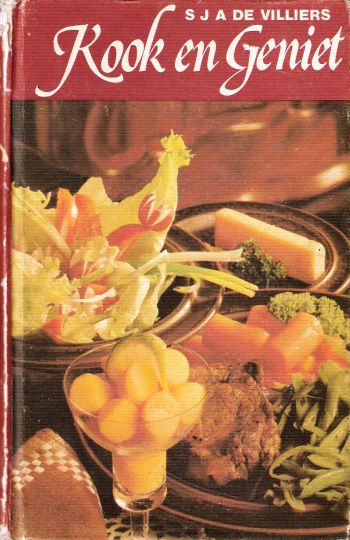
There is no single version of Kook en Geniet. Each edition retains a core of essential recipes, but methods and ingredients change as new products appear. Dishes are added and, less frequently, subtracted as culinary fashions evolve. De Villiers wrote in the preface to the 1992 edition:
As the microwave oven and food processor have become nearly indispensable in many kitchens today, their use is indicated in a number of recipes. However, experienced cooks will be able to use these timesavers for almost any recipe – it is left to their discretion.
My edition contains recipes for moussaka and lasagne. But it’s not for these that I use Kook en Geniet: it’s for staples of Afrikaans cuisine, like buttermilk rusks, Hertzoggies, quince chutney, vinegar pudding, and prickly pear jam. It’s a supremely practical recipe book. Helping out at the pancake stall which seems to accompany every major event – from agricultural shows to local government elections – in small town life? There’s a recipe to make enough batter for a hundred pancakes. Need to make bobotie for fifty at the church fete? Serving sosaties to eighty people at a barbeque? Kook en Geniet will come to the rescue with sensible, authoritative advice.
For anthropologists and historians interested in food, the value of Kook en Geniet lies in the fact that it changed as tastes evolved. It does not present readers with a static, inflexible view of ‘Afrikaner cuisine’. It acknowledges – tacitly – that cooking alters over time.
It’s not, though, the only source on what I’ve called Afrikaans or Afrikaner cuisine – more frequently referred to as boerekos, which translates literally as ‘farmers’ food’, but signifies considerably more than that. Boerekos is the homely, comfort cooking associated particularly with rural Afrikaans living. A wildly popular new series on the Afrikaans cable channel Kyknet, titled simply Boerekos, interviews a collection of Afrikaans women cooking their favourite, old-fashioned boerekos, from mosbolletjies to pie.
Programmes like this one, as well as other books on boerekos, seek to frame it as an unchanging cuisine: as a form of cooking which has remained reassuringly the same during a century of tumultuous change. For Afrikaner nationalists before and during apartheid, food was a useful way of forging a new, unified and distinct Afrikaner identity. As they codified and regularised Afrikaans, so they sought to create a unique Afrikaner cuisine.
C. Louis Leipoldt, culture broker, poet, journalist, doctor, Buddhist, and eugenicist, filled several journals with recipes he collected from friends, acquaintances, and people whom he came across while working during the 1920s and 1930s. (These are now held by the National Library in Cape Town.) He wrote about these recipes and rural cooking for Die Huisgenoot, a popular magazine with a distinct enthusiasm for nationalism, between 1942 and 1947. In 1933, at the height of the Afrikaner nationalist revival, he published Kos vie die Kenner (Food for the Expert), a collection of a more than a thousand recipes. Polfyntjies vir die Proe, Three Hundred Years of Cape Wine, and Leipoldt’s Cape Cookery appeared posthumously.
One of the ironies of boerekos is that so much of it is derived from the cooking of the slaves who were transported to the Cape from southeast Asia during the seventeenth, eighteenth, and early nineteenth centuries. The sambals, atchars, and chutneys of Afrikaner cooking are a particularly obvious debt to the food traditions imported to South Africa from present-day Indonesia and Malaysia.
Although Leipoldt, an unusually thoughtful nationalist, acknowledge that many of the recipes he found were cooked and invented by ‘Malay’ women – a term which he used to describe the largely Muslim and Afrikaans-speaking descendants of slaves who lived in the Cape –their presence gradually disappeared in other, later boerekos recipe books.
There is no neat boundary between Afrikaner cuisine and what most South Africans dub ‘Cape Malay’ cooking: there are recipes for bredie (mutton stew), bobotie, and sosaties (kebabs) in both boerekos and Malay recipe books. But in order to use food to construct distinct, discrete national or group identities, the differences between these two cuisines had to be emphasised over their similarities.
Nationalisms have long co-opted food and cooking to construct national identities. Leipoldt’s recipe books are the first in an extensive literature which seeks – both overtly and inadvertently – to construct an Afrikaner cuisine. It’s telling that the Afrikaanse Taal en Kultuur Vereeniging (Afrikaans Language and Culture Organisation), once strongly allied to the National Party but now a society which works towards the promotion of Afrikaans as a language, bestowed Ina de Villiers with its Afrikoon prize in 2010 for furthering the cause of Afrikaans.
But minority groups use food and recipes in similar ways – to construct, maintain, and assert identities, often in the face of discrimination and social and political marginalisation. Cass Abrahams as well as other Cape-based women have created a rich literature on ‘Cape Malay’ cooking, often basing their writing on recipes collected from, and donated by, local women. These are as much social histories as they are cookery books.

Similarly, one of my favourite South African recipe books, Indian Delights, was compiled by a community organisation, the Women’s Culture Group in Durban. First published in 1961, the book has been revised several times. My mother’s copy – which I covet – is the 1982 ‘Enlarged Super Edition.’ As the editor, Zuleikha Mayat, writes in the introduction, the recipes were
mostly passed on to me by persons ranging from ordinary housewives to the super cooks who abound in our community. This is why Indian Delights remains – as it has always been – a representation of the collective culinary knowledge of our Community.
The book is as much an assertion of a distinct form of South African Indian cooking as it is a record of how a group of women cooked for their families in Natal during the second half of the twentieth century. But it is also an attempt to preserve a culinary tradition at risk of being forgotten as family life changed:
Twenty years ago when Indian Delights was first published, I had stated that the cookery book as such was something foreign to Indian women; that each dish was taught down the generations till daughters became as proficient as their mothers; but that the need of a reliable cookery book was beginning to be felt since daughters were spending more time with studies and acquiring careers.
As a result of this ‘a good reliable cookery book has become essential’.
It’s partly because of this extensive collection of recipe books – from Indian Delights to Kook en Geniet – that it’s particularly obvious that there is no, single homogenous South African cuisine. One of the best collections of South African recipes, African Salad demonstrates this particularly well: it’s a series of photographs and short interviews with of a more-or-less random selection of South Africans on their favourite meals. The recipes are as varied as the interviewees.

I’ve been struck while watching the South African version of the MasterChef franchise by the absence of references to the African cuisines of South Africa. During one episode in which the contestants were required to barbeque, one (black) Twitter user commented jokingly that the black contestants would struggle because they would prefer over- rather than underdone meat.
So far the dominant cuisine (the meta-cuisine?) of the show has been broadly western. It is this which is most closely associated with ‘fine dining’ (hateful phrase). Indeed, I was annoyed when a black contestant was criticised for cooking a steak too well: a liking for pink, lightly cooked meat is both a relatively recent phenomenon and culturally specific. Why should someone be penalised if she has cooked meat according to the dictates of another cuisine?
A couple of contestants have cooked African dishes and I’ve watched those with the most curiosity: as a white South African raised in the Western Cape, I feel that I have a fairly good grasp of Afrikaans and Malay cooking, but African cuisine still eludes me. I know of certain dishes and have seen sheep heads and walkie talkies (chicken heads and feet) being sold, but this is as far as my knowledge goes.
I know that there probably isn’t a single ‘African cuisine’ or African culinary tradition in South Africa – that it must differ between regions and has changed over time. There are, to my knowledge, no substantial recipe books dedicated to this country’s African cuisines – although do please feel free to enlighten me if there are.
With the current wave of enthusiasm for local producers, it’s striking that the various markets which have sprung up around South Africa have tended to model themselves on a foreign – mainly European – model. They are Borough Markets in miniature. These new ingredients – these cheeses, sausages, and free-range duck and chicken – are sold to be used in cassoulet, poule au pot, and arrosto di maiale al latte. We use local products for overseas cuisines.
I’m not some mad nationalist loon who advocates that we only eat local cuisines, but as South African society changes during the early twenty-first century – as urbanisation increases and as our middle class expands – we are, as in the case of any rapidly evolving society, in danger of losing a lot of culinary knowledge. This is a pity: not only do food and cooking provide useful ways of understanding how societies function, but it also strikes me as deeply strange that the white, middle-class customers of the Neighbourgoods Market in Cape Town know more about the cooking of northern Italy than they do of the Eastern Cape. Or Langa, which is right next door.

Tangerine and Cinnamon by Sarah Duff is licensed under a Creative Commons Attribution-ShareAlike 3.0 Unported License.


 Tangerine and Cinnamon
Apr 21
The Cult of Authenticity
Last weekend I went to a wedding in Napier, a village in the rural Overberg, about a two-hour drive from Cape Town. I saw a family of baboons sunbathing on the Akkedisberg mountain pass; went to a church bazaar and bought jam; and saw a shop (alas closed at the time) which sold ‘piesangs, psalmboeke en dinamiet’ (bananas, prayer books, and dynamite).
It was a very good weekend indeed. And made even better by the quantities of excellent food which I ate. I was struck, though, by the numbers of restaurants in Napier which advertised their menus as being particularly ‘authentic’. Napier is experiencing a kind of low-key gentrification at the moment, so this isn’t really all that surprising. But it was amusing how the idea of what is authentic was stretched beyond all recognition.
I had lunch at a place which specialises in ‘authentic tapas’ and was advised to order two items, as tapas are, well, small plates. I doubt that the vat of curried sweet potato soup and mound of salad, which included the best part of a head of butter lettuce and two avocados, I was served bore even the remotest resemblance to the tapas of Barcelona. But they were delicious.
I was wondering why, though, a café in a remote South African village would stake so much on serving authentic tapas. There is, I suppose, a kind of thrill in eating exotic, ‘real’ tapas. Even so, most of its clientele are unlikely to have sampled the real thing or, even, to care about the authenticity of their supper. (I don’t mean this in a patronising way. Travel abroad is expensive.)
This is part of a wider cultural trend, where people who describe themselves as ‘serious’ about food (I’m not entirely sure what that means) claim to be able to distinguish between those dishes which are really authentic – which are absolutely true replicas of the ‘original’ dish – and those which have been adulterated through adaptation.
For instance, Cape Town’s best Mexican restaurant El Burro advertises itself as ‘authentic’ Mexican cuisine, and local reviewers go out of their way to emphasise just how authentic its menu is: here is no inauthentic Tex- or Cal-Mex cooking, but, instead it is the Real Thing. (How many of them have actually visited Mexico is open to debate.)
There is, really, no such thing as ‘authentic’ Mexican – or Italian, or Spanish, or Greek, or Indian, or Thai, or Norwegian – cuisine. These, and other countries, have a range of cuisines, which differ from region to region, and which have also changed over time. As Jeffrey Pilcher argues in his recent book Planet Taco: A Global History of Mexican Food, it is more accurate to refer to a number of Mexican cuisines which exist simultaneously both within and without the borders of the country.
The problem with trying to identify ‘authentic’ cuisine is that it’s rather like trying to nail jelly to the wall. The same dish will vary from area to area – from household to household – in one country. I have seen recipes for ‘authentic’ risotto which assert, with equal vehemence, that it should be so thick that you can stand a spoon in it or, equally, that it should be liquid and flowing. My mother’s recipe for bobotie – a South African delicacy – contains grated apple. My friend Carina’s mother’s recipe has no apple, but, rather, raisins. Which is the authentic version? Both. Neither.
Food changes over time. In the early twentieth century, the medical doctor, poet, Afrikaner nationalist, and Buddhist C. Louis Leipoldt recorded a recipe for bobotie which, in today’s terms, would be understood as a meatloaf: it was not the dish that, today, we think of as being bobotie – a layer of spiced, slightly sweet minced meat underneath a buttermilk and egg custard. Although according to the European Union, authentic Cornish pasties may contain only beef, swede, and potatoes, there is plenty of evidence to suggest that Cornish miners in the past had a range of ingredients in their pies – and not only this holy pasty trinity.
There is also the problem of anachronism. Mexico became an independent state in 1810 and its borders changed over the course of the nineteenth century. Should only those dishes which were made within the country’s present boundaries be considered ‘Mexican’? The state of Texas remained part of Mexico until 1836, and significant numbers of Mexicans settled in the United States – particularly in New Mexico, California, and Arizona. Should we consider Texan cuisine to be Mexican? And, surely, it would be churlish somehow to consider the cuisine developed by Mexicans in the United States as somehow being of less value than that prepared by Mexicans in Mexico (whatever we may mean by ‘Mexico’)?
So which version do we accept as being the ‘real’ version of a dish? Which one is ‘authentic’? More often than not, a range of factors not particularly linked to food influence our decisions over what is considered to be properly authentic. There is a connection, for instance, between nationalism and cookery books. During the nineteenth century, middle-class Mexicans living in the United States used food both to maintain links with Mexico, as well as to assert the sophistication of Mexican culture. Encarnación Pinado’s El cocinero español (The Spanish Chef), published in 1898, described a Mexican cuisine made using modern technology, and incorporating dishes from Mexico, European, and the Mexican-American borderlands.
Something similar happened in Italy, as Tim Hayward explains:
In fact, a lot of what we consider to be ‘real’ Italian food today, was created in a dialogue between Italian immigrants in the United States and Italians at home. Even relatively poor immigrants could afford the tomatoes, dried pasta, olive oil, meat, and dairy products which constituted the feast dishes of the homeland. This invented ‘traditional’ cuisine was used to construct and delineate new immigrant Italian identities. Overseas demand for the products of ‘home’ stimulated the Italian food industry – and the mass production of tinned tomatoes and other products made them more easily available in Italy. This American connection of Italian identity with a particular kind of Italian cooking was also exported back to Italy.
Authentic cuisines are, then, heavily constructed. There is no direct, unmediated way of accessing the food of the past. Indeed, it is also pretty difficult to replicate the cooking of foreign countries at home. Rachel Laudan notes that if she were to write a cookbook on ‘authentic’ Mexican cooking, she would have to take into account the difficulty of finding many ingredients outside of Mexico:
Also, she argues that she would be constrained by middle-class Americans’ own ideas around what should constitute Mexican cuisine. The cult of authenticity is informed not only by snobbery (being able to identify and cook the ‘real thing’ is a marker of sophistication), but also by a powerful nostalgia for a pre-industrialised food past where all cooking was done from scratch:
This is a nostalgia produced by anxieties around change and a perceived homogenisation of the world’s diets. It is partly as a result of this concern that old ways of cooking and eating are being ‘lost’ that the EU introduced a protected geographical status framework in 1993, which provides legal protection to certain dishes and products in the EU, preventing them from being copied elsewhere. So only sparkling wine produced in Champagne can be called ‘champagne’, and only Prosciuitto Toscano made in Tuscany can be called Prociutto Tascano.
For all that this is an attempt to preserve a food heritage, as the philosopher Julian Baggini makes the point, the EU actually decides what is authentic and what is not:
Similarly, UNESCO’s recognition of Mexican cuisine, the French ‘gourmet meal’, the Mediterranean diet, and the gingerbread craft of Northern Croatia as the ‘intangible patrimony of humanity’ in 2010, fixed these culinary traditions in aspic. Also, the Mexican application focussed on only one regional cuisine, the ‘Michoacán paradigm,’ which, interestingly, happened to feature the home state of the President, Felipe Calderón…
This recognition from UNESCO will boost the region’s tourism, and EU appellations have helped many small producers in Europe to continue to work in difficult economic times. The mania for ‘authenticity’ helps, inadvertently, to force our attention to how people cooked and ate in the past – to look at methods, ingredients, and cultivars which we may have forgotten. We shouldn’t try to return to the past, but we can certainly learn from it.
My problem with the cult of authenticity – other than its tedious pedantry – is that it conflates eating ‘authentically’ with some ability to make a meaningful difference in the world. More often that not, peasant food is labelled authentic food. Even the most passing familiarity with what most poor people eat will demonstrate that people’s diets improve as their disposable income increases. Peasant food in Italy before the mid-twentieth century was nutritionally inadequate: it consisted of bread and polenta with onions oil and, occasionally, cheap fish and vegetables.
There is nothing wrong with eating peasant food, but it is deeply problematic to believe that eating ‘real’ peasant food represents a solidarity with the struggles of the poor. In fact, it’s a distraction from the ways in which food and big agricultural companies exploit labourers and put small and peasant farmers out of business.
Food is political. Particularly if it’s ‘authentic.’
Tangerine and Cinnamon by Sarah Duff is licensed under a Creative Commons Attribution-ShareAlike 3.0 Unported License.