Skip to content

Posts tagged ‘Britain’

Food Links, 16.05.2012

How to control global food commodity trading.

A spike in food prices is predicted for 2013.

Egypt’s kitchen uprising. (Thanks, Stephanie!)

How Mexican food became American. (Thanks, Hester!)

How poor women in rural India cope with food shortages.

Coke and Pepsi change their recipes – to avoid a cancer warning.

The dark side of soya.

What the world eats.

An entirely edible recipe book.

The vogue for squirrel meat and other forms of game. (Thanks, Milli!)

Why going to dinner with a foodie is an ordeal.

Edible silk sensors to monitor your food.

A pasta-naming game.

Sketch gets a makeover from Martin Creed.

The British government must not undermine efforts to stop the exploitation of agricultural workers.

How the conditions in which pigs are kept in the United States may be improving.

Heston Blumenthal explains the revamp of the Fat Duck.

In South Africa, bottled water is more expensive than petrol – so why its popularity?

The Middle Class Handbook on Sunday night supper.

The eight kinds of drunkenness, by Thomas Nashe.

Vodka made out of quinoa.

Should one rinse mushrooms?

A strange new phenomenon in the Middle East: children who are malnourished and obese.

How well does the language of wine tasting describe wine?

Why Big Food must go.

Five grains which could help to feed the world.

Baked beans in Maine.

Is ice cream as addictive as cocaine?

Meat theft is on the rise in the United States.

The return of the pressure cooker. (Thanks, Mum!)

What it looks like to eat on a dollar a day.

The politics of cinema snacks.

Mitt Romney’s diet.

Dictator cakes for Amnesty International.

Olivier de Schutter recommends five ways to fix unhealthy diets.

How to make your own pita bread.

Not your grandmother’s yogurt.

Aliens secretly study humanity under the guise of a 1960s sandwich recipe book.

Osman’s shanty bar, Istanbul.

Why we have sliced bread.

Know your pasta shapes.

A new documentary about Detroit’s urban farms.

Fancy dress as a side of bacon. From 1894.

How to make a chocolate model of your brain.

Square Meals

The best television chef ever is Adam on Northern Exposure (surely the greatest series ever made). Dirty, self-centred, arrogant, appallingly rude, yet phenomenally talented – he once turned down a job at the legendary Tour d’Argent – Adam appears periodically, often accompanied by his neurotic, hypochondriac, and equally selfish wife, Eve, cooks incredible food, and then vanishes.

Adam is the anti-foodie. His enthusiasm for cooking isn’t borne out of snobbery or a desire to demonstrate either his sophistication or moral superiority, but, rather, out of a liking for food and eating. And possibly a hatred for the people for whom he cooks.

He is a world away from the TV chef-celebrities who populate cooking-driven channels like the Food Network. Indeed, when Northern Exposure aired between 1990 and 1995, the idea that a single TV channel could be devoted entirely to food was relatively new. In the US, the Food Network launched in 1993, and the now-defunct Carlton Food Network – for which, incidentally, a young David Cameron did PR – aired for the first time three years later in the UK.

Now, food is everywhere on television, and food programmes have evolved from their most basic format – a chef cooking in a kitchen – to embrace travel and reality programmes. There’s been a lot of fuss about the launch of the most recent incarnation of the unbelievably successful MasterChef franchise in South Africa. In fact, the evolution of MasterChef says a great deal about how food on television has changed over the past few decades.

The original MasterChef series aired in the UK between 1990 and 1999 and was presented by pasta sauce entrepreneur and mid-Atlantic accent promoter, Loyd Grossman. It was all very serious and restrained and most of the contestants were terribly tense ladies from the Home Counties who replicated the nouvelle cuisine they had eaten at Le Gavroche, with varying degrees of success and anxiety.

It was revamped in 2005. With two shouty judges and considerably more socially representative participants, its popularity demonstrating the shifting significance of food within middle-class Britain. The new series’s focus on training contestants to be good, highly skilled chefs is meant to produce people who could, conceivably, run their own restaurants – which, to the credit of MasterChef, winners like Thomasina Miers and Mat Follas have done successfully.

The Australian, American, and South African versions of MasterChef have increased the emphasis on teaching would-be chefs how to work in professional kitchens. Of course, people watch these series for the same reasons that they tune into The Amazing Race, Strictly Come Dancing, and Project Runway. But MasterChef has the added appeal that it aims to teach its audience about cooking: the master classes offered by its presenters are aimed as much at those watching the series as at the contestants.

In fact, the earliest and most enduring TV cookery shows were intended primarily to educate, rather than only entertain, audiences. Dione Lucas – who claimed, incorrectly, to be the first woman graduate of the Cordon Bleu Cookery Institute in Paris – taught classical French cooking to the affluent American middle classes during the 1950s. Julia Child, an altogether warmer and more appealing presenter, did the same in her long-running series. Their aim was to teach Americans how to cook properly – and during the 1950s and 1960s, ‘proper’ food was French food.

Even Fanny Cradock, despite her increasingly ridiculous television appearances towards the end of her career, cooked a version of French cuisine which was meant to be affordable and accessible to her audience. Delia Smith’s first series, Family Fayre, in the mid-1970s was intended to teach its audience how to cook. Her success – built partly on the fact that her impeccably-tested recipes always do work – owed a great deal to her ability to teach and to de-mystify processes which may at first seem difficult and complicated.

Many of the cookery shows of the 1980s and early 1990s were made by the BBC’s Continuing Education Department: Madhur Jaffrey and Ken Hom, among others, owe their early success to the Beeb’s efforts to educate audiences. It was only with the coming of Graham Kerr – the ‘Galloping Gourmet’ – and, more successfully, Keith Floyd, that cookery programmes began to shift their emphasis from education to entertainment.

I’ve never really understood Floyd’s appeal, as Paul Levy writes:

Keith Floyd was a television cook who enjoyed and profited from a large audience despite having no outstanding talent, either as a cook or as a TV presenter, no great knowledge of his subject, or any apparent passion for anything but drink.

But he could be amusing – and more so than most of the considerably more serious presenters of food programmes in Britain. In many ways, the entertainment- and lifestyle-driven series presented by Nigella Lawson, Ainsley Harriott, Sophie Dahl and others are part of Floyd’s unwitting legacy.

I’m more interested in the way that presenters of food programmes have linked their teaching to wider, social projects. In post-revolution Cuba, cookbook writer Nitza Villapol used her long-running television series to teach Cubans a cuisine which was at once ‘authentically’ Cuban but also compatible with the country’s system of food rationing. During the Special Period, she provided recipes and advice for making limited supplies go further. She is still – regardless of her association with the period – seen as the pre-eminent expert on Cuban cooking.

In Egypt, Ghalia Mahmoud has recently emerged as a popular TV chef on the 25 January cable channel. From a working-class background, Mahmoud teaches audiences ‘traditional Egyptian food, such as mahshi (stuffed vine leaves), bisara and keshk, simple fava-bean and buttermilk-based stews.’ Not only do her recipes respect the differing dietary requirements of Egypt’s range of religious groups, but she cooks with an awareness that many members of her audience have limited resources. This is patriotic cuisine for a new Egypt: one which demonstrates how to feed a family on only 250g of meat a week.

It’s particularly telling that the TV chefs of the final years of the Mubarak regime were, as Mahmoud says, ‘bigger than movie stars and spoke English and French.’ The most popular cookery teachers on television – and this includes Ina Paarman in South Africa – have been lower- to middle-class women. It’s a common observation – even complaint – that while the majority of people who cook family meals are women, the best-known and most feted cooks are all male. This isn’t entirely true. Arguably, the most influential cooks of the late twentieth and early twenty-first centuries – those who actually teach their audiences how to prepare food – are women.

Creative Commons License Tangerine and Cinnamon by Sarah Duff is licensed under a Creative Commons Attribution-ShareAlike 3.0 Unported License.

Justice, not Philanthropy

This week José Graziano da Silva, the Director General of the UN’s Food and Agriculture Organisation, announced that the famine in Somalia has ended. A combination of good rain, the most successful harvest in seventeen years, and the effective dispersal and deployment of food and agricultural aid means that most Somalis now have adequate access to food. But this is likely to be a temporary reprieve: it’s uncertain if food stocks will last until April, when the next rainy season begins and the main planting is done.

This already fragile situation is compounded by Somalia’s complicated politics: the southern part of the country is still controlled by the Islamist group al-Shabaab, which banned the Red Cross from operating in the area this week, and has disrupted food supplies in the past. Tellingly, around half of the 2.34 million people still in need of humanitarian assistance and seventy per cent of the country’s acutely malnourished children are in southern Somalia.

The end of the famine is no cause for celebration, then. Thirty-one per cent of the Somali population remains reliant on food aid, famine looms in another three months, and there are the after-effects of the famine to cope with: the plight of the refugees scattered around Somalia, Ethiopia, and Kenya; and the generation of malnourished children.

It’s estimated that between 50,000 and 100,000 people died in this famine, half of them children.

Clearly, something isn’t working.

And as one famine comes to an end – or, at least, a halt – in East Africa, another one seems to be developing on the other side of the continent. Niger, and, indeed, its neighbours Chad and Mali, is both drought- and famine-prone. Even in good years, it struggles to feed itself. Fifteen per cent of the world’s malnourished children live in Niger. But poor rainfall at the end of 2011 and a spike in global food prices means that the country’s population faces famine.

Niger’s last famine was in 2010, when the World Food Programme provided food to 4.5 million people. But things seem to be more hopeful there than in Somalia, and largely because Niger has a government which functions relatively well. Realising that it needs to store its food supply properly, provide jobs so that its population can afford to buy food, and also limit the growth of its population, the government of Niger is introducing measures to improve people’s access to food. One new piece of legislation will make it compulsory for children to remain in school until the age of sixteen, partly because of the strong link between girls’ education and declining family size.

Somalia’s weak and ineffectual government can’t do anything to prevent famine from occurring there again. With all the will in the world, there is no way that Somalia’s food crisis will end until its political situation stabilises.

The comparison of Niger and Somalia is particularly useful for demonstrating the extent to which responses to famine – from the media, NGOs, charities, and other international organisations – are heavily politicised. Reporting on the Niger famine in 2010 was fairly muted and I’ve only seen a couple of references to its most recent food crisis. Somalia, though, never seems to be out of the news. The reason for this is depressingly simple:

Niger, the large West African country whose name is best known for being just one unfortunate letter away from a pejorative racial insult, has a few terrorists, but not enough to really matter. Elements from al Qaeda in the Islamic Maghreb wander across Niger’s border every now and then, taking advantage of the large desolate areas which characterise most of the country, but for the most part its contribution to the War on Terror is minimal.

Al-Shabaab is loosely affiliated to al Qaeda and the United States fears that the Horn of Africa could prove to be a useful base for planning future terrorist activities. It probably also helps that Somalia has media-friendly pirates too.

So all famines aren’t equal. All famines are complicated. Indeed, the whole question of ‘hunger’ is complex. I was amused to note that Monday marks the beginning of the WFP’s Free Rice Week. The project encourages individuals to play a game on a website. For every correct answer, Free Rice Week’s sponsors donate ten grains of rice to the WFP. The aim of the project is to ‘provide education to everyone for free’. Hmm…. ok – it includes some basic, if vague, information about ‘hunger’. And also to ‘help end world hunger by providing rice to hungry people for free.’

Huh?

So this is going to end world hunger by giving all hungry people rice?

Seriously?

Other than the fact that it would be as – or even more – effective for the project’s sponsors and participants to skip the cute competition and simply donate rice to the WFP (or, even better, to a local feeding scheme or food bank), this really isn’t going to end world hunger.

I know that this seems like a soft target to shout at, and, really, there’s nothing wrong with donating food or money to the WFP, but my annoyance with projects and competitions like this one, stems from the fact that they’re dishonest. There is no way that Free Rice Week is going to end world hunger. It’s a pity that the WFP sees fit to inform people that by taking part in it they’re contributing to solving the food crisis.

In fact, I think that Free Rice Week and other, similar projects actually contribute to the problem.

Firstly, they fudge the meaning of ‘hunger’.  Over the past year or so, we’ve become familiar with the FAO’s horrifying statistic that one billion people go hungry every day – that one sixth of the world’s population does not have adequate access to food. But there are problems with this statistic:

it is not the only way to measure food insecurity. Over the years, it has been criticised on many fronts: for the poor quality of underlying data; for the focus on calorie intake, without consideration of proteins, vitamins and minerals; and for the emphasis on availability – rather than affordability, accessibility or actual use – of food. Some say we’d be better off focusing on improving household consumption surveys, opinion polls, and direct measures of height and body weight.

These figures need to be accurate because they ‘are also used to help guide where to send foreign aid, track progress towards international development goals, and hold governments to account for promises made.’

Moreover, it glosses over the fact that there are many kinds of hunger: the extreme events – the famines – which are the products of natural disasters, conflict, and state collapse; the hunger which is the product of poor diets and an inability to buy or access enough food; and the hunger in developed nations. In Britain and the United States, the numbers of people now reliant on food stamps and food banks has spiked during the recession.

Secondly, these projects ignore the fact that responding to various kinds of hunger requires far, far more than throwing money at the problem. In fact, the WFP’s website even acknowledges this: ‘People can go hungry even when there’s plenty of food around. Often it’s a question of access – they can’t afford food or they can’t get to local markets.’ Famines in the twentieth- and twenty-first centuries occur as a result of a collapse of distribution systems, usually caused by conflict or a crisis in government. Famines tend not to happen in stable democracies. The WFP must receive money for food aid – that is absolutely non-negotiable – but long-term change, as we’ve seen in the cases of Somalia and Niger, can only occur once stable, effective governments are in place. No amount of free rice is going to end famine in Somalia.

In other cases of hunger, it’s clear that people are simply too poor to buy food: employment, education, good health systems, and higher wages will go far in remedying this situation. But even then, we have to accommodate the choices that poor people make when spending their money. In an article for Foreign Policy’s special edition on food last year, Abhijit Banerjee and Esther Duflo took a closer look at the lives of the ‘one billion hungry’ and came to some interesting conclusions:

We often see the world of the poor as a land of missed opportunities and wonder why they don’t invest in what would really make their lives better. But the poor may well be more sceptical about supposed opportunities and the possibility of any radical change in their lives. They often behave as if they think that any change that is significant enough to be worth sacrificing for will simply take too long. This could explain why they focus on the here and now, on living their lives as pleasantly as possible and celebrating when occasion demands it.

We asked Oucha Mbarbk [a Moroccan peasant] what he would do if he had more money. He said he would buy more food. Then we asked him what he would do if he had even more money. He said he would buy better-tasting food. We were starting to feel very bad for him and his family, when we noticed the TV and other high-tech gadgets. Why had he bought all these things if he felt the family did not have enough to eat? He laughed, and said, ‘Oh, but television is more important than food!’

We need to take people’s choices about how they spend their limited funds, more seriously.

Thirdly, by focussing on raising funds, the WFP transforms itself into a philanthropic organisation. Donations of food and other forms humanitarian aid are absolutely necessary to alleviating food crises, but they won’t end these crises – or end ‘hunger’ (whatever we may mean by that). In an excellent article for the Guardian, the UN’s Special Rapporteur on the Right to Food, Olivier de Schutter argues:

our global food system…is in crisis. Last year’s famine in the Horn of Africa, and the current woes in the Sahel, are the surface cracks of a broken system. These regional outbreaks of hunger are not, as such, extreme events.

Beyond semantics, this is a crucial distinction. In viewing these events as extreme and unexpected, we fail to acknowledge the regularity and predictability of hunger. This flaw is fatal, for it means failing to acknowledge that the food system itself is broken. It means failing to build readiness for persistent famine into international development and humanitarian policy. And it means waiting until people starve before doing anything.

Food aid doesn’t address the deeper, structural problems underlying the food crisis. It doesn’t consider bad governance; the impact of food speculation on rising food prices; and agricultural efficiency, particularly in the light of climate change.

By appealing to people to donate money to fund their response to food crises – which could have been avoided – the WFP and others cast hunger as something which can be remedied with old-fashioned philanthropy. It’s certainly true that philanthropic organisations can do immensely good work – like reducing rates of polio and malaria in the developing world. But this doesn’t necessarily solve the problems which give rise to these crises:

the poor are not begging us for charity, they are demanding justice. And when, on the occasion of his birthday, a sultan or emperor reprieved one thousand prisoners sentenced to death, no one ever called those pardons justice. Nor is it justice when a plutocrat decides to reprieve untold thousands from malaria. Human beings should not have to depend upon a rich man’s whim for the right to life.

Precisely. The world’s poor should not be dependent on the goodwill of wealthy people who have the time and inclination to play games on the internet.

Creative Commons License Tangerine and Cinnamon by Sarah Duff is licensed under a Creative Commons Attribution-ShareAlike 3.0 Unported License.

Milking It

This week the committee organising the 2012 Olympics in London caused widespread anger when it announced that breastfeeding mothers would have to buy an extra ticket to bring their babies into sports venues. Some venues have a few discounted tickets for children, but others don’t. One commentator posted on Mumsnet

that while she and her husband were lucky enough to get tickets to an equestrian event in August, organisers had told her there are no children’s tickets so she will have to pay £95 for a three-month old in a sling.

Those who can’t afford an extra ticket, or who lose out in the next round of ticket allocation, are advised to stay away. Unsurprisingly, Britain’s Equality and Human Rights Commission has suggested that this is potentially a case of ‘indirect sex discrimination’ because it will affect considerably more women than men.

This situation is ridiculous in so many ways. What angers me the most is that the Olympic committee took this decision in a country where the National Health Service advises that babies be breastfed exclusively for the first six months of life. The members of the committee seem either to think that women shouldn’t breastfeed in public – an irritating view about which I am going to be extraordinarily rude at some stage – or that mothers with babies have no desire to attend public events.

In the midst of the uproar, The Ecologist tweeted an article which it had published six years ago about the debate over whether women should breast- or bottle-feed their babies. It’s an argument that parents, doctors, and policy makers have been holding since at least the beginning of the twentieth century, and it’s to the credit of Pat Thomas that her piece provides a good overview of shifting attitudes towards infant feeding over the course of the past hundred years or so.

But it’s also a problematic piece of writing, and one which demonstrates particularly well why so many mothers feel bullied about how they decide to feed their babies. Thomas makes no attempt to hide her view that all mothers should breastfeed their children. She begins with a terrifying list of statistics:

The health consequences – twice the risk of dying in the first six weeks of life, five times the risk of gastroenteritis, twice the risk of developing eczema and diabetes and up to eight times the risk of developing lymphatic cancer – are staggering. With UK formula manufacturers spending around £20 per baby promoting this ‘baby junk food’, compared to the paltry 14 pence per baby the government spends promoting breastfeeding, can we ever hope to reverse the trend?

I’d love to know where she found these figures – particularly given her opening statement that women have breastfed for ‘nearly half a million years’. (How does she know this? Why the coy, qualifying ‘nearly’?) Thomas is, though, correct to point to the compelling evidence that breastfed babies tend to be healthier than those who are fed on formula, and that breastfed children may do better at school and have stronger immune systems. Also, there is a direct and proven link between the use of baby formula and high child mortality rates in the developing world.

She blames the slow decline of breastfeeding over the course of the twentieth century on the medicalization of childcare, and on the advertising strategies employed by formula companies – most notoriously Nestle. I have little to add to her second point, other that, broadly, I agree with her. The International Code of Marketing of Breastmilk Substitutes, a response to the Nestle Boycott of the late seventies, needs to be properly implemented. But her argument about the medicalization of women’s experiences of childbirth and childrearing is not entirely correct. She quotes Mary Renfrew from the Mother and Infant Research Unit at the University of York:

‘If you look at medical textbooks from the early part of the 20th century, you’ll find many quotes about making breastfeeding scientific and exact, and it’s out of these that you can see things beginning to fall apart.’ This falling apart, says Renfrew, is largely due to the fear and mistrust that science had of the natural process of breastfeeding.

In particular, the fact that a mother can put a baby on the breast and do something else while breastfeeding, and have the baby naturally come off the breast when it’s had enough, was seen as disorderly and inexact. The medical/scientific model replaced this natural situation with precise measurements – for instance, how many millilitres of milk a baby should ideally have at each sitting – which skewed the natural balance between mother and baby, and established bottlefeeding as a biological norm.

During the early years of twentieth century, global concern about high rates of child mortality animated a child welfare movement which aimed to improve the conditions in which children were raised. In Europe, North America, Australia, New Zealand, and parts of Africa and Latin America, medical professionals held up rational and scientific methods of feeding and caring for babies as the best means of eradicating the ‘ignorant’ practises which, many believed, caused babies to die. This new emphasis on hygiene, speedy medical intervention, and regular monitoring of babies’ development and health at clinics and hospitals did lower rates of morbidity – as did declining fertility rates, the control of infectious disease, economic prosperity, and increased attendance of school.

Doctors and specialists in the relatively new field of paediatrics were particularly interested in how babies were fed. Contrary to what Thomas suggests, the nineteenth-century orthodoxy that breastfeeding was the healthiest and best option for both mothers and babies lasted well into the 1940s. Innovations in artificial formulas provided mothers who couldn’t breastfeed – for whatever reason – with good alternatives, and doctors did recommend them. There were anxieties that malnourished mothers’ milk would not feed babies sufficiently, and doctors recommended ‘top ups’ with formula or other liquid.

The real difference between nineteenth- and twentieth-century attitudes towards breastfeeding was that it was increasingly controlled and patrolled by trained professionals. As Renfrew notes, mothers were told how much milk their babies needed at each feed, and there was a lot of debate in medical journals and in other professional forums about how and when babies should be fed.

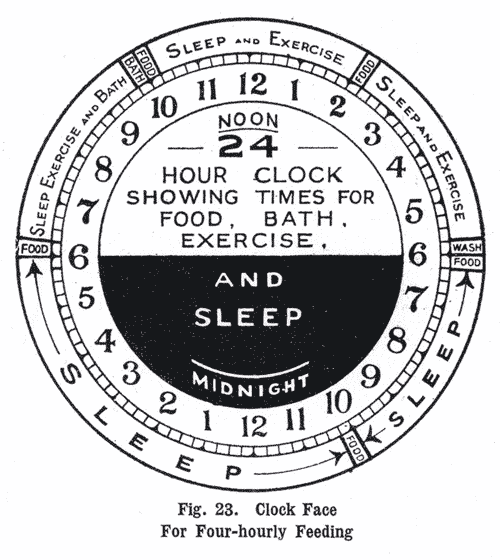
The set of guidelines formulated by the incredibly influential, New Zealand-based Dr Truby King emphasised the importance of routine in feeding. King’s mothercraft movement – which established clinics and training centres around the British Empire during the first half of the twentieth century – taught mothers to feed ‘by the clock’. At five months, a baby was to be fed only five times per day – and at the same time every day – while one month-old babies had an extra, sixth feed.

Like many childcare professionals of the period, King believed that feeding on demand was not only unhealthy – it placed babies at risk of under- or overfeeding – but it was morally and intellectually damaging too. Babies who understood that crying would cause them to be fed would become spoilt, lazy children and adults. Indeed, this points to the infant welfare movement’s more general preoccupation with mothers and motherhood. As the interests of the state were seen, increasingly, as being linked to the proper rearing and education of children, the role of the mother grew in importance. King called his centres ‘shrines to motherhood’, for instance.

But the naturally fussy, over-cautious, and credulous mother was not to be trusted to follow her own instincts: authorities and professionals, who tended to be male, were to provide her with rational, scientific advice on raising her baby. It’s difficult to gauge mothers’ response to the information aimed at them. In her study of mothers in the United States in the 1920s and 1930s, Julia Grant concludes that mothers did heed childcare professionals, but modified their advice according to the views and experiences of their peers. Similarly, mothers in New Zealand took what they wanted from King’s pamphlets on childrearing.

Equally, mothercraft clinics and breastfeeding advice days were well attended by mothers and babies. Several mothercraft centres all over the world also included a dietetic wing, where nursing mothers could stay for up to a fortnight, learning how to breastfeed their babies. There, they would be taught how to breastfeed by the clock, and how to cope with mastitis and painful breasts and nipples. Wonderfully, hospital fees were means tested, so poor mothers could attend for free.

Throughout its existence, the Cape Town dietetic hospital never had an empty waiting list, and similar units in Britain, Australia, and New Zealand were as enthusiastically supported by women. Mothercraft seems to have been at its most successful when mothers could choose how and when they wanted to its advice and services.

While it’s true that the medicalization of breastfeeding transformed this act into a ‘science’ which needed to be re-taught to mothers – that it became possible to inform a mother that she was breastfeeding incorrectly – and that this was underpinned by misogynistic and eugenicist ideas around childhood, motherhood, and the nation, it is as true that mothers did respond positively to the advice provided by mothercraft and other organisations. Clearly, mothers wanted more advice about how to feed their babies – and that they altered it to suit their conditions and needs.

It’s for this reason that I think that Thomas is doing mothers a disservice. Encouraging more women to breastfeed needs to respect the fact that women’s choices about how to feed their babies are influenced by a variety of factors and considerations. Thomas – and other breastfeeding evangelicals – seems to buy into the same discourse of maternal irresponsibility as childcare professionals did in the early twentieth century: the belief that women somehow don’t really understand what’s best for their babies, and must be properly educated. Even if her – and others’ – motives are progressive and well-meaning, they still fail to take mothers seriously.

Further Reading

Sources cited here:

Rima D. Apple, Mothers and Medicine: A Social History of Infant Feeding, 1890-1950 (Madison: University of Wisconsin Press, 1987).

Linda Bryder, A Voice for Mothers: The Plunket Society and Infant Welfare 1907-2000 (Auckland: Auckland University Press, 2003).

Julia Grant, Raising Baby by the Book: The Education of American Mothers (New Haven and London: Yale University Press, 1998).

Philippa Mein Smith, Mothers and King Baby: Infant Survival and Welfare in an Imperial World: Australia 1880-1950 (Basingstoke: Macmillan, 1997).

Other sources:

Linda M. Blum, At the Breast: Ideologies of Breastfeeding and Motherhood in the Contemporary United States (Boston: Beacon Press, 1999).

Molly Ladd-Taylor, Mother-Work: Women, Child Welfare, and the State, 1890-1930 (Urbana and Chicago: University of Illinois Press, 1994).

Marilyn Yalom, A History of the Breast (New York: Ballantine Books, 1997).

Creative Commons License
Tangerine and Cinnamon by Sarah Duff is licensed under a Creative Commons Attribution-ShareAlike 3.0 Unported License.

Food Links, 25.01.2012

Niger faces famine. Again.

The role of Glencore in the international food chain.

Badaude designs a sausage menu.

Awesome lunchboxes.

How to make orange beer.

A history of daft diets.

How smart are smart fridges?

Climate change and beer.

How to sell a burger.

The science of taste.

Baghdad Eggs.

Claufoutis by Virginia Woolf; Chaucer’s onion tart; and a recipe for lamb with dill sauce by Raymond Chandler: famous authors of literary fiction re-imagined as food writers.

Paula Deen’s most egregrious recipes.

The amazing history of the bendy straw.

Opening a bottle of wine…with a shoe.

Glass and sugar.

Cutlery as jewellery.

Cleaning up the Mexican dairy industry.

Cocktails exploding in slow motion.

Sex, death, and kefir.

The British government’s food buying standards are worse than McDonald’s.

In praise of my favourite fruit: quinces.

An interview with Heston Blumenthal.

A new hangover cure?

Big food opposes measures to encourage American children to eat more fruit and vegetables.

Decoding famous recipes.

Nerdalicious – a food blog for nerds.

Food Links, 11.01.2012

Capetonians! Worried about the rolling blackouts threatened by Eskom over the next few weeks? Fear not, and join this amazing workshop on Sunday to learn how to make your own hot box.

A Child’s Larder of Verse.

Matthew Fort demonstrates why the UK government’s Change for Life programme is serious bollocks.

Thanksgiving-like holidays around the world.

What do we really mean by ‘organic’ food? (Thanks Mum!)

How the meat industry re-brands itself.

How British supermarkets fare abroad. (Not well.)

Food and provenance.

A poem about cheese. And a woman.

Tea in Britain and the thirteen colonies – with lovely pictures.

Behind the scenes at a flavouring factory.

How the Obamas are changing the way Americans eat.

Eat leftovers and save the world.

Producing food from waste.

The ten best food moments from film.

Extreme locavore-dom.

Diners and American politics.

New York’s juice bar craze.

How to shuck an oyster.

A project to rehabilitate prisoners by teaching them how to cook.

Eat more kale.

Eat the Rich

Today’s City Press includes a fantastically interesting article about the increased incidence of obesity in post-1994 South Africa. The piece explores the links between the country’s transition to democracy and the fact that 61% of all South Africans – 70% of women over the age of 35, 55% of white men 15 years and older, and a quarter of all teenagers – are obese or overweight.

The reasons for these incredibly high levels of obesity are, as the article acknowledges, complex. In many ways, South Africa conforms to a pattern emerging throughout the developing world. In a report published a few months ago, the World Health Organisation noted that lifestyle-related diseases – like diabetes, high blood pressure, heart disease, and obesity – are now among the main causes of death and disease in developing nations. These diseases of affluence are no longer limited to the West.

For the new South African middle classes, fast food and branded processed products, like Coke, are markers of sophistication: of having ‘made it’ in this increasingly prosperous society. But, as in the rest of the world, those at the top of the social scale tend not to be overweight:

contrary to popular myth, obesity is not a ‘rich man’s disease’.

Indeed, the most affluent urbanites can get into their SUVs and drive to gym or to Woolies food hall where, for a price, they can load up their trolleys with fresh, top-quality groceries – from free-range chickens to organic lemons.

This means, says [Prof Salome] Kruger, that ‘the highest income earners are thinner’.

For urban dwellers who earn less, fresh food is usually more difficult, and expensive, to buy than processed non-food:

But for your average city dweller – earning money, but not necessarily enough to own a car to get them out to the major supermarket malls – food is where you find it.

Typically, this is in small corner shops selling a limited, and often more expensive, range of fresh foods. Fruit and veg can be hard to find among the toothpaste and toilet paper spaza staples.

‘R15!’ It’s taxi fare from Orlando to the Pick n Pay in Soweto’s Maponya Mall – and it was 25-year-old road worker Lindiwe Xorine’s reply when City Press asked her how far it was to the nearest supermarket.

We call these areas where access to fresh food is limited, ‘food deserts’. It’s entirely possible to buy fruit, vegetables, and free-range meat in South African cities, but high prices and bad transport infrastructure limit people’s ability to purchase these products.

We’re dealing, effectively, with the effects of mass urbanisation since the ending of influx control in the mid-1980s and the 1994 elections.

The migration of South Africans from rural to urban areas has been a key factor in the nation’s radical change of lifestyle habits.

Twenty years ago, restricted by apartheid laws, just 10% of black South Africans lived in urban areas. Today, more than 56% do.

Alison Feeley, a scientist at the Medical Research Council, says this massive shift to a fast-paced urban life has resulted in dietary patterns shifting just as dramatically from ‘traditional foods to fast foods’.

But this isn’t the first time that South Africa, or indeed other countries, has had to cope with the impact of urbanisation on people’s diets. During the nineteenth century, industrialisation caused agricultural workers to abandon farming in their droves, and to move to cities in search of employment, either in factories or in associated industries. In Britain, this caused a drop in the quality of urban diets. Food supplies to cities were inadequate, and the little food that the new proletariat could afford was monotonous, meagre, and lacking in protein and fresh fruit and vegetables.

One of the effects of this inadequate diet was a decrease in average height – one of the best indicators of childhood health and nutrition – among the urban poor in Victorian cities. In fact, British officers fighting the South African War (1899-1902) had to contend with soldiers who were physically incapable of fighting the generally fitter, stronger, and healthier Boer forces, most of whom had been raised on diets rich in animal protein.

This link between industrialisation, urbanisation, and a decline in the quality of city dwellers’ diets is not inevitable. For middle-class Europeans in cities like London, Paris, and Berlin, industrialised transport and food production actually increased the variety of food they could afford. In the United States, from the second half of the nineteenth century onwards, a burgeoning food industry benefitted poorer urbanites as well. Processed food was cheap and readily available. Impoverished (and hungry) immigrants from Eastern Europe, Ireland, and Italy were astonished by the variety and quantity of food they could buy in New York, Detroit, and San Francisco.

It’s difficult to identify similar patterns in South Africa. We know that the sudden growth of Kimberley and Johannesburg after the discovery of diamonds (1867) and gold (1882) stimulated agriculture in Griqualand West and the South African Republic. Farmers in these regions now supplied southern Africa’s fastest growing cities with food. The expansion of Kimberley and Johannesburg as a result of the mineral revolution was different from that of London or New York because their new populations were overwhelmingly male – on the Witwatersrand, there were roughly ninety men for every woman – and highly mobile. These immigrants from the rest of Africa, Europe, Australia, and the United States had little intention of settling in South Africa. As a result of this, it’s likely that these urban dwellers weren’t as badly effected by poor diets as their compatriots in the industrialised cities of the north Atlantic.

Cape Town’s slums and squatter settlements were, though, populated by a new urban poor who migrated with their families to the city during the final three decades of the nineteenth century. Most factory workers were paid barely enough to cover their rent. Mr W. Dieterle, manager of J.H. Sturk & Co., a manufacturer of snuff and cigars, said of the young women he employed:

It would seem incredible how cheaply and sparsely they live. In the mornings they have a piece of bread with coffee, before work. We have no stop for breakfast, but I allow them to stand up when they wish to eat. Very few avail themselves of this privilege. They stay until one o’clock without anything, and then they have a piece of bread spread with lard, and perhaps with the addition of a piece of fish.

This diet – heavy on carbohydrates and cheap stimulants (like coffee), and relatively poor in protein and fresh produce – was typical of the city’s poor. It wasn’t the case that food was unavailable: it was just that urban workers couldn’t afford it.

In fact, visitors to the Cape during this period commented frequently on the abundance and variety of fruit, vegetables, and meat on the tables of the middle classes. White, middle-class girls at the elite Huguenot Seminary in Wellington – a town about 70km from Cape Town – drank tea and coffee, ate fruit, and smeared sheep fat and moskonfyt (syrupy grape jam) on their bread for breakfast and supper. A typical lunch consisted of soup, roasted, stewed, curried, or fried meat (usually mutton), three or four vegetables, rice, and pudding.

It’s also worth noting that the Seminary served its meals during the morning, the middle of the day, and in the evening – something which was relatively new. Industrialisation caused urban workers’ mealtimes to change. Breakfast moved earlier in the day – from the middle of the morning to seven or eight o’clock – lunch (or dinner) shifted to midday from the mid-afternoon, and dinner (or tea) emerged as a substantial meal at the end of the day.

Factory workers in Cape Town ate according to this new pattern as well. The difference was the quality of their diet. A fifteen year-old white, middle-class girl in leafy Claremont who had eaten an ample, varied diet since early childhood was taller and heavier than her black contemporaries in Sturk’s cigar factory. In all likelihood, she would have begun menstruating earlier, and would have recovered from illness and, later, childbirth far more quickly than poorer young women of the same age. She would have lived for longer too.

Urbanisation changes the ways in which we eat: we eat at different times and, crucially, we eat new and different things. By looking at a range of examples from the nineteenth century, we can see that this change isn’t necessarily a bad thing. The industrial revolution contributed to the more varied and cheaper diets of the middle classes. Industrialised food production and transport caused the urban poor in the United States to eat better than many of those left behind in rural areas, for example. But it’s also clear that it exacerbates social inequality. In the 1800s, the poor had too little to eat and that which they did have was not particularly nutritious. Children raised on these diets were shorter and more prone to illness than those who ate more varied, plentiful, and protein-rich food. Now, the diets available to the poor in urbanising societies are as bad, even if the diseases they contribute to are caused by eating too much rather than too little.

Most importantly, we have an abundance of food in our growing cities. Just about everyone can afford to eat. The point is that only a minority can afford good, fresh food, and have the time, knowledge, and equipment to prepare it. Food mass produced in factories helped Europe and North America’s cities to feed their urban poor a hundred years ago. I’m not sure if that’s the best solution for the twenty-first century.

Creative Commons License Tangerine and Cinnamon by Sarah Duff is licensed under a Creative Commons Attribution-ShareAlike 3.0 Unported License.
Food Links, 02.11.2011

On famine and food in North Korea.

How hummus conquered Britain.

How to taste wine without sounding obnoxious.

Cape Town appears in the London Review of Breakfasts.

More evidence that healthy people shouldn’t take vitamin supplements.

Beer and the ethics of food blogging.

Allegra McEvedy discusses her knife collection.

The New York Times awards Imperial No. Nine no stars in a scathing review – and here are some of the worst lines, presented by kittens.

The link between obesity and the incredible increase in rates of type 2 diabetes in the UK.

So who is Ruth Bourdain?

Will the cupcake ever die? (Thanks Jane!)

How to make sloe gin. (The answer? Sloe-ly. *ahem* Sorry.)

The empty pantry: food insecurity in the United States.

Jay Rayner waxes lyrical about a new food venture in London, Brixton Village.

China seems to re-think its embrace of industrial agriculture.

How to make vanilla extract.

Peanut butter and climate change.

The ten best and worst aspects of America’s food scene.

On cooking sous-vide. (Thanks Dad!)

Ten food myths debunked. (Thanks Mum!)

Berliner Pfannkuchen.

How to eat the rich.

Food Links, 14.09.2011

The Observer profiles Britain’s new young farmers, Sarah Boden, Ed Hamer, and Richard Thomas.

Check out Sonia Cabano’s review of the Toffie Food Festival.

A slide show of New York’s hot dogs.

There is such a thing as honey laundering.

‘An additional Walmart Supercenter per 100,000 residents increases average BMI by 0.25 units and the obesity rate by 2.4%.’ And there are fifteen more amazing/appalling facts about Walmart here.

On changing attitudes towards restaurant staffs’ tattoos.

David Lebovitz discusses his favourite pudding recipe books – and is interviewed by the Financial Times.

Consider chocolate.

A brief history of menu design in the United States.

A list of favourite French recipes by Julia Child.

Jay Rayner interviews David Tanis, the head chef at Chez Panisse – and here are some of Tanis’s recipes.

On the history of biscuit embossing.

It would seem that the company providing food parcels to the poor in Britain…has links with the Tories. Funny, that.

Rene Redzepi explains the thinking behind his Mad Food Camp.

These flags made of food are surprisingly lovely.

More from What I Eat: Around the World in Eighty Diets.

How to chop an onion. (Thanks Mum!)

The perils of restaurant reviewing.

Food Links, 31.08.2011

On Spanish pigs.

What to drink with your meal if you’re teetotal.

Where are the undernourished?

This infographic demonstrates beautifully that healthy food tends to be more expensive than sugary, salty snack food.

Chocolate is good for your heart.

Tom Philpott reviews Nick Cullather‘s The Hungry World, a new history of the Green Revolution.

The dangers of ‘detox’.

On the famine in Somali: It’s the Politics…Stupid.

Transforming fridges into cinemas.

The rise of street food in Britain.

Are vegetables losing their nutrients?

Mark Bittman discusses US legislation around salmonella.

A Swedish man splits atoms in his kitchen. I think this is glorious. And this is his blog which is named, of course, Richard’s Reactor.

On the rise of the ‘super insects’ which are resistant to the pesticides which the evil empire Monsanto markets alongside its seeds.

The tricks of food photography (thanks Isabel!).

How far would you travel for amazing food?

Is eating well and healthily always expensive?