
Not in my trolley
This has not been a particularly edifying week for white South Africans. After an angry blog post about Woolworths’s hiring policies went viral, a surprisingly large group of white people have threatened to boycott the supermarket. Woolies – an upmarket food-and-clothing store similar to Marks and Spencer in the UK – notes in some of its job advertisements that certain positions are available only to black candidates.
Pierre de Vos, Professor of constitutional law, points out that this is ‘neither illegal nor unconstitutional.’ The purpose of the measure is to address the absence of black South Africans in particular categories of jobs. The company has not introduced a moratorium on hiring whites, and whites may still apply for jobs advertised as being aimed specifically at black candidates.
In a magnificent riposte to the white loons threatening never to shop again at Woolworths – in the strange belief that other supermarkets don’t have similar hiring policies (they do) – Ferial Haffajee, editor of the City Press, explained:
Without affirmative action, I would likely be a retrenched clothing factory worker or a low-level banking clerk. That was the expected, the planned outcome for people like me. The system was called apartheid. We needed help to escape our destiny and millions of South Africans still need that help.
It is not reverse racism, but a Constitutional imperative to fix our society. …those of you who spammed the Woolies CEO for applying the law are wrong. You discount, completely, the role of inter-generational privilege in your life.
To make a good future society demands we have make-right policies for the old one. It doesn’t fix itself.
I doubt that the boycott will have any effect on Woolies’ sales this year. The satirical site Hayibo summed up middle-class South Africans’ relationship with the store particularly well:
‘I will never shop at Woolies again, until later this afternoon when I will go and get salmon and malva pudding,’ said one irate shopper.
Indeed.
As this was a lost opportunity to have a constructive discussion about affirmative action and economic empowerment in post-apartheid South Africa – two issues always worth thinking about – this also represents a moment to think about the nature and effects of consumer boycotts.
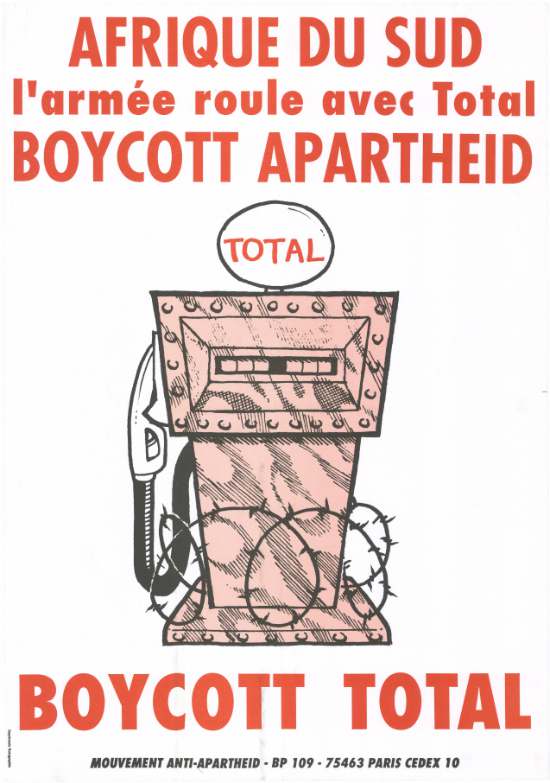
I was particularly amused by this threatened whites-only boycott because of the impact that international boycotts had on apartheid South Africa. The country’s economy was brought to its knees after the 1986 Comprehensive Anti-Apartheid Act became law in the US, preventing American businesses and banks from exporting and importing some commodities to and from South Africa, and investing in, and extending loans to, the country. Sport and cultural boycotts accompanied these sanctions.
The Anti-Apartheid Movement in Britain originated as a boycott campaign against South African produce in 1959. It organised boycotts of Cape Fruit, Outspan oranges, and a range of other products, as well as of businesses like Barclays and Total which operated in South Africa. Even if this campaign – and others around the world – didn’t pose as much as a threat to the apartheid state as the sanctions of the 1980s, what they achieved was to make ordinary people aware of apartheid by appealing to them not to support the South African economy.

There seems to have been an increase in this kind of political consumer boycott since the 1980s, and probably as a result of a heightened awareness of the connection between the exercise of political power and the emergence of global corporations. One of the best – and most successful – examples of these was the Nestle Boycott organised by War on Want and other groups in 1977, to draw attention to the link between the marketing of infant formula and high rates of child mortality in the developing world.
But political consumerism and consumer boycotts have existed long before then. In fact, the abolitionist movement has been described as one of the first examples of concerted consumer activism in support of a political cause. Not only could early opponents to slavery buy abolitionist-themed crockery from Wedgwood, but, particularly during the nineteenth century, abolitionists all over the world refused to buy American sugar or cotton.
Lawrence B. Glickman writes:
consumer activism – the attempt to mobilise consumers for political purposes – has been important to American political culture at least since the Boston Tea Party. Indeed…American national identity was forged in no small part through collective acts of consumption. Central to African American claims for political and economic inclusion have been demands for…‘consumer entitlement,’ ranging from boycotting Jim Crow street cars to taking advantage of the ‘autonomy and anonymity’ of catalogue shopping as a way of avoiding mistreatment by merchants, to boycotting tourism in South Carolina as a way of protesting the Confederate flag that until recently flew over the state house. Similarly…among many women in the Progressive Era ‘consumer consciousness built political consciousness’ as they boycotted unsafe and costly food and campaigned for minimum wages and decent labour standards for those who produced what they bought.
It’s striking how frequently consumer boycotts have been used by those who are politically and socially marginalised, to demand equal treatment and an end to discrimination. They were a key strategy in the American Civil Rights movement, and featured to some extent in the Defiance Campaign against apartheid legislation in the early 1950s, and, later, during the township rebellion in the 1980s.
Some of the earliest consumer boycotts in the United States and Britain were organised by women, and usually in response to sudden increases in the price of staple foods. For instance, in 1902, immigrant Jewish women in New York organised a boycott after the price of Kosher beef increased by half. By withdrawing their support from local butchers – and, admittedly, rioting in lower Manhattan – they managed to reduce prices.
In 1924 and 1933, Jewish women in Toronto – many of them members of communist groups – also organised boycotts of Kosher butchers to protest rising prices of meat. On both occasions, significant numbers of women were mobilised not only to stop shopping for meat, but to picket butchers.
Indeed, there were widespread boycotts organised by women during the Great Depression. These ‘housewives’ protests’ were part of a broader movement in which women sought to mitigate the effects of the Depression by lobbying government, planting community gardens, establishing bartering systems for food and other goods, and even engaging in acts of civil disobedience. In Cleveland, for instance, black mothers protested a power company’s decision to switch off electricity as a result of non-payment of bills, by hanging wet washing over the power lines. The electricity was switched on the next day.
In 1946, the Washington Committee for Consumer Protection was formed by a group of women – including some who had been active in union politics during the 1930s – to organise boycotts of red meat and other products to protest the increase in food prices at the end of the Second World War. (The American government had kept them artificially low during the conflict.) Other committees organised boycotts of milk and dairy products for similar reasons.
Boycotts demonstrate particularly well that buying power – and the exercise or withholding of this power – seems to function as a replacement of real access to political power for those who are socially marginalised.
I don’t want to suggest for a moment that there’s an equivalence between the heroic housewives of 1930s America and the white nitwits who are trying – and probably failing – to organise a boycott of Woolworths. But I do think that the rage which has propelled this boycott suggests that there is a section of South Africa’s white population which feels – with some justification – that its interests are not being represented by mainstream political parties. And this is worth taking seriously.
Further Reading
Monroe Friedman, ‘American Consumer Boycotts in Response to Rising Food Prices: Housewives’ Protests at the Grassroots Level,’ Journal of Consumer Policy, vol. 18 (1995), pp. 55-72.
Lawrence B. Glickman, ‘“Buy for the Sake of the Slave”: Abolitionism and the Origins of American Consumer Activism,’ American Quarterly, vol. 56, no. 4 (Dec., 2004), pp. 889-912.
Lawrence B. Glickman, ‘The Strike in the Temple of Consumption: Consumer Activism and Twentieth-Century American Political Culture,’ The Journal of American History, vol. 88, no. 1 (Jun., 2001), pp. 99-128.
Matthew Hilton, ‘The Female Consumer and the Politics of Consumption in Twentieth-Century Britain,’ The Historical Journal, vol. 45, no. 1 (Mar., 2002), pp. 103-128.
Stacy Kinlock Sewell, ‘The “Not-Buying Power” of the Black Community: Urban Boycotts and Equal Employment Opportunity, 1960-1964,’ The Journal of African American History, vol. 89, no. 2, African Americans and the Urban Landscape (Spring, 2004), pp. 135-151.
Annelise Orleck, ‘“We Are That Mythical Thing Called the Public”: Militant Housewives during the Great Depression,’ Feminist Studies, vol. 19, no. 1 (Spring, 1993), pp. 147-172.
Kathleen C. Schwartzman, ‘Can International Boycotts Transform Political Systems? The Cases of Cuba and South Africa,’ Latin American Politics and Society, vol. 43, no. 2 (Summer, 2001), pp. 115-146.
Andor Skotnes, ‘“Buy Where You Can Work”: Boycotting for Jobs in African-American Baltimore, 1933-1934,’ Journal of Social History, vol. 27, no. 4 (Summer, 1994), pp. 735-761.
Dietlind Stolle, Marc Hooghe, and Michele Micheletti, ‘Politics in the Supermarket: Political Consumerism as a Form of Political Participation,’ International Political Science Review, vol. 26, no. 3 (Jul., 2005), pp. 245-269.
Lynne Taylor, ‘Food Riots Revisited,’ Journal of Social History, vol. 30, no. 2 (Winter, 1996), pp. 483-496.

Tangerine and Cinnamon by Sarah Duff is licensed under a Creative Commons Attribution-ShareAlike 3.0 Unported License.


 Tangerine and Cinnamon
Oct 13
The President’s Vegetable Garden
There are very few countries, I think, where a satirical news site is frequently mistaken for being entirely serious. Hayibo – the South African equivalent of the Daily Mash or the Onion – must, occasionally, point out to its readers that its stories are made up, rather than real.
Readers can be forgiven for wondering if a report about striking Marikana mineworkers being charged for the Helderberg plane crash is true, when the ANC announces an official policy on the serving of cake at party celebrations. Or if Cosatu officials really did believe they could move into Cape Town stadium, after the ANC Women’s League decided to march against a rude painting of Jacob Zuma, rather than protest the circumstances which allowed for the serial abuse and gang rape of a seventeen year-old mentally incapacitated girl.
A Hayibo post from this week suggests that the ANC’s national conference to be held in December in Manguang, will be replaced by an episode of Come Dine with Me. Instead of conference delegates voting to choose the new leader of the party – and, thus, by default, the next president of South Africa – four contestants will compete in a series of dinner parties:
It would all be much more amusing were it not so very, very serious. I was thinking about food and South African politics this week, after the Mail and Guardian produced a handy interactive guide to the development of Nkandla, the village in which Zuma’s private residence is based.
The Nkandla scandal has rocked South African politics and civil society over the past few weeks, as the City Press revealed that the Department of Public Works has committed to spending R203 million – about US$23 million or £14 million – of public money, not only in developing this village in rural KwaZulu-Natal, but in building Zuma’s increasingly elaborate home.
South African Wonder Woman-incarnate Thuli Madonsela, the Public Protector, has announced an investigation into the development. Despite her interest and increasing public outrage, the government remains unrepentant: it has declared Nklandla a ‘national key point’, meaning that it comes under security legislation and can’t be reported on; the Minister for Public Works, Thulas Nxesi, declared at a press conference that ‘questioning the need for spending hundreds of millions of rands in Nkandla showed insensitivity to the cultural diversity of South Africa’; and the state has launched an investigation into how the City Press got hold of the documents which revealed the scale of the spending at Nklandla.
Not for nothing has Nkandla been nicknamed ‘Zumaville’. The M&G’s guide reveals how the village will be transformed with new roads, housing, and a shopping centre. Zuma’s own residence will have two helicopter landing pads, a football pitch, tennis court, and underground bunkers. (Remembering, of course, that he has two official houses, one in Pretoria and the other in Cape Town.) I was intrigued by the fact that a vegetable garden has also been included in the development.
The M&G explains:
I am all for heads of state planting vegetable gardens: I think it’s an excellent idea, particularly as a means of encouraging people to grow their own food. I wish more presidents and prime ministers would plant vegetables to show their commitment to feeding their families healthily and relatively cheaply. But I have a couple of reservations about this garden.
Firstly, the Department of Public Works justifies funding the garden on the grounds that food insecurity could pose a threat to Zuma and his guests. What do we mean by ‘food security’? As a paper published in the Bulletin of the World Health Organisation, and cited by the M&G, explains:
The authors of the paper argue that although food insecurity declined in South Africa between 1995 and 2008 – due partly to the social grants system and the work of the National School Nutrition Programme – one third of South African children do not eat an adequately varied diet, and 18% of them are malnourished:
One of the main reasons for food insecurity in South Africa is poverty and, partly as a result of this, the country’s population is at risk of becoming even more insecure. A 2009 report on food security published by the Human Sciences Research Council notes:
Although the government deserves praise for reducing levels of hunger in South Africa, far too many people, particularly children, don’t have adequate access to food. Indeed, it would appear that with rising food prices internationally, there is a risk that the country may become more food insecure.
To justify the public funding of a vegetable garden for the president’s private residence on the grounds of ‘food security’ is deeply offensive to the numbers of South Africans who can’t afford to feed themselves and their families properly. If the president and the Department of Public Works were genuinely interested in reducing food insecurity in the region, it would make far better sense for them to plant a larger, communal garden for all of Nkandla’s residents.
President Zuma’s homestead at Nkandla (from http://www.sowetanlive.co.za/news/2012/10/11/family-helped-nkandla-renovation—zuma)
My second problem with Zuma’s vegetable garden is the very dubious way in which it’s been funded. There is a link between poor governance and food insecurity. One of the best recent examples of how corruption impedes food distribution occurred in Uttar Pradesh. Throughout India, only 41 per cent of the food intended for the very poor by the Food Corporation of India – the government agency established in 1965 to ensure India’s food supply – reaches households. This is due partly to wastage, but also to corruption.
In Uttar Pradesh, though, nearly all food aid was stolen by corrupt officials over the course of three years, as Bloomberg reports:
The irony is that India’s food reserves are full – and there’s more than enough food to go around:
But with corrupt officials, there’s no way of guaranteeing that this food will reach the poor. When distribution systems fail, people go hungry – and more than half of India’s children, and 21 per cent of adults, suffer from malnutrition.
This is, admittedly, an extreme example of the implications of corruption for food security, but it demonstrates particularly well how poor governance can impact the lives of the very poor. Given the rising levels of corruption in South Africa, it’s not too much of a stretch to conclude that the government’s good work on reducing hunger has the potential to be reversed if systems are corrupted through bribery, theft, and mismanagement.
It’s an obvious point, but the R203 million set aside for Zumaville could have been used to build roads, railways, food silos, and other infrastructure to improve the distribution of food to rural areas.
Six years ago, Lonmin commissioned a report into the health of the communities in seven villages – including Marikana – around its platinum mines. One of the main findings was that malnutrition was a major problem, and that children had been discovered suffering from kwashiorkor:
Why the president feels that he and his guests deserve a state-funded vegetable garden when South African children are suffering from a condition associated with failed states, is utterly beyond me.
Further Reading
Miriam Altman, Tim Hart, and Peter Jacobs, Food Security in South Africa (Human Sciences Research Council, 2009).
Tangerine and Cinnamon by Sarah Duff is licensed under a Creative Commons Attribution-ShareAlike 3.0 Unported License.