
Free Markets
A couple of months ago I spent a weekend in Johannesburg to celebrate my friend Kate’s thirtieth birthday. Knowing me well, she suggested that we have lunch at the newish Neighbourgoods Market in Braamfontein, a neighbourhood which has been included in Joburg’s inner city improvement district scheme. Alongside 70 Juta, a small row of shops (one, inevitably, devoted to lomography), galleries, and cafes, the Neighbourgoods Market is part of a wider effort to attract people – and particularly those with disposable income – back into the city’s centre.
The decline of the Joburg CBD since mid-90s has been well documented: the flight of businesses to suburbs like Sandton and developments such as Melrose Arch means that the old city centre has changed beyond recognition. Buildings are derelict and crumbling, and crime is a significant problem. To my shame, I don’t know Joburg terribly well, even though I enjoy visiting it enormously. What struck me was not that the city centre has ‘died’, but, rather, that it is vibrantly alive, albeit – with the abundance of cheap Chinese shops, fast food joints, and street stalls – not in ways we would usually define a bustling, ‘healthy’ CBD.
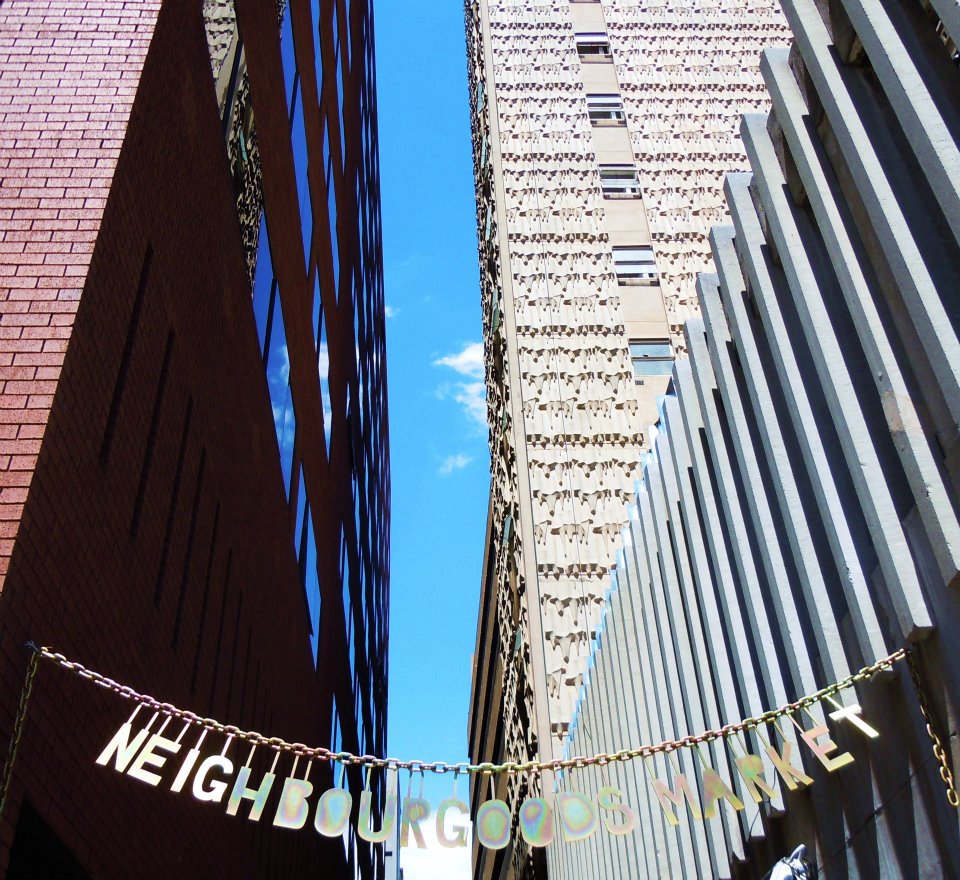
The entrance to Braamfontein's Neighbourgoods Market
The point is that something needs to be done to bring businesses back to central Johannesburg, crime and grime must to be brought under control, and the city’s amazing mid-century architecture should be restored. The Neighbourgoods Market is in the parking lot of the most incredible brutalist skyscraper, the façade of which was designed by Eduardo Villa. Open on Saturday mornings, it brings people in to an area which would be otherwise deserted – and dangerous – on weekends. I really, really enjoyed it: the food was great and, as is usually the case in Joburg, both punters and stall holders were fantastically friendly.

Inside Braamfontein's Neighbourgoods Market
In fact, I liked it rather more than the original Neighbourgoods Market in Cape Town. Established for similar reasons as the Joburg incarnation, the Market in Cape Town is located in a newish redevelopment of an old biscuit mill in the traditionally working- and lower middle-class suburb of Woodstock – although this area is now achingly cool, having been dubbed ‘Cape Town’s Manhattan’ by the New York Times. The more gentrified sections of Woodstock are now awash with vintage stores, bicycle shops, and Michelle Obama-attracting organic lunch cafes. Particularly on the main road, it’s all beginning to look like a set for a Wes Anderson movie.
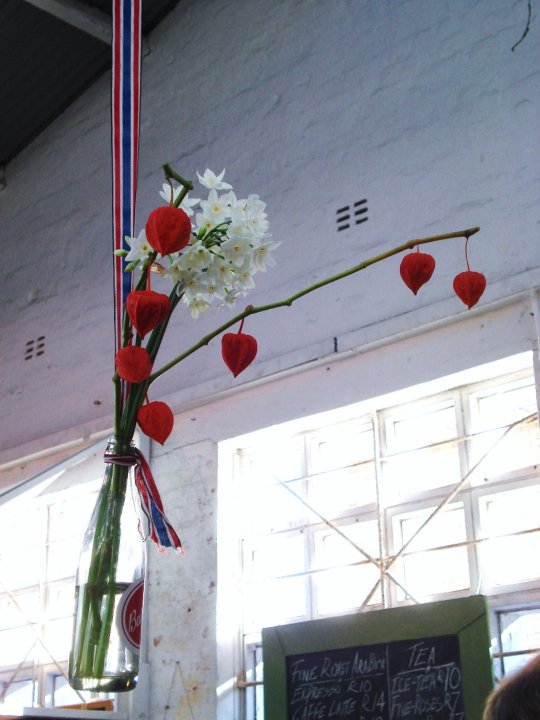
At the Woodstock Neighbourgoods Market
There’s been a fair amount of debate about the gentrification of Woodstock, and much as I find the Neighbourgoods Market unpleasantly overcrowded and many of the people it attracts deeply annoying, I am less unsettled by its effects on the suburb than the wholesale transformation of the Bo-Kaap, near the centre of Cape Town, where a very poor group of people – many of them descendants of slaves – have slowly been evicted from their picturesque, brightly-painted cottages by landlords keen to attract yuppies in their massive Chelsea tractors.
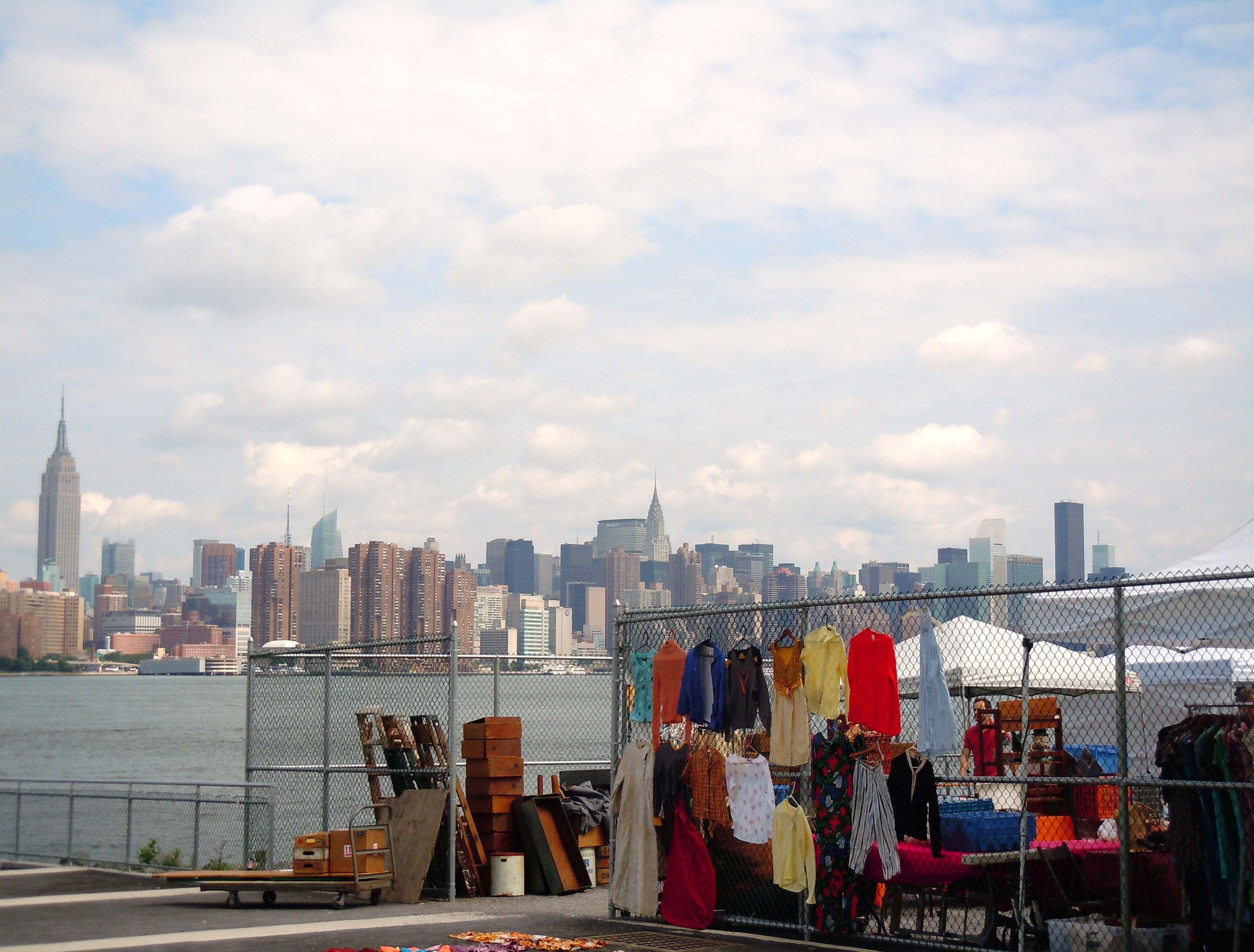
The view from the Williamsburg Flea
The debates we’re having in Cape Town about gentrification are by no means particular to South Africa. In New York last year, my friend Geoff commented that he found the new-found coolness of Brooklyn’s Williamsburg – a working-class suburb once dominated by Orthodox Jews – baffling. I went to the Williamsburg Flea, a market selling food, craft, and an assortment of handmade and vintage clothes and furniture. My friends and I enjoyed it enormously – as much as we did exploring Bedford Avenue – but I could understand the original inhabitants’ unhappiness at how much this hipster invasion has changed the neighbourhood.

At the Williamsburg Flea
The point about the Neighbourgoods Market and the Williamsburg Flea is that they both attract people who are either new to those suburbs, or who don’t live there at all: they’re not aimed at the existing communities. (They’re too expensive, to begin with.) At a hipster night market in Dalston in December – it sold food, not hipsters because that would be illegal – I stood for a half an hour in a queue, risking hypothermia to buy supper at a food market in a covered parking lot near the Dalston Kingsland overground station.

At the Long Table night market in Dalston
Dalston has followed on from Islington, Shoreditch, and Stoke Newington as being the favoured spot for not-particularly-wealthy lefties looking for somewhere cheap and central to stay. It’s in Hackney, one of the poorest boroughs in Britain, and not overwhelmingly picturesque, but it’s now overrun with hipsters and Guardian-reading lefties (I count myself as one of these, obviously, I mean obviously). I didn’t see any members of Dalston’s original community at the night market – which included a stall run by Moro.

More of the Dalston night market
As I’ve noted before, this link between food and gentrification is nothing new. Kathe Newman has argued that ‘cupcake shops can provide a more accurate and timely guide to the frontiers of urban gentrification than traditional demographic and real estate data sets.’ Danya al-Saleh demonstrates this particularly well in her map of the slow encroachment of cupcake bakeries in San Francisco’s gang territories (click here for a bigger version):
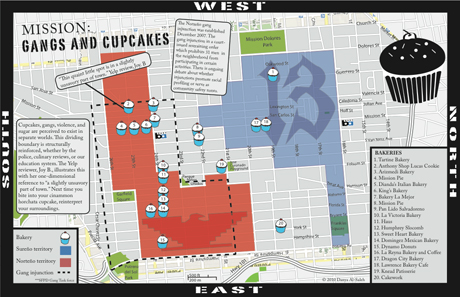
As one commentator explains:
In the 1990s, it might have been the proliferation of Starbucks coffee houses that indicated gentrifying neighbourhoods, and in the 1980s, perhaps gourmet yoghurt shops moving into an area, etc. I don’t know about other cities, but in NYC where I live, right now it would be the new doggie day care centres that are springing up in many places that appear to designate a change to a more affluent, up-and-coming hipster-ish nabe.
Markets, cafes, and restaurants increase footfall in cities. I had breakfast at the newly-opened Clarke’s in the Cape Town CBD yesterday morning (it was fantastic – go), and was struck by how busy the area was: aside from the tourist traps around Greenmarket Square (not a green market) and Long Street, the CBD used to be deserted over weekends. Now, though, Capetonians are flocking to Jason’s, Skinny Legs & All and other places. The city feels safe, and alive again. The Cape Town Partnership, which has driven much of this renewal, has recognised the power of coffee shops in attracting pedestrians into the city.
At the furthest extreme, there is the urban farming which is seeking to transform Detroit, a city brought to the edge of collapse by bad urban planning and, more recently, the 2008 recession. But Detroit is a deeply unusual case. What’s happening in Braamfontein, Woodstock, Williamsburg, Dalston, and elsewhere is part of a trend which began in the 1990s: the connection between the, then, new-found enthusiasm for whole, ‘real’ food brought into city markets by farmers and small producers, and the regeneration and gentrification of poor or decayed urban districts. Visiting the Union Square farmers’ market now, it’s difficult to imagine that Union Square used to be extremely dangerous.

At the Union Square farmers' market
These are markets for the middle classes, and it’s easy to criticise them for not doing more to integrate wealthy newcomers and less well-off original inhabitants – which is why, I think, the Joburg Neighbourgoods Market is a potentially less awkward experience than the Woodstock version. There aren’t very many people actually living in Braamfontein.
But I’m interested in the continuing success of these markets – and they’ve proliferated – in a time of economic downturn. They’re sustained by gentrification, but why their continuing success during times of financial insecurity? Will they continue to flourish as the tide of gentrification begins to recede? Are they sustainable?
As sales of organic vegetables in supermarkets have plummeted during the recession, there are more food and farmers’ markets than ever before. Last week’s coverage of Tesco’s extraordinarily bad performance over Christmas in the UK referred to the fact that part of the business’s problem is that it hasn’t responded adequately to changing patterns in consumer culture. As one article noted, people are relying increasingly on the internet for basic food shopping because it’s convenient and also allows them to compare deals and prices more efficiently. Shoppers are savvier in the recession.
But they still buy treats and luxuries – hence the success of Marks & Spencer, Waitrose, and John Lewis. Waitrose has been particularly clever in opening convenience stores in city centres: they’re certainly pricier than the ubiquitous Tesco Metro, but shoppers seem to be willing to fork out cash to shop in bright, clean, and, yes, convenient shops. The Tesco model of establishing enormous, town centre-decimating, and car-reliant hypermarkets on the edge of urban developments no longer appears to be successful. Tesco CEO Philip Clarke
was not sure Tesco needed any more of the sprawling out-of-town Extra stores it has spent so long battling planners to build – and that were vital in its conquest of Britain’s retail sector in the 1990s. He didn’t want to go as far as to label its more than 200 out-of-town hypermarkets as ‘white elephants’ but said they were now a ‘less potent force’ as electricals and clothing sales shifted online.
I think we can account partly for farmers’ markets’ continued success in similar ways. Even if very few people can afford to do a weekly shop at them, many will buy small luxuries to perk up meals in a time of financial insecurity: nice chunks of unusual cheese, proper bread, and handmade sausages. I wonder, though, if this change in shopping patterns indicates a fundamental shift in the functioning of consumerism – and in attitudes towards food.
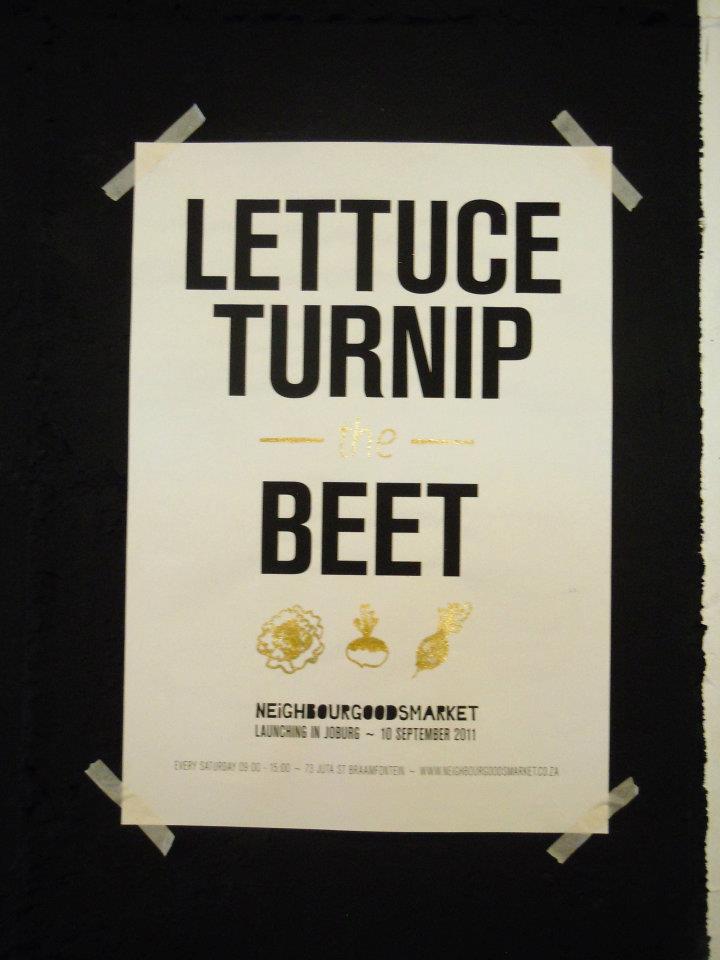
At the Braamfontein Neighbourgoods Market

Tangerine and Cinnamon by Sarah Duff is licensed under a Creative Commons Attribution-ShareAlike 3.0 Unported License.





 Tangerine and Cinnamon
Jun 24
Check Your Privilege
Yesterday, the circulation of a photograph of a new Hackney café, The Advisory, caused a minor flurry of controversy on social media. The restaurant has been established on the site of the – now closed – Asian Women’s Advisory Service. As many pointed out, its decision to retain the Service’s sign and to appropriate the language of the centre in the name of foodie-ism, is in exceptionally poor taste. A sign on its window advertises: ‘This centre is responsible for a refined preparation of brunch, lunch and dinners.’ It adds: ‘We also respond to thirst related needs.’
In response to this criticism, The Advisory has removed the sign and, in a statement, explained that the building had been derelict for several years. A review of the café on Cherie City – which praised its ‘rough-luxe feel’ – has also been taken down.
Regardless of whether the building was empty or not, The Advisory’s decision to model itself as an advice centre in one of the UK’s poorest boroughs, and in the midst of debates over the effects of the ‘hipsterfication’ of east London, is deeply insensitive.
This certainly isn’t the only example of tone-deaf foodiesm that I’ve encountered. A couple of years ago, I attended an event in Cape Town where a well-meaning author attempted to recreate the life of Nelson Mandela for the audience by providing us with meals he ate at key moments, supplied by … Woolworths. (It’s rather like Marks & Spencer handing out packets of rice to help punters to understand Gandhi’s struggles better.)
These are, admittedly, particularly bad examples of foodie thoughtlessness. But I think that they point to a wider problem within the ‘food world’ (so to speak – I mean restaurateurs, food writers, and journalists). Since its emergence in the US and the UK, during the late 1960s, the food movement – which questions industrial agriculture, supports small farmers and co-operatives, opposes GM and buys organic – has remained largely middle class. There’s nothing inherently wrong with this, but it does mean that the movement has a tendency to ignore its own, vast privilege.
I’ve been thinking about this a lot recently, after having come across a new book on how Londoners can eat locally and sustainably. It’s called The Modern Peasant. I understand why Jojo Tulloh wanted to call her book that – she wanted to evoke the small, self-sufficient, self-contained world of the peasants of pre-industrial Britain – but I think it’s an immensely problematic choice, not least because it seems to imply that peasants no longer exist. They do. In their millions. The vast majority of farmers in Africa and south Asia are small farmers. These peasants produce 70% of the world’s food supply.
La Via Campesina celebrates the tenth anniversary of its founding this year. It is the largest peasant organisation in the world and is, arguably, one of the most significant forces within food politics at the moment. It originated the concept of food sovereignty, which puts power relations at the heart of creating a fair food system:
So calling a book about eating well in London ‘The Modern Peasant’, displays rather a lot of ignorance about how the world’s food systems operate.
My point is not to bash well-meaning, if occasionally tin eared, middle-class foodies who only want to encourage others to eat good, ethically-produced food. But, rather, to argue that they need to recognise that – by virtue of their whiteness and class – they operate from a position of power.
There has been a lot of debate among feminists over the past year or so about the usefulness of asking or telling straight, white, middle-class feminists to ‘check their privilege’ when addressing issues relevant to LGBT and working-class feminists, or women of colour. Although I have fairly mixed feelings about how ‘privilege checking’ has been used, it is a useful way of encouraging those in privilege to become aware of how powerful they are – and to recognise that any attempt to remedy broken food chains and to ensure that everyone has enough (of the right kind of) food to eat, is dependent on addressing power imbalances. And not only foraging for wild garlic in Hackney.
Tangerine and Cinnamon by Sarah Duff is licensed under a Creative Commons Attribution-ShareAlike 3.0 Unported License.