
From Customers to Consumers
I love this video – it’s an overview of a century of fashion, music, and dance in London’s East End:
It’s not an art installation. It’s not part of a community project. It’s an ad. For a shopping mall. And this isn’t any mall – it’s Europe’s biggest, and one of the key developments in the Olympic site in Stratford. In fact, it seems that most of the spectators attending next year’s Summer Olympics will enter the games through Westfield Stratford City: its casino, 300 shops, 50 restaurants, three hotels, and 17 cinema screens.
I’m not a massive fan of shopping malls, and said as much when I posted this video on Facebook. And then my friend Jean-François, who’s an architect, made the point that the development will create a massive 10,000 jobs, and has funded literacy classes for the astonishingly high number of applicants who seemed to be illiterate. In an area as deprived as Stratford, surely this shopping centre could only be a Good Thing?
There has been a great deal of criticism of the way in which Stratford has been transformed by the Olympic site. I don’t want to romanticise life in a very poor borough of London, and I’m not sure that commentators like Iain Sinclair – who has been vociferous in his opposition to the 2012 Olympic bid – offer much in the way of ideas for providing jobs, decent housing, and education for the area. But I feel uncomfortable about the way that a temple to consumerism seems to be offered up as the only possible way of raising living standards in Stratford. As Suzanne Moore – not, admittedly, my favourite columnist – wrote in yesterday’s Guardian:
Next week a new Westfield opens. It’s not in west London, it’s in the east, in Stratford. It will cash in on the Olympics. Is this what this deprived area really needs? Another giant, weatherless mall that has exactly the same shops as everywhere else? Maybe this deliberately disorientating social space will be a place of connection and hope. Maybe it will offer the local youth something other than an expensive bowling alley, a multiplex and some minimum-wage jobs.
But is this just a case of lefty, middle-class squeamishness? When I buy a Margot Molyneux blouse from Mungo & Jemima, or even a dress from an upmarket chain like White Stuff or online store like Toast, it’s not any ‘better’ than purchasing a t-shirt from Mr Price. Both decisions support people who designed and made the garment. When I buy from small, local grocers and food shops, it’s partly because of a belief that this is good for our food system, but it also says something about me – about how I choose to constitute my identity in relation to a particular way of thinking about being an ‘ethical’ shopper. However critical I may be of consumerism, I am, inevitably, bound up in it.
I am interested in the shift from defining people who buy things from shops as ‘customers’ to being described as ‘consumers’. There’s a growing collection of historians interested in tracing and analysing this transition. One of the reasons why I’m so interested in it is because of the pivotal role played by the food industry in creating consumers.
Given the dire state of the average American diet, it probably comes as no surprise to learn that the United States was the first country to witness the rise of a food industry reliant on consumers who had begun to buy an increasing number of good produced in factories by big food companies towards the end of nineteenth century. Consumerism is inextricably linked to the industrialisation of food production.
The first people to benefit from the Industrial Revolution were the middle classes. In Britain, Europe, America and elsewhere, the newly-wealthy bourgeoisie could afford to buy more food, and employed more servants to prepare it. They had leisure in which to enjoy the eating of this food – and it became a way of marking newly-acquired middle-class status.
Until 1850 in Europe, and 1830 in the US, the diets of the urban poor actually deteriorated. The average height of working-class people living in the rapidly expanding cities of the industrialised world actually declined – one of the most potent indicators of the levels of deprivation experienced by this new proletariat. This was the first generation of workers to be disconnected from food production: these were people who no longer grew their own food, and were dependent on inadequate and expensive food systems to supply towns and cities. Poor diets were centred around starches and cheap, poor-quality food.
But from the mid-nineteenth century onwards, food became progressively cheaper, more plentiful, and varied – and this happened earlier and more quickly in the United States. So what caused this drop in price and greater availibility in cities? A revolution in transport made it easier to take produce from farms to urban depots by rail, and shipping brought exotic fruit and vegetables from the rest of the world to Europe and the United States. When Europe’s grain harvest failed during the 1870s, the continent was fed with wheat imported by steam ship from Canada. Farmers now began to cultivate land which had previously been believed to be inaccessible – and to grow market-oriented produce. The rise of the iceberg lettuce – which could cope with being transported over vast distances with little bruising – is directly attributable to this.
The agricultural revolution of the eighteenth century made farming more productive. New systems of crop rotation, the use of higher-yielding plant hybrids and improved implements, and the enclosure movement in Britain meant that fewer farmers were producing more food than ever before. And this produce was processed far more quickly, and cheaply. With innovations in the preservation of food through refrigeration, bottling, and canning, food could be transported over greater distances, but also, and crucially, manufactured in larger quantities and then kept before distribution on a mass scale.
Food companies began to control nearly every aspect of the newly industrialised food chain: businesses like Heinz formed alliances with farmers and transportation companies which supplied their factories with meat, fruit, and vegetables. Increasingly, they also began to advertise their products. The rise of these ‘food processors’, as they’re often called, caused a fundamental change in the way in which people ate. Most Americans began to eat similar diets based around processed food produced in factories.
Americans weren’t, of course, compelled to eat processed food. They did so for a number of reasons. Factory-baked bread, tinned vegetables, and processed meat were cheap, easy to prepare, and, importantly, believed to be free from contamination and disease. But with most people’s basic nutritional and calorific needs now met, food processors began to use advertising and brands to a far greater extent to encourage customers – dubbed ‘consumers’ – to buy more and that which they didn’t need. Susan Strasser explains:
Formerly customers, purchasing the objects of daily life in face to-face relationships with community-based craftspeople and store keepers, Americans became consumers during the Progressive Era. They bought factory-produced goods as participants in a complex network of distribution – a national market that promoted individuals’ relationships with big, centrally organised, national-level companies. They got their information about products, not from the people who made or sold them, but from advertisements created by specialists in persuasion. These accelerating processes, though by no means universal, had taken firm hold of the American way of life.
Food processors needed to persuade consumers to buy their products, and in greater quantities:
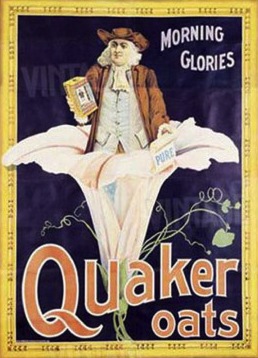
People who had never bought cornflakes were taught to need them; those once content with oats scooped from the grocer’s bin were told why they should prefer Quaker Oats in a box. Advertising, when it was successful, created demand…. Advertising celebrated the new, but many people were content with the old. The most effective marketing campaigns encouraged new needs and desires…by linking the rapid appearance of new products with the rapid changes that were occurring in all areas of social and cultural life.
We have always attached a variety of meanings to food, but within a consumer society, the decisions we make about what to buy and eat are shaped to a large extent by the desires and needs manufactured by a massive advertising industry.
The industrialisation of food production has, as I noted last week, allowed more people to eat better than ever before. But this has come at a cost: we know that many food companies engage in ecologically unsustainable practices, mistreat their employees, hurt animals, and occasionally produce actively harmful food. Moreover, it was part of a process which transformed people from customers into consumers – into individuals whose happiness is linked to what and how much they buy. This does not make us happy – nor is it environmentally or economically sound. Justin Lewis writes:
the promise of advertising is entirely empty. We now have a voluminous body of work showing that past a certain point, there is no connection between the volume of consumer goods a society accumulates and the well-being of its people.
The research shows that a walk in the park, social interaction or volunteering – which cost nothing – will do more for our well-being than any amount of ‘retail therapy’. Advertising, in that sense, pushes us towards maximising our income rather than our free time. It pushes us away from activities that give pleasure and meaning to our lives towards an arena that cannot – what Sut Jhally calls ‘the dead world of things’.
As customers were made consumers, so it is possible for us to change once again. How we are to achieve this, though, is difficult to imagine.
Further Reading
Texts quoted here:
Harvey A. Levenstein, Revolution at the Table: The Transformation of the American Diet (New York: Oxford University Press, 1988).
Susan Strasser, Customer to Consumer: The New Consumption in the Progressive Era,’ OAH Magazine of History, vol. 13, no. 3, The Progressive Era (Spring, 1999), pp. 10-14.
Other sources:
Warren Belasco and Philip Scranton (eds.), Food Nations: Selling Taste in Consumer Societies (New York: Routledge, 2002).
Jack Goody, ‘Industrial Food: Towards the Development of a World Cuisine,’ in Cooking, Cuisine, and Class: A Study in Comparative Sociology (Cambridge: Cambridge University Press, 1982), pp. 154-174.
Roger Horowitz, Meat in America: Technology, Taste, Transformation (Baltimore: Johns Hopkins University Press, 2005).
Tim Jackson, Prosperity without Growth: Economics for a Finite Planet (London: Earthscan, 2009).
Nancy F. Koehn, ‘Henry Heinz and Brand Creation in the Late Nineteenth Century: Making Markets for Processed Food,’ The Business History Review, vol. 73, no. 3 (Autumn, 1999), pp. 349-393.
Rebecca L. Spang, The Invention of the Restaurant: Paris and Modern Gastronomic Culture (Cambridge: Harvard University Press, 2000).
Peter N. Stearns, ‘Stages of Consumerism: Recent Work on the Issues of Periodisation,’ The Journal of Modern History, vol. 69, no. 1 (Mar., 1997), pp. 102-117.
Susan Strasser, ‘Making Consumption Conspicuous: Transgressive Topics Go Mainstream,’ Technology and Culture, vol. 43, no. 4, Kitchen Technologies (Oct., 2002), pp. 755-770.
Lorine Swainston Goodwin, The Pure Food, Drink, and Drug Crusadors, 1879-1914 (Jefferson: McFarland & Co., 1999).
Frank Trentmann, ‘Beyond Consumerism: New Historical Perspectives on Consumption,’ Journal of Contemporary History, vol. 39, no. 3 (Jul., 2004), pp. 373-401.
 Tangerine and Cinnamon by Sarah Duff is licensed under a Creative Commons Attribution-ShareAlike 3.0 Unported License.


 Tangerine and Cinnamon
Feb 23
Secrets
I spent part of this week at a workshop on theorising secrecy and transparency. Based on a variety of readings – on a range of subjects, from drone warfare to the world’s first biometric money, and from women Free Masons in Italy to Wikileaks – we discussed how secrecy and transparency can only exist in relation to one another; how we need secrets in order to function socially; how transparency tends to pertain only to information and not knowledge; and what do we mean by discretion, and privacy?
And so, perhaps inevitably, my thoughts turned to food. We are all fairly familiar with the idea of the secret recipe. KFC markets its chicken as being flavoured with eleven secret herbs and spices. The contents of Worcestershire Sauce and Coca-Cola are closely guarded secrets. Such is the intensity of people’s curiosity around these products, there is now a cottage industry dedicated to discovering just what goes into Seven-Up or Dr Pepper.
One of my favourite episodes of This American Life attempts to recreate what is, apparently, the original, true recipe for Coke. The formula for the syrup on which Coca-Cola is based – called Merchandise 7x – is a very carefully guarded secret. However, the producers of the show managed to track down what seems to have been one of the first recipes for Coca-Cola, in a 1979 edition of the Atlanta Journal and Constitution.
Asa Candler, who founded the company in 1892, did not invent Coke. That person was a chemist, John Pemberton, who, in 1882, created Coca-Cola to sell alongside other drinks and patent medicines. Famously, its name derives from the fact that it contained extract of coca leaf. (Coca-Cola removed cocaine from its recipe in 1903.) After his death, the recipe circulated among other chemists – and it is this formula which was printed in 1979.
It is this formula which Ira Glass asks two people from Jones Soda in Seattle to recreate, but with not particularly encouraging results. They describe it as tasting like Froot Loops, or medicine, or aspirin. After refining the recipe and their ingredients (which include lemon and coriander oil, vanilla, lime juice, and lots of sugar) they arrive at something which approximates Coke so closely that they – and others – find it virtually indistinguishable from the ‘real’ product.
What is so interesting about this investigation is that it suggests that there were once several recipes for Coke circulating around Atlanta and, secondly, that the recipe itself has changed over time. In fact, one of the best indicators of this is the popularity of Mexican Coke. Many claim that it tastes considerably better than the American variety, and this is probably due to the fact that Coca-Cola made in the US now contains corn syrup – which is cheaper – rather than the original cane sugar.
It is unsurprising that manufactures of processed food would want to advertise their products on the grounds that they’re based on fixed, never-changing ‘secret’ recipes. This adds to the ‘specialness’ of the sauce, drink, or seasoning and, most obviously, suggests that these cannot be made at home. In fact, this is probably true: foodstuffs made in factories contain ingredients, and are put through processes, unavailable to the domestic kitchen. Also, unlike home cooking, manufactures are able to claim – despite evidence to the contrary – that these products will – apparently – always be absolutely uniform. One bottle of Worcestershire Sauce is supposed to be exactly the same as the next.
Current campaigns to force food companies accurately to label their products are partly a manifestation of suspicion of the contents of Big Food’s secret processes and recipes. This insistence on transparency is not particularly new, though. Towards the end of the nineteenth century, Heinz – one of the first, and now one of the biggest – food companies in the world distinguished itself from its competitors by selling its sauces and condiments in clear glass bottles.
As concerns about food contamination grew in both the US and elsewhere, Heinz argued that its clear bottles proved to shoppers the purity of their products. Unlike their competitors, they didn’t add lead, chalk, arsenic or any other contaminants to their merchandise. Partly as a result of this, Heinz could ally itself closely to the pure food movement in the US – linked to temperance organisations – as the best example of what an ethical food producer should look like. This made exceptionally good business sense. HJ Heinz was able to exert some influence over the committee responsible for writing the landmark Food, Drink, and Drugs Act of 1906. Although this legislation was designed to end food contamination, it worked to create a uniform, nation-wide set of regulations over the production and marketing of processed food.
Transparency – literally in the case of Heinz – actually enabled food companies to grow their markets across the United States. But although technology and industrialisation change the ways in which we understand and define transparency and secrecy, these have existed in the food world long before the nineteenth century. Chefs and cooks guarded their recipes in the same ways as other artisans and tradespeople protected knowledge about their skills.
I’ve been reading Bill Buford’s fascinating account of a journey through restaurant kitchens and butchers in New York and Tuscany. One of the themes running through Heat is secrecy: in an age where it’s ever-easier to share information, and where chefs are compelled to produce recipe books at regular intervals, how to keep iconic dishes – the food which defines restaurants – secret?
But secrecy is most important for three chefs in Italy and, significantly, all of them women. Intent on learning how to make pasta ‘properly’ (like an Italian, in other words), Buford gets in touch with the best pasta cooks he knows. Firstly, he calls Miriam Leonardi who runs Trattoria la Buca near Parma, and asks to spend some time in her kitchen, learning from her:
Next he tries Valeria Piccini, whose response is similar. This time, though, Buford realises why: ‘was it because she didn’t want to share her pasta secrets?’ He finally manages to secure a place in a small restaurant run by Betta Valdiserri in Poretta. It was here that Mario Batali learned Italian cuisine, and Buford, having spent a year in Batali’s restaurant Babbo, is accepted because of his connection with Batali.
Miriam is, though, as loath to share her secrets, and particularly for tortellini. While she does eventually divulge her recipe, she does so over a period of time, so that Buford needs to make a series of return visits to learn each step in the process of making tortellini:
For all three of these women who have managed to be successful in an industry which is male dominated and frequently sexist, and within a profoundly patriarchal society, keeping secrets becomes a way of claiming power. Their recipes are what define them, as Buford explains:
So although secrecy (and the pretense of transparency) is useful for big food companies, it is also a strategy useful for women negotiating a place within a world often designed to thwart their ambitions.
Sources
Bill Buford, Heat (New York: Vintage Books, [2006] 2007).
Gabriella M. Petrick, ‘“Purity as Life”: HJ Heinz, Religious Sentiment, and the Beginning of the Industrial Diet,’ History and Technology, vol. 27, no. 1 (2011), pp. 37-64.
Tangerine and Cinnamon by Sarah Duff is licensed under a Creative Commons Attribution-ShareAlike 3.0 Unported License.