Public service announcement: The National Assembly is due to vote on the Protection of State Information Bill on Tuesday, 22 November. Please wear black to show your opposition to the Bill, and join the Right2Know Campaign’s protests against this Draconian piece of legislation. (If you’d like to know more about the Secrecy Bill, check out this post I wrote for FeministsSA.)
One of my favourite places in London is Exmouth Market. It was about a five-minute walk from my amazing hall of residence in Bloomsbury, and its street food – some of the best in the UK, apparently – made a pleasingly delicious lunch from time to time. Its book shop, Clerkenwell Tales, is also excellent.
I think, though, that Exmouth Market is best known as the sometime home of Brindisa, the Spanish delicatessen which is also based in Borough Market, and Moro, the restaurant which more-or-less introduced the cooking of Spain, North Africa, and the eastern Mediterranean to Britain. Having cooked from the first Moro recipe book, and having read a great deal about its founders, Sam and Sam Clark, I was curious about the restaurant itself, but I never went further than a detailed perusal of its menu: the place was simply far too pricey for my student budget.
Like so many of the young chefs who led the revolution in Britain’s eating habits during the 1990s and early 2000s, and this includes Jamie Oliver and Hugh Fearnley-Whittingstall, the Clarks had worked at the River Cafe. Founded by Ruth Rogers and Rose Gray, the restaurant was never intended to be more than a canteen for Rogers Stirk Harbour + Partners, the famous architectural firm run by Ruth’s husband, Richard Rogers. But it evolved into something more: into the first restaurant in Britain to emphasise the heavily regionalised and seasonal nature of Italian cuisine. The River Cafe imported Ligurian olive oil, cavolo nero, and Pecorino Romano to replicate the cooking of Italy in London.
It could be terribly precious and seemed to confuse eating ‘authentic’ Italian cuisine with some kind of food-based morality. The River Cafe recipe books exuded the restaurant’s self-righteousness, as Julian Barnes explains:
When the first River Cafe Cook Book came out – the blue one – it drew high praise followed by a certain raillery. Some felt they were having a lifestyle package thrust at them; some felt the emphasis on just this kind of olive oil and just those kinds of lentils was a little discouraging. As James Fenton put it in the Independent at the time: ‘I’ve been picking it up and putting it down for weeks now. I can’t say I’ve actually cooked anything from it. More, what I’m doing is deciding whether I can live up to its exacting standards.’
As many pointed out, the food served by the River Cafe, Moro, and others, is, essentially, peasant food. There is something deeply – and amusingly – ironic about the lefty middle classes (and the River Cafe had a deserved association with the rise of New Labour) paying through the nose to eat bread and cabbage soup, a range of cheap cuts of meat, and polenta.
Polenta is a staple of northern Italy and for all its association with the sophisticated eating of the 1990s, it’s really only cornmeal – or maize– or mielie meal, as we’d call it in South Africa. Partly because of the endless variety of the maize plant, cornmeal comes in both yellow and white and can be ground as finely or as coarsely as tastes demand. In fact, the difference between the yellow, medium-ground cornmeal used to produce polenta or the finer-textured yellow flour for cornbread from the American south, and the fine, white cornmeal favoured for mielie pap in South Africa is minimal.
People’s preferences for yellow or white cornmeal are, then, culturally determined. A recent article published by the magnificent Mail and Guardian explores South Africa’s taste for whiter, finer maize meal:
In the poorest communities a bag of maize meal is often the only way of satisfying a family’s hunger, and the cost factor plays a role too. An 80kg bag of maize meal is about R400: on a 500g portion a person a day, an extended family of 10 people would consume an 80kg bag in about 16 days. The daily total consumption of maize meal in South Africa is about 10 000 tonnes.
But these maize-meal consumers demand a product that is white – stripped of roughage and nutrients – and manufacturers have remodelled their businesses to serve this demand.
South Africa’s best-selling brand of maize meal is White Star, produced by Pioneer Foods. White Star is whiter and finer than other brands. Premier Foods and Tiger Brands, the country’s other two big producers of maize meal, have also invested in technology which produces this whiter maize meal.
In the pursuit of whiteness, the big millers began installing new-generation degerminators about a decade ago. In the grinding process, the degerminator extracts the greyish germ of the maize, which contains oil and other nutrients. The more of the germ extracted, the whiter and blander the end product.
Maize meal that has the least germ extracted is called ‘unsifted’; moving up the scale it becomes ‘sifted’, ‘special’ and ‘super’. Unsifted and sifted maize-meal products have been discontinued by the bigger millers. ‘Super’ is generally defined by millers as having less than 1% oil and it almost exclusively consists of the starchy endosperm. Degerminators were originally expensive technology used only by large mills, but today even relatively small maize millers have them.
The latest development in the quest for greater whiteness is colour-sorting machines, which examine every grain of maize and remove any discoloured (non-white) grain. …
A manager at Premier Foods’ Kroonstad mill, the largest in the world, said there might nevertheless still be some discoloured specks in the final product, which happened when the seed was white on the outside but had discolouration within.
Removing the germ from the maize meal means that it tastes blander and has a longer shelf life (the germ contains oil which goes off quickly). It also means that the meal is considerably less nutritious – even though South African millers do fortify maize meal and wheat flour with vitamins A, B1, B2, and B6, as well as niacin, folic acid, iron, and zinc. And what happens to the discarded germ? It goes into cattle feed, rendering animal feed more nutritious than human food.
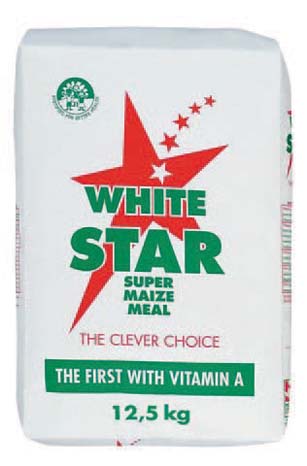
This demand for white food is neither particular to South Africa – there is a similar trend in Mexico, for instance – nor is it a recent phenomenon. Historically, food that is white – white bread, white sugar, white rice, or white maize meal – is more expensive to produce because it needs to be processed in order to rid it of those impurities or elements which cause it to be darker in colour. white food is associated with wealth and luxury.
The coming of industrialised food production caused an increase in the scale of the adulteration of food to make it go further or seem more appealing. As a result of this, whiteness was associated increasingly with purity. Ironically, though, food producers used poisonous additives like caustic lime to make bread and other products whiter.
The production of food in factories also reduced its price, and this was particularly noticeable for highly processed products like white sugar and white flour. Now produced on a mass scale, even the very poor could afford to drink white sugar in their tea. Indeed, white bread and sugar came to be seen as ‘affordable luxuries’ from the end of the nineteenth century and into the twentieth. These were comforting, ‘special’ items which could make an already meagre diet seem more luxurious. George Orwell wrote in The Road to Wigan Pier (1937):
The miner’s family spend only tenpence a week on green vegetables and tenpence half-penny on milk (remember that one of them is a child less than three years old), and nothing on fruit; but they spend one and nine on sugar (about eight pounds of sugar, that is) and a shilling on tea. The half-crown spent on meat might represent a small joint and the materials for a stew; probably as often as not it would represent four or five tins of bully beef. The basis of their diet, therefore, is white bread and margarine, corned beef, sugared tea, and potatoes – an appalling diet. Would it not be better if they spent more money on wholesome things like oranges and wholemeal bread…? Yes, it would, but the point is that no ordinary human being is ever going to do such a thing. The ordinary human being would sooner starve than live on brown bread and raw carrots. And the peculiar evil is this, that the less money you have, the less inclined you feel to spend it on wholesome food. A millionaire may enjoy breakfasting off orange juice and Ryvita biscuits; an unemployed man doesn’t. … When you are unemployed, which is to say when you are underfed, harassed, bored, and miserable, you don’t want to eat dull wholesome food. You want something a little bit ‘tasty’. There is always some cheaply pleasant thing to tempt you. Let’s have three pennorth of chips! Run out and buy us a twopenny ice-cream! Put the kettle on and we’ll all have a nice cup of tea! … White bread-and-marg and sugared tea don’t nourish you to any extent, but they are nicer (at least most people think so) than brown bread-and-dripping and cold water. Unemployment is an endless misery that has got to be constantly palliated, and especially with tea, the English-man’s opium. A cup of tea or even an aspirin is much better as a temporary stimulant than a crust of brown bread.
In the same way, in the midst of rising food prices and a stagnating job market, South Africa’s poor buy white, fine maize meal.
However, there does seem to be a surprising shift in bread sales, as lower-income consumers appear to be buying more brown bread – as opposed to the white bread they usually favour. This, though, is probably due to the fact that brown bread costs less because it’s exempted from value-added tax. This is a change caused by necessity rather than a new set of ideas around white or brown bread.
As Orwell makes the point, it’s the association of comfort with particular kinds of food which renders them more attractive – even if a diet rich in white sugar and white bread is not at all healthy. A combination of education, affluence, and a new set of values which associate unprocessed, ‘whole’ food – wholegrain bread, whole wheat flour, brown or wild rice, and sticky brown sugar – cause the middle classes to favour products which are overwhelmingly more nutritious.
It is infinitely strange that former peasant food – like polenta – should be sold at a premium to the middle classes at restaurants, while those who are poor prefer white maize because of an association with luxury and wealth. If we are to encourage more people to eat better, it’s clear that we need to lower the prices of ‘whole’ foods. But changing people’s buying habits is related more to a set of cultural assumptions about whiteness than to cost or even knowledge about their nutritional value.
Further Reading
Sources cited here:
Julian Barnes, The Pedant in the Kitchen (London: Atlantic, 2003).
Warren Belasco, Meals to Come: A History of the Future of Food (Berkeley: University of California Press, 2006).
Sidney W. Mintz, Sweetness and Power: The Place of Sugar in Modern History (New York: Penguin, 1985).
George Orwell, The Road to Wigan Pier (London: Gollancz, 1937).
Lorine Swainston Goodwin, The Pure Food, Drink, and Drug Crusadors, 1879-1914 (Jefferson: McFarland & Co., 1999).
Other sources:
Joyce Appleby, The Relentless Revolution: A History of Capitalism (New York: WW Norton, [2010] 2011).
Warren Belasco and Philip Scranton (eds.), Food Nations: Selling Taste in Consumer Societies (New York: Routledge, 2002).
Jack Goody, ‘Industrial Food: Towards the Development of a World Cuisine,’ in Cooking, Cuisine, and Class: A Study in Comparative Sociology (Cambridge: Cambridge University Press, 1982), pp. 154-174.
Harvey A. Levenstein, ‘The Rise of the Giant Food Processors,’ Revolution at the Table: The Transformation of the American Diet (New York: Oxford University Press, 1988), pp. 30-87.
Anne EC McCants, ‘Poor consumers as global consumers: The Diffusion of Tea and Coffee Drinking in the Eighteenth Century,’ Economic History Review, vol. 61 (2008), pp. 172-200.
Sidney W. Mintz, ‘Sweet, Salt, and the Language of Love,’ MLN, vol. 106, no. 4, French Issue: Cultural Representations of Food (Sep., 1991), pp. 852-860.
Sidney W. Mintz, Tasting Food, Tasting Freedom (Boston: Beacon Press, 1996).
James Walvin, Fruits of Empire: Exotic Produce and British Taste, 1660-1800 (Basingstoke and London: Macmillan, 1997).
 Tangerine and Cinnamon by Sarah Duff is licensed under a Creative Commons Attribution-ShareAlike 3.0 Unported License.


 Tangerine and Cinnamon
Nov 6
Dude Food
A couple of weeks ago Tamar Adler, former chef and editor of Harper’s Magazine, wrote an article for the New Yorker in which she politely and neatly eviscerates Anthony Bourdain for leaving ‘a crude hickey’ on America’s ‘food culture’. Although he is probably now better known – at least in the US – for his food-and-travel television series, Bourdain rose to fame, or notoriety, for his memoir Kitchen Confidential: Adventures in the Culinary Underbelly (2000).
It is a deeply entertaining, amusing, and often instructive guide to the strange world of restaurants and professional cooking. It explores the ‘personal and institutional perversity that runs fast through the veins of restaurants’. Bourdain details the astonishingly crude language and behaviour of badly paid, sleep deprived chefs in the hot, tiny restaurant kitchens he worked in and, later, oversaw. But it is also an excellent introduction to the mechanics and the politics of how kitchens function.
Although Bourdain and his crew do some pretty repellent things, all this is balanced by the fact that, as Adler notes, Bourdain does ‘not prescribe that life, or condone it.’ Indeed, he devotes a whole chapter to kitchens which don’t run the risk of collapsing into anarchy and violence if the chef for one moment ceases swearing at the staff. He admits:
He adds:
And that is the issue with Bourdain’s description of the food world: it is overwhelmingly, completely male. The women chefs whom he respects are those who are ‘tough-as-nails, foul-mouthed, trash-talking’ – the ones who go out of their way to fit in to ‘the testosterone-heavy’ world of restaurant kitchens. But, at least in Kitchen Confidential, he acknowledges that there are kitchens where women aren’t expected to put up with being groped, or with their colleagues festooning their stations with pornography. Visiting Scott Bryan’s restaurant Veritas he notices
She was, in other words, ‘generally holding down her end like an ass-kicking, name-taking mercenary of the old school, only cleaner and better.’ It turned out that she’d been trained by Alain Ducasse.
The problem is that Bourdain loses much of this self-reflection in his later books and series. As he became better known ‘he confused what he’d written about once with the world itself.’ Adler explains:
His relationship with – and views on – food have become centred around his masculinity:
Although I agree with Adler’s point that it’s a pity that he feels the need to dress up his opinions on food in a kind of gung-ho machismo because much of what he says is worth listening to, it was time that someone called out Bourdain for his casual sexism. Bourdain seems to insist that good cooking can only be produced by kitchens overseen by obsessive, potentially murderous alpha males caught up in a kind of adolescent, On the Road-like existential struggle with the meaning of existence. Women – unless they behave like men – are to be viewed with suspicion, as is the food which he associates with them:
It’s no coincidence that most pastry chefs are women. Bourdain implies that pastry, like women, is difficult, too sweet, boring, and unimaginative: real chefs are men – wild, creative genuises – who cook ‘Flintsone-sized lengths of veal shank,’ understand the value of bones, and who carry long, sharp knives.
For an industry with a reputation for not dealing adequately with charges of ingrained discrimination against women, Bourdain’s attitudes towards food and cooking certainly don’t help. But it’s worth noting that for all the excitement that surrounded the publication of Kitchen Confidential – when it was hailed as a fresh and unconventional take on America’s restaurant world, which it was, to some extent – Bourdain’s views on the relationship between masculinity and food are neither particularly new, nor limited to himself.
There has long been an association between meat-eating and manliness. Until the late eighteenth century, when eating in moderation and a slim physique were connected, increasingly, with the ideal Enlightenment male, a healthy appetite for wine and meat indicated strength and vitality. In England, a taste for roast beef was, as Roy Porter notes, linked to a patriotism which associated roast meat with English vigour and virility. Even a century later, Victorians argued that men’s strong, machine-like bodies needed meaty fuel in order to function efficiently.
Men, in other words, needed to eat ‘man food’ – spicy, strong-flavoured, and rich in protein. This was taken to a logical – or an illogical, depending on your point of view – extreme by the Italian Futurists and Mussolini-enthusiasts FT Marinetti and Luigi Colombo in their 1930 Manifesto of Futurist Cooking. Of course, the document is completely mad – like just about everything Marinetti did – but it’s a useful window on to the ways in which fascists of the 1930s understood gender. As the Italian state recast women as mothers – and only mothers – of the nation, so men were urged to become its warrior-protectors.
Marinetti and Colombo write:
Italians should do this, they argue, by giving up pasta:
They suggest that rice take the place of pasta. But this is only the first of several ideas for the remaking of food for a faster, more efficient future. Their most significant point was that science should ‘take on the task of providing the body with its necessary calories through equivalent nutrients provided free by the State, in powder or pills, albumoid compounds, synthetic fats and vitamins.’ Not only would this make Italians better-fuelled and more efficient workers, but it would reduce the amount of food they ate.
Those few meals which they would then eat would be, as they write, ‘perfect’. Given the role of Italian women in feeding their families, what Marinetti and Colombo advocate is a kind of man-made food: the dishes they describe for their ‘perfect meals’ – like the Woodcock Mount Rose with Venus sauce – are invented by chefs.
Although their remaining ideas are increasingly ludicrous – ‘The rapid presentation, between courses, under the eyes and nostrils of the guests, of some dishes they will eat and others they will not, to increase their curiosity, surprise and imagination’ and ‘The creation of simultaneous and changing canapés which contain ten, twenty flavours to be tasted in a few seconds’ – their association of ‘perfect’ cooking with men, and homely, everyday cooking with women, was – and is – hardly unusual.
A great deal has been written about the irony that while most of the world’s ‘top chefs’ – whatever we may mean by that – are male, the overwhelming majority of people who cook to feed their families are female. I think that this distinction is something of an oversimplification: while it is certainly true that the most Michelin-starry chefs are still male, this is changing, albeit slowly. More importantly, the chefs and cooks who have had the greatest impact on the way we all cook in the twentieth and twenty-first centuries have, arguably, been women: Constance Spry, Marguerite Patten, Delia Smith, and Madhur Jaffrey in Britain; Julia Child and Martha Stewart in the US; Nitza Villapol in Cuba; Stephanie Alexander and Maggie Beer in Australia; and Ina Paarman, Ina de Villiers, and Lynn Bedford Hall in South Africa.
Moreover, there has been a recent and relatively widespread decrease in tolerance for the antics of bullying, super-macho male chefs. Gordon Ramsay’s spectacular fall from grace – the collapse of his business empire, the decline in quality of his restaurants – is a particularly good example of this. Adler’s take-down of Bourdain is part of this trend – and it’s particularly telling that Bourdain devotes his highest praise to Ramsay (‘England’s greatest chef’) in A Cook’s Tour: In Search of the Perfect Meal (2001), excusing and celebrating Ramsay’s reputation as a bully on the grounds of gender:
This kind of macho chest-beating now feels distinctly passe. The male celebrity chefs of the late 2000s and early 2010s are an altogther nicer, kinder group of chaps: from earth-warrior Hugh Fearnley-Whittingstall and home-cooking dad Jamie Oliver, to shambling Valentine Warner and lovely Nigel Slater. We have cerebral, thoughtful Fergus Henderson and Heston Blumenthal.
I’m not absolutely sure what this shift in public taste suggests – and it’s certainly part of a wider, cultural change, which has seen Ryan Gosling and James Franco replace Sylvester Stallone and Steven Segal as male icons. It’s also occurred at the same time as the emergence of a food trend which can only really be described as ‘dude food’ – food made to appeal to men. Craft beer, the wild enthusiasm for bacon, even the recent rediscovery of the burger, are, I think, driven partly by a belief – held by magazine editors, television producers, and some food writers – that food needs to be made ‘manly’ to appeal to men. Tellingly, most of this is pretty meaty food.
What I find so interesting about dude food is that it’s directed at a generation of young men – my contemporaries and younger – for whom cooking is not necessarily seen as being, as Bourdain noted earlier, something that only women do. Unless I have the good fortune only to have dated, and to be friends with, peculiarly enlightened men, it seems to me that Generation Y men don’t seem to feel that cooking and baking undermine their masculinity. After all, not only were all three finalists on the last series of Great British Bake Off men, but two of them were fairly young. So is dude food a kind of ironic embrace of the manly, meaty food associated with being male since, at least, the seventeenth century – much in the same way that contemporary feminists have reclaimed baking and, crucially, the cupcake – or is it something else altogether? Either way, I can’t imagine that Marinetti would be all that pleased.
Sources
Anthony Bourdain, A Cook’s Tour: In Search of the Perfect Meal (London: Bloomsbury, 2001).
Anthony Bourdain, Kitchen Confidential: Adventures in the Culinary Underbelly (London: Bloomsbury 2000).
Roy Porter, Flesh in the Age of Reason: How the Enlightenment Transformed the Way We See Our Bodies and Souls (London: Penguin, 2003).
Tangerine and Cinnamon by Sarah Duff is licensed under a Creative Commons Attribution-ShareAlike 3.0 Unported License.