
Closing the Stable Door
About a month ago, the ever-amazing Bill Nighy argued in an interview with the UK’s Sunday Independent that hunger – whatever we may mean by that – could be eradicated by forcing big multinationals to pay their taxes. Nighy, who is a spokesman for the anti-hunger If Campaign, has a point. As a Guardian investigation demonstrates, these global businesses and their subsidiaries go out of their way not to pay their taxes – something which hits developing nations particularly hard:
The Zambian sugar-producing subsidiary of Associated British Foods, a FTSE100 company, contributed virtually no corporation tax to the state’s exchequer between 2007 and 2012, and none at all for two of those years.
The firm, Zambia Sugar, has recently posted record pre-tax profits and its huge plantation is increasing its capacity to produce more sugar for markets in Europe and Africa. Yet it paid less than 0.5% of its $123m pre-tax profits in corporation tax between 2007 and 2012.
The company benefits from generous capital allowance and tax-relief schemes in Zambia, but the investigation also found that it funnels around a third of its pre-tax profits to sister companies in tax havens, including Ireland, Mauritius and the Netherlands. Tax treaties between Zambia and some of those countries mean the state’s revenue authorities are unable to charge their normal tax on money leaving their shores.
If businesses like Associated British Food paid their taxes in countries like Zambia, then, the logic goes, these governments would have enough money to ensure that everyone would have access to enough food.
But tax evasion has implications for everyone’s food supply, and not only those who live in low- to middle-income countries. As the recent horsemeat scandal in Europe shows, the presence of horsemeat in ready meals and fast food products was partly the work of a network of businesses which managed to evade both (admittedly shambolic) regulators and tax by operating through scrutiny-free offshore companies.
Romanian horsemeat entered the European food chain when meat from two abattoirs was sold to Draap Trading Limited, which sold the meat to European food companies, like the meat processor Spanghero – whose licence was suspended earlier this month after being accused of knowingly mislabelling horsemeat as beef in some of its products.
Draap Trading Limited operates in the Netherlands, but is registered in tax-flexible Cyprus. Its sole shareholder is a firm based in the British Virgin Islands, another tax haven. Not only does this arrangement allow Draap to avoid paying tax, but it becomes almost impossible to identify Draap’s shareholder. Investigators suggest that the shareholder may be linked to a collection of Russia-linked offshore companies which have, in the past, been involved in high-profile transactions in Russian industry. Importantly, there are allegations that these businesses are connected to gang activity.
Exciting as these revelations may be, this is certainly not the first time that food adulteration has been linked to organised crime. In Italy, write Anna Sergi and Anita Lavorgna:
The Cosa Nostra, the Camorra and the ’Ndrangheta have long sought to gain a foothold in the fruit and vegetable market, which is one of the most profitable markets in southern Italy. Police investigations over the past two years indicate that mafia families are beginning to have a presence in every stage of the agricultural market – from production to transport. The illegal activities are numerous and market distortion is fundamentally based on the monopoly to transport and distribution in the south, but the phenomenon is widespread across Italy.
The clans have been entering every stage of production – from cultivating products to transporting goods to local markets. It is a business that involves approximately 150 different crimes every day, according to SOS Impresa (an association of Italian business owners created to combat organised crime) and an estimated one third of farmers are affected by this.
Crimes include ‘theft of machinery and tools; extortion; the theft of livestock and cattle; unregulated butchery practices; fraudulent claims for EU funds; and the exploitation of labour.’ These have appalling consequences for the environment, employment practices, and, indeed, food safety – particularly because the clans not only ignore regulations around hygiene and animal welfare, but are also involved in the illegal butchering and trafficking of potentially contaminated meat.
In the US, the Mafia and pizzerias have a long and complicated relationship. Between 1985 and 1987, the Pizza Connection Trial revealed that mobsters had used a collection of pizza parlours as fronts for the sale and collection of heroin and cocaine. Throughout the twentieth century, though, the mob controlled supplies of ingredients to pizzerias. For instance,
Al Capone – who owned a string of dairy farms near Fond du Lac, Wisconsin – forced New York pizzerias to use his rubbery mob cheese, so different from the real mozzarella produced … in New York City since the first immigrants from Naples arrived in Brooklyn around 1900.
As the story goes, the only places permitted to use good mozzarella made locally were the old-fashioned pizza parlours like Lombardi’s, Patsy’s, and John’s, which could continue doing so only if they promised to never serve slices. … Apparently, neighbourhood pizzerias that served slices and refused to use Capone’s cheese would be firebombed.
As the connection between organised crime and food is nothing new, so is the link between food and tax evasion. Nicholas Shaxson begins his excellent Treasure Islands: Tax Havens and the Men Who Stole the World (2011) with an account of the incredible wealth and power of the Vestey brothers. These two men controlled the meat industry during the early twentieth century. Ian Phimister explains:
Prior to 1914, Vesteys had interests in South America, China and Russia, and extensive land holdings in South Africa; it gradually extended its operations to embrace Australia, New Zealand and Madagascar. The company also owned ‘five steamers refrigerated and fitted for the carriage of frozen meat which they use largely for their own trade. Major expansion occurred, however, primarily after the war when in 1922 they absorbed the British and Argentine Meat Company. Vesteys had previously owned over 3,000 butcher shops in England, and the take-over added between 800 and 900 shops to that total. Overall, it was thought that the ‘deal gave Vesteys control over one-quarter of the Argentine export trade.’ On the other side of the world, Vesteys leased 20 million acres in northern Australia where they ran 300,000 cattle. Generally speaking, these were low-grade animals, but their low cost of production gave Vesteys a competitive selling edge, especially during the Great Depression when beef prices collapsed. There were no rail charges because cattle were ‘walked’ to the freezing works, and labour costs were the envy of even South Rhodesia: ‘they employ about 200 aborigines who do not seem to have advanced as far as our natives – at any rate they are only starting to ask for money wages.’
Essentially, Vesteys owned every link in the food chain: from the land on which cattle were farmed, to abattoirs and newly-invented cold storage warehouses, to refrigerated ships and the butchers who sold the meat to shoppers in Britain. But they didn’t limit themselves to beef: they shipped eggs, chicken, ducks, pork, and dairy products from China and Russia, as well as mutton from Australia and New Zealand.
What the example of Vesteys demonstrates – above all – is that big food multinationals have existed since the early twentieth century and have used the same tactics for more than a hundred years. Monsanto and Cargill have the same monopolistic instincts and low regard for labour rights and animal welfare as Vesteys. Moreover, our food supply has been globalised for as long – if not longer – and the myth that once upon a time all butchers were independent and totally ethical is, well, just that – a myth.
But Vesteys also illustrates how food companies dodge taxes. William and Edmund Vestey went out of their way never to pay tax if they could help it. When the British government began to tax British companies on profits earned abroad, to raise funds for the war effort in 1914, the Vestey brothers first lobbied against the measure, and then upped sticks to Chicago and then Buenos Aires, to take advantage of America and Argentina’s less onerous systems of taxation.
They used a range of strategies now commonplace among multinationals to channel their profits away from countries with high tax rates – the countries, in other words, where they did business. Also, in 1921 the Vesteys established a trust based in Paris which the British authorities could not tax (they didn’t even discover it until 1929). Giving evidence to a Royal Commission established to investigate how to tax multinational businesses, William Vestey summed up his attitude towards taxation:
If I kill a beast in the Argentine and sell the product of that beast in Spain, this country can get no tax on that business. You may do what you like, but you cannot have it.
In 1934, Argentinian authorities which had long been uneasy about the brothers’ cutthroat business practices came across a cache of secret documents hidden under a pile of guano on their ship, the Norman Star. The investigation launched after finding this deeply incriminating evidence was blocked and manipulated at every turn by the Vesteys – who were particularly concerned by British authorities’ interest in it. In the end, the man in charge of the committee and with the greatest knowledge of the Vesteys’ tax evasion systems, Senator de la Torre, shot himself in 1939, leaving a suicide note ‘which expressed his disappointment at the general behaviour of mankind.’
The British government never succeeded in making Vesteys pay its full tax bill. In 1980 it was revealed that two years previously, the Vesteys’ Dewhurst chain of butchers had paid only £10 tax on a profit of more than £2.3 million. As one official commented: ‘Trying to come to grips with the Vesteys over tax is like trying to squeeze a rice pudding.’
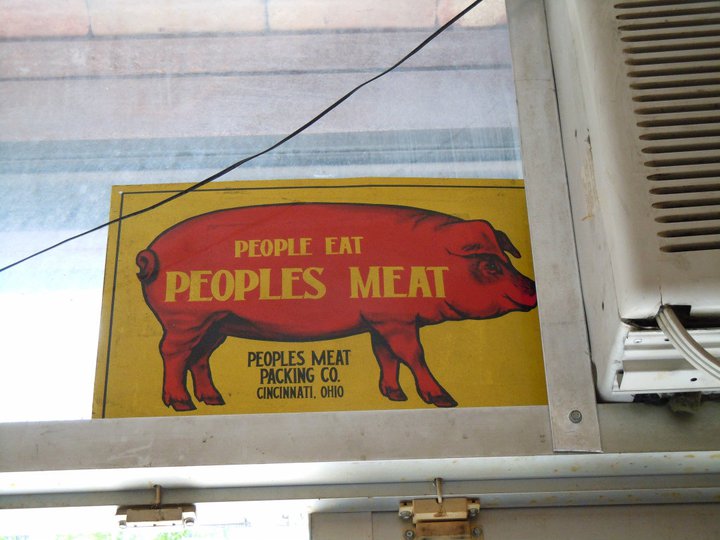
A poster in Williamsburgh’s Spoonbill & Sugartown bookshop
The only way to prevent tax evasion and organised crime is through better policing and enforcement of the law. But when food is involved, it is absolutely crucial for efficient regulatory bodies to be put in place. The publication of Upton Sinclair’s novel The Jungle in 1906, which exposed the appalling conditions under which people worked and cattle were slaughtered in Chicago’s meat packing industry, so appalled readers that momentum behind legislation to enforce standards of animal welfare and hygiene and prevent food adulteration, gathered. The same year, Teddy Roosevelt signed the Pure Food and Drugs Act into law. Even though sustained lobbying from big food had weakened America’s regulatory bodies – and has allowed for an increase in instances of contaminated food being recalled – American food is considerably safer now than it was at the end of the nineteenth century.
Without regulation, disasters like the recent milk scandal in China, can occur. Indeed, in 2011 a study published in the Chinese Journal of Food Hygiene estimated that more than 94 million people in China become sick – and 8,500 die – each year from food poisoning. Other than the discovery of melamine in milk and infant formula, there have also been scandals around ‘meat containing the banned steroid clenbuterol, rice contaminated with cadmium, noodles flavored with ink and paraffin, mushrooms treated with fluorescent bleach and cooking oil recycled from street gutters.’
Rotten peaches pickled in outdoor pools surrounded by garbage are spiked with sodium metabisulfite to keep the fruit looking fresh and with bleaching agents and additives harmful to the human liver and kidneys. The peaches are packed in uncleaned bags that previously held animal feed and then shipped off to big-brands stores.
These discoveries – of deadly infant formula, endemic tax evasion among big food companies, food cartels, forged hygiene certificates, forced labour, and deliberately mislabeled meat – are made only at the end of a series of criminal acts. Trying to fix food systems at the point at which food scandals are discovered – by blaming shoppers for buying cheap meat or for supporting multinational companies – avoids tackling the major, systemic problems which allow for businesses not to pay tax, or for criminals to take over the food chain. It’s like shutting the stable door after the horse has bolted.
Sources
Jennifer Ning Chang, ‘Vertical Integration, Business Diversification, and Firm Architecture: The Case of the China Egg Produce Company in Shanghai, 1923-1950,’ Enterprise and Society, vol. 6, no. 3 (September 2005), pp. 419-451.
Arlene Finger Kantor, ‘Upton Sinclair and the Pure Food and Drugs Act of 1906: “I Aimed at the Public’s Heart and by Accident I Hit It in the Stomach,”’ AJPH, vol. 66, no. 12 (December 1976), pp. 1202-1205.
I. R. Phimister, ‘Meat and Monopolies: Beef Cattle in Southern Rhodesia, 1890-1938,’ Journal of African History, vol. 19, no. 3 (1978), pp. 391-414.
Anna Sergi and Anita Lavorgna, ‘Trade Secrets: Italian Mafia Expands its Illicit Business,’ Jane’s Intelligence Review, September 2012, pp. 44-47.
Nicholas Shaxson, Treasure Islands: Tax Havens and the Men Who Stole the World (London: Vintage, [2011] 2012).

Tangerine and Cinnamon by Sarah Duff is licensed under a Creative Commons Attribution-ShareAlike 3.0 Unported License.



 Tangerine and Cinnamon
Apr 21
The Cult of Authenticity
Last weekend I went to a wedding in Napier, a village in the rural Overberg, about a two-hour drive from Cape Town. I saw a family of baboons sunbathing on the Akkedisberg mountain pass; went to a church bazaar and bought jam; and saw a shop (alas closed at the time) which sold ‘piesangs, psalmboeke en dinamiet’ (bananas, prayer books, and dynamite).
It was a very good weekend indeed. And made even better by the quantities of excellent food which I ate. I was struck, though, by the numbers of restaurants in Napier which advertised their menus as being particularly ‘authentic’. Napier is experiencing a kind of low-key gentrification at the moment, so this isn’t really all that surprising. But it was amusing how the idea of what is authentic was stretched beyond all recognition.
I had lunch at a place which specialises in ‘authentic tapas’ and was advised to order two items, as tapas are, well, small plates. I doubt that the vat of curried sweet potato soup and mound of salad, which included the best part of a head of butter lettuce and two avocados, I was served bore even the remotest resemblance to the tapas of Barcelona. But they were delicious.
I was wondering why, though, a café in a remote South African village would stake so much on serving authentic tapas. There is, I suppose, a kind of thrill in eating exotic, ‘real’ tapas. Even so, most of its clientele are unlikely to have sampled the real thing or, even, to care about the authenticity of their supper. (I don’t mean this in a patronising way. Travel abroad is expensive.)
This is part of a wider cultural trend, where people who describe themselves as ‘serious’ about food (I’m not entirely sure what that means) claim to be able to distinguish between those dishes which are really authentic – which are absolutely true replicas of the ‘original’ dish – and those which have been adulterated through adaptation.
For instance, Cape Town’s best Mexican restaurant El Burro advertises itself as ‘authentic’ Mexican cuisine, and local reviewers go out of their way to emphasise just how authentic its menu is: here is no inauthentic Tex- or Cal-Mex cooking, but, instead it is the Real Thing. (How many of them have actually visited Mexico is open to debate.)
There is, really, no such thing as ‘authentic’ Mexican – or Italian, or Spanish, or Greek, or Indian, or Thai, or Norwegian – cuisine. These, and other countries, have a range of cuisines, which differ from region to region, and which have also changed over time. As Jeffrey Pilcher argues in his recent book Planet Taco: A Global History of Mexican Food, it is more accurate to refer to a number of Mexican cuisines which exist simultaneously both within and without the borders of the country.
The problem with trying to identify ‘authentic’ cuisine is that it’s rather like trying to nail jelly to the wall. The same dish will vary from area to area – from household to household – in one country. I have seen recipes for ‘authentic’ risotto which assert, with equal vehemence, that it should be so thick that you can stand a spoon in it or, equally, that it should be liquid and flowing. My mother’s recipe for bobotie – a South African delicacy – contains grated apple. My friend Carina’s mother’s recipe has no apple, but, rather, raisins. Which is the authentic version? Both. Neither.
Food changes over time. In the early twentieth century, the medical doctor, poet, Afrikaner nationalist, and Buddhist C. Louis Leipoldt recorded a recipe for bobotie which, in today’s terms, would be understood as a meatloaf: it was not the dish that, today, we think of as being bobotie – a layer of spiced, slightly sweet minced meat underneath a buttermilk and egg custard. Although according to the European Union, authentic Cornish pasties may contain only beef, swede, and potatoes, there is plenty of evidence to suggest that Cornish miners in the past had a range of ingredients in their pies – and not only this holy pasty trinity.
There is also the problem of anachronism. Mexico became an independent state in 1810 and its borders changed over the course of the nineteenth century. Should only those dishes which were made within the country’s present boundaries be considered ‘Mexican’? The state of Texas remained part of Mexico until 1836, and significant numbers of Mexicans settled in the United States – particularly in New Mexico, California, and Arizona. Should we consider Texan cuisine to be Mexican? And, surely, it would be churlish somehow to consider the cuisine developed by Mexicans in the United States as somehow being of less value than that prepared by Mexicans in Mexico (whatever we may mean by ‘Mexico’)?
So which version do we accept as being the ‘real’ version of a dish? Which one is ‘authentic’? More often than not, a range of factors not particularly linked to food influence our decisions over what is considered to be properly authentic. There is a connection, for instance, between nationalism and cookery books. During the nineteenth century, middle-class Mexicans living in the United States used food both to maintain links with Mexico, as well as to assert the sophistication of Mexican culture. Encarnación Pinado’s El cocinero español (The Spanish Chef), published in 1898, described a Mexican cuisine made using modern technology, and incorporating dishes from Mexico, European, and the Mexican-American borderlands.
Something similar happened in Italy, as Tim Hayward explains:
In fact, a lot of what we consider to be ‘real’ Italian food today, was created in a dialogue between Italian immigrants in the United States and Italians at home. Even relatively poor immigrants could afford the tomatoes, dried pasta, olive oil, meat, and dairy products which constituted the feast dishes of the homeland. This invented ‘traditional’ cuisine was used to construct and delineate new immigrant Italian identities. Overseas demand for the products of ‘home’ stimulated the Italian food industry – and the mass production of tinned tomatoes and other products made them more easily available in Italy. This American connection of Italian identity with a particular kind of Italian cooking was also exported back to Italy.
Authentic cuisines are, then, heavily constructed. There is no direct, unmediated way of accessing the food of the past. Indeed, it is also pretty difficult to replicate the cooking of foreign countries at home. Rachel Laudan notes that if she were to write a cookbook on ‘authentic’ Mexican cooking, she would have to take into account the difficulty of finding many ingredients outside of Mexico:
Also, she argues that she would be constrained by middle-class Americans’ own ideas around what should constitute Mexican cuisine. The cult of authenticity is informed not only by snobbery (being able to identify and cook the ‘real thing’ is a marker of sophistication), but also by a powerful nostalgia for a pre-industrialised food past where all cooking was done from scratch:
This is a nostalgia produced by anxieties around change and a perceived homogenisation of the world’s diets. It is partly as a result of this concern that old ways of cooking and eating are being ‘lost’ that the EU introduced a protected geographical status framework in 1993, which provides legal protection to certain dishes and products in the EU, preventing them from being copied elsewhere. So only sparkling wine produced in Champagne can be called ‘champagne’, and only Prosciuitto Toscano made in Tuscany can be called Prociutto Tascano.
For all that this is an attempt to preserve a food heritage, as the philosopher Julian Baggini makes the point, the EU actually decides what is authentic and what is not:
Similarly, UNESCO’s recognition of Mexican cuisine, the French ‘gourmet meal’, the Mediterranean diet, and the gingerbread craft of Northern Croatia as the ‘intangible patrimony of humanity’ in 2010, fixed these culinary traditions in aspic. Also, the Mexican application focussed on only one regional cuisine, the ‘Michoacán paradigm,’ which, interestingly, happened to feature the home state of the President, Felipe Calderón…
This recognition from UNESCO will boost the region’s tourism, and EU appellations have helped many small producers in Europe to continue to work in difficult economic times. The mania for ‘authenticity’ helps, inadvertently, to force our attention to how people cooked and ate in the past – to look at methods, ingredients, and cultivars which we may have forgotten. We shouldn’t try to return to the past, but we can certainly learn from it.
My problem with the cult of authenticity – other than its tedious pedantry – is that it conflates eating ‘authentically’ with some ability to make a meaningful difference in the world. More often that not, peasant food is labelled authentic food. Even the most passing familiarity with what most poor people eat will demonstrate that people’s diets improve as their disposable income increases. Peasant food in Italy before the mid-twentieth century was nutritionally inadequate: it consisted of bread and polenta with onions oil and, occasionally, cheap fish and vegetables.
There is nothing wrong with eating peasant food, but it is deeply problematic to believe that eating ‘real’ peasant food represents a solidarity with the struggles of the poor. In fact, it’s a distraction from the ways in which food and big agricultural companies exploit labourers and put small and peasant farmers out of business.
Food is political. Particularly if it’s ‘authentic.’
Tangerine and Cinnamon by Sarah Duff is licensed under a Creative Commons Attribution-ShareAlike 3.0 Unported License.