
Peas in a Pod
For various reasons I once attended a talk by Tim Noakes, the sport scientist-turned-diet guru. I use the world ‘guru’ deliberately. Although many of his arguments are thought-provoking and, to some extent, compelling – essentially, he suggests that we should switch to a low-carbohydrate, protein-based, high fat diet – much of what he said was undermined by the manner of his delivery.
He presents his findings in the manner of a big tent evangelist. In a room packed to capacity by the middle classes anxious to discover the elixir of thinness, Noakes spoke for almost two hours, painting himself as a champion of natural eating, maligned by Big Food companies hell bent on making us eat more sugar and carbohydrates. If the back row had leapt to its feet, shouting ‘hallelujah!’ I would not have been surprised.
As I sat there, my mind wandered to a contemplation of diets eaten and advocated by other evangelicals. The leadership of the nineteenth-century Dutch Reformed Church in the Cape Colony were all evangelicals, who, during the American Civil War, refused to eat sugar in solidarity with the struggles of that country’s slaves. In doing so, they were part of an international boycott, supported by Christian churches all over the world.
These Christian evangelicals believed that their faith should manifest itself in every aspect of their day-to-day lives. In other words, piety was not to be kept for Sundays. Not drinking and refusing to gamble, avoiding debt, and becoming involved in good works were all manifestations of leading good Christian lives. Partly because many of the new middle classes produced by industrialisation were members of these churches, up until around the middle of the century evangelicals managed to exert a profound influence over public life in Britain, and parts of Europe, North America, Australia, and South Africa.
Although as far as I can see, none of South Africa’s evangelicals were particularly interested in shaping their or their congregants’ diets, it was certainly not unusual for evangelicals and Christians who were members of smaller, splinter groups to embrace restricted diets as manifestations of their piety. In the seventeenth and eighteenth centuries, some Christian sects practiced forms of vegetarianism for a variety of reasons: because a diet containing fewer animal products was ‘purer’ than those that did; or because killing animals was sacrilegious. Roger Crab, a seventeenth-century vegetarian believed that meat eating was a consequence of the Fall, as Alan Rudrum explains:
By the age of twenty he was restricting himself to a diet of vegetables and water, ‘avoiding butter, cheese, eggs and milk’, that is, he was what we now call a vegan. As time passed he became more austere, dropping carrots and potatoes as luxuries, though in old age (he lived to be 59) he allowed himself parsnips. Crab’s vegetarianism seems partly to have been dictated by a self-administered vow of poverty; living on dock-leaves and grass, he claimed to live on three farthings a week. But he argued that ‘Eating of Flesh is an absolute Enemy to pure Nature’.
William Cowherd founded the vegetarian Bible Christians near Manchester in 1809. Ian Miller notes:
the Bible Christians … had hoped to create a new form of Christian church with its unique rituals and dietary regulations. For the adherents to this group, meat eating was conceived of as the most vivid symbol of man’s fall from grace, as well as being a source of social evil. William Cowherd (1763-1816) ran the Bible Christian chapel at King Street, Salford, attracting a large following of working-class people, who were encouraged not least by offers of hot vegetable soup, medical help, and a free burial ground.
Crab and Cowherd may appear to be fairly extreme examples, but their influence was felt far beyond their immediate communities. The Vegetarian Society was established in Ramsgate in 1847. Its founders were a motley collection of socialists and other progressives, many of them heavily influenced by the thought and pedagogy pioneered by Bronson Alcott (father of the more famous Louisa May), as well as by representatives of the Salford Bible Christians. One of these, James Simpson, was elected the Society’s first president.
As Ian Miller argues, in its early years, the Vegetarian Society used markedly religious language to promote and explain vegetarianism to an otherwise sceptical audience. One contributor to the Vegetarian Messenger wrote that
abstinence from meat appeared to supply man with important pre-conditions for the perception, understanding, application, and obeying of the teachings of Christ while removing some of the difficulties which lay in the way of the carnal man’s submission to his rule and governance. Vegetarianism alone, it seemed, could not bring about a more spiritual outlook by itself but could at least act as a starting point given that the individual was situated within the right conditions.
Miller adds:
the early writings of the vegetarian movement regularly emphasised a vegetarian world that had existed prior to the Fall that was to be restored following the end of the present age of spiritual and social progress…
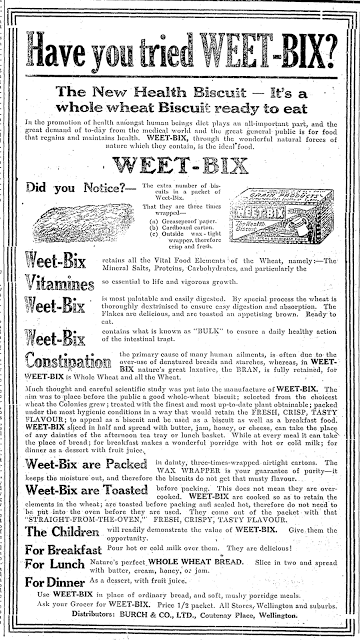
This was a vegetarian propaganda which would have been palatable, so to speak, to non-vegetarian evangelicals who shared a similar world-view. However, other, more mainstream, Christian groups have long been sympathetic to vegetarianism, and particularly the Quakers and the Seventh Day Adventists. The latter’s commitment to lifelong, healthy eating has, in fact, influenced the ways in which many of us eat: the Adventist-owned Australian and New Zealand food company Sanitarium produces muesli, granola, and, most famously, Weet-Bix.
John Harvey Kellogg was an Adventist too. Other than breakfast cereals, the Kellogg company also popularised graham crackers – biscuits invented in the 1830s by the deeply pious Presbyterian minister Sylvester Graham from Connecticut, who believed that the passions and emotions could best be mastered by eating plain, bland food.
Noakes’s preaching uses, probably unwittingly, the same techniques employed by evangelicals since the end of the eighteenth century. I think, though, that are other similarities between his enthusiasm for a high-fat diet and the Christians involved in the early Vegetarian Society. They all believe that changing eating habits will be better for the whole world – that the transformation of the individual will lead to the remaking of society more generally. After all, the subtitle of Noakes’s new book is ‘Changing the World One Meal at a Time.’
Sources
Ian Miller, ‘Evangelicalism and the Early Vegetarian Movement in Britain, c.1847-1860,’ Journal of Religious History, vol. 35, no. 2 (June 2011), pp. 199-210.
Alan Rudrum, ‘Ethical Vegetarianism in Seventeenth-Century Britain: Its Roots in Sixteenth-Century Theological Debate,’ The Seventeenth Century, vol. 18, no. 1 (2003), pp. 76-92.
Colin Spencer, The Heretic’s Feast: A History of Vegetarianism (Lebanon, NH: University Press of New England, 1995).

Tangerine and Cinnamon by Sarah Duff is licensed under a Creative Commons Attribution-ShareAlike 3.0 Unported License.


 Tangerine and Cinnamon
Jan 26
In a Nutshell
On my fridge, I have a collection of business cards from cafes and shops visited on trips abroad. This afternoon—months late—I added another few from a recent month-long stay in Canada and the US, and I was reminded of a fantastic breakfast at the August First bakery in Burlington, Vermont. I was in Burlington for a conference and spent a couple of days beforehand working and wandering around a small university town – I grew up in a small university town so I have a professional interest in them – which has a reputation for extraordinarily progressive and inclusive politics. There were posters advertising make-your-own banjo classes (out of gourds, apparently), vegan Thanksgiving, and homebrew nights; the local Democratic party was next door to a Tibetan dumpling shop; and I have never been so aware of the plight of the Dalai Lama as I was in the week I spent in Vermont. And there was the most amazing co-operative, which had a wall – a wall! – of granola. Progressive America is, truly, the most amazing place. (In a similar vein, Ann Arbor’s community co-op is opposite a Birkenstock shop.)
  I had, then, granola at August First. And it was wonderful granola, with whole walnuts and fat raisins, and with plenty of really good plain yoghurt. Burlington has embraced its granola. But – and I write this as one who makes her own granola – there is a contradiction at the heart of the association of granola with progressive living: a lot of the time, it’s full of sugar. Unlike muesli, which is left raw, granola is baked usually with honey, maple syrup, or (sometimes and) sugar, as well as oil, and, occasionally, egg white. This is not necessarily the healthiest breakfast. So why does granola signify healthy eating?
  This isn’t the only food to be linked to left wing politics. Paul Laity notes:
Orwell’s ‘cranks’—a term reclaimed by the London vegetarian restaurant in 1961—were the free-thinking and –living British Bohemians of the early twentieth century, who experimented with new forms of comfortable dress, sustainable eating, eastern religions, egalitarian social arrangements, and alternative sexual identities. This early counter culture was strongly influenced by late nineteenth-century dieticians and naturopaths—many of them based in Germany—who advocated raw, simple eating in contrast to the meat- and starch-heavy meals which characterised most middle-class diets. As Catherine Carstairs remarks in her essay ‘The Granola High: Eating Differently in the Late 1960s and 1970s,’ it was immigrants from central Europe who brought health food shops to North America, stocking vitamin supplements, wholewheat bread, and, inevitably, fruit juice. It was these shops that made widely available the foods eaten at more exclusive sanatoriums in Europe and the United States.
Like muesli and bircher muesli, granola was invented in a health spa. In her excellent and exhaustively detailed history of granola, Karen Hochman argues that Dr James Caleb Jackson—a farmer, journalist, and doctor—invented granula in 1863 for the patients at his spa, Our Home on the Hillside, in upstate New York. Relying heavily on Graham flour—invented by the dour evangelical preacher Sylvester Graham—he baked sheets of biscuits and crumbled them into granules to be soaked in milk and then eaten for breakfast. It’s likely that granula—the predecessor of Grape Nuts—would never have moved beyond the confines of Our Home on the Hillside had it not come to the attention of a rival sanatorium doctor and Seventh Day Adventist, William Kellogg, who used rolled, toasted oats instead of Graham flour biscuits. He renamed his product granola, and it became for a while a significant money earner for his Sanitarium Food Company (renamed Kellogg’s Food Company in 1908).
But enthusiasm for granola remained—largely—limited to the relatively small numbers of people who shopped in health food stores until the 1960s and 1970s. Then, concern about the effects of pesticides and additives on human, plant, and animal health; suspicion of the food industry; a desire to experiment with diets from elsewhere; and a back to the land movement all coincided to produce an interest in purer, healthier, more ‘natural’ foods. Hippies—another food counter culture—looked back and found granola. So did big food companies, as Hochman writes about the US:
The sweet, nut- and dried fruit-filled granola we eat today is derived from the granola reinvented in the 1960s and 1970s. Despite having been popularised by Quaker and General Mills—the enemies of the second food counter culture—granola retained its association with progressive, healthy living.
This cultural history of granola tell us three things, I think. Firstly, that the food counter culture has roots in alternative experiments in living stretching as far back as the late eighteenth century, when vegetarianism and lighter diets were picked up as markers of enlightened, rational eating. Secondly, that business has long taken advantage of the experiments done by people working and living on the fringes of respectability.
Finally, it also traces the shifting meanings of what we define as ‘healthy.’ Despite evidence presented to us by nutritionists, what we think of as being healthy food depends on a range of factors, including whether, historically, a product has been associated with health-conscious living.