
Be Modern: Worship Food?
On Monday evening I watched the first episode of the latest series of Australian MasterChef to be broadcast in South Africa. The previous series was so wildly popular here that I was interested to see what the fuss was about. Based on the latest incarnation of the MasterChef franchise in the UK, over the course of a few weeks the programme whittles down a group of fifty aspiring cooks to a four or five finalists who are put through a series of challenges – working a shift in a hotel kitchen, recreating a chef’s impossibly complicated signature dish (I hate the term) – until only one contestant emerges triumphant. It’s fun, self-important, and utterly ridiculous.
And then, towards the end of this first episode of season two, an audience of at least sixty intelligent adults applauded a pavlova.
A pudding consisting of egg whites, sugar, vinegar, and vanilla received a round of applause. I mean, I lecture three times a week and I’m never applauded.

Donna Hay's adored pavlova
I love pavlova and the MasterChef version – baked and unveiled by Donna Hay – looked fantastic, and I really don’t have much against reality TV shows (I can’t – I was once badly addicted to the second series of My Restaurant Rules.) And, to be fair, to accuse MasterChef of not being adequately realistic would be to miss the point. The British version is hosted and judged by two middle-aged men who yell things like ‘Cooking doesn’t get tougher than this!’ at the camera. It’s a competition and no attempt to train a new generation of chefs. But the round of applause and the reverence for a pudding struck me as being more than silly. It was, in fact, too serious.
MasterChef is like many other reality shows: it judges contestants on their ability at a particular skill. This skill can be anything – from fashion design to hairdressing – because it’s secondary to the format of the programme. It’s the vehicle for television series which are, essentially, talent shows, but on a more elaborate and glamorous scale. The adulation of the pavlova undermined this format. All of a sudden, the focus of that episode of MasterChef shifted from the contestants to the food.
Am I overreacting? Probably. But not without reason. Earlier that day I had read an article written by Angela Carter in 1984 for the London Review of Books, in which she reviewed The Official Foodie Handbook by Ann Barr and Paul Levy, Elizabeth David’s An Omelette and a Glass of Wine, and Alice Waters’s Chez Panisse Menu Cookbook. While she acknowledged that the Foodie Handbook was meant to lampoon middle-class ‘foodies’, it is was one of a series of guides – like the Sloan Ranger and Yuppie handbooks – to middle-class living which, she felt, walked an uneasy line between guide and satire. Writing about the Preppy Handbook she noted:
The book was an ill-disguised celebration of the snobbery it affected to mock and, under its thinly ironic surface, was nothing more nor less than an etiquette manual for a class newly emergent under Reaganomics. It instructed the nouveaux riches in the habits and manners of the vieux riches so that they could pass undetected amongst them. It sold like hot cakes.
Along with David and Waters, the authors of the Foodie Handbook elevate the preparation and eating of food to a rarefied art form only done ‘properly’ by those educated and sensitive enough truly to understand cooking. The book advised its readership: ‘Be modern: worship food!’ Carter was, like Jay Rayner and Anthony Bourdain, particularly scathing of Alice Waters:
Alice Waters [serves] a Franco-Californian cuisine of almost ludicrous refinement, in which the simplest item is turned into an object of mystification. A ripe melon, for example, is sought for as if it were a piece of the True Cross. Ms Waters applauds herself on serving one. ‘Anyone could have chosen a perfect melon, but unfortunately most people don’t take the time or make an effort to choose carefully and understand what that potentially sublime fruit should be.’ She talks as if selecting a melon were an existential choice of a kind to leave Jean-Paul Sartre stumped.
She concludes, gloriously:
Ms Waters has clearly lost her marbles through too great a concern with grub, so much so that occasionally ‘Alice Waters’ sounds like a pseudonym for S.J. Perelman. ‘I do think best while holding a tomato or a leg of lamb,’ she confides. For a person of my generation, there is also the teasing question: could she be the Alice, and ‘Chez Panisse’ the real Alice’s Restaurant, of the song by Arlo Guthrie? And if this is so, what does it prove?
Carter bases much of her criticism of the Foodie Handbook, Waters, and Elizabeth David on the grounds of insensitivity: how is it possible to be so precious about food, she asks, when so many people go without? I agree that there is something profoundly wrong with a world where some populations have so much food that they feel that they should spend a day searching for the perfect watermelon, while others starve or are reliant on the tender mercies of aid organisations.
We have, though, always imbued food with meaning. Food provides nourishment, but it also carries with it a range of assumptions, symbols, and signs which are occasionally as important as its primary function. When Spanish missionaries in sixteenth-century Mexico refused to celebrate communion using maize, instead of wheat, wafers, they did so purely on the grounds that wheat, an imported crop, represented Europe and, thus, civilisation. Similarly, when well-meaning lady food reformers attempted to ‘Americanise’ the cuisine of recent immigrants to the United States during the 1920s, they did so because the cooking of Italy, Poland, and Ireland was seen as less ‘civilised’ than that prepared by white, Protestant Americans.
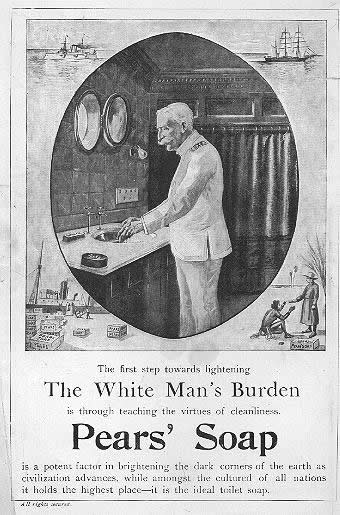
Pears' Soap - The White Man's Burden
There is a difference, though, between the association of food with civilisation and cultural superiority and giving a round of applause to a pavlova – or, indeed, to a melon. In Imperial Leather: Race, Gender, and Sexuality in the Colonial Context (1995), Anne McClintock examines the ways in which Victorian advertisers used images of empire to sell their products. Pears, the soap manufacturers, produced a series of advertisements which implied that soap was somehow connected to the success of British imperialism. In one of their best known ads from the early 1890s, a sea captain – surrounded by images of travel and conquest – is depicted washing his hands in his ship. It’s captioned: ‘The first step towards lightening the white man’s burden is through teaching the virtues of cleanliness.’ Another titled ‘The Birth of Civilisation’ is of an African man holding aloft a bar of soap which has floated ashore after a shipwreck.
This campaign crudely linked cleanliness – long associated with being ‘civilised’ – with the civilising mission. Colonised people, suggested Pears, could be made European by a bath with Pears soap. In the first volume of Capital (1867), Karl Marx began to develop the idea of ‘commodity fetishism’ to explain the kind of ‘magical’ attraction and meaning which commodities – ordinary, manufactured objects – seem to exude. He argued that a range of meanings – which are socially and culturally inflected and which change over time – are attached to commodities. Capitalism encourages people to confuse the utility of the object and social meanings – this is what Marx called ‘commodity fetishism’. In other words, objects take on meanings to the extent that they assume a kind of independence from their utility. The purpose of soap was no longer to clean bodies and clothes, but, rather, to civilise.

Pears' Soap - the Birth of Civilisation
A similar process occurred with the pavlova on MasterChef: it was no longer simply a pudding, but, rather, representative of success and good taste. When one of the contestants in the final round produced what she thought would be a bad pavlova, she collapsed in tears and refused to continue. It was as if it was she – rather than her ability to bake a pudding – who was being tested. When Alice Waters hunted for the perfect melon, she was not only seeking out a fruit, but also an object which embodied what she believed to be her goodness and moral superiority.
I wouldn’t be writing this post if I thought that this strange affliction was limited to Californian chefs and anxious Australians. Look at food magazines and food programmes: aimed at middle-class audiences, they conflate being able to cook well and to eat good – whole, organic, humanely reared – food with being good, successful, and environmentally and socially responsible. I have absolutely nothing against farmers’ markets, artisan bakers, small-scale farmers, co-operative supermarkets, and organic grocers – in fact, I think that they’re helping to create new ways of thinking about food – but I am deeply concerned when their produce is no longer thought of simply as food, but becomes a marker of middle-class morality.
This form of commodity fetishism is limiting: it associates good food with class and wealth. It encourages those who consume this food to think only about the product which they buy, and not to consider the complex processes which brought that piece of cheese or that steak to their deli or supermarket. It also mystifies the production, preparation, and eating of food. If we are to become more careful eaters – and more aware of how our eating habits impact on the world around us – we need to see food as food: as a product which is fundamental to life and which all people have a right to eat.
Further Reading
Texts quoted here:
Donna R. Gabaccia, We are what we eat: Ethnic food and the making of Americans (Cambridge MA: Harvard University Press, 1998).
Karl Marx, Capital: Capital: A Critique of Political Economy, vol. I, trans. Ben Fowkes (New York: Penguin, [1867] 1990).
Anne McClintock, Imperial Leather: Race, Gender and Sexuality in the Colonial Context (New York and London: Routledge, 1995).
Jeffrey M. Pilcher, ¡Que vivan los tamales! Food and the Making of Mexican Identity (Albuquerque: University of New Mexico Press, 1998).
Other sources:
Timothy Burke, Lifebuoy Men, Lux Women: Commodification, Consumption, and Cleanliness in Modern Zimbabwe (London: Leicester University Press, 1996).
Hasia Diner, Hungering for America: Italian, Irish, and Jewish Foodways in the Age of Migration (Cambridge: Harvard University Press, 2001).
Yves Péhaut, ‘The Invasion of Foreign Foods,’ in Food: A Culinary History from Antiquity to the Present, eds. Jean-Louis Flandrin and Massimo Montanari, English ed. by Albert Sonnenfeld (New York: Columbia University Press, 1999), pp. 457-470.
Tangerine and Cinnamon by <a rel=”cc:attributionURL” href=”https://tangerineandcinnamon.wordpress.com/”>Sarah Duff</a> is licensed under a <a rel=”license” href=”http://creativecommons.org/licenses/by-sa/3.0/”>Creative Commons Attribution-ShareAlike 3.0 Unported License</a>.

Tangerine and Cinnamon by Sarah Duff is licensed under a Creative Commons Attribution-ShareAlike 3.0 Unported License.


 Tangerine and Cinnamon

Sep 4
The Root of the Evil
Over the past few weeks I’ve been watching with barely-disguised glee, the evisceration of a recent Newsweek article by Niall Ferguson – pet historian of the American right – in which he provides a deeply flawed analysis of Barack Obama’s past four years in power. As Matthew O’Brien notes, before systematically working through Ferguson’s argument (or, indeed, ‘argument’), ‘He simply gets things wrong, again and again and again.’
I’m no fan of Ferguson’s. This has less to do with our political differences – in relation to him, I’m so left-wing I should be living in a Himalayan hippy commune practising an obscure form of yoga while teaching Capital to peasants – but because of the way he shapes his interpretations of the past to suit a particular neoliberal agenda.
Of course, no historian is capable of writing an absolutely objective history of anything – nor would we want to because it would be dreadfully boring – but Ferguson presents, and defends, his arguments on the grounds that they are absolute truth.
He was called out on this last year by Pankaj Mishra, in a fantastic review of Civilisation: The West and the Rest for the London Review of Books. In Civilisation, Ferguson argues that
Leaving aside the strange question of why an historian writing in the twenty-first century thinks that it’s possible to divorce the ‘West’ (whatever we may mean by that) from the rest of the world – and even why an historian feels like writing a triumphalist history of Europe and North America (I thought we stopped doing that in the sixties?) – this is a history which largely ignores, or plays down, the implications of modern capitalism and globalisation for those people outside of the West.
As in his writing on the creation of European empires, Ferguson has a problem with accounting for the widespread resistance of Africans, Asians, and others to European conquest – and the violence and exploitation which followed colonisation. Mishra writes:
Recently I’ve been thinking a great deal about a comment which Roger Casement made in a report for the British government about atrocities committed in the Congo Free State during the late nineteenth century. Writing in 1900, he concluded:
The Congo Free State came into being at the 1884-1885 Berlin West Africa Conference, where the assembled representatives of European states acknowledged the Belgian king’s right to establish a colony in central Africa. Leopold II’s International Association – a front organisation for his own commercial interests – was allowed to operate in the region.
There were strings attached to the deal – Leopold had to encourage both humanitarianism and free trade, for instance – but with the sharp increase in international demand for rubber in the 1890s, after JB Dunlop’s invention of inflatable rubber tyres, Leopold’s interest in the Congo, which had only ever extended to exploiting the country for its natural resources, narrowed even further. Leopold operated his own monopoly on the rubber trade, leasing some land to other companies on the proviso that they pay him a third of their profits.
The ‘evil’ to which Casement referred was the transformation of the Congolese population into a mass of forced labourers compelled to contribute quotas of rubber to the various businesses operating in the Free State. Those who failed to do so, those who refused to do so, or those who were suspected of not doing so, faced brutal reprisals from the State’s Force Publique, including being killed, often along with their families; having their hands cut off; and seeing their villages and property burned and destroyed.
It’s estimated that ten to thirteen million Congolese died as a result of murder, starvation, exhaustion, and disease between 1885 and 1908, when international condemnation of Leopold’s regime forced the Belgian government to take control of the Free State.
Although other colonial regimes in Africa could be brutal, violent, and unjust, none of them – with the possible exception of Germany in (what is now) Namibia – managed to commit atrocities on the scale that Leopold did in the Congo. As Casement makes the point, ‘the root of the problem’ was that the Congo was run entirely for profit, and that the businesses which operated in the region were not regulated in any way. This was capitalism at its most vicious.
But what does this all have to do with food? Well I was reminded of Casement’s comment when reading about Glencore’s response to the current droughts – chiefly in the US, but also elsewhere – which are partially responsible for global increases in food prices:
This weekend, it was revealed that Barclays has made more than £500 million from food speculation:
What bothers me so much about these massive profits is partly the massive profits – the fact that these businesses are actually making money out of a food crisis – but mainly it’s that these monstrously wealthy businessmen are so unwilling to admit that what they’re doing is, even in the most charitable interpretation, morally dubious.
Barclays’s claim that its involvement in food speculation is simply a form of futures trading is disingenuous: futures trading is an entirely legitimate way for farmers to insure themselves against future bad harvests. What Barclays and other banks, as well as pension funds, do is to trade in agricultural commodities in the same way as they do other commodities – like oil or timber.
In 1991, Goldman Sachs came up with an investment product – the Goldman Sachs Commodity Index – which allowed for raw materials, including food, to be traded as easily as other products. When the US Commodities Futures Trading Commission deregulated futures markets eight years later, for the first time since the Great Depression, it became possible to trade in maize, wheat, rice, and other foodstuffs for profit.
The current food crisis has been caused by a range of factors – from the drought, to the excessive use of maize and other crops for biofuel – and exacerbated by climate change and pre-existing conflicts, corruption, inequalities, and problems with distribution. In Europe, unemployment and low wages will add to people’s inability to buy food – hence the rise in demand for food banks in Britain, for example.
Food speculation has not caused the crisis, but it does contribute to it by adding to food price volatility. I’m not – obviously – comparing Glencore or Barclays to Leopold II’s International Association, but the atrocities committed in the Congo Free State provide an excellent example of what happens when capitalism is allowed to run rampant. Let’s not make that mistake with our food supply.
Tangerine and Cinnamon by Sarah Duff is licensed under a Creative Commons Attribution-ShareAlike 3.0 Unported License.