Last week there was a flurry of excitement as commentators compared the R1 million pledged by the South African government to aid the victims of the famine in the Horn of Africa, and the potential billion rand loan which it is currently considering for Swaziland. Not only could Africa’s economic powerhouse donate considerably more than a million rand (about £90,000 or US$150,000) to Somalia, but granting a conditions-free loan to King Mswati III’s dysfunctional kingdom would serve only to prop up the continent’s last absolute monarch.
Although I was as outraged by my government’s apparent indifference to the plight of Somalis, I did begin to wonder if that money could be used more wisely. Of course, South Africa must – and can – contribute to the international effort to distribute food in Somalia. Given the scrutiny of aid agencies working in the region, as well as the awareness of how aid money has been channelled to elites over the past few decades, it’s likely that South Africa’s donation will go to those who need it. But giving money to alleviate the famine is a short-term fix.
Possibly because of the way it echoes Africa’s other best-known famine, the Live Aid-engendering Ethiopian famine of 1984-1985, the famine in the Horn of Africa has generated an enormous amount of coverage in the international press. More information and analysis can only ever be a good thing, but much of the discussion around the famine suggests that it’s a crisis which emerged suddenly and without any warning. As the Guardian’s John Vidal put it, ‘A massive drought, as if out of nowhere, has settled over the Horn of Africa’. Moreover, some commentators, like Vidal, have blamed the famine on only one or two factors, usually climate change or Western indifference to African suffering.
The causes of famines are complex, but they are never entirely unpredictable. Counterintuitively, they are not necessarily caused by a lack of food, but are, rather, the result of long-term systemic failure: in agriculture, trade, and, most importantly, in government. By suggesting that South Africa’s paltry million rand donation would be better spent, my point is that South Africa’s involvement in the Somali crisis should go beyond giving money for food. It needs to stop famines from happening in the first place, and that is not impossible.
We have managed largely to eradicate famine in the twentieth century. Before then, food shortages and famines were part of the rhythms of everyday life. In societies where food production was inefficient both in terms of labour and technology – and until the eighteenth century, eighty per cent of the population of Europe was engaged in agriculture – frequent crop failures meant that famine occurred often. But during the 1700s, an agricultural revolution allowed greater, more regular, and, crucially, more reliable yields to be produced by smaller numbers of people. International trade also meant that countries could buy food to supplement local shortfalls. For example, during the 1870s, the failure of the European grain crop boosted Canadian and American wheat exports, as these two countries fed Europe for almost a decade.
Although initially developed in the Netherlands and Britain (and there is a strong link between the development of capitalist economies and efficient food systems), the methods pioneered during this green revolution of the eighteenth and nineteenth centuries spread around the globe. By the early 1900s, famine was caused increasingly by people, rather than only by nature. That said, the Great Famine in Ireland (1845-1852) was certainly the product of the potato blight, but it also occurred at a time when Ireland was an exporter of wheat: there was enough food to go around, it was just that those who were starving couldn’t afford to buy bread. The Cattle Killing Movement in South Africa (1856-1857) caused widespread famine among the Xhosa. Around 40,000 people died of starvation, 33,000 moved away from the eastern Cape to seek work, and the authority of the Xhosa polity was fatally undermined. But this was caused by a decision to slaughter cattle and destroy crops on a mass scale.
Equally, some twentieth-century famines were caused partly by crop failure, but were also the product of bad governance and ineffective systems of food distribution. As Cormac Ó Gráda explains:
Wars, blockades, poor governance, and civil unrest can also lead to famines; panics about the food supply and poorly performing markets can exacerbate them. In such cases…factors other than crop shortfalls reduce the purchasing power or ‘entitlements’ of vulnerable sections of the population: the size of the loaf matters less than its distribution.
The Nobel Prize-winning economist Amartya Sen argued in Poverty and Famines (1981) that – contra Thomas Malthus who suggested that exponential population growth would result inevitably in famine – famines can occur in times of peak food production. Why? I think it’s worth quoting Sen in full:
In every society that exists, the amount of food that a person or a family can command is governed by one set of rules or another, combined with the contingent circumstances in which that person or that family happens to be placed vis-à-vis those rules. For example, in a private ownership market economy, how much food a person can command will depend on (1) what he owns, and (2) what he can get in exchange for what he owns either through trade, or through production, or some combination of the two. Obviously, in such an economy a person may suddenly face starvation either because his ownership bundle collapses (e.g., through alienation of land to the money lenders), or because the ‘exchange entitlement’ of his ownership (i.e., the command of what he owns) collapses (e.g., through his becoming unemployed and not being able to sell his labour power, or through a decline in his terms of trade vis-à-vis food).
In other words, people starve when they can’t buy food – either because they no longer have the money to exchange for food (as a result of unemployment, for example) or because food prices become prohibitively high. Peaks in food prices could be due to droughts and other ecological factors, conflict, and speculation.
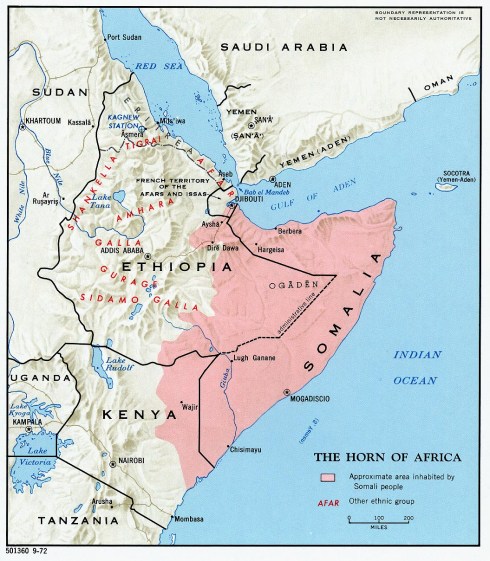
The crisis in Somalia demonstrates particularly well how state intervention can prevent or cause famine. In 1960, British Somaliland and Italian Somalia became the independent Republic of Somalia. Nine years later, Major-General Mohamed Siad Barre seized power in a bloodless coup and ruled Somalia through a military dictatorship until the collapse of his government in 1991. Somalia’s experience of food shortages and famine must be understood in this context of Barre’s government (or lack thereof) and economic policies. In 1970, he announced the implementation of ‘scientific socialism’, introduced strict central planning, and viciously stamped out all forms of opposition. Peter T. Leeson writes:
The government slaughtered civilians who posed threats to the government’s plans or political power, used coercive intimidation to create artificial support for its activities, and forcibly relocated others to further the political or economic ends of Barre and his cronies. ‘Both the urban population and nomads living in the countryside [were] subjected to summary killings, arbitrary arrest, detention in squalid conditions, torture, rape, crippling constraints on freedom of movement and expression and a pattern of psychological intimidation’. The state ruthlessly suppressed free speech and controlled all forms of information reaching Somalis. Newspapers (only one was officially permitted by the government), radio, and television were fully censored and dissent in any form squelched with force. Under Somalia’s National Security Law No. 54, ‘gossip’ became a capital offense. Twenty other basic civil freedoms involving speech, association and organisation also carried the death penalty.
Funds were diverted from public works, education, healthcare, and infrastructure to the military, on whose support and ability to terrify and brutalise the Somali population Barre depended. The nationalisation of land and industry in 1975 was, predictably, a disaster. The abandonment of socialism at the end of the 1970s in order to attract assistance from the International Monetary Fund made very little difference either. Somalia was heavily dependent on international food aid during the 1970s and 1980s. The Horn of Africa is prone to drought, but it’s worth noting that despite catastrophic droughts in the mid-1970s and mid-1980s, Somalia managed to avoid famine – unlike its war-torn neighbour, Ethiopia, whose government ignored the plight of its population.
As Abdi Ismail Samatar notes,
Somalia’s last major famine was in 1992 and was not caused by drought. Nearly 300,000 innocent people starved to death because of sectarian politics. The epicentre of that famine was in Bay, one of the country’s most productive agricultural regions, and starvation was induced by warlords who used food as a weapon against farmers and pastoralists.
Barre’s government collapsed in 1991, plunging Somalia into civil war and a chaos from which it has yet to emerge. It’s telling that a country which had managed to avoid famine for over half a century, despite drought, food shortages, and incredible food insecurity, saw widespread famine only after food supplies were disrupted by war.
So why famine now? Over the course of sixteen years, Somalia has been the subject of fourteen reconciliation conferences, none of which managed to produce a stable government. In 2004, the Transitional Federal Government (TFG), an anti-Islamist, pro-Ethiopian political grouping, was put into power in Somalia under the leadership of Abdullahi Yusuf and with the support of the United Nations. However, the TGF was neither popular nor effective as a government. In the absence of effective leadership, a number of attempts were made by Islamic groups, war lords, civil society organisations, and others to create some sort of order in Somalia, and particularly in Mogadishu. One of these, the Alliance for the Restoration of Peace and Counter-Terrorism, was formed by a group of war lords in February 2006. They were backed by the United States who saw them as allies against Islamic groups in the region.
Armed clashes between the Alliance and Islamist groups soon broke out and developed into a war which the Islamists won decisively. By the middle of 2006, they had taken control of Mogadishu as well as central and southern Somalia. Not only was this an embarrassment to the United States and its ally Ethiopia, but for the first time it seemed that Somalia was offered the possibility of a relatively popular and effective government in the hands of the Islamists, who quickly organised themselves into the Council of Islamic Courts (CIC). However, an invasion by Ethiopia at the end of 2006 caused the collapse of the CIC, the reinstallment of the almost entirely ineffective TFG, and the beginning of a new civil war between the Government and opposition groups. The most successful of these was Al-Shabab. Originally the CIC’s youth wing and affiliated with al-Qaeda, Al-Shabab is an Islamist group which now controls most of southern Somalia.
Years of political uncertainty, conflict, and chaos (best exemplified by the way piracy has flourished along the Somali coast) have left Somalis particularly vulnerable to drought and the less predictable effects of climate change. A combination of a US- and UN-backed blockade of the parts of Somalia controlled by Al-Shabab, as well as this organisation’s unwillingness to allow the World Food Programme to deliver food to southern Somalis has caused the famine. Samatar explains:
Normally, societies have three lines of defence against mass starvation: local capacity, national government and the international community. When a disaster hits a region, the first help comes from local administrations and the communities themselves. If events overwhelm the first responders, then the national government takes charge of operations; and when the crisis exceeds the wherewithal of the nation, international actors come to the rescue.
It is clear that all three levels of livelihood protections have failed in Somalia. Al-Shabab has prohibited the local population from organising their municipal governments and charities to fend off the disaster. Similarly, Somalia’s national government, which is beholden to sectarian leadership and international patrons, has been oblivious to the emerging calamity, and has thwarted the international community from coming to its aid
This was a famine which could have been avoided had order been established in Somalia. Here, Somali politicians and war lords are as much to blame as the international community, East Africa’s Intergovernmental Authority on Development, the UN, and, crucially in my view, the African Union. This famine is not the result solely of dastardly foreign countries plundering Africa, nor can blame be laid entirely on Somalis themselves. But after the effort to feed Somalis has ended, reconstruction needs to begin. And it’s here where South Africa must – and I think is obliged to – take a leading role.
Somalia also demonstrates the extent to which food security is linked to strong, functioning governments. Countries which are badly run, have weak economies, and, most importantly, are authoritarian, are the most strongly disposed towards famine. Last year’s narrowly-avoided famine in West Africa was due largely to the incompetence of Niger and Chad’s malfunctioning, undemocratic political dispensations. Only the spread of democratic and open government, with, crucially, a free flow of information, will prevent famines from happening in Africa. As Sen remarked, ‘There is, indeed, no such thing as an apolitical food problem.’
Note: I try to use sources which are easily available, but for this post I’ve relied on articles from academic journals. Unfortunately, these are securely behind paywalls. If you’d like copies of them, let me know.
Further Reading
Texts cited here:
Joyce Appleby, The Relentless Revolution: A History of Capitalism (New York and London: W.W. Norton, [2010] 2011).
Cormac Ó Gráda, ‘Making Famine History,’ Journal of Economic Literature, vol. 45, no. 1 (Mar., 2007), pp. 5-38.
Peter T. Leeson, ‘Better off stateless: Somalia before and after government collapse,’ Journal of Comparative Economics, vol. 35 (2007), pp. 689-710.
Ken Menkhaus, ‘The Crisis in Somalia: Tragedy in Five Acts,’ African Affairs, vol. 106/204 (2007), pp. 357-390.
Amartya Sen, ‘The Food Problem: Theory and Policy,’ Third World Quarterly, vol. 4, no. 3 (Jul., 1982), pp. 447-459.
Other sources:
L.A. Clarkson and E. Margaret Crawford, Feast and Famine: Food and Nutrition in Ireland 1500-1920 (Oxford: Oxford University Press, 2001).
Jean Drèze and Amartya Sen (eds.), The Political Economy of Hunger, 3 vols. (Oxford: Clarendon Press, 1990).
Cormac Ó Gráda, Black ’47 and Beyond: the Great Irish Famine in History, Economy and Memory (Princeton: Princeton University Press, 1999).
Cormac Ó Gráda, Famine: A Short History (Princeton: Princeton University Press, 2009).
Cormac Ó Gráda, ‘Revisiting the Bengal Famine of 1943-4,’ History Ireland, vol. 18, no. 4, The Elephant and Partition: Ireland and India (July/August 2010), pp. 36-39.
Cormac Ó Gráda, ‘The Ripple that Drowns? Twentieth-Century Famines in China and India as Economic History,’ Economic History Review, vol. 61, (2008), pp. 5-37.
C.P. Melville, ‘The Persian Famine of 1870-72: Prices and Politics,’ in Food, Diet, and Economic Change Past and Present (Leicester: Leicester University Press, 1993), pp. 133-150.
Amartya Sen, ‘Famines as Failures of Exchange Entitlements,’ Economic and Political Weekly, vol. 11, no. 31/33, Special Number: Population and Poverty (Aug., 1976), pp. 1273-1280.
Amartya Sen, Poverty and Famines: An Essay on Entitlement and Deprivation (Oxford: Clarendon Press, 1981).
Anne M. Thompson, ‘Somalia: Food Aid in a Long-Term Emergency,’ Food Policy (Aug. 1983), pp. 209-219.
C. Paul Vincent, The Politics of Hunger: The Allied Blockade of Germany, 1915-1919 (Athens: Ohio University Press, 1985).
Christian Webersik, ‘Mogadishu: An Economy without a State,’ Third World Quarterly, vol. 27, no. 8 (2006), pp. 1463-1480.
S.G. Wheatcroft, ‘Famine and Food Consumption Records in Early Soviet History, 1917-25,’ in Food, Diet, and Economic Change Past and Present (Leicester: Leicester University Press, 1993), pp. 151-174.
 Tangerine and Cinnamon by Sarah Duff is licensed under a Creative Commons Attribution-ShareAlike 3.0 Unported License.


 Tangerine and Cinnamon
Feb 25
Closing the Stable Door
About a month ago, the ever-amazing Bill Nighy argued in an interview with the UK’s Sunday Independent that hunger – whatever we may mean by that – could be eradicated by forcing big multinationals to pay their taxes. Nighy, who is a spokesman for the anti-hunger If Campaign, has a point. As a Guardian investigation demonstrates, these global businesses and their subsidiaries go out of their way not to pay their taxes – something which hits developing nations particularly hard:
If businesses like Associated British Food paid their taxes in countries like Zambia, then, the logic goes, these governments would have enough money to ensure that everyone would have access to enough food.
But tax evasion has implications for everyone’s food supply, and not only those who live in low- to middle-income countries. As the recent horsemeat scandal in Europe shows, the presence of horsemeat in ready meals and fast food products was partly the work of a network of businesses which managed to evade both (admittedly shambolic) regulators and tax by operating through scrutiny-free offshore companies.
Romanian horsemeat entered the European food chain when meat from two abattoirs was sold to Draap Trading Limited, which sold the meat to European food companies, like the meat processor Spanghero – whose licence was suspended earlier this month after being accused of knowingly mislabelling horsemeat as beef in some of its products.
Draap Trading Limited operates in the Netherlands, but is registered in tax-flexible Cyprus. Its sole shareholder is a firm based in the British Virgin Islands, another tax haven. Not only does this arrangement allow Draap to avoid paying tax, but it becomes almost impossible to identify Draap’s shareholder. Investigators suggest that the shareholder may be linked to a collection of Russia-linked offshore companies which have, in the past, been involved in high-profile transactions in Russian industry. Importantly, there are allegations that these businesses are connected to gang activity.
Exciting as these revelations may be, this is certainly not the first time that food adulteration has been linked to organised crime. In Italy, write Anna Sergi and Anita Lavorgna:
Crimes include ‘theft of machinery and tools; extortion; the theft of livestock and cattle; unregulated butchery practices; fraudulent claims for EU funds; and the exploitation of labour.’ These have appalling consequences for the environment, employment practices, and, indeed, food safety – particularly because the clans not only ignore regulations around hygiene and animal welfare, but are also involved in the illegal butchering and trafficking of potentially contaminated meat.
In the US, the Mafia and pizzerias have a long and complicated relationship. Between 1985 and 1987, the Pizza Connection Trial revealed that mobsters had used a collection of pizza parlours as fronts for the sale and collection of heroin and cocaine. Throughout the twentieth century, though, the mob controlled supplies of ingredients to pizzerias. For instance,
As the connection between organised crime and food is nothing new, so is the link between food and tax evasion. Nicholas Shaxson begins his excellent Treasure Islands: Tax Havens and the Men Who Stole the World (2011) with an account of the incredible wealth and power of the Vestey brothers. These two men controlled the meat industry during the early twentieth century. Ian Phimister explains:
Essentially, Vesteys owned every link in the food chain: from the land on which cattle were farmed, to abattoirs and newly-invented cold storage warehouses, to refrigerated ships and the butchers who sold the meat to shoppers in Britain. But they didn’t limit themselves to beef: they shipped eggs, chicken, ducks, pork, and dairy products from China and Russia, as well as mutton from Australia and New Zealand.
What the example of Vesteys demonstrates – above all – is that big food multinationals have existed since the early twentieth century and have used the same tactics for more than a hundred years. Monsanto and Cargill have the same monopolistic instincts and low regard for labour rights and animal welfare as Vesteys. Moreover, our food supply has been globalised for as long – if not longer – and the myth that once upon a time all butchers were independent and totally ethical is, well, just that – a myth.
But Vesteys also illustrates how food companies dodge taxes. William and Edmund Vestey went out of their way never to pay tax if they could help it. When the British government began to tax British companies on profits earned abroad, to raise funds for the war effort in 1914, the Vestey brothers first lobbied against the measure, and then upped sticks to Chicago and then Buenos Aires, to take advantage of America and Argentina’s less onerous systems of taxation.
They used a range of strategies now commonplace among multinationals to channel their profits away from countries with high tax rates – the countries, in other words, where they did business. Also, in 1921 the Vesteys established a trust based in Paris which the British authorities could not tax (they didn’t even discover it until 1929). Giving evidence to a Royal Commission established to investigate how to tax multinational businesses, William Vestey summed up his attitude towards taxation:
In 1934, Argentinian authorities which had long been uneasy about the brothers’ cutthroat business practices came across a cache of secret documents hidden under a pile of guano on their ship, the Norman Star. The investigation launched after finding this deeply incriminating evidence was blocked and manipulated at every turn by the Vesteys – who were particularly concerned by British authorities’ interest in it. In the end, the man in charge of the committee and with the greatest knowledge of the Vesteys’ tax evasion systems, Senator de la Torre, shot himself in 1939, leaving a suicide note ‘which expressed his disappointment at the general behaviour of mankind.’
The British government never succeeded in making Vesteys pay its full tax bill. In 1980 it was revealed that two years previously, the Vesteys’ Dewhurst chain of butchers had paid only £10 tax on a profit of more than £2.3 million. As one official commented: ‘Trying to come to grips with the Vesteys over tax is like trying to squeeze a rice pudding.’
A poster in Williamsburgh’s Spoonbill & Sugartown bookshop
The only way to prevent tax evasion and organised crime is through better policing and enforcement of the law. But when food is involved, it is absolutely crucial for efficient regulatory bodies to be put in place. The publication of Upton Sinclair’s novel The Jungle in 1906, which exposed the appalling conditions under which people worked and cattle were slaughtered in Chicago’s meat packing industry, so appalled readers that momentum behind legislation to enforce standards of animal welfare and hygiene and prevent food adulteration, gathered. The same year, Teddy Roosevelt signed the Pure Food and Drugs Act into law. Even though sustained lobbying from big food had weakened America’s regulatory bodies – and has allowed for an increase in instances of contaminated food being recalled – American food is considerably safer now than it was at the end of the nineteenth century.
Without regulation, disasters like the recent milk scandal in China, can occur. Indeed, in 2011 a study published in the Chinese Journal of Food Hygiene estimated that more than 94 million people in China become sick – and 8,500 die – each year from food poisoning. Other than the discovery of melamine in milk and infant formula, there have also been scandals around ‘meat containing the banned steroid clenbuterol, rice contaminated with cadmium, noodles flavored with ink and paraffin, mushrooms treated with fluorescent bleach and cooking oil recycled from street gutters.’
These discoveries – of deadly infant formula, endemic tax evasion among big food companies, food cartels, forged hygiene certificates, forced labour, and deliberately mislabeled meat – are made only at the end of a series of criminal acts. Trying to fix food systems at the point at which food scandals are discovered – by blaming shoppers for buying cheap meat or for supporting multinational companies – avoids tackling the major, systemic problems which allow for businesses not to pay tax, or for criminals to take over the food chain. It’s like shutting the stable door after the horse has bolted.
Sources
Jennifer Ning Chang, ‘Vertical Integration, Business Diversification, and Firm Architecture: The Case of the China Egg Produce Company in Shanghai, 1923-1950,’ Enterprise and Society, vol. 6, no. 3 (September 2005), pp. 419-451.
Arlene Finger Kantor, ‘Upton Sinclair and the Pure Food and Drugs Act of 1906: “I Aimed at the Public’s Heart and by Accident I Hit It in the Stomach,”’ AJPH, vol. 66, no. 12 (December 1976), pp. 1202-1205.
I. R. Phimister, ‘Meat and Monopolies: Beef Cattle in Southern Rhodesia, 1890-1938,’ Journal of African History, vol. 19, no. 3 (1978), pp. 391-414.
Anna Sergi and Anita Lavorgna, ‘Trade Secrets: Italian Mafia Expands its Illicit Business,’ Jane’s Intelligence Review, September 2012, pp. 44-47.
Nicholas Shaxson, Treasure Islands: Tax Havens and the Men Who Stole the World (London: Vintage, [2011] 2012).
Tangerine and Cinnamon by Sarah Duff is licensed under a Creative Commons Attribution-ShareAlike 3.0 Unported License.