
No Sweeteners
One of the best things about being an academic is the stuff that people send you in the – usually entirely correct – belief that you’ll find it interesting. I’ve had emails about pink slime (for the blog) and on programmes about children’s literature (for my research). Recently, my friend Elizabeth, who’s a lawyer, forwarded me this from Legalbrief:
New draft baby feeding regulations will forbid formula manufacturers from ‘aggressively marketing’ their products to mothers and from sponsoring meals and professional development courses for healthcare practitioners, says a Weekend Argus report. It adds the standards set in the draft regulations, which the Department of Health has released for public comment, intend to promote safe nutrition for babies and young children and restrict inappropriate marketing practices. The department stressed that the regulations would not stop baby formula and complementary foods from being sold at retailers. ‘Although breastfeeding is best, government recognises that some women cannot breast-feed or decide not to breast-feed. These regulations do not in any way compel women to breast-feed against their will,’ the department is reported to have stated.
The proposed regulations, which fall under Section 15 (1) of the Foodstuffs, Cosmetics and Disinfectants Act, 1972, make for fascinating reading. Other than banning trans fats and artificial sweeteners in baby formula, their emphasis is on curtailing the advertising and promotion of artificial foods.
For instance, the packaging of baby formula may not have pictures of infants, young children, or any other ‘humanised figures,’ except for those included in instructions for preparing the product. Tins and containers may not ‘contain any information or make any negative claim relating to the nutritional content or other properties of human milk’, and they’re not allowed to include toys or gifts. Packaging must include in English, in bold letters at least 3mm tall, the message: ‘Breast milk is the best food for babies.’
The regulations will also radically limit the advertising of baby formula shops, in print and online, ban the distribution of gift packs and free samples, and prevent formula manufacturers from sponsoring or donating equipment bearing the logo of their products. These manufacturers may not
provide research grants or any other financial assistance relating to infant or young child nutrition to health care personnel working in a health establishment or health care personnel linked to a health establishment.
Nor may they give doctors, nurses, and health workers gifts, and ‘heads of health establishments, national, provincial and local health authorities shall take measures to promote, support and protect breastfeeding.’
It’s an ambitious piece of legislation, but one which is entirely in line with the World Health Organisation’s International Code on the Marketing of Breast Milk Substitutes. The Code was adapted in 1981, and places stringent regulations on how baby formula is advertised: it advises that baby milk formula should not be allowed to market products directly to pregnant women and mothers with young children, including handing out samples. Products should also state that breast milk is superior to formula.
Implementation of the Code has been slow, and there is evidence to suggest that it has been particularly poorly policed in developing nations where oversight of the activities of powerful multinationals is often lax. The South African regulations are far stricter than the Code, particularly as regards the relationship between the pharmaceuticals industry and academic research, but address a problem which campaigners have long identified: that there is a link between the way in which formula is advertised and how women feed their babies.
This isn’t to suggest that women should have their choices about how they feed their babies curtailed – or that it’s only advertising which causes women to choose to use baby formula. Far from it. The problem, though, is that, particularly in poor nations, advertising or other promotional methods encourage breastfeeding mothers to switch to baby formula when it’s unlikely that they’ll be able to afford to buy more formula, and where they may dilute formula with too much water to make it go further. This water may not be clean, and it’s difficult to keep bottles and teats sterile without electricity or plumbing.
The purpose of these regulations is to ensure that formula manufacturers don’t use the often less than ideal conditions in which mothers in developing nations raise their babies, to their own advantage.
We tend to associate the WHO’s Code with the Nestle Boycott, which was launched in 1977. The Boycott was based on a pamphlet published by War on Want in 1974, titled ‘The Baby Killer’ and, in Switzerland, ‘Nestle Kills Babies’. The charity alleged that Nestle’s advertising strategies were responsible for high rates of child mortality. After a legal tussle as well as an attempt to refute the Boycott’s allegations, Nestle agreed to implement the Code in 1984, although there remains some scepticism as to Nestle’s, and other companies’, commitment to this.
But concern about the advertising of baby formula predated the 1970s, and even the 1940s, when breastfeeding began to decline globally. As I’ve sat in the National Library over the past few months, reading Child Welfare and other child health magazines from the first half of the twentieth century, I’ve been struck by the number of advertisements for baby formula. They all feature fat, healthy babies and testimonials from relieved mothers who claim that the child was fed from birth on Lactogen or whichever other patent food.
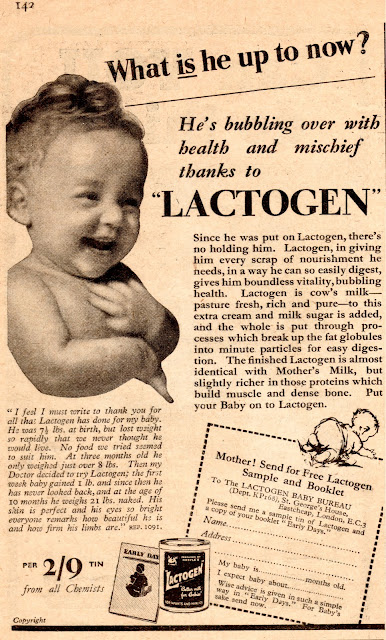
Even Truby King, early twentieth-century breastfeeding evangelical and founder of the global mothercraft movement, developed artificial baby food which was produced in New Zealand and then shipped all over the world. Kariol, Karilac, and Karil were meant to be prescribed for babies who were not, for whatever reason, breastfed either as a supplement to cows’ milk, or to be taken on their own.
Although King’s patent foods seemed to contradict his enthusiasm for breastfeeding – and he came under enormous criticism in New Zealand and Australia for his promotion of Kariol and Karilac – there was a certain logic to his decision to manufacture wholesome baby formula. During the early decades of the twentieth century, doctors in Britain and the United States noticed that bottle-fed babies were considerably more likely to die during early infancy than those who were breastfed. Artificial foods – which ranged from thin porridges and condensed milk to baby formulas – were often nutritionally inadequate, particularly in poor families who could not afford better and more expensive substitutes.
But they also identified a link between bottle feeding and diarrhoea, then, as now, one of the main causes of death in infancy. William J. Howarth, the Medical Officer of Health for Derby
arranged in 1900 to receive weekly lists of the births registered during the past seven days from the local registrar. From November of that year until November 1093 women inspectors enquired into the feeding method of each registered child by personally visiting the mother and infant at home.
The results of the study, published in 1905, were telling. Of the infants surveyed, 63% were breastfeed, 17% were partly bottle-fed, and 19% entirely bottle-fed:
The mortality rates from ‘diarrhoea and epidemic enteritis’ in addition to those from ‘gastritis and gastro-enteritis’ were as expected: 52, or 10 per 1,000 of the breastfed, 36 or 25.1 per 1,000 of the mixed-fed, and 94 or 57.9 per 1,000 of the bottle-fed babies died. In other words the mortality rate of the bottle-fed infants was nearly six times greater than that of the breast-fed babies.
Howarth concluded: ‘In not one single instance does the death-rate in any class of disease among hand-fed children even approximate that recorded among children who are breastfed; the rate is invariably higher.’
The problem, in terms of the link between bottle feeding and diarrhoea, was not so much the nutritional content of artificial foods, but the difficulties in keeping them free from contamination, and particularly during summer when infant mortality rates soared.
Indeed, South African advertisements for Lactogen emphasised that the product did not spoil in warm weather. As criticism of artificial foods grew louder, so advertising became more subtle, and better adept at appealing to mothers aware of the potential problems of bottle feeding. Doctors were, though, also aware of the effects of advertising on mothers’ choices, as a medical officer based in Johannesburg wrote in 1925:
No one can deny the fact that the proprietary foods of today are a vast improvement upon those of twenty years ago. They all contain very sound instructions as to the preparation of the food and the amount to be given. The advertising of such foods is carried out on a most extensive scale and in a clever and attractive manner. No hoarding today is without a picture of a flabby and over-fat infant alleged to have been reared solely on the proprietary food advertised thereon. Many a mother who for one reason or another, is not satisfied with the progress of her baby, sees this advertisement, and immediately rushes off to secure this particular food for non-thriving infant.
But not only mothers were influenced by this advertising. He admitted that it was ‘only too true that many medical men and trained nurses are also gulled by such advertisements and circulars’. Dr Cicely Williams, best known for her identification of the condition kwashiorkor in the 1930s, worked in the Colonial Medical Service in West Africa and southeast Asia before World War II and became particularly interested in the treatment of the diseases of early infancy.
She was critical of the introduction of baby formula to Singapore and Malaya, where white-coated sales reps distributed samples of artificial foods to poor mothers. In 1939 she published a pamphlet, ‘Milk and Murder,’ in which she pointed out the benefits to both mothers and babies of breastfeeding.
Nevertheless, Nestle and other companies were still using the same strategies to convince mothers in developing nations to use baby formula in the 1970s, and there are still concerns that they are not fully compliant with the Code on breast milk substitutes. The new South African regulations, if passed, are aimed at remedying this.
The cause for these new regulations and other measures introduced internationally to encourage mothers to breastfeed for the first six months of life, is a concern that rates of breastfeeding remain low in comparison to what they were during the early twentieth century. For all the good that the Code and other laws have done, it remains the exception, rather than the rule, for women to breastfeed for such an extended period of time.
However true it may be that advertising does have an impact on women’s choices, it’s certainly not the only factor which influences how women feed their babies. What’s missing from these measures is any attempt to communicate with mothers themselves. As doctors in the early twentieth century believed that mothers, whom they characterised as emotional and irrational, simply followed any and all advice which they read or heard, so campaigners and governments today seem to be too quick to seek only one reason for women’s decision to breast- or bottle-feed.
In fact, we need to make it easier for women to choose to breastfeed: to eliminate the ridiculous prejudice against breastfeeding in public spaces; for work and childcare not to be mutually exclusive; and for sympathetic advice and information to be made available for all new mothers.
Further Reading
Texts cited here:
Linda Bryder, A Voice for Mothers: The Plunket Society and Infant Welfare, 1907-2000 (Auckland: University of Auckland Press, 2003).
Deborah Dwork, War is Good for Babies and Other Young Children: A History of the Infant and Child Welfare Movement in England, 1898-1918 (London and New York: Tavistock Publications, 1987).
Philippa Mein Smith, Mothers and King Baby: Infant Survival and Welfare in an Imperial World: Australia, 1880-1950 (Basingstoke: Macmillan, 1997).
Other sources:
Rima D. Apple, Mothers and Medicine: A Social History of Infant Feeding (Madison: University of Wisconsin Press, 1987).
Linda M. Blum, At the Brast: Ideologies of Breastfeeding and Motherhood in the Contemporary United States (Boston: Beacon Press, 1999).
Marulyn Yalom, A History of the Breast (New York: Ballantine Books, 1997).

Tangerine and Cinnamon by Sarah Duff is licensed under a Creative Commons Attribution-ShareAlike 3.0 Unported License.


 Tangerine and Cinnamon
Nov 20
The Story of the Teeth
I was born with comically bad teeth. I have only one wisdom tooth – welded firmly to my jaw – and had multiple permanent teeth for some of my milk teeth, and none for others. (I still have two milk teeth.) That I don’t look like a caricature of a Blackadder-ish wisewoman is down entirely to my parents’ swift removal of me to a brilliant orthodontist who – with the aid of braces, plates, and two operations – gave me a decent set of teeth.
I spent rather a lot of my childhood and adolescence in pain, as my teeth and jaw were cajoled and wired into place. (I must add, though, that my parents provided me with an endless supply of sympathy, and soft, delicious things to eat, as well as plenty to read.) It was partly for this reason that I never understood the outrage that greeted the news of Martin Amis’s decision to spend around £20,000 in fixing his teeth, ending decades of persistent toothache.
Of course, much of the anger about this amount was linked to his lucrative move, in 1995, from the late Pat Kavanagh, the literary agent who helped him to build his career, to Andrew Wylie, causing an acrimonious rift with Julian Barnes, Kavanagh’s husband. Indeed, AS Byatt later apologised to him for having criticised both his dental work and his acceptance of an extraordinarily high advance negotiated by Wylie, explaining that she had had toothache at the time.
In his memoir, Experience (2000), Amis writes evocatively of the hell of toothache: that it seems to be the only manifestation of dull pain which can’t be blocked out or ignored. It demands attention. (Apparently James Joyce and Vladimir Nabokov were fellow martyrs to tooth pain. There is, clearly, a link between toothache and stylistic experimentation.)
It’s no wonder that modern dentistry is usually cited as one of the best reasons against time travel. The dentist Horace Wells (1815-1848) originated the use of nitrous oxide (laughing gas) as an anaesthetic during dental surgery. Wells died – partly as a result of an addiction of chloroform, ironically – before nitrous oxide became the anaesthetic of choice, rather than ether for example, among dentists. In South Africa, I’ve found evidence to suggest that it was possible to have teeth extracted under anaesthetic from around the 1880s – although it’s likely that this was available to wealthier patients before then.
In fact, the state of one’s teeth has been a potent indicator of class difference since at least the nineteenth century. Access to dentists and technology – powders, pastes – to prevent tooth decay meant that the middle and upper classes had better teeth than those who were poor, whose diets tended to feature substantial amounts of tooth-eroding sugar, and whose visits to dentists – who had usually had little or no training – were done only in case of dire emergency.
In the pub conversation described in TS Eliot’s The Waste Land (1922), the speaker refers to a friend, Lil, who worries that her recently demobbed husband will leave her, partly because she had aged so much during the recent Great War:
As false teeth became cheaper and more widely available, it seemed to make better sense to have all one’s teeth out at once, rather than suffer a lifetime’s worth of dental pain.
We attach a wide range of meanings to teeth: from the elongated incisors of vampires, to the whiter-than-white rictus grins of celebrities. My friend Shahpar in Dhaka points out that in south Asia, some Muslims associate oral hygiene using the bark of the miswak tree with holiness, as they believe that the Prophet used the bark to clean his teeth. More generally, people in the region place an exceptionally high value on having a healthy, full mouth of teeth – reflected in some truly appalling jokes.
I’ve been reading about anxieties about oral hygiene and dentistry recently, hence this interest in shifting cultural and social constructions of teeth. During the early decades of the twentieth century, global anxieties about infant mortality and childhood health, resulted in a heightened concern about the care of children’s teeth. This was part of an infant welfare movement which had emerged all over the world at the end of the nineteenth century, in response to unease about high rates of infant mortality (usually as a result of diarrhoea), the apparently failing health of urban working-class men, and eugenicist anxieties about maintaining white control over political, social, and economic power.
Denture Shop, India, 1946*
Although child welfare campaigners during the nineteenth century drew parents’ attention to the need to instil in their children good habits of dental hygiene, the discourse around the state of children’s teeth during the early twentieth century differed. To be fair, rotting teeth and gum disease are the cause of a range of health problems, and it makes sense to direct public health policy towards making dental services freely available.
But particularly during the 1920s and 1930s, preventing poor oral hygiene and tooth decay began to take on moral overtones. Doctors and child welfare activists increasingly understood bad oral health as a signifier of chaotic, ‘unscientific’ upbringings – which, they believed, tended to occur in working-class families. Writing about Major General Sir Frederick Barton Maurice’s influential 1903 study of the large numbers of volunteers who were deemed to be physically unfit to fight in the South African War (1899-1902), Anna Davin explains:
This was one of several essays and articles which argued that poor nutrition in childhood – most notably feeding babies food meant for adults – caused ‘bad teeth’ and, thus, compromised health in adulthood. The best means of remedying this situation was to encourage mothers (and in the minds of doctors, welfare campaigners, and policy makers, these mothers were inevitably working-class) to adhere to ‘scientific principles’ in raising their children, chief of which was providing babies and young children with a diet calibrated precisely to their needs. These principles and diets were formulated by health professionals – medical men – and they, as well as nurses, health visitors, and others, encouraged mothers to abandon ‘superstitious’ and ‘ignorant’ childrearing practice in favour of properly ‘scientific’ guidelines.
Those doctors and campaigners influenced by eugenics argued, though, that children’s moral character depended on good dental hygiene. (Susanne Klausen explains what we mean by ‘eugenics’: ‘in its broadest definition…eugenics was concerned with improving the qualities of the human race either through controlling reproduction or by changing the environment or both.’) In The Story of the Teeth, and How to Save Them (1935), Dr Truby King, the extraordinarily influential founder of the global mothercraft movement, argued that the health and strength of babies’ and children’s teeth depended, firstly, on the health of the pregnant and lactating mother, and, secondly, on proper nutrition.
Breastfeeding – not on demand, but at regular intervals depending on the age of the baby – was, he believed, the foundation for the development of strong teeth and jaws. The introduction of nutritious food once the baby was six months old should, he wrote, encourage the child to chew, thus stimulating the nerves and blood vessels in the face, causing the milk and permanent teeth to emerge quickly and cleanly.
King had dire warnings to those parents – particularly mothers – who, he suggested, ‘gave in’ to the demands of their babies and children:
Why? Because oral hygiene and healthy teeth ensured that the citizens of the future would be morally good, productive, conscientious individuals:
Good teeth meant good citizens. Bizarre as this thinking may have been, it did – often – have positive outcomes. For instance, similar views held among South African doctors and child welfare campaigners were behind the establishment of a network of dental clinics for poor children – albeit mainly white children – during the 1920s and 1930s. Children whose parents could not afford private dental care, could attend these clinics gratis.
One of the most striking characteristics of eugenicist thinking was its tendency to blame mothers’ ignorance, stupidity, or credulousness for the poor health of their babies and children, ignoring the environmental factors – the contexts – in which they raised their offspring. King’s implication was that mothers were ultimately responsible for the ‘vice and criminality’ of society: if they, he wrote, had simply disciplined their children, feeding them properly and ignoring their demands, then all adults would be productive, self-controlled citizens.
Although King’s reasoning is demonstrably bonkers, this tendency to blame (single) mothers for children’s anti-social behaviour persists, particularly within right-wing political and media circles. This is a strategy which absolves the state and other institutions of any responsibility for ensuring that children are adequately care for.
The study of attitudes towards teeth and dentistry reveals a range of beliefs about parenting, childhood, and, nutrition. It seems, then, that we are not only what we eat, but we are also how we eat.
Sources cited here:
Anna Davin, ‘Imperialism and Motherhood,’ History Workshop, no. 5 (Spring 1978), pp. 9-65.
Susanne Klausen, ‘“For the Sake of the Race”: Eugenic Discourses of Feeblemindedness and Motherhood in the South African Medical Record, 1903-1926,’ Journal of Southern African Studies, vol. 23, no. 1 (March 1997), pp. 27-50.
Antora Mahmud Khan and Syed Masud Ahmed, ‘“Why do I have to Clean Teeth Regularly?” Perceptions and State of Oral and Dental Health in a Low-income Rural Community in Bangladesh’ (Dhaka: BRAC, 2011).
Truby King, The Story of the Teeth and How to Save Them (Auckland: Whitcombe & Tombes, 1935).
Further Reading:
Naomi Murakawa, ‘Toothless: The Methamphetamine “Epidemic,” “Meth Mouth,” and the Racial Construction of Drug Scares,’ Du Bois Review, vol. 8, no. 1 (2011), pp. 219-228.
Alyssa Picard, Making the American Mouth: Dentists and Public Health in the Twentieth Century. (New Brunswick: Rutgers University Press. 2009).
David Sonstrom, ‘Teeth in Victorian Art,’ Victorian Literature and Culture, vol. 29, no. 2 (2001), pp. 351-382.
* This photograph is from Retronaut.
Tangerine and Cinnamon by Sarah Duff is licensed under a Creative Commons Attribution-ShareAlike 3.0 Unported License.