Skip to content

Posts tagged ‘United States’

Bananas

This term a colleague and I are teaching a course on the 1960s to our third-year students (who are uniformly lovely – henceforth I shall only teach third-year students, Head of Department-willing). I’ve spent the past two lectures on the counter-cuisine, a movement located mainly in California from around 1966 onwards. Aside from the loonier fringes represented by the Diggers and some members of the back-to-the-land movement, the most durable remnant of the food counterculture was the co-operative movement. Over five thousand buying clubs and co-operative groceries were established between 1969 and 1979. Warren Belasco explains:

Although many consumers flocked to these hip stores just for the cheaper, healthier food, co-op organisers frequently had a more ambitious agenda: using socialised food distribution as a starting point, they hoped to establish a decentralised, democratic, alternative economic network that would sustain an oppositional culture and eventually subvert the wider society.

One woman, who was a member of the West Concord Food and Friendship Co-Op remembers:

Every week we picked up our orders of whole grains, nuts, oils, dried fruits, seeds, tofu, yogurt, cheese, and peanut butter, bringing our own re-used quart and gallon jars and plastic containers. When it was our turn to place and break down the order we collated all the previous week’s orders, placed the order with NEFCO, the New England Federation of Cooperatives, and then divided up the bulk goods into boxes for each member. The food was first rate: gallon jars of organic yogurt with the cream on top, vats of tofu in pound blocks bought directly from Boston’s Chinatown, and 10-pound blocks of sharp cheddar cheese from the Cabot dairy cooperative in Vermont – for we purchased from producer cooperatives whenever possible.

One of the things which struck me as I wrote these lectures was how similar the present food revolution – whatever that may be – is to the counter-cuisine: as the Diggers distributed free food at Golden Gate Park in 1966, using food discarded by supermarkets, so organisations like This is Rubbish raise awareness about food waste by ‘skipping’ – collecting fresh produce past its sell-by date and then serving it in free feasts. The amazing People’s Supermarket provides an alternative to supermarkets by being run along co-operative lines.

As the co-operatives of the 1960s went out of their way to support local producers – as Alice Waters’s Chez Panisse (founded in 1971) bases its menus on what local organic farmers are harvesting – so now eating ‘locally’ is seen as one of the best ways of eating responsibly and sustainably. ‘Locavorism’ offers an alternative to a globalised, industrialised food system which stocks supermarkets with strawberries – flown halfway across the world – in the middle of winter.

But our food supply has been globalised since at least the beginning of the twentieth century. Already in the 1870s, improvements in transportation meant that Canadian and American wheat fed Europe during one of the worst harvest failures of that century. But the excitement many felt during the twentieth century at the prospect of relatively cheap pineapples and papaya grown abroad and flown and shipped to Western supermarkets, has been replaced by a deep concern about the environmental cost of unseasonal eating, and the power of Big Food.

There is another reason to think twice about food shipped in from abroad: its political cost.

I’ve just finished reading Nicholas Shaxon’s eye-poppingly good Treasure Islands: Tax Havens and the Men Who Stole the World (2011). He argues that tax havens – which the International Monetary Fund estimates to hold more than a third of the world’s GDP on their balance sheets – have fundamentally undermined the world’s economic system. Not only has the legitimate, on-shore financial system become progressively deregulated to compete with offshore – helping to cause the 2008 crash – but tax avoidance keeps poor nations reliant on aid. He explains:

Offshore business is, at heart, about artificially manipulating paper trails of money across borders. To get an idea of how artificial it can be, consider the banana.

Each bunch takes two routes into your fruit bowl. The first route involves a Honduran worker employed by a multinational who picks the bananas, which are packaged and shipped to Britain. The multinational sells the fruit to a big supermarket chain, which sells it to you.

So far, so obvious. But then it becomes more interesting:

The second route – the accountants’ paper trail – is more round-about. When a Honduran banana is sold in Britain, where are the final profits generated, from a tax point of view? In Honduras? In the British supermarket? In the multinational’s US head office? How much do management expertise, the brand name, or insurance contribute to profits and costs? Nobody can say for sure. So the accountant can, more or less, make it up. They might, for example, advise the banana company to run its purchasing network from the Cayman Islands and run its financial services out of Luxembourg. The multinational might locate the company brand in Ireland; its shipping arm in the Isle of Man; ‘management expertise’ in Jersey and its insurance subsidy in Bermuda.

Say the Luxembourg financing subsidiary now lends money to the Honduras subsidiary and charges interest at $20 million per year. The Honduran subsidiary deducts this sum from its local profits, cutting or wiping them out (and its tax bill). The Luxembourg’s subsidiary’s $20 million in extra income, however, is only taxed at Luxembourg’s ultra-low tax haven rate. With a wave of an accountant’s wand, a hefty tax bill has disappeared, and capital has shifted offshore.

What are the implications of this? Most importantly, our banana multinational has managed to avoid paying the Honduran government – or indeed any government – any tax.

About two-thirds of global cross-border world trade happens inside multinational corporations. Developing countries lose an estimated $160 billion each year just to corporate trade mispricing of this kind. That much spent on health-care, Christian Aid reckons, could save the lives of 1,000 under-five children per day.

In 2006, the world’s three biggest banana companies, Del Monte, Dole, and Chiquita, paid only $235,000 tax between them – despite combined profits of nearly $750 million.

I’m sure that Shaxon chose deliberately to use Honduras as an example. Until 1970, Chiquita was known as the United Fruit Company. Fans of One Hundred Years of Solitude (1967) by Gabriel Garcia Marquez might have inkling about the United Fruit Company’s murky past:

The gringos…built a separate town across the railroad tracks with streets lined with palm trees…. The section was surrounded by a metal fence topped with a band of electrified chicken wire which during the cool summer mornings would be black with roasted swallows. No one knew yet what they were after, or whether they were actually nothing but philanthropists, and they had already caused a colossal disturbance…. Endowed with means that had been reserved for Divine Providence in former times, they changed the pattern of the rains, accelerated the cycle of the harvests, and moved the river from where it had always been and put it with its white stones and icy currents on the other side of the town, behind the cemetery.

The coming of the Americans – all of them employees of an unnamed banana company – is the cause of the ‘events that would deal Macondo its fatal blow’, chief of which is a massacre of striking workers. The employees of the banana company decide to down tools because of low pay and their appalling working conditions – something justified by the ‘mournful lawyers’ of the banana company on the grounds that

the banana company did not have, never had had, and never would have any workers in its service because they were all hired on a temporary and occasional basis. …it was established and set down in solemn decrees that the workers did not exist.

Caught in this ‘hermeneutical delirium’, the striking workers are at the mercy of the banana company and the army, sent to quell their action. The strike ends with a massacre in the town square, when soldiers turn their automatic weapons on an unarmed crowd.

This is a description of a real event, the massacre de las bananerasthe banana massacre – in Ciénaga, Colombia, on 6 December 1928. Garcia Marquez’s ‘banana company’ was the United Fruit Company, which hired labour only through local agents to avoid having to comply with Colombia’s labour laws. When Colombian workers demanded better conditions and formalised contracts, their strike became the biggest in Colombian history, and came to an end when the Colombian army opened fire on peaceful protestors in Ciénaga.

The term ‘banana republic’ was coined by O. Henry in his anthology Cabbages and Kings (1904) in his account of his brief stay in Honduras – on the run from an embezzling charge – to describe a country run for the profit of a small elite of politicians and businessmen. The business in question was the United Fruit Company – and the term could be used to describe most of the Latin American countries in which United Fruit operated.

Founded in 1909, United Fruit emerged as the largest North American banana importer during the first two decades of the twentieth century. Its success was due partly to its strategy of manipulating governments into allowing it to pursue its interests, mainly by excluding all other opposition. It created monopolies by paying local producers higher prices than its competitors – and then dropped these prices to well below acceptable levels once the rivals had left the market, often impoverishing its suppliers.

When United Fruit began cultivating its own plantations during the 1930s, it did so across Latin America. If one of its divisions succumbed to Panama disease (Fusarium cubens), the company simply abandoned it – and those workers – and destroyed all the infrastructure which would have allowed other companies to begin farming there again once the plants were rid of the fungus.

To top this, the company was not averse to manipulating governments through bribery and intimidation, and sponsoring the odd coup d’état. United Fruit lobbied hard for the CIA-backed coup in Guatemala in 1954, when the left-leaning Jacobo Árbenz Guzmán – who had expropriated land claimed by the company – was replaced by the rightwinger Carlos Castillo Armas.

As Pablo Neruda wrote in his poem ‘La United Fruit Co.’ (1950):

When the trumpet sounded
everything was prepared on earth,
and Jehovah gave the world
to Coca-Cola Inc., Anaconda,
Ford Motors, and other corporations.
The United Fruit Company
reserved for itself the most juicy
piece, the central coast of my world,
the delicate waist of America.

It rebaptised these countries
Banana Republics,
and over the sleeping dead,
over the unquiet heroes
who won greatness,
liberty, and banners,
it established an opera buffa:
it abolished free will,
gave out imperial crowns,
encouraged envy, attracted
the dictatorship of flies:

It seems that Chiquita still engages in questionable practises, other than doing its best not to pay tax. An investigation into Chiquita’s business dealings in Latin America during the late nineties alleged that the company bribed officials, used dangerous pesticides, employed its workers in appalling conditions, and illegally maintained a monopoly on banana production.

In 2003, Chiquita admitted to paying $1.7 million to the paramilitary group the United Self Defence Forces of Colombia (AUC), which has been listed as a terrorist organisation by the US State Department. The company also allegedly provided AK-47s to the group. Chiquita said that the payments were to protect its workers, but the Colombian authorities reject this, arguing that they were meant to allow Chiquita to continue producing bananas and to discourage labour unrest. It’s difficult to believe Chiquita’s claims as it becomes clear that nearly all of the victims of the AUC were Colombian workers.

So what are earnest locavores to do? They could stop buying bananas altogether, along with other imported produce. I have mixed feelings about this. I really like being able to support farmers in Kenya. We know that the distance that food travels between producer and plate is not necessarily linked to its impact on the environment: a ready meal made in a local factory may have a bigger carbon footprint than string beans grown in Tanzania. Another alternative would be to buy certified, Fair Trade products.

But, even so, Fair Trade can have only a limited impact. The problem with Fair Trade is that it asks consumers – those at the end of the food chain – to make the choices which will change a whole food system. This, particularly during a recession, is absolutely impossible. For real change to happen, we need a fundamental reform of both political and economic systems:

Fair trade alone cannot address the core problem of excessively concentrated markets in which a handful of overpowerful transnational corporations dictate terms of trade and suck profits up into their own coffers.

What is needed for really fair trade is a more equitable distribution of the money in the chain. That will only be achieved with a shift in power which requires political action.

Which is why, oddly, getting Chiquita to pay its taxes is the first step in creating a better and fairer food system.

Further Reading

Sources cited here:

Warren Belasco, Meals to Come: A History of the Future of Food (Berkeley: University of California Press, 2006).

Warren Belasco, Review of Storefront Revolution: Food Co-ops and the Counterculture by Craig Cox, The Journal of American History, vol. 82, no. 2 (Sep., 1995), pp. 853-854.

Marcelo Bucheli, ‘Enforcing Business Contracts in South America: The United Fruit Company and Colombian Banana Planters in the Twentieth Century,’ The Business History Review, vol. 78, no. 2 (Summer, 2004), pp. 181-212.

Gabriel Garcia Marquez, One Hundred Years of Solitude, trans. Gregory Rabassa (London: Penguin, [1967] 1973).

Mark Moberg, ‘Crown Colony as Banana Republic: The United Fruit Company in British Honduras, 1900-1920,’ Journal of Latin American Studies, vol. 28, no. 2 (May, 1996), pp. 357-381.

Nicholas Shaxon, Treasure Islands: Tax Havens and the Men Who Stole the World, revised ed. (London: Vintage, 2012).

Other sources:

Anthony Ashbolt, ‘From Haight-Ashbury to Soulful Socialism: Culture and Politics in the Movement,’ AJAS, vol. 1, no. 3 (July 1982), pp. 28-38.

Warren Belasco, Appetite for Change: How the Counterculture Took on the Food Industry, 1966-1988, revised ed. (London: Cornell University Press, 2007).

Andrew Kirk, ‘Appropriating Technology: The Whole Earth Catalog and Counterculture Environmental Politics,’ Environmental History, vol. 6, no. 3 (Jul., 2001), pp. 374-394.

Creative Commons License Tangerine and Cinnamon by Sarah Duff is licensed under a Creative Commons Attribution-ShareAlike 3.0 Unported License.

Food Links, 29.02.12

How and why food habits change.

Is there such a thing as vegetarian Parmesan?

Why Fairtrade won’t fix the food system.

How should governments regulate our sugar intake?

How to cook after a catastrophe.

The first World Pasty Championships at the Eden Project in Cornwall.

This is HILARIOUS: the Food Quiz.

The absurdity of the Michelin guide – and the concept of ‘fine dining’.

How to dye yarn with Kool-Aid.

You can’t taste in space.

Why attempts to curb salt intake are misguided.

Chefs help to improve the food served at schools in Seattle.

Some Peruvian recipes.

The cake pop craze.

The funny thing about food fraud.

This is a fantastic review of The Delauney by Marina O’Loughlin.

I don’t understand why chefs still accidentally cook poisonous mushrooms.

Designer hot dogs.

An account of the American sunflower oil industry.

Why pepper? (Thanks Mum!)

Cooking with Joël Robuchon.

Lucy Mangan on Heston Blumenthal’s new TV series.

Scientists re-create the whisky taken to Antarctica by Ernest Shackleton.

The cult of bonkers birthday cakes.

The beauty of breadcrumbs.

Is Walmart the answer to food deserts?

The four most common mistakes in cooking bacon.

Why do we heat oil before cooking with it?

About half of the fresh fruit eaten in the US is imported.

Kathryn Hughes reviews a new history of dieting.

The sublime and scandalous world of olive oil. (Thanks Isabelle!)

The best food scenes in movies.

Iranian bread.

A McDonald’s burger in a rice cooker.

Food Links, 22.02.2012

Why we can end world hunger. And famine looms in the Sahel. Again.

A guide to restaurants according to how they treat their employees.

Walmart’s slow take over of the American food system.

What to eat while watching Downton Abbey (which is about to begin in South Africa).

Peta has tofu for brains.

A menu change sparks class conflict in Stoke Newington. (Where else?)

Mountain Dew can dissolve mouse carcasses. Nice.

The psychology of cupcakes.

A dream of toasted cheese.

Charles McIlvaine, pioneer of mycophagy in America.

Bruised cakes.

Everything you need to know about different cuts of meat.

Why gluten-free diets are over-hyped (unless you have coeliac disease, obviously).

The very worst of British cuisine.

Changing patterns of bush meat consumption in Gabon.

Communal eating.

Terry Wogan considers the catering at the BBC.

Books written on rice.

The true cost of winter tomatoes.

How much would you have to eat to rupture your stomach?

The rampant corruption in the Italian olive oil industry. (Thanks Isabelle!)

I’m not all that sure about this advertising campaign to end obesity in Georgia (in the US).

Will vegetarianism save the planet?

Crisps taste better if you open them from the bottom.

In 1977, Andy Warhol almost opened a fast food joint – and nine other failed New York restaurants.

Bees without Borders.

The curse of the Michelin star.

Food Links, 15.02.2012

South Africa seems set to introduce laws to control the fat and salt content of food.

No wonder the middle classes feel besieged – the price of muesli has increased steadily over the past five years.

It’s Shrove Tuesday/Fat Tuesday/Mardi Gras/Carnevale next Tuesday – what to eat in Venice.

How long does food last in the fridge?

South African Cookery Made Easy, by Mrs PW de Klerk.

Radio for food nerds: the Kitchen Cabinet.

The growing popularity of American Chinese food in…China.

On the opposition to GM crops.

Is the best burger in the world Japanese?

The potentially deadly perils of food writing.

A review of the Fleet River Bakery, Holborn.

No-yeast doughnuts.

Music + food = Turntable Kitchen.

Matthew Fort’s thoughts on leaving the Guardian.

How to make a better toasted cheese sandwich.

A history of the rise of Walmart.

Why is Bolivia a McDonald’s-free zone?

The whiskey flavour map.

Drinking with Faulkner.

The US government’s secret string bean agenda.

Public health posters. (Thanks Milli!)

A tour of the world in whisky.

Why there’s nothing wrong with MSG.

Twelve (potentially) useful hangover cures.

The revolutionary origins of Philadelphia pepper pot.

The flavour network.

Epazote.

Sugar of lead.

Justice, not Philanthropy

This week José Graziano da Silva, the Director General of the UN’s Food and Agriculture Organisation, announced that the famine in Somalia has ended. A combination of good rain, the most successful harvest in seventeen years, and the effective dispersal and deployment of food and agricultural aid means that most Somalis now have adequate access to food. But this is likely to be a temporary reprieve: it’s uncertain if food stocks will last until April, when the next rainy season begins and the main planting is done.

This already fragile situation is compounded by Somalia’s complicated politics: the southern part of the country is still controlled by the Islamist group al-Shabaab, which banned the Red Cross from operating in the area this week, and has disrupted food supplies in the past. Tellingly, around half of the 2.34 million people still in need of humanitarian assistance and seventy per cent of the country’s acutely malnourished children are in southern Somalia.

The end of the famine is no cause for celebration, then. Thirty-one per cent of the Somali population remains reliant on food aid, famine looms in another three months, and there are the after-effects of the famine to cope with: the plight of the refugees scattered around Somalia, Ethiopia, and Kenya; and the generation of malnourished children.

It’s estimated that between 50,000 and 100,000 people died in this famine, half of them children.

Clearly, something isn’t working.

And as one famine comes to an end – or, at least, a halt – in East Africa, another one seems to be developing on the other side of the continent. Niger, and, indeed, its neighbours Chad and Mali, is both drought- and famine-prone. Even in good years, it struggles to feed itself. Fifteen per cent of the world’s malnourished children live in Niger. But poor rainfall at the end of 2011 and a spike in global food prices means that the country’s population faces famine.

Niger’s last famine was in 2010, when the World Food Programme provided food to 4.5 million people. But things seem to be more hopeful there than in Somalia, and largely because Niger has a government which functions relatively well. Realising that it needs to store its food supply properly, provide jobs so that its population can afford to buy food, and also limit the growth of its population, the government of Niger is introducing measures to improve people’s access to food. One new piece of legislation will make it compulsory for children to remain in school until the age of sixteen, partly because of the strong link between girls’ education and declining family size.

Somalia’s weak and ineffectual government can’t do anything to prevent famine from occurring there again. With all the will in the world, there is no way that Somalia’s food crisis will end until its political situation stabilises.

The comparison of Niger and Somalia is particularly useful for demonstrating the extent to which responses to famine – from the media, NGOs, charities, and other international organisations – are heavily politicised. Reporting on the Niger famine in 2010 was fairly muted and I’ve only seen a couple of references to its most recent food crisis. Somalia, though, never seems to be out of the news. The reason for this is depressingly simple:

Niger, the large West African country whose name is best known for being just one unfortunate letter away from a pejorative racial insult, has a few terrorists, but not enough to really matter. Elements from al Qaeda in the Islamic Maghreb wander across Niger’s border every now and then, taking advantage of the large desolate areas which characterise most of the country, but for the most part its contribution to the War on Terror is minimal.

Al-Shabaab is loosely affiliated to al Qaeda and the United States fears that the Horn of Africa could prove to be a useful base for planning future terrorist activities. It probably also helps that Somalia has media-friendly pirates too.

So all famines aren’t equal. All famines are complicated. Indeed, the whole question of ‘hunger’ is complex. I was amused to note that Monday marks the beginning of the WFP’s Free Rice Week. The project encourages individuals to play a game on a website. For every correct answer, Free Rice Week’s sponsors donate ten grains of rice to the WFP. The aim of the project is to ‘provide education to everyone for free’. Hmm…. ok – it includes some basic, if vague, information about ‘hunger’. And also to ‘help end world hunger by providing rice to hungry people for free.’

Huh?

So this is going to end world hunger by giving all hungry people rice?

Seriously?

Other than the fact that it would be as – or even more – effective for the project’s sponsors and participants to skip the cute competition and simply donate rice to the WFP (or, even better, to a local feeding scheme or food bank), this really isn’t going to end world hunger.

I know that this seems like a soft target to shout at, and, really, there’s nothing wrong with donating food or money to the WFP, but my annoyance with projects and competitions like this one, stems from the fact that they’re dishonest. There is no way that Free Rice Week is going to end world hunger. It’s a pity that the WFP sees fit to inform people that by taking part in it they’re contributing to solving the food crisis.

In fact, I think that Free Rice Week and other, similar projects actually contribute to the problem.

Firstly, they fudge the meaning of ‘hunger’.  Over the past year or so, we’ve become familiar with the FAO’s horrifying statistic that one billion people go hungry every day – that one sixth of the world’s population does not have adequate access to food. But there are problems with this statistic:

it is not the only way to measure food insecurity. Over the years, it has been criticised on many fronts: for the poor quality of underlying data; for the focus on calorie intake, without consideration of proteins, vitamins and minerals; and for the emphasis on availability – rather than affordability, accessibility or actual use – of food. Some say we’d be better off focusing on improving household consumption surveys, opinion polls, and direct measures of height and body weight.

These figures need to be accurate because they ‘are also used to help guide where to send foreign aid, track progress towards international development goals, and hold governments to account for promises made.’

Moreover, it glosses over the fact that there are many kinds of hunger: the extreme events – the famines – which are the products of natural disasters, conflict, and state collapse; the hunger which is the product of poor diets and an inability to buy or access enough food; and the hunger in developed nations. In Britain and the United States, the numbers of people now reliant on food stamps and food banks has spiked during the recession.

Secondly, these projects ignore the fact that responding to various kinds of hunger requires far, far more than throwing money at the problem. In fact, the WFP’s website even acknowledges this: ‘People can go hungry even when there’s plenty of food around. Often it’s a question of access – they can’t afford food or they can’t get to local markets.’ Famines in the twentieth- and twenty-first centuries occur as a result of a collapse of distribution systems, usually caused by conflict or a crisis in government. Famines tend not to happen in stable democracies. The WFP must receive money for food aid – that is absolutely non-negotiable – but long-term change, as we’ve seen in the cases of Somalia and Niger, can only occur once stable, effective governments are in place. No amount of free rice is going to end famine in Somalia.

In other cases of hunger, it’s clear that people are simply too poor to buy food: employment, education, good health systems, and higher wages will go far in remedying this situation. But even then, we have to accommodate the choices that poor people make when spending their money. In an article for Foreign Policy’s special edition on food last year, Abhijit Banerjee and Esther Duflo took a closer look at the lives of the ‘one billion hungry’ and came to some interesting conclusions:

We often see the world of the poor as a land of missed opportunities and wonder why they don’t invest in what would really make their lives better. But the poor may well be more sceptical about supposed opportunities and the possibility of any radical change in their lives. They often behave as if they think that any change that is significant enough to be worth sacrificing for will simply take too long. This could explain why they focus on the here and now, on living their lives as pleasantly as possible and celebrating when occasion demands it.

We asked Oucha Mbarbk [a Moroccan peasant] what he would do if he had more money. He said he would buy more food. Then we asked him what he would do if he had even more money. He said he would buy better-tasting food. We were starting to feel very bad for him and his family, when we noticed the TV and other high-tech gadgets. Why had he bought all these things if he felt the family did not have enough to eat? He laughed, and said, ‘Oh, but television is more important than food!’

We need to take people’s choices about how they spend their limited funds, more seriously.

Thirdly, by focussing on raising funds, the WFP transforms itself into a philanthropic organisation. Donations of food and other forms humanitarian aid are absolutely necessary to alleviating food crises, but they won’t end these crises – or end ‘hunger’ (whatever we may mean by that). In an excellent article for the Guardian, the UN’s Special Rapporteur on the Right to Food, Olivier de Schutter argues:

our global food system…is in crisis. Last year’s famine in the Horn of Africa, and the current woes in the Sahel, are the surface cracks of a broken system. These regional outbreaks of hunger are not, as such, extreme events.

Beyond semantics, this is a crucial distinction. In viewing these events as extreme and unexpected, we fail to acknowledge the regularity and predictability of hunger. This flaw is fatal, for it means failing to acknowledge that the food system itself is broken. It means failing to build readiness for persistent famine into international development and humanitarian policy. And it means waiting until people starve before doing anything.

Food aid doesn’t address the deeper, structural problems underlying the food crisis. It doesn’t consider bad governance; the impact of food speculation on rising food prices; and agricultural efficiency, particularly in the light of climate change.

By appealing to people to donate money to fund their response to food crises – which could have been avoided – the WFP and others cast hunger as something which can be remedied with old-fashioned philanthropy. It’s certainly true that philanthropic organisations can do immensely good work – like reducing rates of polio and malaria in the developing world. But this doesn’t necessarily solve the problems which give rise to these crises:

the poor are not begging us for charity, they are demanding justice. And when, on the occasion of his birthday, a sultan or emperor reprieved one thousand prisoners sentenced to death, no one ever called those pardons justice. Nor is it justice when a plutocrat decides to reprieve untold thousands from malaria. Human beings should not have to depend upon a rich man’s whim for the right to life.

Precisely. The world’s poor should not be dependent on the goodwill of wealthy people who have the time and inclination to play games on the internet.

Creative Commons License Tangerine and Cinnamon by Sarah Duff is licensed under a Creative Commons Attribution-ShareAlike 3.0 Unported License.
Food Links, 01.02.2012

Hunger in Britain.

Antarctic cuisine.

Monsanto moves to control America’s food chain.

London’s first self-service pub.

Is vegetarianism passe?

The wonders of aioli.

Give praise, academics: the gin revival.

The music played in restaurants.

On eating horse.

The phonetic taste of coffee.

A brief history of recipe cards.

How to make a gingerbread geodesic dome.

The Poodle Duck Club menu from 1905.

How airline meals are made.

A history of pickles.

The language of crisp advertising and branding. (Thanks, Mum!)

Vegetarianism in America.

The worst book ever written.

An eighteenth-century recipe for onion soup.

Window shopping.

Twin Peaks cupcakes.

An excellent history of the American banana industry.

The dangers of exploding churros.

A history of the frito pie.

A guide to rolling pins.

Milking It

This week the committee organising the 2012 Olympics in London caused widespread anger when it announced that breastfeeding mothers would have to buy an extra ticket to bring their babies into sports venues. Some venues have a few discounted tickets for children, but others don’t. One commentator posted on Mumsnet

that while she and her husband were lucky enough to get tickets to an equestrian event in August, organisers had told her there are no children’s tickets so she will have to pay £95 for a three-month old in a sling.

Those who can’t afford an extra ticket, or who lose out in the next round of ticket allocation, are advised to stay away. Unsurprisingly, Britain’s Equality and Human Rights Commission has suggested that this is potentially a case of ‘indirect sex discrimination’ because it will affect considerably more women than men.

This situation is ridiculous in so many ways. What angers me the most is that the Olympic committee took this decision in a country where the National Health Service advises that babies be breastfed exclusively for the first six months of life. The members of the committee seem either to think that women shouldn’t breastfeed in public – an irritating view about which I am going to be extraordinarily rude at some stage – or that mothers with babies have no desire to attend public events.

In the midst of the uproar, The Ecologist tweeted an article which it had published six years ago about the debate over whether women should breast- or bottle-feed their babies. It’s an argument that parents, doctors, and policy makers have been holding since at least the beginning of the twentieth century, and it’s to the credit of Pat Thomas that her piece provides a good overview of shifting attitudes towards infant feeding over the course of the past hundred years or so.

But it’s also a problematic piece of writing, and one which demonstrates particularly well why so many mothers feel bullied about how they decide to feed their babies. Thomas makes no attempt to hide her view that all mothers should breastfeed their children. She begins with a terrifying list of statistics:

The health consequences – twice the risk of dying in the first six weeks of life, five times the risk of gastroenteritis, twice the risk of developing eczema and diabetes and up to eight times the risk of developing lymphatic cancer – are staggering. With UK formula manufacturers spending around £20 per baby promoting this ‘baby junk food’, compared to the paltry 14 pence per baby the government spends promoting breastfeeding, can we ever hope to reverse the trend?

I’d love to know where she found these figures – particularly given her opening statement that women have breastfed for ‘nearly half a million years’. (How does she know this? Why the coy, qualifying ‘nearly’?) Thomas is, though, correct to point to the compelling evidence that breastfed babies tend to be healthier than those who are fed on formula, and that breastfed children may do better at school and have stronger immune systems. Also, there is a direct and proven link between the use of baby formula and high child mortality rates in the developing world.

She blames the slow decline of breastfeeding over the course of the twentieth century on the medicalization of childcare, and on the advertising strategies employed by formula companies – most notoriously Nestle. I have little to add to her second point, other that, broadly, I agree with her. The International Code of Marketing of Breastmilk Substitutes, a response to the Nestle Boycott of the late seventies, needs to be properly implemented. But her argument about the medicalization of women’s experiences of childbirth and childrearing is not entirely correct. She quotes Mary Renfrew from the Mother and Infant Research Unit at the University of York:

‘If you look at medical textbooks from the early part of the 20th century, you’ll find many quotes about making breastfeeding scientific and exact, and it’s out of these that you can see things beginning to fall apart.’ This falling apart, says Renfrew, is largely due to the fear and mistrust that science had of the natural process of breastfeeding.

In particular, the fact that a mother can put a baby on the breast and do something else while breastfeeding, and have the baby naturally come off the breast when it’s had enough, was seen as disorderly and inexact. The medical/scientific model replaced this natural situation with precise measurements – for instance, how many millilitres of milk a baby should ideally have at each sitting – which skewed the natural balance between mother and baby, and established bottlefeeding as a biological norm.

During the early years of twentieth century, global concern about high rates of child mortality animated a child welfare movement which aimed to improve the conditions in which children were raised. In Europe, North America, Australia, New Zealand, and parts of Africa and Latin America, medical professionals held up rational and scientific methods of feeding and caring for babies as the best means of eradicating the ‘ignorant’ practises which, many believed, caused babies to die. This new emphasis on hygiene, speedy medical intervention, and regular monitoring of babies’ development and health at clinics and hospitals did lower rates of morbidity – as did declining fertility rates, the control of infectious disease, economic prosperity, and increased attendance of school.

Doctors and specialists in the relatively new field of paediatrics were particularly interested in how babies were fed. Contrary to what Thomas suggests, the nineteenth-century orthodoxy that breastfeeding was the healthiest and best option for both mothers and babies lasted well into the 1940s. Innovations in artificial formulas provided mothers who couldn’t breastfeed – for whatever reason – with good alternatives, and doctors did recommend them. There were anxieties that malnourished mothers’ milk would not feed babies sufficiently, and doctors recommended ‘top ups’ with formula or other liquid.

The real difference between nineteenth- and twentieth-century attitudes towards breastfeeding was that it was increasingly controlled and patrolled by trained professionals. As Renfrew notes, mothers were told how much milk their babies needed at each feed, and there was a lot of debate in medical journals and in other professional forums about how and when babies should be fed.

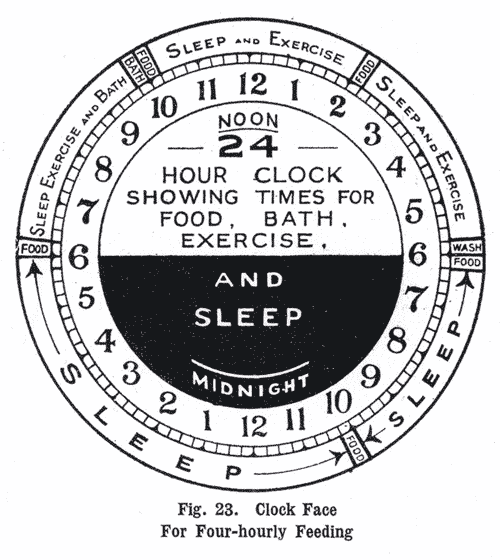
The set of guidelines formulated by the incredibly influential, New Zealand-based Dr Truby King emphasised the importance of routine in feeding. King’s mothercraft movement – which established clinics and training centres around the British Empire during the first half of the twentieth century – taught mothers to feed ‘by the clock’. At five months, a baby was to be fed only five times per day – and at the same time every day – while one month-old babies had an extra, sixth feed.

Like many childcare professionals of the period, King believed that feeding on demand was not only unhealthy – it placed babies at risk of under- or overfeeding – but it was morally and intellectually damaging too. Babies who understood that crying would cause them to be fed would become spoilt, lazy children and adults. Indeed, this points to the infant welfare movement’s more general preoccupation with mothers and motherhood. As the interests of the state were seen, increasingly, as being linked to the proper rearing and education of children, the role of the mother grew in importance. King called his centres ‘shrines to motherhood’, for instance.

But the naturally fussy, over-cautious, and credulous mother was not to be trusted to follow her own instincts: authorities and professionals, who tended to be male, were to provide her with rational, scientific advice on raising her baby. It’s difficult to gauge mothers’ response to the information aimed at them. In her study of mothers in the United States in the 1920s and 1930s, Julia Grant concludes that mothers did heed childcare professionals, but modified their advice according to the views and experiences of their peers. Similarly, mothers in New Zealand took what they wanted from King’s pamphlets on childrearing.

Equally, mothercraft clinics and breastfeeding advice days were well attended by mothers and babies. Several mothercraft centres all over the world also included a dietetic wing, where nursing mothers could stay for up to a fortnight, learning how to breastfeed their babies. There, they would be taught how to breastfeed by the clock, and how to cope with mastitis and painful breasts and nipples. Wonderfully, hospital fees were means tested, so poor mothers could attend for free.

Throughout its existence, the Cape Town dietetic hospital never had an empty waiting list, and similar units in Britain, Australia, and New Zealand were as enthusiastically supported by women. Mothercraft seems to have been at its most successful when mothers could choose how and when they wanted to its advice and services.

While it’s true that the medicalization of breastfeeding transformed this act into a ‘science’ which needed to be re-taught to mothers – that it became possible to inform a mother that she was breastfeeding incorrectly – and that this was underpinned by misogynistic and eugenicist ideas around childhood, motherhood, and the nation, it is as true that mothers did respond positively to the advice provided by mothercraft and other organisations. Clearly, mothers wanted more advice about how to feed their babies – and that they altered it to suit their conditions and needs.

It’s for this reason that I think that Thomas is doing mothers a disservice. Encouraging more women to breastfeed needs to respect the fact that women’s choices about how to feed their babies are influenced by a variety of factors and considerations. Thomas – and other breastfeeding evangelicals – seems to buy into the same discourse of maternal irresponsibility as childcare professionals did in the early twentieth century: the belief that women somehow don’t really understand what’s best for their babies, and must be properly educated. Even if her – and others’ – motives are progressive and well-meaning, they still fail to take mothers seriously.

Further Reading

Sources cited here:

Rima D. Apple, Mothers and Medicine: A Social History of Infant Feeding, 1890-1950 (Madison: University of Wisconsin Press, 1987).

Linda Bryder, A Voice for Mothers: The Plunket Society and Infant Welfare 1907-2000 (Auckland: Auckland University Press, 2003).

Julia Grant, Raising Baby by the Book: The Education of American Mothers (New Haven and London: Yale University Press, 1998).

Philippa Mein Smith, Mothers and King Baby: Infant Survival and Welfare in an Imperial World: Australia 1880-1950 (Basingstoke: Macmillan, 1997).

Other sources:

Linda M. Blum, At the Breast: Ideologies of Breastfeeding and Motherhood in the Contemporary United States (Boston: Beacon Press, 1999).

Molly Ladd-Taylor, Mother-Work: Women, Child Welfare, and the State, 1890-1930 (Urbana and Chicago: University of Illinois Press, 1994).

Marilyn Yalom, A History of the Breast (New York: Ballantine Books, 1997).

Creative Commons License
Tangerine and Cinnamon by Sarah Duff is licensed under a Creative Commons Attribution-ShareAlike 3.0 Unported License.
Food Links, 18.01.2012

Why pupils at a Los Angeles rejected new, healthy school dinners.

Three utopian feasts at the School of Life.

America: the land of the free and the hungry.

Food trends that fizzled out. (I’m particularly sorry about Mupcakes.)

Bizarre: a Russian ad for Burger King.

The history of the Chinese take-away container.

A taxonomy of bread in New York.

The guerilla grafters.

Hmmm…. I’m not all that sure about this, but it’s interesting: the difference between ‘Western’ and ‘Asian’ food flavours.

Slow Food USA appears to have gone into meltdown. (Unsurprisingly: it’s based on an entirely misguided set of principles.)

Occupy the food system.

The making of Italian American cuisine. (Thanks, Mum!)

On the mallow plant.

Are supper clubs the future of the restaurant?

The shady world of sugar substitutes.

Paintings made out of spices and salt.

Kitchens from the 1950s.

January is be kind to food servers month.

The ten best non-burger fast food dishes.

The Philosophy of Food Project.

Tips for freezing stock.

In search of the endangered Melipona beecheii bee.

Introducing LUPEC, Ladies United for Preservation of Endangered Cocktails.

The most dangerous tea in the world.

This is really, really good: testing the belief that McDonald’s burgers don’t rot.

A toaster made from cinderblock.

Food Links, 30.11.2011

An interview with Michael Pollan.

The surprising potential of breadfruit?

A lending library for kitchen gadgets. What a clever idea.

Slightly bizarre: food landscapes.

The meanings of -vore. (Thanks Mum!)

A week in the life of a competitive eater.

Consider wine cake.

The shifting meanings of ‘artisan‘ food.

Foraging for food in Rome.

The politics of chocolate.

Michael Pollan on the world’s (=America’s) most powerful ‘foodies’.

Why do Americans shoplift meat and cheese?

The Simpsons on foodies.

Possibly the most ill-judged cake in history.

Why not eat insects?

The American local food economy, in two graphs.

A story about one woman’s response to the recession in the US.

Which Formula?

So this is my blog’s thirty-sixth post. And, wow, what a year it’s been. Thank you, dear readers, for staying the course, and I promise more for 2012. This, though, is going to be the last essay for 2011. I’ll be spending December eating, cooking, researching, and teasing the cat. Really, it’s going to be wild. But before the fun begins, I’ll be in the UK for ten days, to present a seminar paper and to do a little research at the amazing Wellcome Library.

My real, live academic research pertains to the history of childhood in the British Empire. My PhD thesis traces the ways in which ideas around childhood and youth changed in the Cape Colony during the second half of the nineteenth century. It pays particular attention to the role and impact of Dutch Reformed evangelicalism in this process. But my postdoctoral project – which is being funded by the National Research Foundation (peace be upon it) – looks at the work of the Mothercraft movement within the British Empire between 1907 and 1945.

Mothercraft was pioneered in New Zealand in 1907 in response to concerns about the very high child mortality rates among the country’s Pākehā population. Dr Truby King devised a twelve-point programme to teach specially-trained nurses – known as Plunket nurses in New Zealand and Athlone nurses in South Africa – how to encourage mothers raise healthy babies. The success of Mothercraft was such that King was invited to establish a Mothercraft Training Centre in Britain in 1917. First called the Babies of the Empire League, it sent its nurses around the Empire: to Canada, Australia, India, east Africa, the Caribbean, and South Africa. My project focuses on the work the South African Mothercraft Centre and League, which were established in the mid-1920s.

But what, I hear you say, does this have to do with food? Well, a surprising amount. One of the main emphases of Mothercraft was on the proper feeding of babies. King was an enthusiastic promoter of breastfeeding.

We have a misconception that most babies were fed by wet nurses during the nineteenth century. It bolsters the view we have of middle-class Victorian ladies who were so terrified of their own bodies that feeding their babies was simply beyond the pale. This wasn’t strictly true, though. To begin with, wet nurses were expensive to hire and only the very wealthiest families could afford them. Most middle class women fed their own babies, as did many working-class women too.

In fact, the majority of women who relied on others to feed their babies were poor. In a time when working hours were yet to be properly defined by law, long days in factories or shops were the norm for female urban workers. Those without relatives, paid ‘baby farms’ – a house run by a woman who would care for babies and young children – to care for their offspring, often for weeks at a time. The quality of the care in these early crèches was variable: some were good, but many neglected the babies kept there. All over the world, baby farms had astonishingly high mortality rates.

Most of the popular childrearing manuals of the 1800s recommended that women breastfeed their babies. Thomas Bull, the author of the very popular Maternal Management of Children, in Health and Disease (1840) recommended breastfeeding on the grounds that it benefitted both mother and baby.

The period of suckling is generally one of the most healthy of a women’s life. But there are exceptions to this as a general rule; and nursing, instead of being accompanied by health, may be the same cause of its being materially, and even fatally, impaired. This may arise out of one of two causes, – either, a parent continuing to suckle too long; or, from the original powers or strength not being equal to the continued drain on the system.

If the mother could not breastfeed, then the best alternative was to hire a wet nurse. Only if this was an impossibility should the child be raised ‘by hand’:

To accomplish this with success requires the most careful attention on the part of the parent, and at all times is attended with risk to the life of the child; for although some children, thus reared, live and have sound health, these are exceptions to the general rule, artificial feeding being in most instances unsuccessful.

Bull acknowledged that the various concoctions fed to babies tended often to undermine, rather than fortify, their health. Popular recipes for baby formulas usually included corn or rice flour mixed to a paste with water or milk. This had little or no nutritional value, and would have been very difficult for immature digestive systems to process. Other popular substitutes were cows’ or goats’ milk, tea, and thin gruel.

It’s little wonder, then, that the Mothercraft programme placed such emphasis on breastfeeding. Many Mothercraft Centres provided beds for new mothers, who could spend up to a fortnight there, learning how to feed their babies.

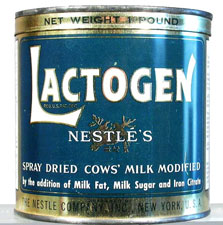
At around the same period, infant formulas were beginning to improve in quality and producers, most notably Nestlé, began to promote them as a healthy – even the healthier – and clean alternative to breast feeding. Nestlé is credited – rightly or wrongly – with the invention of formula milk in 1867. The popularity of powdered baby milk only began to grow during the 1940s and 1950s. Nestlé promoted Lactogen through recipe books, pamphlets, and free samples. Problematically, these were usually distributed at hospitals and clinics – at precisely the places where women would be taught how to breastfeed. By the middle of the twentieth century in the west, it was increasingly the norm for babies to be bottle fed.

I don’t particularly want to address the fraught debate over whether women should breastfeed or not. I am, though, interested in the politics of bottle feeding in the developing world, where big companies – like Nestlé – have promoted formula assiduously since the 1950s. Here, the issue with bottle feeding is not so much the quality of the formula, but the fact that it’s mixed with dirty water or fed to babies in unsterilized bottles. Also, many of the women who use formula can’t afford it, so they water it down, meaning that their children don’t receive adequate nutrition.

In 1974, War against Want published a pamphlet accusing Nestlé of profiting from the deaths of millions of children in poor countries. Three years later, an international boycott of Nestlé began, causing the World Health Organisation to proscribe the promotion of Lactogen and other formulas in its 1981 International Code for the Marketing of Breast Milk Substitutes.

But the Code has been poorly policed, and even in developed nations, compliance has been slow. In Australia, for instance, the advertising of baby milk powders only ended in the mid-1990s. There is much evidence to suggest that Nestlé and others continue the practice, albeit under different guises. In the United States, for instance, the Special Supplemental Nutrition Programme for Women, Infants and Children (WIC) distributes more than half the formula sold in the US every year. Companies provide this formula to the WIC at a discount.

All over the world, governments are endorsing breastfeeding in the first six months of life as the best – the healthiest and the cheapest – way of feeding a baby. Companies like Nestlé are actively undermining this, despite the best intentions of the WHO. The implications of the continued use of formula in the developing world are devastating:

According to Save the Children… infant mortality in Bangladesh alone could be cut by almost a third – saving the lives of 314 children every day – if breastfeeding rates were improved. Globally, the organisation believes, 3,800 lives could be saved each day. Given that world leaders are committed to cutting infant mortality by two thirds by 2015 as one of the Millennium Development Goals, protecting and promoting breastfeeding is almost certainly the biggest single thing that could be done to better child survival rates.

A few weeks ago I wrote a post which criticised the World Food Programme’s decision to go into partnership with a range of exceptionally dodgy multinationals – Cargill, Vodafone, Unilever, Yum!Brands – to reduce world hunger. I really don’t have anything against public/private partnerships, and am an enthusiastic supporter of corporate social responsibility (when it’s done well, though). But it’s deeply concerning that the WFP is providing unwitting PR to a group of particularly nasty businesses.

In a recent article for the Guardian, Felicity Lawrence discusses growing concern about big food companies’ decision to shift their focus to developing markets:

As affluent western markets reach saturation point, global food and drink firms have been opening up new frontiers among people living on $2 a day in low- and middle-income countries. The world’s poor have become their vehicle for growth.

SABMiller, Unilever, and Nestlé have developed campaigns to target poorer markets:

The companies say they are finding innovative ways to give isolated people the kind of choices the rich have enjoyed for years and are providing valuable jobs and incomes to some of the most marginalised. But health campaigners are raising the alarm. They fear the arrival of highly processed food and drink is also a vector for the lifestyle diseases, such as obesity, diabetes, heart disease and alcoholism, which are increasing at unprecedented rates in developing countries.

This is Nestlé’s strategy in Brazil:

Nestlé’s floating supermarket took its maiden voyage on the Amazon last year and has been distributing its products to around 800,000 isolated riverside people each month ever since. Christened Nestlé Até Você, Nestlé comes to you, the boat carries around 300 branded processed lines, including ice creams, and infant milk , but no other foods. The products are in smaller pack sizes to make them more affordable. The boat also acts as a collection point for the network of door-to-door saleswomen Nestlé has recruited to promote its brands. Targeting consumers from socioeconomic classes C, D and E is part of the company’s strategic plan for growth, it says. Nestlé has also set up a network of more than 7,500 resellers and 220 microdistributors to reach those at the bottom of the pyramid in the slums of Rio and São Paulo and other major Brazilian cities.

Even if Nestlé does respect the terms of the International Code for the Marketing of Breast Milk Substitutes, and I hope it does, not only is it selling unhealthy processed non-foods, but it also gains legitimacy via its partnership with…the United Nations. Earlier this year, Nestlé supported the UN’s ‘Every Woman Every Child’ initiative, which aims to improve child and maternal health. So an organisation implicated in contributing to the high rate of child mortality in the developing world, and in facilitating a global obesity epidemic, is working with the UN…to improve child health.

Merry Christmas.

Further Reading

Texts quoted here:

Thomas Bull, The Maternal Management of Children, in Health and Disease (London: Longman, Orme, Brown, Green, and Longmans, 1840).

Christina Hardyment, Dream Babies: Childcare Advice from John Locke to Gina Ford. Revised ed. (London: Frances Lincoln, 2007).

Virginia Thorley, ‘Commercial Interests and Advice on Infant Feeding: Marketing to Mothers in Postwar Queensland,’ Health and History, vol. 5, no. 1 (2003), pp. 65-89.

Other sources:

Linda Bryder, ‘Breastfeeding and Health Professionals in Britain, New Zealand and the United States, 1900-1970,’ Medical History. vol. 49, no. 2 (2005), pp. 179-196.

Linda Bryder, ‘From breast to bottle: a history of modern infant feeding.’ Endeavour, vol. 33, issue 2 (June 2009), pp. 54-59.

Linda Bryder, Not Just Weighing Babies: Plunket in Auckland, 1980-1998 (Pyramid Press, Auckland, 1998).

S.E. Duff, ‘What will this child be? Children, Childhood, and the Dutch Reformed Church in the Cape Colony, 1860-1894’ (PhD thesis, Birkbeck, University of London, 2010).

Nancy Rose Hunt, ‘“Le Bebe en Brousse”: European Women, African Birth Spacing and Colonial Intervention in Breast Feeding in the Belgian Congo,’ The International Journal of African Historical Studies, vol. 21, no. 3 (1988), pp. 401-432.

Creative Commons License Tangerine and Cinnamon by Sarah Duff is licensed under a Creative Commons Attribution-ShareAlike 3.0 Unported License.