
Occupy Food
So. Farwell then, Occupy London? There’s nothing like writing a (relatively) topical blog to remind you of how fast news develops. When I began thinking about this post, the protestors at Occupy London outside St Paul’s had lost their appeal against their eviction. It seemed that this wing of the occupy movement had gone the same way as Occupy Wall Street when Zuccotti Park was cleared. But now the campers have found a new, fifth spot, still in the City of London: Roman House, an empty building in the Barbican.
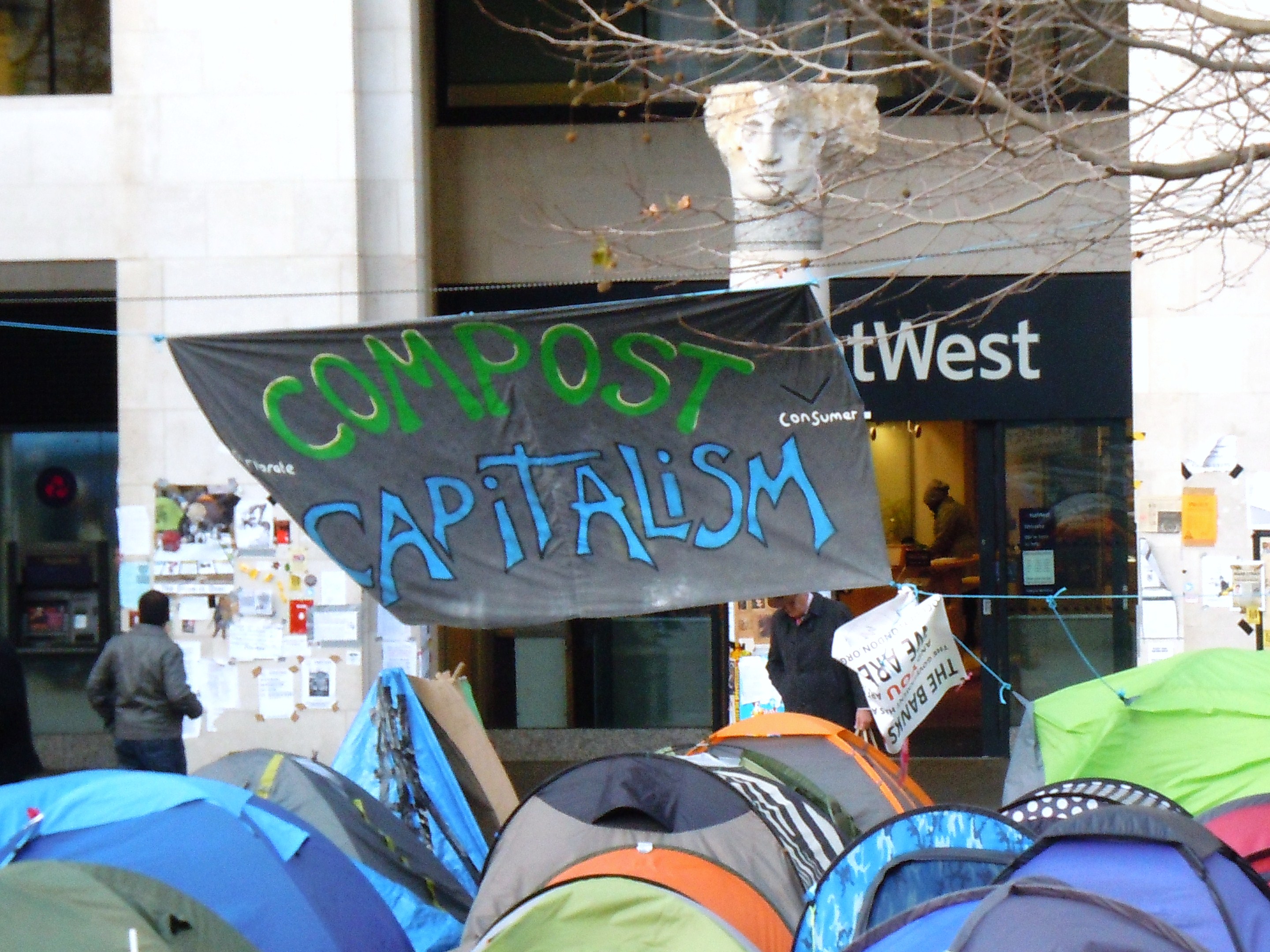
I visited Occupy London in December last year. I had arranged to attend a drawing class presented by Baduade (this is her account of it, with some of our contributions) and was hopelessly early, so I decided to visit two of the protest’s other sites, in Finsbury Square and in the abandoned UBS building in Sun Street – now rechristened the Bank of Ideas. I was struck by the social and ideological complexity of the protest. Not only did the protestors represent a variety of opinions, but were a varied group of people who had decided to camp for different reasons. Laurie Penny’s recent article on Occupy London sums this up particularly well:
The people who live full or part-time in the camps can now be divided into roughly three categories: those who were homeless before the occupations, those who will shortly be homeless, and those who merely look homeless. Three months of sleeping in tents, washing in the bathrooms of nearby cafes and working around-the-clock to run a kitchen feeding thousands with no running water and little electricity will transform even the most fresh-faced student into a jittering bundle of aching limbs and paranoia.
In his account of a night spent at the St Paul’s camp, James Macintyre noted a class difference between the sites, with more middle-class protestors choosing to settle at Finsbury Park – the site which produces The Occupied Times. My experience certainly bore this out: as I arrived at the Finsbury Park welcome tent, the girl supervising it bounded up to me and exclaimed in tones which would cheer any elocution teacher, ‘oh I love your badges!’.
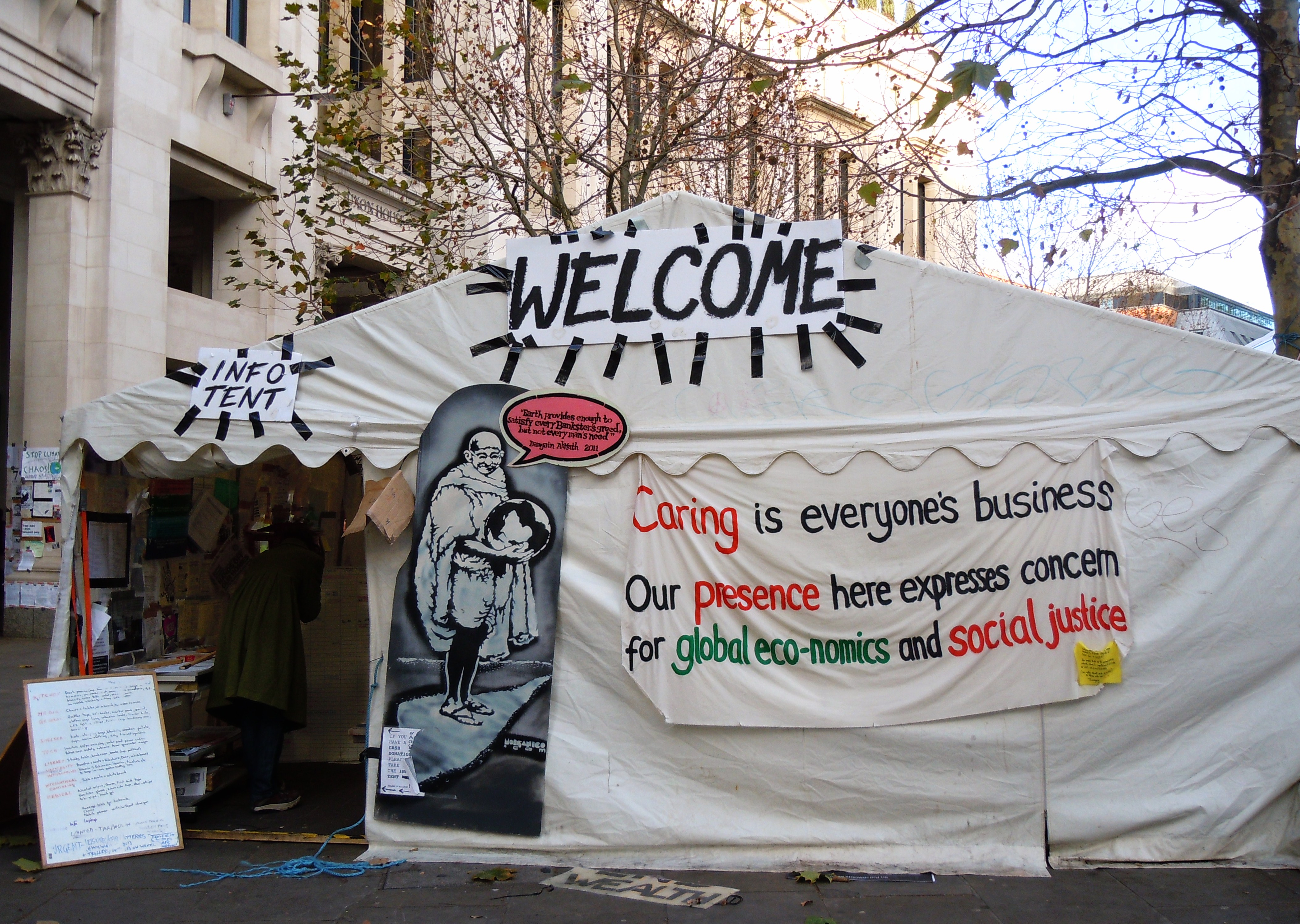
Part of the appeal of the camp, commented Macintyre, particularly for homeless people, is that it has a kitchen which provides food for free:
The campers, a multi-ethnic mix, are fed in the soup kitchen by volunteers, including several part-time chefs; they say they feed up to 1,500 people a day, most of whom are just around the camp during the day. The volunteers’ chief concerns are the need for more donations of vegetables, and the lack of storage facilities for meat, rather than the evils of global capitalism.
The same was true at Zuccotti Park which developed a reputation for the quality of the cuisine which its cooks – some of them professional chefs – prepared. In fact, the kitchen’s output proved to be so popular that overworked and apparently ‘underappreciated’ volunteers temporarily refused to make food. Indeed, there were even some reports that Occupy Wall Street decided to limit the kitchen’s output because of the numbers of homeless people the protest was attracting.

Whatever the politics of feeding so many protestors may have been, Occupy Wall Street’s achievements are worth celebrating: its kitchen relied entirely on donations, meaning that meal planning was almost impossible and relied on cooks’ inventiveness and ability to think quickly. Also, the kitchen was not allowed to use any form of open flame.

The kitchen at the St Paul’s protest was as heroic, and reminded me of the cooking done at the Climate Camps a few years ago (and I think that there’s more to be said about the overlap between the Climate Camp movement and Occupy London): using mainly donated produce and almost always vegan – a practical choice in terms of storage and dietary requirements – food was prepared using wood-fired rocket stoves and provided free to all people on the campsite. It was delicious – and I write this as one whose experiment with veganism lasted only a week.

In both cases, the food served at the camps was emblematic of the concerns and ideals of the protestors, as the New York Times described the Zuccotti Park protest:
The makeshift kitchen has fed thousands of protesters each day. Along the way, it has developed a cuisine not unlike the Occupy Wall Street movement itself: free-form, eclectic, improvisatory and contradictory.
Requests for food go out on Twitter and various Web sites sympathetic to the protesters. And somehow, in spontaneous waves, day after day, the food pours in. The donations are received with enthusiasm, even when they are not precisely what the troops might have desired.
Robert Strype, 29, a protester from the Poughkeepsie, N.Y., area who was wearing a T-shirt that expressed his displeasure with Monsanto, said that anger about practices like factory farming and the genetic modification of vegetables was one of the factors that had roused him and some of his fellow occupiers. ‘Food plays a huge part in this movement,’ he said. ‘Because people are tired of being fed poison.’
Of all the various manifestations of the occupy movement – from the recent Occupy Nigeria, to Occupy Art and Occupy History (my favourite, obviously) – one of the most persistent has been Occupy Food. Perhaps unsurprisingly, it began in the United States. The Occupy movement was produced by the inequalities of Obama’s America, and no country on earth has as powerful a food industry as the US. Whereas it’s an exaggeration to refer to Big Food in South Africa or Argentina, this is certainly not the case for America. As Strype makes the point, Americans ‘are tired of being fed poison.’
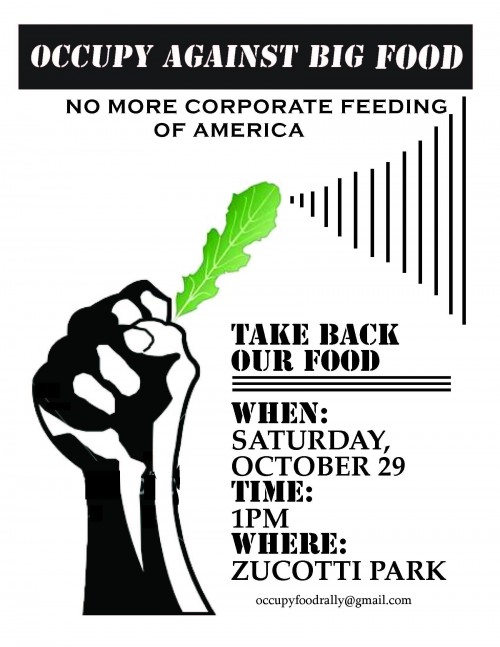 But the idea has had a worldwide resonance, despite the fact that ‘occupying food’ seems like an inherently illogical idea: how can you ‘occupy’ something which is so ubiquitous? The organisers of the first Occupied Food protest at the re-named Zucchini Park explained:
We started Occupy Big Food because we thought it was really important to bring the discussion of food to what is happening at Occupy Wall Street. The goals of OWS and OBF are totally aligned — we are against the corporate takeover of our food system.
The Occupy Food rally was followed a month later by a farmers’ march to Occupy Wall Street to ‘to ‘fight and expose corporate control of the food supply.’ Willie Nelson – yes, for it was he – writing in his capacity as the President of Farm Aid, urged his readers to Occupy the Food System:
From seed to plate, our food system is now even more concentrated than our banking system. Most economic sectors have concentration ratios hovering around 40%, meaning that the top four firms in the industry control 40% of the market. Anything beyond this level is considered ‘highly concentrated,’ where experts believe competition is severely threatened and market abuses are likely to occur.
Many key agricultural markets like soybeans and beef exceed the 40% threshold, meaning the seeds and inputs that farmers need to grow our crops come from just a handful of companies. Ninety-three per cent of soybeans and 80% of corn grown in the United States are under the control of just one company. … Today, three companies process more than 70% of beef in the U.S.; four companies dominate close to 60% of the pork and chicken markets.
In an article for Mother Jones, Tom Philpott elaborated on Nelson’s point. Firstly, the food system is dominated by a handful of very big businesses, whose reach is global: Monsanto has a virtual monopoly of the world’s seed supply; only four companies – including Cargill (which begs the question why the World Food Programme sees fit to do business with it) – control the grain trade; and Walmart’s reach is extending around the world.
Secondly, the size of these businesses allows them unprecedented power over the whole food chain. In an effort to drive down prices, farmers and suppliers are put out of business, wages plummet, standards of animal welfare decline steeply, and the use of pesticides, antibiotics, and other poisons increases.
Thirdly, the growing involvement of hedge funds and banks in the commodities market – which now includes food commodities – has led to concern that speculation on wheat, maize, and other staples is driving up the price of food. The best known example of this occurred two years ago when hedge fund Armajaro bought up Ghana’s total cocoa crop – about 7% of global production – causing a 150% rise in cocoa prices and many Ghanaian farmers to go out of business. Several economists have drawn a link between high food prices and the origins of the Arab Spring.
Finally, the relationship between food companies and governments can be uncomfortably close. In the United States, intense lobbying from the food, agriculture, and beverage industries has caused already light regulation to crumble. In the UK, a collection of food companies – including PepsiCo and Mars – advise the government on how to curb obesity and have formulated a programme which helps to swell their profits.
In other words, the food system is controlled by too few organisations. A lack of regulation of both industry and the economic system has driven up prices, contributed to a decline in the quality of food, and undermined job security, animal welfare, and ethical farming practices. On its own, this is enough to compel us to occupy the food system by growing our own food, supporting small farmers and producers, lobbying supermarkets to stock sustainable and ethically-produced food, and taking action against the cosy relationship between business and government.
But beyond this, there are few more potent indicators of inequality than access to food. The Occupy movement came to prominence partly because of, as my friend Seb commented, one of the best slogans in history: ‘we are the 99%’. It’s catchy and, most importantly, accurate (even if it may be the case that we’re actually the 99.9%). We know that the poorer people are, the poorer their diets are. In extreme cases, they simply can’t afford food, and starve and suffer from extreme malnutrition. But for most of the 99%, good, fresh, ‘whole’ food – the food that the shrinking middle classes can afford to buy from Woolworths, Waitrose, and Trader Joe’s – is simply too expensive, or too far away. They rely instead on heavily processed food.
As a recent report published by the World Health Organisation indicates, obesity and other lifestyle-related diseases are now as much a problem in the developing world as they are in the developed. This is partly the result of prosperity – the new middle classes crave McDonald’s burgers and Coca Cola as indicators of status – but mainly because of shifts in eating patterns caused by high food prices and the greater availability of cheap, processed proteins and non-foods.
In an extract from his new book Why It’s Kicking Off Everywhere: The New Global Revolutions, Paul Mason responds to critics who argue that the Occupy movement – and, indeed, the other protests which dominated the news in 2010 and 2011 – had few clearly defined goals and viable alternatives to the social and political status quo. Referring to Andre Gorz’s Farewell to the Working Class (1980), he explains:
parts of the book now bear rereading, in particular Gorz’s definition of revolution: taking power implies taking it away from its holders, not by occupying their posts but by making it permanently impossible for them to keep their machinery of domination running. Revolution is first and foremost the irreversible destruction of this machinery. It implies a form of collective practice capable of bypassing and superseding it through the development of an alternative network of relations. By this definition we are in the middle of a revolution: something wider than a pure political overthrow and narrower than the classic social revolutions of the 20th century.
If this is so, the occupy movement signals a beginning in a shift in our understanding of how power should work in society, and particularly as regards inequality.
We are the 99%. And we demand to eat well too.

 Tangerine and Cinnamon by Sarah Duff is licensed under a Creative Commons Attribution-ShareAlike 3.0 Unported License.


 Tangerine and Cinnamon
Feb 5
Justice, not Philanthropy
This week José Graziano da Silva, the Director General of the UN’s Food and Agriculture Organisation, announced that the famine in Somalia has ended. A combination of good rain, the most successful harvest in seventeen years, and the effective dispersal and deployment of food and agricultural aid means that most Somalis now have adequate access to food. But this is likely to be a temporary reprieve: it’s uncertain if food stocks will last until April, when the next rainy season begins and the main planting is done.
This already fragile situation is compounded by Somalia’s complicated politics: the southern part of the country is still controlled by the Islamist group al-Shabaab, which banned the Red Cross from operating in the area this week, and has disrupted food supplies in the past. Tellingly, around half of the 2.34 million people still in need of humanitarian assistance and seventy per cent of the country’s acutely malnourished children are in southern Somalia.
The end of the famine is no cause for celebration, then. Thirty-one per cent of the Somali population remains reliant on food aid, famine looms in another three months, and there are the after-effects of the famine to cope with: the plight of the refugees scattered around Somalia, Ethiopia, and Kenya; and the generation of malnourished children.
It’s estimated that between 50,000 and 100,000 people died in this famine, half of them children.
Clearly, something isn’t working.
And as one famine comes to an end – or, at least, a halt – in East Africa, another one seems to be developing on the other side of the continent. Niger, and, indeed, its neighbours Chad and Mali, is both drought- and famine-prone. Even in good years, it struggles to feed itself. Fifteen per cent of the world’s malnourished children live in Niger. But poor rainfall at the end of 2011 and a spike in global food prices means that the country’s population faces famine.
Niger’s last famine was in 2010, when the World Food Programme provided food to 4.5 million people. But things seem to be more hopeful there than in Somalia, and largely because Niger has a government which functions relatively well. Realising that it needs to store its food supply properly, provide jobs so that its population can afford to buy food, and also limit the growth of its population, the government of Niger is introducing measures to improve people’s access to food. One new piece of legislation will make it compulsory for children to remain in school until the age of sixteen, partly because of the strong link between girls’ education and declining family size.
Somalia’s weak and ineffectual government can’t do anything to prevent famine from occurring there again. With all the will in the world, there is no way that Somalia’s food crisis will end until its political situation stabilises.
The comparison of Niger and Somalia is particularly useful for demonstrating the extent to which responses to famine – from the media, NGOs, charities, and other international organisations – are heavily politicised. Reporting on the Niger famine in 2010 was fairly muted and I’ve only seen a couple of references to its most recent food crisis. Somalia, though, never seems to be out of the news. The reason for this is depressingly simple:
Al-Shabaab is loosely affiliated to al Qaeda and the United States fears that the Horn of Africa could prove to be a useful base for planning future terrorist activities. It probably also helps that Somalia has media-friendly pirates too.
So all famines aren’t equal. All famines are complicated. Indeed, the whole question of ‘hunger’ is complex. I was amused to note that Monday marks the beginning of the WFP’s Free Rice Week. The project encourages individuals to play a game on a website. For every correct answer, Free Rice Week’s sponsors donate ten grains of rice to the WFP. The aim of the project is to ‘provide education to everyone for free’. Hmm…. ok – it includes some basic, if vague, information about ‘hunger’. And also to ‘help end world hunger by providing rice to hungry people for free.’
Huh?
So this is going to end world hunger by giving all hungry people rice?
Seriously?
Other than the fact that it would be as – or even more – effective for the project’s sponsors and participants to skip the cute competition and simply donate rice to the WFP (or, even better, to a local feeding scheme or food bank), this really isn’t going to end world hunger.
I know that this seems like a soft target to shout at, and, really, there’s nothing wrong with donating food or money to the WFP, but my annoyance with projects and competitions like this one, stems from the fact that they’re dishonest. There is no way that Free Rice Week is going to end world hunger. It’s a pity that the WFP sees fit to inform people that by taking part in it they’re contributing to solving the food crisis.
In fact, I think that Free Rice Week and other, similar projects actually contribute to the problem.
Firstly, they fudge the meaning of ‘hunger’. Over the past year or so, we’ve become familiar with the FAO’s horrifying statistic that one billion people go hungry every day – that one sixth of the world’s population does not have adequate access to food. But there are problems with this statistic:
These figures need to be accurate because they ‘are also used to help guide where to send foreign aid, track progress towards international development goals, and hold governments to account for promises made.’
Moreover, it glosses over the fact that there are many kinds of hunger: the extreme events – the famines – which are the products of natural disasters, conflict, and state collapse; the hunger which is the product of poor diets and an inability to buy or access enough food; and the hunger in developed nations. In Britain and the United States, the numbers of people now reliant on food stamps and food banks has spiked during the recession.
Secondly, these projects ignore the fact that responding to various kinds of hunger requires far, far more than throwing money at the problem. In fact, the WFP’s website even acknowledges this: ‘People can go hungry even when there’s plenty of food around. Often it’s a question of access – they can’t afford food or they can’t get to local markets.’ Famines in the twentieth- and twenty-first centuries occur as a result of a collapse of distribution systems, usually caused by conflict or a crisis in government. Famines tend not to happen in stable democracies. The WFP must receive money for food aid – that is absolutely non-negotiable – but long-term change, as we’ve seen in the cases of Somalia and Niger, can only occur once stable, effective governments are in place. No amount of free rice is going to end famine in Somalia.
In other cases of hunger, it’s clear that people are simply too poor to buy food: employment, education, good health systems, and higher wages will go far in remedying this situation. But even then, we have to accommodate the choices that poor people make when spending their money. In an article for Foreign Policy’s special edition on food last year, Abhijit Banerjee and Esther Duflo took a closer look at the lives of the ‘one billion hungry’ and came to some interesting conclusions:
We need to take people’s choices about how they spend their limited funds, more seriously.
Thirdly, by focussing on raising funds, the WFP transforms itself into a philanthropic organisation. Donations of food and other forms humanitarian aid are absolutely necessary to alleviating food crises, but they won’t end these crises – or end ‘hunger’ (whatever we may mean by that). In an excellent article for the Guardian, the UN’s Special Rapporteur on the Right to Food, Olivier de Schutter argues:
Food aid doesn’t address the deeper, structural problems underlying the food crisis. It doesn’t consider bad governance; the impact of food speculation on rising food prices; and agricultural efficiency, particularly in the light of climate change.
By appealing to people to donate money to fund their response to food crises – which could have been avoided – the WFP and others cast hunger as something which can be remedied with old-fashioned philanthropy. It’s certainly true that philanthropic organisations can do immensely good work – like reducing rates of polio and malaria in the developing world. But this doesn’t necessarily solve the problems which give rise to these crises:
Precisely. The world’s poor should not be dependent on the goodwill of wealthy people who have the time and inclination to play games on the internet.