Skip to content

Posts from the ‘comment’ Category

Breast is Best?

On a cold morning in early December last year, I found myself sitting in the Highgate Literary and Scientific Institution in London, looking at pages and pages of breasts.

Pausing occasionally to wonder at the collection of life choices which had led to this moment, I scanned these black and white photographs of lactating women from the 1920s and 1930s, attempting to understand the set of criteria according to which they were categorised into ‘good’ and ‘bad’ breasts.

The pictures were taken and kept by the Mothercraft Training Centre in London, and were intended for nurses and other healthcare practitioners working with mothers and young babies. Informed by the programme of scientific childrearing developed by the New Zealand doctor Truby King during the first decade of the twentieth century, the Centre’s staff promoted breastfeeding as the best way of providing babies with adequate nutrition.

In King’s view, breastfeeding needed to be approached scientifically. Mothers should not feed on demand but, rather, according to a strict schedule, depending on the age of the infant. This feeding by the clock was a technique aimed as much at mothers as it was at shaping obedient and self-reliant babies and young children.

Like other specialists in the relatively new field of paediatrics, King believed that mothers were irrational and emotional, and inclined to follow what he characterised as the unscientific and unsanitary advice provided by their female relatives. By breastfeeding in King’s ‘scientific’ manner, mothers could learn to be rational creatures.

In King’s view, not only were there right and wrong ways of breastfeeding, but also good and bad breasts. The photographs in the Mothercraft Training Centre’s collection were meant to help nurses identify the link between the shape of women’s breasts and the ways they would feed their babies.

I was reminded of these photographs this week by the most recent cover of Time magazine, which features 26 year-old Jamie Lynn Grumet breastfeeding her son. She is young, slim, and wears a skimpy top, and her child is a sturdy three year-old.

The debate which erupted around the cover focussed on the age of the boy: wasn’t it weird, asked some, for a mother to be feeding so old a child? The picture – deliberately, I think – provoked this controversy by upsetting contemporary notions of what nurturing motherhood should look like.

But what interested me is that Time chose this particular photograph for its cover. The edition’s focus is not, in fact, on breastfeeding. It’s about a popular childrearing guide The Baby Book (1992) written by William Sears, which advocates that mothers and babies remain as close together as possible for as long as possible. Kate Pickert explains:

While the concept sounds simple, the practicalities of attachment parenting ask a great deal of mothers. The three basic tenets are breast-feeding (sometimes into toddlerhood), co-sleeping (inviting babies into the parental bed or pulling a bassinet alongside it) and ‘baby wearing,’ in which infants are literally attached to their mothers via slings. Attachment-parenting dogma also says that every baby’s whimper is a plea for help and that no infant should ever be left to cry.

Hilariously lampooned by Maggie Gyllenhaal in Away We Go, attachment parenting has been the subject of extensive and frequently ferocious debate. Breastfeeding, though, is only one feature of this particular mode of parenting. So why the cover on Time? It’s partly because photographs of breastfeeding women still – depressingly – provoke argument. As Jill Lepore writes, there’s a long history of banning magazines which print pictures of breastfeeding women:

Like its historical antecedents – a centrefold in a 1938 issue of Life called ‘The Birth of a Baby,’ and another, in 1965, called ‘The Drama of Life’ – it has gotten a great deal of attention. Sales have been brisk. Interest has been prurient. Outrage is all the rage.

Lifes ‘Birth of a Baby’ issue was banned all over the country (but not before selling seventeen million copies). Overnight, Gallup conducted a nationwide poll, asking: ‘In your opinion, do these pictures violate the law against publication of material which is obscene, filthy or indecent?’ (Twenty-four per cent of respondents said yes; seventy-six per cent no.) A generation later, the photographs on the 1965 cover, ‘The Drama of Life’ were shipped into outer space on board the Voyager (but not before selling eight million copies in four days). Each gave rise to criticism, some of it quite wonderful. The week after Life published ‘The Birth of a Baby,’ The New Yorker published a parody, called ‘The Birth of an Adult,’ written by EB White. ‘The Birth of an Adult is presented with no particular regard for good taste,’ White wrote. ‘The editors feel that adults are so rare, no question of taste is involved.’

‘Respectable’ news magazines often print photographs of women with semi-covered breasts. If these usually sexualised images of women are tolerated, why do pictures of breastfeeding women provoke such disgust? Given that the World Health Organisation and many governments advise mothers to breastfeed their babies exclusively for the first six months of life, it seems strange that breastfeeding women should be regarded as a kind of social embarrassment.

Indeed, Facebook’s decision to treat photographs of women breastfeeding as pornography, and women’s experiences of being forced out of public spaces when breastfeeding, seem to suggest that the issue is connected to how women’s bodies are understood socially.

Our bodies are socially and culturally constructed. As South Africa has seen over the past fortnight, the portrayal of the President’s penis in Brett Murray’s painting ‘The Spear’ has provoked outrage partly because it defies taboos around nudity in some South African communities and is seen as being part of a long history of white exploitation of black bodies.

Depictions of breastfeeding women are relatively common in art before the early twentieth century. These were meant to celebrate women as mothers – in a role which most believed celebrated women’s God-given and ‘natural’ role on earth. The photographs of lactating breasts in the Mothercraft Training Centre collection were intended for medical purposes – as were the pictures of breastfeeding mothers in mothercraft publications. I wonder if it’s possible to link the worldwide decline in breastfeeding during the 1940s and 1950s to the decreasing tolerance for the portrayal of breastfeeding women in popular publications? As breasts have become increasingly sexualised in advertising and the media, has this accompanied a discomfort with the idea that they can also be used to nourish and to nurture?

Although decades apart, there are similarities between the attitudes which informed mothercraft and those behind the Time cover: that women’s bodies are not their own to control. The Time cover suggests, firstly, that breastfeeding in public is not only worthy of comment, but also freakish – that it should be done within the secluded confines of the home. And, secondly, it implies that when women are in charge of raising their children, they behave irrationally: that they embrace ‘gurus’ and are ‘driven to extremes’. There is nothing on this cover to suggest that this mother chose – calmly and carefully – to feed and to care for her child in this way.

Further Reading

Marilyn Yalom, A History of the Breast (New York: Ballantine Books, 1997).

Creative Commons License
Tangerine and Cinnamon by Sarah Duff is licensed under a Creative Commons Attribution-ShareAlike 3.0 Unported License.

National Kitchens

It was my birthday a couple of weeks ago and my parents gave me a copy of the new revised English edition of that Bible of Afrikaans cooking, Cook and Enjoy. It’s testimony to the ubiquity of the book that I find myself referring to it by its Afrikaans title Kook en Geniet, rather than its English name.

Kook en Geniet is the Afrikaans Mrs Beeton’s Book of Household Management. Published as a guide to housekeeping and cooking for young brides in 1951 by Ina de Villiers, a Stellenbosch-based home economist, it has never been out of print. There are very few Afrikaans households which do not possess at least one copy of the book – and, like Mrs Beeton, its success lies partly in the fact that it is regularly updated.

De Villiers herself was responsible for testing and re-testing recipes, and for producing new editions of Kook en Geniet. Her long-standing association with the book helped Kook en Geniet to gain its reputation for being a fail-proof authority on Afrikaans cooking. Since her death in 2010, her daughter, Eunice van der Berg, who also happens to be a home economist, has taken over responsibility for it.
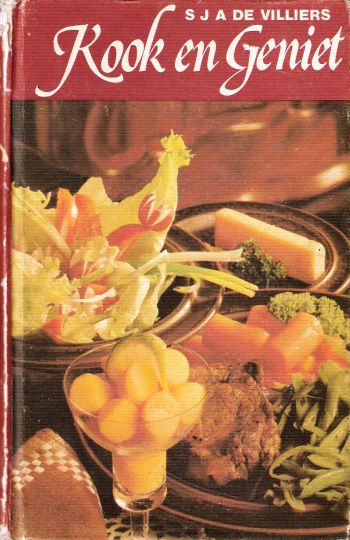
There is no single version of Kook en Geniet. Each edition retains a core of essential recipes, but methods and ingredients change as new products appear. Dishes are added and, less frequently, subtracted as culinary fashions evolve. De Villiers wrote in the preface to the 1992 edition:

As the microwave oven and food processor have become nearly indispensable in many kitchens today, their use is indicated in a number of recipes. However, experienced cooks will be able to use these timesavers for almost any recipe – it is left to their discretion.

My edition contains recipes for moussaka and lasagne. But it’s not for these that I use Kook en Geniet: it’s for staples of Afrikaans cuisine, like buttermilk rusks, Hertzoggies, quince chutney, vinegar pudding, and prickly pear jam. It’s a supremely practical recipe book. Helping out at the pancake stall which seems to accompany every major event – from agricultural shows to local government elections – in small town life? There’s a recipe to make enough batter for a hundred pancakes. Need to make bobotie for fifty at the church fete? Serving sosaties to eighty people at a barbeque? Kook en Geniet will come to the rescue with sensible, authoritative advice.

For anthropologists and historians interested in food, the value of Kook en Geniet lies in the fact that it changed as tastes evolved. It does not present readers with a static, inflexible view of ‘Afrikaner cuisine’. It acknowledges – tacitly – that cooking alters over time.

It’s not, though, the only source on what I’ve called Afrikaans or Afrikaner cuisine – more frequently referred to as boerekos, which translates literally as ‘farmers’ food’, but signifies considerably more than that. Boerekos is the homely, comfort cooking associated particularly with rural Afrikaans living. A wildly popular new series on the Afrikaans cable channel Kyknet, titled simply Boerekos, interviews a collection of Afrikaans women cooking their favourite, old-fashioned boerekos, from mosbolletjies to pie.

Programmes like this one, as well as other books on boerekos, seek to frame it as an unchanging cuisine: as a form of cooking which has remained reassuringly the same during a century of tumultuous change. For Afrikaner nationalists before and during apartheid, food was a useful way of forging a new, unified and distinct Afrikaner identity. As they codified and regularised Afrikaans, so they sought to create a unique Afrikaner cuisine.

C. Louis Leipoldt, culture broker, poet, journalist, doctor, Buddhist, and eugenicist, filled several journals with recipes he collected from friends, acquaintances, and people whom he came across while working during the 1920s and 1930s. (These are now held by the National Library in Cape Town.) He wrote about these recipes and rural cooking for Die Huisgenoot, a popular magazine with a distinct enthusiasm for nationalism, between 1942 and 1947. In 1933, at the height of the Afrikaner nationalist revival, he published Kos vie die Kenner (Food for the Expert), a collection of a more than a thousand recipes. Polfyntjies vir die Proe, Three Hundred Years of Cape Wine, and Leipoldt’s Cape Cookery appeared posthumously.

One of the ironies of boerekos is that so much of it is derived from the cooking of the slaves who were transported to the Cape from southeast Asia during the seventeenth, eighteenth, and early nineteenth centuries. The sambals, atchars, and chutneys of Afrikaner cooking are a particularly obvious debt to the food traditions imported to South Africa from present-day Indonesia and Malaysia.

Although Leipoldt, an unusually thoughtful nationalist, acknowledge that many of the recipes he found were cooked and invented by ‘Malay’ women – a term which he used to describe the largely Muslim and Afrikaans-speaking descendants of slaves who lived in the Cape –their presence gradually disappeared in other, later boerekos recipe books.

There is no neat boundary between Afrikaner cuisine and what most South Africans dub ‘Cape Malay’ cooking: there are recipes for bredie (mutton stew), bobotie, and sosaties (kebabs) in both boerekos and Malay recipe books. But in order to use food to construct distinct, discrete national or group identities, the differences between these two cuisines had to be emphasised over their similarities.

Nationalisms have long co-opted food and cooking to construct national identities. Leipoldt’s recipe books are the first in an extensive literature which seeks – both overtly and inadvertently – to construct an Afrikaner cuisine. It’s telling that the Afrikaanse Taal en Kultuur Vereeniging (Afrikaans Language and Culture Organisation), once strongly allied to the National Party but now a society which works towards the promotion of Afrikaans as a language, bestowed Ina de Villiers with its Afrikoon prize in 2010 for furthering the cause of Afrikaans.

But minority groups use food and recipes in similar ways – to construct, maintain, and assert identities, often in the face of discrimination and social and political marginalisation. Cass Abrahams as well as other Cape-based women have created a rich literature on ‘Cape Malay’ cooking, often basing their writing on recipes collected from, and donated by, local women. These are as much social histories as they are cookery books.

Similarly, one of my favourite South African recipe books, Indian Delights, was compiled by a community organisation, the Women’s Culture Group in Durban. First published in 1961, the book has been revised several times. My mother’s copy – which I covet – is the 1982 ‘Enlarged Super Edition.’ As the editor, Zuleikha Mayat, writes in the introduction, the recipes were

mostly passed on to me by persons ranging from ordinary housewives to the super cooks who abound in our community. This is why Indian Delights remains – as it has always been – a representation of the collective culinary knowledge of our Community.

The book is as much an assertion of a distinct form of South African Indian cooking as it is a record of how a group of women cooked for their families in Natal during the second half of the twentieth century. But it is also an attempt to preserve a culinary tradition at risk of being forgotten as family life changed:

Twenty years ago when Indian Delights was first published, I had stated that the cookery book as such was something foreign to Indian women; that each dish was taught down the generations till daughters became as proficient as their mothers; but that the need of a reliable cookery book was beginning to be felt since daughters were spending more time with studies and acquiring careers.

As a result of this ‘a good reliable cookery book has become essential’.

It’s partly because of this extensive collection of recipe books – from Indian Delights to Kook en Geniet – that it’s particularly obvious that there is no, single homogenous South African cuisine. One of the best collections of South African recipes, African Salad demonstrates this particularly well: it’s a series of photographs and short interviews with of a more-or-less random selection of South Africans on their favourite meals. The recipes are as varied as the interviewees.

I’ve been struck while watching the South African version of the MasterChef franchise by the absence of references to the African cuisines of South Africa. During one episode in which the contestants were required to barbeque, one (black) Twitter user commented jokingly that the black contestants would struggle because they would prefer over- rather than underdone meat.

So far the dominant cuisine (the meta-cuisine?) of the show has been broadly western. It is this which is most closely associated with ‘fine dining’ (hateful phrase). Indeed, I was annoyed when a black contestant was criticised for cooking a steak too well: a liking for pink, lightly cooked meat is both a relatively recent phenomenon and culturally specific. Why should someone be penalised if she has cooked meat according to the dictates of another cuisine?

A couple of contestants have cooked African dishes and I’ve watched those with the most curiosity: as a white South African raised in the Western Cape, I feel that I have a fairly good grasp of Afrikaans and Malay cooking, but African cuisine still eludes me. I know of certain dishes and have seen sheep heads and walkie talkies (chicken heads and feet) being sold, but this is as far as my knowledge goes.

I know that there probably isn’t a single ‘African cuisine’ or African culinary tradition in South Africa – that it must differ between regions and has changed over time. There are, to my knowledge, no substantial recipe books dedicated to this country’s African cuisines – although do please feel free to enlighten me if there are.

With the current wave of enthusiasm for local producers, it’s striking that the various markets which have sprung up around South Africa have tended to model themselves on a foreign – mainly European – model. They are Borough Markets in miniature. These new ingredients – these cheeses, sausages, and free-range duck and chicken – are sold to be used in cassoulet, poule au pot, and arrosto di maiale al latte. We use local products for overseas cuisines.

I’m not some mad nationalist loon who advocates that we only eat local cuisines, but as South African society changes during the early twenty-first century – as urbanisation increases and as our middle class expands – we are, as in the case of any rapidly evolving society, in danger of losing a lot of culinary knowledge. This is a pity: not only do food and cooking provide useful ways of understanding how societies function, but it also strikes me as deeply strange that the white, middle-class customers of the Neighbourgoods Market in Cape Town know more about the cooking of northern Italy than they do of the Eastern Cape. Or Langa, which is right next door.

Creative Commons License
Tangerine and Cinnamon by Sarah Duff is licensed under a Creative Commons Attribution-ShareAlike 3.0 Unported License.

Quackers

Patient and loyal readers – immense apologies for the absence of this week’s blog post. I have just emerged from this semester’s marking hell, so normal service will resume this weekend. (For colleagues currently contemplating the point of their existence and wondering why they didn’t become professional tennis players, I give you this, and this. They helped immeasurably.)

This is, then, just a short post to point you in the direction of a recent ruling by South Africa’s Advertising Standards Authority. Last year, the respected NGO Equal Education laid an official complaint with the ASA about radio advertisements for a nutritional supplement called Smart Kids Brain Boost developed by quack nutritionist Patrick Holford. In the ads, Holford claimed that the product would improve ‘mental vitality’ (whatever that is) and better children’s performance at school.

As a submission from Harris Steinman demonstrates – in exhaustive detail – Holford’s claims are based on a clutch of peer-reviewed articles (good) whose research is outdated (not good) and which occasionally contradict him (really bad). This is not the first time that the ASA has ruled against Holford – an earlier complaint lodged by Steinman (who’s a real doctor) against the Mood Food nutritional supplement was upheld. Steinman proved that it was unlikely that Holford’s pills would make people feel happier or more motivated.

This most recent decision by the ASA pleases me enormously. Not only does it strike a blow against the nutrition industry which peddles the misinformation that all people need to take supplements in order to be healthy and happy, but it prevents a very wealthy man from benefitting from parents’ credulity. South Africa’s education system is dysfunctional, and it is likely that pupils’ poor performance is linked partly to bad diets. But these diets will not be improved by taking magic tablets. Only by alleviating poverty, and ensuring that parents are able to afford to buy the fruit, vegetables, protein, and carbohydrates that constitute healthy diets, will children’s performance at school improve.

This post owes a great deal to the excellent work done by the magnificently-named Quackdown! Do check it out.

Good Neighbours

At the beginning of this year Michael Olivier asked me to contribute an article to his online magazine Crush!.  It could be on whichever topic I fancied, and because I had recently spent rather a lot of time at food markets both abroad and in South Africa, and had been thinking a great deal about the relationship between these markets and the communities in which they were held, I decided to write about Woodstock.

The point that I wanted to make in the piece is that there is considerably more to Woodstock than the Neighbourgoods Market at the Old Biscuit Mill: that this multiracial inner-city suburb has a long and complicated history, and that its transformation into the embodiment of Capetonian hipster cool is not only a relatively recent phenomenon, but has profound implications for the community who lives there.

Woodstock – originally called Papendorp after the farmer on whose land it was founded – has never been a wealthy suburb. Situated in the teeth of the Cape Doctor – the southeasterly wind which blasts the city during summer – its population has tended to be poor and working class. With its low rents and easy proximity to the city’s industrial and business districts, it drew many of the thousands of immigrants who arrived in Cape Town from southern Africa and the rest of the world during South Africa’s industrial revolution at the end of the nineteenth century.

Cape Town’s first factories – which manufactured jam, matchsticks, artificial feathers and flowers, sweets, and cigars – were established in Woodstock, and employed a large proportion of the people who lived in the suburb’s growing slums. In the 1880s and 1890s, a collection of ministers, city councillors, and philanthropic organisation launched a campaign to clean up the appalling conditions in which people lived in Woodstock – with many calling it Cape Town’s ‘East End’.

Given the racial politics of nineteenth- and twentieth-century South Africa, much of the concern about Woodstock stemmed from the fact that it was racially mixed. As a result of the Group Areas Act (1950), one of the keystones of apartheid legislation, black and coloured (or racially mixed) people were forced to move out of the parts of Woodstock which were declared ‘white’. Those people who, according to the Population Registration Act (1950), were not white, were required to move to areas classified ‘black’ or ‘coloured’.

My mother grew up in Fairview Avenue, which was part of an area zoned as white. During the early 1960s, several families in her street left for other parts of Cape Town, or immigrated to other countries, because they were deemed officially to be black or coloured. But other parts of Woodstock were allowed to remain racially mixed. It’s worth understanding the social make-up of Woodstock geographically: above the Main Road – where Fairview Avenue is located – it is lower-middle- to middle-class with a largely white population which includes many Portuguese and Jewish families.

Below Main Road and above the railway, Woodstock becomes poorer and more racially mixed. And it is lower Woodstock which has experienced the brunt of the recent gentrification of the suburb. The revitalising of the businesses along Sir Lowry Road – developments like the Palms Centre and Buchanan Square, and the cluster of cafes, restaurants, and shops which have emerged between these two business hubs – have drawn relatively little criticism, as far as I can see (although do please let me know if it has).

Most criticism has been levelled at the Biscuit Mill development in Albert Road in lower Woodstock. The consortium responsible for the development, Indigo Properties, has recently come under fire for its revamp of the Woodstock Industrial Centre, which provided cheap rents and space for the small collective of artists who work in the suburb. On the one hand, the restoration of buildings – and Woodstock has some lovely, albeit crumbling, Victorian and Edwardian architecture – and the attraction of business to an otherwise poor area could be seen as a Good Thing. In Sir Lowry Road, for instance, the increase of pedestrian traffic between the Kitchen, the Deli, and the various agencies and offices along the road has made the area feel decidedly safer.

But on the other, it is questionable whether the Biscuit Mill and, now, the Industrial Centre developments benefit the community who lives in lower Woodstock.

On a ferociously hot Saturday towards the end of January, I parked as near to the Neighbourgoods Market at the Biscuit Mill – as near as I could, given its phenomenal popularity on weekends – and then made my way down Albert Road. Cars of eager market-goers zip down Albert Road on Saturdays, making only for the Biscuit Mill and the shops and restaurants which have opened around it. They ignore the large section of lower Woodstock which they pass through to get to the end of Albert Road.

My aim was to talk to the owners of the cafes and corner shops who actually sell to the people who live in lower Woodstock. I asked several what they thought about the Neighbourgoods Market and the response was similar: a shrug, followed by a comment that the people who go to the Market don’t really seem to be all that interested in the rest of the suburb. One or two laughed when I asked if they had benefitted from the opening of the development.

Just as I was nearing Gympie Street – infamous for its association with the gangs which have long blighted life in lower Woodstock – a man standing outside Saleem’s Café beckoned to me. He was Rashied, the brother-in-law of the owner of the café, and seated comfortably indoors on upturned plastic crates, we had a chat about the development on the area. Rashied was deeply critical of the Neighbourgoods Market and the Biscuit Mill, making the point that they had done little to regenerate an extremely poor suburb. What profits they do make – and there is good reason to believe that the development is lucrative – benefit the shopkeepers, stall owners, and, of course, Indigo Properties.

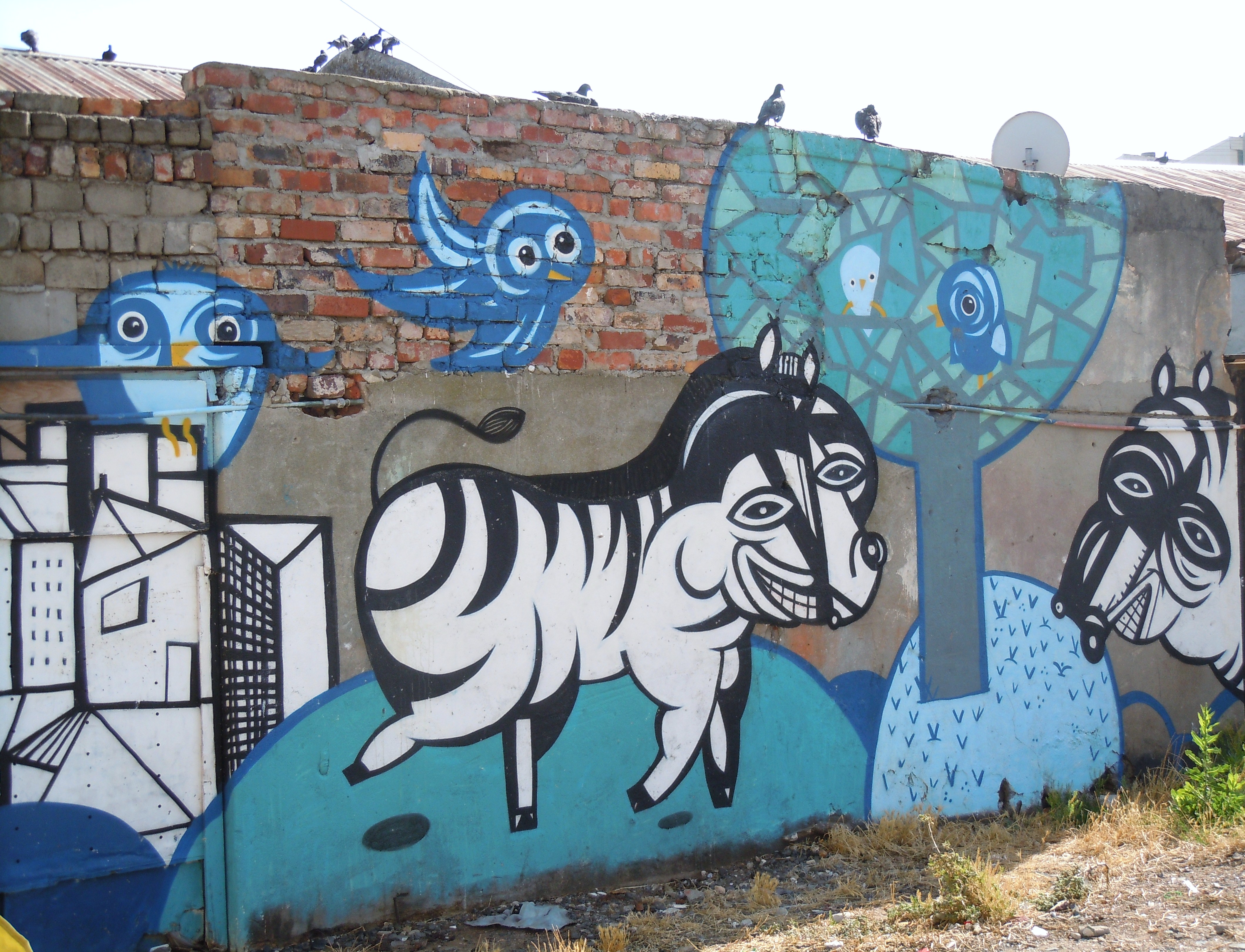
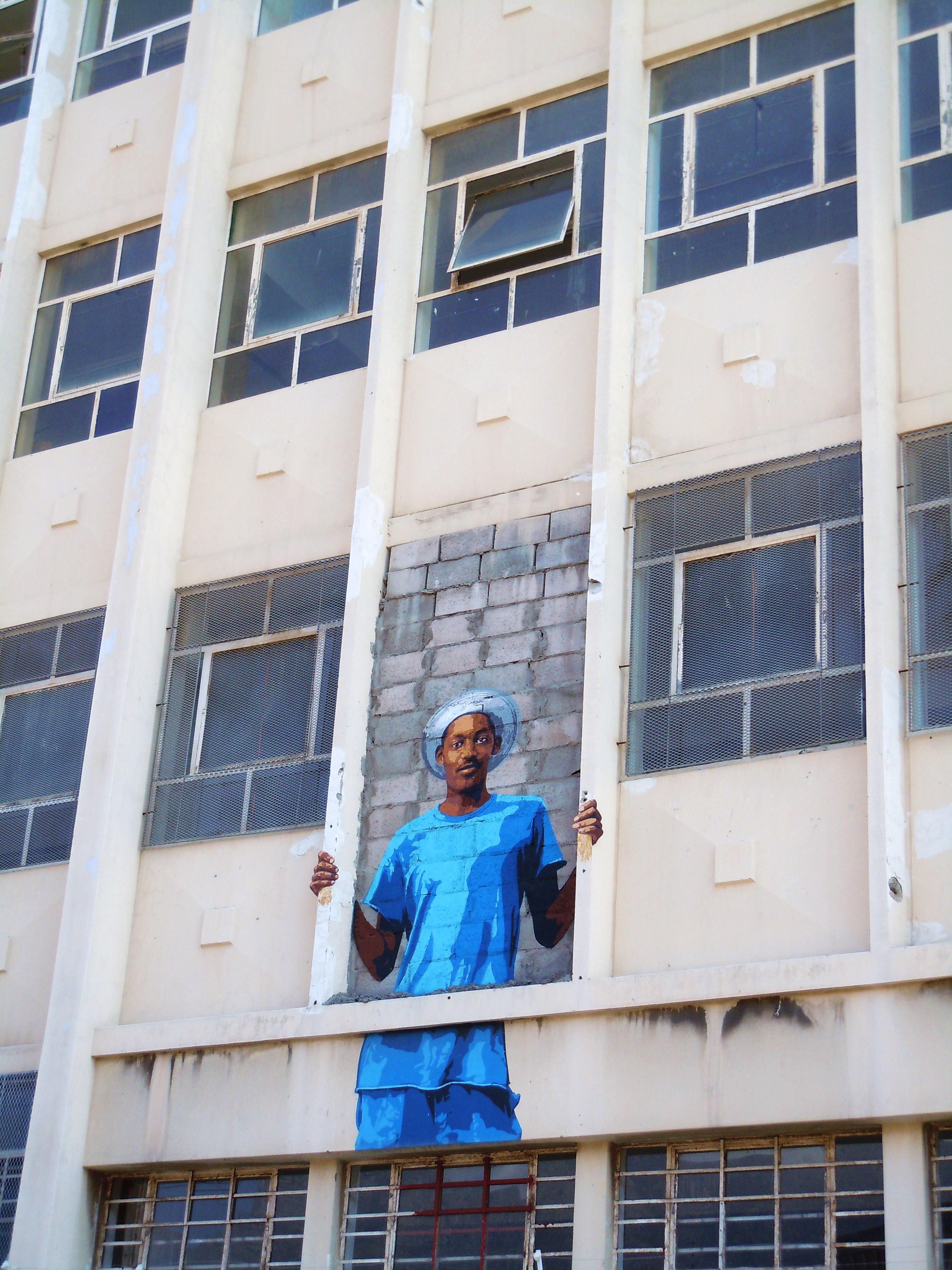
Rashied is involved with I Art Woodstock, a project launched by Ricky Lee Gordon of A Word of Art last year. I Art Woodstock brings artists from around the world to paint murals in lower Woodstock. The project involves the suburb’s children, and it aims partly to encourage more people to visit the area, to look at the murals – and they are truly magnificent. Rashied invited me to take a look at the murals with him: he was due to check up on two artists, one from Sao Paulo, the other from New York, who were at work on a new mural, and he wanted to distribute yogurts to the area’s children.

The state does not exist in lower Woodstock. There are houses owned by gangs where drugs are sold and taken. There are people who live in shacks, with no hope of ever moving into houses with electricity and plumbing. It is unlikely that most of the children playing in the streets are attending school. These streets are dirty and unkempt. When incidences of domestic violence occur, the chances of police being called – or, if they are called, of arriving – are very slim.

As a recent, powerful editorial in the Mail and Guardian argued, South Africa’s policy makers and politicians must recognise the link between the appalling conditions in which people live, and the very high rates of violent crime which characterise so many poor communities:

we are building settlements that reproduce sexual violence, crime and xenophobia: shoddily constructed, disconnected from economic opportunity, home to failing schools that sit cheek by jowl with shebeens on shit-soaked streets.

It is certainly true that there are people in lower Woodstock who are employed, who send their children to school, and who manage to save a little towards their retirement. Their children will go on to tertiary education and to employment. They will move out of lower Woodstock and join South Africa’s growing middle class. But these constitute only one, small group of people within a much larger population, most of whom live in desperate poverty.

And within ten minutes’ walk of lower Woodstock – with its murals, yes, but also with its population of shack dwellers who do not have access to flushing toilets – is the incredible wealth and luxury of the Neighbourgoods Market, and the thousands of wealthy Capetonians who drive past lower Woodstock every Saturday morning to buy ice cream and artisanal, free-range bacon.

I don’t object to gentrification per se. Salon has reported recently on the so-called ‘Whole Foods effect’, where the opening of a new branch of Whole Foods – the US-based chain of organic supermarkets – is an indicator, and also cause, of the revitalisation of suburbs which have become crime-ridden, grimy, and run-down. The business is about to open a Whole Foods store in Midtown Detroit – signalling to many that the city’s long decline is now in reverse.

As Will Doig writes:

the Whole Foods Effect isn’t caused by the store itself, it’s caused by the events it sets into motion. And one thing Whole Foods does is stay open later than a lot of the other shops around it, laying the groundwork for expanding the length of that neighbourhood’s day.

The Neighbourgoods Market in Braamfontein – the sister of the market in Woodstock – is doing precisely this in Joburg. Situated in the parking lot of a skyscraper, that Neighbourgoods Market attracts footfall to an inner-city suburb which would usually be deserted – and dangerous – over the weekend. Similarly, the Hope Street Market in Cape Town brings life into an otherwise quiet corner of the CBD on Saturdays.

What angers me about the Biscuit Mill and the Neighbourgoods Market in Woodstock is that they exist within a community which desperately needs investment: which needs housing, plumbing, and, above all, jobs. Of course, it is primarily the function of the state to provide basic services, policing, and social welfare – but where there is so much wealth, there is a moral imperative to improve the lives of so many who have so little.

The Neighbourgoods Market’s success has grown partly as a result of an increased interest in the provenance and production of good, ‘whole’, food among Cape Town’s middle classes. This is excellent. But how do these customers – who desire to live and eat ethically – drive past such incredible poverty every Saturday, without thinking twice about the people who live there?

Creative Commons License
Tangerine and Cinnamon by Sarah Duff is licensed under a Creative Commons Attribution-ShareAlike 3.0 Unported License.
Brain Food

Recently I’ve been mildly obsessed with Elif Batuman’s The Possessed: Adventures with Russian Books and the People who Read Them (2011). It’s a collection of essays about Russian literature and her experiences as a PhD student at Stanford. In the first chapter, ‘Babel in California,’ Batuman describes a conference at Stanford, dedicated to the analysis of the work of Isaak Babel. Like so many academic conferences, it is simultaneously enlightening and farcical.

Read more

Hot Cross Bun Fight

Just before Easter this year, a group of Christians in South Africa objected to the labelling of hot cross buns at Woolworths, a premium supermarket, as halal. Possibly chastened by the furore which erupted over its stocking of Christian magazines a couple of years ago, Woolies apologised. But, wonderfully, the response of the South African public was hilarity: what on earth, asked people on social media and radio chat shows, was wrong with making hot cross buns available to Muslims?

As many pointed out, it would be interesting to see if these Christians also avoided McDonald’s, KFC, Nando’s or any of the other fast food chains which serve halal food. In a country as socially and culturally diverse as South Africa, it makes sense for restaurants and shops to sell halal and kosher products. Most chicken sold in South Africa is halal, for instance.

In fact, the South African Easter meal of choice is pickled fish – a dish developed by slaves brought to the Cape from southeast Asia, India, and elsewhere during the seventeenth and eighteenth centuries. Many of these slaves would have been Muslim, a religion tolerated by the Dutch and, later, British authorities on the grounds that they believed it to be ‘civilised’ and unlikely to encourage slaves to revolt or disobey their masters and mistresses.

So South African Christians eat a dish at Easter which was created by Muslim slaves more than two centuries ago. And even those who are not Christian eat it: we had my Mum’s version of pickled fish on Good Friday – based on a recipe my Great-Grandmother cooked – with pilaf instead of the usual bread-and-butter, and it was delicious.

My Mum's pickled fish

I was interested by the hot cross bun debate because – I think – it’s the first major discussion South Africans have had about the labelling of halal food. Last year there was some controversy about a meat supplier which allegedly sold haram meat as halal, but the debates then were about the regulation of the meat industry, and not about the public’s willingness – or otherwise – to eat halal food.

This ‘storm in a baking pan,’ as Father Chris Townsend of the Southern African Catholic Bishops’ Conference put it, was fairly unusual, in international terms, in the way that it was greeted with such widespread condemnation. In France, the first country in Western Europe to ban women from wearing the burqa and niquab in public, the labelling of halal food is now an electoral issue. Concerned by the depressing popularity of far-right loon Marine le Pen, Nicolas Sarkozy announced in January that if re-elected, he would enact legislation to ensure that all halal foods are clearly labelled. (You can donate to Francois Hollande’s campaign here.)

Sarkozy justified these new measures – which angered Jewish leaders as well – by implying that the ritual slaughter of animals for halal and, by implication, kosher meat is inhumane. But French Muslims argue that Sarkozy and the French right’s attack on ritual slaughter has less to do with the treatment of animals than it does to broader debates about multiculturalism and social integration in France. As one French blogger commented:

Nicolas Sarkozy and Marine Le Pen have resorted to this because they have no solutions to the real problems. It’s the last desperate thrashings of a mad dog that has nothing to lose. It’s part of a chain of thought that goes from halal meat to Islamism to terrorism.

This isn’t the only recent debate about the labelling of halal meat and ritual slaughter. Australia and Canada have seen similar discussions, and the Daily Mail seems to specialise in a kind of hysterical journalism which links the widespread availability of halal meat to the end of Britain and the imminent arrival of Armageddon. Religious slaughter is banned in New Zealand, Switzerland, Luxembourg, Norway, and Sweden. An attempt to enact a similar ban in the Netherland last year was blocked at the last minute.

What makes these debates interesting is that they are hardly new. David Smith writes that in 1995,

a federal German court effectively banned Muslims from slaughtering animals without prior stunning. The court ruled that the practice was not required by their religion and was thus not protected by the constitution’s guarantee of freedom of religious expression. In January 2002, however, the Federal Constitutional Court ruled that the right to freedom of religious expression and choice of occupation did in fact ensure the entitlement of Germany’s Muslims, or at least those responsible for their provision with halal meat, to resume stunningless methods for such ends without the threat of legal action.

In his excellent Franz Kafka, the Jewish Patient (1995), Sander Gilman explores shifting attitudes towards shehitah, the slaughter of animals in accordance with Judaic law and custom. In the 1880s and 1890s, various campaigns to outlaw shehitah emerged in Europe. In Germany, only Saxony eventually banned shehitah in 1897. While many supporters of the campaign were anti-vivisectionists or were concerned about the treatment of animals in abattoirs, there is no coincidence that this interest in the butchering of kosher meat developed at the same time as a wave of anti-Semitism swept Europe.

In 1883, delegates at a meeting of the Congress for the Protection of Animals in Vienna argued that the protection of ritual slaughter was an indication of Jewish influence over European politics. But others pointed out that the attempt effectively to ban kosher meat was driven by anti-Semitism. In 1885, the Lord Mayor of London compared the campaign to the allegations around Jewish ritual murder during the medieval period. The liberal Berlin Daily News declared in 1893 that those opposed to ritual slaughter were ‘pure anti-Semites’. Unsurprisingly, the Nazis outlawed ritual slaughter – also in the name of preventing cruelty to animals – during the 1930s.

There is, then, an obvious link between anxiety about religious difference, and even racism, and concerns about ritual slaughter. That said, expressing concern about the ways in which animals are slaughtered should not necessarily immediately be construed as religious or cultural intolerance. Countries need to find a balance between facilitating the religious practices of all their citizens, and the humane treatment of animals.

The South African hot cross bun fight (ahem, sorry) was not, though, about ritual slaughter. The Christians who complained about the labelling of hot cross buns in Woolworths were angry about the association of a Christian symbol – the cross on the bun – with a sticker connected to Islam. Next year, Woolies will sell hot cross buns (without the halal sticker) and spiced buns (with a halal sticker). The buns will be identical, with the exception of a flour-and-water-paste cross on the former.

I don’t know enough about the history of attitudes towards religious slaughter in South Africa to position this incident within a broader, historical context, but there are several examples of religious communities coexisting fairly harmoniously during periods of this country’s past. Most of the butchers in nineteenth-century Cape Town were Muslim, for example. This meant that the majority of Victorian Capetonians ate halal meat, regardless of their religious beliefs.

This incident demonstrates not only the extent to which food is integral to the maintenance of religious identities – which is particularly ironic given the fact that so many of the traditions and rituals we associate with Easter have pagan origins – but that people’s anxieties about religious freedom and identity are frequently played out through debates around food.

Further Reading

Sources cited here:

Sander Gilman, Franz Kafka, the Jewish Patient (New York and London: Routledge, 1995).

Pablo Lerner and Alfredo Mordechai Rabello, ‘The Prohibition of Ritual Slaughtering (Kosher Shechita and Halal) and Freedom of Religion of Minorities,’ Journal of Law and Religion, vol. 22, no. 1 (2006/2007), pp. 1-62.

David Smith, ‘“Cruelty of the Worst Kind”: Religious Slaughter, Xenophobia, and the German Greens,’ Central European History, vol. 40, no. 1 (Mar., 2007), pp. 89-115.

Ellen Wiles, ‘Headscarves, Human Rights, and Harmonious Multicultural Society: Implications of the French Ban for Interpretations of Equality,’ Law & Society Review, vol. 41, no. 3 (Sep., 2007), pp. 699-735.

Creative Commons License
Tangerine and Cinnamon by Sarah Duff is licensed under a Creative Commons Attribution-ShareAlike 3.0 Unported License.

Feed the Children

There has been some fuss recently around the publication of Charles Murray’s new book, Coming Apart: The State of White America, 1960-2010. Murray, who co-authored The Bell Curve: Intelligence and Class Structure in American Life in 1994, has a reputation for annoying left-leaning academics and public policy makers. His description of the Bell Curve was accused of being blind to cultural and social influences on learning and childhood development, and his most recent polemic has been criticised for its rose-tinted view of the American white working class during the mid-twentieth century.

One of the best criticisms of the book which I’ve come across is Nell Irvin Painter’s article for the New York Times, ‘When Poverty was White.’ Painter, whose History of White People (2010) I urge you to read, makes the point that America has a well-hidden and very recent history of white poverty. She accuses Murray of ‘historical blindness’ caused by his

narrow focus on the cultural and policy changes of the 1960s as the root of white America’s decline. The story of white poverty…is much longer and more complex than he and his admirers realise or want to admit.

Her point is that to understand the nature of poverty – why some families seem incapable of escaping it, why certain members of society seem to be particularly susceptible to it – we need to historicise it.

There is a similar argument to be made about white poverty in South Africa. One of the reasons why photographs of poor whites in South Africa draw such attention is because South Africans tend to think of poverty as being black. Poor whites are a strange anomaly in the economic and racial politics of post-1994 South Africa.

But ‘poor whiteism’ as a social and political phenomenon only disappeared during the economic boom of the early 1960s. Since at least the 1920s, South African governments were preoccupied by the ‘poor white problem’ – by the existence of a substantial group of people who, as the popular author Sarah Gertrude Millin wrote in 1926, could not support themselves ‘according to a European standard of civilisation’ and who could not ‘keep clear the line of demarcation between black and white.’

South Africa’s earliest soup kitchens were not for black, but, rather, for white children. The first child welfare organisations aimed their work not at black families, but, rather, at white families who were poor. South Africa’s attempts to introduce compulsory elementary education in the 1910s and 1920s pertained only to white, not to black, children. This isn’t to suggest that black poverty was somehow less acute or widespread than white poverty. Far from it. State concern about poor whiteism was borne out of a eugenicist belief that, as Millin suggested, white poverty signalled a decline in white power.

The first attempts to eradicate white poverty were directed at families and children. Although we tend to associate the poor white problem with the 1920s and 1930s, there had been a large group of impoverished white farmers in the country’s rural interior since at least the middle of the nineteenth century. By the 1880s and 1890s, colonial politicians, and particularly those in the Cape, were increasingly anxious about this class of whites. This was partly because the numbers of impoverished whites – both in rural and urban areas – had increased during the region’s industrialisation after the discovery of diamonds and gold, but it was also the result of decades of poor education which had produced at least two generations of unemployable whites.

Both in South Africa and in the rest of the world, poverty was racialised during the 1880s and 1890s. The existence of unemployed and unemployable poor whites challenged the association of ‘natural’ supremacy and the exercise of power with whiteness. The term ‘poor white’ no longer simply referred to white people who lived in poverty, but, rather, invoked a set of fears around racial mixing and white superiority.

Impoverished white adults were believed to be beyond saving, as one Cape industrialist argued in 1895: ‘the adults are irreclaimable. You must let them die off, and teach the young ones to work.’ The Cape government poured money into schools for poor white children. In 1905, education became compulsory for all white children in the Cape between the ages of seven and fourteen. Politicians also passed legislation to allow these children to be removed from parents deemed to be unable to care for them appropriately. After the declaration of the Union of South Africa in 1910, government spending on education grew from 14 per cent of the national budget to 28 per cent in 1930.

But the problem did not go away. Industrialisation and economic expansion, as well as the effects of the Great War, two depressions, and urbanisation in the 1920s and 1930s increased the numbers of impoverished whites. By the end of the 1920s, it was estimated that out of a total of 1,800,000 whites, 300,000 were ‘very poor’, and nearly all of these were Afrikaans. The Carnegie Commission of Investigation on the Poor White Question (1929-1932) concluded that an inability to adapt to a changing economic climate, outdated farming methods, and poor education were to blame for the existence of such a large population of impoverished whites.

In 1929, the South African government devoted 13 per cent of its budget to the eradication of white poverty. Much of this went to education, social welfare, and housing. The introduction of more stringent segregationist legislation progressively disenfranchised blacks, and reserved skilled work for whites.

There was also a shift in emphasis in how child welfare societies – the numbers of which had mushroomed during the 1920s – dealt with poor white children. No longer did they only work to ensure that white children were sent to school and adequately cared for by their parents, but they began to focus on how these children were fed.

I’m still trying to account for this new concern about the effects of malnutrition on white children. I think that it was due largely to an international scientific debate about the significance of nutrition in raising both physically and intellectually strong children. Louis Leipoldt – Medical Inspector for Schools in the Transvaal, food writer, Buddhist, poet, and Afrikaner culture broker – was particularly aware of this new thinking about childhood development and nutrition, and wrote about it extensively in publications on child health and welfare in South Africa.

In a report of a survey of the health of children in the Cape published in 1922, the province’s Medical Inspector of Schools, Elsie Chubb, argued that malnutrition was widespread in the Cape’s schools for white children. In most schools, around 10% of the pupils were malnourished. In one school in the rural Karoo, 79% of children were found to be severely malnourished.

Chubb recognised that malnutrition was not purely the result of an inadequate supply of food – although it was certainly the case that many poor parents simply couldn’t afford to buy enough food to feed their children – but of poor diet. Some child welfare volunteers wrote of children sent to school on coffee and biltong, and who returned home at the end of the day for a basic supper of maize meal and cheap meat. Chubb wrote that far too many children were fed on a diet heavy in carbohydrates and animal protein. Children did not eat enough fresh fruit and vegetables, and milk. She recommended that feeding schemes be established to supplement children’s diets with these foodstuffs.

Helen Murray, the headmistress of a girls’ school in Graaff Reinet and active member of the town’s child welfare society explained the contemporary understanding of the link between malnutrition and poor whiteism particularly well in 1925:

In the winter of 1918 our schools had regular medical inspection for the first time. The doctor who inspected told some of us that he had found some fifty children in our poor school suffering from malnutrition and spoke strongly of the results of such a condition. The children were not in danger of dying of starvation, they had dry bread and black coffee enough to prevent that, but they were in danger of growing up to be ‘poor whites’ of the most hopeless type. The body insufficiently nourished during the years of growth would develop physically weak, and the brain as a result would be unfit for real mental effort. The child suffering from years of wrong feeding could not be expected to grow into the strong, healthy, clearheaded man or woman our country needs today, and will need ten and twenty years hence. To see that the underfed child is well fed is not a matter of charity, but must be undertaken in self-defence.

As a result of the inspection, the child welfare society found a room in the town where between fifty and ninety children could be provided with ‘a good, hot meal’ on every school day:

We had been told that these children could be saved from growing up weaklings if they could have one good meal of fat meat, vegetables or fruit, on every school day of the year….

We have the satisfaction of knowing that there has been a marked improvement in the health of the children and of hearing from a Medical Inspector that she has found the condition of the children here better than in many other schools of the same class.

Murray’s experience in Graaff Reinet was not unique. As child welfare societies were established in the towns and villages of South Africa’s vast interior, their first work was usually to establish soup kitchens, either in schools or in a central locations where schoolchildren could be sent before the school day – for porridge and milk – and at lunchtime, for soup or a more substantial meal, depending on the resources of the local society.

In Pietersburg (now Polokwane), to eliminate the stigma of free meals for poor children, all white children were provided with a mug of soup at lunchtime. Better-off parents paid for the soup, thus subsidising those children whose parents could not contribute. In Reitz, local farmers, butchers, and grocers donated meat and vegetables to the soup kitchen, and in Oudtshoorn children were encouraged to bring a contribution – onions, carrots, or cabbage – to their daily meal.

The National Council for Child Welfare, the umbrella body established in 1924 which oversaw the activities of local child welfare societies, liked to emphasise the fact that it was concerned for the welfare of all children, regardless of class or race. Some welfare societies, and particularly those in areas which had large ‘locations’ for black residents, did establish clinics and crèches for black children. But most of the NCCW’s work was aimed at white children in the 1920s and 1930s, and the same was true of the South African state. By the 1920s, most municipalities in towns and cities made free milk available to poor white mothers with babies and very young children.

Increasing state involvement in child welfare, alongside the work of independent societies, had a significant impact on the health of white children in South Africa during the early twentieth century. But it was only because of the growing prosperity and better education of the majority of white South Africans after World War II that white poverty and malnutrition were gradually eradicated in the 1950s and 1960s.

By historicising poverty – by understanding that white prosperity in South Africa is a relatively recent phenomenon – we can understand it as a phenomenon which is not only eradicable, but which is also the product of a range of social, economic, and political forces. As South African governments and welfare organisations were able to reduce white poverty and malnutrition dramatically during the early twentieth century, so it is possible for contemporary governments to do the same.

But charity and soup kitchens were not the sole cause of the disappearance of white poverty and malnutrition. Jobs, education, and better living conditions were as – if not more – significant in ensuring that white children no longer went hungry.

Further Reading

Texts cited here:

SE Duff, ‘“Education for Every Son and Daughter of South Africa”: Race, Class, and the Compulsory Education Debate in the Cape Colony,’ in Citizenship, Modernisation, and Nationhood: The Cultural Role of Mass Education, 1870-1930, eds. Lawrence Brockliss and Nicola Sheldon (Basingstoke: Palgrave Macmillan, 2011).

E.G. Malherbe, Education in South Africa, vol. I (Cape Town: Juta, 1925).

E.G. Malherbe, Education in South Africa, vol. II (Cape Town: Juta, 1977).

E.G. Malherbe, Report of the Carnegie Commission of Investigation on the Poor White Question in South Africa, vol. III (Stellenbosch: Pro Ecclesia-Drukkery, 1932).

Sarah Gertrude Millin, The South Africans (London: Constable, 1926).

Jennifer Muirhead, ‘“The children of today make the nation of tomorrow”: A Social History of Child Welfare in Twentieth Century South Africa’ (MA thesis, Stellenbosch University, 2012).

Other sources:

Vivian Bickford-Smith, Ethnic Pride and Racial Prejudice in Victorian Cape Town (Johannesburg: Wits University Press, 1995).

Colin Bundy, ‘Vagabond Hollanders and Runaway Englishmen: White Poverty in the Cape Before Poor Whitesim,’ in Putting a Plough to the Ground: Accumulation and Dispossession in Rural South Africa 1880-1930, eds. William Beinart, Peter Delius, and Stanley Trapido (Johannesburg: Ravan Press, 1986).

J.M. Coetzee, White Writing: On the Culture of Letters in South Africa (New Haven: Yale University Press, 1988).

Saul Dubow, A Commonwealth of Knowledge: Science, Sensibility and White South Africa 1820-2000 (Oxford: Oxford University Press, 2006).

Marijke du Toit, ‘Women, Welfare and the Nurturing of Afrikaner Nationalism: A Social History of the Afrikaanse Christelike Vroue Vereniging, c.1870-1939’ (D.Phil. thesis, University of Cape Town, 1996).

Hermann Giliomee, The Afrikaners: Biography of a People (Cape Town: Tafelberg, 2003).

Isabel Hofmeyr, ‘Building a Nation from Words: Afrikaans Language, Literature and Ethnic Identity, 1902-1924,’ in The Politics of Race, Class and Nationalism in Twentieth-Century South Africa, eds. Shula Marks and Stanley Trapido (London: Longman, 1987).

Creative Commons License
Tangerine and Cinnamon by Sarah Duff is licensed under a Creative Commons Attribution-ShareAlike 3.0 Unported License.
No Sweeteners

One of the best things about being an academic is the stuff that people send you in the – usually entirely correct – belief that you’ll find it interesting. I’ve had emails about pink slime (for the blog) and on programmes about children’s literature (for my research). Recently, my friend Elizabeth, who’s a lawyer, forwarded me this from Legalbrief:

New draft baby feeding regulations will forbid formula manufacturers from ‘aggressively marketing’ their products to mothers and from sponsoring meals and professional development courses for healthcare practitioners, says a Weekend Argus report. It adds the standards set in the draft regulations, which the Department of Health has released for public comment, intend to promote safe nutrition for babies and young children and restrict inappropriate marketing practices. The department stressed that the regulations would not stop baby formula and complementary foods from being sold at retailers. ‘Although breastfeeding is best, government recognises that some women cannot breast-feed or decide not to breast-feed. These regulations do not in any way compel women to breast-feed against their will,’ the department is reported to have stated.

The proposed regulations, which fall under Section 15 (1) of the Foodstuffs, Cosmetics and Disinfectants Act, 1972, make for fascinating reading. Other than banning trans fats and artificial sweeteners in baby formula, their emphasis is on curtailing the advertising and promotion of artificial foods.

For instance, the packaging of baby formula may not have pictures of infants, young children, or any other ‘humanised figures,’ except for those included in instructions for preparing the product. Tins and containers may not ‘contain any information or make any negative claim relating to the nutritional content or other properties of human milk’, and they’re not allowed to include toys or gifts. Packaging must include in English, in bold letters at least 3mm tall, the message: ‘Breast milk is the best food for babies.’

The regulations will also radically limit the advertising of baby formula shops, in print and online, ban the distribution of gift packs and free samples, and prevent formula manufacturers from sponsoring or donating equipment bearing the logo of their products. These manufacturers may not

provide research grants or any other financial assistance relating to infant or young child nutrition to health care personnel working in a health establishment or health care personnel linked to a health establishment.

Nor may they give doctors, nurses, and health workers gifts, and ‘heads of health establishments, national, provincial and local health authorities shall take measures to promote, support and protect breastfeeding.’

It’s an ambitious piece of legislation, but one which is entirely in line with the World Health Organisation’s International Code on the Marketing of Breast Milk Substitutes. The Code was adapted in 1981, and places stringent regulations on how baby formula is advertised: it advises that baby milk formula should not be allowed to market products directly to pregnant women and mothers with young children, including handing out samples. Products should also state that breast milk is superior to formula.

Implementation of the Code has been slow, and there is evidence to suggest that it has been particularly poorly policed in developing nations where oversight of the activities of powerful multinationals is often lax. The South African regulations are far stricter than the Code, particularly as regards the relationship between the pharmaceuticals industry and academic research, but address a problem which campaigners have long identified: that there is a link between the way in which formula is advertised and how women feed their babies.

This isn’t to suggest that women should have their choices about how they feed their babies curtailed – or that it’s only advertising which causes women to choose to use baby formula. Far from it. The problem, though, is that, particularly in poor nations, advertising or other promotional methods encourage breastfeeding mothers to switch to baby formula when it’s unlikely that they’ll be able to afford to buy more formula, and where they may dilute formula with too much water to make it go further. This water may not be clean, and it’s difficult to keep bottles and teats sterile without electricity or plumbing.

The purpose of these regulations is to ensure that formula manufacturers don’t use the often less than ideal conditions in which mothers in developing nations raise their babies, to their own advantage.

We tend to associate the WHO’s Code with the Nestle Boycott, which was launched in 1977. The Boycott was based on a pamphlet published by War on Want in 1974, titled ‘The Baby Killer’ and, in Switzerland, ‘Nestle Kills Babies’. The charity alleged that Nestle’s advertising strategies were responsible for high rates of child mortality. After a legal tussle as well as an attempt to refute the Boycott’s allegations, Nestle agreed to implement the Code in 1984, although there remains some scepticism as to Nestle’s, and other companies’, commitment to this.

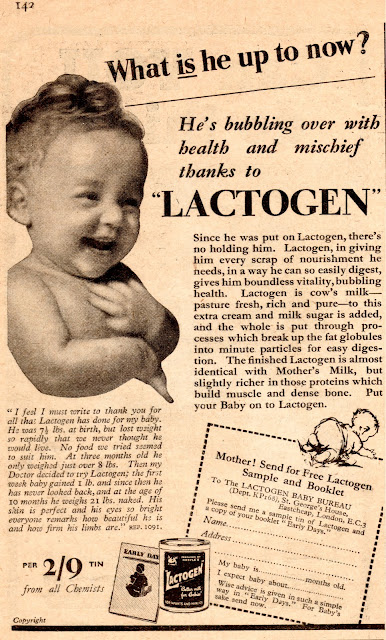
But concern about the advertising of baby formula predated the 1970s, and even the 1940s, when breastfeeding began to decline globally. As I’ve sat in the National Library over the past few months, reading Child Welfare and other child health magazines from the first half of the twentieth century, I’ve been struck by the number of advertisements for baby formula. They all feature fat, healthy babies and testimonials from relieved mothers who claim that the child was fed from birth on Lactogen or whichever other patent food.

Even Truby King, early twentieth-century breastfeeding evangelical and founder of the global mothercraft movement, developed artificial baby food which was produced in New Zealand and then shipped all over the world. Kariol, Karilac, and Karil were meant to be prescribed for babies who were not, for whatever reason, breastfed either as a supplement to cows’ milk, or to be taken on their own.

Although King’s patent foods seemed to contradict his enthusiasm for breastfeeding – and he came under enormous criticism in New Zealand and Australia for his promotion of Kariol and Karilac – there was a certain logic to his decision to manufacture wholesome baby formula. During the early decades of the twentieth century, doctors in Britain and the United States noticed that bottle-fed babies were considerably more likely to die during early infancy than those who were breastfed. Artificial foods – which ranged from thin porridges and condensed milk to baby formulas – were often nutritionally inadequate, particularly in poor families who could not afford better and more expensive substitutes.

But they also identified a link between bottle feeding and diarrhoea, then, as now, one of the main causes of death in infancy. William J. Howarth, the Medical Officer of Health for Derby

arranged in 1900 to receive weekly lists of the births registered during the past seven days from the local registrar. From November of that year until November 1093 women inspectors enquired into the feeding method of each registered child by personally visiting the mother and infant at home.

The results of the study, published in 1905, were telling. Of the infants surveyed, 63% were breastfeed, 17% were partly bottle-fed, and 19% entirely bottle-fed:

The mortality rates from ‘diarrhoea and epidemic enteritis’ in addition to those from ‘gastritis and gastro-enteritis’ were as expected: 52, or 10 per 1,000 of the breastfed, 36 or 25.1 per 1,000 of the mixed-fed, and 94 or 57.9 per 1,000 of the bottle-fed babies died. In other words the mortality rate of the bottle-fed infants was nearly six times greater than that of the breast-fed babies.

Howarth concluded: ‘In not one single instance does the death-rate in any class of disease among hand-fed children even approximate that recorded among children who are breastfed; the rate is invariably higher.’

The problem, in terms of the link between bottle feeding and diarrhoea, was not so much the nutritional content of artificial foods, but the difficulties in keeping them free from contamination, and particularly during summer when infant mortality rates soared.

Indeed, South African advertisements for Lactogen emphasised that the product did not spoil in warm weather. As criticism of artificial foods grew louder, so advertising became more subtle, and better adept at appealing to mothers aware of the potential problems of bottle feeding. Doctors were, though, also aware of the effects of advertising on mothers’ choices, as a medical officer based in Johannesburg wrote in 1925:

No one can deny the fact that the proprietary foods of today are a vast improvement upon those of twenty years ago. They all contain very sound instructions as to the preparation of the food and the amount to be given. The advertising of such foods is carried out on a most extensive scale and in a clever and attractive manner. No hoarding today is without a picture of a flabby and over-fat infant alleged to have been reared solely on the proprietary food advertised thereon. Many a mother who for one reason or another, is not satisfied with the progress of her baby, sees this advertisement, and immediately rushes off to secure this particular food for non-thriving infant.

But not only mothers were influenced by this advertising. He admitted that it was ‘only too true that many medical men and trained nurses are also gulled by such advertisements and circulars’. Dr Cicely Williams, best known for her identification of the condition kwashiorkor in the 1930s, worked in the Colonial Medical Service in West Africa and southeast Asia before World War II and became particularly interested in the treatment of the diseases of early infancy.

She was critical of the introduction of baby formula to Singapore and Malaya, where white-coated sales reps distributed samples of artificial foods to poor mothers. In 1939 she published a pamphlet, ‘Milk and Murder,’ in which she pointed out the benefits to both mothers and babies of breastfeeding.

Nevertheless, Nestle and other companies were still using the same strategies to convince mothers in developing nations to use baby formula in the 1970s, and there are still concerns that they are not fully compliant with the Code on breast milk substitutes. The new South African regulations, if passed, are aimed at remedying this.

The cause for these new regulations and other measures introduced internationally to encourage mothers to breastfeed for the first six months of life, is a concern that rates of breastfeeding remain low in comparison to what they were during the early twentieth century. For all the good that the Code and other laws have done, it remains the exception, rather than the rule, for women to breastfeed for such an extended period of time.

However true it may be that advertising does have an impact on women’s choices, it’s certainly not the only factor which influences how women feed their babies. What’s missing from these measures is any attempt to communicate with mothers themselves. As doctors in the early twentieth century believed that mothers, whom they characterised as emotional and irrational, simply followed any and all advice which they read or heard, so campaigners and governments today seem to be too quick to seek only one reason for women’s decision to breast- or bottle-feed.

In fact, we need to make it easier for women to choose to breastfeed: to eliminate the ridiculous prejudice against breastfeeding in public spaces; for work and childcare not to be mutually exclusive; and for sympathetic advice and information to be made available for all new mothers.

Further Reading

Texts cited here:

Linda Bryder, A Voice for Mothers: The Plunket Society and Infant Welfare, 1907-2000 (Auckland: University of Auckland Press, 2003).

Deborah Dwork, War is Good for Babies and Other Young Children: A History of the Infant and Child Welfare Movement in England, 1898-1918 (London and New York: Tavistock Publications, 1987).

Philippa Mein Smith, Mothers and King Baby: Infant Survival and Welfare in an Imperial World: Australia, 1880-1950 (Basingstoke: Macmillan, 1997).

Other sources:

Rima D. Apple, Mothers and Medicine: A Social History of Infant Feeding (Madison: University of Wisconsin Press, 1987).

Linda M. Blum, At the Brast: Ideologies of Breastfeeding and Motherhood in the Contemporary United States (Boston: Beacon Press, 1999).

Marulyn Yalom, A History of the Breast (New York: Ballantine Books, 1997).
Creative Commons License
Tangerine and Cinnamon by Sarah Duff is licensed under a Creative Commons Attribution-ShareAlike 3.0 Unported License.
Square Meals

The best television chef ever is Adam on Northern Exposure (surely the greatest series ever made). Dirty, self-centred, arrogant, appallingly rude, yet phenomenally talented – he once turned down a job at the legendary Tour d’Argent – Adam appears periodically, often accompanied by his neurotic, hypochondriac, and equally selfish wife, Eve, cooks incredible food, and then vanishes.

Adam is the anti-foodie. His enthusiasm for cooking isn’t borne out of snobbery or a desire to demonstrate either his sophistication or moral superiority, but, rather, out of a liking for food and eating. And possibly a hatred for the people for whom he cooks.

He is a world away from the TV chef-celebrities who populate cooking-driven channels like the Food Network. Indeed, when Northern Exposure aired between 1990 and 1995, the idea that a single TV channel could be devoted entirely to food was relatively new. In the US, the Food Network launched in 1993, and the now-defunct Carlton Food Network – for which, incidentally, a young David Cameron did PR – aired for the first time three years later in the UK.

Now, food is everywhere on television, and food programmes have evolved from their most basic format – a chef cooking in a kitchen – to embrace travel and reality programmes. There’s been a lot of fuss about the launch of the most recent incarnation of the unbelievably successful MasterChef franchise in South Africa. In fact, the evolution of MasterChef says a great deal about how food on television has changed over the past few decades.

The original MasterChef series aired in the UK between 1990 and 1999 and was presented by pasta sauce entrepreneur and mid-Atlantic accent promoter, Loyd Grossman. It was all very serious and restrained and most of the contestants were terribly tense ladies from the Home Counties who replicated the nouvelle cuisine they had eaten at Le Gavroche, with varying degrees of success and anxiety.

It was revamped in 2005. With two shouty judges and considerably more socially representative participants, its popularity demonstrating the shifting significance of food within middle-class Britain. The new series’s focus on training contestants to be good, highly skilled chefs is meant to produce people who could, conceivably, run their own restaurants – which, to the credit of MasterChef, winners like Thomasina Miers and Mat Follas have done successfully.

The Australian, American, and South African versions of MasterChef have increased the emphasis on teaching would-be chefs how to work in professional kitchens. Of course, people watch these series for the same reasons that they tune into The Amazing Race, Strictly Come Dancing, and Project Runway. But MasterChef has the added appeal that it aims to teach its audience about cooking: the master classes offered by its presenters are aimed as much at those watching the series as at the contestants.

In fact, the earliest and most enduring TV cookery shows were intended primarily to educate, rather than only entertain, audiences. Dione Lucas – who claimed, incorrectly, to be the first woman graduate of the Cordon Bleu Cookery Institute in Paris – taught classical French cooking to the affluent American middle classes during the 1950s. Julia Child, an altogether warmer and more appealing presenter, did the same in her long-running series. Their aim was to teach Americans how to cook properly – and during the 1950s and 1960s, ‘proper’ food was French food.

Even Fanny Cradock, despite her increasingly ridiculous television appearances towards the end of her career, cooked a version of French cuisine which was meant to be affordable and accessible to her audience. Delia Smith’s first series, Family Fayre, in the mid-1970s was intended to teach its audience how to cook. Her success – built partly on the fact that her impeccably-tested recipes always do work – owed a great deal to her ability to teach and to de-mystify processes which may at first seem difficult and complicated.

Many of the cookery shows of the 1980s and early 1990s were made by the BBC’s Continuing Education Department: Madhur Jaffrey and Ken Hom, among others, owe their early success to the Beeb’s efforts to educate audiences. It was only with the coming of Graham Kerr – the ‘Galloping Gourmet’ – and, more successfully, Keith Floyd, that cookery programmes began to shift their emphasis from education to entertainment.

I’ve never really understood Floyd’s appeal, as Paul Levy writes:

Keith Floyd was a television cook who enjoyed and profited from a large audience despite having no outstanding talent, either as a cook or as a TV presenter, no great knowledge of his subject, or any apparent passion for anything but drink.

But he could be amusing – and more so than most of the considerably more serious presenters of food programmes in Britain. In many ways, the entertainment- and lifestyle-driven series presented by Nigella Lawson, Ainsley Harriott, Sophie Dahl and others are part of Floyd’s unwitting legacy.

I’m more interested in the way that presenters of food programmes have linked their teaching to wider, social projects. In post-revolution Cuba, cookbook writer Nitza Villapol used her long-running television series to teach Cubans a cuisine which was at once ‘authentically’ Cuban but also compatible with the country’s system of food rationing. During the Special Period, she provided recipes and advice for making limited supplies go further. She is still – regardless of her association with the period – seen as the pre-eminent expert on Cuban cooking.

In Egypt, Ghalia Mahmoud has recently emerged as a popular TV chef on the 25 January cable channel. From a working-class background, Mahmoud teaches audiences ‘traditional Egyptian food, such as mahshi (stuffed vine leaves), bisara and keshk, simple fava-bean and buttermilk-based stews.’ Not only do her recipes respect the differing dietary requirements of Egypt’s range of religious groups, but she cooks with an awareness that many members of her audience have limited resources. This is patriotic cuisine for a new Egypt: one which demonstrates how to feed a family on only 250g of meat a week.

It’s particularly telling that the TV chefs of the final years of the Mubarak regime were, as Mahmoud says, ‘bigger than movie stars and spoke English and French.’ The most popular cookery teachers on television – and this includes Ina Paarman in South Africa – have been lower- to middle-class women. It’s a common observation – even complaint – that while the majority of people who cook family meals are women, the best-known and most feted cooks are all male. This isn’t entirely true. Arguably, the most influential cooks of the late twentieth and early twenty-first centuries – those who actually teach their audiences how to prepare food – are women.

Creative Commons License Tangerine and Cinnamon by Sarah Duff is licensed under a Creative Commons Attribution-ShareAlike 3.0 Unported License.

Tall Tales

I’m convinced that one of the reasons I became a historian was early exposure to the Indiana Jones films. (For all non-academics, they’re the best and most accurate depiction of academia in any cultural medium ever.)* My favourite remains Indiana Jones and the Temple of Doom – surely the greatest film ever made – and particularly for the bizarre and appalling feast to which Jones and his sidekicks are subjected at the Pankot Palace. I watched it again last night:


There are, of course, enormous problems with the film: it was banned in India for its depiction of Indians and Hinduism, and it can hardly be credited for providing an accurate portrayal of the subcontinent’s colonial politics during the 1930s. For me, the film’s campness and cartoonishness save it – like Tintin, it is barely on nodding acquaintance with reality.

But it does offer a useful way of understanding the relationship between food and colonialism during the nineteenth and twentieth centuries. The Pankot Palace feast is inedibly disgusting: from ‘Snake Surprise’ (a python slit open to reveal writhing, live snakes) and giant scarab beetles, to eyeball soup and monkey brains for pudding.

The scene cuts between our heroine’s increasingly panicked response to the meal and a tense, yet polite conversation between Jones, a British officer, and the juvenile Maharajah’s smoothly suave Prime Minister. Jones raises the question of the implications of the Kali-worshipping Thuggee (yes, really) cult for the local villagers – something which he argues is a greater threat to British rule in that region of India than was the 1857 Rebellion.

It’s all utterly ridiculous, obviously, but the film’s point is that the Palace’s enthusiasm for human sacrifice and the enslavement of children – we later see that the Maharajah’s wealth is mined by thousands of shackled child labourers – is linked in some way to its appalling eating habits.

For nineteenth- and twentieth-century colonialists such a view would have made perfect sense. During this period, British imperialism was justified, increasingly, on the grounds that it brought the light of civilisation to the dark and frightening jungles and deserts of Africa and Asia. (The residents of these jungles and deserts – these communities, nations, and empires – begged to differ on this point, but their views were hardly deemed important at the time.) This ‘civilising mission’ empowered imperial agents, from officials to missionaries, to ‘civilise’ colonial subjects.

Importantly, this process extended beyond conversion to Christianity and – for boys, at least – education. The domestic space was a key site for the creation of civilised subjects. In Britain, the home was a marker of respectability: the furnishings, cleanliness, and efficient running of the home by servants were all signs of a family’s good morals. Food and dining helped to establish class status as well.

For missionaries attempting to civilise colonial subjects, living in the right way was as important as thinking in the right way. Converts were encouraged to wear Western dress, live in square – not round – houses, and adopt British eating habits. Not only were they to eat three meals a day, but these were to be modelled, as far as possible, on what the middle class would have eaten in Britain, using British ingredients and British recipes.

In her study of missionaries working in the Belgian Congo, Nancy Rose Hunt argues that the progress of the Congolese living on the mission station was measured in terms of their willingness to swop local dishes for steak and kidney pudding, rissoles, and fruit cake. She notes the ‘evolutionary theme[s]’ evoked by the missionaries to emphasise the progress of their protégés, from ‘darkness to lightness, savagery to civilisation, heathens to Christians, monkey stew to roast beef.’ Roast beef is on the same side as Christianity and civilisation, assuming, thus, a moral value.

This discourse around civilisation, domesticity, and eating exercised an enormous effect on the lives of colonised peoples. Such was its strength that settlers in India and Britain’s African colonies insisted upon eating versions of familiar dishes – despite the differences in climate and available ingredients. EM Forster wrote in A Passage to India (1924):

the menu was: Julienne soup full of bullety bottled peas, pseudo-cottage bread, fish full of branching bones, pretending to be plaice, more bottled peas with the cutlets, trifle, sardines on toast: the menu of Anglo-India. A dish might be added or subtracted as one rose or fell in the official scale, the peas might rattle less or more, the sardines and the vermouth be imported by a different firm, but the tradition remained: the food of exiles, cooked by servants who did not understand it.

The new, educated middle classes in Africa ate British-style food to signify their civilised, sophisticated status. In Nervous Conditions (1988), Tsitsi Dangarembga uses food to illustrate the differences between Tambudzai – the slightly educated young daughter of a large, poor family in rural Zimbabwe – and the middle-class, British-educated aunt and uncle with whom she lives to go to school. Her aunt offers her a spoon and a mound of sadza when she has difficulty eating a ‘western’ meal using a knife and fork. Tambudzai is amazed by the cake, biscuits, and jam she is offered at teatime – all luxuries at her parents’ homestead. Accustomed to drinking from an enamel mug, she misjudges the heat of her tea in the china teacup and burns her mouth. Food plays a vital role in her transition from ‘peasant’ to ‘a clean, well-groomed, genteel self.’

This was, then, a powerful discourse. However strange and illogical this narrative about food, civilisation, and identity may seem to us, similar narratives continue to be constructed by many Westerners to understand Africa, and their relationship with a continent whose complexity and diversity they can’t – or won’t – seem to understand.

In the current narratives about the continent, Africans are depicted either as innocent, perpetually suffering victims or as vicious, murdering monsters. The success – if that is to be measured by the number of times a video is watched on YouTube – of the extraordinarily misguided Kony 2012 campaign demonstrates the extent to which people consider these narratives to be true.

This annoys me, both as an African and as someone who believes strongly that in the age of Google, ignorance of a whole continent is totally unacceptable and inexcusable. Moreover, there is plenty of evidence to suggest that this stereotyping has an impact on American and, to some extent, European policy towards the continent. Tracing a shift in American attitudes towards Africa from around 2000, when concern about the AIDS epidemic was at its height, Kathryn Mathers writes:

Suddenly there were no conversations about new democracies in Africa, or investment opportunities; the potential consumers were represented as too sick to labour, let alone to shop. This became the burden of caring Americans whose consumption practices can give a sick child in Africa ARVs or provide mosquito nets against the ravages of malaria.

It’s for this reason that she is so critical of the reporting done by Nicholas Kristof on Africa. Kristof, a popular New York Times journalist, has the power to shape American attitudes towards the continent. But he tells a story which persistently denies the agency of Africans:

This model does not question the causes of poverty, either general or specific, for the people it is meant to help. It does not pay attention to what people are doing for themselves or ask what they need. It is founded on a story that treats people as if they were just part of a natural landscape washed ashore by forces that aid agencies do not participate in or have any control over. It offers solutions, often expensive and technological, and therefore measurable, that inevitably cannot be sustained or make any genuine long term change in the lives of poor people around the world.

There is very little difference between Kristof’s view of Africa and that of nineteenth-century missionaries: the continent – populated by suffering and poweless, but essentially angelic, women and children – is the white man’s burden.

So what are the implications of such simple, and incorrect, narratives about Africa? Alex de Waal suggests that the attention that Kony 2012 drew to Uganda and the Lord’s Resistance Army may well detract from more nuanced and better targeted policy making around Africa. In an analysis of how three discourses have impacted on foreign intervention in the Democratic Republic of Congo, Séverine Autesserre writes:

The dominant narratives have oriented international programmes on the ground toward three main goals – regulating trade of minerals, providing care to victims of sexual violence, and helping the state extend its authority – at the expense of all the other necessary measures, such as resolving land conflict, promoting inter-community reconciliation, jump-starting economic development, ensuring that state authorities respect human rights, and fighting corruption.

She adds:

Even worse, because of these exclusive focuses, the international efforts have exacerbated the problems that they aimed to combat: the attempts to control the exploitation of resources have enabled armed groups to strengthen their control over mines; the disproportionate attention to sexual violence has raised the status of sexual abuse to an effective bargaining tool for combatants; and the state reconstruction programmes have boosted the capacity of an authoritarian regime to oppress its population.

This has profound implications for dealing with famine and food shortages in parts of Africa as well. Johan Swinnen and Pasquamaria Squicciarini point out that NGOs, think tanks, and policy makers need to think through the implications of the recent spike in the price of food for food security. Making the point that while high food prices increase the likelihood of poor people going hungry, they also benefit poor farmers, Swinnen and Squicciarini demonstrate that as recently as 2005, Oxfam and the Food and Agriculture Organisation were blaming low food prices for hunger. They write: ‘it can be hard to find a relation between underlying analytical work and the policy messages sent by communications departments.’

The problem with an approach which argues that only one factor – like food prices – causes hunger is that it can actually worsen the situation. For instance, consistently advocating an end to import tariffs and export subsidies in rich countries – ostensibly to benefit farmers in poor countries – could actually cause the price of food to increase.

The recent announcement that one billion people are hungry is equally problematic. Not only have these statistics been queried, but they ignore the fact that ‘[n]ew studies suggest that the number of hungry may have declined, possibly by many millions, despite the food price increase.’ This simple narrative about hunger and povety – which slots into pre-existing notions about the helpless African poor – actually undermines further investigation into the complex causes of hunger.

So why the disconnect between policy and research? Swinnen and Squicciarini suggest that in order to raise funds and to influence governments, NGOs tend to use – rather than challenge – the narratives offered by the media on poverty, Africa, and food security.

This is why stories and narratives are so dangerous. As Swinnen and Squicciarini conclude:

If the objective is to assist those who are hurt by price changes, this is no excuse for simplistic messages.

*Not really.

Further Reading

Sources cited here:

Séverine Autesserre, ‘Dangerous Tales: Dominant Narratives on the Congo and Their Unintended Consequences,’ African Affairs, vol. 111, no. 442 (January 2012), pp. 1-21.

Tsitsi Dangarembga, Nervous Conditions (London: The Women’s Press, [1988] 2001).

EM Forster, A Passage to India (London: Penguin, [1924] 1989).

Nancy Rose Hunt, ‘Colonial Fairy Tales and the Knife and Fork Doctrine in the Heart of Africa,’ in African Encounters with Domesticity, ed. Karen Tranberg Hansen (New Brunswick, New Jersey: Rutgers University Press, 1992.)

Kathryn Mathers, ‘Mr Kristof, I presume? Saving Africa in the Footsteps of Nicholas Kristof,’ Transition, no. 107 (2012), pp. 15-31.

Johan Swinnen and Pasquamaria Squicciarini, ‘Mixed Messages on Prices and Food Security,’ Science, vol. 335 (27 January 2012), pp. 405-406.

Other sources:

Jean and John L. Comaroff, ‘Home-Made Hegemony: Modernity, Domesticity, and Colonialism in South Africa,’ in African Encounters with Domesticity, ed. Karen Tranberg Hansen (New Brunswick, New Jersey: Rutgers University Press, 1992.)

Anne McClintock, Imperial Leather: Race, Gender and Sexuality in the Colonial Contest (London and New York: Routledge, 1995).

Creative Commons License Tangerine and Cinnamon by Sarah Duff is licensed under a Creative Commons Attribution-ShareAlike 3.0 Unported License.