Skip to content

Posts from the ‘comment’ Category

Is Baking Feminist?

Life in post-1994 South Africa can be very strange. Yesterday morning my friend Ester and I went to the National Gallery’s retrospective on…Tretchikoff. Yes, apartheid South Africa’s favourite producer of kitsch, bad, and, occasionally, bizarre artwork has earned himself a serious exhibition and re-evaluation. As far as I can see, his sole redeeming feature was his consistency: Vladimir Tretchikoff was never mediocre, but always uniformly, consistently, bad.

But on our way into the Gallery, we came across Cape Town’s first experiment in yarn bombing. This is a form of graffiti or street art where knitting and other needlework is used to decorate public spaces. Statues get scarves; railings are covered in woolly tubes; and trees are festooned with crafty baubles.

A yarn-bombed lamp in Hay-on-Wye

Yarn bombing is now a global phenomenon, and it’s part of a broader craft movement which seeks to celebrate, promote, and often re-learn hobbies like knitting, crotchet, and tatting. Stitch and Bitch societies – founded originally in the United States – can be found now in nearly every major city, and knitting is particularly hip. Much of this is given a feminist spin. It’s an attempt to reclaim activities once derided as unimportant because they were performed largely by women. Some craftivists make the – legitimate – point that suffragettes used embroidery, tapestry, and quilting to create banners and to raise funds for their cause.

Baking has undergone a similar transformation. At the Hay Festival a fortnight ago, Nigella Lawson argued:

Baking is the less applauded of the cooking arts, whereas restaurants are a male province to be celebrated. There’s something intrinsically misogynistic about decrying a tradition because it has always been female.

I agree.

She added that How to be a Domestic Goddess (2000), the recipe book which kick started both her career and the British enthusiasm for cupcakes, is an ‘important feminist tract’. Now if this is the case – and I write this as one whose copy is scuffed, stained, and torn from extensive use – then I am a three-toed sloth. But her point that baking is seen as a particularly feminine, and, as a result of this, frivolous, pursuit is worth considering.  In fact, professional cake-baking seems to be dominated by women: most pastry chefs are female. Restaurant cooking and bread baking are largely a male preserve, and are seen as more serious, complex, and creative activities.

The yarn-bombed National Gallery in Cape Town

But feminists are not the first women to celebrate baking and home cooking as part of the construction of particular femininities. However much money suffragettes may have raised with their needlework, even larger numbers of women organised tea parties and sold cakes, cookies, and delicately embroidered goods at fetes and bazaars to support missionary work and other more conservative causes. In 1881, the Huguenot Seminary, an elite girls’ school near Cape Town in the Cape Colony, organised a bazaar selling cake and embroidery and raised enough to fund a year’s rent and living expenses for a woman missionary working on a Dutch Reformed mission station in the Transvaal.

Baking has been used by different women at different times to mean many things. What is so interesting about the recent rediscovery of baking (and knitting too, for that matter) is that it’s been embraced enthusiastically by young, educated, middle-class women. I think that this is the product of a variety of factors: the impact of a resurgent green movement and the global economic recession have encouraged a rediscovery of craft and cooking both to save money and to reduce our impact on the environment; young fashion designers and cooks’ interest in knitting and baking have made these fashionable pursuits and rendered ‘make-do-and-mend’ cool; the impact of television series like Mad Men have prompted a (hopefully ironic) re-embrace of domesticity; and this is also a reaction to the feminism of the 1970s which rejected traditionally feminine pursuits because of their connection to women’s subordination.

And here is a crucial point: middle-class women now have no need to bake or to knit. These are leisure activities, to be done in the evenings and over weekends. We forget that until relatively recently in the West, most women baked and sewed not out of choice, but because they had to: because shop-bought cakes and clothes were expensive. One of my maternal great-grandmothers was a seamstress because that was deemed to be an appropriate trade for a white, lower middle-class adolescent in pre-War Cape Town. But my very bourgeois paternal grandmother employed a cook, nanny, and maidservant to do her domestic work for her – as indeed her mother had done too.

I don’t know what my great grandmother would have made of yarn bombing, nor of the slow gentrification of the Cape Town suburb in which she lived for most of her life. Woodstock, recently dubbed ‘Cape Town’s Manhattan’ by the New York Times, is being gradually transformed into a hip, middle-class enclave. And baking is an aspect of this transformation.

This map drawn by UC Berkeley student Danya Al-Saleh plots the gentrification of San Francisco’s Mission District through bakeries. (See here for a bigger version.)

She’s not the first to do this. Kathe Newman has argued that ‘cupcake shops can provide a more accurate and timely guide to the frontiers of urban gentrification than traditional demographic and real estate data sets.’ This is certainly true for Cape Town. The very traumatic gentrification of parts of the Bo-Kaap or Malay Quarter – where families were forced to move out of houses which they had rented for generations – was signalled by the arrival of upscale bakeries. In Woodstock, where  gentrification seems to be proceeding at a slower pace and without the fracturing of existing communities, bakeries and cafes have begun to appear along the main road and near the Neighbourgoods Market, that ultimate expression of Capetonian cool.

In the city’s eastern precinct – the district which stretches from Parliament at the top of Roeland Street and all the way to the Cape Archives – people have been lured out of their cars and onto pavements first by Charly’s Bakery, and then by Mugged on Roeland Street (ho ho), and the coffee- and cupcake-selling Book Lounge. When I first started working at the Archives in 2005 for my MA thesis, the furthest I would go for lunch was to dash across the parking lot to a slightly dodgy sandwich shop. I returned in 2008 while researching my PhD, and could choose between at least five different places to eat – and felt safe to walk to all them.

As one commentator notes, it’s because cupcakes and cake shops are fashionable at the moment that we can use them as an indicator of gentrification:

In the 1990s, it might have been the proliferation of Starbucks coffee houses that indicated gentrifying neighbourhoods, and in the 1980s, perhaps gourmet yoghurt shops moving into an area, etc. I don’t know about other cities, but in NYC where I live, right now it would be the new doggie day care centres that are springing up in many places that appear to designate a change to a more affluent, up-and-coming hipster-ish nabe.

The point remains that cupcakes have been embraced with enthusiasm by middle-class women and have been implicated in the creation of contemporary middle class femininities. Activities once performed by women out of necessity have been transformed into hobbies – and because of middle-class buying power, cake shops and cupcake bakeries are now involved in the gentrification of poor, often crime-ridden neighbourhoods.

More yarn bombing at the National Gallery in Cape Town

I am not suggesting, to paraphrase Cyril Connolly on George Orwell, that I can’t eat a cupcake without commenting on the appalling working conditions in the icing sugar industry. I understand how fraught and disruptive processes of gentrification can be, but I really enjoy being able to walk down main road Woodstock to buy coffee and cake at The Kitchen. And I think that it’s fantastic that so many cake shops and cafes are run by women, and I’m so pleased that the craft movement is reviving and remembering skills which were at risk of being forgotten.

But I do think we need some perspective. Our enthusiasm for cupcakes and cakes is helping to fuel gentrification of poor neighbourhoods – and we need to think carefully about the implications of this. As my friend Shahpar pointed out a few weeks ago, cupcakes are snack food for Dhaka’s busy street vendors. In other words, cakes and baking mean different things all over the world. Cakes, cupcakes, and baking can only be associated with feminism for white, affluent middle-class women. Baking a tray of cupcakes may be a subversive, feminist act for me, but it’s a well nigh impossible one for a woman living in Gugulethu.

Creative Commons License
Tangerine and Cinnamon by Sarah Duff is licensed under a Creative Commons Attribution-ShareAlike 3.0 Unported License.

Is the Future of Food Medieval?

Public service announcement: if you’re in Cape Town and would like to know more about the Protection of Information Bill and what YOU can do about it, come to Right2Know‘s public meeting on Tuesday, 7 June, at 18:00 at Idasa, 6 Spin Street. Judith February will be joined by Pregs Govender, Zapiro, Pierre de Vos, and others.

This week Oxfam published a report on the state of the world’s food systems. Titled ‘Growing a Better Future,’ the study argues that by 2030 the world will be in a state of permanent food crisis. Staples will cost twice as much in twenty years time, with the price of maize increasing by as much as 180%. The world’s poorest will be the worst affected by the crisis. As demand for food outstrips supply and places pressure on existing food distribution systems, more than a billion people will go hungry every day.

Already, the average growth rate in agricultural yields has halved since 1990, and this is set to decline even further. A combination of factors have converged to produce this crisis. Climate change, increasingly limited natural resources, commodity speculation, the demand for biofuels, population growth, and changing, more meat- and dairy-heavy diets are working to destabilise our food system.

The result of the food crisis is not only hunger, but poverty and increasing political upheaval:

we have entered an age of growing crisis, of shock piled upon shock: vertiginous food price spikes and oil price hikes, devastating weather events, financial meltdowns, and global contagion. Behind each of these, slow-burn crises continue to smoulder: creeping and insidious climate change, growing inequality, chronic hunger and vulnerability, the erosion of our natural resources. The broken food system is at once a driver of this fragility and highly vulnerable to it.

Alongside this report, Oxfam has launched a campaign, ‘Grow’, to publicise its set of solutions to the food crisis. It’s attempting to mobilise opposition to land grabs and commodity speculation, to promote small-scale agriculture, and also to highlight awareness of the links between climate change and food prices.

In his analysis of the report, Mark Lynas makes the point that one of its most interesting features is its pragmaticism. The report notes (rightly):

The romanticisation of ‘the peasant’ and rejection of new technologies and trade have the potential to lock farmers into poverty. International trade and new technologies are not magic bullets, but each has a major contribution to make, one which can be increased massively if governments direct them towards delivering public goods.

It even adds:

Large-scale agriculture also has a role to play in meeting the sustainable production challenge. It is better able to meet the exacting standards that have come to characterize the food supply chains that feed burgeoning cities. Moreover, as economic development takes place, and labour costs rise relative to capital costs, larger, more mechanized modes of production become more viable, in turn providing an exit from agriculture for poor rural people as long as sufficient jobs are created in industry.

Has Oxfam lost its marbles? Of course not. This report is a tacit rejection of the idea that industrialisation is itself the cause of the instability of the food system. It makes the point that while technology may have caused incredible damage to ecosystems and even reduced yields, it has the potential to get us out of this crisis as well. The issue isn’t the technology itself, but, rather, the way in which it is used.

I am concerned that Oxfam will have an uphill battle over this point. So many organisations seem to have swallowed whole the concept that we need to return to the farming, cooking, and eating of the past in order to eat better in the present, and future. The Oxfam report demonstrates that our food crisis is so complex that this simplistic way of thinking about food simply won’t do.

As I wrote last week, the Slow Food Movement has long described itself as offering an alternative way of thinking about food. I think that despite the good that Slow Food has done in the world, its views on food and the past are not only deeply troubling, but actively harmful. Its Manifesto on the Future of Food argues for a wholesale rejection of all forms of technology and a ‘transition to a more decentralized, democratic and cooperative, non-corporate, small-scale organic farming as practiced by traditional farming communities, agroecologists, and indigenous peoples for millennia.’

The Slow Food Manifesto (and Slow Food seems to like nothing more than a manifesto) states:

Our defence should begin at the table with Slow Food.  Let us rediscover the flavours and savours of regional cooking and banish the degrading effects of Fast Food. In the name of productivity, Fast Life has changed our way of being and threatens our environment and our landscapes. So Slow Food is now the only truly progressive answer. … Slow Food guarantees a better future.

It is partly this enthusiasm for the regional, the local, the ‘indigenous’, and the ‘traditional’ which makes me question that Slow Food does guarantee a ‘better future’. To which ‘tradition’ do we return?

It’s particularly interesting that Slow Food originated in Italy. This is a country with a heavily invented notion of its own food traditions, and a suitably bad memory of what Italians really did eat in the recent past.

Up until the end of the First World War, Italian diets were very poor – which, given Italy’s climate, terrain, and precarious political situation throughout the nineteenth century, isn’t terribly surprising. Most main meals consisted either of bread or polenta with onions, oil, and whatever cheap fish and vegetables were available. The components of what we now believe to be the age-old Italian or Mediterranean diet – pasta, tomatoes, wine, dairy products, and other fresh produce – were eaten only during festivals. Carol Helstosky writes in Garlic & Oil: Food and Politics in Italy:

Although few people starved or fell seriously ill from malnutrition in the nineteenth and twentieth centuries, the majority of the Italian population did not consume a nutritionally adequate diet because of economic and political constraints on their behaviour as consumers and eaters. Subsistence farming and local markets characterized Italian agriculture while a weak national economy limited consumer options, even for urban workers and members of the middle class. … Italian consumers remained trapped in a post-subsistence economy for multiple reasons, unable to make the transition to a more varied and nutritious diet.

The change came in 1919. During the Great War, state control over food distribution systems meant that the diets of ordinary Italians actually improved. (Something similar happened in Britain during the Second World War.) Diets were increasingly more homogenous, and wheat flour began to replace maize and other carbohydrates.

In addition to this, Italian immigrants in the United States began to shape a new kind of national cuisine. Even relatively poor, newly-arrived Italians could afford a greater variety of food in America than they could at home. They were able to buy the tomatoes, pasta, and olive oil which they couldn’t afford in Italy. Helstosky adds:

as Italians began to leave the peninsula for greater economic opportunities in the Americas and elsewhere, they sought to recreate familiar dishes. This led to a growing body of consumers for Italian products (dried pasta, canned tomatoes, and olive oil), which in turn greatly aided the development of certain food industries within Italy. Only after substantial numbers of Italians abroad began consuming these foods did domestic production furnish more products for Italians at home. Ironically, it was because of the ‘imagined communities’ outside Italy that the food industry inside Italy produced the goods that became the foundations of Italian cuisine.

In America, this invented ‘traditional’ cuisine was used to construct and delineate new immigrant Italian identities. Overseas demand for the products of ‘home’ stimulated the Italian food industry – and the mass production of tinned tomatoes and other products made them more easily available in Italy. This American connection of Italian identity with a particular kind of Italian cooking was also exported back to Italy.

In a sense, ‘Italian cuisine’ was created in a dialogue between poor, badly nourished Italians in Italy and their wealthier, better-fed cousins in the United States. During the economic boom of the 1950s and 1960s, Italians began to eat the same food as Italian immigrants, supplementing their diets to a greater extent with meat and dairy products. They also began to link this invented notion of Italian food with being Italian.

The Italian cuisine promoted by the Slow Food Movement was created in the United States and in Italy during the second half of the twentieth century. The ‘traditional’ food to which Slow Food harks back is not the chestnut flour and woody vegetables of inadequate nineteenth-century peasant diets, but, rather, the invented ‘traditional’ Italian food of artisanal olive oil, balsamic vinegar, red peppers, prosciutto, and ricotta.

This is only one example of how a rose-tinted, faulty understanding of history hides the fact that peasant diets – both in the past and those in the present – are produced by backbreaking labour and are usually nutritionally inadequate. We are taller, healthier, and live longer today because our diets are more varied and contain more protein than those of our ancestors.  To suggest to peasants that their diets are somehow better than those in the West is patronising and ignorant.

But the technologies of the twentieth century which revolutionised our food systems are not sustainable. The Green Revolution’s enthusiasm for pesticides and large-scale irrigation, the neglect of small farmers, industrial agriculture, and the increasing concentration of the world’s food supply in the hands of a small collection of supermarkets, agricultural businesses, and food companies, have helped to land us in the situation we’re in now. Clearly, things need to change. Tim Lang writes:

An entire 20th-century approach to food modernity is under threat. Consumer expectations, not least that we can eat whatever we like whenever we like, are at stake. The 20th century squandered scientific possibilities. It created the fiction that ever more food can be produced by tapping oil, throwing fertiliser at seeds, spraying endless water and treating the soil as blotting paper, a neutral medium. We now know how fragile that mix is, and how fragile the Earth’s crust and biology are too.

The future of food is not in the past. Even the Slow Food Movement celebrates a peasant diet which was invented partly in twentieth-century North America. I believe very strongly that we can learn from history to improve our eating and attitudes towards food today, but an unthinking return to ‘tradition’ is both impossible and undesirable.

Update: for more on the general dodginess of Slow Food, see Luca Simonetti’s excellent analysis of the moment’s political and ideological leanings.

Further Reading

Texts quoted here:

Robert Bailey, Growing a Better Future: Food Justice in a Resource-Constrained World (Oxfam, 2011).

Carol Helstosky, Garlic & Oil: Food and Politics in Italy (Oxford and New York: Berg, [2004] 2006).

Eric Hobsbawm and Terence Ranger (eds.), The Invention of Tradition (Cambridge: Cambridge University Press, 1992).

Jerry Mander (ed.), Manifesto on the Future of Food (The International Commission on the Future of Food and Agriculture, 2006).

Other sources:

Julia Csergo, ‘The Emergence of Regional Cuisines,’ in Food: A Culinary History from Antiquity to the Present, eds. Jean-Louis Flandrin and Massimo Montanari, English ed. by Albert Sonnenfeld (New York: Columbia University Press, 1999), pp. 500-515.

John Dickie, Delizia! The Epic History of the Italians and Their Food (London: Hodder and Stoughton, 2007).

Donna R. Gabaccia, ‘As American as Budweiser and Pickles? Nation Building in American Food Industries,’ in Food Nations: Selling Taste in Consumer Societies, eds. Warren Belasco and Philip Scranton (New York and London: Routledge, 2002), pp. 175-193.

Kolleen M. Guy, ‘Rituals of Pleasure in the Land of Treasures: Wine Consumption and the Making of French Identity in the Late Nineteenth Century,’ in Food Nations: Selling Taste in Consumer Societies, eds. Warren Belasco and Philip Scranton (New York and London: Routledge, 2002), pp. 34-47.

Kolleen M. Guy, When Champagne Became French: Wine and the Making of a National Identity (Baltimore: Johns Hopkins University Press, 2003).

Emiko Ohnuki-Tierney, ‘Rice in the Discourse of Selves and Others,’ in Rice as Self: Japanese Identities through Time (Princeton: Princeton University Press, 1993), pp. 99-113.

Jeffrey M. Pilcher, ‘The Tortilla Discourse: Nutrition and Nation Building,’ in iQue vivan los tamales! Food and the Making of Mexican Identity (Albuquerque: University of New Mexico Press, 1998), pp. 77-97.

Creative Commons License
Tangerine and Cinnamon by Sarah Duff is licensed under a Creative Commons Attribution-ShareAlike 3.0 Unported License.


Whose Slow Food?

While I was a PhD student in London I stayed at a really magnificent residence for postgraduate students in Bloomsbury. Our closest supermarket was a Waitrose which distributed leaflets to the local student population every September (the beginning of the academic year in the UK). Their most successful campaign stated simply, ‘Make your Mum happy. Shop at Waitrose.’ I did as I was told, and shopped at Waitrose. And Mum was indeed very happy.

In Britain, admitting that you shop at Waitrose is similar to calling yourself a Guardian reader: it denotes not only class status (Waitrose is very bourgeois), but also a set of values. Waitrose is like Woolworths in South Africa or, to a lesser extent, Trader Joe’s in the United States. It’s a business which has a commitment to stocking ethically-sourced, free range, and organic products and groceries – hence its association with the lefty, greeny, and affluent middle classes.

It does seem to be hypocritical to admit to shopping at Waitrose – or the even more expensive Marks & Spencer, which attracts a slightly different demographic – while vilifying those who depend on budget chains like Tesco in the UK or Shoprite in South Africa. After all, they’re all supermarkets, and it’s clear that supermarkets are responsible for over a million tonnes of wasted food per year in Britain alone; engage in environmentally harmful practices; exploit their employees; stifle small and local producers; destroy communities; and encourage poor eating habits.

But not all supermarkets are the same. Tim Lang, the food policy expert who invented the term ‘food miles’, suggests that one of the best ways of eating responsibly is to shop at supermarkets which preselect their products on ethical lines. So instead of buying free-range beef directly from the farmer (something which very few of us can do, in practical or financial terms), we should – if we can – shop at supermarkets which encourage this kind of farming. And we should place pressure on bigger chains to stock free range eggs and meat.

I love supermarkets. They’re one of the first places I visit when I go to new cities. When I stayed with a friend in Zürich last year I enjoyed the Swiss supermarkets (the yogurt!) almost as much as the Kunsthaus (the Giacometti statues!). Supermarkets tell us things about how a population thinks about its relationship with food.

It’s partly for this reason that I am concerned about the motives of the Slow Food Movement. Founded in Italy in 1986, and as a global organisation three years later, the Slow Food Movement is now a wealthy, international network of ‘convivia’ – or local branches – which encourage a ‘slow’ attitude towards food. Its members are encouraged to cook and to eat slowly, and also to think more carefully about how their food is produced and sold.

With its emphasis on localism and sustainability, Slow Food has, I think, done a great deal of good. It’s one of the forces behind the increasing popularity of farmers’ markets, and I’m particularly impressed by its publicising of the working conditions of farm workers, many of whom are migrants who are exploited ruthlessly by their employers.

The world is certainly a better place for the existence of Slow Food, but I am concerned by two aspects of its manifesto: its enthusiasm for regional food, which I’ll discuss next week, and its argument that we all cooked and ate better in the past. As an interview with the Movement’s founder and chair, Carlo Petrini, notes:

Slow Food launched courses to put consumers in touch with the producers of the food and wine they enjoyed, recreating the umbilical cord that was cut when supermarkets invaded the market place.

Petrini adds:

‘The idea of the modern has been superseded; the challenge today is to return to the small scale, the handmade, to local distribution – because today what we call ‘modern’ is out of date. The crisis we have been facing in the past year is not merely a financial crisis but also a crisis of systems and values. To overcome it we need to change our behaviour.’

Slow Food was founded at a time when McDonalds and the first big supermarkets opened their doors in Italy. It disapproves of supermarkets on the grounds, as Petrini suggested, that they facilitate a ‘fast’ way of living which relies on the consumption of processed food and does not allow for the enjoyment of cooking and eating. Slow Food asks for a return to ‘traditional’ eating patterns which celebrate ‘ancient’ knowledge about food. For all its efforts to think about the future of food, Slow Food seems to build its model of an ideal system on a set of ideas about ‘traditional’ cooking and eating.

As an historian, I am always suspicious of any movement or organisation which demands a return to or rekindling of tradition. Petrini and Slow Food are pretty vague as to which ‘tradition’ – which ‘past’ – they’d like to return. And considering that Slow Food is a global movement, they seem to imply that all countries and regions have a similar, glorious food past which they should revitalise.

I’d like to know how they would propose to do this in South Africa. Even the most cursory overview of life in late nineteenth-century Cape Town suggests that a return to the past isn’t necessarily a great idea. All white, upper middle-class households employed cooks who, although supervised by their mistresses, were responsible for providing families’ meals. These families ate well: meat every day, even if it was reheated meat, with a variety of vegetables, both cooked and raw, starch of some kind, and usually a pudding with tea or coffee. This was an international diet. Visitors to Cape Town and surrounding towns commented that they ate as well – or even better, given the quality of local produce – in these affluent homes as they did at home in Britain or the United States.

Depending on the generosity of the household, servants may have eaten the same as their masters and mistresses, but, more likely, ate scraps from the table. So most of the food in these families was prepared and cooked by employees, many of whom did not share the same good diet.

Middle- and lower-middle-class households would have employed a maid-of-all-work who would have done some cooking, assisted by her mistress. The reason why a cook was such a desirable addition to the household – and cooks were the most expensive servants to employ – was the sheer backbreaking nature of nineteenth-century cooking. Meat was bought in bulk, with the cook or mistress having to cut down a whole or half-carcass of beef, lamb, or pork herself. All baking had to be done on one day per week – leaving little time for the equally laborious weekly laundry – and the lack of refrigeration meant that dairy products had to be used quickly. A spoiled batch of bread on Monday meant no bread for the rest of the week. Want to make a jelly? Well, you’d have to buy calves’ feet, crack them open, and boil them down to create a jelly which could be added to milk or a fruit puree.

‘Malay’ households padded out diets with rice and fish. The bredies and breyanis which we associate with Cape Malay cooking today were reserved for special occasions. Eggs and dairy products were expensive, even for wealthier households. For the poor in Cape Town’s slums, most meals consisted of a starchy staple – maize porridge, rice, or, possibly, bread – along with fish or whatever else could affordably garnish an otherwise unappetising, and not particularly nutritious, meal. And poor households would have had only one main meal.

These are only some of the diets eaten in South Africa during this period, but I’ve used them to demonstrate how difficult it is to define what we mean by a food tradition. Which one of these Capetonian diets should we return? To the one eaten by white, upper-middle class families? If so, should we ask one member of our households to devote her- or himself to the laborious preparation of these meals? This tiny proportion of colonial society ate precisely the kind of diet promoted by the Slow Food Movement – completely locally-sourced and homemade – but it required one person working all day to execute it in its entirety.

Women, in particular, need to take a closer look at Slow Food. We’re the ones who tend – still – to cook for our families, and much of Slow Food’s criticism of contemporary eating rests on a belief that something in the way in which families ate went profoundly wrong during the 1960s and 1970s. The mass entry of women into employment during these decades did mean that eating patterns changed, but I refuse to return to a time when my role would be limited to keeping house. And I can’t, and won’t, employ someone else to do my cooking for me. It’s interesting that Slow Food emerged from Italy, a country with a distinctly bad track record on women’s rights.

It’s for this reason that I think that Slow Food’s opposition to supermarkets is misguided. Of course, and as I’ve noted above, supermarkets do an enormous amount of harm, but they do allow us to feed ourselves affordably and conveniently. To reject them entirely, when so many people rely on them, is not the way to create a sustainable food system. But, possibly more importantly, I disagree with Slow Food’s belief that we need to return to the past to improve the future. We can certainly learn from the past, but this reification of ‘tradition’ can only be dangerous. Who decides which ‘tradition’ we should turn to? And who’ll cook it?

Further Reading

Texts cited here:

S.E. Duff, ‘Head, Heart, and Hand: The Huguenot Seminary and College and the Construction of Middle-Class Afrikaner Femininity, 1873-1910’ (MA thesis, Stellenbosch University, 2006).

SE Duff, ‘What will this child be? Children, Childhood, and Dutch Reformed Evangelicalism in the Cape Colony, 1860-1895’ (PhD thesis, University of London, 2010).

Tim Lang, David Barling, and Martin Caraher, Food Policy: Integrating Health, Environment and Society (Oxford: Oxford University Press, 2009).

Arthur Marwick, The Sixties: Cultural Revolution in Britain, France, Italy and the United States, c.1958-c.1974 (Oxford: Oxford University Press, 1999).

Other sources:

John Dickie, Delizia! The Epic History of the Italians and Their Food (London: Hodder and Stoughton, 2007).

Claude Fischer, ‘The “McDonaldisation” of Culture,’ in Food: A Culinary History from Antiquity to the Present, eds. Jean-Louis Flandrin and Massimo Montanari, English ed. by Albert Sonnenfeld (New York: Columbia University Press, 1999), pp. 530-547.

Kolleen M. Guy, ‘Rituals of Pleasure in the Land of Treasures: Wine Consumption and the Making of French Identity in the Late Nineteenth Century,’ in Food Nations: Selling Taste in Consumer Societies, eds. Warren Belasco and Philip Scranton (New York and London: Routledge, 2002), pp. 34-47.

Kolleen M. Guy, When Champagne Became French: Wine and the Making of a National Identity (Baltimore: Johns Hopkins University Press, 2003).

Carol Helstosky, Garlic and Oil: Politics and Food in Italy (London: Berg, 2004).

Tim Lang and Michael Heasman, Food Wars: The Battle for Mouths, Minds, and Markets (London: Earthscan, 2004).

Emiko Ohnuki-Tierney, ‘Rice in the Discourse of Selves and Others,’ in Rice as Self: Japanese Identities through Time (Princeton: Princeton University Press, 1993), pp. 99-113.

Jeffrey M. Pilcher, ‘The Tortilla Discourse: Nutrition and Nation Building,’ in iQue vivan los tamales! Food and the Making of Mexican Identity (Albuquerque: University of New Mexico Press, 1998), pp. 77-97.

James L. Watson (ed.), Golden Arches East: McDonald’s in East Asia (Stanford: Stanford University Press, 1997).

Creative Commons License
Tangerine and Cinnamon by Sarah Duff is licensed under a Creative Commons Attribution-ShareAlike 3.0 Unported License.
Ladyfood

Like all fashions, food fads are by their nature transient. The Atkins diet enjoyed a mercifully brief vogue during the early 2000s; and in 1997 Britain’s supply of cranberries was totally depleted when Delia Smith cooked with them in that year’s Christmas special for her television series. (Something similar happened when Nigella Lawson professed a weakness for frozen peas. Truly, the British are mad.)

Inevitably, after a surge in popularity, these diets or ingredients are either dropped or supplanted by new fashions, or incorporated into our diets to such an extent that we wonder why we were ever so mad about them in the first place (I think of sundried tomatoes, balsamic vinegar, smoked paprika….). It’s not often, though, that people declare themselves ‘sick’ of a particular product – or ask that there be a ‘backlash’ against it. But this has happened, and also fairly recently.

In the past fortnight or so I’ve read a range of articles calling for an end to…cupcakes. Yes, this most mini member of the cake family seems to be facing a kind of culinary doom. But why? What could be so appalling about a dab of Victoria sponge topped with either royal icing, or a blob of butter cream? They were the first cakes my sister and I baked on our own, and I made some last week for an indoor birthday picnic.

Valentine Warner writes in this month’s Delicious:

My assistant brought a pretty blue tin into work the other day and sweetly said, ‘This is for you.’ I prized open the lid and had to disguise my flaring nostrils. Cupcake alert! Feeling the need to be polite, I reached in gingerly, wondering why I feel so unkind towards this fancy spongy hell-spawn.

In the recent tenth anniversary edition of Observer Food Monthly, an article lists the top ten food trends of the past decade. Among its five worst are supermarket vegetable boxes (a genuinely daft idea, I agree) and cupcakes. Why? Because ‘these twee treats have had their day.’ Are cupcakes really as bad as genetically modified food – another of the Observer’s five worst food trends since 2001?

I think that it’s worth thinking about the vehemence of the anti-cupcake lobby. Food, as I have noted before, represents considerably more than simply nourishment. We attach a range of assumptions, prejudices, and meanings to food. These change over time and vary according to context, but remain a potent influence over how – and what – we eat. Importantly, they also shape our identities: food contributes to the construction of national, social, racial, and gendered identities. Cupcakes aren’t simply cupcakes. They are more than sponge cake and icing.

Cupcakes were not always fashionable. Warner writes:

Cupcakes aren’t exactly new. Most of us ate a paddling pool full of them between the ages of five and 10. They were party cakes whose function was twofold: half to be eaten and half to be smeared over the car on the way home.

I know exactly what he means. When I was a little girl in Paarl in the late 1980s and early 90s, cupcakes – or fairy cakes as we tended to call them – were birthday party food. They were dyed pink and lilac to go with our fairy dresses and decorated liberally with hundreds and thousands, glace cherries, silver balls, and whatever else we found in the baking cupboard. Woeker en Woel, Paarl’s biggest tuisnywerheid (a cooperative selling food, needlework, and other things made by women at home) used to sell them in batches of twelve in beer boxes. They were iced in green and pink and I remember them as being enormous – about the same size as flat, brown mushrooms. By no stretch of the imagination could these be considered elegant.

The rise of the cupcake began during the late 90s, and many pin this to the opening of the Magnolia Bakery in New York City in 1996. The Bakery sells individual, beautifully-decorated cupcakes alongside its more usual selection of cakes and pastries. Of course, other bakeries may well have been doing this for decades, but what makes Magnolia different is that it is in Manhattan, and that it is fashionable. The ascendancy of the cupcake was confirmed in 1998 when a couple of episodes of the then wildly popular HBO series Sex and the City depicted Carrie and her friends scoffing cupcakes in the Bakery.

Adre Meyer's Cupcakes at the Hope Street Market in Cape Town

Since then, macaroons, pies, and whoopie pies have been dubbed the ‘new cupcake’, but to little effect. Even with the apparent current backlash, cupcakes appear still to sustain a baking industry: there are legions of recipe books (even Martha Stewart deigned to write one), blogs, websites, market stalls, bakeries, and cafes dedicated solely to cupcakes. This is also a global fashion which spread quickly from the eastern seaboard of the United States to the rest of the world.

In Britain, the cupcake was popularised by Nigella Lawson’s How to be a Domestic Goddess (2000). Unlike other food writers, she acknowledges that their appeal is based on a nostalgia for childhood. She notes: ‘At about the same time I started getting into top cupcake and fairy-cake mode, ostensibly for children, I noticed that the people who really seemed to get excited by them were the children’s parents. I think it’s not till you hit 30 that nostalgia is even a remotely comforting option.’

In contrast, the Telegraph’s Xanthe Clay writes, in all seriousness, that her favourite cupcake decoration is ‘summer berries whose freshness cuts the sugary icing. Perched atop each cupcake like a Philip Treacy hat, they’re as exuberant as Carrie’s wardrobe and they taste fabulous.’ This is food – almost literally – as fashion. Valentine Warner adds:

I think it’s the re-branding of this childish treat that gets me so cross. Or perhaps it’s not the cupcakes that annoy me but, rather, their west London devotees climbing into huge urban four-wheel-drives holding wee shiny boxes crammed with mouse-sized cakelets.

Cupcakes are associated with women. They’re girly. They’re ladyfood. And this isn’t inherently problematic. In fact, some contemporary feminists argue – rightly – that the labelling of cooking, baking, knitting, needlework, and other ‘feminine’ pursuits as being silly, frivolous, or demeaning is sexist. They point out that all over the world, suffragettes embroidered banners and other protest material, and held tea parties and cake sales to raise funds for the campaign for women’s right to vote.

I’m not, of course, accusing Valentine Warner of misogyny – although I do feel that some of the anti-cupcake movement is informed by a dislike of things associated with women – and I think his point that cupcakes are simply glorified children’s food is important. Cupcakes are marketed to women on the grounds that these little treats are dainty, pink, and pretty – like women (or, rather, girls, or ladies). They are safe for slim, demure ladies to eat: they contain fewer calories than a wedge of cake, and they’re easy to pick at with a (mini) cake fork. When Warner describes the cupcakes as ‘mouse-sized’, he could as easily be referring to the women who buy them.

Like cupcakes, this gendering of food isn’t anything new. As I noted a few weeks ago, some Victorian doctors advised that women, children, and invalids be fed carbohydrate-heavy, bland food to ensure that their delicate systems remained calm: too much red meat, fruit, or spice would upset them and cause them to behave inappropriately.

What concerns me is that we’re still associating children’s food with a particular kind of childlike femininity. Why are cupcakes marketed so successfully to well-off, educated middle-class women? (And cupcakes are often exorbitantly expensive so it’s only well-off women who can afford them.) In a nasty irony, when Sex and the City depicts Carrie eating cupcakes it isn’t to emphasise her healthy attitude towards food (that we should eat everything in moderation), but, rather, to indicate that even when she does eat cake, it’s small, childlike, and entirely unthreatening (as she is).

Further Reading

Texts quoted here:

Judith Flanders, The Victorian House (London: Harper Perennial, 2003).

Nigella Lawson, How to be a Domestic Goddess (London: Chatto and Windus, [2000] 2003).

Valentine Warner, ‘Valentine’s Notebook,’ Delicious, May 2011, p. 49.

Other sources:

Sander L. Gilman, Fat: A Cultural History of Obesity (Cambridge: Polity, 2008).

Harvey A. Levenstein, ‘Scientists, Pseudoscientists, and Faddists’ and ‘Too Rich and Too Thin?’, in Revolution at the Table: The Transformation of the American Diet (New York: Oxford University Press, 1988), pp. 86-97, 194-211.

Susie Orbach, ‘Interpreting Starvation,’ in Consuming Passions: Food in the Age of Anxiety, eds. Sian Griffiths and Jennifer Wallace (Manchester: Mandolin, 1998), pp. 133-139.

Kerry Segrave, Obesity in America, 1850-1939: A History of Social Attitudes and Treatment (Jefferson, NC,: McFarlane, 2008).

Peter N. Stearns, Fat History: Bodies and Beauty in the Modern West (New York: New York University Press, 1997).

Doris Wit, ‘“How Mama Started to Get Large”: Eating Disorders, Foetal Rights, and Black Female Appetite,’ in Black Hunger: Food and the Politics of US Identity (New York and Oxford: Oxford University Press, 1999), 183-210.

Creative Commons License
Tangerine and Cinnamon by Sarah Duff is licensed under a Creative Commons Attribution-ShareAlike 3.0 Unported License.

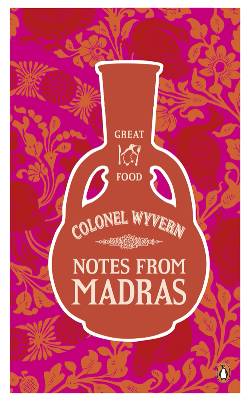
Notes from Madras

Penguin has published a new series focussing on the best food writing of the past four hundred years. Titled Great Food, this collection of twenty slim volumes fillets and reduces the work of well-known writers – MFK Fisher, Eliza Acton, and Claudia Roden – as well as of (now) more obscure authors – William Verrall, Agnes Jekyll, and Gervase Markham –into a hundred pages each.

Last Saturday I bought Notes from Madras, a digest of Colonel Wyvern’s classic Culinary Jottings from Madras (first published 1878 and substantially revised in 1885). I confess that I’d heard neither of the Colonel nor of Jottings before reading a review of the series, and I am so pleased that I’ve discovered him. Elizabeth David wrote: ‘I should recommend anyone with a taste for Victorian gastronomic literature to snap up [Wyvern’s recipes]. His recipes are so meticulous and clear that the absolute beginner could follow them, yet at the same time he has much to teach the experienced cook.’

Coralie Bickford-Smith's beautiful cover design for Notes from Madras

Colonel Arthur Robert Kenney-Herbert (1840-1916) was an officer in the British Indian Army who began to write about Indian cooking while stationed in the subcontinent during the second half of the nineteenth century. First published in newspaper articles, he went on to author a series of recipe books and found a cookery school in London. The purpose of his writing was to demystify cooking in India for the white, middle-class memsahibs who travelled to India with their husbands. Not only does Jottings provide recipes and menus, but detailed, practical advice about setting up and stocking a kitchen and training a servant.

David is entirely correct when she suggests that Wyvern be used by inexperienced or unconfident cooks. His recipes describe simply and precisely the ingredients and methods that go into preparing a range of dishes: from macaroni cheese to curries. He makes sure to explain the principles behind cooking: his instructions for boiling and preparing potatoes run to six pages; there are twelve steps for making the perfect fritter. Long-winded, perhaps. But fool-proof? Definitely.

Jottings from Madras has a number of surprising features. For the contemporary reader, the most striking is Wyvern’s enthusiasm for parmesan cheese, basil, and minimally-cooked vegetables. His writing runs counter to all the things we believe about heavy, bland, and overcooked Victorian meals. Partly as a result of this, Wyvern’s views on Indian servants and cooks seem of place.  Although Jottings advises colonial wives to treat their cooks with patience and respect, and to address them directly – not via a butler – in whichever pidgin English was spoken in their region, he believes that the country’s indigenous people are fundamentally inferior to himself and other Europeans:

There can be no doubt that in our Ramasámy we possess admirable materials out of which to form a good cook. The work comes to him, as it were, of its own accord. But we should take heed lest he grow up at random, clinging affectionately to the ancient barbarisms of his forefathers. We should watch for his besetting sins, and root them out whenever they manifest themselves.

This paternalistic – racist, certainly – attitude towards ‘Ramasámy’, his typical Indian cook, helps, I think, to account for Wyvern’s views on Indian cuisine. In terms of recipes, the primary aim of Jottings from Madras is to teach and assist readers to cook the standard, heavily Francophile food popular in Europe during the period. The genius of the book is Wyvern’s practical approach to cooking northern European cuisine in hot, humid south Asian conditions where many ingredients on which French cooking relies were not freely available.

Wyvern was not unusual in his assertion that most Europeans in India would want to eat primarily European dishes. One of my favourite sections of EM Forster’s A Passage to India (1924) describes an attempt to replicate the cooking of ‘home’ in a household in India with an Indian cook wholly unfamiliar with British and French cuisines:

the menu was: Julienne soup full of bullety bottled peas, pseudo-cottage bread, fish full of branching bones, pretending to be plaice, more bottled peas with the cutlets, trifle, sardines on toast: the menu of Anglo-India. A dish might be added or subtracted as one rose of fell in the official scale, the peas might rattle less or more, the sardines and the vermouth be imported by a different firm, but the tradition remained: the food of exiles, cooked by servants who did not understand it.

In the future I’ll discuss the ways in which this insistence upon serving and eating a British menu in India – and, indeed, elsewhere in the Empire – were connected to the construction and maintenance of ‘civilised’ European identities, but, for the moment, I’d like to focus on Wyvern’s attempts to find a happy medium between Indian and English cooking.

In Jottings he expressly advises against stocking up with too many bottled and tinned fruit, vegetables, and meat, arguing that wives should acquaint themselves with the fresh produce on offer at local markets. Wyvern makes the reasonable point that there is little point in trying to cook simple, yet delicious, French-style meals with inferior ingredients.

There are many ladies who, when giving out stores for a dinner party, have no hesitation in issuing ‘tins’ to the value of many rupees, but if asked for extra cream, butter, eggs, and gravy-meat, – the true essentials of cookery, – begin to consider themselves imposed upon. The poverty of our cookery in India results almost wholly from our habit of ignoring these things, the very backbone, as it were, of the cook’s art. If an English cook, surrounded with the best market supplies in the world, be helpless without her stock, her kitchen butter, and her cream and eggs, how much more should Ramasámy be pitied if he be refused those necessaries, for his materials stand in far greater need of assistance.

Wyvern also suggests that curries and aspects of Indian cuisine be incorporated into everyday menus. In fact, he writes that curries should feature as the centrepiece of formal dinners, lamenting that this practice had fallen out of fashion since the formalising of British rule in the middle of the century. (Before then, the British East India Company had constituted Britain’s presence in India. British wives, families, and domesticity arrived with the Raj.) Like other British authors, Wyvern refers to a range of Indian dishes as ‘curry’, but he does recognise that Indian cooking is heavily regionalised – and not all of it is ‘curry’. He provides a collection of recipes for Madras and Sri Lankan curries, using ingredients and flavours specific to these areas.

However, as in the case with Ramasámy, while he acknowledges that the curries are good to eat using traditional methods, they can, nevertheless, be improved upon using European methods and ingredients:

Among other adjuncts that may be written down as indispensable are the ingredients needed to produce that suspicion of sweet-acid which it will be remembered, forms a salient feature of a superior curry. The natives of the south use a rough tamarind conserve worked, sometimes, with a very little jaggery or molasses, and a careful preparation of tamarind is decidedly valuable. Why, however, should we not improve upon this with red currant jelly and if further sharpness be needed, a little lime or lemon juice? In England, and I daresay in India also, chopped apple is sometimes used, and perhaps chopped mango, in the fool-days of the fruit, would be nice.

Curries cannot afford to dispense with the assistance of some stock or gravy. It is not uncommon to hear people say that they have eaten far better curries in England than in India, the chief reason being that Mary Jane will not undertake to make the disk without at least a breakfast-cupful and a half of good stock.

So in go red currant jelly and stock – two ingredients which could not be more remote from the cooking of south India. Wyvern also devotes some space to mulligatawny, a soup which seems to have originated in Victorian Madras when Indian cooks were asked to invent a soup for their British employers. They based it on the Tamil molo tunny, or pepper water, a medicinal preparation for curing stomach ailments. To the original recipe of water, black pepper, chillies, and tamarind were added the inevitable chicken stock, fried onions, chicken, and, depending on taste, rice. This mulligatawny was, as Lizzie Collingham notes in Curry: A Tale of Cooks and Conquerors (2005), one of the first examples of a hybrid Anglo-Indian cuisine which developed in British settlements in the subcontinent. Others include kedgeree and new versions of curry – which were not only exported to Britain, but spread around India.

One of the most important products to emerge from this new Anglo-Indian cooking was ‘curry powder’. As I noted a fortnight ago, the idea of ‘curry powder’ is a British one. In south Asia, garam masala is a mix of spices which differs across regions, shops, and households. There is no single, correct recipe for it. Curry powder is a product blended by businesses for mass consumption. Wyvern believed strongly that the basis for any good curry was a good curry powder, but acknowledged that not every housewife had the skill, confidence, or time to produce her own:

I shall presently give a very valuable receipt for a stock household powder, one that was surrendered to me by an accomplished chatelaine, on the eve of her departure from India, as a token of the sincerest friendship. But for those who wish to avoid trouble and yet to have good curries, I strongly advocate the use of Barrie’s Madras curry-powder and paste. I am not employed as an advertising medium. My advice is not the advice of a ‘gent’ travelling for Messrs. Barrie and Co., it is the honest exhortation of one, my friends, who has the success of your curries very closely at heart. After more than twenty years’ experience of Barrie’s condiments, I say boldly, that I am aware of no preparations in the market that can equal them.

However much I do believe that Colonel Wyvern held the success of his readers’ curries ‘very closely at heart’, I wonder how much he did Barrie’s profit margins as well: Barrie’s appears frequently in Jottings. But Barrie’s was only one product in a very crowded market. The first British-produced curry powder was marketed at the end of the eighteenth century, and local as well as imported brands jostled for attention on the shelves of grocers around Britain by the late 1800s. These were blander and less fiery than Indian garam masala, but found an enthusiastic audience in Britain.

Collingham laments the Anglicisation of Indian cooking in British kitchens in both India and Britain, seeing it as a distinctly poor cousin to the original (or originals). I’m sure that many of the curries prepared in officers’ bungalows in Hyderabad and in suburban London weren’t terribly good, but I think it’s more useful to think of them as a kind of nineteenth-century imperial cuisine: the curries eaten by the British in India and in Britain in the nineteenth and early twentieth centuries were, really, British. Collingham demonstrates:

On arrival in Bombay in 1858 as the bride of a British army officer, Matty Robinson discovered that Anglo-Indian curries were quite unlike the British ones she was used to: ‘I can’t touch the Indian fruits or the fish which they say is so delicious, and as to the curries it makes me sick to think of them; give me an English one!’

In recent – and entirely laudable – efforts to replicate the more nuanced nature of regional Indian cooking, these curries – the Madras curries of British invention – have been sidelined and even ridiculed. They are held up to illustrate the unsophisticated nature of the British palate. I think it’s a pity because these are truly delicious dishes.

But it would seem that they might be heading for a revival. Marcus Wareing has recently opened The Gilbert Scott, the new restaurant at the magnificently renovated and refurbished St Pancras Hotel in London. Like Heston Blumenthal at Dinner, Wareing has drawn inspiration from old, British recipe books, and particularly those from the period in which the St Pancras Hotel was built. He includes, of course, a mulligatawny soup. In this BASTARD video WHICH REFUSES TO EMBED (sorry, long day), the Guardian’s Tim Hayward waxes lyrical on the St Pancras Hotel, the Gilbert Scott, and Wareing’s menu. He samples the mullgatawny, and approves of it mightily on the grounds that it tastes ‘authentically’ of…curry powder. This, he suggests, is an example of proper, British cooking. Curry powder, a strange hybrid of British and Indian cuisines, has now become a ‘classic’ and, ironically, ‘authentic’.

Further Reading

Texts quoted here:

Lizzie Collingham, Curry: A Tale of Cooks and sConquerors (London: Vintage, [2005] 2006).

EM Forster, A Passage to India (London: Penguin, [1924] 1989).

Colonel Wyvern, Culinary Jottings: A Treatise in Thirty Chapters on Reformed Cookery, 5th ed. (Madras: Higginbotham and Co., 1885).

—-, Notes from Madras (London: Penguin, 2011).

Other sources:

K.T. Achaya, The Food Industries of British India (Delhi: Oxford University Press, 1994).

David Burton, French Colonial Cookery (London: Faber and Faber, 2000).

Lizzie Collingham, Imperial Bodies: The Physical Experience of the Raj, c.1800-1947 (Cambridge: Polity Press, 2001).

James E. McWilliams, A Revolution in Eating: How the Quest for Food Shaped America (New York: Columbia University Press, 2005).

Sidney W. Mintz, Sweetness and Power: The Place of Sugar in Modern History (New York: Penguin, 1985).

—-, Tasting Food, Tasting Freedom (Boston: Beacon Press, 1996), pp. 67-83.

Wolfgang Schivelbusch, Tastes of Paradise: A Social History of Spices, Stimulants, and Intoxicants, trans. David Jacobson (New York: Random House, 1992).

James Walvin, Fruits of Empire: Exotic Produce and British Taste, 1660-1800 (Basingstoke and London: Macmillan, 1997).

Creative Commons License Tangerine and Cinnamon by Sarah Duff is licensed under a Creative Commons Attribution-ShareAlike 3.0 Unported License.

Revolution, Revival, and Food

Over the past fortnight another corporate conglomerate has bid to replace the evil empire Monsanto as the most problematic business within the global food industry. It has emerged that the Swiss-based Glencore,  a commodity trader specialising in energy and food which was listed publicly for the first time this week, was partly responsible for causing the hike in food prices at the end of last year when it became clear that Russia’s grain crop would be badly damaged by catastrophic fires. Raj Patel explains:

Glencore has now revealed its traders placed bets that the price of wheat would go up. On 2 August Glencore’s head of Russian grain trading called on Russia’s government to ban wheat exports. Three days later, that’s what it did. The price of wheat went up by 15% in two days. Of course, just because a senior executive at one of the world’s most powerful companies suggested a course of action that a country chose to follow doesn’t mean Glencore made it happen. But happen it did, and the consequences rippled round the world.

At the time, Mozambique experienced a massive uprising in response to increased food and fuel prices. Protests were organised via text messages and, in actions that foreshadowed those of governments in the Arab spring, the Mozambican state responded by shutting down text capability for pre-paid phones and sweeping up hundreds of protesters. Over a dozen people died, many were injured, and millions of dollars of damage was caused. It’s safe to say that tens of thousands were pushed further towards hunger as a result of the higher wheat prices.

Six months later, the Arab world exploded. The riots which began the insurrection in Tunisia were partly in response to high food prices. In Egypt, the government increased spending on wheat to compensate for a fifty percent hike in the cost of imported grain and cereals – even so, the price of bread rose by a quarter in Cairo’s private markets. In Libya, expensive and scarce food has fuelled the uprising against Muammar Gaddafi. Even the World Bank has woken up to the connection between food prices and political unrest, and warned that unstable regimes in North Africa and the Middle East were seriously undermined by discontent over the price of staples, like bread and pulses.

This association of high food prices and revolution isn’t anything new, as this graph posted by Paul Mason on his blog, shows:

Bread Prices, 1848 and 2011

What this graphic demonstrates is the extent to which political instability and the cost of food, and bread especially, are connected. This is particularly interesting because the graph links the Springtime of the Peoples, the ‘failed’ revolutions of 1848, with this year’s Arab Spring. In 1848, only four countries were immune to the revolution which swept Europe: Russia and Poland, and Britain and Belgium. The first two had small middle classes – the group largely responsible for the upheaval in the rest of Europe – and very efficient means of controlling and monitoring dissent. The second two had strong, flexible constitutional governments which could implement change and respond effectively to demands for reform.

High food prices are not, then, the main cause of revolutions, but it is telling that Britain could feed her population for less than did other nations in Europe in 1848. With the repeal of the protectionist Corn Laws in 1846 and improvements in technology which allowed commodities to be shipped around the world more quickly, grain prices remained low in Britain throughout the second half of the nineteenth century.

I think that it’s best to think about food protests as catalysts for revolutions: they cause people who would not normally take to the streets – women in particular – to become involved in anti-government demonstrations. Protesting about food prices or shortages is not an especially politically partisan activity. Food protests demand simply that the state successfully distribute food and regulate prices – that it, in other words, fulfil one of its most basic obligations to its citizens.

As the Nobel prize-winning economist and all-round good egg Amartya Sen argued in his classic Poverty and Famines: An Essay on Entitlement and Deprivation (1981), food shortages and famines tend to occur not when there isn’t enough food to go around, but, rather, when it isn’t distributed effectively. This happens when systems of exchange – a labourer works in exchange for money which she can exchange for food – break down or change radically. Writing in 1976, Sen explained:

A recent example was the 1974 famine in Bangladesh. The flood that destroyed the crop did reduce the availability of food, but the sharp decline in employment and the failure of exchange entitlement of labour was immediate, and the famine was made severe by that.

The European potato crop failed in the mid-1840s because of an infection of Phytophthora infestans, but it was only in Ireland that this caused widespread and devastating famine. In 1845, at least a third of the Irish population ate only potatoes. When the blight destroyed the year’s supply of potatoes there seemed to be nothing else to eat. Why? After all, not all Irish people were dependent on potatoes in the mid-nineteenth century: about half ate grains as well. A century and a half previously, all the Irish ate a considerably more varied diet. The difference was that the system of assizes – rules originating during the medieval period which governed the weight, quality, and distribution of bread – were repealed in 1838, allowing the price of bread the rise according to market forces. This meant that the Irish who were starving in 1845, and these were, overwhelmingly, the poorest proportion of the population, weren’t able to buy bread – of which there was enough to feed everyone.

Famines are caused by bad harvests, but they are also the product of dysfunctional systems of trade and distribution. It’s little wonder that they should cause revolutions: they demonstrate very clearly when governments are no longer able to respond to the needs of populations. In France, the Flour War erupted in 1775 after the introduction of laissez-faire economic policies caused the ancient guild system to go into a terminal decline: the groups of merchants who had once controlled the pricing and trade of grain and flour in France were no longer responsible for doing so, and bread prices rocketed. The widespread violence – caused frequently by women – forced Louis XVI to fire Jacques Turgot, his controller general.

This was a prime example of the state’s inability to feed and care for its subjects. The War was also partly responsible for politicising poor French women, who on 5 October 1789 marched to Versailles to demand that Louis sign the Declaration of the Rights of Man and that he lower the price of bread. This very, very angry mob of women forced the royal family not only to accede to the new revolutionary Assembly, but to move to Paris.

The Women's March to Versailles, 5 October 1789

It isn’t necessarily the case the famine and food shortages will cause revolution: there was a catastrophic famine in North Korea in the mid-nineties and the country still has periodic food shortages, but dissent has not been allowed to grow into any significant anti-government activity. This is due to the effectiveness of North Korea’s security forces and to the fact that North Koreans are simply too hungry, too tired, and too broken to overthrow their leadership. They have been starved into submission.

But food shortages are responsible for other mass movements too. The Cape Colony experienced a series of bad droughts during the second half of the nineteenth century, the worst of which occurred in the late 1850s and early 1860s, at the same time as outbreaks of rust on the wheat and the appearance of the oidium mildew on vineyards. The Cape’s newspapers described the increasingly desperate situation in rural areas: all the water dried up in Swellendam, farmers lost their sheep and horses, and the land was too dry to plough; there were allegations that farmers were stealing water from neighbouring farms’ rivers in Ladysmith; in Victoria West and Calvinia the cost of meat, groceries and other household goods rose sharply, and transporting produce to Port Elizabeth was almost impossible as draught animals were in short supply. Finding freshly-slaughtered mutton – the meat of choice in the Cape – was difficult. On top of this, the population, many of whom had already been weakened physically by food shortages, was also subjected to ‘unusually virulent’ epidemics of measles, typhus, and ‘white sore throat’ (diphtheria).

It is no coincidence that the 1860 Great Revival began in the worst affected rural areas. From the 1850s onwards, the ministers of the Dutch Reformed Church – numerically the biggest church in the Colony and the most politically powerful – had encouraged its members to pray for revival and religious ‘awakening’. Religious revivals are group manifestations of intense emotion, ranging from weeping and fainting to trances and speaking in tongues during which supplicants pray for conversion and salvation. Clergymen ascribed these outbursts of extreme religious enthusiasm to the presence of the Holy Spirit, but they were as much the product of social and economic change as anything else. There were at least three major revivals which swept most of the congregations of the Dutch Reformed Church in the nineteenth century (in 1860, 1874-1875, and 1884-1885), as well as several smaller, more localised ones.

The Great Revival in 1860 began in the colony’s impoverished, hungry, and desperate rural interior. It was brought to the attention of the church’s leadership when a fifteen year-old coloured servant girl went into an ecstatic trance during a service in Worcester – then the parish of Andrew Murray jnr, one of the church’s most prominent ministers. The girl lived in the rural village of Montagu and was visiting friends in Worcester. Her behaviour, which whipped the other congregants into a religious frenzy, mimicked that which had taken root at her church in Montagu. The revival subsequently from Worcester throughout the Cape.

The colonial state – rightly – blamed farmers’ unwillingness to conserve water during times of plenty for the devastating effects of the drought. But others – including members of the Dutch Reformed Church – accused the Cape’s government of not doing enough to help them, and believed that the scarcity of rain and food were a punishment from God. People’s willingness to turn to the church and to religion – away, in other words, from the state – showed that the authority of the state was being undermined by the crisis.

Similar circumstances contributed to the uprisings in the Arab world: instead of turning to charismatic religion, people in Tunisia, Egypt, Libya, Syria, Yemen, and elsewhere demanded the removal of unpopular, corrupt, and dysfunctional regimes. In a time of increasing food scarcity and volatility, governments will have to work harder to prove their necessity to their citizenry.

Further Reading

Texts quoted here:

Cynthia A. Bouton, The Flour War: Gender, Class, and Community in Late Ancien Régime French Society (University Park: Pennsylvania State University Press, 1993).

L.A. Clarkson and E. Margaret Crawford, Feast and Famine: Food and Nutrition in Ireland 1500-1920 (Oxford: Oxford University Press, 2001).

Barbara Demick, Nothing to Envy: Ordinary Lives in North Korea (London: Granta, 2010).

S.E. Duff, ‘What will this child be? Children, Childhood, and the Dutch Reformed Church in the Cape Colony, 1860-1895’ (PhD thesis, University of London, 2010).

Amartya Sen, ‘Famines as Failures of Exchange Entitlements,’ Economic and Political Weekly, vol. 11, no. 31/33, Special Number: Population and Poverty (Aug., 1976), pp. 1273-1280.

Barbara Clark Smith, ‘Food Rioters and the American Revolution,’ The William and Mary Quarterly, vol. 51, no. 1 (Jan., 1994), pp. 3-38.

Other sources:

Wayne Dooling, Slavery, Emancipation, and Colonial Rule in South Africa (Scottsville: University of KwaZulu-Natal Press, 2007).

Jean Drèze and Amartya Sen (eds.), The Political Economy of Hunger, 3 vols. (Oxford: Clarendon Press, 1990).

André du Toit, ‘The Cape Afrikaners’ Failed Liberal Moment, 1850-1870,’ in Democratic Liberalism in South Africa: Its History and Prospect, eds. Jeffrey Butler, Richard Elphick, and David Welsh (Middletown and Cape Town: Wesleyan University Press and David Philip, 1987), pp. 35-64.

Walter J. Hollenweger, The Pentecostals, trans. R.A. Wilson (London: SCM, 1976).

Steven Laurence Kaplan, Provisioning Paris: Merchants and Millers in the Grain and Flour Trade during the Eighteenth Century (Ithaca: Cornell University Press, 1984).

C.P. Melville, ‘The Persian Famine of 1870-72: Prices and Politics,’ in Food, Diet, and Economic Change Past and Present (Leicester: Leicester University Press, 1993), pp. 133-150.

Rhoads Murphey, ‘Provisioning Istanbul: The State and Subsistence in the Early Modern Middle East,’ Food and Foodways 2 (1988), pp. 217-263.

Creative Commons License
Tangerine and Cinnamon by Sarah Duff is licensed under a Creative Commons Attribution-ShareAlike 3.0 Unported License.
Waste

The only vaguely British royal-themed food I’ve eaten was sorely disappointing mock turtle soup (at an Oxford College – where else?) and coronation chicken. I wanted to write something about coronation chicken this week: it’s one of those dishes which say a great deal about a country’s attitudes towards food – and the relationship between these attitudes and national identities – as a particular moment in time.

This salad of cold chicken in a curried mayonnaise was invented by Rosemary Hume – the business partner of the more famous Constance Spry of the eponymous recipe book – to commemorate the coronation of Elizabeth II in 1953. (Originally it was called poulet reine Elizabeth.) Before I continue, this is the original recipe:

Coronation Chicken (serves 6-8)

2 young roasting chickens

water and a little wine to cover

carrot

a bouquet garni

salt

3-4 peppercorns

cream of curry sauce (see below)

Poach the chickens, with carrot, bouquet, salt, and peppercorns, in water and a little wine, enough barely to cover, for about 40 minutes or until tender. Allow to cool in the liquid. Joint the birds, remove the bones with care. Prepare the sauce given below. Mix the chicken and the sauce together, arrange on a dish, coat with the extra sauce.

Cream of curry sauce

1 tablespoon oil

2 oz. onion, finely chopped

1 dessertspoon curry-powder

1 good teaspoon tomato puree

1 wineglass red wine

¾ wineglass water

a bay-leaf

salt, sugar, a touch of pepper

a slice or two of lemon and a squeeze of lemon juice

1-2 tablespoons apricot puree

¾ pint mayonnaise

2-3 tablespoons lightly whipped cream

Heat the oil, add onion, cook gently 3-4 minutes, add curry-powder. Cook again 1-2 minutes. Add puree, wine, water, and bay-leaf. Bring to boil, add salt, sugar to taste, pepper, and the lemon and lemon juice. Simmer with the pan uncovered 5-10 minutes. Strain to cool. Add by degrees to the mayonnaise with the apricot puree to taste. Adjust seasoning, adding a little more lemon juice if necessary. Finish with the whipped cream. Take a small amount of sauce (enough to coat the chicken) and mix with a little extra cream and seasoning.

As any good English graduate will quote to you, the world is a text. In other words, any thing – any book, chair, poem, song, garden, hat, or film – can be read as a ‘text’: as a collection of signs, or symbols, which, according to material and historical context, will mean a variety of things. So a washing machine manufactured in the 1950s and bought by a white, middle-class family in Pinelands (a Cape Town suburb built along the lines of a ‘garden city‘) is not only a washing machine: it’s indicative of the impact of wartime innovations in technology on households; of rising post-war middle-class affluence; of the association of race and class in apartheid South Africa; of the slow move of women out of the home and into the workplace; but also of the reaction against women working and the social conservatism of the 1950s.

In this way, a recipe is a text like any other, and a particularly rich source for social, cultural, and economic history. Coronation chicken is interesting for a number of reasons. Firstly, it’s a dish designed to be eaten with one, fork-clutching hand. This is food that can be eaten in front of the television – and Elizabeth II’s coronation was a landmark in television history. Secondly, its inclusion of mayonnaise – something which still needed to be made by hand during the 1950s – nods to the massive influence of French cordon bleu cuisine on British cooking until, at least, the 1960s. Elizabeth David’s enthusiasm for the bourgeois cooking of Provence and other regions had yet to make an impact. In books like The Constance Spry Cookery Book, cordon bleu remained the standard for all forms of cooking.

And then there’s the curry powder. Although the Victorians and Edwardians embraced Anglicised versions of some Indian dishes – kedgeree and curry, most famously – it was only after independence in 1948 that Indian food became more widely available and popular in Britain. Admittedly, these Indian restaurants served a range of dishes which had been adapted to British tastes – they had thicker, richer gravies and were usually less spicy – but their growing popularity pointed to the fact that in post-austerity Britain, the population was enthusiastic to try exotic new flavours, if only in moderation (coronation chicken has only two teaspoons of curry powder). Indeed, the idea of curry powder is a foreign one: in India, any blend of spices is called garam masala and will vary from shop to shop, or household to household. What we call ‘curry powder’ is a mix of spices chosen by food companies. The curry powder which I use – Rajah (owned by Unilever) – contains, according to the box, cumin, coriander, and turmeric along with other spices.

As tastes have become more sophisticated, so have interpretations of coronation chicken. In a recent article in which she reworks the dish, Felicity Cloake makes the point that it’s been subject to a range of changes: curry powder has been replaced with freshly roasted and ground cumin and coriander (although in her recipe she keeps shop-bought curry powder for its retro quality); yogurt and chutney have taken the place of cream and of apricot and tomato puree; and fruit and nuts have made welcome appearances.

Possibly the greatest difference between coronation chicken prepared in 2011 and that which was made in 1953 is that cooks in the 1950s would have been more likely to use leftovers. The dish was designed purposefully to dress up potentially unappetising leftover food. Even if the original recipe included instructions for poaching chickens, the curried mayonnaise complements leftover roast chicken just as well. The accompaniment which Spry and Hume suggest also uses leftovers: a cold, dressed rice and cucumber salad.

When I was leafing through my mother’s elderly copy of the Constance Spry Cookery Book (1956) – it belonged originally to a great-aunt – I read the introduction for the first time, and was struck by the way in which Spry linked the purpose of the recipe book – providing home cooks with clear, well-written good, delicious recipes – with its post-war social and economic context. Listing the changes in attitude towards food and cooking since the late 1940s, she adds:

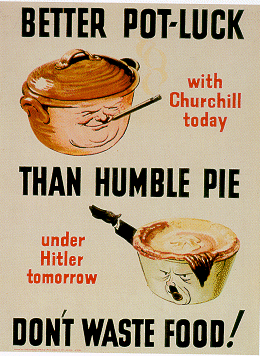
Something else is new too: the immensely better and fairer distribution of food among all grades of society. This is due to a variety of causes, not the least of which was the rationing system at which we grumbled so incessantly and to which we so thankfully said good-bye. Remembering as I do the days of immensely long, boring, wasteful dinners, remembering too the starvation which was all too often at our very doors, I cannot forbear to remind you how much respect ought to be paid to food, how carefully it should be treated, how shameful waste is.

I think that the greatest achievement of Lord Woolton’s tenure as Britain’s Minister of Food during the Second World War was the way in which he not only eked out the nation’s food supply, but that he ensured that most Britons ate well. Food rationing was introduced on 8 January 1940 and at first included only butter (4 oz per person per week), sugar (12 oz), raw bacon or ham (4 oz), cooked bacon or ham (3.5 oz), and eggs (2). Meat rationing began in March that year, and, gradually, tea, jam, and cheese were also rationed. During the war, bread, potatoes, coffee, fruit, vegetables, and fish were not rationed, although supplies of these were very limited.

Food rationing did not end with the war: it continued until 1953. Bread was rationed for the first time between 1946 and 1948, and potatoes in 1947. In the same year, the fruit and alcohol for Princess Elizabeth and Philip Mountbatten’s wedding cake was donated by Girl Guides in Australia, South Africa, and Jamaica because of the strictness of the rationing system.

A combination of increased exercise and a limited diet relatively low in saturated fat and sugar meant that the health of the British population actually improved during and after the war. In fact, many Britons ate considerably better during the war than before: improved distribution and a relatively standardised diet meant that those who had been too poor – or even too ignorant – to eat well before 1939 now received regular, healthy meals. George Orwell’s description of working-class meals in Wigan during the 1930s is particularly evocative:

The miner’s family spend only tenpence a week on green vegetables and tenpence half-penny on milk (remember that one of them is a child less  than three years old), and nothing on fruit; but they spend one and nine on sugar (about eight pounds of sugar, that is) and a shilling on tea. The half-crown spent on meat might represent a small joint and the materials for a stew; probably as often as not it would represent four or five tins of bully beef. The basis of their diet, therefore, is white bread and margarine, corned beef, sugared tea, and potatoes – an appalling diet.

Compare this to the Woolton Pie recommended by the Ministry of Food as a nutritious and thrifty (if not necessarily tasty) way of feeding a family:

Take 1Ib each of diced potatoes, cauliflower, swedes and carrots, three or four spring onions – if possible, one teaspoonful of vegetable extract, and one tablespoonful of oatmeal. Cook all together for 10 minutes with just enough water to cover. Stir occasionally to prevent the mixture from sticking. Allow to cool; put into a pie dish, sprinkle with chopped parsley, and cover with a crust of potatoes or wheatmeal pastry. Bake in a moderate oven until the pastry is nicely brown and serve hot with brown gravy.

This wouldn’t have made a particularly delicious supper, but it was much healthier and more filling than sweet tea and white bread with margarine. Again, this recipe made the best of leftovers and scraps. There’s a famous wartime propaganda poster which exhorts Britons to not waste food: ‘Better pot-luck with Churchill today than humble pie under Hitler tomorrow’.

Given the success of rationing in Britain, it’s not really surprising that so many green groups have suggested that it serves as an excellent model for limiting carbon emissions and the use of fossil fuels. It’s even been argued that a return to a wartime diet would reduce the numbers of overweight and obese children in Britain. Although I think that these are creative and useful ideas, I’m concerned that they’re based partly on an idealised notion of life on the home front: that they don’t take into account the drudgery of cooking with such a limited range of ingredients (and how boring the food was); and the fact that many people did their utmost to get around rationing by growing their own food (good idea) and trading on the black market (not so good).

It’s particularly telling that the habits taught by rationing did not outlast the war. As Orwell made the point, low pay was only one reason why poor families in Wigan ate badly:

When you are unemployed, which is to say when you are underfed, harassed, bored, and miserable, you don’t want to eat dull wholesome food. You want something a little bit ‘tasty’. There is always some cheaply pleasant thing to tempt you. Let’s have three pennorth of chips! Run out and buy us a twopenny ice-cream! Put the kettle on and we’ll all have a nice cup of tea! … White bread-and-marg and sugared tea don’t nourish you to any extent, but they are nicer (at least most people think so) than brown bread-and-dripping and cold water.

I’m not sure that rationing will fundamentally alter people’s attitudes towards food and eating, but there are other lessons to be learned, and chiefly around controlling waste. In Waste: Uncovering the Global Food Scandal (2009), Tristram Stuart makes the point that in the United States and Europe, about half of all edible, safe food is thrown away. This is done mainly by supermarkets and food manufacturers, but households contribute as well. There’s no single way of reducing food waste – changing legislation on ‘sell-by’ and ‘use-by’ dates would be a start – but one strategy would be to encourage people to think more carefully about how they buy food: teach them that ‘buy one get one free’ specials tend to encourage waste, for example, and make the point that wasted food is, essentially, wasted money.

And this isn’t a totally unrealistic goal. After all, not very long ago, British households threw away much less food: 2-3 per cent during the 1930s, and 4-6 per cent two decades later. Moreover, Japan, Taiwan, and South Korea all have successful programmes which have reduced the amount of food waste. The latter two have made it illegal for food to go to landfill, and all three have educated the public about the importance not only of throwing away as little food as possible, but of composting or recycling that which absolutely has to go. South Korea transforms its food waste into pigswill (something banned in Britain after the outbreak of mad cow disease). Stuart writes:

Koreans obey the waste recycling law largely because they have resigned themselves to the reality: that sending food into landfill is against their own interests and that of the planet they live in. They know about the disease outbreak in Britain, and they know about the ban on swill-feeding – and they conclude, as a result, that Europeans are blithely continuing their reckless, self-interested exploitation of the planet in the manner that has characterised them for centuries.

You wouldn’t throw money away – so why do the same with food?

Further Reading

Texts cited here:

George Orwell, The Road to Wigan Pier (London: Secker and Warburg, [1937] 1959).

Constance Spry and Rosemary Hume, The Constance Spry Cookery Book (London: The Cookery Book Club, 1956).

Tristram Stuart, Waste: Uncovering the Global Food Scandal (London: Penguin, 2009).

Other sources:

Warren Belasco, Meals to Come: A History of the Future of Food (Berkeley: University of California Press, 2006).

Gordon Conway, The Doubly Green Revolution: Food for All in the Twenty-First Century (Ithaca: Cornell University Press, 1997).

Brian Harrison, ‘The Kitchen Revolution,’ in Consuming Passions: Food in the Age of Anxiety, eds. Sian Griffiths and Jennifer Wallace (Manchester: Mandolin, 1998), pp. 139-149.

Harvey Levenstein, Paradox of Plenty: A Social History of Eating in Modern America, revised ed. (Berkeley: University of California Press, 2003).

Michael Pollan, In Defence of Food (London: Penguin, 2008).

Creative Commons License
Tangerine and Cinnamon by Sarah Duff is licensed under a Creative Commons Attribution-ShareAlike 3.0 Unported License.

Disgust

One of my favourite books, and one to which I turn when I need comforting and amusing, is Julian Barnes’s collection of essays on cooking called The Pedant in the Kitchen (2003). It is wildly funny – there’s a particularly fantastic piece about cooking a Nigel Slater recipe for pork chops and chicory – and deeply wise about preparing and eating food. My favourite chapter is titled ‘Once is Enough’ and is about exotic delicacies which, once sampled, one is happy never to eat again. Some taste revolting, or are so closely associated with a particular event that eating them once more would raise far too many difficult memories. Others are simply too complicated to replicate:

I once bought an eel from a Chinese fishmonger in Soho, carried it home on the Northern Line, and then realised my next job was to skin it. This is what you have to do: nail it to a door-frame or other substantial wooden part of your dwelling, make an incision on either side of the neck, take a pair of pliers in each hand, grip the two cut pieces of skin, put your foot against the door level with the eel’s head, and slowly haul back the skin, which is firm and elasticated, like a dense inner tube. Afterwards I was glad to have done it. Now I shall know how to proceed if forced to survive somewhere with only an eel, two pairs of pliers, and a doorframe for company; but I don’t otherwise need the activity to be central to my life. Smoked, stewed, barbecued – eel is welcome on my plate in most forms; but from now on I’ll let others do the skinning.

I know exactly what he means. I feel much the same about pickling chillies: really, once was enough. But as to ordinary food – the sort found in supermarkets and the average recipe book – there are only two things which I refuse, absolutely, to eat. I don’t particularly care for mangoes, papaya, blue cheese, strawberries (yes, I know), and raw tomatoes, but I’ll eat them for the sake of politeness. Yet goats’ cheese and bananas are entirely beyond me. Even the thought of eating them makes me shudder with revulsion: for both it’s a case of pungent, unpleasant smell mingling with a sticky-soft texture and a gag-inducing flavour. I have only one friend who shares my antipathy for both foods, but I know at least three others who feel the same way about bananas, and my issues with goat’s cheese seem to be fairly widespread. So I refuse to feel that I should account for my antipathy.

It’s true that as our palates develop, what once revolted us as children ceases to do so when we’re adults. I remember the stomach-churning revulsion I felt when, as a child, I first smelled my father boiling artichokes. Now, I love them. And the same goes for olives and mussels. But our responses to food, as I noted in my previous post, are governed by a range of factors, several of which are irrational (so no chance of me ever willingly eating goats’ cheese or banana), while others are socially and culturally determined. Barnes writes:

No doubt in the future some of our eating habits will be high-mindedly condemned as shameful and disgusting and incomprehensible. Rather as we feel when we learn that they used to eat herons in the late Middle Ages and Renaissance; further, that they trained falcons to hunt them. The English roasted heron with ginger, the Italians with garlic and onions; the Germans and Dutch made them into pies; the French thought it bad form to serve heron without any sauce, and La Varenne further suggested decorating the platter with flowers to make the dish look more appealing.

As taste has changed over time, so has what we define as being too disgusting to eat. Medieval princes may have supped on lampreys; now these jawless fish are left largely to their own devices.

I’ve been reading a collection of Hugh Fearnley-Whittingstall’s journalism, Hugh Fearlessly Eats It All (2006), and was struck by an article in which he lists all the unusual – and usually disgust-inducing – food which he has eaten and, for the most part, liked. In ‘Taste Not, Want Not’, he moves from the relatively normal (brains) to the weird (goose barnacles) to the (to me) utterly revolting (maggots). I was surprised, though, by his inclusion of donkey salami. Donkeys, to whose sanctuaries the British donate millions of pounds every year, and whose apparent uncomplaining willingness to be beasts of burden, seem to be the last animals who should be allowed onto a menu. They are too good – too noble – to eat. And yet they are eaten in France – along with horses.

My discomfort at Fearnley-Whittingstall’s admission – and he adds that he was initially uneasy about the salami – turned into a contemplation of how easily we distinguish between two groups of animals: between those that we will eat, and those that we won’t. More importantly, we imbue these two categories with moral meanings. It’s not just disgusting to eat dog, but morally wrong too. Our shifting views on the acceptability of eating animals are determined by a range of factors, not least of which is how we think about our pets. Humans have domesticated animals for thousands of years, but it’s only relatively recently that we’ve begun to keep animals exclusively for our amusement. This is not to suggest that Xhosa herdsmen during the 1700s felt no affection for their cattle, but, rather, the idea that a family should include an adored pet originates in the West during the nineteenth century.

Along with our pet-keeping, our increasing concern for protecting wildlife has helped to diminish our enthusiasm for eating wild animals. It’s interesting how willing the employees of the Dutch East India Company stationed at the Cape Colony during the seventeenth century were to eat hippopotamus – and their enthusiasm was rewarded by the fact that it tasted ‘like calf’. Now, we eat neither hippopotamus nor calf. Indeed, veal is an interesting case: its popularity diminished substantially during the 1980s when the appalling conditions in which male calves were reared were made better known. I’ve never eaten veal mainly for this reason. But there is an excellent case for eating veal: bull calves are a by-product of the dairy industry and those which are not marked out for consumption as veal, are shot at birth. As an omnivore, I do have an obligation, then, to eat veal.

Veal: the ethical choice?

My disgust at eating veal is not because I am revolted by the idea of eating cattle or, even, young animals (I eat lamb, after all), but as a result of the fact that these calves had to suffer so that I may drink milk. I think it’s here that we could fundamentally alter the way in which we associate disgust and particular kinds of meat. With urbanisation and the industrialisation of food processing, we are no longer as familiar with the ways in which animals are raised for food: for someone brought up in a town and whose only close association with animals is the family pet, watching a chicken being killed is, understandably, horrifying. But we should not allow this distance between ourselves and production of food cause us to become too disgusted to think about how the meat we eat is prepared.

It is absolutely hypocritical to eat pork – an adult pig is as ‘intelligent‘ as a dog – but to refuse to eat donkey. Rather, I wish we’d distinguish between humanely reared and factory-farmed animals. I don’t want to eat any animal that endured a painful existence to allow me to eat it. Moreover, it’s clear that the conditions in which cattle, pigs, and chickens are raised en masse are not only cruel, but ecologically unsustainable.

A range of thinkers – Gandhi, Peter Singer, and JM Coetzee – have described the slaughter of animals for human consumption as mass murder. I agree with Michael Pollan and others who argue that we do need to rear and eat meat for the benefit of our and the planet’s health. We should consume fewer dairy products and eat less meat, and all of these products should be free range. Most importantly, we must rethink our sense of disgust around eating animals: I think it is far more disgusting to eat factory-farmed chicken breasts than humanely reared and –kept donkeys.

Further Reading

Texts quoted here:

Journal of Jan van Riebeeck, vol. I, ed. H.B. Thom (Cape Town: A.A. Balkema, 1952).

Julian Barnes, The Pedant in the Kitchen (London: Atlantic, 2003).

Hugh Fearnley-Whittingstall, Hugh Fearlessly Eats It All: Dispatches from the Gastronomic Front Line (London: Bloomsbury, [2006] 2007).

Other sources:

Kathleen Kete, The Beast in the Boudoir: Petkeeping in Nineteenth-Century Paris (Berkeley: University of California Press, [1994] 1995).

Michael Pollan, The Omnivore’s Dilemma (London: Bloomsbury, 2006).

Harriet Ritvo, The Animal Estate: The English and Other Creatures in the Victorian Age (Cambridge, MA: Harvard University Press, 1987).

Peter Singer, ‘A Vegetarian Philosophy,’ in Consuming Passions: Food in the Age of Anxiety, eds. Sian Griffiths and Jennifer Wallace (Manchester: Mandolin, 1998), pp. 71-80.

Colin Spencer, The Heretic’s Feast: A History of Vegetarianism (Lebanon: University Press of New England, 1996).

Tristram Stuart, The Bloodless Revolution: Radical Vegetarians and the Discovery of India (London: Harper Press, 2006).

Sandra Swart, Riding High: Horses, Humans, and History in South Africa (Johannesburg: Wits University Press, 2010).

Creative Commons License
Tangerine and Cinnamon by Sarah Duff is licensed under a Creative Commons Attribution-ShareAlike 3.0 Unported License.

Food, Love, and Molecules

This post is late because I came unstuck on a piece about food shortages and revolution and must entirely rethink my argument. So instead I present you with a soufflé of a post: a reflection on this year’s list of Top 50 restaurants which was announced on Monday.

For a long time I’ve wanted to discuss the kind of cooking labelled ‘molecular gastronomy’, practised most famously by Heston Blumenthal at the Fat Duck and, originally, at El Bulli in Spain by Ferran Adrià. I suppose that given last week’s rant about the adoration of the pavlova on MasterChef Australia it would be reasonable to assume that I am deeply critical of the food served at these restaurants. On the contrary, I’m fascinated by it and am a fan of both Blumenthal and Adrià.

This may seem like I’m trying to square the circle, but let me explain. It’s worth defining precisely what I mean by molecular gastronomy because, depending on context, it can refer to two separate, yet related, activities. Firstly, it describes what has also been dubbed ‘modernist cuisine’: a type of cooking which uses a range of unorthodox methods and equipment radically to alter familiar foodstuffs and dishes. For example, in a recent television series, In Search of Perfection, Blumenthal entirely reinvented, among other things, that classic of 1970s dining, black forest gateau. Adrià dislikes the term molecular gastronomy, preferring describe his cooking as ‘deconstructionist’, and I think that this is a useful way of understanding his and Blumenthal’s technique.

Heston Blumenthals revamped black forest gateau

Blumenthal reduced the gateau to its most basic components – chocolate, cream, maraschino cherries, and kirsch – and then reassembled it using aerated chocolate and cream jelly to emphasise the intensity of the dark chocolate, the richness of the cream, and the sweet-sourness of the cherries. Drawing attention to its origins during the 70s, the cake was spray-painted with a mock wood veneer in chocolate. Finally, Blumenthal poured the kirsch into a spray bottle and spritzed it in to the air as the cake was being eaten: we use our sense of smell to taste (which is why everything tastes of boiled knitting when your nose is blocked), and the scent of the kirsch combined with the taste of chocolate, cream, and cherries blends together as the cake is eaten.

In its second, more exact, meaning, molecular gastronomy describes a branch of food science which pays particular attention to the process of cooking. It was invented in 1988 by Nicholas Kurti and Hervé This, who explains:

Despite having a huge impact on other aspects of our lives, scientific advances have done little to change our cooking habits. When it comes to preparing food – the most important aspect of our life from a physiological point of view – citizens in developed countries still cook almost the same way as their ancestors did centuries ago. … Kitchens are equipped with basically the same pans, whisks and sieves that cooks used in the seventeenth century.

Indeed, cooking was the last of the ‘chemical arts’ to become the object of scientific scrutiny and it still relies on telltale and anecdotal knowledge rather than solid science. As recently as 2001, an inspector from the French Department of Public Education said, during a public lecture, that her mayonnaise failed when she was menstruating. Such old wives’ tales were partly the reason behind the creation of molecular gastronomy: I first started experimental studies of cooking after encountering a recipe for cheese soufflé that advised adding egg yolks ‘two by two, never by fractions’. Another reason was that the late Nicholas Kurti, professor of physics at Oxford University, UK, was upset by the poor and unscientific way that people cook. …in 1988, Kurti and I decided that we should create a new scientific discipline to investigate culinary transformations.

Originally, molecular gastronomy had five aims: ‘to collect and investigate old wives’ tales about cooking; to model and scrutinize existing recipes; to introduce new tools, products and methods to cooking; to invent new dishes using knowledge from the previous three aims; and to use the appeal of food to promote science.’ This has since been reduced to two: to look at how food is described or defined (a mayonnaise is a thick, jelly-like emulsion of egg yolk and oil, for example), and the range of hints, tips, and advice that accompany instructions for making food (when making mayonnaise, heat the bowl and add the oil in a thin trickle).

However, we rapidly found this new programme insufficient as well, because the main aim in cooking is to produce good food, which is art and not technique. Furthermore, a dish can be cooked perfectly, but if it is not presented in an appealing way, all the art and science will mean little to the customer or guest; we therefore decided that we must include the ‘love’ component of culinary practice. Of course, science will probably never be able to fully explain art or love, but it can help; for example, evolutionary biology can contribute to the exploration of human behaviours, and, accordingly, culinary practice. Consequently, molecular gastronomy not only uses science to explore the technical aspect of cooking but also the ‘art’ and ‘love’ components, both of which are important for the main aim of cooking: to delight guests.

I think that this sums up why I am fascinated, rather than repelled, by molecular gastronomy: it melds scientific enquiry (why do we cook in the way we do?) with a recognition that much of our response to food and eating is emotional, aesthetic, and irrational. This argues convincingly that the usefulness of molecular gastronomy lies in its ability to tell us more about how food is cooked: ‘If we are able to use the knowledge gained on food preparation, we might find new ways to make healthy food more attractive, we might persuade more people to cook better food and, last but not least, we might convince society to regard eating as a pleasure rather than a necessity.’

It’s for this reason that I am interested in what top-end restaurants do: the two uses of molecular gastronomy overlap in that both require us to think more closely about how we prepare food, and then to use this knowledge to look again at how we eat. I agree that it would be impossible to accuse Pierre Gagnaire and René Redzepi of producing affordable, interesting, and healthy food for the masses – and the same is true of the three South African restaurants (Le Quartier Francais (36), Rust en Vrede (61), and La Colombe (82)) listed in the Top 100. But then none of them pretend to do so: these restaurants are spaces in which food is the subject of experimentation and where, paradoxically, chefs are at liberty not to take it too seriously (as on MasterChef). They are free to play with food, and to rethink the ways in which we eat and respond to food.

There is a connection between restaurant and home cooking. When the much derided nouvelle cuisine of the 1980s swopped heavy, flour-laden sauces for lighter reductions, home cooking gradually followed suit (although this change took place within a broader context of heightened concern about healthy eating in the West). When Blumenthal unveiled his snail porridge at the Fat Duck, the dish was greeted with derision and disgust. But now – around a decade later – deeply savoury snails on a risotto-like porridge of oats is no longer thought to be repellent. In fact, Blumenthal simply combined a collection of ingredients usually loved by diners in a slightly different format.

In this way, these restaurants can be seen as laboratories in which the food of the future – the jellies, foams, sous vide cooking, and new flavour combinations – is developed. It’s worth noting that Adrià has recently announced the closure of El Bulli, and the opening of a research foundation dedicated to spreading the lessons learned from the technology developed at the restaurant. In particular, he aims to show how cooking and eating can – and should – be both healthy and delicious. That love, in other words, is as important as technique in cooking.

<a rel=”license” href=”http://creativecommons.org/licenses/by-sa/3.0/”><img style=”border-width: 0;” src=”http://i.creativecommons.org/l/by-sa/3.0/88×31.png&#8221; alt=”Creative Commons License” /></a>
Tangerine and Cinnamon by <a rel=”cc:attributionURL” href=”https://tangerineandcinnamon.wordpress.com/”>Sarah Duff</a> is licensed under a <a rel=”license” href=”http://creativecommons.org/licenses/by-sa/3.0/”>Creative Commons Attribution-ShareAlike 3.0 Unported License</a>.

Creative Commons License
Tangerine and Cinnamon by Sarah Duff is licensed under a Creative Commons Attribution-ShareAlike 3.0 Unported License.

Be Modern: Worship Food?

On Monday evening I watched the first episode of the latest series of Australian MasterChef to be broadcast in South Africa. The previous series was so wildly popular here that I was interested to see what the fuss was about. Based on the latest incarnation of the MasterChef franchise in the UK, over the course of a few weeks the programme whittles down a group of fifty aspiring cooks to a four or five finalists who are put through a series of challenges – working a shift in a hotel kitchen, recreating a chef’s impossibly complicated signature dish (I hate the term) – until only one contestant emerges triumphant. It’s fun, self-important, and utterly ridiculous.

And then, towards the end of this first episode of season two, an audience of at least sixty intelligent adults applauded a pavlova.

A pudding consisting of egg whites, sugar, vinegar, and vanilla received a round of applause. I mean, I lecture three times a week and I’m never applauded.

Donna Hay's adored pavlova

I love pavlova and the MasterChef version – baked and unveiled by Donna Hay – looked fantastic, and I really don’t have much against reality TV shows (I can’t – I was once badly addicted to the second series of My Restaurant Rules.) And, to be fair, to accuse MasterChef of not being adequately realistic would be to miss the point. The British version is hosted and judged by two middle-aged men who yell things like ‘Cooking doesn’t get tougher than this!’ at the camera. It’s a competition and no attempt to train a new generation of chefs. But the round of applause and the reverence for a pudding struck me as being more than silly. It was, in fact, too serious.

MasterChef is like many other reality shows: it judges contestants on their ability at a particular skill. This skill can be anything – from fashion design to hairdressing – because it’s secondary to the format of the programme. It’s the vehicle for television series which are, essentially, talent shows, but on a more elaborate and glamorous scale. The adulation of the pavlova undermined this format. All of a sudden, the focus of that episode of MasterChef shifted from the contestants to the food.

Am I overreacting? Probably. But not without reason. Earlier that day I had read an article written by Angela Carter in 1984 for the London Review of Books, in which she reviewed The Official Foodie Handbook by Ann Barr and Paul Levy, Elizabeth David’s An Omelette and a Glass of Wine, and Alice Waters’s Chez Panisse Menu Cookbook. While she acknowledged that the Foodie Handbook was meant to lampoon middle-class ‘foodies’, it is was one of a series of guides – like the Sloan Ranger and Yuppie handbooks – to middle-class living which, she felt, walked an uneasy line between guide and satire. Writing about the Preppy Handbook she noted:

The book was an ill-disguised celebration of the snobbery it affected to mock and, under its thinly ironic surface, was nothing more nor less than an etiquette manual for a class newly emergent under Reaganomics. It instructed the nouveaux riches in the habits and manners of the vieux riches so that they could pass undetected amongst them. It sold like hot cakes.

Along with David and Waters, the authors of the Foodie Handbook elevate the preparation and eating of food to a rarefied art form only done ‘properly’ by those educated and sensitive enough truly to understand cooking. The book advised its readership: ‘Be modern: worship food!’ Carter was, like Jay Rayner and Anthony Bourdain, particularly scathing of Alice Waters:

Alice Waters [serves] a Franco-Californian cuisine of almost ludicrous refinement, in which the simplest item is turned into an object of mystification. A ripe melon, for example, is sought for as if it were a piece of the True Cross. Ms Waters applauds herself on serving one. ‘Anyone could have chosen a perfect melon, but unfortunately most people don’t take the time or make an effort to choose carefully and understand what that potentially sublime fruit should be.’ She talks as if selecting a melon were an existential choice of a kind to leave Jean-Paul Sartre stumped.

She concludes, gloriously:

Ms Waters has clearly lost her marbles through too great a concern with grub, so much so that occasionally ‘Alice Waters’ sounds like a pseudonym for S.J. Perelman. ‘I do think best while holding a tomato or a leg of lamb,’ she confides. For a person of my generation, there is also the teasing question: could she be the Alice, and ‘Chez Panisse’ the real Alice’s Restaurant, of the song by Arlo Guthrie? And if this is so, what does it prove?

Carter bases much of her criticism of the Foodie Handbook, Waters, and Elizabeth David on the grounds of insensitivity: how is it possible to be so precious about food, she asks, when so many people go without? I agree that there is something profoundly wrong with a world where some populations have so much food that they feel that they should spend a day searching for the perfect watermelon, while others starve or are reliant on the tender mercies of aid organisations.

We have, though, always imbued food with meaning. Food provides nourishment, but it also carries with it a range of assumptions, symbols, and signs which are occasionally as important as its primary function. When Spanish missionaries in sixteenth-century Mexico refused to celebrate communion using maize, instead of wheat, wafers, they did so purely on the grounds that wheat, an imported crop, represented Europe and, thus, civilisation. Similarly, when well-meaning lady food reformers attempted to ‘Americanise’ the cuisine of recent immigrants to the United States during the 1920s, they did so because the cooking of Italy, Poland, and Ireland was seen as less ‘civilised’ than that prepared by white, Protestant Americans.

Pears' Soap - The White Man's Burden

There is a difference, though, between the association of food with civilisation and cultural superiority and giving a round of applause to a pavlova – or, indeed, to a melon. In Imperial Leather: Race, Gender, and Sexuality in the Colonial Context (1995), Anne McClintock examines the ways in which Victorian advertisers used images of empire to sell their products. Pears, the soap manufacturers, produced a series of advertisements which implied that soap was somehow connected to the success of British imperialism. In one of their best known ads from the early 1890s, a sea captain – surrounded by images of travel and conquest – is depicted washing his hands in his ship. It’s captioned: ‘The first step towards lightening the white man’s burden is through teaching the virtues of cleanliness.’ Another titled ‘The Birth of Civilisation’ is of an African man holding aloft a bar of soap which has floated ashore after a shipwreck.

This campaign crudely linked cleanliness – long associated with being ‘civilised’ – with the civilising mission. Colonised people, suggested Pears, could be made European by a bath with Pears soap. In the first volume of Capital (1867), Karl Marx began to develop the idea of ‘commodity fetishism’ to explain the kind of ‘magical’ attraction and meaning which commodities – ordinary, manufactured objects – seem to exude. He argued that a range of meanings – which are socially and culturally inflected and which change over time – are attached to commodities. Capitalism encourages people to confuse the utility of the object and social meanings – this is what Marx called ‘commodity fetishism’. In other words, objects take on meanings to the extent that they assume a kind of independence from their utility. The purpose of soap was no longer to clean bodies and clothes, but, rather, to civilise.

Pears' Soap - the Birth of Civilisation

A similar process occurred with the pavlova on MasterChef: it was no longer simply a pudding, but, rather, representative of success and good taste. When one of the contestants in the final round produced what she thought would be a bad pavlova, she collapsed in tears and refused to continue. It was as if it was she – rather than her ability to bake a pudding – who was being tested. When Alice Waters hunted for the perfect melon, she was not only seeking out a fruit, but also an object which embodied what she believed to be her goodness and moral superiority.

I wouldn’t be writing this post if I thought that this strange affliction was limited to Californian chefs and anxious Australians. Look at food magazines and food programmes: aimed at middle-class audiences, they conflate being able to cook well and to eat good – whole, organic, humanely reared – food with being good, successful, and environmentally and socially responsible. I have absolutely nothing against farmers’ markets, artisan bakers, small-scale farmers, co-operative supermarkets, and organic grocers – in fact, I think that they’re helping to create new ways of thinking about food – but I am deeply concerned when their produce is no longer thought of simply as food, but becomes a marker of middle-class morality.

This form of commodity fetishism is limiting: it associates good food with class and wealth. It encourages those who consume this food to think only about the product which they buy, and not to consider the complex processes which brought that piece of cheese or that steak to their deli or supermarket. It also mystifies the production, preparation, and eating of food. If we are to become more careful eaters – and more aware of how our eating habits impact on the world around us – we need to see food as food: as a product which is fundamental to life and which all people have a right to eat.

Further Reading

Texts quoted here:

Donna R. Gabaccia, We are what we eat: Ethnic food and the making of Americans (Cambridge MA: Harvard University Press, 1998).

Karl Marx, Capital: Capital: A Critique of Political Economy, vol. I, trans. Ben Fowkes (New York: Penguin, [1867] 1990).

Anne McClintock, Imperial Leather: Race, Gender and Sexuality in the Colonial Context (New York and London: Routledge, 1995).

Jeffrey M. Pilcher, ¡Que vivan los tamales! Food and the Making of Mexican Identity (Albuquerque: University of New Mexico Press, 1998).

Other sources:

Timothy Burke, Lifebuoy Men, Lux Women: Commodification, Consumption, and Cleanliness in Modern Zimbabwe (London: Leicester University Press, 1996).

Hasia Diner, Hungering for America: Italian, Irish, and Jewish Foodways in the Age of Migration (Cambridge: Harvard University Press, 2001).

Yves Péhaut, ‘The Invasion of Foreign Foods,’ in Food: A Culinary History from Antiquity to the Present, eds. Jean-Louis Flandrin and Massimo Montanari, English ed. by Albert Sonnenfeld (New York: Columbia University Press, 1999), pp. 457-470.

<a rel=”license” href=”http://creativecommons.org/licenses/by-sa/3.0/”><img style=”border-width: 0;” src=”http://i.creativecommons.org/l/by-sa/3.0/88×31.png&#8221; alt=”Creative Commons License” /></a>
Tangerine and Cinnamon by <a rel=”cc:attributionURL” href=”https://tangerineandcinnamon.wordpress.com/”>Sarah Duff</a> is licensed under a <a rel=”license” href=”http://creativecommons.org/licenses/by-sa/3.0/”>Creative Commons Attribution-ShareAlike 3.0 Unported License</a>.

Creative Commons License
Tangerine and Cinnamon by Sarah Duff is licensed under a Creative Commons Attribution-ShareAlike 3.0 Unported License.