
A Pumpkin Spice too Far
I spent most of October and November in the United States and Canada, coinciding with Canadian Thanksgiving, Hallowe’en, and, probably most importantly, pumpkin spice season. This blend of cinnamon, nutmeg, and cloves—the flavourings associated with pumpkin pie—has become comically ubiquitous in the US. Alongside pumpkin spice muffins, macaroons, and cupcakes, I saw pumpkin spice air freshener, rooibos tea, and beer. I tried pumpkin spice chips (inadvisable) and Icelandic yogurt (odd).
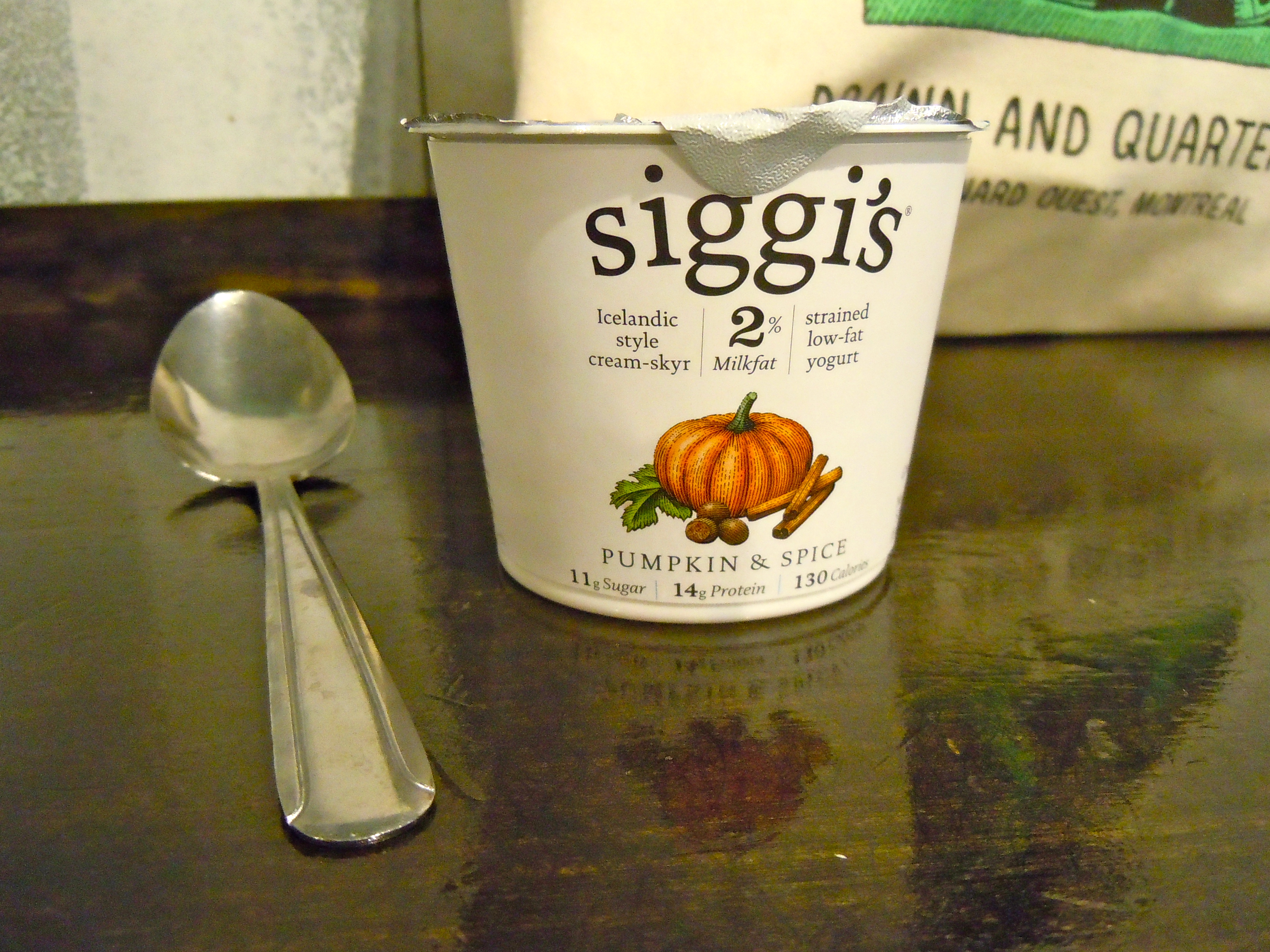
Too far, I think.
The pumpkin spice phenomenon originated in 2003, when Starbucks—then on the cusp of almost-global domination—debuted a new flavour for autumn. As reported last year to mark the drink’s ten-year anniversary, the company was hesitant to introduce the pumpkin spice latte. It already sold several flavoured coffees, but was not entirely sure that another seasonal drink would take off. They needn’t have worried. Forbes reports that in 2013 Starbucks had sold more than 200 million pumpkin spice lattes:
If you just do the math, that means Starbucks has sold an average 20 million beverages a year whose flavoring once belonged primarily in a seasonal pie…
At the basic price of about $4 for a 12-ounce tall size, PSL means at least $80 million in revenue … for Starbucks, which serves it beginning in September. … The company says the PSL is by far the most popular seasonal beverage in its lineup.
In fact, the pumpkin spice latte was held responsible for a bounce in the chain’s revenues this year. Outrages and fears over pumpkin spice shortages, and the annual dash for the first pumpkin spice latte of the season, are canny marketing strategies which have helped to position the drink—the #PSL on Twitter—alongside Starbucks’s red cups as a marker of the beginning of autumn and the holiday season. Unsurprisingly, other chains and supermarkets have begun to produce their own versions of the PSL.
Small, independent coffee shops—the alternatives to corporate caffeine—have also developed ways of cashing in on the pumpkin spice craze. I had a pumpkin pie flavoured latte at New Moon—an excellent café in Burlington, Vermont—and a lumberjack latte at Babo in Ann Arbor, Michigan. They were sweet and spicy: less coffee than coffee flavoured drinks.
I don’t think that the wild enthusiasm for pumpkin spice—as a flavouring—is particularly surprising. After all, in the US, Europe, and some other parts of the world, this combination of spices has long been a feature of winter or festive cooking and baking. A more interesting question is why Americans drink so much flavoured coffee. In the interests of research, I also tried vanilla, and brown sugar and sea salt flavoured coffees, and resolved never to waver from the true path of Americanos, flat whites, and the odd cappuccino. For all the fact that new technologies and techniques—drip, siphon, cold brew—have gained wild popularity for making coffee which tastes, apparently, more acutely and complicatedly of coffee, the popularity of flavoured coffees continues unabated.

It’s decorative gourd season at the Ann Arbor farmers’ market.
America remains the largest coffee market in the world, with a third of consumers drinking ‘gourmet’ (or specially prepared) brews every day. To some extent, the ubiquity of coffee today is linked to a major fall in the price of the commodity twenty years ago. In 1962, John F. Kennedy shepherded the International Coffee Agreement into existence. Including mainly Latin American countries—the producers of superior Arabica coffee beans—the ICA controlled the price of coffee globally and was also intended to stabilise these countries’ economies, immunising them against potential Soviet influence. The ICA favoured the US and Brazil, giving both countries veto rights on policy decisions.
The collapse of the ICA, along with the Berlin Wall, in 1989 was produced both by shifting Cold War politics as well as by the emergence of new coffee producing countries—like Vietnam—which were not signatories to the Agreement. The fall in the price of coffee meant a coffee boom, particularly in the US where enthusiasm for Arabica had grown steadily over the course of the 1980s. It is no coincidence that you may have tried your first cappuccino—in the US and elsewhere—in the early 1990s. The growth of Starbucks—founded as a small independent in Seattle in 1981—traced the demise of the ICA and the fall in the international coffee price.
It is now easier than ever to buy extraordinarily good coffee for relatively little money. I wonder if this could account for the amazing variety of coffee based drinks available in the US. As a cheap beverage—as an affordable luxury, as Sidney Mintz describes the consumption of sugar in the nineteenth century—has coffee become unmoored from its position as a bitter drink to be had in small quantities at defined moments in the day, to a sweet, comforting snack to be consumed at any time?
Further Reading
Isaac A. Kamola, ‘Coffee and Genocide,’ Transition, no. 99 (2008), pp. 54-72.
Sidney W. Mintz, Sweetness and Power: The Place of Sugar in Modern History (New York: Penguin, 1985).
Stefano Ponte, ‘Behind the Coffee Crisis,’ Economic and Political Weekly, vol. 36, no. 46/47 (Nov. 24-30, 2001), pp. 4410-4417.
 Tangerine and Cinnamon by Sarah Duff is licensed under a Creative Commons Attribution-ShareAlike 3.0 Unported License.









 Tangerine and Cinnamon
Dec 20
Fugitive Knowledge
I never expected to receive an email from the Wayne County Airport Police. I had been so disoriented by the unpleasantness of immigration, crossing from Canada to the United States, that I’d dropped my travel notebook in Detroit airport. I’d only discovered its absence when unpacking in Ann Arbor and, as with most deep, unhappy losses, had only begun to realise how much I missed my small, black Moleskine diary a day or two later. But it was found, and a policewoman emailed to ask if it was mine. It arrived in a Fedex box six times its size within the week.
The diary would mean very little to anyone, I think. It contains addresses and phone numbers; lists of places to visit, things to buy, books to read, what to pack. It also includes recipes and descriptions of food I’ve eaten in Australia, Europe, Canada, and the US. It was these that I was particularly sorry to lose. In Kingston—a few days before arriving in Michigan—I’d written down the recipe for apple pie made by Elva McGaughey, my friend Jane’s mother, and an encyclopaedia of information on the home cooking of Ontario families.
That it was apple pie was significant. A week previously, Jane and Jennifer and Jennifer’s small son Stephen and I had picked apples in Québec’s Eastern Townships. We drove from Montréal, through bright green, softly rolling countryside. The sky was low and it drizzled. At the orchard, as Stephen snored gently in his sling, we filled deep paper bags with McIntosh and Cortland apples.
Several people pointed out to me that the saying should be, really, ‘as Canadian as apple pie’ because—in their view—the best pie is made with Macs, a popular variety developed by John McIntosh, who discovered these tart, crunchy apples on his farm in Ontario in 1811. The Mac now constitutes 28% of the Canadian apple crop, and two thirds of all the apples grown in New England. It is—as I discovered—excellent for eating straight off the tree, and cooks down into a slightly sour, thick mush in pie.
Today, the Mac is one of only a handful of apples grown commercially. Industrialised food chains demand hardy, uniform, easily grown varieties which can withstand long periods of storage and transport without going off or developing bruises. Until comparatively recently, there were thousands of apple varieties to choose from. Writing about the United States, Rowan Jacobsen explains:
Nomenclature of the Apple: A Catalogue of the Known Varieties Referred to in American Publications from 1804 to 1904 by the pomologist WH Ragan, lists 17,000 apple names. I wonder if a small part of the enthusiasm fueling the current rediscovery of old varieties—even neglected apple trees will continue bearing fruit for decades—is due to the multiple meanings we’ve attached to apples over many, many centuries. They feature prominently in classical and Norse mythology, where they are symbols of fertility, love, youth, and immortality, but also of discord. They are fruit with doubled meanings. The apple in fairytales represents both the victory of the evil stepmother, as well as the beginning of our heroine’s salvation: her prince will kiss her out of the coma induced by the poisoned apple. In her novel The Biographer’s Tale, AS Byatt represents the two wives—one in England, the other Turkish—of the bigamist Victorian explorer Sir Elmer Bole with green and red apples. The fruit in the Garden of Eden—since at least the first century CE described as an apple—bestowed both knowledge and banishment.
If the name McIntosh seemed oddly familiar, then it may be because of a now-ubiquitous Californian brand: the Apple Macintosh, launched in 1984, was named ‘Apple’ by Steve Jobs—apparently then on a fruitarian diet—and after the Mac apple, a favourite of one of the company’s top engineers. It is appropriate that these sophisticated machines which offer access to so much knowledge—licit, illicit, open, secret—should be named for apples.
In Berlin Childhood around 1900, Walter Benjamin describes being woken early—at half past six—on winter mornings before school. His nursemaid would light the fire in a small stove by his bed:
The baked apple—Proust’s madeleine for twenty-first-century theorists—both opens up Benjamin’s memories of childhood during a period of acute homesickness, but, as a child, it contained the ‘fugitive knowledge’ of what lay ahead. It could fortify—sustain—him on the journey to school, between the dark warmth of home and the noise and brightness of school.
Notebooks contain the same fugitive knowledge: they are both guides for future action, and repositories of information, memory, fact gathered over time and place. They travel in pockets and backpacks and book bags from Drawn and Quarterly, accruing meaning, emotional and intellectual. They belong to time present, as well as time future and past.