Skip to content

Posts from the ‘history’ Category

The Empire Bites Back

Well, HELLO there! Dear readers, I have missed you dreadfully. I return to normal service as the madness of the past few weeks simmers down. Also, I have a re-enamelled bath, which is useful.

This veeeery long post is a paper I presented a few weeks ago at the ‘Breaking the Boundaries‘ seminar series organised by the Department of Historical Studies at the University of Cape Town. I’m hoping that this will form the basis of a new research project, so all comments, criticism, and feedback (ho ho) are particularly welcome. It’s very draft-y, so please excuse the wonkiness of the writing and the inevitable inaccuracies and omissions. If you’d like a properly referenced version with all the academic bells and whistles – although I have listed the sources I’ve cited, below – please let me know (sarahemilyduff [at] gmail [dot] com) and I’ll email you a copy.

Introduction

In the preface to her eponymous recipe book, Alice B. Toklas noted:

Though born in America, I have lived so long in France that both countries seem to be mine, and knowing, loving both, I took to pondering on the differences in eating habits and general attitude to food and the kitchen in the United States and here. I fell to considering how every nation…has its idiosyncrasies in food and drink conditioned by climate, soil and temperament. And I thought about wars and conquests and how invading or occupying troops carry their habits with them and so in time perhaps the national kitchen or table.

Toklas’s point that national cuisines are produced as much by local circumstances as they are by war and conquest – by global forces, in other words – is worth considering. The study of food, and particularly of food in history, requires us to think beyond boundaries and borders: ingredients travel around the world, and, at least since the seventeenth century, we have become accustomed to eating things – plants and animals – alien to our natural environments; regional patterns of cookery are shaped by migration and occupation by foreign forces; local customs, techniques, and flavours are exported around the world. The way we produce, distribute, prepare, and consume food is determined by a range of factors, many of which operate on a global scale. The study of food also exceeds disciplinary boundaries: it opens a window on to the linkages between political, economic, social, and cultural spheres. By its nature, this study is universal: all people eat and experience hunger. Food history has an immediacy which links the personal with the historical.

Despite the growing popularity of the field of food history, little has been written about the place of food within the British Empire, one of the most important global networks of trade, administration, and communication in the eighteenth, nineteenth, and early twentieth centuries. The purpose of this paper is twofold: firstly, to provide an introduction to the origins, development, and nature of the field of food history, and, secondly, to suggest ways in which food can be inserted into histories of British Imperialism. I conclude with the outline of a project which I hope to pursue in the future.

We are what we eat: food histories

‘The history of food’, writes Raymond Grew, ‘can be thought of as beginning with biology and the hard realities of climate, soil, property, and labour; but it continues through social structure, economic exchange, and technology to embrace culture and include a history of collective and individual preferences.’ In other words, food history seems to offer a way of studying change over time which takes into account nearly every sphere of human activity. It bridges the gap between the cultural and the material. Food provides nourishment, but it also carries with it a range of assumptions, symbols, and signs which are occasionally as important as its primary function. When Spanish missionaries in sixteenth-century Mexico refused to celebrate communion using maize, instead of wheat, wafers, they did so purely on the grounds that wheat, an imported crop, represented Europe and, thus, civilisation. Similarly, when well-meaning lady food reformers attempted to ‘Americanise’ the cuisine of recent immigrants to the United States during the 1920s, they did so because the cooking of Italy, Poland, and Ireland was seen as less ‘civilised’ than that prepared by white, Protestant Americans.

Given their aim to write total history, it seems inevitable that the first examples of food history were published in the journal of the Annales school in France in the 1960s. Beginning with a series of articles which examined the diets of a group of former European servicemen during the Second World War, Annales ESC regularly featured writing on food history. An edited volume of the best scholarship on the topic, Food and Drink in History, appeared in 1979. The Oxford Symposium for Food and Cookery was founded by Theodore Zeldin and Alan Davidson, the editor of the Oxford Companion to Food (1999), in 1981. Beyond Annales and the papers read at the Symposium, the first significant work in the field was Alfred Crosby’s The Columbian Exchange: Biological and Cultural Consequences of 1492 (1972). Crosby’s achievement was to write about the implications of the conquest of Latin America for human bodies and for landscapes – both Latin American and European. By writing about disease (specifically syphilis), plants, animals, and other foodstuffs, he demonstrated the extent to which political conquest altered the environment, demographics, and social and cultural life of Latin America and Europe. This study, along with Bridget Ann Henisch’s Fast and Feast: Food in Medieval Society (1977), and Savouring the Past: The French Table from 1300 to 1789 (1983) by Barbara Ketcham Wheaton, heralded the beginning of a flood of histories of national and migrant cuisines, recipes, particular ingredients, hunger and famine, gender and food, and food and imperialism.

This historical research was complimented by a range of anthropological and, to a lesser extent, sociological studies published at around the same time: Claude Lévi-Strauss’s The Raw and the Cooked (1965), Mary Douglas’s Purity and Danger: An Analysis of Concepts of Pollution and Taboo (1966), and Cooking, Cuisine, and Class: A Study in Comparative Sociology (1982) by Jack Goody being some of the most influential texts. It was the publication of Sweetness and Power: The Place of Sugar in Modern History by Sidney Mintz in 1985 which blurred disciplinary boundaries between history and anthropology. Indeed, more recently, the field has as frequently been called ‘food studies’ as ‘food history’ to indicate its interdisciplinary nature.

It is no coincidence that food history emerged as a field in its own right during the 1970s. The effects of Green Revolution, which used technology to increase wheat, maize, and rice yields all over the world, but most spectacularly in Mexico, India, and Vietnam, became particularly evident in this decade – and these, along with the oil crisis and a spike in global food prices between 1972 and 1974, were partly responsible for the emergence of a more vocal green movement. The first Earth Day was held in 1970, and in 1972 the Club of Rome’s The Limits to Growth argued that humanity must learn to live within the earth’s natural limits. One of the important streams within the movement was the food counterculture – sometimes dubbed the ‘counter-cuisine’ and exemplified by the cooking of Alice Waters at her Berkeley restaurant Chez Panisse –  which had particularly strong support in California in the 1960s and 1970s. Food activists argued for a rejection of industrialised food production and encouraged consumers not only to buy ‘natural’, locally sourced food, but also to grow their own. In Diet for a Small Planet (1971), the book which summed up much of the thinking of the counter-cuisine, Frances Moore Lappé wrote that the meat-centred diet favoured by most Americans threatened the ability of future generations to feed themselves. Later, she argued that meat-centred diets were not only unhealthy, but also as socially and ecologically unfair.

It is not surprising, then, that historians should turn to food history as a way of accounting for contemporary diets and explaining how tastes and food preferences change over time. Like environmental and women’s history, then, the origins of food history overlap to some extent with a kind of activism. This is particularly evident in the body of work which has been produced since the 1990s. There are few more potent indicators of global inequalities than the over-abundance and waste of food in the West, and the scarcity of food and famine in the third world. With concerns about food supplies, food security, changing eating patterns, obesity, and the industrialisation of food production escalating, it is unsurprising that the history of food has emerged as a popular field over the past decade. Food history is now as frequently styled food studies – even when written by historians – and the best known food historian is a professor of journalism at UC Berkeley, Michael Pollan, author of the wildly popular The Omnivore’s Dilemma: A Natural History of Four Meals (2006).

If there is anything unusual about the field of food history, other than its plurality of focus, it is its popularity among lay audiences. Indeed, Gastronomica, one of the three main journals for food history (the others being Food and Foodways and Food, Culture, and Society) is a popular periodical sold in upmarket American supermarkets. The discipline is largely based in the United States. Its professional organisation, the Association for the Study of Food and Society, is located there, and the most prominent food historians are American: Jeffrey Pilcher has written extensively about histories of food, identity, and nationalism in Mexico – his study ¡Que vivan las tamales: Food and the Making of Mexican Identity (1998) is considered by many to be the founding text for the new generation of food historians; and Harvey Levenstein and Warren Belasco both focus on the nature and history of the American food industry since the beginning of the nineteenth century – the oldest, most extensive, and most influential such industry in the world. There is a strong streak of activism in Levenstein and Belasco’s writing. In Meals to Come: The History of the Future of Food (2006) by Belasco and Levenstein’s The Paradox of Plenty (2003), the authors argue that their purpose is to account for, and offer solutions to, the pervasiveness of bad American eating habits. Similarly, Italian food historians – who constitute the second biggest grouping within the field – have allied themselves closely to the Slow Food Movement.

But like the heavily interdisciplinary, largely US-based history of childhood (or, increasingly, childhood studies), the ascendancy of food history is due also to the ‘cultural turn’ in the humanities during the early nineties which drew attention to the interconnectedness between the discursive and the material. And it is related to the growing popularity of the field of global history. Interest in global or world history is linked as much to contemporary concerns about the implications of globalisation as it is to efforts within the discipline to write from less ‘West-centric’ points of view. Food history is particularly suited to understanding history in global or transnational terms. As Raymond Grew notes, the ‘universality of food gives it enormous potential as an indicator of cultural differences and historical change’. He adds: ‘food can be used as a kind of trace element, tracking the direction of change, revealing the complex intersections of old and new that demark the global and the local but belong to both.’

All societies produce, distribute, prepare, and consume food, and all societies construct rules around the preparation and consumption of food. The study of food is a useful means of gauging economic progress: it links labour systems with technological innovation, transport, social organisation, environmental factors, and nutrition. Since the sixteenth century, at least, the distribution of food has occurred on a global scale. As Grew notes, food history provides ‘particularly satisfying evidence of how ordinary, daily activities are related to larger, historical trends’. The study of food encourages the comparison of different societies on equal terms, and avoids imposing western models on non-western societies. The tracing of the diffusion of ingredients across the globe allows for the comparison of different responses to the same product, showing up the ways in which groups of people define themselves against others. Food history examines how food is used in the definition and demarcation of social and national identities, and how these change over time. It draws attention to how power is implicated in the distribution and consumption of food. Grew explains: ‘the study of food demonstrates how deeply processes of political and social change can reach into society. No wonder then that commentary on contemporary cuisine is often also a comment on politics, commercialisation, the ecology, and cultural decline.’ Food opens up ways of understanding how power operates within societies.

It is unsurprising that the field of food history is extraordinarily varied, and although generally politically left leaning, it is not dominated by any particular dogmas or controversies. This may be related to the fact that food historians do frequently write for lay audiences. One of the strongest and most popular trends within the field is the fashion for writing histories of single dishes, ingredients, or foodstuffs: like tea, salt, or milk. These are useful in showing how societies give ‘new’ cultural and social meanings, how these ingredients are integrated into existing social structures to reinforce or undermine identities and boundaries. Histories of chocolate and coffee, for example, trace how two beverages became quickly associated with elite status during the sixteenth after having been introduced to Europe, and then slid down the social scale as free trade policies, the development of the plantation system, and industrialisation caused prices to drop.

There is also a growing literature on the industrialisation of food production, and on the construction of national and immigrant identities. But possibly the most significant trend within recent food history has been its focus on addressing contemporary food-related problems – such as obesity, famine, unsustainable agriculture, and the apparently unstoppable power of the largely American, yet increasingly globalised, food industry – through food history. Grew notes that ‘commentary on contemporary cuisine is often also a comment on politics, commercialisation, ecology, and cultural decline’ and I think that this is true of food history as well. Indeed, this may be the cause of one of the field’s greatest weaknesses: historians’ present-mindedness often produces a rose-tinted view of the past, and a desire to return to a way of cooking and eating that never really existed. In fact, one of the most sustained criticisms of the field is that it is academically lightweight. Much of what passes under the name of food history can best be described as pedantic antiquarianism. And for all the field’s claims to being truly global in focus, it has largely ignored Africa and large swathes of Asia.

There is some scholarship on African food history, although much of it has been produced by anthropologists and archaeologists. Southern Africa has a kind of inadvertent food history: Diana Wylie’s Starving on a Full Stomach: Hunger and the Triumph of Cultural Racism in Modern South Africa (2001), Beer, Sociability, and Masculinity in South Africa (2010) by Anne Mager, and Lance van Sittert’s research on the South African fishing industry, and William Beinart’s writing on large-scale livestock farming, and especially sheep in South Africa, constitute, among others, a significant body of work. Elias Mandala’s The End of Chidyerano: A History of Food and Everyday Life in Malawi, 1860-2004 (2005) and Igor Cusack’s writing on recipe books and the construction of new, national identities in sub-Saharan Africa, engage with the field of food history to the greatest extent.

One way of addressing this lacuna is to consider the role of food within histories of imperialism, and especially of British imperialism.

Food and Empire

Histories of national cuisines are, inevitably, transnational histories too. In Britain, for example, the national dish of chicken tikka masala does not exist as such in south Asia, but was invented in ‘Indian’ restaurants staffed mainly by Bengalis in centres like London and Birmingham to invent a meal that would appeal to British palates while simultaneously appearing to be exotic and, at least at first, sophisticated. A history of twentieth-century cooking in Britain is as much a history of the British Empire, the Commonwealth, India, and Bangladesh. Indeed, the history of imperial conquest since the sixteenth century cannot be disentangled from histories of food. Sidney Mintz argues:

Sugar did more than revolutionise the tastes of the British people. It put into place a major economic and strategic system which lasted for more than two centuries and saw the lines of British trade and production directed along routes and towards destinations which were to dominate British global interests long after.

Although Mintz overstates his case, his point that imperialism, and particularly in its early stages in the seventeenth and eighteenth centuries, was driven by demand for luxury goods – such as spices, tea, and coffee – is an important one. Even if there is no acknowledged subdiscipline on imperial food histories, there is a large body of work which understands the complex workings of power within the British Empire through food. So much so, in fact, that some commentators have noted the absence of food in the recent Oxford History of the British Empire (2002). As in the case of the larger field of food history, there is no single approach or focus which distinguishes this historiography on food history in the British Empire. Some of the most popular works have been on single foodstuffs, like tea, curry, and, most recently, opium. These studies attempt to bridge cultural, social, and economic history by demonstrating how the meanings attached to particular ingredients or commodities change over both time and space – and the implications of these shifts for imperial networks of trade and finance.

Perhaps the best place to begin looking for such a history is the large scholarship on nineteenth-century domesticity. In an article about curry and cookbooks in Victorian households, Susan Zlotnick concludes:

As figures of domesticity, British women helped incorporate Indian food into the national diet and India into the British empire; and this process of incorporation remains etched on the pages of the domestic cookery books written by middle-class women like Eliza Acton and Isabella Beeton. If a later, more aggressively masculinist imperial discourse tries to erase them from the annals of empire …early Victorian cookery books attest to the important ideological function women performed in the construction of Victorian imperialism. At both the symbolic and the practical level, Victorian women domesticated imperialism.

As middle-class notions of domesticity were evoked in missionaries’ attempts to ‘civilise’ African subjects, so food, its preparation, and its consumption became increasingly significant in defining who was, and who was not, civilised. Nancy Rose Hunt demonstrates this in her study of the role of missionaries in educating young Congolese men and women during the early twentieth century, pointing out the number of ‘evolutionary theme[s]’ evoked by the missionaries to emphasise the progress of their protégés, from ‘darkness to lightness, savagery to civilisation, heathens to Christians, monkey stew to roast beef.’ ‘Civilisation’ is achieved when a traditional European meal replaces that originating from Africa.

Histories of food are, then, particularly useful in explaining the cultural and social implications of British Imperialism for both men and women. To my mind, the most interesting work on food history within the British Empire is being done in a relatively new sub-field which focuses on imperial trade, commodities, and consumerism during the late nineteenth and twentieth centuries. The Commodities of Empire research project run jointly by the Open University, the British Academy, the University of London’s School of Advanced Study, and London Metropolitan University, ‘explores the networks through which such commodities circulated within, and in the spaces between, empires’ as a means of understanding how ‘local processes…significantly influenced the encounter between the world economy and regional societies.’ Arguing that imperial expansion, the trade in commodities, and the industrial revolution should be understood in relation to one another, the project considers how the ‘expanded production and global movements’ of commodities ‘brought vast spatial, social, economic, and cultural changes to both metropoles and colonies.’ It is telling that of the seventeen working papers produced by the project so far, nine are on food, and half of the articles in the Journal of Global History’s special edition on commodities, empires, and global history are on food. Alan Pryor explains how the study of Indian ‘pale ale’ provides new ways of understanding the construction of imperial identities and the workings of imperial free trade:

The story of the development of Indian pale ale is one of cultural invention. This was a new product that was neither British nor Indian, occupying the space in between those two cultures in British India. In the late eighteenth century, George Hodgson developed a new beer for India in an obscure brewery on the eastern periphery of London. Hodgson’s pale ale was a light beer with a refreshing bitter taste, which was to become a signifier of Anglo-Indian identity in numerous accounts of life in India. Eighteenth-century beer was a relatively low-value product, and its export to India was only made possible by the Byzantine economics of the East India Company. The growing demand for pale ale in India brought competition from other brewers, particularly from Burton-on-Trent. …the difficult trading conditions of India were instrumental in the development of new marketing techniques, were subsequently employed to introduce a new genre of beer into Britain, Indian pale ale.

…there was an unofficial agenda to commodify the British Empire, particularly India, which is epitomised with the development of Indian pale ale. Heroic accounts of colonial adventures were often peppered with references to its restorative qualities. The sub-text was that India was Britain’s challenge, particularly the climate, but the superiority of her manufacturing ability was able to produce a beer that was able to meet it. This fitted with an idealised version of empire, where the metropole imported the raw materials for its manufacture, rewarding the colony with manufactured goods, education, governance and progress. By following the marketing and development of this product it becomes possible to gain greater understanding of the emerging debate over protectionism and free trade as it affected Britain’s relationship with its empire.

Frank Trentmann has shown how the development of the Empire Marketing Board during the early twentieth century to protect and encourage imperial trade in food was connected to the development of early consumerism: the ‘imperial consumers’ – rather than customers – of the 1920s who could afford to choose between a new range of branded food, bought foodstuffs promoted by the Empire Marketing Board for the good of the Empire. In a study of the Empire Marketing Board’s promotion of the King’s Christmas Pudding in the late 1920s, Kaori O’Connor concludes:

The incorporation of specifically empire ingredients in a symbolic dish made especially for the king, and the partaking of the royal pudding in households throughout the kingdom, the dominions, and the colonies that Christmas Day of 1927, was an act of secular communion, the enacting of empire through consumption. It emerged as a unifying force during a time of social dissent and division at home and abroad, and it appealed to the public on many levels and across social classes. To begin, the King’s Christmas pudding was highly popular with the new breed of women consumers. It validated the social activism of women previously engaged in the empire and related movement; it was a gift to all the women to whom Christmas dinner in general, and the pudding in particular, were the ultimate test of their skills and taste as cook or hostess; it empowered women by giving them the opportunity to practise critical consumption. Retailers and wholesalers welcomed the promotion of the King’s Christmas pudding and empire ingredients as an additional spur to trade. After EMB initiatives, Sainsbury, for example, actively promoted ‘Empire’ goods across their product range and the firm’s Christmas advertisements began to specify the origins of dried fruit: ‘Australian sultanas’; ‘Special Offer for your Christmas Pudding and Mincemeat – try our Empire Raisins’. Origins had always been important in the luxury trade, and now they acquired a more general political significance. Above all, as a recipe the King’s Christmas pudding provided the vital link between production and consumption, becoming an instrument of social action.

By focussing on the production and reception of one commodity or product – be it Christmas pudding, pale ale, cassava, or tobacco – historians are able to construct an understanding of how the effects of imperial trade were felt and shaped by a range of people: housewives in Britain, businessmen in the City of London, producers in the colonies, and traders in imperial cities like Cape Town, Delhi, and Melbourne.

I would like to sketch briefly a project which addresses a lacuna in this imperial history of food commodities.

Meaty Questions

In a country where Heritage Day is renamed National Braai Day (or barbeque day), it seems that historians should not have to work very hard to justify the study of the historical significance of meat eating in South Africa. I became interested in tracing attitudes towards eating meat – and examining how these attitudes influenced and were shaped by the introduction of livestock farming and the growth of a meat industry in the nineteenth and twentieth centuries – when thinking about why it is that no meal is seen as complete unless it contains meat of some kind. As Pollan writes about vegetarianism, meat is not only convenient and quick to cook, but most of our cultural and religious celebrations are based around the consumption of some form of meat. In a time of growing anxiety about the ever-increasing amounts of meat which the world’s population appears to be demanding – although there is some reason to believe that this concern is not based on any firm evidence – as well as mounting evidence to demonstrate the ecological unsustainablility of the meat and dairy industries, it seems reasonable to ask why meat is associated with prosperity and with eating well.

It also seems logical to base this study on a series of examples drawn from the southern hemisphere. Southern Africa, Australia, New Zealand, Argentina, and Brazil all have prosperous meat industries which supply both local and international markets with beef and lamb. This is a transnational history of meat-eating. All of these countries and regions are also all former colonies and dominions, and an understanding of how meat industries developed in these regions must be understood within imperial contexts. There is a small body of work on meat-eating, the best known of which is Roger Horowitz’s history of the American meat industry, Putting Meat on the American Table: Taste, Technology, Transformation (2006). And research into livestock and cattle- and sheep farming in southern Africa, Australia, and other places constitute a foundation for such a study. But equally importantly, all of these nations constitute national and gendered identities around the consumption of meat – and particularly red meat.

I would like to trace not only the origins of the meat industries in these regions, but also consider how the origins of these businesses were linked to the complicated ways in which meat was used to define social, national, or gendered identities. Preliminary research on South Africa positions food, and particularly meat, as being central to the early colonial encounter, and I’ll end with a tentative discussion of how attitudes towards meat can be used to illustrate the first interactions between white settlers and the indigenous inhabitants of the Cape in the seventeenth century.

In a history of cassava production in Brazil, Kaori O’Connor notes:

It is a curious feature of colonial and imperial studies that food security and details of food production, preparation and consumption, which contemporary documents show was the overriding concern of settlers’ daily lives and the motivation for many of their relations with Amerindians and slaves, has been consistently overlooked or minimised in academic and economic histories of the period. A preoccupation with food and the dread of scarcity and famine runs through all the early European accounts of New World colonisation generally….

Indeed, Jan van Riebeeck’s journal of his time as Commander of the Dutch East India Company (DEIC) settlement at the Cape is preoccupied with food. This was overwhelmingly the result of the fact that the settlement’s primarily – indeed only – goal was to produce and, where possible, procure fruit, vegetables, and meat for passing Company ships. Failure of the settlement’s gardens meant a failure of the scheme altogether. But Van Riebeeck and the other employees of the DEIC spent their first few years at the Cape with very little to eat: feeding themselves was considerably more difficult than they had anticipated it to be. Additionally, the consumption of particular foodstuffs was a marker of identity, and food became a means of facilitating contact between indigenous peoples and European settlers. The first communication between the employees of the DEIC and the Khoikhoi centred around food: two representatives of a Khoikhoi group were invited on board a DEIC ship and the Dutch ‘generously filled their bellies with food and drink’ in exchange for information about Khoikhoi willingness to barter cattle for DEIC goods. Later, a skipper who had gone ashore to find fresh provisions was presented with ‘4 bags of beautiful mustard leaves and sorrel and also a catch of about 750 lovely steenbras’.

There is evidence of some exchange of culinary traditions – the Khoikhoi developed a taste for bread and the Dutch took to penguins’ eggs – but this was no example of happy multiculturalism: exchanges occurred because these foodstuffs tasted good and did not fundamentally alter the ways in which identities were forged through food. One of the most constant refrains in the journals is Van Riebeeck’s relief that the edible plants and animals at the Cape were similar to those ‘at home’. He wrote that the fish at the Cape were ‘quite as good and tasty’ as ‘any fish in the Fatherland’. Even hippopotamus meat tasted ‘like calf’. This meant that the Cape was a viable place for the cultivation of fruit and vegetables grown from European seeds for European ships, and that European settlement was possible in this part of Africa. It also meant that this landscape could allow Europeans to be ‘civilised’ in it.

For instance, in October 1652, nearly six months after landing in Table Bay, DEIC employees held a farewell dinner for a group of visiting Company officials. Van Riebeeck described the menu: ‘Everything on the table was produced at the Cape: the fowls were reared here, new green peas, spinach, chervil, pot-herbs, asparagus (a finger’s thickness) and lettuce as hard as cabbage and weighing at least 1¼ lbs each.’ It is reasonable to assume that his cook did his best to replicate the cooking of the Netherlands. This was European cuisine prepared using vegetables grown from seeds imported from Europe, but produced in the Cape. This feast was more than a meal: its purpose exceeded simply providing a group of DEIC employees with dinner. The inclusion of local ingredients or aspects of Khoikhoi cuisine would have been seen to undermine the authority of European settlement in the Cape.

Food did facilitate contact with indigenous people: the Khoikhoi were as willing to accept bread, tobacco, and alcohol in barter as they were copper wire or beads. Yet the Khoikhoi did not willingly relinquish the one possession which the Dutch desired above all: their cattle. After an initial exchange of a cow and her calf for ‘3 small plates of copper and 3 pieces of ½ fathom copper wire’, the Khoikoi were considerably less forthcoming. Cattle were not only a source of protein for the Khoikhoi, but represented wealth and status. There is some evidence to suggest that the Khoikhoi actually ate very little red meat, keeping it – like many societies all over the world – for times of celebration and, even then, only slaughtering as few animals as possible. Bags of copper wire could not compensate for the loss of such valuable beasts.

It is, thus, telling that one of the few recorded Khoikhoi outbursts against the Dutch centres around food. The diarist and DEIC official JG van Grevenbroek spent much of his time at the Cape – which spanned between c.1685 and his death in c.1726 – compiling a study of a group of people whom he dubbed ‘Hottentots’, based on a series of interviews which he conducted with them. By 1705, Grevenbroek had written an account of various Khoikhoi groups in the western Cape. He paid a great deal of attention to their eating habits, and recorded one Khoikhoi man: ‘You eaters of grass and lettuce. Feed it to your oxen: personally we would rather fast. Your habits disgust and sicken us: we never belch or fart. With your foolish values, you treasure a woman’s necklace of tiny beads above sheep.’ Here, the Khoikhoi – accused by white settlers of being dirty, smelly, and uncouth – turn the tables on the Dutch colonists, describing them as uncivilised, and partly for their enthusiasm for ‘grass and lettuce’ – foodstuffs considered by the Khoikhoi to be cattle feed.

But Grevenbroek notes that Khoikhoi tastes did change:

Our lettuces also and other vegetables they have at length learned to eat greedily, thought at first, mocking the indiscriminate taste of Europeans, they would say that they were only fit to be eaten by cattle along with the grass of field. Then, if asked to lunch or dinner, they would retort, make the oxen your guests, pile up the grass, boasting that they could endure fasting and had learned to bear poverty from childhood.

Ironically, travellers to the Cape during the eighteenth and nineteenth centuries echoed the Khoikhoi outburst against Dutch settlers, describing the farmers of the rural interior as uncouth and uncivilised for their almost exclusively meat-based diets. James Ewart, a British officer stationed at the Cape between 1811 and 1814 described the ‘Boer’ – who was also, significantly, a stock farmer – with whose family he lodged on the eastern frontier:

At his meals that is dinner and supper the only which are regular, he eats an enormous quantity of beef or mutton swimming in the fat of the sheep’s tail, with a proportionate allowance of coarse bread or vegetables; this he washes down with liberal potations of common brandy, being excessively fond of ardent spirits, seldom using wine which he could easily procure. Having sufficiently gorged himself during dinner, he takes a sleep for two or three hours, and on rising again, resumes his pipe which is seldom out of his mouth.

These few examples demonstrate how food, and meat in particular, mediated the colonial encounter – and from both sides. I think that they are suggestive of a wider history which needs to be written about histories of meat, and especially red meat, in transnational perspective.

Conclusion

As histories of childhood tend to be about adults’ views of children rather than of children themselves – and the same could possibly said of animal history – so the history of food is not so much about food, but rather the complex interactions around it. Indeed, some of the worst examples of food history tend to focus on food itself, producing painfully nitpicking histories of ingredients and recipes. Nevertheless, a history of the ways in which we have used food to construct identities, to forge and break relationships, to fund and found empires, and to sustain economies provides us with new ways of understanding the functioning of imperialism, and of connecting global trends and changes with local, and even individual, experience.

Further Reading

Texts quoted here:

Ken Albala, ‘History on the Plate: The Current State of Food History,’ Historically Speaking, vol. 10, no. 5 (Nov. 2009), pp. 6-8.

‘An Elegant and Accurate Account of the African Race Living Round the Cape of Good Hope Commonly Called Hottentots, from a Letter Written by J.G. van Grevenbroek in the Year 1695,’ trans. B. Farrington, in The Early Cape Hottentots, ed. I. Schapera (Cape Town: Van Riebeeck Society, 1933).

Warren Belasco, Meals to Come: A History of the Future of Food (Berkeley: University of California Press, 2006).

Lizzie Collingham, Curry: A Tale of Cooks and Conquerors (London: Vintage [2005] 2006).

Donna R. Gabaccia, We are what we eat: Ethnic food and the making of Americans (Cambridge MA: Harvard University Press, 1998).

Raymond Grew, ‘Food and Global History,’ in Food in Global History, ed. Raymond Grew (Newton Centre: New Global History Press, [1999] 2004).

Joseph M. Hawes and N. Ray Hiner, ‘Hidden in Plain View: The History of Children (and Childhood) in the Twenty-First Century,’ JHCY, vol. 1, no. 1 (2008), pp. 43-49.

Nancy Rose Hunt, ‘Colonial Fairy Tales and the Knife and Fork Doctrine in the Heart of Africa,’ in African Encounters with Domesticity, ed. Karen Tranberg Hansen (New Brunswick, New Jersey: Rutgers University Press, 1992).

James Ewart’s Journal Covering his Stay at the Cape of Good Hope (1811-1814) and his Part in the Expedition to Florida and New Orleans (1814-1815), ed. A. Gordon-Brown (Cape Town: Struik: 1970).

Journal of Jan van Riebeeck, vol. 1 1651-1655, ed. H.B. Thom (Cape Town and Amsterdam: AA Balkema, 1952).

Harvey Levenstein, Paradox of Plenty: A Social History of Eating in Modern America, revised ed. (Berkeley: University of California Press, 2003).

Harvey Levenstein, Revolution at the Table: The Transformation of the American Diet (New York: Oxford University Press, 1988).

Anne MacClintock, Imperial Leather: Race, Gender and Sexuality in the Colonial Contest (London and New York: Routledge, 1995).

Sidney W. Mintz, Sweetness and Power: The Place of Sugar in Modern History (New York: Penguin, 1985).

Sidney W. Mintz and Christine M. du Bois, ‘The Anthropology of Food and Eating,’ Annual Review of Anthropology, vol. 31 (2002), pp. 99-119.

Peter Novick, That Noble Dream:  The ‘Objectivity Question’ and the American Historical Profession (Cambridge: Cambridge University Press, 1988).

Kaori O’Connor, ‘Beyond “Exotic Groceries”: Tapioca-Cassava, a Hidden Commodity of Empire,’ Commodities of Empire, Working Paper no. 10 (January 2009), pp. 1-32.

Kaori O’Connor, ‘The King’s Christmas Pudding: Globalisation, Recipes, and the Commodities of Empire,’ Journal of Global History, vol. 4, no. 1 (2009), pp. 127-155.

Douglas M. Peers, ‘Review: Is Humpty Dumpty Back Together Again?: The Revival of Imperial History and the Oxford History of the British Empire,’ Journal of World History, vol. 13, no. 2 (Autumn, 2002), pp. 455-456.

Jeffrey M. Pilcher, iQue vivan los tamales! Food and the Making of Mexican Identity (Albuquerque: University of New Mexico Press, 1998).

Michael Pollan, The Omnivore’s Dilemma: A Natural History of Four Meals (London: Penguin [2006] 2007).

Alan Pryor, ‘Indian Pale Ale: An Icon of Empire,’ Commodities of Empire, Working Paper no. 13 (November 2009), pp. 1-22.

E.C. Spary, ‘Review: Ways with Food,’ Journal of Contemporary History, vol. 40, no. 4 (Oct., 2005), pp. 763-771.

John Styles, ‘Product Innovation in Early Modern London’, Past and Present, no. 168 (2000), pp. 124-169.

John C. Super, ‘Food and History,’ Journal of Social History, vol. 36, no. 1 (Autumn 2002), pp. 165-178.

Alice B. Toklas, The Alice B. Toklas Cook Book (New York: Harper & Row, [1954] 1984).

Frank Trentmann, Free Trade Nation: Commerce, Consumption, and Civil Society in Modern Britain (Oxford: Oxford University Press, 2009).

Susan Zlotnick, ‘Domesticating Imperialism: Curry and Cookbooks in Victorian England,’ Frontiers: A Journal of Women Studies, vol. 16, no. 2/3, Gender, Nations, and Nationalisms (1996), pp. 51-68.

Other sources:

K.T. Achaya, The Food Industries of British India (Delhi: Oxford University Press, 1994).

William Beinart, The Rise of Conservation in South Africa: Settlers, Livestock, and the Environment 1770-1950 (Oxford: Oxford University Press, 2003), pp. 1-27.

Warren Belasco, Appetite for Change: How the Counterculture Took on the Food Industry (Ithaca: Cornell University Press, [1993] 2007).

Warren Belasco and Philip Scranton (eds.), Food Nations: Selling Taste in Consumer Societies (New York: Routledge, 2002).

David Burton, French Colonial Cookery (London: Faber and Faber, 2000).

Judith A. Carney, Black Rice: The African Origins of Rice Cultivation in the Americas (Cambridge: Harvard University Press, 2001).

Yong Chen, ‘Food as World History: Broadening the Horizon and Reach of Historical Research,’ Journal of World History, vol. 21, no. 2 (June 2010), pp. 297-304.

Sophie and Michael Coe, The True History of Chocolate (London: Thames & Hudson, 2003).

E.M. Collingham, Imperial Bodies: The Physical Experience of the Raj, c.1800-1947 (Cambridge: Polity Press, 2001).

Philip Conford, The Origins of the Organic Movement (Edinburgh: Floris Books, 2001).

Gordon Conway, The Doubly Green Revolution (London: Penguin, 1997).

Joseph Cotter, Troubled Harvest: Agronomy and Revolution in Mexico, 1880-2002 (New York: Praeger, 2003).

William Cronon, Nature’s Metropolis: Chicago and the Great West (New York: W.W. Norton, 1991).

Igor Cusack, ‘“Equatorial Guinea’s National Cuisine Is Simple and Tasty”: Cuisine and the Making of National Culture,’ Arizona Journal of Hispanic Cultural Studies, vol. 8 (2004), pp. 131-148.

Igor Cusack, ‘African Cuisines: Recipes for Nation-Building?’ Journal of African Cultural Studies, vol. 13, no. 2 (Dec., 2000), pp. 207-225.

Hasia Diner, Hungering for America: Italian, Irish, and Jewish Foodways in the Age of Migration (Cambridge: Harvard University Press, 2001).

Gary S. Dunbar, ‘African Ranches Ltd., 1914-1931: An Ill-Fated Stockraising Enterprise in Northern Nigeria,’ Annals of the Association of American Geographers, vol. 60, no. 1 (Mar., 1970), pp.102-123.

Sander L. Gilman, Fat: A Cultural History of Obesity (Cambridge: Polity, 2008).

Lorine Swainston Goodwin, The Pure Food, Drink, and Drug Crusaders, 1879-1914 (Jefferson, NC: McFarland & Co., 1999).

Kevin Grant, Philippa Levine, and Frank Trentmann (eds.), Beyond Sovereignty: Britain, Empire and Transnationalism, c.1880-1950 (Basingstoke: Palgrave Macmillan, 2007).

Sian Griffiths and Jennifer Wallace (eds.), Consuming Passions: Food in the Age of Anxiety (Manchester: Mandolin, 1998).

Kolleen M. Guy, When Champagne Became French: Wine and the Making of a National Identity (Baltimore: Johns Hopkins University Press, 2003).

Carol Helstosky, Garlic and Oil: Politics and Food in Italy (London: Berg, 2004).

Roger Horowitz, Jeffrey M. Pilcher, and Sydney Watts, ‘Meat for the Multitudes: Market Culture in Paris, New York City, and Mexico City over the Long Nineteenth Century,’ The American Historical Review, vol. 109, no. 4 (October 2004), pp. 1055-1083.

M. Hubbard, ‘Desperate Games: Bongola Smith, the Imperial Cold Storage Company and Bechuanaland’s Beef,1931,’ Botswana Notes and Records, vol. 13 (1981), pp. 19-24.

Eno Blankson Ikpe, Food and Society in Nigeria: A History of Food Customs, Food Economy and Cultural Change, 1900-1989 (Stuttgart: Franz Steiner Verlag, 1994).

Naomichi Ishige, The History and Culture of Japanese Food (London: Kegan Paul, 2001).

John Keay, The Spice Route: A History (London: John Murray, 2005).

Kenneth K. Kiple and Virginia Himmelsteib King, Another Dimension to the Black Diaspora: Diet, Disease, and Racism (Cambridge: Cambridge University Press, 1981).

Mark Kurlansky, Cod: A Biography of the Fish that Changed the World (London: Penguin [1997] 1998).

Mark Kurlansky, Salt: A World History (London: Jonathan Cape, 2002).

Julia Lovell, The Opium War: Drugs, Dreams, and the Making of China (London: Picador, 2011).

Victor H. Mair and Erling Hoh, The True History of Tea (London: Thames & Hudson, 2009).

James E. McWilliams, A Revolution in Eating: How the Quest for Food Shaped America (New York: Columbia University Press, 2005).

S. Milton, ‘To Make the Crooked Straight: Settler Colonialism, Imperial Decline and the South African Beef Industry, 1902-1942’ (PhD thesis, University of London, 1996).

Robert Morrell, ‘Farmers, Randlords and the South African State: Confrontation in the Witwatersrand Beef Markets, c. 1920-1923,’ The Journal of African History, vol. 27, no. 3 (1986), pp. 513-532.

Alexander Nutzendal and Frank Trentmann (eds.), Food and Globalisation: Consumption, Markets, and Politics in the Modern World (Oxford: Berg, 2008).

Emiko Ohnuki-Tierney, Rice as Self: Japanese Identities through Time (Princeton: Princeton University Press, 1993).

Mark Pendergrast, Uncommon Grounds: The History of Coffee and How It Transformed Our World (New York: Basic Books, 1999).

John H. Perkins, Geopolitics and the Green Revolution: Wheat, Genes, and the Cold War (New York: Oxford University Press, 1997).

Richard Perren, Taste, Trade, and Technology: The Development of the International Meat Industry Since 1840 (Aldershot: Ashgate, 2006).

I.R. Phimister, ‘Meat and Monopolies: Beef Cattle in Southern Rhodesia, 1890-1938,’ The Journal of African History, vol. 19, no. 3 (1978), pp. 391-414.

J.A.G. Roberts, From China to Chinatown: Chinese Food in the West (London: Reaktion Books, 2002).

Sarah Rose, For All the Tea in China: Espionage, Empire, and the Secret Formula for the World’s Favourite Drink (London: Hutchinson, 2009).

Nhamo Samasuwo, ‘Food Production and War Supplies: Rhodesia’s Beef Industry during the Second World War, 1939-1945,’ Journal of Southern African Studies, vol. 29, no. 2 (Jun., 2003), pp. 487-502.

Nhamo Samasuwo, ‘“There Is Something About Cattle”: Towards an Economic History of the Beef Industry in Colonial Zimbabwe with Special Reference to the Role of the State’ (PhD thesis, University of Cape Town, 2000).

Kerry Segrave, Obesity in America, 1850-1939: A History of Social Attitudes and Treatment (Jefferson, NC,: McFarlane, 2008).

Peter N. Stearns, Fat History: Bodies and Beauty in the Modern West (New York: New York University Press, 1997).

Frank Trentmann, ‘Beyond Consumerism: New Historical Perspectives on Consumption,’ Journal of Contemporary History, vol. 39, no. 3 (July, 2004), pp. 373-401.

Frank Trentmann, ‘Political Culture and Political Economy: Interest, Ideology and Free Trade,’ Review of International Political Economy, vol. 5, no. 2 (Summer, 1998), pp. 217-251.

Jack Turner, Spice: The History of a Temptation (London: HarperCollins, 2004).

Deborah Valenze, Milk: A Local and Global History (New Haven: Yale University Press, 2011).

Lance van Sittert, ‘“Making Like America”: The Industrialisation of the St Helena Bay Fisheries c.1936-c.1956,’ Journal of Southern African Studies, vol. 19, no. 3 (Sep., 1993), pp. 422-446.

Lance van Sittert, ‘“More in the Breach than in the Observance”: Crayfish, Conservation & Capitalism c.1890-c.1939,’ Environmental History Review, vol. 17, no. 4 (Winter, 1993), pp. 20-46.

James Walvin, Fruits of Empire: Exotic Produce and British Taste, 1660-1800 (Basingstoke and London: Macmillan, 1997).

David Y.H. Wu and Tan Chee-beng (eds.), Changing Chinese Foodways in Asia (Hong Kong: Chinese University Press, 2001).

James L. Watson (ed.), Golden Arches East: McDonald’s in East Asia (Stanford: Stanford University Press, 1997).

Creative Commons License Tangerine and Cinnamon by Sarah Duff is licensed under a Creative Commons Attribution-ShareAlike 3.0 Unported License.
From Customers to Consumers

I love this video – it’s an overview of a century of fashion, music, and dance in London’s East End:

It’s not an art installation. It’s not part of a community project. It’s an ad. For a shopping mall. And this isn’t any mall – it’s Europe’s biggest, and one of the key developments in the Olympic site in Stratford. In fact, it seems that most of the spectators attending next year’s Summer Olympics will enter the games through Westfield Stratford City: its casino, 300 shops, 50 restaurants, three hotels, and 17 cinema screens.

I’m not a massive fan of shopping malls, and said as much when I posted this video on Facebook. And then my friend Jean-François, who’s an architect, made the point that the development will create a massive 10,000 jobs, and has funded literacy classes for the astonishingly high number of applicants who seemed to be illiterate. In an area as deprived as Stratford, surely this shopping centre could only be a Good Thing?

There has been a great deal of criticism of the way in which Stratford has been transformed by the Olympic site. I don’t want to romanticise life in a very poor borough of London, and I’m not sure that commentators like Iain Sinclair – who has been vociferous in his opposition to the 2012 Olympic bid – offer much in the way of ideas for providing jobs, decent housing, and education for the area. But I feel uncomfortable about the way that a temple to consumerism seems to be offered up as the only possible way of raising living standards in Stratford. As Suzanne Moore – not, admittedly, my favourite columnistwrote in yesterday’s Guardian:

Next week a new Westfield opens. It’s not in west London, it’s in the east, in Stratford. It will cash in on the Olympics. Is this what this deprived area really needs? Another giant, weatherless mall that has exactly the same shops as everywhere else? Maybe this deliberately disorientating social space will be a place of connection and hope. Maybe it will offer the local youth something other than an expensive bowling alley, a multiplex and some minimum-wage jobs.

But is this just a case of lefty, middle-class squeamishness? When I buy a Margot Molyneux blouse from Mungo & Jemima, or even a dress from an upmarket chain like White Stuff or online store like Toast, it’s not any ‘better’ than purchasing a t-shirt from Mr Price. Both decisions support people who designed and made the garment. When I buy from small, local grocers and food shops, it’s partly because of a belief that this is good for our food system, but it also says something about me – about how I choose to constitute my identity in relation to a particular way of thinking about being an ‘ethical’ shopper. However critical I may be of consumerism, I am, inevitably, bound up in it.

I am interested in the shift from defining people who buy things from shops as ‘customers’ to being described as ‘consumers’. There’s a growing collection of historians interested in tracing and analysing this transition. One of the reasons why I’m so interested in it is because of the pivotal role played by the food industry in creating consumers.

Given the dire state of the average American diet, it probably comes as no surprise to learn that the United States was the first country to witness the rise of a food industry reliant on consumers who had begun to buy an increasing number of good produced in factories by big food companies towards the end of nineteenth century. Consumerism is inextricably linked to the industrialisation of food production.

The first people to benefit from the Industrial Revolution were the middle classes. In Britain, Europe, America and elsewhere, the newly-wealthy bourgeoisie could afford to buy more food, and employed more servants to prepare it. They had leisure in which to enjoy the eating of this food – and it became a way of marking newly-acquired middle-class status.

Until 1850 in Europe, and 1830 in the US, the diets of the urban poor actually deteriorated. The average height of working-class people living in the rapidly expanding cities of the industrialised world actually declined – one of the most potent indicators of the levels of deprivation experienced by this new proletariat. This was the first generation of workers to be disconnected from food production: these were people who no longer grew their own food, and were dependent on inadequate and expensive food systems to supply towns and cities. Poor diets were centred around starches and cheap, poor-quality food.

But from the mid-nineteenth century onwards, food became progressively cheaper, more plentiful, and varied – and this happened earlier and more quickly in the United States. So what caused this drop in price and greater availibility in cities? A revolution in transport made it easier to take produce from farms to urban depots by rail, and shipping brought exotic fruit and vegetables from the rest of the world to Europe and the United States. When Europe’s grain harvest failed during the 1870s, the continent was fed with wheat imported by steam ship from Canada. Farmers now began to cultivate land which had previously been believed to be inaccessible – and to grow market-oriented produce. The rise of the iceberg lettuce – which could cope with being transported over vast distances with little bruising – is directly attributable to this.

The agricultural revolution of the eighteenth century made farming more productive. New systems of crop rotation, the use of higher-yielding plant hybrids and improved implements, and the enclosure movement in Britain meant that fewer farmers were producing more food than ever before. And this produce was processed far more quickly, and cheaply. With innovations in the preservation of food through refrigeration, bottling, and canning, food could be transported over greater distances, but also, and crucially, manufactured in larger quantities and then kept before distribution on a mass scale.

Food companies began to control nearly every aspect of the newly industrialised food chain: businesses like Heinz formed alliances with farmers and transportation companies which supplied their factories with meat, fruit, and vegetables. Increasingly, they also began to advertise their products. The rise of these ‘food processors’, as they’re often called, caused a fundamental change in the way in which people ate. Most Americans began to eat similar diets based around processed food produced in factories.

Americans weren’t, of course, compelled to eat processed food. They did so for a number of reasons. Factory-baked bread, tinned vegetables, and processed meat were cheap, easy to prepare, and, importantly, believed to be free from contamination and disease. But with most people’s basic nutritional and calorific needs now met, food processors began to use advertising and brands to a far greater extent to encourage customers – dubbed ‘consumers’ – to buy more and that which they didn’t need. Susan Strasser explains:

Formerly customers, purchasing the objects of daily life in face to-face relationships with community-based craftspeople and store keepers, Americans became consumers during the Progressive Era. They bought factory-produced goods as participants in a complex network of distribution – a national market that promoted individuals’ relationships with big, centrally organised, national-level companies. They got their information about products, not from the people who made or sold them, but from advertisements created by specialists in persuasion. These accelerating processes, though by no means universal, had taken firm hold of the American way of life.

Food processors needed to persuade consumers to buy their products, and in greater quantities:

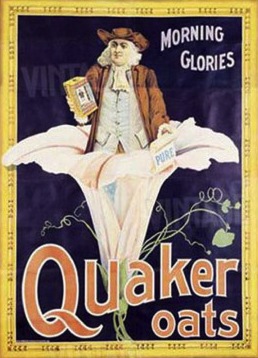
People who had never bought cornflakes were taught to need them; those once content with oats scooped from the grocer’s bin were told why they should prefer Quaker Oats in a box. Advertising, when it was successful, created demand…. Advertising celebrated the new, but many people were content with the old. The most effective marketing campaigns encouraged new needs and desires…by linking the rapid appearance of new products with the rapid changes that were occurring in all areas of social and cultural life.

We have always attached a variety of meanings to food, but within a consumer society, the decisions we make about what to buy and eat are shaped to a large extent by the desires and needs manufactured by a massive advertising industry.

The industrialisation of food production has, as I noted last week, allowed more people to eat better than ever before. But this has come at a cost: we know that many food companies engage in ecologically unsustainable practices, mistreat their employees, hurt animals, and occasionally produce actively harmful food. Moreover, it was part of a process which transformed people from customers into consumers – into individuals whose happiness is linked to what and how much they buy. This does not make us happy – nor is it environmentally or economically sound. Justin Lewis writes:

the promise of advertising is entirely empty. We now have a voluminous body of work showing that past a certain point, there is no connection between the volume of consumer goods a society accumulates and the well-being of its people.

The research shows that a walk in the park, social interaction or volunteering – which cost nothing – will do more for our well-being than any amount of ‘retail therapy’.  Advertising, in that sense, pushes us towards maximising our income rather than our free time.  It pushes us away from activities that give pleasure and meaning to our lives towards an arena that cannot – what Sut Jhally calls ‘the dead world of things’.

As customers were made consumers, so it is possible for us to change once again. How we are to achieve this, though, is difficult to imagine.

Further Reading

Texts quoted here:

Harvey A. Levenstein, Revolution at the Table: The Transformation of the American Diet (New York: Oxford University Press, 1988).

Susan Strasser, Customer to Consumer: The New Consumption in the Progressive Era,’ OAH Magazine of History, vol. 13, no. 3, The Progressive Era (Spring, 1999), pp. 10-14.

Other sources:

Warren Belasco and Philip Scranton (eds.), Food Nations: Selling Taste in Consumer Societies (New York: Routledge, 2002).

Jack Goody, ‘Industrial Food: Towards the Development of a World Cuisine,’ in Cooking, Cuisine, and Class: A Study in Comparative Sociology (Cambridge: Cambridge University Press, 1982), pp. 154-174.

Roger Horowitz, Meat in America: Technology, Taste, Transformation (Baltimore: Johns Hopkins University Press, 2005).

Tim Jackson, Prosperity without Growth: Economics for a Finite Planet (London: Earthscan, 2009).

Nancy F. Koehn, ‘Henry Heinz and Brand Creation in the Late Nineteenth Century: Making Markets for Processed Food,’ The Business History Review, vol. 73, no. 3 (Autumn, 1999), pp. 349-393.

Rebecca L. Spang, The Invention of the Restaurant: Paris and Modern Gastronomic Culture (Cambridge: Harvard University Press, 2000).

Peter N. Stearns, ‘Stages of Consumerism: Recent Work on the Issues of Periodisation,’ The Journal of Modern History, vol. 69, no. 1 (Mar., 1997), pp. 102-117.

Susan Strasser, ‘Making Consumption Conspicuous: Transgressive Topics Go Mainstream,’ Technology and Culture, vol. 43, no. 4, Kitchen Technologies (Oct., 2002), pp. 755-770.

Lorine Swainston Goodwin, The Pure Food, Drink, and Drug Crusadors, 1879-1914 (Jefferson: McFarland & Co., 1999).

Frank Trentmann, ‘Beyond Consumerism: New Historical Perspectives on Consumption,’ Journal of Contemporary History, vol. 39, no. 3 (Jul., 2004), pp. 373-401.

Creative Commons License Tangerine and Cinnamon by Sarah Duff is licensed under a Creative Commons Attribution-ShareAlike 3.0 Unported License.

Dangerous Bodies

On Saturday I was part of Cape Town’s SlutWalk. A local manifestation of a global movement which emerged in response to a Toronto policeman’s daft comments about rape and women’s ‘slutty’ choice of clothes in January this year, Cape Town’s SlutWalk was a resounding success. It was the most fun, friendly, and good natured march I’ve ever been on. According to the Mail & Guardian and – hurrah! – the Washington Post, about 2,000 people marched from Prestwich Memorial to Green Point stadium. I really was impressed by the numbers of men there, and by the range of ages represented by the marchers. (This is my report for FeministsSA.)

The posters were brilliant, and people came dressed in ball gowns, angel wings, bunny ears, leotards, jeans and t-shirts, fishnets and thigh-high boots, and (almost) nothing at all. In many ways, it was a typically Capetonian event: we gathered outside hip Truth Coffee beforehand, and the march began half an hour late. It was also overwhelmingly middle-class and, really, for an anti-rape protest to make any sense in Cape Town, it should have been in Khayelitsha or Manenberg.

But I don’t want to detract from the success of the event. In particular, I hope that it’ll prove to be the basis for a campaign against street harassment. SlutWalk is, inadvertently, a protest against the constant low-level harassment of women in public spaces. I was, though, deeply unsettled by the vitriol aimed at SlutWalk when it was announced that South African marches were in the offing. Commentators on SlutWalk Cape Town’s Facebook page accused the organisers of being irresponsible, stupid, and of contributing to – rather than solving – the problem of victim blaming.

If anything, those remarks demonstrated the extent to which women are still held responsible for rape. One particularly unpleasant contributor insisted that only one per cent of all reported rapes are ‘genuine’ – the rest, he alleged, are simply made up by women. What many of these angry men (and they were mainly men) had in common was a fear of a group of scantily-clad women marching together in public: a belief that the amount of naked flesh on display would have – alas undefined – catastrophic ramifications for the women on the march.

Another commentator explained that she opposed the event because she prefers women to ‘have a little mystery’ about them. Unfortunately, she didn’t specify if this was to be achieved by wearing false moustaches, speaking in strange foreign accents, or investing in trench coats.

Women’s bodies, argue the anti-Slutwalk brigade, need to be covered and contained. Because female nakedness is usually sexualised, it’s seen as excessive, dangerous, and disruptive. Clothing is, then, one way of controlling women in patriarchal societies. We are told to cover ourselves up for our own good – because our bodies exercise too powerful an influence over terminally suggestible, weak-willed men.

Food is another means of exercising control over women. As I’ve written in the past, the current vogue for cupcakes is partly the product of the fact that they are the acceptable face of feminine eating: they’re small, childlike (indeed, they’re children’s party food), and pretty – like the women who are supposed to eat them. (I should like to add, for the record, that after SlutWalk, my friends and I picnicked and feasted on cheesecake, samoosas, egg sandwiches, naartjies, as well as breast-shaped cupcakes.)

This link between women’s diet and the control of their bodies can be traced to the eighteenth century. A few weeks ago, I mentioned the influential Enlightenment physician George Cheyne (1671-1743), whose writing on health and eating was not only extraordinarily popular among the English upper classes, but was also partly responsible for a shift in the understanding of the ideal physical form during the 1750s. Partly as a result of Cheyne’s own obesity, he associated excess flesh with excessive behaviour and a kind of moral laxity. Whereas before, fleshiness had been a sign of good health, increasingly slimness was associated with physical and moral health, strength, and beauty.

Cheyne’s audience and the patients whom he treated at his fashionable practice in even more fashionable Bath, were primarily female. In a society where eating meat had long been associated with masculinity – and this had even deeper roots in the ancient humoral system which associated meat and spicy food with the blood, the most ‘manly’ of the four humors – Cheyne advocated the renunciation of all meat, and the adoption of a dairy-rich, vegetarian diet. Men, in other words, needed to eat like women.

During this period, the female body was slowly being reconceptualised as being more delicate – more easily upset – than the male body, and also ruled by the unpredictable emotions, rather than the rational, sober intellect. Although gendered, this emotions-intellect binary did not necessarily privilege the one over the other: the Romantic cult of sensibility celebrated the emotional and irrational, for example. But male and female bodies – or, more accurately, middle-class male and female bodies – needed to be fed differently.

Cheyne was unusual in his implacable opposition to meat-eating, but he and other physicians were united in the belief that a moderate diet was essential for good health – and this was particularly important for women. Cheyne became interested in the ‘nervous’ complaints which seemed to plague his female patients, and connected their diet to their psychological well-being. Essentially, the less women ate, the better. Anita Guerrini explains:

Cheyne’s audience, the aristocracy and new merchant class that frequented Bath, was also the audience for William Law’s exhortations in his popular devotional work A Serious Call (1728). He provided contrasting models of female character in the ‘maiden sisters’ Flavia and Miranda, who ‘have each of them two hundred pounds a year,’ a comfortable middle-class income. While Flavia spent her income on clothes, luxurious foods, sweetmeats, and entertainment, the ascetic Miranda ate only enough to keep herself alive and spent her income on charity. Miranda, said Law, ‘will never have her eyes swell with fatness, or pant under a heavy load of flesh;’ such excess flesh was not only morally depraved, it was physically disgusting. Cheyne’s patients, like the doctor himself, grew in spirit as they wasted in flesh.

During the 1720s, Catherine, the adolescent daughter of British Prime Minister Robert Walpole, was referred to Cheyne because of his specialisation in nutrition and nervous diseases. She suffered from loss of appetite, fainting, and chronic pain, and died in 1722 aged eighteen. Cheyne tried his best to treat her, but could not find a way of making her eat more.

This association of femininity – of physical and moral beauty – and not eating persisted into the nineteenth century and, I would suggest, into the present. Even though we have records which indicate that people, and particularly young women, have purposefully starved themselves to death since the Middle Ages and usually for religious reasons, anorexia nervosa was isolated as a specific ailment by William Withey Gull (1816-1890) in a paper he presented to the Clinical Society of London on 24 October 1873. He argued that this ‘peculiar form of disease occurring mostly in young women, and characterised by extreme emaciation’ was not a symptom of the catch-all feminine disorder ‘hysteria’, but a separate condition with its own symptoms and treatment.

As Joan Jacobs Brumberg notes, this identification of anorexia nervosa occurred within a wider cultural concern about the phenomenon of ‘fasting girls’: young, adolescent women who denied themselves food on religious grounds. Sarah Jacob from Wales claimed that her piety was such that she was able to live without eating.

Some British doctors regarded Sarah Jacob’s claim to total abstinence as a simple fraud and, therefore, an affront to science… Consequently, they called for a watch, with empirical standards, which deprived the girl of all food and, not surprisingly, killed her within 10 days because she was already severely undernourished. Some British doctors attributed Sarah Jacob’s condition to girlhood hysteria, provoked by religious enthusiasm and her celebrity status.

In other words, girls’ decision to starve themselves moved from the realm of religion or mysticism, to science and medicine. It was a disorder which could be described and treated. For example, the French psychiatrist Charles Lasegue (1816-1883) suggested that anorexia should be treated by examining the dynamics of middle-class family class. He

noted the difficult relation between anorectics and their parents but went on to elaborate how the girl obsessively pursued a peculiar and inadequate diet-such as pickled cucumbers in cafe au lait – despite the threats and entreaties of her anxious parents. ‘The family has but two methods at its service which it always exhausts,’ he wrote, ‘entreaties and menaces …. The delicacies of the table are multiplied in the hope of stimulating the appetite, but the more solicitude increases the more the appetite diminishes’.

This shift was due to the increasing medicalisation of the body, and also the secularisation of public life. By the 1870s, doctors exercised the same – or even more – authority as ministers. But what had not changed over the course of eighteenth and nineteenth centuries was the association of femininity with eating very little.

Anorexia is caused by a range of factors, but the connection of ideal femininities with eating a restricted diet only exacerbates the condition. As rape isn’t really about sex, so anorexia isn’t entirely about food: it’s a manifestation of (mainly, but not exclusively) women’s attempts to exercise control over their circumstances through their bodies. Because of the wider, cultural approval of feminine thinness and not eating, these starving young women receive a kind of affirmation for their self-denial.

It’s easy to talk glibly about encouraging a ‘positive attitude’ towards food and eating. We can only achieve this when we acknowledge that women’s bodies are still perceived as dangerous – as needing to be contained by their clothes, kept pure by a range of hygiene products, and made small through dieting and exercise. This is why we still need feminism. In South Africa – where the ANC Women’s League and Lulu Xingwana‘s Department of Women, Children, and Disabled Persons have shown a singular lack of enthusiasm for leading a feminist movement – I hope that SlutWalk represents the beginnings of a new, stronger feminism.

Further Reading

Texts cited here:

Joan Jacobs Brumberg, ‘“Fasting Girls”: Reflections on Writing the History of Anorexia Nervosa,’ Monographs of the Society for Research in Child Development, vol. 50, no. 4/5, History and Research in Child Development (1985), pp. 93-104.

Anne Charlton, ‘Catherine Walpole (1703-22), an Eighteenth-Century Teenaged Patient: A Case Study from the Letters of the Physician George Cheyne (1671 or 73-1743),’ Journal of Medical Biography, vol. 18, no. 2 (May 2010), pp. 108-114.

Anita Guerrini, ‘The Hungry Soul: George Cheyne and the Construction of Femininity,’ Eighteenth-Century Studies, vol. 32, no. 3, Constructions of Femininity (Spring, 1999), pp. 279-291.

Erin O’Connor, ‘Pictures of Health: Medical Photography and the Emergence of Anorexia Nervosa,’ Journal of the History of Sexuality, vol. 5, no. 4 (Apr., 1995), pp. 535-572.

Roy Porter, Flesh in the Age of Reason: How the Enlightenment Transformed the Way We See Our Bodies and Souls (London: Penguin, [2003] 2004).

Martha J. Reineke, ‘“This Is My Body”: Reflections on Abjection, Anorexia, and Medieval Women Mystics,’ Journal of the American Academy of Religion, vol. 58, no. 2 (Summer, 1990), pp.245-265.

Edward Shorter, ‘The First Great Increase in Anorexia Nervosa,’ Journal of Social History, vol. 21, no. 1 (Autumn, 1987), pp. 69-96.

Other sources:

I. de Garine, Food, Diet, and Economic Change Past and Present (Leicester: Leicester University Press, 1993).

Sander L. Gilman, Fat: A Cultural History of Obesity (Cambridge: Polity, 2008).

Harvey A. Levenstein, ‘The Perils of Abundance: Food, Health, and Morality in American History,’ in Food: A Culinary History from Antiquity to the Present, eds. Jean-Louis Flandrin and Massimo Montanari, English ed. by Albert Sonnenfeld (New York: Columbia University Press, 1999), pp. 516-529.

Harvey A. Levenstein, Revolution at the Table: The Transformation of the American Diet (New York: Oxford University Press, 1988).

Susie Orbach, ‘Interpreting Starvation,’ in Consuming Passions: Food in the Age of Anxiety, eds. Sian Griffiths and Jennifer Wallace (Manchester: Mandolin, 1998), pp. 133-139.

Kerry Segrave, Obesity in America, 1850-1939: A History of Social Attitudes and Treatment (Jefferson, NC,: McFarlane, 2008).

Peter N. Stearns, Fat History: Bodies and Beauty in the Modern West (New York: New York University Press, 1997).

Doris Wit, Black Hunger: Food and the Politics of US Identity (New York and Oxford: Oxford University Press, 1999).

Creative Commons License Tangerine and Cinnamon by Sarah Duff is licensed under a Creative Commons Attribution-ShareAlike 3.0 Unported License.

London Meals

Like many people, I spent this week glued to the news, following the riots in Britain. I have friends who live in the parts of London which witnessed some of the worst violence, and I was stunned how areas of London I know and love – areas which I think of as home – were transformed by the rioting and looting. Even Bloomsbury was not left unscathed: Gay’s the Word in Marchmont Street, one of the most beloved bookstores in London, had its windows smashed, rather undermining claims that the looters tended to leave book shops alone. (And such a pity they missed Alain de Botton’s daft School of Life next door.)

So when I read on Twitter that Broadway Market was a potential target for the rioters, my heart sank. When I moved to London to begin my PhD, I remapped the city according to the destinations I most loved: book shops, art galleries (so that was central London, South Kensington, Pimlico, the south bank, Whitechapel, and Dulwich sorted), and places to eat. I did this because I have a comically bad sense of direction. During a holiday in Ireland a few years ago, my friend Carina realised quickly that the best way of discovering the correct direction to walk in, was to go in the opposite way I suggested. If I turned left, it was almost certainly the case that we should have gone right.

Guided partly by the London Farmers’ Markets website, I came to know London through its markets, delis, and kitchen and food shops. I walked all the way to Notting Hill from Bloomsbury once (map-reading has never been a strength) and, disappointed by that farmers’ market, spent the morning at Books for Cooks and discovered possibly the best culinary invention in the history of humanity at a local deli: glass jars containing crème de marrons and vanilla-flavoured yogurt. When Charles Saatchi (re-)opened his gallery in the Duke of York’s Building, it gave me another reason to visit that part of Sloaney London: Partridges also sells those crème de marrons-and-yogurt concoctions (admittedly for £1.50 each, but with all that yogurt they’re practically health food).

At Broadway Market

If I was feeling uninspired on Saturday mornings, I would walk to the inevitable Borough Market through the eerily silent City, and buy coffee from Monmouth and a bacon roll – easy on the mustard, heavy on the brown sauce – and watch the stall holders set up before the tourist hordes arrived.

But my favourite parts of the city were further east. Broadway Market, near London Fields, trades on a stretch of road which has been used by merchants and travellers for around a thousand years. It’s ancient and at the same time, emblematic of the regeneration of Hackney, London’s poorest borough, but also, arguably, its most socially diverse. On Sundays it was a long walk through Clerkenwell, Old Street, Shoreditch, and Bethnal Green for breakfast at Columbia Road Flower Market – with coffee bought from what must be the city’s smallest coffee shop – a splurge at the second hand bookshop, and an attempt not to knock over any plants (I once caused, accidentally, an avalanche of Christmas trees).

My other guide was sent to me by my mother: the fantastic London Review of Breakfasts. It’s a website which takes breakfast Very Seriously Indeed. Listing cafes, greasy spoons, and restaurants from all over London, it considers not only what these establishments serve and how they go about doing this, but why. What I like about it most – other than its understanding of the psychologically restorative nature of breakfast – is its anti-snobbery.  Bermondsey’s Cat and Cucumber is given higher – and deserving – praise for its breakfast, than the branch of Whole Foods in Kensington:

It just doesn’t feel organic in the way I understand it. And frankly neither do any of the 26 varieties of killer tomatoes on sale, particularly the insipid orb that is part of my tepid, refectory-style ‘English Breakfast; on the first floor. The rest of this dry, fatty, Americanised assembly – grey-green scrambled eggs, semi-raw sausage, bacon jerky, white toast (‘no brown available’! In the temple of choice!) – requires five separate squirts of ketchup to render it edible. It is pathetic.

More of Broadway Market

No other collection of reviews is this relentlessly entertaining. My favourite remains of the Euphorium Bakery in Islington:

you started to tremble and had to content yourself with an egg mayonnaise sandwich on thick brown bread. It would have been an eggy, creamy delight, I think, if there had been any filling to delight in. But alas, a mere smear across the bread, a hint of a yolk and a whiff of white was all that was present. We wept. I craved a sympathetic glance from the staff. They were oblivious to our pain and announced that “that was how they made their sandwiches”. How they let themselves down. How they let us down. The pastries so perfect. The sandwiches so disappointing. My fan dropped to the floor, you rose from your chair, nearly careering into one of the many mothers with babies as you hastened to exit.

‘Pierre!’ I shouted, ‘Don’t leave me! I will make you an egg sandwich wearing nothing but a silk negligee whilst I recite passages from Voltaire!’

In short, the London Review of Breakfasts sets a standard not only for eating breakfast, but for living.

It’s particularly fitting that this website devoted to breakfast should be based in London. We know that mass urbanisation at the beginning of the nineteenth century caused changes in people’s behaviour. Quite simply, people lived and behaved differently in cities – where most of them were crammed into tenements and slums – than they did in the countryside. This change was caused overwhelmingly by the fact that the nature of work altered during the 1800s. Cities grew as a result of industrialisation. Factory employees, as well as the office workers who staffed the businesses that serviced these new industrial economies, worked longer and more regular hours than ever before.

In a predominantly agrarian society, work is determined by the weather and is seasonal – hours tend to be longer in summer than in winter, for example. In the factories and offices of Victorian Britain, the clock – and then laws governing how long people were allowed to work – ruled the working day, something Dickens satirised in Hard Times. Work began promptly at around seven or eight o’clock, and continued without stopping until the evening. Gas lamps and, later, electricity, meant that work could go on regardless of when the sun rose or set. Work was decoupled from nature.

The tiny coffee shop at the Columbia Road Flower Market

One of the first aspects of people’s lives to change as a result of these new working patterns was how they ate. In Britain, up until the early nineteenth century, most people ate a substantial breakfast at around ten or eleven o’clock (what we’d now refer to as brunch), and then dinner, the main meal of the day, in the mid-afternoon. In the evening, before they went to bed, they’d have tea with biscuits or a light snack. Supper was a late, savoury meal eaten by the wealthy, and usually after an evening’s entertainment.

With the coming of industrialisation, mealtimes changed and particularly according to the kind of work people performed. For the urban middle classes, dinner moved later into the day, partly as an indicator of the fact that they were wealthy enough to afford candles, gas, or electricity to light the meal. Luncheon and afternoon tea, served with cake and sandwiches, emerged to fill the long gap between breakfast and dinner. Further down the social scale, tea, served at the end of the working day, frequently replaced dinner. This tea – referred to as ‘high tea’ or ‘meat tea’ – included protein, usually potted meat or smoked fish, to assuage the hunger pangs of tired labourers.

The strange British snobbery around the names of mealtimes emerges from this period: it’s upper- and middle-class to refer to breakfast, lunch, and dinner (or supper), and lower-middle- and working-class to say breakfast, dinner, and tea. Breakfast, though, changed in the same way for workers of all kinds: it was eaten earlier in the

day, but remained fairly substantial.

Flowers at the Columbia Road Flower Market

Our eating habits are still evolving – and they’ll continue doing so, particularly as urbanisation continues. It’s estimated that seventy per cent of the world’s population will live in cities by 2050, and we know that this will have massive implications for how we live: from the way in which we plan our cities, to how we eat. It’s not simply a case that our food systems will have to accommodate the fact that food will have to travel further – or will need to be grown in cities – to feed us all, but our working patterns will change too. What and how we eat cannot be disentangled from where we live.

Creative Commons License Tangerine and Cinnamon by Sarah Duff is licensed under a Creative Commons Attribution-ShareAlike 3.0 Unported License.

Affordable Luxury

I had a powerful sense of déjà vu yesterday as I read this weekend’s Financial Times. As the news section described the world economy’s recent nose-dive and entry into Phase Five of the early twenty-first century’s Great Depression, the FT’s monthly magazine How to spend it blithely informed its readers that ‘Homes are constantly borrowing bright ideas from luxury hotels.’ And went on to recommend the installation of architect-designed pool houses – which tend to go for around £3,000 per square metre.

Have you read How to spend it? If ever there was a cultural artefact which encapsulated the excess and arrogance of the boom time before the near-collapse of the British and American financial systems in 2008, then this is it. It’s a magazine aimed at the super-rich – at the sort of people who have so much money that they need advice on how they should spend it. I read it – or, at least, I read as much of it as I can before I’m engulfed with rage – because it offers an insight into a bizarre, yet incredibly powerful, world to which I will never have access. (And, frankly, life’s far too short to spend months in search of the perfect example of summer cashmere.)

Printed on glossy, A3-sized sheets of paper, it describes trends in the art market and fashion world; which yacht is de rigeur this season; where best to order bespoke jewellery; and whether or not it’s worth hiring a private chef. How to spend it is a celebration not of money – that would be vulgar – but, rather, of luxury.

In this week’s edition, Terence Conran comments in an article about his perfect weekend (which features his routine in his Georgian manor, designing furniture, and resting by his specially-altered river), that ‘luxury usually means simplicity, or easy living, rather than things that cost a lot of money.’ That Conran’s description of luxury as costing nothing is in a magazine which devotes itself to the top-end, exclusive, and incredibly expensive, is a pleasing irony. But it did make me think about how we define luxury, and particularly as regards food.

In his landmark study Sweetness and Power: The Place of Sugar in Modern History (1985), the anthropologist Sidney Mintz traces how in Britain, sugar shifted from being a luxury available only to the very wealthy, to being an affordable commodity for most people by the early nineteenth century. Yet despite this –  despite the fact that sugar was cheap and consumed in large quantities by the British population, and particularly by the poor – it was still seen as a treat. It became an affordable or everyday luxury.

It was the increasing popularity and cheapness of sugar – and it gradually replaced honey as the world’s sweetener of choice – which caused the democratisation of a range of other products, and chiefly chocolate, tea, and coffee. Chocolate, once associated with ritual and celebration in pre-Columbian Mexico, was introduced as a beverage to Spain in 1527, but only took off In Europe once sugar was added to it. It became popular among the aristocracy, partly because it tasted delicious but also as a result of its supposed medicinal qualities. It became widely available at the end of the eighteenth century when imports increased and the production of solid chocolate was industrialised.

Similarly, coffee arrived in Europe via Turkey – cafes were opened in Constantinople from 1554, and the first coffee house in Paris was established in 1672 – and more efficient production, bigger imports, and the relatively new idea of sweetening coffee with sugar meant that it was popular throughout the continent by the 1700s. Tea was introduced to Britain by Catherine of Braganza, Charles II’s Portuguese wife, but it was only when someone discovered that stirring sugar into it made it less bitter, that it gained a bigger audience among the middle and upper classes. It was heavily promoted by the financially shaky East India Company, and also by the British government in the mid-eighteenth century as an alternative to alcohol. A drop in the tea price in 1784 caused the spike in British tea drinking: between 1801 and 1810, 12,000 tons of tea was drunk annually in Britain. By 1890, that soared to almost 90,000 tons.

All of these affordable luxuries – tea, sugar, coffee, and chocolate – were popularised because innovations in technology and higher yields abroad made it possible for prices to fall at home. What revolutionised the cultivation the crops was the fact that they could be grown successfully all over the world – tea was taken from south-east Asia to east Africa, coffee from Ethiopia to south-east Asia and Brazil, and chocolate from central America to west Africa and south-east Asia – and in vast plantations.

It’s little wonder that colonialism is so closely associated with the production of all of these commodities, and particularly with sugar. Not only were imperial powers, most notably the Dutch, Portuguese, and British, responsible for globalising the cultivation of these crops, but they put slaves to work on tea, coffee, and sugar plantations. The plantation system of farming – in which a single crop is farmed over a vast area – is labour intensive, and European colonisers worked their slaves, literally, to death.

In this way, slave labour allowed for the democratisation of chocolate, sugar, tea, and coffee. This is particularly ironic in the case of coffee. Coffee houses were connected to the rise of modernity in Europe. Anne E.C. McCants explains:

The expression ‘to break bread together’ now has an archaic feel to it. A proximate contemporary substitute, albeit devoid of the powerful religious significance of bread, is to ‘go out for a cup of coffee’, which is at least as much about conversation as it is about nourishment per se. Historians associate this total reorientation of the culture of food and drink with the substitution of coffeehouses for taverns; the wider dissemination of public news; trading on the stock exchange; … new arrangements of domestic and public space; [and] the ability to sustain new industrial work schedules despite their tedium….

Not only is there a connection between coffee drinking and the Enlightenment and democracy in Europe, but also between coffee, sugar, tea, and chocolate – and capitalism and consumerism. Joyce Appleby writes:

American slave-worked plantations and mechanical wizardry for pumping water, smelting metals, and powering textile factories…may seem unconnected. Certainly we have been loath to link slavery to the contributions of a free enterprise system, but they must be recognised as twin responses to the capitalist genie that had escaped the lamp of tradition during the seventeenth century. Both represented radical departures from previous practices.

Both factories and plantations took a significant capital investment to set up; both produced healthy profits which were reinvested; both relied on plentiful, cheap labour; and both introduced new work routines. Appleby describes sugar as ‘one of capitalism’s first great bonanzas’, arguing that ‘its successes also revealed the power of the profit motive to override any cultural inhibitions to gross exploitation.’

As sugar shaped the capitalist system of the eighteenth century, so it did consumerism. Demand for particular items had driven trade for hundreds of years, but it was only during the eighteenth century that widespread demand from all classes of people, and particularly in Britain where wages tended to be higher, began to fuel capitalist economies:

[A] large body of domestic consumers fuelled England’s commercial expansion and a richly elaborated material culture dependent upon the market. … New attachments to objects, a raging delight in novelties, and the pleasures of urban sociability bespoke a deep engagement with the material world that made spending seem more beneficial to the economy than did parsimony.

As Appleby implies, consumerism links a desire for things with the construction of identities. Sugar, coffee, chocolate, and tea were the first foodstuffs to be transformed into consumer goods. By no means essential to our diets, demand for them was driven by factors other than hunger: people bought them in the eighteenth and nineteenth centuries because, even though they were cheap, they represented luxury and comfort.

Food has always signified more than simply nutrition, but it’s been implicated in the rise of a consumerist society since the eighteenth century. This means that not only do consumers attach a range of new meanings to the food that we buy – we purchase food not only because we need to eat, but because of how we construct our identities as consumers of goods – but consumer demand drives the production of food. It’s for this reason that efforts to reform eating habits – either to combat lifestyle-related diseases or, indeed, to produce a more sustainable food system – have to deal with the fact that we approach food as consumers operating within a global food system.

Further Reading

Sources cited here:

Joyce Appleby, The Relentless Revolution: A History of Capitalism (New York: WW Norton, [2010] 2011).

Anne EC McCants, ‘Poor consumers as global consumers: The Diffusion of Tea and Coffee Drinking in the Eighteenth Century,’ Economic History Review, vol. 61 (2008), pp. 172-200.

Sidney W. Mintz, Tasting Food, Tasting Freedom (Boston: Beacon Press, 1996).

Sidney W. Mintz, Sweetness and Power: The Place of Sugar in Modern History (New York: Penguin, 1985).

James Walvin, Fruits of Empire: Exotic Produce and British Taste, 1660-1800 (Basingstoke and London: Macmillan, 1997).

Other sources:

K.T. Achaya, The Food Industries of British India (Delhi: Oxford University Press, 1994).

Judith A. Carney, Black Rice: The African Origins of Rice Cultivation in the Americas (Cambridge: Harvard University Press, 2001).

E.M. Collingham, Imperial Bodies: The Physical Experience of the Raj, c.1800-1947 (Cambridge: Polity Press, 2001).

Alain Huertz de Lemps, ‘Colonial Beverages and the Consumption of Sugar,’ in Food: A Culinary History from Antiquity to the Present, eds. Jean-Louis Flandrin and Massimo Montanari, English ed. by Albert Sonnenfeld (New York: Columbia University Press, 1999), pp. 383-393.

Kenneth K. Kiple and Virginia Himmelsteib King, Another Dimension to the Black Diaspora: Diet, Disease, and Racism (Cambridge: Cambridge University Press, 1981).

James E. McWilliams, A Revolution in Eating: How the Quest for Food Shaped America (New York: Columbia University Press, 2005).

Sidney W. Mintz, ‘Sweet, Salt, and the Language of Love,’ MLN, vol. 106, no. 4, French Issue: Cultural Representations of Food (Sep., 1991), pp. 852-860.

Wolfgang Schivelbusch, Tastes of Paradise: A Social History of Spices, Stimulants, and Intoxicants, trans. David Jacobson (New York: Random House, 1992).

Frank Trentmann, ‘Beyond Consumerism: New Historical Perspectives on Consumption,’ Journal of Contemporary History, vol. 39, no. 3 (Jul., 2004), pp. 373-401.

Frank Trentmann, ‘Materiality in the Future of History: Things, Practices, and Politics,’ Journal of British Studies, vol. 48, no. 2 (April 2009), pp. 283-307.

Marijke van der Veen, ‘When Is Food a Luxury?’ World Archaeology, vol. 34, no. 3, Luxury Foods (Feb., 2003), pp. 405-427.

Creative Commons License Tangerine and Cinnamon by Sarah Duff is licensed under a Creative Commons Attribution-ShareAlike 3.0 Unported License.

No Famine is Inevitable

Last week there was a flurry of excitement as commentators compared the R1 million pledged by the South African government to aid the victims of the famine in the Horn of Africa, and the potential billion rand loan which it is currently considering for Swaziland. Not only could Africa’s economic powerhouse donate considerably more than a million rand (about £90,000 or US$150,000) to Somalia, but granting a conditions-free loan to King Mswati III’s dysfunctional kingdom would serve only to prop up the continent’s last absolute monarch.

Although I was as outraged by my government’s apparent indifference to the plight of Somalis, I did begin to wonder if that money could be used more wisely. Of course, South Africa must – and can – contribute to the international effort to distribute food in Somalia. Given the scrutiny of aid agencies working in the region, as well as the awareness of how aid money has been channelled to elites over the past few decades, it’s likely that South Africa’s donation will go to those who need it. But giving money to alleviate the famine is a short-term fix.

Possibly because of the way it echoes Africa’s other best-known famine, the Live Aid-engendering Ethiopian famine of 1984-1985, the famine in the Horn of Africa has generated an enormous amount of coverage in the international press. More information and analysis can only ever be a good thing, but much of the discussion around the famine suggests that it’s a crisis which emerged suddenly and without any warning. As the Guardian’s John Vidal put it, ‘A massive drought, as if out of nowhere, has settled over the Horn of Africa’. Moreover, some commentators, like Vidal, have blamed the famine on only one or two factors, usually climate change or Western indifference to African suffering.

The causes of famines are complex, but they are never entirely unpredictable. Counterintuitively, they are not necessarily caused by a lack of food, but are, rather, the result of long-term systemic failure: in agriculture, trade, and, most importantly, in government. By suggesting that South Africa’s paltry million rand donation would be better spent, my point is that South Africa’s involvement in the Somali crisis should go beyond giving money for food. It needs to stop famines from happening in the first place, and that is not impossible.

We have managed largely to eradicate famine in the twentieth century. Before then, food shortages and famines were part of the rhythms of everyday life. In societies where food production was inefficient both in terms of labour and technology – and until the eighteenth century, eighty per cent of the population of Europe was engaged in agriculture – frequent crop failures meant that famine occurred often. But during the 1700s, an agricultural revolution allowed greater, more regular, and, crucially, more reliable yields to be produced by smaller numbers of people. International trade also meant that countries could buy food to supplement local shortfalls. For example, during the 1870s, the failure of the European grain crop boosted Canadian and American wheat exports, as these two countries fed Europe for almost a decade.

Although initially developed in the Netherlands and Britain (and there is a strong link between the development of capitalist economies and efficient food systems), the methods pioneered during this green revolution of the eighteenth and nineteenth centuries spread around the globe. By the early 1900s, famine was caused increasingly by people, rather than only by nature. That said, the Great Famine in Ireland (1845-1852) was certainly the product of the potato blight, but it also occurred at a time when Ireland was an exporter of wheat: there was enough food to go around, it was just that those who were starving couldn’t afford to buy bread. The Cattle Killing Movement in South Africa (1856-1857) caused widespread famine among the Xhosa. Around 40,000 people died of starvation, 33,000 moved away from the eastern Cape to seek work, and the authority of the Xhosa polity was fatally undermined. But this was caused by a decision to slaughter cattle and destroy crops on a mass scale.

Equally, some twentieth-century famines were caused partly by crop failure, but were also the product of bad governance and ineffective systems of food distribution. As Cormac Ó Gráda explains:

Wars, blockades, poor governance, and civil unrest can also lead to famines; panics about the food supply and poorly performing markets can exacerbate them. In such cases…factors other than crop shortfalls reduce the purchasing power or ‘entitlements’ of vulnerable sections of the population: the size of the loaf matters less than its distribution.

The Nobel Prize-winning economist Amartya Sen argued in Poverty and Famines (1981) that – contra Thomas Malthus who suggested that exponential population growth would result inevitably in famine – famines can occur in times of peak food production. Why? I think it’s worth quoting Sen in full:

In every society that exists, the amount of food that a person or a family can command is governed by one set of rules or another, combined with the contingent circumstances in which that person or that family happens to be placed vis-à-vis those rules. For example, in a private ownership market economy, how much food a person can command will depend on (1) what he owns, and (2) what he can get in exchange for what he owns either through trade, or through production, or some combination of the two. Obviously, in such an economy a person may suddenly face starvation either because his ownership bundle collapses (e.g., through alienation of land to the money lenders), or because the ‘exchange entitlement’ of his ownership (i.e., the command of what he owns) collapses (e.g., through his becoming unemployed and not being able to sell his labour power, or through a decline in his terms of trade vis-à-vis food).

In other words, people starve when they can’t buy food – either because they no longer have the money to exchange for food (as a result of unemployment, for example) or because food prices become prohibitively high. Peaks in food prices could be due to droughts and other ecological factors, conflict, and speculation.

The crisis in Somalia demonstrates particularly well how state intervention can prevent or cause famine. In 1960, British Somaliland and Italian Somalia became the independent Republic of Somalia. Nine years later, Major-General Mohamed Siad Barre seized power in a bloodless coup and ruled Somalia through a military dictatorship until the collapse of his government in 1991. Somalia’s experience of food shortages and famine must be understood in this context of Barre’s government (or lack thereof) and economic policies. In 1970, he announced the implementation of ‘scientific socialism’, introduced strict central planning, and viciously stamped out all forms of opposition. Peter T. Leeson writes:

The government slaughtered civilians who posed threats to the government’s plans or political power, used coercive intimidation to create artificial support for its activities, and forcibly relocated others to further the political or economic ends of Barre and his cronies. ‘Both the urban population and nomads living in the countryside [were] subjected to summary killings, arbitrary arrest, detention in squalid conditions, torture, rape, crippling constraints on freedom of movement and expression and a pattern of psychological intimidation’. The state ruthlessly suppressed free speech and controlled all forms of information reaching Somalis. Newspapers (only one was officially permitted by the government), radio, and television were fully censored and dissent in any form squelched with force. Under Somalia’s National Security Law No. 54, ‘gossip’ became a capital offense. Twenty other basic civil freedoms involving speech, association and organisation also carried the death penalty.

Funds were diverted from public works, education, healthcare, and infrastructure to the military, on whose support and ability to terrify and brutalise the Somali population Barre depended. The nationalisation of land and industry in 1975 was, predictably, a disaster. The abandonment of socialism at the end of the 1970s in order to attract assistance from the International Monetary Fund made very little difference either. Somalia was heavily dependent on international food aid during the 1970s and 1980s. The Horn of Africa is prone to drought, but it’s worth noting that despite catastrophic droughts in the mid-1970s and mid-1980s, Somalia managed to avoid famine – unlike its war-torn neighbour, Ethiopia, whose government ignored the plight of its population.

As Abdi Ismail Samatar notes,

Somalia’s last major famine was in 1992 and was not caused by drought. Nearly 300,000 innocent people starved to death because of sectarian politics. The epicentre of that famine was in Bay, one of the country’s most productive agricultural regions, and starvation was induced by warlords who used food as a weapon against farmers and pastoralists.

Barre’s government collapsed in 1991, plunging Somalia into civil war and a chaos from which it has yet to emerge. It’s telling that a country which had managed to avoid famine for over half a century, despite drought, food shortages, and incredible food insecurity, saw widespread famine only after food supplies were disrupted by war.

So why famine now? Over the course of sixteen years, Somalia has been the subject of fourteen reconciliation conferences, none of which managed to produce a stable government. In 2004, the Transitional Federal Government (TFG), an anti-Islamist, pro-Ethiopian political grouping, was put into power in Somalia under the leadership of Abdullahi Yusuf and with the support of the United Nations. However, the TGF was neither popular nor effective as a government. In the absence of effective leadership, a number of attempts were made by Islamic groups, war lords, civil society organisations, and others to create some sort of order in Somalia, and particularly in Mogadishu. One of these, the Alliance for the Restoration of Peace and Counter-Terrorism, was formed by a group of war lords in February 2006. They were backed by the United States who saw them as allies against Islamic groups in the region.

Armed clashes between the Alliance and Islamist groups soon broke out and developed into a war which the Islamists won decisively. By the middle of 2006, they had taken control of Mogadishu as well as central and southern Somalia. Not only was this an embarrassment to the United States and its ally Ethiopia, but for the first time it seemed that Somalia was offered the possibility of a relatively popular and effective government in the hands of the Islamists, who quickly organised themselves into the Council of Islamic Courts (CIC). However, an invasion by Ethiopia at the end of 2006 caused the collapse of the CIC, the reinstallment of the almost entirely ineffective TFG, and the beginning of a new civil war between the Government and opposition groups. The most successful of these was Al-Shabab. Originally the CIC’s youth wing and affiliated with al-Qaeda, Al-Shabab is an Islamist group which now controls most of southern Somalia.

Years of political uncertainty, conflict, and chaos (best exemplified by the way piracy has flourished along the Somali coast) have left Somalis particularly vulnerable to drought and the less predictable effects of climate change. A combination of a US- and UN-backed blockade of the parts of Somalia controlled by Al-Shabab, as well as this organisation’s unwillingness to allow the World Food Programme to deliver food to southern Somalis has caused the famine. Samatar explains:

Normally, societies have three lines of defence against mass starvation: local capacity, national government and the international community. When a disaster hits a region, the first help comes from local administrations and the communities themselves. If events overwhelm the first responders, then the national government takes charge of operations; and when the crisis exceeds the wherewithal of the nation, international actors come to the rescue.

It is clear that all three levels of livelihood protections have failed in Somalia. Al-Shabab has prohibited the local population from organising their municipal governments and charities to fend off the disaster. Similarly, Somalia’s national government, which is beholden to sectarian leadership and international patrons, has been oblivious to the emerging calamity, and has thwarted the international community from coming to its aid

This was a famine which could have been avoided had order been established in Somalia. Here, Somali politicians and war lords are as much to blame as the international community, East Africa’s Intergovernmental Authority on Development, the UN, and, crucially in my view, the African Union. This famine is not the result solely of dastardly foreign countries plundering Africa, nor can blame be laid entirely on Somalis themselves. But after the effort to feed Somalis has ended, reconstruction needs to begin. And it’s here where South Africa must – and I think is obliged to – take a leading role.

Somalia also demonstrates the extent to which food security is linked to strong, functioning governments. Countries which are badly run, have weak economies, and, most importantly, are authoritarian, are the most strongly disposed towards famine. Last year’s narrowly-avoided famine in West Africa was due largely to the incompetence of Niger and Chad’s malfunctioning, undemocratic political dispensations. Only the spread of democratic and open government, with, crucially, a free flow of information, will prevent famines from happening in Africa. As Sen remarked, ‘There is, indeed, no such thing as an apolitical food problem.’

Note: I try to use sources which are easily available, but for this post I’ve relied on articles from academic journals. Unfortunately, these are securely behind paywalls. If you’d like copies of them, let me know.

Further Reading

Texts cited here:

Joyce Appleby, The Relentless Revolution: A History of Capitalism (New York and London: W.W. Norton, [2010] 2011).

Cormac Ó Gráda, ‘Making Famine History,’ Journal of Economic Literature, vol. 45, no. 1 (Mar., 2007), pp. 5-38.

Peter T. Leeson, ‘Better off stateless: Somalia before and after government collapse,’ Journal of Comparative Economics, vol. 35 (2007), pp. 689-710.

Ken Menkhaus, ‘The Crisis in Somalia: Tragedy in Five Acts,’ African Affairs, vol. 106/204 (2007), pp. 357-390.

Amartya Sen, ‘The Food Problem: Theory and Policy,’ Third World Quarterly, vol. 4, no. 3 (Jul., 1982), pp. 447-459.

Other sources:

L.A. Clarkson and E. Margaret Crawford, Feast and Famine: Food and Nutrition in Ireland 1500-1920 (Oxford: Oxford University Press, 2001).

Jean Drèze and Amartya Sen (eds.), The Political Economy of Hunger, 3 vols. (Oxford: Clarendon Press, 1990).

Cormac Ó Gráda, Black ’47 and Beyond: the Great Irish Famine in History, Economy and Memory (Princeton: Princeton University Press, 1999).

Cormac Ó Gráda, Famine: A Short History (Princeton: Princeton University Press, 2009).

Cormac Ó Gráda, ‘Revisiting the Bengal Famine of 1943-4,’ History Ireland, vol. 18, no. 4, The Elephant and Partition: Ireland and India (July/August 2010), pp. 36-39.

Cormac Ó Gráda, ‘The Ripple that Drowns? Twentieth-Century Famines in China and India as Economic History,’ Economic History Review, vol. 61, (2008), pp. 5-37.

C.P. Melville, ‘The Persian Famine of 1870-72: Prices and Politics,’ in Food, Diet, and Economic Change Past and Present (Leicester: Leicester University Press, 1993), pp. 133-150.

Amartya Sen, ‘Famines as Failures of Exchange Entitlements,’ Economic and Political Weekly, vol. 11, no. 31/33, Special Number: Population and Poverty (Aug., 1976), pp. 1273-1280.

Amartya Sen, Poverty and Famines: An Essay on Entitlement and Deprivation (Oxford: Clarendon Press, 1981).

Anne M. Thompson, ‘Somalia: Food Aid in a Long-Term Emergency,’ Food Policy (Aug. 1983), pp. 209-219.

C. Paul Vincent, The Politics of Hunger: The Allied Blockade of Germany, 1915-1919 (Athens: Ohio University Press, 1985).

Christian Webersik, ‘Mogadishu: An Economy without a State,’ Third World Quarterly, vol. 27, no. 8 (2006), pp. 1463-1480.

S.G. Wheatcroft, ‘Famine and Food Consumption Records in Early Soviet History, 1917-25,’ in Food, Diet, and Economic Change Past and Present (Leicester: Leicester University Press, 1993), pp. 151-174.

Creative Commons License Tangerine and Cinnamon by Sarah Duff is licensed under a Creative Commons Attribution-ShareAlike 3.0 Unported License.

Temptations of the Flesh

I’ve had an explosively sneezy cold this week, but with bed rest and pain killers to help me to sleep, I’m almost well again. (Unfortunately, my Head of Department remains unconvinced by my theory that I’ve been suffering from a bad allergy to undergraduate lecturing.) I really don’t see the point of taking anti-cold medication. It certainly won’t get rid of the bug, and the only time I’ve ever taken tablets for a cold – just before a long flight home from Paris – I hallucinated so badly that I thought it best never to repeat the experience. Taking it easy, avoiding dehydration, and being generally sensible seem to work every time. I’ve also had a range of advice about what I should eat: vitamin C supplements, garlic, zinc, lemon, and ginger. I’ve managed to consume nearly all of these over the past few days (although not at the same time), and – who knows? – maybe they made a difference.

We know that our diet influences our health. We know that the better we eat, the stronger our immune systems are and the longer we’ll live. It’s for this reason that many seem to believe that it’s possible to eat ourselves well: that we can both prevent and cure illnesses by eating some things, and avoiding others. I was struck forcibly by the strength of this thinking when I saw that Gwyneth Paltrow wrote a recipe book partly because she believed that her father’s eating habits caused the cancer which killed him. No, I am not completely mad, and, yes, I do realise that, at best, Paltrow can be described as a ray of ‘demented sunshine’, but this is an enormously popular and influential woman who really does think that had her father eaten more brown rice, he wouldn’t have had cancer – or, at least, wouldn’t have died from it.

There’s a logic to this thinking: if we eat pure, wholesome food, then, surely, we should be healthy and strong. The problem is that it’s difficult to define what is ‘pure’, ‘wholesome’, and ‘good’ food. However much nutritionists may dress up their work as ‘science’, we don’t know precisely what diet is best for our health. In the past few weeks new studies have demonstrated that drinking eight glasses of water and eating five portions of fruit and vegetables per day…will have very little effect on us at all. Oh, and vitamin supplements and probiotics are of dubious value too. It’s certain that we should eat plenty of fruit and vegetables and lessen our intake of red meat and saturated fat, but everything else remains guesswork. That study about Omega 3 supplements and children’s brains? It was nonsense. As is the advice sprouted by Patrick Holford. So, no, drinking green tea and eating mung beans and quinoa will not stave off cancer. (Sorry.) The amazing people at Information is Beautiful have provided a helpful visualisation of the relative benefits of dietary supplements (see here for a bigger and pleasingly animated version):


Our ideas around healthy diets have changed over time, and are inflected by a range of factors, including current debates in science and medicine, the interests of industry and food lobbies, and religious belief. In his magnificent study Flesh in the Age of Reason: How the Enlightenment Transformed the Way We See Our Bodies and Souls (2003), Roy Porter traces a shift in thinking about health and eating during the mid-eighteenth century. He argues that during the early modern period, stoutness and eating heartily – if not in excess – were seen as signs of good health. In Britain, a taste for roast beef was also connected to support for an incipient national ‘English’ consciousness.

But from the 1750s onwards, physical beauty was associated more frequently with slimness. (Compare, for example, portraits by Rubens and Constable.) Enlightenment bodies needed also to be fed in restrained, rational ways. One of the most popular prophets of the new eating orthodoxy was the physician George Cheyne (1673-1743) who based his views on plain, wholesome eating on his own experience of being morbidly obese. In The English Malady (1733) he argued that ‘corpulence produced derangements of the digestive and nervous systems which impaired not only health but mental stability. … Excess of the flesh bred infirmities of the mind.’ Porter explains:

Cheyne’s call to medical moderation was, however, also an expression of a mystical Christian Platonism trained at the emancipation of the spirit – he can thus be thought of as recasting traditional Christian bodily anxieties into physiological and medical idioms. For Cheyne, the flesh was indeed the spirit’s prison house. Excessive flesh encumbered the spirit; burning it off emancipated it.

Following the teachings of the German mystic Jakob Boehme, he imagined prelapsarian bodies innocently feeding on ‘Paradisiacal Fruits’. After the Fall, the flesh of the newly carnivorous humans had been subjected to the laws of the corruption of matter. …his works aimed at recovering the purity of the prelapsarian body.

Cheyne recommended a vegetarian diet on the grounds that it most closely resembled that eaten in the Garden of Eden. It was, in other words, the diet of spiritual perfection. Much of the success of his writing was due also to rise of a vegetarian movement in Europe during the eighteenth century. These Enlightenment vegetarians argued that it was cruel to slaughter animals merely for food, and also believed that ‘greens, milk, seeds and water would temper the appetite and produce a better disciplined individual.’

There has long been an association between corpulence and moral or spiritual laxity, and thinness with (self-) discipline. But what Cheyne advocated went further than this: he argued that rational individuals were partly responsible for their own ill-health because they could choose what they ate. Moreover, because he connected eating meat with sinfulness, deciding what to eat was also a moral choice.

Cheyne’s thinking proved to be remarkably durable. In the late nineteenth century, left-leaning social reformers promoted vegetarianism as the best example of ethical consumerism. Vegetarianism was healthy and it did not – they believed – cause the needless sacrifice of animals (although they didn’t address what happened to the bull calves and billy goats produced by lactating cows and nanny goats). In Sheila Rowbotham’s magnificent biography of the immensely influential socialist writer Edward Carpenter (1844-1929), she describes how Carpenter’s dictum of simple living took hold among the members of the Fellowship of the New Life, the forerunner of the Fabian Society. Carpenter agued for simple clothing, simple houses, and simple food:

Carpenter combined his evangelical call for a new lifestyle with an alternative moral economy. This recycled, self-sufficient praxis involved growing your own vegetables, keeping hens and using local not imported grain – American produce was forcing down British farmers’ prices.

But this met with some resistance. The physician and social reformer Havelock Ellis

protested against Carpenter’s advocacy of vegetarianism on the grounds that meat was a  ‘stimulant’. Ellis wanted to know why meat? Why not potatoes? Was not all food a stimulant?

I’m with Ellis on this one.

The food counterculture of the 1960s embraced vegetarianism and an enthusiasm for ‘whole foods’ as a manifestation of a way of living ethically and sustainably. Last week I discussed Melissa Coleman’s memoir of her childhood on her parents’ homestead in rural Maine during the early seventies. Her father, Eliot Coleman, is dubbed the father of the American organic movement, and he fed his growing family mainly from the garden he soon established. They supplemented their diet with bought-in grains, seeds, honey, nut butters, and oils, but were strictly vegetarian. Their role models, Helen and Scott Nearing, were highly critical of immoral ‘flesh eaters’. Their book, Living the Good Life (1954), which became the homesteading Bible, argued that it was possible to feed a family on produce grown organically. Again, the choice of what to eat was a moral one. Eliot and Sue Coleman believed that their diet guaranteed their good health:

Papa often quoted Scott’s sayings, ‘Health insurance is served with every meal.’ As Papa saw it, good food was the secret to longevity and well-being that would save him from the early death of his father. The healthily aging Nearings were living proof that a simple diet was the key.

But, as Melissa Coleman notes, this was not a diet that suited everyone. The family suffered from a lack of Vitamin B, and at times they simply didn’t eat enough. It also didn’t prevent Eliot from developing hyperthyroidism.

His heart seemed to beat too quickly in his chest, and he had a cold he couldn’t kick, despite gallons of rose-hip and raspberry juice. … He tried to make sense of things in his mind. Health insurance, he believed, was on the table at every meal. In other words, the best way to deal with illness was to invest in prevention – eating a good diet that kept the body healthy. … He’d read up on vitamins and minerals, learning which foods were highest in A, B, C, D, and minerals like calcium, magnesium, and zinc. He drank rose-hip juice for vitamin C, ate garlic and Echinacea to build immunity, used peppermint and lemon balm tea to soothe the stomach, and used chamomile to calm the nerves, but perhaps all this wasn’t enough.

She concludes: ‘He never thought to question the vegetarian diet espoused by the Nearings.’

I don’t – obviously – want to suggest that vegetarianism is deadly. Rather, my point is that the choices we make about our diets are influenced as much – or even more – by a set of assumptions about morality, our responsibility for our health, and other beliefs as they are by information about the nutritional benefits of food. I am concerned by two aspects of this belief that we are somehow able to eat ourselves better. We need to acknowledge that what we eat will not prevent us from falling ill. Sickness is caused by many things, and although important, diet is not an overriding factor.

Secondly, it mystifies what is actually very simple. Michael Pollan writes:

Eat food. Not too much. Mostly plants. That, more or less, is the short answer to the supposedly incredibly complicated and confusing question of what we humans should eat in order to be maximally healthy.

This won’t make terribly much money for nutritionists or the food industry, hence their interest in promoting things which, they suggest, will do miraculous things for our health. They almost certainly won’t. Unless you suffer from an ailment which needs to be treated with a special diet, deciding what to eat is not a complicated, mysterious process. No amount of goji berries will make you a healthier, happier, or better person.

Further Reading

Texts quoted here:

Melissa Coleman, This Life is In Your Hands: One Dream, Sixty Acres, and a Family Undone (New York: Harper, 2011).

Roy Porter, Flesh in the Age of Reason: How the Enlightenment Transformed the Way We See Our Bodies and Souls (London: Penguin [2003] 2004).

Other sources:

Warren Belasco, Meals to Come: A History of the Future of Food (Berkeley: University of California Press, 2006).

Philip Conford, The Origins of the Organic Movement (Edinburgh: Floris Books, 2001).

Harvey Levenstein, Paradox of Plenty: A Social History of Eating in Modern America, revised ed. (Berkeley: University of California Press, 2003).

Colin Spencer, The Heretic’s Feast: A History of Vegetarianism (Lebanon: University Press of New England, 1996).

Tristram Stuart, The Bloodless Revolution: Radical Vegetarians and the Discovery of India (London: Harper Press, 2006).

Creative Commons License Tangerine and Cinnamon by Sarah Duff is licensed under a Creative Commons Attribution-ShareAlike 3.0 Unported License.

In whose hands?

I am not by nature a joiner. I became a member of the Green Party in the UK mainly to spite Phil Woolas after he made some more than usually daft comments about non-EU immigrants. That the Green Party did exceptionally well in the last general election and seems, to me, to offer the only credible way out of the global recession were pleasing perks of membership, but otherwise I didn’t appreciate being told to toe the party line on a few issues, sugar pill-based quackery homeopathy being one of them. I suppose that I don’t particularly enjoy being told what to think. This is why I’m in academia which is, as a friend put it, the last refuge of the sociopathic.

It’s partly for this reason that I’m fascinated by groups of people who set out, purposefully, to create alternative communities away from mainstream society: people who base these experiments in new living on complex rules for behaviour and thought. It’s something I would never do, and I am curious as to why others find it so attractive. I wrote my MA thesis about the first boarding school for the daughters of the Cape Colony’s Dutch-Afrikaner middle classes in the nineteenth century. This institution was a secluded, strictly evangelical retreat from colonial society for the pupils who lived there, many of whom complained that they found it difficult to return to the habits and routines of normal family life. Mission stations run by societies like the Moravian Brotherhood were similar. There, at places like Genadendal and Elim, residents were required to adhere to strict rules regarding work, dress, and speech.

The best known of these retreats were Robert Owen’s utopian socialist communities in the United States during the 1820s. The first of these, New Harmony, lasted only a few years. But there have been hundreds of similar examples, most of them unsuccessful. It seems that nearly every generation of reformers has a fringe which believes that the best way to reform society is to leave it, and construct a new way of living on its fringes. There are elements of this in the recent Dark Mountain Project founded by Paul Kingsnorth and Dougald Hine. They argue that the best way to prepare for a post-peak oil world and catastrophic climate change is to retreat, and to learn how to live sustainably and self-sufficiently away from society.

One of the most striking features of these experiments is the primacy they give to food. The cultivation of crops and, less frequently, the care of animals (and it’s interesting, although not surprising, how many alternative communities were vegetarian) were central to life in these societies. Not only was this importance due to practical reasons – before the beginning of the twentieth century, at least, it would have been too expensive to buy in adequate food supplies in rural areas – but for symbolic ones: ‘pure’ food produced by hardworking and hardthinking workers was bound to be better than that grown by exploited wage labourers.

I’ve recently finished reading This Life is in Your Hands, Melissa Coleman’s gripping memoir of her early childhood on the homestead established by her father, Eliot Coleman, a man believed by many to be the father of the modern organic movement in the United States. In 1968, Eliot and is wife Sue packed their belongings into a VW van and travelled to rural Maine – five hours from Boston, and three from Portland – to a plot of land on which they intended to build a homestead and grow enough vegetables and fruit for their own consumption. They had been inspired by the experiences of an older generation of ‘homesteaders’, Helen and Scott Nearing. Indeed, the idea of modern homesteading – living entirely self-sufficiently – was popularised by the Nearings’ book Living the Good Life: How to Live Simply and Sanely in a Troubled World (1954) in which they described a lifestyle in which was independent from the economy; healthy; and completely ethical. It was a life sustained by work done by their own hands.

The Colemans bought their land from the Nearings, and, using Living the Good Life as their Bible, set about living in accordance to the rules established by the Nearings. Eliot built their wooden cabin himself; they lived without electricity and running water; they cultivated most of their food themselves; and they bought as little as possible from the local shopkeepers. However idyllic this life may have appeared, it was precarious and dependent on backbreaking labour:

That my parents had chosen this lifestyle over an easier one wouldn’t matter in the moment when the goats had eaten the spring lettuce, there was nothing left in the root cellar, the drinking water was muddy with runoff, and there was no money under the couch for gas to get to town – not to mention that Jeep’s registration had expired, and we had no savings account, trust fund, or health insurance policy, no house in town to fall back on.

They soon realised that complete self-sufficiency was impossible. The Nearings, for all their status as homesteading gurus, bought in a range of luxuries, and the Colemans had to purchase oats and other grains, yeast, seeds, bacteria for making yogurt, and vitamin B supplements for their diet. And the absolute seclusion they enjoyed during their first year or two of homesteading – when Melissa was born – came to an abrupt end as a result of an article in the Washington Post by a sympathetic journalist, and Eliot’s ambitions to spread the gospel about organic gardening. He was already selling the surplus from their garden, and believed that organic methods offered an alternative to the new farming orthodoxy espoused by Nixon’s Secretary for Agriculture, Earl Butz, who advised farmers to plant maize ‘from fence row to fence row’.

Eliot’s increasing renown, his ever longer absences to study and lecture, as well as the numbers of enthusiastic students who came to work on the garden in the summer – often in the nude – put strain on the Colemans’ marriage. And it’s here that one of the main problems of these alternative communities becomes especially apparent. For all their desire not to replicate the power structures of mainstream society, they invariably do. Women continue to undertake the burden of domestic labour. Eliot Coleman worked unbelievably hard – to the extent that he developed hyperthyroidism as a result of stress and exhaustion – but, as a contemporary article on homesteading makes the point, he did the ‘fun’ bit: the growing. When he finished his work in the garden at night, he could rest. Sue, though, was responsible for keeping house and doing laundry without soap, detergent, or appliances. She ground their own flour, made yogurt, sewed and mended their clothes, and bottled, canned, and preserved food to see them through the winter. She had three daughters under the age of seven to care for. Oh, and she ran their vegetable stall too. Her work – invisible and largely unappreciated – was unremitting.

Michelle Nijhuis suggests that one of the reasons why women find homesteading so difficult is because of the absence of labour saving devices like washing machines and vacuum cleaners: without them, otherwise easy chores become difficult, time consuming, and very, very boring. But I’m not so sure about this argument. (Although who am I to disagree? I wouldn’t touch homesteading with a bargepole and she’s a paid-up member of the movement.)

Much of This Life is in Your Hands reminds me of John Matteson’s Pulitzer Prize-winning double biography of Louisa May and Bronson Alcott, Eden’s Outcasts (2007). Louisa May is now best remembered as the author of Little Women (1868), but during the mid-nineteenth century her father, Bronson, was a well-known and controversial educationalist and philosopher with strong links to the Transcendentalists. He also experimented with living away from society and, like the Colemans, his and his family’s time at Fruitlands, a commune in Massachusetts, ended in disaster. Established in 1843, Fruitlands lasted slightly more than a year, and Bronson was largely responsible for this: he and his small group acolytes planted the fields too late, ran out of money, and constructed a set of rules which actively hindered work on the farm. All animal products and labour were banned, and the members spent as much time raising funds and discussing whether or not they should drink coffee, as they did actually working the land.

Indeed, most of the work was done by Abba Alcott, Bronson’s long-suffering wife. She cared for their four young daughters, cooked, sewed, cleaned, chopped wood, and washed laundry. This was not an unusual lot for a women in nineteenth-century America, but it was made worse by their poverty, and wilful refusal to use ‘luxuries’ – warm clothes, hot water, a greater range of foodstuffs – which would have made the work any easier or, at least, more interesting. And, of course, the point of the commune was that it was meant to be wholly egalitarian. In the end, Abba did the same work – in possibly worse conditions – as women living in nearby Concord.

Towards the end of her memoir, Melissa Coleman describes her mother’s mental breakdown after the drowning of Melissa’s little sister, Heidi. But she makes it clear that this was the trigger for something which had long been developing:

Just that morning the gardens were bustling as usual with apprentices and customers and vegetables needing to be picked. It was a humid-hot day, a Saturday near the end of July. Baby Clara was strapped to Mama’s back in Heidi’s old sling, sleeping mouth-open as Mama cooked lunch, skin glowing and tan from summer. Skates was coming to visit, and Mama needed time to clean the house, to hide from her mother-in-law the chaos her life had become: Bess and Papa having breakfast together that morning, mud tracked in from the gardens, piles of laundry to be washed by hand, Heidi and I running around the small kitchen pulling each other’s hair and screaming.

In a recent post for Grist, Tom Laskawy makes the point that the longer hours worked by Americans – and I think that this is true elsewhere as well – have been sustained by the greater availability of cheap food – food which is not necessarily nutritionally sound, nor ethically produced.         On the other hand, appliances and a greater variety of food available at affordable prices in supermarkets have facilitated women’s greater entry to the workplace in greater numbers. We know, nonetheless, that this is part of a food system which is entirely unsustainable.

So what do we do? I certainly don’t want a retreat into homesteading. I suggest that we take another look at the ways in which we work: both at home and outside it. There is a significant body of work which suggests that a reduction in the numbers of hours we work would not only be good for our and the planet’s wellbeing, but also for the economy. If we had more time to cook and to grow our own food – although within reason – we would have the beginnings of a more stable food system. Importantly, most of the labour performed in the home is still by women and, clearly, men need to share more of it. The burden of ensuring a shift to more sustainable lifestyles cannot be women’s responsibility alone.

Creative Commons License Tangerine and Cinnamon by Sarah Duff is licensed under a Creative Commons Attribution-ShareAlike 3.0 Unported License.

We could be anywhere

I’ve spent the past fortnight in New York – mainly for a conference at Columbia – and on my last morning had breakfast at a restaurant which could only have been in New York, and, more specifically, in Morningside Heights. The Hungarian Pastry Shop is a shabby, comfortable, and much adored cafe among local residents and Columbia’s students and academics. It serves a range of unbelievably good cakes and pastries, the menu for which is an ancient and faded handwritten banner above the counter. Mothers with small children munch apple strudel alongside workmen in overalls, lecturers with textbooks, and small old ladies with thick foreign accents.

The Hungarian Pastry Shop in Morningside Heights, New York

Founded by immigrants, this could only be called The Hungarian Pastry Shop outside of Hungary. Over the years, it’s been tweaked to satisfy the demands of now elderly mittel-European customers, a group of whom was sitting in the sunshine when I arrived, as well as the undergraduates who spend long hours reading over its big mugs of strong coffee. The Shop has a menu in German and table service, as well as an exterior decorated with murals, a graffiti-covered loo, and posters advertising digs, extra tuition, and auditions for student productions.

Breakfast at the Hungarian Pastry Shop

Over a cherry danish, orange juice, and iced coffee, I considered a comment made by my friend Ester a few weeks ago when we had lunch at a new cafe which has recently opened in Cape Town. Skinny Legs and All (yes, as in the novel by Tom Robbins) in Loop Street serves ‘real food, unadulterated, and unadorned’. We had homemade lemonade, soup, and excellent coffee.

As we were admiring the cafe’s interior, Ester noted perceptively that we could have been anywhere – that we could have found this restaurant and eaten similar food, underpinned by the same values and ideas about cooking, in any other city with a demand for sophisticated good food, be it Melbourne, San Francisco, or London. I think that this is a point worth exploring.

The menu at the Hungarian Pastry Shop

In New York I had coffee and lunch in cafes which I could have described in precisely the same terms. At Bubby’s in Brooklyn’s Dumbo, Tablespoon in the Flatiron District, and the City Bakery off Fifth Avenue I could have been anywhere. Of course, all of these restaurants say a great deal about New York, its gentrification and the role of food and restaurants in this process. The City Bakery was founded in 1990, at a time when the slow regeneration of Manhattan was nearing completion and when enthusiasm for artisan bread (best exemplified by the craze for sourdough in San Francisco) was beginning to peak. Bubby’s and Tablespoon – both of which emphasise the extent to which they source seasonal ingredients locally – ride on the City Bakery’s success. In a similar way, Skinny Legs and All is an indicator of the success of Cape Town’s central city improvement district, and also of the very, very slow emergence of a food-focussed South African green movement.

For all their localism, these restaurants are very similar: they serve similar food, they’re influenced by the same collection of chefs and food writers, their attitude towards cooking is based on an understanding of the value of seasonality, and they are influenced by global fashions in decor. Even the cafe I went to in achingly cool Williamsburg – populated by hipsters who conformed pleasingly to type with oversized sunglasses, topknots (for the girls), v-necked t-shirts (for the boys), and MacBooks – could as easily operate in Cape Town’s Woodstock, or in the trendier parts of east London.

Tablespoon in the Flatiron District

To note this similarity isn’t a criticism – it’s simply to point out that these cafes are local manifestations of a global phenomenon. But not all aspects of globalised eating are seen in such positive terms. Since the 1980s at least, there has been a heightened concern that globalisation is causing diets to become homogenised: that the international popularity of fast food chains, supremely McDonald’s, signals the end of discrete, local food cultures.

The apparent ubiquity of the golden arches seemed to indicate a kind of culinary ‘end of history’: as liberal democracy appeared to triumph with the collapse of the Soviet Union, so did the eating habits of the West. The opening of a branch of McDonald’s in Red Square in Moscow in 1990 was the final nail in communism’s coffin. I remember clearly going to eat at one of the first McDonald’s to open in South Africa after the end of the international business boycott. Eating there was as much an affirmation of South Africa’s re-entry into the world as was the country’s participation in the 1992 summer Olympics.

I think it’s fair to say, though, that McDonald’s no longer means these things – which isn’t to suggest that it’s not doing well. A recent article in the Economist predicts that McDonald’s and other budget chains, like Aldi, are set to profit out of a world in recession. However much revelations about the chain’s profoundly unhealthy products and poor environmental and labour practices have dented its apparent invincibility, it is still believed to be part of a broader shift in an international Westernisation of diet. This was confirmed, apparently, by Oxfam’s recent report on the global food crisis, Growing a Better Future, which claims that pasta is the world’s favourite food.

The City Bakery, off Fifth Avenue

But is this anything new? And it is possible for all of us, truly, to eat the same diet? As I wrote a few weeks ago, the survey on which Oxfam bases its report on favourite foods seems to be pretty dubious to me. It’s also worth noting that the success of global brands depends on their ability to ‘localise’ their products. McDonald’s has diversified its menu to appeal to local tastes, with a greater number of vegetarian options in Indian branches, smaller portions in Japan, rice products in Singapore and Taiwan, kebabs in Isreal, and pita bread in Greece. In other words, the success of McDonald’s lies not in the imposition of a foreign brand, but in its ability to make its products at once familiar and enticingly exotic.

Restaurants on the upper end of the scale use precisely the same strategy. Writing about the opening of a branch of Les Halles in Tokyo, Anthony Bourdain describes how he adapted his French bistro cuisine to suit Japanese tastes:

I…scale[d] down the portions and [prettied] up the presentations. …I rearranged plates to resemble smaller versions of what we were doing in New York: going more vertical, applying some new garnishes, and then observing customer reactions. I looked for and found ways to get more colour contrast on the plates, moved the salads off to separate receptacles, stuck sprigs of herb here than there.

At Gordon Ramsay’s restaurant Verre in Dubai, the head chef had to become accustomed to cooking halal meat, which is drained of much of its blood and can’t be aged. Jay Rayner writes:

Then there was local taste. Some ingredients simply didn’t sell. If he brought in pigeon, he told me, they would lie in the fridge for a week, neglected by the customers, until, in desperation, he would turn them into a terrine. ‘And then I would eat the terrine.’ He also found himself serving a lot of meat well done.

On a domestic scale, the middle classes have eaten strikingly similar things all over the world since at least the nineteenth century. The movement of people within the British Empire caused the same dishes and menus to be served up on at last four different continents. When Abbie Ferguson and Anna Bliss arrived at the Cape from Connecticut in 1873 to establish an elite girls’ school, they were pleased – and relieved – to find that their middle-class Dutch-Afrikaner hosts ate the same meals, and in the same way, as they had done in the United States. Bliss wrote to her mother:

thus far I have seen quite as well regulated families & as much attention paid to ‘propriety’ as in America. … Wherever I have taken a meal there has been a servant in the room to wait on table or one has come at the tap of the bell, & all done so quietly & orderly.

The circulation of recipe books and advice on cookery in newspapers and in private correspondence around the Empire demonstrates the extent to which these diets remained fairly similar. They were, as today, inflected by local tastes and produce. In the Cape, the American teachers commented on the colonial habit of eating ‘yellow rice’ (rice cooked with turmeric and raisins and flavoured with cinnamon and bay) with every meal – something introduced by slaves from southeast Asia during the seventeenth and eighteenth centuries.

The City Bakery, New York

In other words, the diets of the wealthy have tended to be fairly globalised since international travel was made easier, and more common, from around the beginning of the nineteenth century. With the invention of the jet engine in the mid-twentieth century and, latterly, the internet, these trends have moved around the world more quickly and we’re also considerably more aware of them. It’s the poor – those whose diets we have an unfortunate tendency to romanticise – who have historically tended to eat a fairly limited range of things.

The difference now is that there are far more middle class people wanting to eat similar diets. Oxfam also notes that the newly-affluent Indian and Chinese middle classes consume more meat and dairy products than ever before. Exactly the same trend occurred in Europe during the 1950s and 1960s, but this was a shift on a far smaller scale and in a world where food systems were not as globalised as they are today.

How to find the City Bakery

I think that it’s misleading to suggest that diets are becoming progressively more Western. Rather, particular ingredients – meat and dairy above all – are increasingly popular in societies which, traditionally, have tended to eat more fish, vegetables, and other starches. Our planet simply can’t sustain meat- and dairy-heavy diets. Refocusing our attention to responding to the demand for these foodstuffs would be considerably more effective than simply bemoaning the Westernisation and homogenisation of global diets. This is an argument which not only draws an impossible distinction between ‘bad’ global and ‘good’ local diets, but also ignores a long history of global culinary exchange which has been mitigated by local tastes and preferences.

Further Reading

Texts quoted here:

Anthony Bourdain, Kitchen Confidential: Adventures in the Culinary Underbelly (London: Bloomsbury, [2000] 2001).

Sarah Emily Duff, ‘Head, Heart, and Hand: The Huguenot Seminary and College and the Construction of Middle-Class Afrikaner Femininity, 1873-1910’ (MA thesis, Stellenbosch University, 2006).

Jay Rayner, The Man Who Ate the World: In Search of the Perfect Dinner (London: Headline Review, 2008).

James L. Watson (ed.), Golden Arches East: McDonald’s in East Asia (Stanford: Stanford University Press, 1997).

Other sources:

Warren Belasco, Meals to Come: A History of the Future of Food (Berkeley: University of California Press, 2006).

Rick Fantasia, ‘Fast Food in France,’ Theory and Society 24 (1995), pp. 201-243.

Claude Fischer, ‘The “McDonaldisation” of Culture,’ in Food: A Culinary History from Antiquity to the Present, eds. Jean-Louis Flandrin and Massimo Montanari, English ed. by Albert Sonnenfeld (New York: Columbia University Press, 1999), pp. 530-547.

Brian Harrison, ‘The Kitchen Revolution,’ in Consuming Passions: Food in the Age of Anxiety, eds. Sian Griffiths and Jennifer Wallace (Manchester: Mandolin, 1998), pp. 139-149.

Harvey A. Levenstein, ‘The Perils of Abundance: Food, Health, and Morality in American History,’ in Food: A Culinary History from Antiquity to the Present, eds. Jean-Louis Flandrin and Massimo Montanari, English ed. by Albert Sonnenfeld (New York: Columbia University Press, 1999), pp. 516-529.

Creative Commons License Tangerine and Cinnamon by Sarah Duff is licensed under a Creative Commons Attribution-ShareAlike 3.0 Unported License.

Malawian Cornish Pasties

This week, Oxfam released a report on the world’s favourite food. Based on a survey of 16,000 people in Australia, Brazil, Germany, Ghana, Guatemala, India, Kenya, Mexico, the Netherlands, Pakistan, the Philippines, Russia, South Africa, Spain, Tanzania, the UK and the USA, it tabulates the top three meals in each of these countries. In South Africa, pasta, pizza, and steak are favourites, while it’s chicken, pizza, and Chinese (whatever that may be) in Guatemala. Pasta rules supreme as the world’s favourite food.

Although fun, I think that the conclusions drawn by the survey, which is part of Oxfam’s Grow campaign, are pretty dubious. I don’t think that the likes and dislikes of sixteen thousand people – of a global population of six billion – count for terribly much. I am very surprised that Oxfam reports that most South Africans list pasta as their favourite food. Pasta isn’t included in the Medical Research Council’s list of the most widely foods consumed in South Africa – the top five of which are maize meal, white sugar, tea, bread, and milk. It seems to me that the people included in this survey were mainly middle-class urban dwellers – precisely the people who would list pizza, pasta, and steak as their favourite food.

But the purpose of the survey, flawed as it may be, is to demonstrate

the spread of Western diets across the world.  Although national dishes are still popular – such as paella in Spain, schnitzel in Germany and biryani in India – pizza and pasta are now the favourite foods of many, with more than half of the countries (nine out of 17) listing one or both in their top three foods.

I doubt that, as Oxfam suggests, all ‘people’s diets are actually changing, with many not eating the same foods as they did just two years ago.’ Diets change slowly over time. It’s more accurate to suggest that food preferences are changing. It’s only the affluent who can afford to change what they eat. As in Western Europe after 1945, the Chinese and Indian middle classes are eating more animal protein than ever before. In South Africa, pasta remains prohibitively expensive for most people – who still base their diets around maize meal.

It’s worth considering how the meanings of particular food stuffs change over time and space. Particular dishes may mean one thing in the region in which they originate and something quite different in the countries to which they are taken by immigrants, fashion, or supermarkets and restaurants. We tend to assume that this ‘globalisation’ of food or taste is a relatively recent and pernicious phenomenon. But it’s far more complicated than that.

In response to last week’s post on cupcakes, feminism, and gentrification, our woman in Bangladesh comments:

I am also thinking about the term ‘gentrification’ in Dhaka‘s context. We have cakeshops here but they didn’t pop up as precursors to gentrification. They tended to set up shop near urban dwellings (lots of birthday cakes to be sold?) and later on they became common near office areas, since cakeshops in Dhaka these days also sell fried chicken and chicken patties (pronounced chicken petis) that office people love to eat, along with pastries (pronounced pess tree). Given that, what does gentrification connote in Dhaka and what are the precursors to it?

Shahpar had noted previously:

I was with Bangladeshi friends while chasing cupcakes. We noted how different cupcakes were in NYC than in Dhaka. Here they are made with the cheapest quality ingredients and sold in roadside shops. No frosting. Just a chunk of cake in marigold yellow, sitting in a greasy pleated paper skirt. We used to get them in our school canteens and kids in Bengali medium schools like the one I went to probably still eat cupcakes. It’s the food to go with roadside tea and is a quick snack for the blue collar workers. Rickshaw wallahs and bus ticket sellers and garment factory workers all eat it. Nothing girly about it.

In Dhaka, cupcakes and cake shops mean very different things than they do in Cape Town. Can you imagine a more heavenly combination than cake and fried chicken?

A cupcake in Dhaka

Cupcakes, cake, and pastries are the, now entirely assimilated, products of the long British presence in Bengal. As I wrote a few weeks ago, colonialism gave rise to imperial cuisines – the fusion of foreign and domesticated cooking – all over the world. It also caused a range of British or European foodstuffs to take on new meanings once exported to the colonies.

Set in Rhodesia in the 1960s, Tsitsi Dangarembga’s novel Nervous Conditions (1988) is a bildungsroman which focuses on Tambudzai, a little girl sent from her parents’ impoverished homestead to be educated by her middle-class, town-dwelling aunt and uncle. Upon her arrival at her new home, she has afternoon tea with her aunt, Maiguru:

There was food too, lots of it. Lots of biscuits and cakes and jam sandwiches. Maiguru was offering me the food, but it was difficult to decide what to take because everything looked so appetising. We did not often have cake at home. In fact, I remembered having cake only at Christmas time or at Easter. At those times Babamukuru [her father] brought a great Zambezi slab home with home and cut it up in front of our eager eyes, all the children waiting for him to distribute it. This he did one piece each at a time so that for days on end, long after the confectionery had lost its freshness, we would be enraptured. We would spend many blissful moments picking off and nibbling, first the white coconut and then the pink icing and last the delicious golden cake itself…. Biscuits were as much of a treat as cake, especially when they were dainty, dessert biscuits with cream in the middle or chocolate on top.

For Tambudzai, cheap cake and biscuits were part of annual celebrations. But for her wealthier, well educated aunt who had lived abroad, afternoon tea is indicative of her sophisticated, middle-class status. It’s also a marker of her assimilation of ‘western’ (or ‘civilised’) values and patterns of living.

One of the most striking features of the diets of British officials and expats living in southern Africa and southeast Asia during the late nineteenth and twentieth centuries was their rigid adherence to the menus and diets of ‘Home’. In publications like the Kenya Settlers’ Cookery Book and Guide, readers were urged not to go native. Eating roast beef, porridge, custard, and dumplings was a way of demonstrating civilised, European status. Local cooks were taught how to cook British staples. In White Mischief James Fox describes the eating habits of Kenya’s aristocratic expats during the 1930s:

The astonishing African talent for cooking European food, in particular hot English puddings, provided undreamed-of comfort. For their part, the Africans were astonished at the number of meals required by Europeans every day, and the quantity of food consumed. Europeans seemed always to be eating.

These attitudes towards food persisted even as – or possibly because – imperial rule came to an end in Africa in the 1960s. My father was a little boy in Olifantsfontein – then a mining village between Johannesburg and Pretoria – during this period. His mother, whose interest in food, cooking, and eating was minimal, employed a Malawian cook to take care of the kitchen.  The strange set of cultural and racist prejudices of the time decreed that Malawians were particularly good cooks. Luckily for my grandmother, Frank Nyama conformed to stereotype. (In a pleasing coincidence, ‘nyama’ means meat in Swahili.)

For my father and his friends in the village, Nyama achieved minor celebrity status on the grounds that his brother had been eaten by a crocodile. (A pointless way to go, as Dad notes.) He cooked the ‘British’ food demanded by my grandparents. In fact, the Cornish pasties that we make at home are from his recipe. Yes, Cornish pasties – from Cornwall – made from a recipe written by a Malawian chef. And they’re fantastic – they’re as good as the (excellent) pasty I ate in Cornwall. Nyama cooked local dishes for himself, sharing them occasionally with Dad and his brothers. For my grandparents, Cornish pasties and other ‘European’ food was the cooking of civilisation, of ‘whiteness’, and of cultural superiority. To eat Nyama’s regional faire would have been, in their view, to admit a kind of racial defeat.

The point is that food has been globalised for as long as human beings have travelled around the world. It has been used to bolster and construct colonial, local, and foreign identities, and as a result of this, the meanings which we attach to particular dishes and food stuffs have changed over time. There is nothing inherently wrong with the globalisation of food. Food is adapted to suit local tastes and to fit into existing attitudes towards cooking and eating.

The change in contemporary diets and food preferences identified by Oxfam is not, then, anything new. I think it’s worth remembering this as we rethink the ways in which we grow and consume food: that there’s no mythical and ‘authentic’ regional food past for us to return to, and that there’s very little point in stopping people from borrowing cuisines and tastes from other countries.

Further Reading

Texts quoted here:

Tsitsi Dangarembga, Nervous Conditions (London: The Women’s Press, [1988] 2001).

James Fox, White Mischief (London: Vintage: [1982] 1988).

The Kenya Settlers’ Cookery Book and Household Guide, seventh ed. (Nairobi: Church of Scotland Women’s Guild, no date).

Other sources:

Janet M. Bujra, ‘Men at Work in the Tanzanian Home: How Did They Ever Learn?’ in African Encounters with Domesticity, ed. Karen Tranberg Hansen (New Brunswick, New Jersey: Rutgers University Press, 1992).

Timothy Burke, ‘“Fork Up and Smile”: Marketing, Colonial Knowledge and the Female Subject in Zimbabwe,’ in Gendered Colonialisms in African History, eds. Nancy Rose Hunt, Tessie P Liu, and Jean Quataert (Oxford: Blackwell, 1997).

Helen Callaway, Gender, Culture and Empire: European Women in the Colonial Nigeria (London: Macmillan, 1987).

Jean and John L. Comaroff, ‘Home-Made Hegemony: Modernity, Domesticity, and Colonialism in South Africa,’ in African Encounters with Domesticity, ed. Karen Tranberg Hansen (New Brunswick, New Jersey: Rutgers University Press, 1992).

LeRay Denzer, ‘Domestic Science Training in Colonial Yorubaland, Nigeria,’ in African Encounters with Domesticity, ed. Karen Tranberg Hansen (New Brunswick, New Jersey: Rutgers University Press, 1992).

Nancy Rose Hunt, ‘Colonial Fairy Tales and the Knife and Fork Doctrine in the Heart of Africa,’ in African Encounters with Domesticity, ed. Karen Tranberg Hansen (New Brunswick, New Jersey: Rutgers University Press, 1992).

Elizabeth Schmidt, ‘Race, Sex, and Domestic Labour: The Question of African Female Servants in Southern Rhodesia, 1900-1939,’ in African Encounters with Domesticity, ed. Karen Tranberg Hansen (New Brunswick, New Jersey: Rutgers University Press, 1992).

Karen Tranberg Hansen, ‘White Women in a Changing World: Employment, Voluntary Work, and Sex in Post-World War II Northern Rhodesia,’ in Western Women and Imperialism: Complicity and Resistance, eds. Nupur Chaudhuri and Margaret Strobel (London and New York: Routledge, 1992).

Creative Commons License Tangerine and Cinnamon by Sarah Duff is licensed under a Creative Commons Attribution-ShareAlike 3.0 Unported License.