Skip to content

Food Links, 07.11.2012

Well America, you had us worried for a moment.

What hurricane Sandy tells us about New York’s food supply chain.

New York’s chefs helping with the Sandy clean-up.

The implications of Sandy for New York’s bees.

Why food trucks won’t be a novelty after Sandy.

Three views on Prop 37.

Lester Brown on food inflation.

The state of the world’s harvests.

Land grabs are endangering food production.

Is this the year that the US food movement finally enters politics?

We’re facing rising food prices.

The French right wing hijacks the pain au chocolat.

The relationship between coffee shops, gentrification, and crime (pdf).

Evaluating Michelle Obama’s anti-obesity campaign.

Michael Pollan on corn.

Sectarian traybacks in Belfast.

The strange persistence of the First Lady Bake-Off.

The doorless fridge.

Mary Berry biting into things.

The science of the souffle.

The fifteen professions that drink the most coffee.

Elif Batuman on Çiya Sofrasi in Istanbul.

How to crack black peppercorns.

In praise of the prickly pear.

Can you get thrown out of an all-you-can-eat buffet?

Reviews of new food.

The most beautiful coffee shops.

Behind the wine label.

The strange history of the spork.

Beautiful apples.

The link between chocolate consumption and Nobel laureates.

Beautiful paintings of food at the Bowes Museum.

The Middle Class Handbook on flat peaches.

Craig’s Artisanal Pickles.

The strange variety of McDonald’s meals.

Why drinking liquid nitrogen cocktails is a very, very bad idea.

Feathers fly in the South African fried chicken industry.

How to introduce a two year-old to Malaysian street food.

A nifty idea for storing fresh herbs.

A man makes beer from yeast found…in his beard.

To peel, or not to peel?

These are courtesy of my mum:

The fortified food conundrum in Afghanistan.

A coffee cup in the shape of a bird.

Japan’s themed cafes.

How to flip food in a pan.

Eight paintings of ham.

Artisanal mayonnaise.

The search for authenticity is futile.

Dude Food

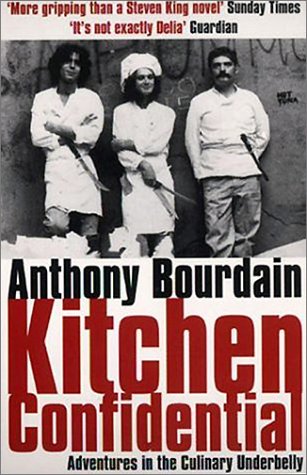
A couple of weeks ago Tamar Adler, former chef and editor of Harper’s Magazine, wrote an article for the New Yorker in which she politely and neatly eviscerates Anthony Bourdain for leaving ‘a crude hickey’ on America’s ‘food culture’. Although he is probably now better known – at least in the US – for his food-and-travel television series, Bourdain rose to fame, or notoriety, for his memoir Kitchen Confidential: Adventures in the Culinary Underbelly (2000).

It is a deeply entertaining, amusing, and often instructive guide to the strange world of restaurants and professional cooking. It explores the ‘personal and institutional perversity that runs fast through the veins of restaurants’. Bourdain details the astonishingly crude language and behaviour of badly paid, sleep deprived chefs in the hot, tiny restaurant kitchens he worked in and, later, oversaw. But it is also an excellent introduction to the mechanics and the politics of how kitchens function.

Although Bourdain and his crew do some pretty repellent things, all this is balanced by the fact that, as Adler notes, Bourdain does ‘not prescribe that life, or condone it.’ Indeed, he devotes a whole chapter to kitchens which don’t run the risk of collapsing into anarchy and violence if the chef for one moment ceases swearing at the staff. He admits:

It is no coincidence that all my kitchens over time come to resemble one another and are reminiscent of the kitchens I grew up in: noisy, debauched and overloaded with faux testosterone – an effective kitchen, but a family affair, and a dysfunctional one, at that. I coddle my hooligans when I’m not bullying them. I’m visibly charmed by their extra-curricular excesses and their anti-social tendencies. My love for chaos, conspiracy and the dark side of human nature colours the behaviour of my charges, most of whom are already living near the fringes of acceptable conduct.

He adds:

Not all kitchens are the press-gang-crewed pressure cookers I’m used to. There are islands of reason and calm, where the pace is steady, where quality always takes precedence over the demands of volume, and where it’s not always about dick dick dick.

And that is the issue with Bourdain’s description of the food world: it is overwhelmingly, completely male. The women chefs whom he respects are those who are ‘tough-as-nails, foul-mouthed, trash-talking’ – the ones who go out of their way to fit in to ‘the testosterone-heavy’ world of restaurant kitchens. But, at least in Kitchen Confidential, he acknowledges that there are kitchens where women aren’t expected to put up with being groped, or with their colleagues festooning their stations with pornography. Visiting Scott Bryan’s restaurant Veritas he notices

A tiny young woman working at a corner station, and I made the immediate Neanderthal assumption as I first took in the crew: ‘Extern, maybe from Peter Krump or French Culinary, having a learning experience dishing out veggies.’ I passed right over her as I swept my eyes down the line looking for the heavy hitters. In time I began, peripherally, to become aware of her movements. I looked again, closer this time, and saw that she was plating fish, cooking risotto, emulsifying sauces, taking on three, then four, then five orders at a time – all the whole never changing expression or showing any visible signs of frustration or exasperation (as I would have under similar circumstances).

She was, in other words, ‘generally holding down her end like an ass-kicking, name-taking mercenary of the old school, only cleaner and better.’ It turned out that she’d been trained by Alain Ducasse.

The problem is that Bourdain loses much of this self-reflection in his later books and series. As he became better known ‘he confused what he’d written about once with the world itself.’ Adler explains:

What Anthony Bourdain does is to bathe everything, even if it’s naturally quiet and normal, in brutishness. It is the difference between not pulling punches and indiscriminately punching. Bourdain now travels round the world, with a camera crew trailing, to eat food in other countries. On his stops at noodle shops, he turns his anxious libido on his bowl of food: ‘Take me to that place where everything is beautiful.’ ‘This is fucking driving me out of my mind. I’m fucking quivering with desire here.’ ‘I would jerk a rusty butter knife over my best friend’s throat just for this,’ he says to the camera while waiting for soup. ‘Come to papa,’ he wheedles.

His relationship with – and views on – food have become centred around his masculinity:

He has managed to insert, through performance of the great feat of eating Vietnamese or Tunisian or Parisian food, the neurotic notion that eating is best understood as a competition or conquest – man versus food. Why choose to merely ingest, he asks, when you can vanquish?

Although I agree with Adler’s point that it’s a pity that he feels the need to dress up his opinions on food in a kind of gung-ho machismo because much of what he says is worth listening to, it was time that someone called out Bourdain for his casual sexism. Bourdain seems to insist that good cooking can only be produced by kitchens overseen by obsessive, potentially murderous alpha males caught up in a kind of adolescent, On the Road-like existential struggle with the meaning of existence. Women – unless they behave like men – are to be viewed with suspicion, as is the food which he associates with them:

Few chefs can really and truly bake. Most chefs, like me, harbour deep suspicions of their precise, overly fussy, somehow feminine, presentation-obsessed counterparts in the pastry section. All that sweet, sticky, messy, goopy, delicate stuff. Pastry, where everything must be carefully measured in exact measurements – and made the same way every single time – is diametically opposed to what most chefs live and breathe, the freedom to improvise, to throw a little of this and a little of that any damn place they want.

It’s no coincidence that most pastry chefs are women. Bourdain implies that pastry, like women, is difficult, too sweet, boring, and unimaginative: real chefs are men – wild, creative genuises – who cook ‘Flintsone-sized lengths of veal shank,’ understand the value of bones, and who carry long, sharp knives.

For an industry with a reputation for not dealing adequately with charges of ingrained discrimination against women, Bourdain’s attitudes towards food and cooking certainly don’t help. But it’s worth noting that for all the excitement that surrounded the publication of Kitchen Confidential – when it was hailed as a fresh and unconventional take on America’s restaurant world, which it was, to some extent – Bourdain’s views on the relationship between masculinity and food are neither particularly new, nor limited to himself.

There has long been an association between meat-eating and manliness. Until the late eighteenth century, when eating in moderation and a slim physique were connected, increasingly, with the ideal Enlightenment male, a healthy appetite for wine and meat indicated strength and vitality. In England, a taste for roast beef was, as Roy Porter notes, linked to a patriotism which associated roast meat with English vigour and virility. Even a century later, Victorians argued that men’s strong, machine-like bodies needed meaty fuel in order to function efficiently.

Men, in other words, needed to eat ‘man food’ – spicy, strong-flavoured, and rich in protein. This was taken to a logical – or an illogical, depending on your point of view – extreme by the Italian Futurists and Mussolini-enthusiasts FT Marinetti and Luigi Colombo in their 1930 Manifesto of Futurist Cooking. Of course, the document is completely mad – like just about everything Marinetti did – but it’s a useful window on to the ways in which fascists of the 1930s understood gender. As the Italian state recast women as mothers – and only mothers – of the nation, so men were urged to become its warrior-protectors.

Marinetti and Colombo write:

We also feel that we must stop the Italian male from becoming a solid leaden block of blind and opaque density. … Let us make our Italian bodies agile, ready for the featherweight aluminium trains which will replace the present heavy ones of wood iron steel.

Italians should do this, they argue, by giving up pasta:

A highly intelligent Neapolitan Professor, Signorelli, writes: ‘In contrast to bread and rice, pasta is a food which is swallowed, not masticated. Such starchy food should mainly be digested in the mouth by the saliva but in this case the task of transformation is carried out by the pancreas and the liver. This leads to an interrupted equilibrium in these organs. From such disturbances derive lassitude, pessimism, nostalgic inactivity and neutralism.’

They suggest that rice take the place of pasta. But this is only the first of several ideas for the remaking of food for a faster, more efficient future. Their most significant point was that science should ‘take on the task of providing the body with its necessary calories through equivalent nutrients provided free by the State, in powder or pills, albumoid compounds, synthetic fats and vitamins.’ Not only would this make Italians better-fuelled and more efficient workers, but it would reduce the amount of food they ate.

Those few meals which they would then eat would be, as they write, ‘perfect’. Given the role of Italian women in feeding their families, what Marinetti and Colombo advocate is a kind of man-made food: the dishes they describe for their ‘perfect meals’ – like the Woodcock Mount Rose with Venus sauce – are invented by chefs.

Although their remaining ideas are increasingly ludicrous – ‘The rapid presentation, between courses, under the eyes and nostrils of the guests, of some dishes they will eat and others they will not, to increase their curiosity, surprise and imagination’ and ‘The creation of simultaneous and changing canapés which contain ten, twenty flavours to be tasted in a few seconds’ – their association of ‘perfect’ cooking with men, and homely, everyday cooking with women, was – and is – hardly unusual.

A great deal has been written about the irony that while most of the world’s ‘top chefs’ – whatever we may mean by that – are male, the overwhelming majority of people who cook to feed their families are female. I think that this distinction is something of an oversimplification: while it is certainly true that the most Michelin-starry chefs are still male, this is changing, albeit slowly. More importantly, the chefs and cooks who have had the greatest impact on the way we all cook in the twentieth and twenty-first centuries have, arguably, been women: Constance Spry, Marguerite Patten, Delia Smith, and Madhur Jaffrey in Britain; Julia Child and Martha Stewart in the US; Nitza Villapol in Cuba; Stephanie Alexander and Maggie Beer in Australia; and Ina Paarman, Ina de Villiers, and Lynn Bedford Hall in South Africa.

Moreover, there has been a recent and relatively widespread decrease in tolerance for the antics of bullying, super-macho male chefs. Gordon Ramsay’s spectacular fall from grace – the collapse of his business empire, the decline in quality of his restaurants – is a particularly good example of this. Adler’s take-down of Bourdain is part of this trend – and it’s particularly telling that Bourdain devotes his highest praise to Ramsay (‘England’s greatest chef’) in A Cook’s Tour: In Search of the Perfect Meal (2001), excusing and celebrating Ramsay’s reputation as a bully on the grounds of gender:

He’s doing what everyone told him growing up that only women should do. … You better have balls the size of jack-fruits if you want to cook at a high level, where an acute sense for flavour and design, as much as brutality and vigilance, is a virtue. And be fully prepared to bulldoze any miserable cocksucker who gets in your way.

This kind of macho chest-beating now feels distinctly passe. The male celebrity chefs of the late 2000s and early 2010s are an altogther nicer, kinder group of chaps: from earth-warrior Hugh Fearnley-Whittingstall and home-cooking dad Jamie Oliver, to shambling Valentine Warner and lovely Nigel Slater. We have cerebral, thoughtful Fergus Henderson and Heston Blumenthal.

I’m not absolutely sure what this shift in public taste suggests – and it’s certainly part of a wider, cultural change, which has seen Ryan Gosling and James Franco replace Sylvester Stallone and Steven Segal as male icons. It’s also occurred at the same time as the emergence of a food trend which can only really be described as ‘dude food’ – food made to appeal to men. Craft beer, the wild enthusiasm for bacon, even the recent rediscovery of the burger, are, I think, driven partly by a belief – held by magazine editors, television producers, and some food writers – that food needs to be made ‘manly’ to appeal to men. Tellingly, most of this is pretty meaty food.

What I find so interesting about dude food is that it’s directed at a generation of young men – my contemporaries and younger – for whom cooking is not necessarily seen as being, as Bourdain noted earlier, something that only women do. Unless I have the good fortune only to have dated, and to be friends with, peculiarly enlightened men, it seems to me that Generation Y men don’t seem to feel that cooking and baking undermine their masculinity. After all, not only were all three finalists on the last series of Great British Bake Off men, but two of them were fairly young. So is dude food a kind of ironic embrace of the manly, meaty food associated with being male since, at least, the seventeenth century – much in the same way that contemporary feminists have reclaimed baking and, crucially, the cupcake – or is it something else altogether? Either way, I can’t imagine that Marinetti would be all that pleased.

Sources

Anthony Bourdain, A Cook’s Tour: In Search of the Perfect Meal (London: Bloomsbury, 2001).

Anthony Bourdain, Kitchen Confidential: Adventures in the Culinary Underbelly (London: Bloomsbury 2000).

Roy Porter, Flesh in the Age of Reason: How the Enlightenment Transformed the Way We See Our Bodies and Souls (London: Penguin, 2003).

Creative Commons License
Tangerine and Cinnamon by Sarah Duff is licensed under a Creative Commons Attribution-ShareAlike 3.0 Unported License.

Food Links, 31.10.2012

The mayor of Phoenix tries to live on food stamps.

Can food riots be predicted?

Austerity and hunger in Spain.

Tom Philpott on baconpocalypse and fishageddon.

The case for veganism.

Food logos and junk food.

Anti-fracking sausages.

The return of ‘wonky‘ fruit and vegetables to supermarkets.

Demand for coffee is set to soar in India and China.

Selling carrots instead of theatre tickets in Spain.

The meanings attached to mooncakes in China.

Capitalism, candy, and Halloween.

The urban legend of the poisoned Halloween candy.

The health benefits of tea.

Cadbury’s wins the exclusive use of Pantone 2685C Purple.

The appeal of Starbucks in India.

Recipes for staff meals in famous restaurants.

The markets of old London.

Eyeball cake pops.

A profile of Bompas & Parr.

What Confederate soldiers ate during the US Civil War.

Be Bold with Bananas.

An interview with Sarah Lohman.

There’s been a decline soup consumption in the US.

The Taihu pig.

The beer milkshake.

Why don’t French children get fat?

Women struggling to drink water.

The ten worst fad diets.

US-politics-themed cookies.

The golden age of British sweets.

Ramens of Japan.

Ten tiny cafes in Melbourne.

Cupcakes in the Gulf.

Can Jamie Oliver’s fifteen-minute meals be made in fifteen minutes?

A pop-up human butchery.

On Carnation Milk.

Every drink consumed in Mad Men.

An interview with Ferran Adria.

The eating of feet.

Beatrix Potter‘s recipe for gingerbread.

How to crack an egg.

Seventeenth-century curd cakes.

Charlie Brooker learns how to cook Japanese cuisine.

These are all courtesy of my Mum:

How food tricks the brain.

The Travelling Gin Co.

There’s been a resurgence of interest in farmers’ markets in Italy.

The new trend for bamboo ash.

Ratatouille at Villanova.

Potato sacks.

No More Cakes or Biscuits

This year marks the centenary of the end of the South African War (1899-1902), a conflict which, it’s not too much to claim, produced modern South Africa, geographically, politically, economically, and, to some extent, socially. There is, unsurprisingly, a vast scholarship on the war, ranging from, for example, more recent sallies into the multiple ways in which it’s been commemorated, and medical histories of the concentration camps established for Boer and African refugees, to more old-fashioned accounts of its battles and sieges.

There are a few – interesting – lacunae in this research, and one of these is around food. For various reasons I’ve recently been doing some work around children in the war, and I’ve been struck how so many of the sources I’ve read are preoccupied with food. This isn’t really surprising. As Lizzie Collingham demonstrates in her recent book, The Taste of War: World War Two and the Battle for Food, it’s during war that the ways in which food is processed, distributed, sold, and valued become particularly significant to states. Food can be made a weapon of war.

Ironically, diets often improve during times of war, and this is particularly true of people who, in peacetime, can’t afford to feed themselves well. Italy during the First World War is an excellent example of this. Italian diets declined in the late nineteenth century because of exponential population growth and poor systems of distribution. The majority of Italians ate what was, essentially, a nutritionally inadequate pre-industrial diet based on cereals and legumes, supplemented occasionally with vegetables, and, even more rarely, with meat and dairy products.

What changed in 1914 was that the Italian state took control over the distribution of food. Carol Helstosky explains:

Wartime ministers were reluctant to take action, but their policies made a dramatic impact on food habits. Italy was ill prepared for war and survived on allied loans and wheat shipments. This situation benefitted consumers, who enjoyed cheap, subsidised bread and could afford to purchase foods like meat, milk, or fresh produce. Wheat bread and pasta became the foundation of diet for many Italians, replacing corn, chestnuts, and rice. … At the war’s end, public debate about the bread subsidy indicated that state intervention brought Italy to a political crossroads: should the government continue to foot the bill for a higher standard of food consumption? Would consumers be forced to choose between the necessity of bread and the luxury of meat as bread prices adjusted to the market?

Something similar occurred in Britain during the Second World War, where the strict system of rationing controlled by Lord Woolton’s Ministry of Food ensured not only that there was enough food to go around, but that most people ate fairly well. All adults received regular – if small – rations of butter, meat, sugar, and eggs. Everyone was encouraged to eat fruit, vegetables, and fish. For poor families who had subsisted on cheap white bread and sweet tea before the war, this represented a considerably healthier and more varied diet.

A combination of increased exercise and this standardised, if limited diet, relatively low in saturated fat and sugar meant that the health of the British population actually improved in the 1940s. This is not, though, to romanticise the effects of conflict on people’s diets. Millions of people died of starvation during the Second World War, as Timothy Snyder explains in his review of A Taste for War:

The Germans and the Japanese lost the war and returned to home territory and home islands. The Germans had hoped to supply themselves for eternity with grain from the rich black soil of Ukraine; but in fact they got very little. This is because, as Collingham demonstrates, war itself tends to disrupt labour, harvests and markets. Even if the intention of the Germans had not been to cause starvation, invasions tend to do so. Some two million people starved to death in French Indochina. At least 10 million starved in China, whose army was living from the land on its own territory. About three million starved in Bengal in British India.

This latter description of disrupted and destroyed food supplies seems to apply more accurately to the South African War. In fact, understanding how and why people were able to access food during the conflict helps us to create a more nuanced understanding of power within South African society during this period. There was enough food to go around – the tragedy was that it didn’t get to those people who needed it.

Indeed, the images most usually associated with the conflict are photographs of emaciated Boer children in concentration camps. These are both testimony to the war’s heavy toll on civilian lives – around 28,000 Boers died in the camps, 22,000 of them under the age of sixteen – as well as an indictment of British mismanagement of the concentration camps. And this, of course, is to say nothing of the even worse organised and provisioned camps for Africans, where both adults and children were used as free labour.

People went hungry in the camps because the British army hugely underestimated the logistics of supplying around 110,000 Boer inhabitants with food and water. The first camps were established early in 1901, in response to the Boer decision to switch to guerrilla warfare after the British annexation of the Transvaal in October 1900. Boer commandoes relied on the network of homesteads across South Africa’s rural interior for support, and it was these households – run overwhelmingly by Boer women – that the British targeted in their scorched earth tactics to end the guerrilla war.

Homesteads were burned or dynamited, crops and livestock were either commandeered or destroyed, and Boer women and children and their African servants were sent to camps. Rations were meagre. Emily Hobhouse, the British humanitarian who campaigned to bring the appalling mismanagement of the Boer – but not the African – camps to the attention of British politicians, wrote to her brother in March 1901:

Couldn’t you and your household try living for – say – a month on the rations given here in the camps? I want to find out whether it is the small amount of food the children suffer from so much, or its [sic] monotony or the other abnormal conditions under which they live. …

Coarse meal: 1lb a head daily

Meat (with bone): ½lb a head daily

Coffee: 1oz a head daily

Sugar: 2oz a head daily

Salt: ½oz a head daily

You must promise faithfully to abjure every other meat and drink – only adding for the children one-twelfth part of a tin of condensed milk a day.

Leonard Hobhouse did not do as his sister suggested, but her speculation that this inadequate diet, alongside the chaos and poor sanitation of the camps, left children particularly vulnerable to the epidemics of measles and typhoid which swept the camps, was correct.

Because of Hobhouse’s campaigning, rations did improve in the camps for Boers. Race, clearly, determined which interned people had access to food: Africans received even smaller rations than did Boers, and these did not increase after the international outcry about the concentration camps – summed up, famously, in Henry Campbell-Bannerman’s ‘methods of barbarism’ speech in June 1901.

Even within the Boer camps, though, there were divisions between those women who were able to buy provisions from the British army, and those who had arrived without money or possessions – and a large proportion of the Boer families in the camps were very poor.

In Johannesburg, this link between class and access to food was particularly evident. Isabella Lipp, the wife of the manager of the African Banking Corporation, kept a diary between the outbreak of war in October 1899, and the capture of Johannesburg by the British in June the following year. Although she complained occasionally of certain foodstuffs – butter, eggs, meat – not being available, throughout this early phase of the war, she and her husband were well fed. But this was not the case for the impoverished Boer women living in the city:

Thirty women, wives, etc. of the police (Zarps) now at the front ran ‘Amok’ as the newspaper heads it, poor things they and their children were starving so they made a desperate raid on some small provisions stores and in spite of the resistence [sic] of special police and constables, effected an entrance and helped themselves to food and who could blame them, certainly not their paternal Government who had neglected giving them their absent breadwinners wages which were due at the end of October.

The situation was considerably more desperate in the towns – Ladysmith, Mafeking, and Kimberley – to which the Boers laid siege during the first six months of the war. As food stocks ran low, Africans were either forced out or encouraged to leave – putting them at the mercy of Boer soldiers – to reduce the numbers of people dependent on rations.

In Kimberley, Lillian Hutton, the wife of a local minister, kept a diary over the course of the siege. The slow reduction of the food available to the inhabitants of the town – and rationing was introduced in December 1899 – signalled the ever more desperate state of Kimberley, as fresh supplies were halted by the Boers. While she noted with amusement in November that Colonel Robert Kekewich – under whose command Kimberley fell – had ordered that ‘No more cakes or biscuits to be made’, she became increasingly critical of the British army as the siege progressed.

As beef and mutton ran out, horses and donkeys were slaughtered for meat. Milk became scarce. She wrote in January 1900:

Mr Alec Hall’s cow, that was giving good milk, has been commandeered by the military to be killed, in spite of the fact that children and sick folk are dying in nos. for want of milk. … Mr Wilkinson had a splendid milk cow, which had just calved, when it was commandeered. These things are a scandal to the military rule of the town. The officers are living on the best of everything in the midst of widespread sickness and want and starvation.

White babies wanted fresh milk, but it’s unlikely that black babies received any adequate nutrition at all. Africans in Kimberley were allotted only mealie meal. Of the 1,500 people who died during the siege – which was ended in February 1900 – nearly all of them were African.

So although in Kimberley, the other siege towns, Johannesburg, the concentration camps, and in all the parts of South Africa under military command, everyone experienced the effects of either government or army control of the food supply, access to food was still mediated by race and class.

The study of food in the South African War also sheds light on contemporary concerns about food. Firstly, as diaries and letters written during the conflict demonstrate, most middle-class and, indeed, poor inhabitants of South African towns and cities at the turn of the century were reliant on shops to buy their food. The idea that ‘we’ (whoever ‘we’ may be) once (whenever that was) grew all our own food is disproved fairly neatly by desperate Kimberley housewives unable to find eggs, milk, or fresh vegetables at the grocer. In fact, Lillian Hutton commented on the novelty of people in Kimberley giving over their flower gardens to vegetables.

Secondly, there has been a vogue recently for holding up Britain’s experience of rationing as a potential solution for both the country’s obesity epidemic, as well as the current, global food crisis. While I agree that eating less meat and dairy, using up leftovers, and other wartime strategies are excellent means of encouraging healthy eating and reducing food waste, we need to be careful of fetishizing austerity.

And, thirdly: we must acknowledge the significance of distribution systems to ensuring that all people receive an adequate supply of food. When shops in rural areas are badly provisioned; when social grants are not paid timeously; when officials steal food intended for the very poor, people go hungry.

Sources

Elizabeth Ann Cripps, ‘Provisioning Johannesburg, 1886-1906’ (MA thesis, Unisa, 2012).

Carol Helstosky, Garlic & Oil: Food and Politics in Italy (Oxford and New York: Berg, [2004] 2006).

Emily Hobhouse: Boer War Letters, ed. Rykie van Reenen (Cape Town and Pretoria: Human & Rousseau, 1984).

Bill Nasson, The Boer War: The Struggle for South Africa (Stroud: The History Press, [2010] 2011).

Creative Commons License
Tangerine and Cinnamon by Sarah Duff is licensed under a Creative Commons Attribution-ShareAlike 3.0 Unported License.

Foodie Pseudery (33)

This is from a hive-inducing article on the ‘new gastronauts’ in London from the Telegraph:

He looks at the menu. ‘It really irritates me when people don’t spend time looking at the menu. In France no one speaks until they have studied the menu. I can’t bear it when people talk before ordering.’ I ask him what he is looking for in a menu. ‘A balance of flavours. I want to be experimental but I also want to match the food up so that we have a full culinary experience.’ I tell him I am happy for him to order for me. He chooses the cuttlefish risotto, rabbit salad, mozzarella plate and a courgette salad and then photographs it on his mobile when it arrives. ‘I photograph everything I eat,’ he says.

Food Links, 24.10.2012

How healthy is raw milk?

Pesticides, bees, and governments’ unwillingness to introduce regulations.

A debate on the origins of opposition to GM crops.

Global warming has changed the fishing industry in southern Greenland.

Are lower pesticide residues a reason to buy organic?

Arguments in favour of national grain reserves.

Reclaiming our seed culture.

The world faces a steep decline in fish stocks.

Colin Tudge on small farms.

Using mushrooms to build cities.

How diseases are spread via the food chain.

Pigs are in crisis.

American fast food chains that don’t support the Republicans.

How long do you need to work before you can afford to buy a beer?

Crispin Odey, banker, plans on building a neo-Classical chicken coop.

Why fish need exercise.

The US election and the snack onslaught.

Crisis in the Greek food and olive oil industries.

Nathaniel Bacon’s ‘Cookmaid with Still Life of Vegetables and Fruit‘.

What is okonomiyaki? (Thanks, Mum!)

On misophonia. (I have this. It’s hell.)

The world’s fastest one-litre engine vehicle runs on cheese.

Ladies who drink.

The extraordinary invention of tabs on cans.

Vagina cupcakes.

Food typography.

Pumpkin pancakes.

Three burning questions about salt.

A new blog on pickling and preserving.

Cheese smuggling in Canada.

Christina McDermott on favourite food blogs.

A brief history of drinking and reading.

Delicious dishes with revolting names.

Berger & Wyse’s food-themed cartoons.

What’s the best shot for photographing food?

On dashi.

Bologna’s new ice cream museum. (Thanks, Catherine!)

Sam Woollaston cooks along to Nigellissima.

Cows respond to the Tim Noakes diet.

A recipe for pudding in verse, from Jane Austen’s family.

How to keep spices fresh.

Fashionable cafes in Paris.

How to eat breakfast cereal.

A recipe for challah.

Vogue plans to open a cafe in Dubai.

A reading of the ingredients in Kraft Dinner. (Thanks, Kelsey!)

The Politics of the Plate

Last week, Michael Pollan argued in the New York Times that this year’s American presidential election may be the first time that the food movement enters mainstream politics. Pollan suggests that the debate around California’s Proposition 37, which would require all products containing genetically modified food to be labelled, is indicative of wider disenchantment with the American food industry:

What is at stake this time around is not just the fate of genetically modified crops but the public’s confidence in the industrial food chain. That system is being challenged on a great many fronts – indeed, seemingly everywhere but in Washington. Around the country, dozens of proposals to tax and regulate soda have put the beverage industry on the defensive, forcing it to play a very expensive (and thus far successful) game of Whac-A-Mole. The meat industry is getting it from all sides: animal rights advocates seeking to expose its brutality; public-health advocates campaigning against antibiotics in animal feed; environmentalists highlighting factory farming’s contribution to climate change.

This disillusionment with Big Food has produced an attempt at transparency by businesses like Monsanto and Nestle, whose recent advertising campaigns have gone out of their way to paint these organisations as purveyors of honest good food.

Pollan wonders, though, if this public scepticism of the industrialised food chain, coupled with the relatively recent interest in ‘whole’ and ‘real’ food sold at farmers’ markets, in vegetable box schemes, and at independent shops, will translate into anti-Big Food votes. In other words, will – largely – middle-class willingness to support small and local producers translate into a political movement?

But this certainly won’t be the first time that food has become a vehicle for political engagement. In fact, it was through food and drink that women all over the world first entered politics at the end of the nineteenth century.

When I went through the photographs I took on a recent trip to Australia, I realised that I’d taken pictures of coffee palaces in nearly every town and city I had visited – these are a couple of them:

Fremantle, Perth

Melbourne

These coffee palaces were established in Australia – and elsewhere – by the temperance movement which swept the globe during the nineteenth century. Coffee palaces, coffee shops, and other, similar, cafes and meeting places were meant to entice men away from pubs, saloons, and ‘canteens’, as they were called in South Africa.

Temperance was one of several causes – from single, working women to abused and neglected animals and children – associated with middle-class philanthropic organisations during the Victorian period. From the 1870s, though, temperance became increasingly associated with women.

The founding of the Women’s Christian Temperance Union (WCTU) in the US in 1874 was a pivotal moment – not only in the history of opposition to public drinking, but in the development of feminism. Jed Dannenbaum describes its origins:

On Sunday, December 23, 1873, Boston-based itinerant lecturer Dio Lewis visited the community of Hillsboro, Ohio. His topic for the evening was temperance reform. Lewis urged the women of the community to band together and pray in the local saloons in an attempt to close them. The next day, Christmas Eve, a group of Hillsboro women enacted Lewis’s plan. The Women’s Crusade had begun.

In the next four months over 32,000 women in more 300 Ohio communities participated in the Crusade. The movement spread throughout the country to several hundred other communities, and in many the crusades succeeded in closing, at least temporarily, all the local retail liquor outlets. The Women’s Crusade severely disrupted the liquor trade and forced out of business manufacturers and wholesalers as well as retailers. Within the year the Crusade had evolved into the Women’s Christian Temperance Union (WCTU), an organisation that was to help shape American history for many decades to come.

Although predated by local temperance organisations, a branch of the WCTU was established in the Cape Colony in 1889 after the visit of an American woman activist to the Huguenot Seminary in Wellington, a small town in the wheat- and wine-producing south-western Cape. Huguenot was modelled on Mount Holyoke Seminary in Connecticut and was staffed by American teachers, who invited representatives of the WCTU to tour the colony.

As in other parts of the world, the Cape WCTU campaigned against the sale of alcohol, promoted temperance by persuading teetotalers to sign pledges never to drink, and organised clubs and societies for children. The Myrtle Branch – run by the Young Women’s Christian Temperance Union in Wellington – taught children about the dangers of tobacco and alcohol, as the secretary noted of a meeting in 1896:

Mrs Fehr spoke to us, she told us that strong drink leads to anger, debt, despair, destruction, and death and showed us how it leads on from one to the other.

Why, then, the appeal of temperance work to so many middle-class women? All over the world, it was a movement to protect the family – specifically women and children – against the violence and erratic behaviour of alcoholic men. Pubs, saloons, and canteens were seen as places where family budgets were squandered on cheap drink, while wives and children waited at home, anxiously, for the return of drunken, and potentially violent, heads of households.

The Cape’s WCTU – like sister unions in Britain and elsewhere – broadened its activities to campaign to protect women and children from ‘vice’, disease, and abuse. It ran a strong campaign against the re-introduction of the Contagious Diseases Act in the Cape in 1891 on the grounds that it was an ‘indignity to women’. In 1893, allied with organisations like the Citizen’s Law and Order League and the Women’s Purity Society, the WCTU campaigned for the raising of the age of consent for girls from twelve to fourteen years, and also for the better control, or eradication, of brothels and prostitution.

It made sense, then, that the WCTU in the Cape established a franchise department in 1895, on the grounds that women’s demands would only be taken more seriously if they could wield power via the ballot box. The collection of Women’s Enfranchisement Leagues established around South Africa between 1902 and 1910 – which were united as the Women’s Enfranchisement Association of the Union in 1911 – owed their origins to the WCTU.

What the campaign against alcohol did was to allow women to enter the male-dominated public sphere. Women and children, they argued, bore the brunt of men’s alcoholism. Theirs was a campaign to maintain the sanctity of family life.

In the United States, a similar movement grew up around concerns about the safety of food processed in factories. A series of scandals drew attention to the ways in which manufacturers added a range of substances – from chalk to arsenic – either to make products go further, or to improve their colour and texture. The women-led campaign for pure food – which culminated in the passing of the Pure Food, Drink, and Drug Act in 1906 under Teddy Roosevelt – was also described as a movement to protect the family.

For all the controversy over the campaign for women’s suffrage around the world during the late nineteenth and early twentieth centuries, it’s worth noting that the food- and drink-based campaigns that gave rise to the franchise movement were often deeply conservative. Writing about the pure food campaigners in the 1880s and 1890s, Lorine Swainston Goodwin explains:

They had formed independent literary clubs, village improvement societies, women’s granges, mother’s circles, and a wide assortment of other groups dedicated to self-improvement and to the well-being of their families and neighbours. The altruistic nature, conservative facade, and vitality of the new organisations appealed to a wide cross-section of discreet women who saw the need to improve and protect their society by employing prudent means, such as circulating petitions, and using personal influence, expose, and court action to achieve effective methods of controlling food, drink, and drugs.

Temperance, too, was often a deeply conservative movement – and this extended to the franchise campaign. The WEAU in South Africa campaigned only for white women’s right to vote; Emmeline Pankhurst was a lifelong Tory; and it’s striking how many British suffragettes went on to be enthusiastic supporters of fascism. Early feminism was not necessarily on the political left.

Pollan’s appeal for the food movement to enter politics is part of a fairly long history of food-based political campaigning. And although it’s clear that he imagines that supporters of the anti-Big Food lobby will vote for Obama (and please do, lovely American readers – and you can donate to his campaign here), there are some lessons to be learned from the temperance and pure food movements of the late nineteenth century: people – women, in particular – became involved in them because they perceived drunkenness and adulterated food to be threats to everyday life. They also meshed with women’s dissatisfaction with being left out of the political process.

Unfortunately, many of the markers of Pollan’s food movement of the early twenty-first century – like farmers’ markets – are perceived as being out-of-reach of the average American. For the food movement to enter politics, it needs to make itself relevant to the lived experiences of ordinary people – and to connect to concerns, like unemployment or welfare, which they feel to be more important. It needs to shed its aura of elitism.

Further Reading

Jack S. Blocker, Jr., ‘Separate Paths: Suffragists and the Women’s Temperance Crusade,’ Signs, vol. 10, no. 3 (Spring, 1985), pp. 460-476.

Jed Dannenbaum, ‘The Origins of Temperance Activism and Militancy among American Women,’ Journal of Social History, vol. 15, no. 2 (Winter, 1981), pp. 235-252.

SE Duff, ‘onschuldig vermaak’: The Dutch Reformed Church and Children’s Leisure Time in the Cape Colony, 1860-1890,’ South African Historical Journal, vol. 63, no. 4 (2011), pp. 495-513.

SE Duff, ‘Saving the Child to Save the Nation: Poverty, Whiteness, and Childhood in the Cape Colony, c.1870-1895,’ Journal of Southern African Studies, vol. 37, no. 2 (June 2011), pp. 229-245.

Lorine Swainston Goodwin, The Pure Food, Drink, and Drug Crusaders, 1879-1914 (Jefferson, NC, and London: McFarland, 1999).

Elizabeth van Heyningen, ‘The Social Evil in the Cape Colony 1868-1902: Prostitution and the Contagious Diseases Acts,’ Journal of Southern African Studies, vol. 10, no. 2 (Apr., 1984), pp. 170-197.

Cherryl Walker, ‘The Women’s Suffrage Movement: The Politics of Gender, Race and Class,’ in Women and Gender in Southern Africa to 1945, ed. Cherryl Walker (Cape Town: David Philip, 1990), pp. 313-345.

Cherryl Walker, The Women’s Suffrage Movement in South Africa (Centre for African Studies, University of Cape Town, 1979).

Creative Commons License
Tangerine and Cinnamon by Sarah Duff is licensed under a Creative Commons Attribution-ShareAlike 3.0 Unported License.

Food Links, 17.10.2012

The UNEP report for World Food Day.

Bankers must be stopped from betting on food.

The number of people on food aid doubles in the UK.

Are we headed towards a food crisis?

Starbucks sells bad coffee, dodges taxes.

There’s been an increase in the amount of arsenic in American rice.

To match the Walton heirs’ fortunes, you’d need to work at Walmart for seven million years.

Farmers begin a mass slaughter as the cost of animal feed rises.

Drought in Spain is pushing up the price of olive oil.

A study of the meals chosen by prisoners on death row.

How to attract bees into cities.

Reflecting on the recent Tim Noakes scandal.

Mushrooming and the man who saved Prospect Park.

Sandor Ellix Katz: fermentation enthusiast.

A restaurant staffed by prisoners has just opened in Wales.

Reflections on being a vegetarian.

Snake venom wine.

The effects of nuclear explosions on beer.

Foreign bodies in food.

The Los Angeles Times‘s new food quiz.

Breakfast in Argentina and Chile.

The £250,000 kitchen.

Accounting for America’s new enthusiasm for avocado.

Amazingly wonderful surreal advertisements for pork, leeks, cress, asparagus, and celery. (Thanks, Mum!)

What makes chocolate so addictive?

Coping with lactose intolerance.

Lawrence Norfolk‘s top ten seventeenth-century recipe books.

The science of peeling hard-boiled eggs.

The Downton Abbey cookbook.

Eating in Burma.

Still lifes of food in art. (Thanks, Jane-Anne!)

Pubs and bars from the past.

Convincing fake meat?

Tim Hortons opens in Dubai.

Bring me the head of Ronald McDonald.

A recipe for carrot cake.

Favourite reader recipes in the New York Times.

Pairing novels with cocktails.

The science of baking with butter.

The middle-class hierarchy of sparkling water.

Matthew Fort reviews Nigellissima.

Why does everything taste like chicken?

How to make your own Nutella.

A blog dedicated to the drinks in Hemingway‘s writing.

Photographing famous food scenes in literature.

A toaster that toasts bread AND forecasts the weather.

How to peel ginger with a spoon.

The state of the jelly salad in America.

The President’s Vegetable Garden

There are very few countries, I think, where a satirical news site is frequently mistaken for being entirely serious. Hayibo – the South African equivalent of the Daily Mash or the Onion – must, occasionally, point out to its readers that its stories are made up, rather than real.

Readers can be forgiven for wondering if a report about striking Marikana mineworkers being charged for the Helderberg plane crash is true, when the ANC announces an official policy on the serving of cake at party celebrations. Or if Cosatu officials really did believe they could move into Cape Town stadium, after the ANC Women’s League decided to march against a rude painting of Jacob Zuma, rather than protest the circumstances which allowed for the serial abuse and gang rape of a seventeen year-old mentally incapacitated girl.

A Hayibo post from this week suggests that the ANC’s national conference to be held in December in Manguang, will be replaced by an episode of Come Dine with Me. Instead of conference delegates voting to choose the new leader of the party – and, thus, by default, the next president of South Africa – four contestants will compete in a series of dinner parties:

The cookery show…will feature President Jacob Zuma take on rival Kgalema Motlanthe, former ANC Youth League leader Julius Malema and Proteas batsman Hashim Amla.

When asked why Amla, a cricketer, was suddenly a contender for the top leadership position in the ANC, BBC producer Cokey McLush shrugged and said ‘Everyone loves that geezer, yeah?’

The four will each host a dinner party on successive nights, and after each dinner will rate the host on his evening. ‘The winner walks away with Pick ‘n Pay vouchers worth R5000, as well as obviously the complete control of South Africa’s political space, so there’s a lot to play for,’ explained McLush.

It would all be much more amusing were it not so very, very serious. I was thinking about food and South African politics this week, after the Mail and Guardian produced a handy interactive guide to the development of Nkandla, the village in which Zuma’s private residence is based.

The Nkandla scandal has rocked South African politics and civil society over the past few weeks, as the City Press revealed that the Department of Public Works has committed to spending R203 million – about US$23 million or £14 million – of public money, not only in developing this village in rural KwaZulu-Natal, but in building Zuma’s increasingly elaborate home.

South African Wonder Woman-incarnate Thuli Madonsela, the Public Protector, has announced an investigation into the development. Despite her interest and increasing public outrage, the government remains unrepentant: it has declared Nklandla a ‘national key point’, meaning that it comes under security legislation and can’t be reported on; the Minister for Public Works, Thulas Nxesi, declared at a press conference that ‘questioning the need for spending hundreds of millions of rands in Nkandla showed insensitivity to the cultural diversity of South Africa’; and the state has launched an investigation into how the City Press got hold of the documents which revealed the scale of the spending at Nklandla.

Not for nothing has Nkandla been nicknamed ‘Zumaville’. The M&G’s guide reveals how the village will be transformed with new roads, housing, and a shopping centre. Zuma’s own residence will have two helicopter landing pads, a football pitch, tennis court, and underground bunkers. (Remembering, of course, that he has two official houses, one in Pretoria and the other in Cape Town.) I was intrigued by the fact that a vegetable garden has also been included in the development.

The M&G explains:

The vegetable garden is outside the main security zone, but still inside the outer fence, making it accessible for the people who tend it without a need for them to use the front entrance of the compound. The public works department says food security was identified as a potential security threat for President Jacob Zuma and visiting dignitaries, which means the establishment of the garden may have been state-funded.

I am all for heads of state planting vegetable gardens: I think it’s an excellent idea, particularly as a means of encouraging people to grow their own food. I wish more presidents and prime ministers would plant vegetables to show their commitment to feeding their families healthily and relatively cheaply. But I have a couple of reservations about this garden.

Firstly, the Department of Public Works justifies funding the garden on the grounds that food insecurity could pose a threat to Zuma and his guests. What do we mean by ‘food security’? As a paper published in the Bulletin of the World Health Organisation, and cited by the M&G, explains:

Food security as an umbrella term includes: (i) the availability of food that is nutritious and safe; (ii) an assured ability to procure and acquire food of good quality in a socially acceptable way (e.g. without resorting to emergency food supplies, scavenging, stealing or similar coping strategies). In contrast, food insecurity exists when food is not easily accessible and households have difficulty securing adequate food.

The authors of the paper argue that although food insecurity declined in South Africa between 1995 and 2008 – due partly to the social grants system and the work of the National School Nutrition Programme – one third of South African children do not eat an adequately varied diet, and 18% of them are malnourished:

Our findings show that the nutrient density of the diet consumed by South African children is insufficient to meet their nutrient requirements. Similarly, they have shown alarmingly low food variety and household dietary diversity scores, both of which have been positively related to children’s nutritional status. … Hence, stunting still affects a large proportion of children.

One of the main reasons for food insecurity in South Africa is poverty and, partly as a result of this, the country’s population is at risk of becoming even more insecure. A 2009 report on food security published by the Human Sciences Research Council notes:

Rising food prices, particularly of maize and wheat which are the staple diet of the poor in South Africa, pose serious problems for the urban and rural poor as most are net buyers of food. Recent information from the Food and Agriculture Organisation…suggest that food prices will increase steadily over the next decade even if there are some fluctuations and the occasional drop in prices. Given increasingly strong linkages between the local level and national and international commodity chains and economic networks, even remote rural households in South Africa are affected by changes in these networks. Unless there are new policy directions, poor households will increasingly be forced to allocate a greater proportion of their expenditure to food, with the result that diets will become less diverse, lower in quality, and energy intake (calories consumed) will drop as people try to cope with the situation. Most severely affected will be the chronically urban and rural poor, the landless and female headed households.

Although the government deserves praise for reducing levels of hunger in South Africa, far too many people, particularly children, don’t have adequate access to food. Indeed, it would appear that with rising food prices internationally, there is a risk that the country may become more food insecure.

To justify the public funding of a vegetable garden for the president’s private residence on the grounds of ‘food security’ is deeply offensive to the numbers of South Africans who can’t afford to feed themselves and their families properly. If the president and the Department of Public Works were genuinely interested in reducing food insecurity in the region, it would make far better sense for them to plant a larger, communal garden for all of Nkandla’s residents.

My second problem with Zuma’s vegetable garden is the very dubious way in which it’s been funded. There is a link between poor governance and food insecurity. One of the best recent examples of how corruption impedes food distribution occurred in Uttar Pradesh. Throughout India, only 41 per cent of the food intended for the very poor by the Food Corporation of India – the government agency established in 1965 to ensure India’s food supply – reaches households. This is due partly to wastage, but also to corruption.

In Uttar Pradesh, though, nearly all food aid was stolen by corrupt officials over the course of three years, as Bloomberg reports:

The scam itself was simple. So much so, that by 2007 corrupt politicians and officials in at least 30 of Uttar Pradesh’s 71 districts had learned to copy it…. All they had to do was pay the government the subsidized rates for the food. Then instead of selling it on to villagers at the lower prices, they sold to traders at market rates.

The irony is that India’s food reserves are full – and there’s more than enough food to go around:

While the Food Corporation of India is required to keep about 32 million metric tons of rice and wheat, bumper harvests have left the country with a stockpile of more than 80 million tonnes, according to the corporation. Stacked in 50-kilogram sacks, the food would reach from Sitapur to the moon, with at least 270,000 bags to spare.

To stop food rotting, the central government lifted a four- year ban on exports of wheat last year. In June, India donated 250,000 tons of wheat to Afghanistan.

But with corrupt officials, there’s no way of guaranteeing that this food will reach the poor. When distribution systems fail, people go hungry – and more than half of India’s children, and 21 per cent of adults, suffer from malnutrition.

This is, admittedly, an extreme example of the implications of corruption for food security, but it demonstrates particularly well how poor governance can impact the lives of the very poor. Given the rising levels of corruption in South Africa, it’s not too much of a stretch to conclude that the government’s good work on reducing hunger has the potential to be reversed if systems are corrupted through bribery, theft, and mismanagement.

It’s an obvious point, but the R203 million set aside for Zumaville could have been used to build roads, railways, food silos, and other infrastructure to improve the distribution of food to rural areas.

Six years ago, Lonmin commissioned a report into the health of the communities in seven villages – including Marikana – around its platinum mines. One of the main findings was that malnutrition was a major problem, and that children had been discovered suffering from kwashiorkor:

an easily prevented condition that occurs when there is insufficient protein in the diet. Kwashiorkor is more common in countries in a state of political unrest, or where there has been a drought or natural disaster.

Why the president feels that he and his guests deserve a state-funded vegetable garden when South African children are suffering from a condition associated with failed states, is utterly beyond me.

Further Reading

Miriam Altman, Tim Hart, and Peter Jacobs, Food Security in South Africa (Human Sciences Research Council, 2009).

Creative Commons License
Tangerine and Cinnamon by Sarah Duff is licensed under a Creative Commons Attribution-ShareAlike 3.0 Unported License.

Foodie Pseudery (32)

Gilt Taste’s series, ‘The Art of Plating’, is a foodie pseud’s joy. This is from an article on Wylie Dufresne’s rib comet:

For the placement, we call that a schmear—taking a quenelle, something very symmetrical, and grabbing the corner and destroying it. We’ve messed around a lot with putting something on a plate, and then moving or changing it, and we like it when it can give the dish a sense of motion.