Skip to content

Food Links, 10.10.2012

How rubber tappers in Indonesia are experiencing the food crisis.

Taking another look at African agriculture.

Tristram Stuart on food waste.

The implications of high food prices in the Middle East.

How Mitt Romney helped Monsanto to take over the world.

Hooters is trying to attract…female customers.

Jay Rayner on the incredible value of school breakfast clubs.

Justice Malala looks forward to the food at Manguang. (Thanks, Dad!)

Australia‘s food revolution.

New York’s earliest hamburgers.

An introduction to the tomatillo.

Chef’s Mask II. (Thanks, Mum!)

The rise of haute macho.

Prize-winning giant vegetables.

Microbiology and food.

How to make a baking tin out of foil.

Billy Corgan of the Smashing Pumpkins opens a…tea shop.

Durian ice cream.

Is hundred-year-old sourdough be a myth?

Simon Hopkinson on how to boil an egg.

Zelda Fitzgerald, in cake. (Thanks, Jane-Anne!)

Gatsby gumballs.

A short interview with Yotam Ottolenghi.

The black-and-white McDonald’s burgers in China.

How to boil water without bubbles.

Nigel Slater’s favourite recipe books.

An A to Z of food trends.

The world’s most expensive meals.

Quinoa.

Why French Masterchef is better than English Masterchef.

An extract from the second volume of Nigel Slater’s Kitchen Diaries.

The perfectly fried egg.

Fifty Shades of Chicken.

Preserving quinces.

Jerusalem street food.

What to eat and drink in Mauritius.

Green Revolutions

Recently, there’s been a lot of debate generated by a study done by a research team at the University of Caen in France. Last month, they published a paper in the peer-reviewed journal Food and Chemical Toxicology, in which they alleged that rats fed Monsanto’s genetically modified maize and exposed to the herbicide Roundup – also produced by Monsanto – over the course of a lifetime, developed tumours and suffered multiple organ damage.

Terrible photographs of some alarmingly lumpy rats circulated around the internet, and it seemed that the green movement’s vociferous opposition to GM crops was vindicated. But almost as soon as the study’s findings were announced, doubts – around the validity of the research itself and the way it had been communicated – began to emerge.

Not only have similar, more rigorous tests, demonstrated that GM crops had no impact on health, but, as the New Scientist reported:

the strain of rat the French team used gets breast tumours easily, especially when given unlimited food, or maize contaminated by a common fungus that causes hormone imbalance, or just allowed to age.

Moreover:

Five of the 20 control rats – 25 per cent – got tumours and died, while 60 per cent in ‘some test groups’ that ate GM maize died. Some other test groups, however, were healthier than the controls.

…the team claims to see the same toxic effects both with actual Roundup, and with the GM maize – whether or not the maize contained any actual herbicide. It is hard to imagine any way in which a herbicide could have identical toxic effects to a gene tweak that gives the maize a gene for an enzyme that actually destroys the herbicide.

This research isn’t entirely without value: it could suggest that even the smallest dose of weed killer or GM maize has the potential to cause physiological harm.

But even this conclusion is undermined by the circumstances in which the study was produced. The research team at Caen is open about its opposition to GM crops; and the anti-GM organisation which orchestrated the publicity around the release of the report, refused to allow journalists to consult other scientists about the paper.

As we’re right to be suspicious of studies undertaken by scientists affiliated to industry – the implications of which Ben Goldacre explores in his latest book on Big Pharma – so we must question the motives, however noble they may be, of this research team funded by anti-GM groups.

What I found so interesting about the response to the study was the vehemence of the anti-GM crop lobby. Like the debates around nuclear energy and, even, animal testing, it seems to me that the strength of feeling – on both sides – has a tendency to shut down all reasonable discussion. I was appalled when, earlier this year, a group of anti-GM activists threatened to destroy a field of GM wheat planted by scientists at the publicly-funded Rothamsted Research. Their work aimed partly to reduce pesticides sprayed on crops.

On the other hand, though, pro-GM scientists, economists, and others seem to be too quick to label those with – legitimate – concerns about the genetic modification of plants and animals as ‘anti-science.’ In an article from 2000, Norman Borlaug argued:

Extremists in the environmental movement, largely from rich nations and/or the privileged strata of society in poor nations, seem to be doing everything they can to stop scientific progress in its tracks. It is sad that some scientists, many of whom should or do know better, have also jumped on the extremist environmental bandwagon in search of research funds. …

We all owe a debt of gratitude to the environmental movement that has taken place over the past 40 years. This movement has led to legislation to improve air and water quality, protect wildlife, control the disposal of toxic wastes, protect the soils, and reduce the loss of biodiversity. It is ironic, therefore, that the platform of the antibiotechnology extremists, if it were to be adopted, would have grievous consequences for both the environment and humanity.

His point is that GM crops have the potential to end world hunger. As the Nobel Peace Prize winner credited with originating the Green Revolution during the 1950s and 1960s, Borlaug was in a position to argue– with some validity – that selective plant breeding had helped to feed a world of, now, seven billion people.

In 1943, concerned about the link between food shortages and political upheaval – particularly as the Cold War loomed – the Rockefeller Foundation began sponsoring research into the development of new drought-resistant and higher yielding plant species in Mexico.

Focussing on wheat, maize, and rice, Borlaug and other scientists affiliated with the programme cross-bred higher-yielding species. These new seeds were distributed at first in Mexico, India, and the Philippines. It’s difficult to underestimate the impact of this research, as Gordon Conway explains:

Cereal yields, total cereal production and total food production in the developing countries all more than doubled between 1960 and 1985. Over the same period their population grew by about 75 per cent. As a result, the average daily calorie supply in the developing countries increased by a quarter, from under 2,000 calories per person in the early 1960s to about 2,500 in the mid-80s, of which 1,500 was provided by cereals.

The Green Revolution has made it possible to feed a population of seven billion people. But it had substantial drawbacks. Conway writes that the ‘potential’ of the Green Revolution crops

could only be realised if they were supplied with high quantities of fertiliser and provided with optimal supplies of water. As was soon apparent, the new varieties yielded better than the traditional at any level of fertiliser application, although without fertiliser they sometimes did worse on poor soils. Not surprisingly, average rates of application of nitrogen fertilisers, mostly ammonium sulphate and urea, doubled and redoubled over a very short period.

We know now that we need a new Green Revolution – one which is not as heavily reliant on water, and which does not poison and destroy ecosystems. There’s a certain logic, then, to many activists’ arguments that it’s ‘science’ which is to blame for present food insecurity: that a return to small-scale peasant farming offers the best means of supplying food to an ever-growing population.

This suspicion of ‘science’ – whatever we may mean by this – is nothing new. During the 1970s, for instance, the green movement emerged partly in response to concerns about the implications of the Green Revolution for human health, biodiversity, and water supplies. Much of this early environmentalism advocated a return to nature, and a rejection of technology.

I haven’t made up my mind about the usefulness or otherwise of GM crops, but I hesitate over the whole-hearted embrace of ‘traditional’ methods of farming. It’s worth remembering that pre-industrial agriculture required the majority of the world’s population to be involved in food production in order to stave off hunger. Now, in developed nations, this number has plummeted to only a couple of per cent. In sub-Saharan Africa, seventy per cent of the population remains in engaged in agriculture, although this is also likely to decline.

Better technology and higher-yielding plant varieties have freed up the majority of the world’s population to do other forms of work. The world has changed a great deal since the eighteenth century.

What concerns me more, though, are the businesses which push GM crops – those which are at the receiving end of European and African bans on the planting of genetically modified wheat, maize, and other plants. Monsanto and Cargill are currently the target of a campaign to end the patenting of seeds – making them cheaper and more freely available to small farmers in the developing world.

These two companies, in particular, have a growing control over the world’s food supply. Not only do they own seed patents, but they provide pesticides and fertilisers. Cargill produces meat and grows grain – in fact, no one knows how much grain it has stored in its silos. Given that Cargill and the commodities trader Glencore have both admitted that their profits have increased as a result of the drought in the US and the resultant rise in food prices around the world, it’s exceptionally worrying that these organisations have so much control over our food chain.

What the GM debate reveals is a set of complex and shifting attitudes around the relationship between food, farming, and science – and around how we define what is ‘natural’. Instead of rejecting the potential benefits of GM crops out of hand, I think it would be wise to encourage more research into their implications both for human health, and for the environment. Moreover, I think we need to scrutinise and hold to account big businesses like Monsanto, Glencore, and Cargill. They represent a far greater threat to our ability to feed ourselves.

Further Reading

Norman Borlaug, ‘Ending World Hunger: The Promise of Biotechnology and the Threat of Antiscience Zealotry,’ Plant Physiology, vol. 124 (Oct. 2000), pp. 487-490.

Gordon Conway, The Doubly Green Revolution (London: Penguin, 1997).

Joseph Cotter, Troubled Harvest: Agronomy and Revolution in Mexico, 1880-2002 (New York: Praeger, 2003).

John H. Perkins, Geopolitics and the Green Revolution: Wheat, Genes, and the Cold War (New York: Oxford University Press, 1997).

Himmat Singh, Green Revolutions Reconsidered: The Rural World of Contemporary Punjab (New Delhi: Oxford University Press, 2001).

Creative Commons License
Tangerine and Cinnamon by Sarah Duff is licensed under a Creative Commons Attribution-ShareAlike 3.0 Unported License.

Food Links, 03.10.2012

Mexico’s small-scale maize farmers are under threat.

Tom Philpott considers the recent Stanford report on organic produce.

More reflection on the latest pro/anti-organics bunfight.

Water and meat consumption.

The history of the lunchbox.

Harvesting a climate disaster.

Chinese farmers in Russia.

A journey along the Silk Road helps to explain the genetic influence over food preference.

The science behind flavour combinations.

The names of pasta shapes. (Thanks, Mum!)

The Royal Society’s top twenty inventions in the history of food and drink.

The journey of a wheel of cheese, from Spain to New York.

Eating in Moscow.

The problem with TV cookery.

A socialist’s guide to drinking.

Re-imagining the ice cream shop.

In praise of buttermilk.

Three good things on a plate.

What it’s like being a chef in Silicon Valley.

The Zagat guide gets London badly wrong.

How to make bourbon salt.

A guide to African cuisine in Paris.

Ruth Bourdain remains at large.

Puddings made with berries.

The rise and rise of Peruvian cuisine.

Calvin Trillin on ceviche.

Food-based art.

Will Self on Garfunkel’s.

George Washington’s small beer.

Lebanese steak tartare.

Food future.

The Renaissance of Nigerian Cuisine.

Brooklyn Blackout Cake.

Seven things to do with apples.

Escher-inspired food art.

Fuck Yeah Biscuits.

What couscous to buy.

Eating fish in Greece.

Lausanne‘s weekend market.

A man drives across the US, using only bacon as currency.

The Onion on Hostess‘s bankruptcy.

Fed Up

This is a short – and late – post because I’ve around 275,532 first-year test scripts to mark. In between correcting essays on the South African War, the trans-Atlantic slave trade, and the Scramble for Africa – yes, wild times this weekend – I’ve been thinking about the recent emergence of a small, yet fierce, anti-foodie movement.

Perhaps ‘movement’ is too strong a word. But it seems to me that there is an increasing unwillingness to tolerate the preciousness and snobbery of foodie-ism. In an extract from his new book on the subject, Steven Poole launches a vicious attack on the ‘food madness’ which has gripped the middle classes:

It is not in our day considered a sign of serious emotional derangement to announce publicly that ‘chocolate mousse remains the thing I feel most strongly about’, or to boast that dining with celebrities on the last night of Ferran Adria’s restaurant El Bulli, in Spain, ‘made me cry’. It is, rather, the mark of a Yahoo not to be able and ready at any social gathering to converse in excruciating detail and at interminable length about food. Food is not only a safe ‘passion’ (in the tellingly etiolated modern sense of ‘passion’ that just means liking something a lot); it has become an obligatory one. The unexamined meal, as a pair of pioneer modern ‘foodies’ wrote in the 1980s, is not worth eating.

Similarly, Hephzibah Anderson makes the point that for all its pretensions of ethical eating, foodie-ism has done very little to change the ways in which most people eat:

If foodism really is about to fizzle, it’s hard to imagine what its legacy will be. Foodists are slavish in their devotion to authenticity, but flipping through bygone cookbooks rarely leaves a person licking their lips. Most of it is revolting. A decade hence, aren’t Heston Blumenthal’s spruce-spritzed mince pies likely to seem just as off-putting? In truth, some molecular gastronomical creations (gorgonzola cheese volleyball, anyone?) don’t sound all that far removed from foodstuffs you’ll find at the nether-end of the dining scale (I’m thinking Turkey Twizzlers and Tater Tots). Naturally, devotees insist that ideas flow in the opposite direction: high-foodism is to the average plate as the Milan catwalk is to the high street. But while it’s true nouvelle cuisine, for instance, brought us the Roux Brothers – ‘the Beatles of gastronomy,’ as Blumenthal labelled them – couldn’t a case be made for Delia Smith having had far more impact on what we actually cook?

Foodie-ism was the product of prosperity: it emerged first during the boom years of the 1980s, and then appeared again – with distinctly moral and ethical overtones – in the early 2000s. It makes sense, then, that the demise of foodie-ism, if that is what is happening, should occur in massive economic crisis. When the poor and unemployed in Greece, Spain, and Britain go hungry, and when people riot in Mexico and Iran because of high food prices, hyperventilating over authentic tapas seems in very poor taste indeed.

___________________________________

Sad news: the brilliant, fearless, and wonderful Eric Hobsbawm died today. His writing made me want to become an historian. I am immensely proud to have been awarded my doctorate from his department.

Creative Commons License
Tangerine and Cinnamon by Sarah Duff is licensed under a Creative Commons Attribution-ShareAlike 3.0 Unported License.

Foodie Pseudery (31)

This – on a new generation of chefs in the US – is possibly the most pretentious article I’ve ever read:

In this new theater of fine dining, once reserved exclusively for chefs who diligently studied a script written for heavily bankrolled restaurants where starched white linen and maître d’s in tuxedos were the currency, a growing cadre of young chefs are finding their own paradigms for shifting gastronomic boundaries, design motifs, service modalities, and the twin emotions that guide diners through the door—desire and expectation—as they abandon the comforts of farm-to-table cooking for more elevated forms of expression.

Food Links, 26.09.2012

How much food gets thrown away?

Visualising the relationship between food, water, and energy.

A food-growing workshop in George this weekend.

Is organic food worth the expense?

Emily Manktelow considers Emma Robertson’s Chocolate, Women, and Empire.

How banks cause hunger.

FoodPods.

Street food in the Muslim Quarter in Xi’an.

The strange history of Kraft Dinner.

Food waste facts.

The legacy of Chicago’s Milk Ladies.

Americans’ relationship with sugar.

The Los Angeles Halaal butcher with a largely Latino clientele.

The enthusiasm for American fast food in the Middle East.

Lawrence Norfolk on food and eating in fiction.

A cultural history of the apple.

The Gladiator Diet. (Thanks, Mum!)

Celebrating Rosh Hashanah in India.

A comprehensive guide to coffee.

The shape of the glass helps to determine how you drink beer.

Grilled cheese.

246 Common in Tokyo.

Marmite – superfood?

Cake in the office.

A poem about potatoes.

If in doubt, make tea.

Oreos adapted for different countries.

Campbells issues Andy Warhol soup cans.

Food and restaurant signs in Greece.

The world’s first pizza museum.

The return of temperance drinks in the UK.

Taipei‘s food scene.

Solar cells powered by…spinach.

How test bicarbonate of soda and baking powder for freshness.

Ideas for using up stale bread.

The world’s shiniest fruit.

Photographs of sandwiches.

Eighteenth-century kitchen gadgets.

Whose Heritage?

On 24 September, South Africans celebrate Heritage Day, during which they’re supposed to commemorate the rich and diverse cultural inheritance of the Rainbow Nation. That, at least, was the intention in 1996. Now, Heritage Day is a day of rallies and speeches organised by the government, or National Braai (Barbecue) Day – an initiative launched in 2007 to unite the nation in its shared enthusiasm for incinerating meat over wood fires.

Although there is something deeply ridiculous about a National Braai Day, there’s a logic in recasting Heritage Day into an uncomplicated, fun event which includes just about every South African. Not only did the then-Department of Arts, Culture, Science, and Technology include food as part of South Africa’s cultural heritage, but most South African cuisines include some form of barbecue. Everyone – from the middle classes in leafy suburbs, to township dwellers – can, and does, braai.

The originators of National Braai Day manage – probably unwittingly – to solve, or to negotiate, the deeply troubling question at the heart of Heritage Day: what on earth do we mean by ‘heritage’?

Like most historians, I find the idea of ‘heritage’ problematic – and particularly in societies, like South Africa, with long histories of nationalist politics. ‘Heritage’ is constructed: it’s what we – the state, and other institutions – select from the past, and what we choose to remember. Usually, we decide to remember those events and people who are useful for the construction of national identities. What we leave out of these narratives of national becoming is almost as important as what we decide to include.

Under apartheid, European explorers like Vasco da Gama, various early Dutch officials, Voortrekkers (pioneer farmers), Boer generals from the South African War, and nationalist politicians were immortalised on bank notes, in statues and monuments, and in thousands of street names. These white men – and some women – represented what the apartheid state defined as South Africa’s heritage – alongside events such as the Battle of Blood River, the songs in the FAK Sangbundel, volkspele (‘folk-games’), and some kinds of Afrikaans literature.

Those aspects of South African history which could not be mobilised in the construction of a narrative of the triumph of white, Afrikanerdom, were ignored. So there was no room for the miners’ strikes of the early decades of the twentieth century; the histories of the ‘hendsoppers’ and ‘joiners’ – Boers who surrendered to, or joined, the British army during the South African War; the implications of the 1913 Land Act for Africans; and the Bulhoek Massacre, for example.

Perhaps inevitably, the ANC has engaged in its own process of myth-making in post-apartheid South Africa, having claimed the 1976 Soweto uprising as its own event (in fact, the exiled ANC was completely taken by surprise by these student protests); interred Sara Baartman – a Khoi woman who toured Europe in various freak shows between 1810 and 1815, and who is now seen as an emblem of African suffering and exploitation under colonial rule – in a grave in the Eastern Cape, a region she probably never visited, but which is the heartland of the ANC; and has renamed airports, cities, and streets.

A couple of weeks ago I attended the annual Steve Biko Memorial Lecture at the University of Cape Town, presented this year by Ben Okri. Biko exemplifies what happens to difficult figures during processes of national myth-creation: as the originator of the Black Consciousness Movement and often critical of the ANC, Biko stands outside of the traditions, events, and movements which the ANC has used to create its version of a South African history. It’s telling that the ANC did not – to my knowledge – release a press statement on 12 September, the thirty-fifth anniversary of Biko’s death, and has done very little to transform him into a hero of the liberation struggle – as they’ve done with Sol Plaatje, for instance.

Although much of Okri’s speech was very, very bad – a woolly, rambling call for a national and nationalist renewal – I liked his opening point that we need to hold on to Biko’s ‘incisive’ questioning, and ‘forensic’ thought. It’s this kind of critical thinking which holds governments to account – particularly when they harness the past in the name of ‘heritage’ to prop up their claims to legitimacy.

One of the best examples of a thoughtful engagement with the pasts that we choose to remember is Jacob Dlamini’s Native Nostalgia (2009). In this memoir-cum-essay, Dlamini makes the – potentially uncomfortable – point that for all the viciousness of life in a township in apartheid South Africa during the 1970s and 1980s, black South Africans found ways of living – occasionally happily – under an oppressive regime.

He argues for remembering the strategies that people used to cope with the violence and discrimination of apartheid South Africa, suggesting that as we commemorate acts of resistance to the apartheid state, we should also remember the complex, ordinary lived experiences of the majority of South Africans.

As an historian and as someone who lived through the transition, I think that this is such an important point. Having been raised in a very politically aware household – both my parents were at various times engaged in anti-apartheid activities, and my mother was a Black Sash activist when I was little – I remember watching on television Nelson Mandela’s release from Victor Verster prison just a few kilometres from our house; shouting ‘vote yes!’ during the 1992 referendum; the riots after Chris Hani’s assassination in 1993; the bomb drills at school; frightening white men dressed in AWB uniforms driving through Paarl, where we lived until 1995 ; listening to radio announcers enumerating the numbers of people killed overnight in the Vaal Triangle, KwaZulu-Natal, and other flashpoints; and the alternating terror and euphoria of the 1994 election.

But it was when ordinary, everyday things began to change, that I realised the implications of the transition to democracy.

It’s difficult to describe the experience of being so isolated from the rest of the world as sanctions were introduced against South Africa during the 1970s and 1980s. As English-speaking opponents of apartheid, our family was doubly isolated – we didn’t have a large social circle in the small, conservative town where we lived.

One of the ways my parents coped with this isolation was through books and, particularly, magazines ordered from abroad. Our meals demonstrated particularly well how different we were from the conservative, white society around us, but also how isolated we were from the rest of the world. My mother cooked from Elizabeth David’s books, and also from Robert Carrier, the Supercook series, Good Housekeeping, and Katie Stewart’s recipes in Country Living. When my friends from school were eating lamb chops, rice, potatoes, and overcooked cabbage, we had paella, coq au vin, pasta in various forms, moussaka, and kofte. We drank proper coffee. We didn’t add Aromat to our food.

Making these dishes required some inventiveness: Arborio rice for risotto was almost impossible to find, and I can remember the first time I saw red peppers, mascarpone, ricotta, watercress, and couscous in the shops. My mother became adept at finding substitutes for the ingredients we couldn’t buy.

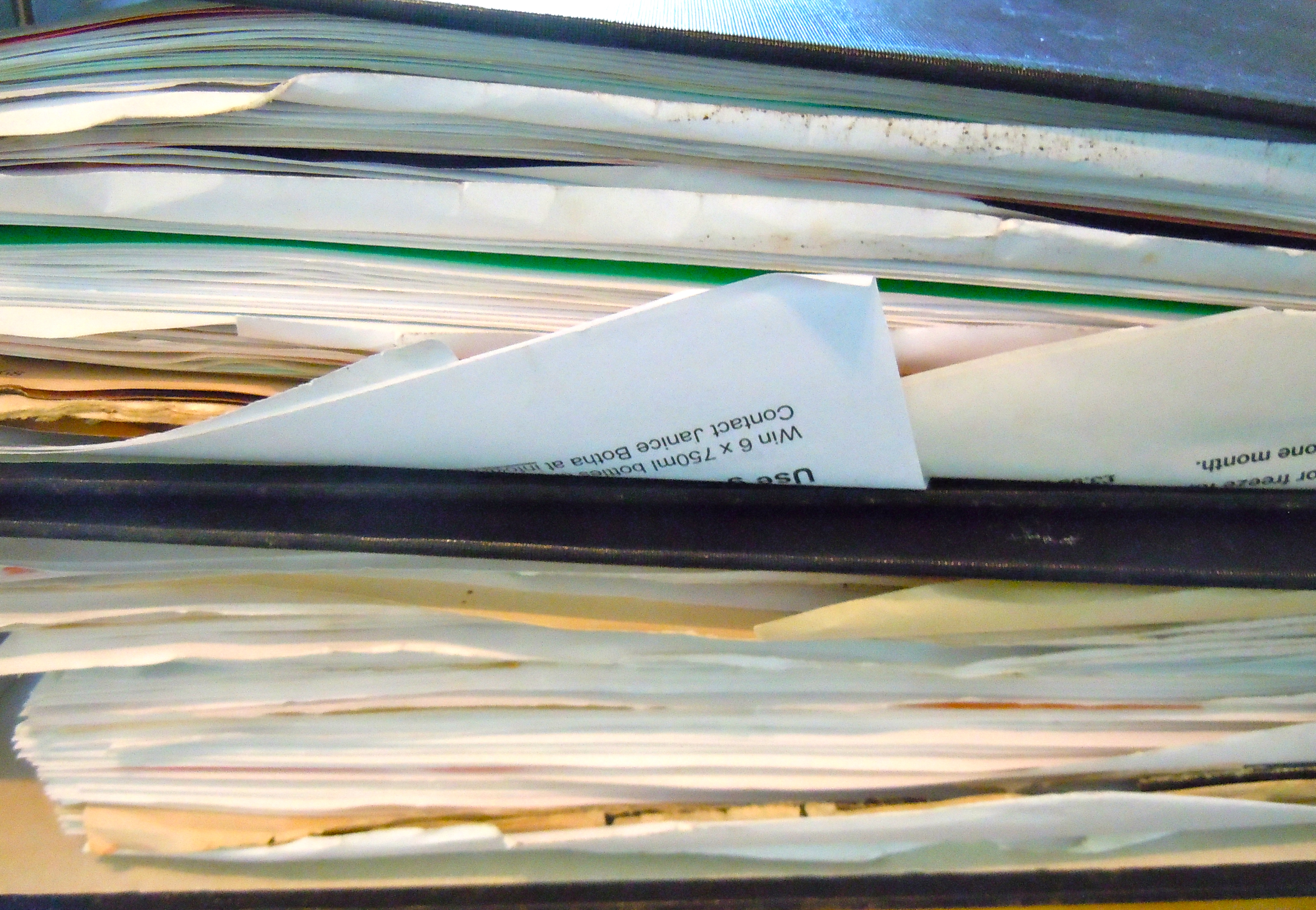
We have two thick recipe files at home – one for cakes and puddings, and the other for everything else. They comprise clippings from magazines and newspapers – Fairlady, the Financial Times – as well as recipes from friends, including my great-aunt’s amazing vinegar pudding, and, more recently, print-outs from blogs. Some of the recipes are older than I am, and we keep adding recipe cards, torn-out pages from magazines, and bits and pieces from the internet. These files – eccentrically categorised by my sister – are a record of my family’s experience of the past thirty or forty years: they’re a catalogue of our heritage.

They don’t, though, fit into the narratives of national becoming pedalled by the government and, even, the organisers of National Braai Day. What’s missing – among many things – in our Heritage Day celebrations is an acknowledgement of ordinary, lived experience under apartheid – of the multiple ways South Africans adjusted to living under an oppressive regime.

Creative Commons License
Tangerine and Cinnamon by Sarah Duff is licensed under a Creative Commons Attribution-ShareAlike 3.0 Unported License.
Food Links, 19.09.2012

The massive and widespread corruption preventing the poor from getting fed in India.

The growth in demand for food banks in Britain.

A victory for the Fair Food Programme.

How nutritious are organic products?

Barclays makes £500 million betting on the food crisis.

Mormon food culture and understanding Mitt Romney.

Regulations do change eating behaviour.

A blog which fact-checks Michael Pollan.

What scientists eat in Antarctica. (Thanks, Lize-Marie!)

The tawdry medical history of soft drinks.

Chicago’s urban orchards.

Kimchi and illustration.

The People’s Free Food Programme.

Ale to the Chief.

Severely calorie-restricted diets don’t prolong life. And what it’s like to exist on such a diet.

The last fish porters of Billingsgate Market.

McDonald’s opens its first vegetarian outlet.

An interview with Yotam Ottolenghi.

When did cooking become so pretentious?

Unravelling the mystery of a lost ravioli recipe.

How to save money at lunchtime.

Microwaves in restaurants.

Onion nuggets.

The return of lard?

Haggis, hipster food of choice in Bangkok.

Marina O’Loughlin on restaurants.

Isle of Wight tomatoes.

How to write with chocolate.

Why bacon mania has gone too far.

The best pastry shops in Paris.

Mouse kebabs.

Bubble tea may be carcinogenic.

Two books on dinner.

African Rice

I’ve recently finished lecturing an undergraduate course on African history up until 1914. It’s one of my favourite areas to teach, partly because students – even South African ones – tend to have very little knowledge about the continent’s past.

In fact, it’s often quite difficult to persuade them that there is a pre-colonial African history to study and teach. Now, most people would be horrified by the racism which underpinned Hugh Trevor-Roper’s 1963 assertion that

Perhaps in the future there will be some African history to teach. But at present there is none, or very little: there is only the history of Europe in Africa. The rest is largely darkness.

But there’s still a relatively widespread belief that not only were African societies not subject to change over time – that their ways of life remained static over the course of several centuries – but that only anthropologists have the requisite skills to study Africans and their past.

This is all nonsense, of course. Since the early 1960s, an extraordinarily rich and varied body of work on African history has been produced by scholars working all over the world. More recently, and particularly as global history has emerged as a popular field, historians have begun to examine the links between the continent and other parts of the world.

Far from being isolated until the arrival of Portuguese traders in the fifteenth century, Africans have long had contact with foreigners. For instance, the trade in gold and salt across the Sahara from around the second and third centuries onwards, connected African kingdoms in the Sahel with the Islamic world.

Too often accounts of, particularly European, contact with Africa describe this trade as benefitting only one side of the exchange: that a plundering of Africa’s natural resources in exchange for beads, alcohol, or muskets deliberately bamboozled Africans into giving up incredibly precious ivory or gold for objects of considerably lesser value.

This was not entirely the case. One of the best ways to understand the complex history of exchange between Africans and traders and other visitors from Europe and Asia is – naturally, dear readers – through food.

Since the second and third centuries AD, the east coast of Africa was part of an international trading network which extended around the Indian Ocean. As Africans came into contact with Arab traders, goods, languages, ideas, and people arrived and left this long coastline over the course of nearly a millennium. During this period, African crops – including millet, sorghum, okra, and watermelon – were taken to the Middle East, India, and beyond. In return, coconut palms, sugarcane, and bananas were introduced to the continent.

Coffee from Ethiopia probably reached Yemen – via the port of Mocha – during the sixth century. Here, Yemenis roasted, rather than fermented, coffee beans, and the drink spread slowly around the Middle East, Turkey, and North Africa. When Europeans discovered that it could be made more palatable with the addition of milk and sugar, it became popular in Europe in the fifteenth and sixteenth centuries. Coffee plantations established in Dutch and French colonies in southeast Asia and the Caribbean during the seventeenth and eighteenth centuries helped to fuel the growth of these European economies.

Sometime between the eighth and twelfth centuries, Oryza sativa, or Asian rice, was introduced to east Africa from India. Muslim traders were probably responsible for the earliest cultivation of rice in Kenya, and migrants from Malaysia and Indonesia brought rice to Madagascar.

All this occurred long before 1492, the year of Christopher Columbus’s crossing of the Atlantic to the Americas, and the beginning of the Columbian exchange. Although there was a significant circulation of crops around the Indian Ocean and Mediterranean worlds, the Columbian Exchange holds a particular significance in histories of food and medicine: it describes the introduction of livestock, European and Asian crops – predominantly wheat – and diseases like syphilis and smallpox to the Americas, and the gradual cultivation of New World staples – maize, potatoes, tomatoes, squash, beans – in Europe, Asia, and Africa.

Judith A. Carney writes:

Within decades of the arrival of Columbus in the Americas, the New World domesticate, maize, was being planted in West Africa. Other Amerindian staples soon followed, such as manioc, sweet potatoes, capsicum peppers, tomatoes, peanuts, cashew nuts, pineapple, pumpkins, squash, and tobacco. The early establishment of maize as a food staple in West and Central Africa illuminates the radical transformation of African agricultural systems wrought by the Columbian exchange.

By the time that the transatlantic slave trade reached its height during the eighteenth century, maize cultivation was widespread throughout west Africa, and was a staple for slaves shipped across to the Americas.

Slaves took with them not only their own languages, cultural practises, and social structures – but also their knowledge of agricultural production. African rice, Oryza glaberrima, had been grown in west Africa since long before the arrival of Asian rice on the east coast of the continent. Carney explains:

Muslim scholars reaching the western Sudan from North Africa in the eleventh century found an already well developed system of rice cultivation in the inland delta of the Niger Delta and a robust regional trade in surpluses. The domestication of glaberrima rice in West Africa was thus established centuries before Asian sativa arrived in East Africa.

It was slaves taken from these regions who used their expertise in rice production in the Americas, and particularly successfully in South Carolina. The cultivation of rice had begun there in the 1690s, and by the eighteenth century, was the source of significant revenue for the colony. There is compelling evidence to suggest that African slaves used the same irrigation and planting systems that they had in west Africa, in South Carolina. Far from being only the labour which worked the plantations in the Americas, they were also responsible for establishing a successful system of rice cultivation.

Labourers on a rice plantation, South Carolina, 1895 (http://www.niu.edu/~rfeurer/labor/chronological.html)

African slaves also pioneered the cultivation of a range of other crops, including black-eyed peas, okra, yams, and watermelons. Perhaps the best example of the circulation of crops around the Atlantic world was the peanut: introduced to west Africa from South America by the 1560s, it was taken to North America by African slaves during the eighteenth century.

What all of this demonstrates is not only that Africa and Africans have participated in global trading networks for centuries, but that they shaped food production in the Americas.

One of the many narratives peddled by foreign coverage of Africa is that the continent’s salvation – whatever we may mean by that – lies in outside intervention: in Nicholas Kristof’s ‘bridge characters’ (foreign aid workers, volunteers), or in elaborate packages created by the IMF or other international organisations.

This narrative is predicated on the wholly incorrect belief that Africans have, historically, been acted upon – have had change thrust upon them – rather than being actors themselves. As an understanding of the transfer of agricultural knowledge and produce across the Atlantic from the seventeenth century onwards demonstrates, this could not have been further from the truth.

Sources

Judith A. Carney, ‘African Rice in the Columbian Exchange,’ Journal of African History, vol. 42, no. 3 (2001), pp. 377-396.

Judith A. Carney, ‘From Hands to Tutors: African Expertise in the South Carolina Rice Economy,’ Agricultural History, vol. 67, no. 3 (Summer 1993), pp. 1-30.

Judith A. Carney, ‘The Role of African Rice and Slaves in the History of Rice Cultivation in the Americas,’ Human Ecology, vol. 26, no. 4 (Dec. 1998), pp. 525-545.

Creative Commons License
Tangerine and Cinnamon by Sarah Duff is licensed under a Creative Commons Attribution-ShareAlike 3.0 Unported License.

Foodie Pseudery (30)

This glorious bit of foodie pseudery is on the website for a new-ish restaurant, Switch, in Dubai. The designer writes:

I wanted Switch to be a strong, symmetrical soft organic womb-like space composed of a continuous, undulating wall that wraps around the entire restaurant.

The food sounds equally bizarre:

To titillate distinguished taste buds, a curved Mediterranean Fusion menu was created with a touch of Asian feel.

What the hell is a ‘curved Mediterranean Fusion menu’?

I am immensely grateful to Sally Prosser, who lives and writes from Dubai, for this link. All submissions welcome!