Skip to content

Food Links, 12.09.2012

How Walmart spread across the US. And how it uses design and logistics to be more efficient.

Britain’s changing diet. (Thanks, Morgan!)

Breastfeeding is a feminist issue.

The unrelenting cruelty of the meat industry.

Why we should all cook.

The extraordinary career of Mary Sia.

The fridge and the human food chain.

John F. Kennedy warns Americans that they’re getting fat.

Americans throw away nearly half their food.

Reading cookbooks as life stories.

The politics of food guides in Canada.

Eating Alabama.

A poster campaign to encourage people to eat local. (With thanks to David Worth.)

The return of wonky fruit and vegetables.

An interview with Thumi Gogela.

Diana Vreeland’s lunch instructions.

The campaign to end brunch.

A farm in a truck.

A shop in Japan which only sells plastic food.

A comprehensive guide to coffee.

Robots making noodles.

A history of the power lunch.

Underground restaurants don’t get more underground than this: a Finnish restaurant in a mine.

A typewriter cake.

I wept with laughter over this: cake in Belgium.

An A to Z of writers and food.

Will Self eats in Wigan.

The Cookie Monster‘s recipe for cookies.

Ten tips for styling and photographing food.

Chicken and waffle cupcakes.

Some amazing cake art.

A new way of separating eggs.

As I Lay Frying.

The discovery of salad.

Eight weird food museums.

Is Swedish Chef, Norwegian?

These are thanks to my eagle-eyed mum:

LunchBook.

Where can’t you buy Coke?

Roman mosaics of food and eating.

Cooking in the Boundary Estate.

Not in my trolley

This has not been a particularly edifying week for white South Africans. After an angry blog post about Woolworths’s hiring policies went viral, a surprisingly large group of white people have threatened to boycott the supermarket. Woolies – an upmarket food-and-clothing store similar to Marks and Spencer in the UK – notes in some of its job advertisements that certain positions are available only to black candidates.

Pierre de Vos, Professor of constitutional law, points out that this is ‘neither illegal nor unconstitutional.’ The purpose of the measure is to address the absence of black South Africans in particular categories of jobs. The company has not introduced a moratorium on hiring whites, and whites may still apply for jobs advertised as being aimed specifically at black candidates.

In a magnificent riposte to the white loons threatening never to shop again at Woolworths – in the strange belief that other supermarkets don’t have similar hiring policies (they do) – Ferial Haffajee, editor of the City Press, explained:

Without affirmative action, I would likely be a retrenched clothing factory worker or a low-level banking clerk. That was the expected, the planned outcome for people like me. The system was called apartheid. We needed help to escape our destiny and millions of South Africans still need that help.

It is not reverse racism, but a Constitutional imperative to fix our society. …those of you who spammed the Woolies CEO for applying the law are wrong. You discount, completely, the role of inter-generational privilege in your life.

To make a good future society demands we have make-right policies for the old one. It doesn’t fix itself.

I doubt that the boycott will have any effect on Woolies’ sales this year. The satirical site Hayibo summed up middle-class South Africans’ relationship with the store particularly well:

‘I will never shop at Woolies again, until later this afternoon when I will go and get salmon and malva pudding,’ said one irate shopper.

Indeed.

As this was a lost opportunity to have a constructive discussion about affirmative action and economic empowerment in post-apartheid South Africa – two issues always worth thinking about – this also represents a moment to think about the nature and effects of consumer boycotts.
I was particularly amused by this threatened whites-only boycott because of the impact that international boycotts had on apartheid South Africa. The country’s economy was brought to its knees after the 1986 Comprehensive Anti-Apartheid Act became law in the US, preventing American businesses and banks from exporting and importing some commodities to and from South Africa, and investing in, and extending loans to, the country. Sport and cultural boycotts accompanied these sanctions.

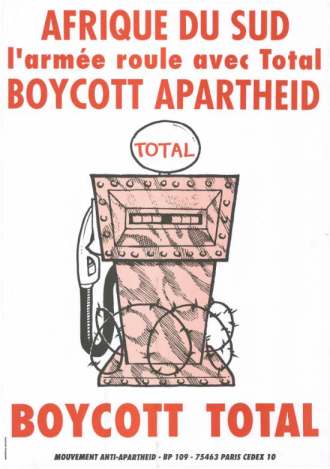
The Anti-Apartheid Movement in Britain originated as a boycott campaign against South African produce in 1959. It organised boycotts of Cape Fruit, Outspan oranges, and a range of other products, as well as of businesses like Barclays and Total which operated in South Africa. Even if this campaign – and others around the world – didn’t pose as much as a threat to the apartheid state as the sanctions of the 1980s, what they achieved was to make ordinary people aware of apartheid by appealing to them not to support the South African economy.

There seems to have been an increase in this kind of political consumer boycott since the 1980s, and probably as a result of a heightened awareness of the connection between the exercise of political power and the emergence of global corporations. One of the best – and most successful – examples of these was the Nestle Boycott organised by War on Want and other groups in 1977, to draw attention to the link between the marketing of infant formula and high rates of child mortality in the developing world.

But political consumerism and consumer boycotts have existed long before then. In fact, the abolitionist movement has been described as one of the first examples of concerted consumer activism in support of a political cause. Not only could early opponents to slavery buy abolitionist-themed crockery from Wedgwood, but, particularly during the nineteenth century, abolitionists all over the world refused to buy American sugar or cotton.

Lawrence B. Glickman writes:

consumer activism – the attempt to mobilise consumers for political purposes – has been important to American political culture at least since the Boston Tea Party. Indeed…American national identity was forged in no small part through collective acts of consumption. Central to African American claims for political and economic inclusion have been demands for…‘consumer entitlement,’ ranging from boycotting Jim Crow street cars to taking advantage of the ‘autonomy and anonymity’ of catalogue shopping as a way of avoiding mistreatment by merchants, to boycotting tourism in South Carolina as a way of protesting the Confederate flag that until recently flew over the state house. Similarly…among many women in the Progressive Era ‘consumer consciousness built political consciousness’ as they boycotted unsafe and costly food and campaigned for minimum wages and decent labour standards for those who produced what they bought.

It’s striking how frequently consumer boycotts have been used by those who are politically and socially marginalised, to demand equal treatment and an end to discrimination. They were a key strategy in the American Civil Rights movement, and featured to some extent in the Defiance Campaign against apartheid legislation in the early 1950s, and, later, during the township rebellion in the 1980s.

Some of the earliest consumer boycotts in the United States and Britain were organised by women, and usually in response to sudden increases in the price of staple foods. For instance, in 1902, immigrant Jewish women in New York organised a boycott after the price of Kosher beef increased by half. By withdrawing their support from local butchers – and, admittedly, rioting in lower Manhattan – they managed to reduce prices.

In 1924 and 1933, Jewish women in Toronto – many of them members of communist groups – also organised boycotts of Kosher butchers to protest rising prices of meat. On both occasions, significant numbers of women were mobilised not only to stop shopping for meat, but to picket butchers.

Indeed, there were widespread boycotts organised by women during the Great Depression. These ‘housewives’ protests’ were part of a broader movement in which women sought to mitigate the effects of the Depression by lobbying government, planting community gardens, establishing bartering systems for food and other goods, and even engaging in acts of civil disobedience. In Cleveland, for instance, black mothers protested a power company’s decision to switch off electricity as a result of non-payment of bills, by hanging wet washing over the power lines. The electricity was switched on the next day.

In 1946, the Washington Committee for Consumer Protection was formed by a group of women – including some who had been active in union politics during the 1930s – to organise boycotts of red meat and other products to protest the increase in food prices at the end of the Second World War. (The American government had kept them artificially low during the conflict.) Other committees organised boycotts of milk and dairy products for similar reasons.

Boycotts demonstrate particularly well that buying power – and the exercise or withholding of this power – seems to function as a replacement of real access to political power for those who are socially marginalised.

I don’t want to suggest for a moment that there’s an equivalence between the heroic housewives of 1930s America and the white nitwits who are trying – and probably failing – to organise a boycott of Woolworths. But I do think that the rage which has propelled this boycott suggests that there is a section of South Africa’s white population which feels – with some justification – that its interests are not being represented by mainstream political parties. And this is worth taking seriously.

Further Reading

Monroe Friedman, ‘American Consumer Boycotts in Response to Rising Food Prices: Housewives’ Protests at the Grassroots Level,’ Journal of Consumer Policy, vol. 18 (1995), pp. 55-72.

Lawrence B. Glickman, ‘“Buy for the Sake of the Slave”: Abolitionism and the Origins of American Consumer Activism,’ American Quarterly, vol. 56, no. 4 (Dec., 2004), pp. 889-912.

Lawrence B. Glickman, ‘The Strike in the Temple of Consumption: Consumer Activism and Twentieth-Century American Political Culture,’ The Journal of American History, vol. 88, no. 1 (Jun., 2001), pp. 99-128.

Matthew Hilton, ‘The Female Consumer and the Politics of Consumption in Twentieth-Century Britain,’ The Historical Journal, vol. 45, no. 1 (Mar., 2002), pp. 103-128.

Stacy Kinlock Sewell, ‘The “Not-Buying Power” of the Black Community: Urban Boycotts and Equal Employment Opportunity, 1960-1964,’ The Journal of African American History, vol. 89, no. 2, African Americans and the Urban Landscape (Spring, 2004), pp. 135-151.

Annelise Orleck, ‘“We Are That Mythical Thing Called the Public”: Militant Housewives during the Great Depression,’ Feminist Studies, vol. 19, no. 1 (Spring, 1993), pp. 147-172.

Kathleen C. Schwartzman, ‘Can International Boycotts Transform Political Systems? The Cases of Cuba and South Africa,’ Latin American Politics and Society, vol. 43, no. 2 (Summer, 2001), pp. 115-146.

Andor Skotnes, ‘“Buy Where You Can Work”: Boycotting for Jobs in African-American Baltimore, 1933-1934,’ Journal of Social History, vol. 27, no. 4 (Summer, 1994), pp. 735-761.

Dietlind Stolle, Marc Hooghe, and Michele Micheletti, ‘Politics in the Supermarket: Political Consumerism as a Form of Political Participation,’ International Political Science Review, vol. 26, no. 3 (Jul., 2005), pp. 245-269.

Lynne Taylor, ‘Food Riots Revisited,’ Journal of Social History, vol. 30, no. 2 (Winter, 1996), pp. 483-496.

Creative Commons License
Tangerine and Cinnamon by Sarah Duff is licensed under a Creative Commons Attribution-ShareAlike 3.0 Unported License.

Food Links, 05.09.2012

Trish Deseine on food in Ireland.

A wet British summer pushes up the price of salad ingredients.

Why meatless Monday is a good thing.

The corn complex.

The goat slaughter.

In Colombia, chocolate cultivation gives way to cocaine.

One of the side-effects of the US drought is sweeter fruit.

Fast-food preferences and politics.

Obama loves beer.

Possibly the most hilarious menu ever. (Thanks, Mum!)

Kate Bush talks to Delia Smith about vegetarianism.

A day in the life of a Mumbai sandwichwallah.

A meditation on hot dogs.

The life and work of a melissopalynologist.

Is tripe over-rated? (Thanks, Ester!)

A cookbook about cookbooks.

So what is the future of beer?

Cafe Riche and the Egyptian revolution.

The shifting price of steak.

A new English-Xhosa-Afrikaans dictionary of wine.

The perfect custard tart.

On stracciatella.

Kiefer Sutherland bakes cupcakes.

The daftness of the paleo diet.

Why luxury foods aren’t worth it.

Julia Child’s correspondence with Avis DeVoto.

What are the origins of the Brazil nut groves in the Amazon?

A history of oven temperatures.

Preserving green beans in oil.

Sculptures made out of food.

How to dismantle a chicken.

The original House of Pies.

Robert Penn Warren’s birthday cocktail.

Which British delicacies should be awarded protected status? (With thanks to David Worth.)

A short history of the gin and tonic.

The best water bottle ever.

The Department of Coffee in Khayelitsha.

The art of the British picnic.

Food and Roald Dahl.

The New York Times on South African craft beer.

Bizarre: emasculated manly food. (Thanks, Jane-Anne!)

An interview with the glorious Mary Berry.

The Root of the Evil

Over the past few weeks I’ve been watching with barely-disguised glee, the evisceration of a recent Newsweek article by Niall Ferguson – pet historian of the American right – in which he provides a deeply flawed analysis of Barack Obama’s past four years in power. As Matthew O’Brien notes, before systematically working through Ferguson’s argument (or, indeed, ‘argument’), ‘He simply gets things wrong, again and again and again.’

I’m no fan of Ferguson’s. This has less to do with our political differences – in relation to him, I’m so left-wing I should be living in a Himalayan hippy commune practising an obscure form of yoga while teaching Capital to peasants – but because of the way he shapes his interpretations of the past to suit a particular neoliberal agenda.

Of course, no historian is capable of writing an absolutely objective history of anything – nor would we want to because it would be dreadfully boring – but Ferguson presents, and defends, his arguments on the grounds that they are absolute truth.

He was called out on this last year by Pankaj Mishra, in a fantastic review of Civilisation: The West and the Rest for the London Review of Books. In Civilisation, Ferguson argues that

civilisation is best measured by the ability to make ‘sustained improvement in the material quality of life’, and in this the West has ‘patently enjoyed a real and sustained edge over the Rest for most of the previous 500 years’. Ferguson names six ‘killer apps’ – property rights, competition, science, medicine, the consumer society and the work ethic – as the operating software of Western civilisation that, beginning around 1500, enabled a few small polities at the western end of the Eurasian landmass ‘to dominate the rest of the world’.

Leaving aside the strange question of why an historian writing in the twenty-first century thinks that it’s possible to divorce the ‘West’ (whatever we may mean by that) from the rest of the world – and even why an historian feels like writing a triumphalist history of Europe and North America (I thought we stopped doing that in the sixties?) – this is a history which largely ignores, or plays down, the implications of modern capitalism and globalisation for those people outside of the West.

As in his writing on the creation of European empires, Ferguson has a problem with accounting for the widespread resistance of Africans, Asians, and others to European conquest – and the violence and exploitation which followed colonisation. Mishra writes:

he thinks that two vaguely worded sentences 15 pages apart in a long paean to the superiority of Western civilisation are sufficient reckoning with the extermination of ten million people in the Congo.

Recently I’ve been thinking a great deal about a comment which Roger Casement made in a report for the British government about atrocities committed in the Congo Free State during the late nineteenth century. Writing in 1900, he concluded:

The root of the evil lies in the fact that the government of the Congo is above all a commercial trust, that everything else is orientated towards commercial gain….

The Congo Free State came into being at the 1884-1885 Berlin West Africa Conference, where the assembled representatives of European states acknowledged the Belgian king’s right to establish a colony in central Africa. Leopold II’s International Association – a front organisation for his own commercial interests – was allowed to operate in the region.

There were strings attached to the deal – Leopold had to encourage both humanitarianism and free trade, for instance – but with the sharp increase in international demand for rubber in the 1890s, after JB Dunlop’s invention of inflatable rubber tyres, Leopold’s interest in the Congo, which had only ever extended to exploiting the country for its natural resources, narrowed even further. Leopold operated his own monopoly on the rubber trade, leasing some land to other companies on the proviso that they pay him a third of their profits.

The ‘evil’ to which Casement referred was the transformation of the Congolese population into a mass of forced labourers compelled to contribute quotas of rubber to the various businesses operating in the Free State. Those who failed to do so, those who refused to do so, or those who were suspected of not doing so, faced brutal reprisals from the State’s Force Publique, including being killed, often along with their families; having their hands cut off; and seeing their villages and property burned and destroyed.

It’s estimated that ten to thirteen million Congolese died as a result of murder, starvation, exhaustion, and disease between 1885 and 1908, when international condemnation of Leopold’s regime forced the Belgian government to take control of the Free State.

Although other colonial regimes in Africa could be brutal, violent, and unjust, none of them – with the possible exception of Germany in (what is now) Namibia – managed to commit atrocities on the scale that Leopold did in the Congo. As Casement makes the point, ‘the root of the problem’ was that the Congo was run entirely for profit, and that the businesses which operated in the region were not regulated in any way. This was capitalism at its most vicious.

But what does this all have to do with food? Well I was reminded of Casement’s comment when reading about Glencore’s response to the current droughts – chiefly in the US, but also elsewhere – which are partially responsible for global increases in food prices:

The head of Glencore’s food trading business has said the worst drought to hit the US since the 1930s will be ‘good for Glencore’ because it will lead to opportunities to exploit soaring prices.

Chris Mahoney, the trader’s director of agricultural products, who owns about £500m of Glencore shares, said the devastating US drought had created an opportunity for the company to make much more money.

‘In terms of the outlook for the balance of the year, the environment is a good one. High prices, lots of volatility, a lot of dislocation, tightness, a lot of arbitrage opportunities [the purchase and sale of an asset in order to profit from price differences in different markets],’ he said on a conference call.

This weekend, it was revealed that Barclays has made more than £500 million from food speculation:

The World Development Movement report estimates that Barclays made as much as £529m from its ‘food speculative activities’ in 2010 and 2011. Barclays made up to £340m from food speculation in 2010, as the prices of agricultural commodities such as corn, wheat and soya were rising. The following year, the bank made a smaller sum – of up to £189m – as prices fell, WDM said.

The revenues that Barclays and other banks make from trading in everything from wheat and corn to coffee and cocoa, are expected to increase this year, with prices once again on the rise. Corn prices have risen by 45 per cent since the start of June, with wheat jumping by 30 per cent.

What bothers me so much about these massive profits is partly the massive profits – the fact that these businesses are actually making money out of a food crisis – but mainly it’s that these monstrously wealthy businessmen are so unwilling to admit that what they’re doing is, even in the most charitable interpretation, morally dubious.

Barclays’s claim that its involvement in food speculation is simply a form of futures trading is disingenuous: futures trading is an entirely legitimate way for farmers to insure themselves against future bad harvests. What Barclays and other banks, as well as pension funds, do is to trade in agricultural commodities in the same way as they do other commodities – like oil or timber.

In 1991, Goldman Sachs came up with an investment product – the Goldman Sachs Commodity Index – which allowed for raw materials, including food, to be traded as easily as other products. When the US Commodities Futures Trading Commission deregulated futures markets eight years later, for the first time since the Great Depression, it became possible to trade in maize, wheat, rice, and other foodstuffs for profit.

The current food crisis has been caused by a range of factors – from the drought, to the excessive use of maize and other crops for biofuel – and exacerbated by climate change and pre-existing conflicts, corruption, inequalities, and problems with distribution. In Europe, unemployment and low wages will add to people’s inability to buy food – hence the rise in demand for food banks in Britain, for example.

Food speculation has not caused the crisis, but it does contribute to it by adding to food price volatility. I’m not – obviously – comparing Glencore or Barclays to Leopold II’s International Association, but the atrocities committed in the Congo Free State provide an excellent example of what happens when capitalism is allowed to run rampant. Let’s not make that mistake with our food supply.

Creative Commons License
Tangerine and Cinnamon by Sarah Duff is licensed under a Creative Commons Attribution-ShareAlike 3.0 Unported License.

Foodie Pseudery (29)

Earlier this year, Brooklyn (where else?) hosted the GoogaMooga festival, featuring both musicians and food. It took itself Very Seriously Indeed. Calling it  ‘the ultimate vortex for American food and music’, the New York Times hyperventilated:

It can’t be an accident that many of these places and personalities resonate with fresh-out-of-college food hunters who seek transcendence through a Korean taco just as their Generation X forebears once sought it through the Smiths, Run-D.M.C. or Fugazi.

If John Lennon and Sinead O’Connor once stirred cultural ferment, it’s now meat-loving knife-slingers (as in David Chang, Gabrielle Hamilton, Jon Shook and Vinny Dotolo) who are seen as having that ‘anti-establishment, sticking-it-to-the-man mentality,’ said Graham Elliot, the Chicago chef who has been culinary director for Lollapalooza since 2010.

Food Links, 29.08.2012

The hidden costs of hamburgers.

What can American’s healthcare system learn from Cheesecake Factory?

A former McDonald’s executive opens a chain of health food restaurants.

Baking bread in Beirut.

What Ireland eats every night.

The terrible tragedy of the healthy eater.

San Francisco has the largest number of restaurants per household in the US.  New Orleans has the most bars.

Favourite dishes from countries competing in the Olympics.

Are Japan’s eel restaurants in danger? (Thanks, Mum!)

Dan Lepard‘s pop-up bakery.

Paying with maple syrup.

Arabella Boxer’s Book of English Food.

Woman vs (bread) machine.

So what *do* Britons call their mealtimes? (Thanks, Anupama!)

Bolivia seeks to expel Coca Cola.

How to make mole.

How to pick the perfect mealie.

Lamb biryani.

Seedless watermelon?

Early Modern recipes for medicine.

Imogen Heap sings Chladni lines into salt.

Red wine and coke.

Lake Trout, a deliberately crappy restaurant. In Williamsburg. Obviously.

A profile of Anita Lo, New York chef. (Thanks, Carl!)

Putting the ‘h’ back into ‘yoghurt‘.

British icons in biscuits.

New York’s biggest roof-top farm. (Thanks, Rafaella!)

Microwave turkish delight.

Four new flavours of ice cream.

Cake.

A pop-up shop which, quite literally, pops up.

Lobster and caviar burgers.

Domestic Science

Lovely readers! This week’s post appears on the delightful blog The Flick. It’s about feminism and convenience food – do take a look.

Food Links, 22.08.2012

Raj Patel on the banking industry’s long history of profiting from drought.

Glencore admits that the US drought is good for business.

What are the health implications of farmers’ use of vaccines on their animals?

The end of the low-fat fad.

Cars, supermarkets, and feeding the city.

The world’s hottest chilli seems to be offering some Indian farmers a route out of poverty.

How the brain creates flavour.

Still lifes of Olympic athletes’ diets.

Vegetables in exchange for recycling?

Tunisian bakers in France.

What will we be eating in twenty years? (Thanks, Inna!)

The Herat Ice Cream Company.

Photographs of the first coffee shop in Khayelitsha.

Eating Nigerian cuisine in London.

Learning how to eat in South Korea.

A review of Jenny Rosenstrach’s Dinner: A Love Story.

Feuding in the Greek yogurt industry.

Recipes from famous writers.

A guide to Afghan food.

London’s best food trucks.

The rise of the food paparazzi.

David Simon on food, eating, and his father.

The world’s best edible coffee cup: made out of cookie.

McDonald’s in India.

The Middle Class Handbook on prosecco.

Easily portable soy sauce.

On running a bakery in Portland, Oregan.

You can never have too many blackberries.

The New York Times on where to eat in…Brixton.

A blog for waiters, waitresses, and those who do the serving in restaurants.

Ice cream truck turf wars in New York.

How to make your own mustard.

Gather – a new journal of food writing.

How to make chocolate fondue.

The rise of the doughnut.

How waiters make punters part with their money.

These are courtesy of my Mum:

The World Carrot Museum.

Odd things to do with watermelons.

Lunch hour in New York City.

So who invented bubble tea?

Japan bans raw beef liver in restaurants.

Thirsty Knowledge

I’ve recently resuscitated my iTunes account, and I’ve been re-acquainting myself with the joys of the podcast. As a mad fan of Internet radio, having the most recent episodes of More or Less, the New York Times Book Review, the Guardian‘s Science Weekly, NPR’s Fresh Air, the Granta Podcast and, obviously, the Food Programme, arriving periodically is a glorious thing.

Relatively recently, I’ve become faintly obsessed with This American Life, and have relied on its extensive archive to keep me sane while writing lectures. I particularly enjoyed two, linked, episodes on Pennsylvania State University. The first, broadcast in December 2009, is an account of why Penn State has consistently been nominated as ‘America’s number one party school,’ and the second, from the end of last year, revisits the university’s reputation for heavy drinking in light of the recent scandal.

As you’d expect of This American Life, both episodes are thoughtful, intelligent accounts of life in State College, PA, where townsfolk have to put up with the antics of drunken students – from stealing traffic signs, to urinating in private gardens – and where the university’s various strategies for dealing with the campus’s drinking culture are impeded by a strong lobby from alumni and other donors.

A lot of what these episodes covered felt familiar. I grew up in a South African university town and now hold a fellowship at that university. The institution is based in the heart of the country’s wine-producing region, so alcohol is cheap and plentiful. As someone with a comically low tolerance of alcohol, I’ve never been a big drinker. I sailed through university as, usually, the only sober person at parties.

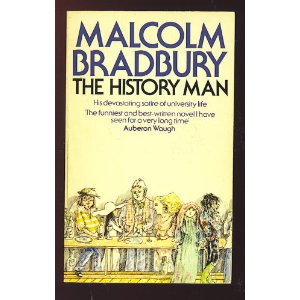
A while ago, I wrote a post about academia and the food at conferences, and one of the themes in the responses I received was that I needed to focus more on the booze. And that’s absolutely true: while we may be – justifiably – concerned about undergraduate binge drinking, there’s a stereotype that academics drink – in the same way that we dress badly, drive banged-up cars, and are chronically forgetful. As Malcolm Bradbury writes in The History Man (1975):

It has often been remarked, by Benita Pream, who services several such departmental meetings, that those in History are distinguished by their high rate of absenteeism, those in English by the amount of wine consumed afterwards, and those in Sociology by their contentiousness.

I think that many would suggest that Benita’s point about the wine could apply to all departmental meetings, regardless of the discipline involved.

Just about every decent campus novel contains at least one scene of drunken, academic embarrassment. Or, indeed, in Kingsley Amis’s Lucky Jim (1954), of success. Jim Dixon spends most of the novel either pursuing the pretty-but-dim Christine in a fairly desultory way, or trying – in post-war, still rationed Britain – to scrape together enough money to buy cigarettes and drink.  In the famous, final scene, he gets completely hammered, delivers a speech which should get him fired, but which, instead, gets him both the girl and his dream job.

My two favourite campus novels, The History Man and Michael Chabon’s Wonder Boys (1995) – yes the one that was turned into the surprisingly fun movie – both feature heroes whose academic careers are linked to the – occasionally excessive – consumption of alcohol and various banned substances. Both novels have parties at key turning-points in the narrative. In The History Man the suave socialist sociologist Howard Kirk and his long-suffering wife, Barbara, host parties at the beginning and end of the novel – places where students and lecturers at a red brick, radical university mingle, discussing contraception, Hegel, revolution, and, of course, religion:

No sooner are the first arrivals in the living-room, with drinks, talking breastfeeding, when more guests arrive. The room fills. There are students in quantities; bearded Jesus youths in combat-wear, wet-look plastic, loon-pants, flared jeans, Afghan yak; girls, in caftans and big boots, with plum-coloured mouths. There are young faculty, serious, solemn examiners of matrimony and its radical alternatives…. Howard goes about, a big two-litre bottle hanging on the loop from his finger, the impresario of the event, feeling the buoyant pleasure of having these young people round him…. He poured wine, seeing the bubbles move inside the glass of the bottle in the changing lights of his rooms.

Howard maintains – and gains – his position of power within his department and on his campus by wielding wine at important moments.

The appropriately named Grady Tripp in Wonder Boys uses grass and a range of other drugs – legal and illegal – to cope with the collapse of his marriage, his career, and his reputation as a writer. He holds a position at a small liberal arts university in Pittsburgh, but can’t finish his novel, is having an affair with the Chancellor, and has been (deservedly) deserted by his wife. Over the course of the university’s annual Wordfest weekend, his life falls apart. As in The History Man, parties take place at pivotal moments – one of them in Grady’s house. He returns to discover

writers in the kitchen, making conversation that whip-sawed wildly between comely falsehood and foul-smelling truths, flicking their cigarette ash into the mouths of beer cans. There were half a dozen more of them stretched out on the floor of the television room, arranged in a worshipful manner around a small grocery bag filled with ragweed marijuana, watching Ghidorah take apart Tokyo.

But most academic drinking is done more decorously: over dinner, and after conferences and workshops. Some of the Oxford and Cambridge colleges have legendarily well-stocked cellars. Just about every seminar I attended in London ended with a trip to the pub. There’s even a Radio 4 series called The Philosopher’s Arms, where Matthew Sweet and a collection of philosophers discuss ideas and issues in a real pub:

Welcome to the Philosopher’s Arms, the only boozer in Britain where, if you ask the landlady whether there’s a happy hour, she’ll remind you of the words of John Stuart Mill: ‘Ask yourself whether you are happy, and you’ll cease to be so.’

The appeal of the pub is that it allows for the usually fairly byzantine rules which govern academic life to relax a little. Anxious postgrads get to talk to well-known, senior researchers, gossip is exchanged, and friendships and alliances formed. One very grand historian who used to convene a weekly seminar I attended, was transformed from an incisive and ruthless eviscerator of poorly-constructed arguments, to a jovial old cove as he nursed his half-pint of real ale.

It’s also true that pubs and drinking can be used to exclude those who don’t drink, for whatever reason, or those who don’t feel welcome in pubs or bars. As AS Byatt points out in an interview with the Paris Review, up until the mid-1960s, university departments could prevent their female staff from contributing to important decisions by conducting meetings in pubs, then an almost exclusively male preserve.

But I don’t think that it’s any coincidence that pubs, in particular, feature so strongly in a lot of the mythology surrounding significant moments in academia: in the discovery of the double helix structure of DNA, and in the meetings of the Inklings – the most famous members of which were CS Lewis and JRR Tolkien – at the Eagle and Child in Oxford, for instance. Pubs – and other, similarly festive occasions involving drinking – provide academics with a chance to talk and to think beyond the usual strictures of academia and, in doing so, to arrive at new and surprising ideas.

Creative Commons License
Tangerine and Cinnamon by Sarah Duff is licensed under a Creative Commons Attribution-ShareAlike 3.0 Unported License.

Foodie Pseudery (28)

Although I usually cringe a little when chefs describe cooking as an art, there is part of me which understands exactly what they mean: cooking and baking can feel as creative as drawing, sewing, or writing. I’m not surprised, then, that a chef in San Francisco has developed what she calls ‘poetic culinaria’. This is a concept with the potential to be sublime, but which seems to be, at least in this fawning article in the Wall Street Journal, ridiculous.

Last month, [chef Dominique Crenn] was walking her boxer and two Chihuahuas in Buena Vista Park with a friend while they discussed an impending state ban on foie gras, pate made from the livers of force-fed geese and ducks. Ms. Crenn said she then spied a bird’s nest in a tree.

‘That’s it. I must begin again,’ without foie gras, she thought. It struck her that a dish, titled ‘Birth,’ using the remnants of her foie gras supply combined with a bird’s nest, would represent a new beginning.

On Saturday morning a week later, Ms. Crenn experimented with some elements for “Birth.” She dropped a purée of corn and melted foie gras fat into liquid nitrogen to create little frozen balls that looked like eggs. She also melted chocolate with porcini powder and streamed ribbons of the mixture into cold water to form thin branches.

While a team of five raced through chores, Ms. Crenn appeared in a deep calm as she recreated foie gras beads and chocolate ribbons. The moment she completed a task, she darted out of the kitchen with ninja-like alacrity, perhaps reflecting her 10 years of judo training, and returned with materials for a new task.

Juan Contreras, her 29-year-old pastry chef, immediately critiqued it, suggesting she should have used branches of salsify instead of chocolate. For a split second, Ms. Crenn’s girlish enthusiasm wilted, her deep-set eyes turned downcast, a flash of vulnerability that vanished as quickly as it came.