Skip to content

Foodie Pseudery (22)

This is from a New York Times article about ‘mindful eating’:

What followed was captivating and mysterious. Surrounded by a murmur of clinking forks, spoons and chopsticks, the Blue Cliff congregation, or sangha, spent the lunch hour contemplating the enjoyment of spice, crunch, saltiness, warmth, tenderness and like-minded company.

Some were thinking, too, about the origins of the food: the thousands of farmers, truck drivers and laborers whose work had brought it here.

As their jaws moved slowly, their faces took on expressions of deep focus. Every now and then came a pause within the pause: A chime would sound, and, according to the monastery’s custom, all would stop moving and chewing in order to breathe and explore an even deeper level of sensory awareness.

It looked peaceful, but inside some of those heads, a struggle was afoot.

Food Links, 25.04.2012

Famous explosions recreated with cauliflower.

Bertha Haffner-Ginger, godmother of the Mexican food craze.

How climate change is transforming the wine industry in the Old World.

How agriculture and the food industry are responding to Ireland’s high levels of unemployment.

An egg sandwich.

Read more

Good Americans

Alongside history, I majored in English and French. (The three, rather than two, majors were due to the fact that I would qualify to enter a scholarship competition organised by the French government to study on Réunion for a month, if I took French in my third year. I did, and I won.) In French we had a thorough introduction to literary traditions of France and her colonies. In English we had a thorough introduction to French literary theory.

Read more

Food Links, 18.04.2012

Syllabub revisited and sugar plum theories.

Maslow’s hierarchy of crisps.

The pros and cons of coconut milk.

Redefining Mormon cuisine.

Old fashioned remedies for weight gain.

The ento box.

Why some bus stops may soon smell like baked potatoes.

Cupcakes are ruining everything. (Thanks, Elizabeth!) And the problem with cupcake feminism.

In praise of rice and beans.

It’s all about bacon. (Thanks, Mum!)

The Americanisation of ‘ethnic’ food.

On cold toast.

I’ve a piece on Woodstock in April’s edition of Crush.

A cat eating corn on the cob. For Life Magazine. I know. I know.

Why we should embrace moderation in what we eat.

Menu design in America, 1850-1985.

The end of cheap coffee.

The Grand Canyon bans bottled water – and annoys Coca Cola.

Fennel facts.

On Elizabeth David.

The quickest, easiest way to cook a hot meal without a kitchen.

Gourmet gaming.

Badaude on how to cure a hangover.

The future of chocolate.

The secret to cheaper, greener local beer.

Why are there so few top female chefs?

Seven secrets about baking powder.

Natural and Dutch-process cocoa.

Eric Schlosser on food and class.

Hot Cross Bun Fight

Just before Easter this year, a group of Christians in South Africa objected to the labelling of hot cross buns at Woolworths, a premium supermarket, as halal. Possibly chastened by the furore which erupted over its stocking of Christian magazines a couple of years ago, Woolies apologised. But, wonderfully, the response of the South African public was hilarity: what on earth, asked people on social media and radio chat shows, was wrong with making hot cross buns available to Muslims?

As many pointed out, it would be interesting to see if these Christians also avoided McDonald’s, KFC, Nando’s or any of the other fast food chains which serve halal food. In a country as socially and culturally diverse as South Africa, it makes sense for restaurants and shops to sell halal and kosher products. Most chicken sold in South Africa is halal, for instance.

In fact, the South African Easter meal of choice is pickled fish – a dish developed by slaves brought to the Cape from southeast Asia, India, and elsewhere during the seventeenth and eighteenth centuries. Many of these slaves would have been Muslim, a religion tolerated by the Dutch and, later, British authorities on the grounds that they believed it to be ‘civilised’ and unlikely to encourage slaves to revolt or disobey their masters and mistresses.

So South African Christians eat a dish at Easter which was created by Muslim slaves more than two centuries ago. And even those who are not Christian eat it: we had my Mum’s version of pickled fish on Good Friday – based on a recipe my Great-Grandmother cooked – with pilaf instead of the usual bread-and-butter, and it was delicious.

My Mum's pickled fish

I was interested by the hot cross bun debate because – I think – it’s the first major discussion South Africans have had about the labelling of halal food. Last year there was some controversy about a meat supplier which allegedly sold haram meat as halal, but the debates then were about the regulation of the meat industry, and not about the public’s willingness – or otherwise – to eat halal food.

This ‘storm in a baking pan,’ as Father Chris Townsend of the Southern African Catholic Bishops’ Conference put it, was fairly unusual, in international terms, in the way that it was greeted with such widespread condemnation. In France, the first country in Western Europe to ban women from wearing the burqa and niquab in public, the labelling of halal food is now an electoral issue. Concerned by the depressing popularity of far-right loon Marine le Pen, Nicolas Sarkozy announced in January that if re-elected, he would enact legislation to ensure that all halal foods are clearly labelled. (You can donate to Francois Hollande’s campaign here.)

Sarkozy justified these new measures – which angered Jewish leaders as well – by implying that the ritual slaughter of animals for halal and, by implication, kosher meat is inhumane. But French Muslims argue that Sarkozy and the French right’s attack on ritual slaughter has less to do with the treatment of animals than it does to broader debates about multiculturalism and social integration in France. As one French blogger commented:

Nicolas Sarkozy and Marine Le Pen have resorted to this because they have no solutions to the real problems. It’s the last desperate thrashings of a mad dog that has nothing to lose. It’s part of a chain of thought that goes from halal meat to Islamism to terrorism.

This isn’t the only recent debate about the labelling of halal meat and ritual slaughter. Australia and Canada have seen similar discussions, and the Daily Mail seems to specialise in a kind of hysterical journalism which links the widespread availability of halal meat to the end of Britain and the imminent arrival of Armageddon. Religious slaughter is banned in New Zealand, Switzerland, Luxembourg, Norway, and Sweden. An attempt to enact a similar ban in the Netherland last year was blocked at the last minute.

What makes these debates interesting is that they are hardly new. David Smith writes that in 1995,

a federal German court effectively banned Muslims from slaughtering animals without prior stunning. The court ruled that the practice was not required by their religion and was thus not protected by the constitution’s guarantee of freedom of religious expression. In January 2002, however, the Federal Constitutional Court ruled that the right to freedom of religious expression and choice of occupation did in fact ensure the entitlement of Germany’s Muslims, or at least those responsible for their provision with halal meat, to resume stunningless methods for such ends without the threat of legal action.

In his excellent Franz Kafka, the Jewish Patient (1995), Sander Gilman explores shifting attitudes towards shehitah, the slaughter of animals in accordance with Judaic law and custom. In the 1880s and 1890s, various campaigns to outlaw shehitah emerged in Europe. In Germany, only Saxony eventually banned shehitah in 1897. While many supporters of the campaign were anti-vivisectionists or were concerned about the treatment of animals in abattoirs, there is no coincidence that this interest in the butchering of kosher meat developed at the same time as a wave of anti-Semitism swept Europe.

In 1883, delegates at a meeting of the Congress for the Protection of Animals in Vienna argued that the protection of ritual slaughter was an indication of Jewish influence over European politics. But others pointed out that the attempt effectively to ban kosher meat was driven by anti-Semitism. In 1885, the Lord Mayor of London compared the campaign to the allegations around Jewish ritual murder during the medieval period. The liberal Berlin Daily News declared in 1893 that those opposed to ritual slaughter were ‘pure anti-Semites’. Unsurprisingly, the Nazis outlawed ritual slaughter – also in the name of preventing cruelty to animals – during the 1930s.

There is, then, an obvious link between anxiety about religious difference, and even racism, and concerns about ritual slaughter. That said, expressing concern about the ways in which animals are slaughtered should not necessarily immediately be construed as religious or cultural intolerance. Countries need to find a balance between facilitating the religious practices of all their citizens, and the humane treatment of animals.

The South African hot cross bun fight (ahem, sorry) was not, though, about ritual slaughter. The Christians who complained about the labelling of hot cross buns in Woolworths were angry about the association of a Christian symbol – the cross on the bun – with a sticker connected to Islam. Next year, Woolies will sell hot cross buns (without the halal sticker) and spiced buns (with a halal sticker). The buns will be identical, with the exception of a flour-and-water-paste cross on the former.

I don’t know enough about the history of attitudes towards religious slaughter in South Africa to position this incident within a broader, historical context, but there are several examples of religious communities coexisting fairly harmoniously during periods of this country’s past. Most of the butchers in nineteenth-century Cape Town were Muslim, for example. This meant that the majority of Victorian Capetonians ate halal meat, regardless of their religious beliefs.

This incident demonstrates not only the extent to which food is integral to the maintenance of religious identities – which is particularly ironic given the fact that so many of the traditions and rituals we associate with Easter have pagan origins – but that people’s anxieties about religious freedom and identity are frequently played out through debates around food.

Further Reading

Sources cited here:

Sander Gilman, Franz Kafka, the Jewish Patient (New York and London: Routledge, 1995).

Pablo Lerner and Alfredo Mordechai Rabello, ‘The Prohibition of Ritual Slaughtering (Kosher Shechita and Halal) and Freedom of Religion of Minorities,’ Journal of Law and Religion, vol. 22, no. 1 (2006/2007), pp. 1-62.

David Smith, ‘“Cruelty of the Worst Kind”: Religious Slaughter, Xenophobia, and the German Greens,’ Central European History, vol. 40, no. 1 (Mar., 2007), pp. 89-115.

Ellen Wiles, ‘Headscarves, Human Rights, and Harmonious Multicultural Society: Implications of the French Ban for Interpretations of Equality,’ Law & Society Review, vol. 41, no. 3 (Sep., 2007), pp. 699-735.

Creative Commons License
Tangerine and Cinnamon by Sarah Duff is licensed under a Creative Commons Attribution-ShareAlike 3.0 Unported License.

Foodie Pseudery (21)

A prize (yet to be determined) to the person who can explain what ON EARTH THIS MEANS:

For food enthusiasts, Fine Dining is not something to be taken lightly as it represents the definition of their culture, based on the newfound pleasure of conviviality, the hunt and curiosity for new tastes.

How does ‘fine dining’ represent the ‘definition’ of a culture? Why is conviviality ‘newfound’? Why must ‘Fine Dining’ not be ‘taken lightly’? Why capitalise ‘Fine Dining’? Why not use a dictionary to define precisely what words mean?

Food Links, 11.04.2012

Abolish the food industry.

Eight ways Monsanto fails at sustainable agriculture.

The rise and rise of KFC in Africa.

What does sweetness sound like?

Inside the matzo industry.

Jezebel is characteristically sensible about the new Caveman Diet fad.

The banana industry in 1935.

An interview with Colin Tudge.

What is mindful eating?

An interview with Judith Jones, Julia Child’s editor.

Yogurt as a tool for social critique and political action in Greece. (No, really.)

Where the staff at Noma like to eat.

How sound influences how we taste food.

A new fashion for iguana meat?

The hidden messages in menus.

Pizza in a jar.

Werner Herzog on chickens.

How to cook like the Beatles and the Rolling Stones.

Five dinner party menus from the Obama administration.

The war against plastic straws.

How to be a jamon carver.

A Russian food primer.

Statistics on pizza consumption.

The dos and don’ts of doughnuts.

President Obama fires a marshmallow cannon.

A black market for designer ice cubes?

A urine-powered restaurant in Melbourne.

How to make your own doner kebab.

Vegetable fat carving.

These are courtesy of my eagle-eyed Mum:

The Great American Cereal Book.

The vegetable man.

Baking the white sandwich loaf of 1950s America. (Really, if you’re going to read any of these links, make it this one.)

Asian ingredients in Senegalese dishes.

The historic cakes of Spitalfields.

Jeffrey Steingarten visits Japan.

A gallery of chickens.

The amazing Coromoto ice cream shop.

Baked hard-boiled eggs.

The Conflict Kitchen.

Feed the Children

There has been some fuss recently around the publication of Charles Murray’s new book, Coming Apart: The State of White America, 1960-2010. Murray, who co-authored The Bell Curve: Intelligence and Class Structure in American Life in 1994, has a reputation for annoying left-leaning academics and public policy makers. His description of the Bell Curve was accused of being blind to cultural and social influences on learning and childhood development, and his most recent polemic has been criticised for its rose-tinted view of the American white working class during the mid-twentieth century.

One of the best criticisms of the book which I’ve come across is Nell Irvin Painter’s article for the New York Times, ‘When Poverty was White.’ Painter, whose History of White People (2010) I urge you to read, makes the point that America has a well-hidden and very recent history of white poverty. She accuses Murray of ‘historical blindness’ caused by his

narrow focus on the cultural and policy changes of the 1960s as the root of white America’s decline. The story of white poverty…is much longer and more complex than he and his admirers realise or want to admit.

Her point is that to understand the nature of poverty – why some families seem incapable of escaping it, why certain members of society seem to be particularly susceptible to it – we need to historicise it.

There is a similar argument to be made about white poverty in South Africa. One of the reasons why photographs of poor whites in South Africa draw such attention is because South Africans tend to think of poverty as being black. Poor whites are a strange anomaly in the economic and racial politics of post-1994 South Africa.

But ‘poor whiteism’ as a social and political phenomenon only disappeared during the economic boom of the early 1960s. Since at least the 1920s, South African governments were preoccupied by the ‘poor white problem’ – by the existence of a substantial group of people who, as the popular author Sarah Gertrude Millin wrote in 1926, could not support themselves ‘according to a European standard of civilisation’ and who could not ‘keep clear the line of demarcation between black and white.’

South Africa’s earliest soup kitchens were not for black, but, rather, for white children. The first child welfare organisations aimed their work not at black families, but, rather, at white families who were poor. South Africa’s attempts to introduce compulsory elementary education in the 1910s and 1920s pertained only to white, not to black, children. This isn’t to suggest that black poverty was somehow less acute or widespread than white poverty. Far from it. State concern about poor whiteism was borne out of a eugenicist belief that, as Millin suggested, white poverty signalled a decline in white power.

The first attempts to eradicate white poverty were directed at families and children. Although we tend to associate the poor white problem with the 1920s and 1930s, there had been a large group of impoverished white farmers in the country’s rural interior since at least the middle of the nineteenth century. By the 1880s and 1890s, colonial politicians, and particularly those in the Cape, were increasingly anxious about this class of whites. This was partly because the numbers of impoverished whites – both in rural and urban areas – had increased during the region’s industrialisation after the discovery of diamonds and gold, but it was also the result of decades of poor education which had produced at least two generations of unemployable whites.

Both in South Africa and in the rest of the world, poverty was racialised during the 1880s and 1890s. The existence of unemployed and unemployable poor whites challenged the association of ‘natural’ supremacy and the exercise of power with whiteness. The term ‘poor white’ no longer simply referred to white people who lived in poverty, but, rather, invoked a set of fears around racial mixing and white superiority.

Impoverished white adults were believed to be beyond saving, as one Cape industrialist argued in 1895: ‘the adults are irreclaimable. You must let them die off, and teach the young ones to work.’ The Cape government poured money into schools for poor white children. In 1905, education became compulsory for all white children in the Cape between the ages of seven and fourteen. Politicians also passed legislation to allow these children to be removed from parents deemed to be unable to care for them appropriately. After the declaration of the Union of South Africa in 1910, government spending on education grew from 14 per cent of the national budget to 28 per cent in 1930.

But the problem did not go away. Industrialisation and economic expansion, as well as the effects of the Great War, two depressions, and urbanisation in the 1920s and 1930s increased the numbers of impoverished whites. By the end of the 1920s, it was estimated that out of a total of 1,800,000 whites, 300,000 were ‘very poor’, and nearly all of these were Afrikaans. The Carnegie Commission of Investigation on the Poor White Question (1929-1932) concluded that an inability to adapt to a changing economic climate, outdated farming methods, and poor education were to blame for the existence of such a large population of impoverished whites.

In 1929, the South African government devoted 13 per cent of its budget to the eradication of white poverty. Much of this went to education, social welfare, and housing. The introduction of more stringent segregationist legislation progressively disenfranchised blacks, and reserved skilled work for whites.

There was also a shift in emphasis in how child welfare societies – the numbers of which had mushroomed during the 1920s – dealt with poor white children. No longer did they only work to ensure that white children were sent to school and adequately cared for by their parents, but they began to focus on how these children were fed.

I’m still trying to account for this new concern about the effects of malnutrition on white children. I think that it was due largely to an international scientific debate about the significance of nutrition in raising both physically and intellectually strong children. Louis Leipoldt – Medical Inspector for Schools in the Transvaal, food writer, Buddhist, poet, and Afrikaner culture broker – was particularly aware of this new thinking about childhood development and nutrition, and wrote about it extensively in publications on child health and welfare in South Africa.

In a report of a survey of the health of children in the Cape published in 1922, the province’s Medical Inspector of Schools, Elsie Chubb, argued that malnutrition was widespread in the Cape’s schools for white children. In most schools, around 10% of the pupils were malnourished. In one school in the rural Karoo, 79% of children were found to be severely malnourished.

Chubb recognised that malnutrition was not purely the result of an inadequate supply of food – although it was certainly the case that many poor parents simply couldn’t afford to buy enough food to feed their children – but of poor diet. Some child welfare volunteers wrote of children sent to school on coffee and biltong, and who returned home at the end of the day for a basic supper of maize meal and cheap meat. Chubb wrote that far too many children were fed on a diet heavy in carbohydrates and animal protein. Children did not eat enough fresh fruit and vegetables, and milk. She recommended that feeding schemes be established to supplement children’s diets with these foodstuffs.

Helen Murray, the headmistress of a girls’ school in Graaff Reinet and active member of the town’s child welfare society explained the contemporary understanding of the link between malnutrition and poor whiteism particularly well in 1925:

In the winter of 1918 our schools had regular medical inspection for the first time. The doctor who inspected told some of us that he had found some fifty children in our poor school suffering from malnutrition and spoke strongly of the results of such a condition. The children were not in danger of dying of starvation, they had dry bread and black coffee enough to prevent that, but they were in danger of growing up to be ‘poor whites’ of the most hopeless type. The body insufficiently nourished during the years of growth would develop physically weak, and the brain as a result would be unfit for real mental effort. The child suffering from years of wrong feeding could not be expected to grow into the strong, healthy, clearheaded man or woman our country needs today, and will need ten and twenty years hence. To see that the underfed child is well fed is not a matter of charity, but must be undertaken in self-defence.

As a result of the inspection, the child welfare society found a room in the town where between fifty and ninety children could be provided with ‘a good, hot meal’ on every school day:

We had been told that these children could be saved from growing up weaklings if they could have one good meal of fat meat, vegetables or fruit, on every school day of the year….

We have the satisfaction of knowing that there has been a marked improvement in the health of the children and of hearing from a Medical Inspector that she has found the condition of the children here better than in many other schools of the same class.

Murray’s experience in Graaff Reinet was not unique. As child welfare societies were established in the towns and villages of South Africa’s vast interior, their first work was usually to establish soup kitchens, either in schools or in a central locations where schoolchildren could be sent before the school day – for porridge and milk – and at lunchtime, for soup or a more substantial meal, depending on the resources of the local society.

In Pietersburg (now Polokwane), to eliminate the stigma of free meals for poor children, all white children were provided with a mug of soup at lunchtime. Better-off parents paid for the soup, thus subsidising those children whose parents could not contribute. In Reitz, local farmers, butchers, and grocers donated meat and vegetables to the soup kitchen, and in Oudtshoorn children were encouraged to bring a contribution – onions, carrots, or cabbage – to their daily meal.

The National Council for Child Welfare, the umbrella body established in 1924 which oversaw the activities of local child welfare societies, liked to emphasise the fact that it was concerned for the welfare of all children, regardless of class or race. Some welfare societies, and particularly those in areas which had large ‘locations’ for black residents, did establish clinics and crèches for black children. But most of the NCCW’s work was aimed at white children in the 1920s and 1930s, and the same was true of the South African state. By the 1920s, most municipalities in towns and cities made free milk available to poor white mothers with babies and very young children.

Increasing state involvement in child welfare, alongside the work of independent societies, had a significant impact on the health of white children in South Africa during the early twentieth century. But it was only because of the growing prosperity and better education of the majority of white South Africans after World War II that white poverty and malnutrition were gradually eradicated in the 1950s and 1960s.

By historicising poverty – by understanding that white prosperity in South Africa is a relatively recent phenomenon – we can understand it as a phenomenon which is not only eradicable, but which is also the product of a range of social, economic, and political forces. As South African governments and welfare organisations were able to reduce white poverty and malnutrition dramatically during the early twentieth century, so it is possible for contemporary governments to do the same.

But charity and soup kitchens were not the sole cause of the disappearance of white poverty and malnutrition. Jobs, education, and better living conditions were as – if not more – significant in ensuring that white children no longer went hungry.

Further Reading

Texts cited here:

SE Duff, ‘“Education for Every Son and Daughter of South Africa”: Race, Class, and the Compulsory Education Debate in the Cape Colony,’ in Citizenship, Modernisation, and Nationhood: The Cultural Role of Mass Education, 1870-1930, eds. Lawrence Brockliss and Nicola Sheldon (Basingstoke: Palgrave Macmillan, 2011).

E.G. Malherbe, Education in South Africa, vol. I (Cape Town: Juta, 1925).

E.G. Malherbe, Education in South Africa, vol. II (Cape Town: Juta, 1977).

E.G. Malherbe, Report of the Carnegie Commission of Investigation on the Poor White Question in South Africa, vol. III (Stellenbosch: Pro Ecclesia-Drukkery, 1932).

Sarah Gertrude Millin, The South Africans (London: Constable, 1926).

Jennifer Muirhead, ‘“The children of today make the nation of tomorrow”: A Social History of Child Welfare in Twentieth Century South Africa’ (MA thesis, Stellenbosch University, 2012).

Other sources:

Vivian Bickford-Smith, Ethnic Pride and Racial Prejudice in Victorian Cape Town (Johannesburg: Wits University Press, 1995).

Colin Bundy, ‘Vagabond Hollanders and Runaway Englishmen: White Poverty in the Cape Before Poor Whitesim,’ in Putting a Plough to the Ground: Accumulation and Dispossession in Rural South Africa 1880-1930, eds. William Beinart, Peter Delius, and Stanley Trapido (Johannesburg: Ravan Press, 1986).

J.M. Coetzee, White Writing: On the Culture of Letters in South Africa (New Haven: Yale University Press, 1988).

Saul Dubow, A Commonwealth of Knowledge: Science, Sensibility and White South Africa 1820-2000 (Oxford: Oxford University Press, 2006).

Marijke du Toit, ‘Women, Welfare and the Nurturing of Afrikaner Nationalism: A Social History of the Afrikaanse Christelike Vroue Vereniging, c.1870-1939’ (D.Phil. thesis, University of Cape Town, 1996).

Hermann Giliomee, The Afrikaners: Biography of a People (Cape Town: Tafelberg, 2003).

Isabel Hofmeyr, ‘Building a Nation from Words: Afrikaans Language, Literature and Ethnic Identity, 1902-1924,’ in The Politics of Race, Class and Nationalism in Twentieth-Century South Africa, eds. Shula Marks and Stanley Trapido (London: Longman, 1987).

Creative Commons License
Tangerine and Cinnamon by Sarah Duff is licensed under a Creative Commons Attribution-ShareAlike 3.0 Unported License.

Food Links, 04.04.2012

Calling time on the pint glass.

Organic pink slime?

A kitchen supper.

Easter baking advice from Dan Lepard and Rose Prince.

The best chocolate animals for Easter.

Robert Scott’s diet in Antarctica.

Honey, from hive to bottle.

Bizarre breakfasts.

How to use your (kitchen) knives properly.

A meditation on kitchen utensils.

Cakes throughout American history.

The curious case of the gigantic sham clam.

A brief overview of royal feasts.

The madness of gourmet crisps.

The surprisingly slow death of prohibition in the US.

A history of julienne soup.

Badaude on how to take a coffee break.

Vandana Shiva on ‘food fascism‘.

How to sell oreos in China. And Trish Deseine’s Oreo peanut butter pie.

Beer in Africa.

A public information film about the coffee bar boom in London during the 1950s and 1960s.

Chocolate-covered sprouts.

Kraft’s underground cheese storeroom.

The Austerity Kitchen.

David Lynch’s ad for David Lynch Coffee.

What (or who) is an ethical vegan?

Five taboo foods.

Pasta by design.

Why you should bake using scales not cups.

Could squirrel meat become fashionable?

America spends less on food than any other country.

Braille burgers.

xkcd on Cadbury Eggs. (Thanks, Mum!)

The evolution of American breakfast cereals.

No Sweeteners

One of the best things about being an academic is the stuff that people send you in the – usually entirely correct – belief that you’ll find it interesting. I’ve had emails about pink slime (for the blog) and on programmes about children’s literature (for my research). Recently, my friend Elizabeth, who’s a lawyer, forwarded me this from Legalbrief:

New draft baby feeding regulations will forbid formula manufacturers from ‘aggressively marketing’ their products to mothers and from sponsoring meals and professional development courses for healthcare practitioners, says a Weekend Argus report. It adds the standards set in the draft regulations, which the Department of Health has released for public comment, intend to promote safe nutrition for babies and young children and restrict inappropriate marketing practices. The department stressed that the regulations would not stop baby formula and complementary foods from being sold at retailers. ‘Although breastfeeding is best, government recognises that some women cannot breast-feed or decide not to breast-feed. These regulations do not in any way compel women to breast-feed against their will,’ the department is reported to have stated.

The proposed regulations, which fall under Section 15 (1) of the Foodstuffs, Cosmetics and Disinfectants Act, 1972, make for fascinating reading. Other than banning trans fats and artificial sweeteners in baby formula, their emphasis is on curtailing the advertising and promotion of artificial foods.

For instance, the packaging of baby formula may not have pictures of infants, young children, or any other ‘humanised figures,’ except for those included in instructions for preparing the product. Tins and containers may not ‘contain any information or make any negative claim relating to the nutritional content or other properties of human milk’, and they’re not allowed to include toys or gifts. Packaging must include in English, in bold letters at least 3mm tall, the message: ‘Breast milk is the best food for babies.’

The regulations will also radically limit the advertising of baby formula shops, in print and online, ban the distribution of gift packs and free samples, and prevent formula manufacturers from sponsoring or donating equipment bearing the logo of their products. These manufacturers may not

provide research grants or any other financial assistance relating to infant or young child nutrition to health care personnel working in a health establishment or health care personnel linked to a health establishment.

Nor may they give doctors, nurses, and health workers gifts, and ‘heads of health establishments, national, provincial and local health authorities shall take measures to promote, support and protect breastfeeding.’

It’s an ambitious piece of legislation, but one which is entirely in line with the World Health Organisation’s International Code on the Marketing of Breast Milk Substitutes. The Code was adapted in 1981, and places stringent regulations on how baby formula is advertised: it advises that baby milk formula should not be allowed to market products directly to pregnant women and mothers with young children, including handing out samples. Products should also state that breast milk is superior to formula.

Implementation of the Code has been slow, and there is evidence to suggest that it has been particularly poorly policed in developing nations where oversight of the activities of powerful multinationals is often lax. The South African regulations are far stricter than the Code, particularly as regards the relationship between the pharmaceuticals industry and academic research, but address a problem which campaigners have long identified: that there is a link between the way in which formula is advertised and how women feed their babies.

This isn’t to suggest that women should have their choices about how they feed their babies curtailed – or that it’s only advertising which causes women to choose to use baby formula. Far from it. The problem, though, is that, particularly in poor nations, advertising or other promotional methods encourage breastfeeding mothers to switch to baby formula when it’s unlikely that they’ll be able to afford to buy more formula, and where they may dilute formula with too much water to make it go further. This water may not be clean, and it’s difficult to keep bottles and teats sterile without electricity or plumbing.

The purpose of these regulations is to ensure that formula manufacturers don’t use the often less than ideal conditions in which mothers in developing nations raise their babies, to their own advantage.

We tend to associate the WHO’s Code with the Nestle Boycott, which was launched in 1977. The Boycott was based on a pamphlet published by War on Want in 1974, titled ‘The Baby Killer’ and, in Switzerland, ‘Nestle Kills Babies’. The charity alleged that Nestle’s advertising strategies were responsible for high rates of child mortality. After a legal tussle as well as an attempt to refute the Boycott’s allegations, Nestle agreed to implement the Code in 1984, although there remains some scepticism as to Nestle’s, and other companies’, commitment to this.

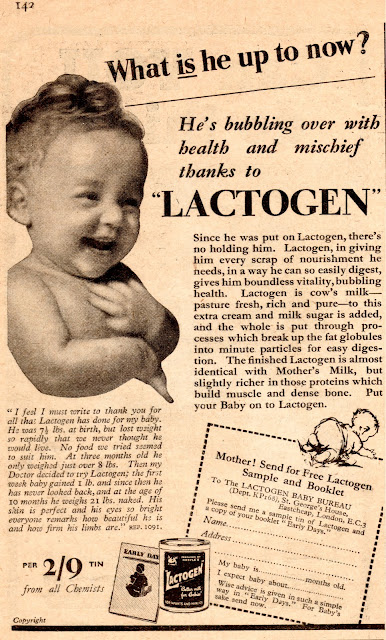
But concern about the advertising of baby formula predated the 1970s, and even the 1940s, when breastfeeding began to decline globally. As I’ve sat in the National Library over the past few months, reading Child Welfare and other child health magazines from the first half of the twentieth century, I’ve been struck by the number of advertisements for baby formula. They all feature fat, healthy babies and testimonials from relieved mothers who claim that the child was fed from birth on Lactogen or whichever other patent food.

Even Truby King, early twentieth-century breastfeeding evangelical and founder of the global mothercraft movement, developed artificial baby food which was produced in New Zealand and then shipped all over the world. Kariol, Karilac, and Karil were meant to be prescribed for babies who were not, for whatever reason, breastfed either as a supplement to cows’ milk, or to be taken on their own.

Although King’s patent foods seemed to contradict his enthusiasm for breastfeeding – and he came under enormous criticism in New Zealand and Australia for his promotion of Kariol and Karilac – there was a certain logic to his decision to manufacture wholesome baby formula. During the early decades of the twentieth century, doctors in Britain and the United States noticed that bottle-fed babies were considerably more likely to die during early infancy than those who were breastfed. Artificial foods – which ranged from thin porridges and condensed milk to baby formulas – were often nutritionally inadequate, particularly in poor families who could not afford better and more expensive substitutes.

But they also identified a link between bottle feeding and diarrhoea, then, as now, one of the main causes of death in infancy. William J. Howarth, the Medical Officer of Health for Derby

arranged in 1900 to receive weekly lists of the births registered during the past seven days from the local registrar. From November of that year until November 1093 women inspectors enquired into the feeding method of each registered child by personally visiting the mother and infant at home.

The results of the study, published in 1905, were telling. Of the infants surveyed, 63% were breastfeed, 17% were partly bottle-fed, and 19% entirely bottle-fed:

The mortality rates from ‘diarrhoea and epidemic enteritis’ in addition to those from ‘gastritis and gastro-enteritis’ were as expected: 52, or 10 per 1,000 of the breastfed, 36 or 25.1 per 1,000 of the mixed-fed, and 94 or 57.9 per 1,000 of the bottle-fed babies died. In other words the mortality rate of the bottle-fed infants was nearly six times greater than that of the breast-fed babies.

Howarth concluded: ‘In not one single instance does the death-rate in any class of disease among hand-fed children even approximate that recorded among children who are breastfed; the rate is invariably higher.’

The problem, in terms of the link between bottle feeding and diarrhoea, was not so much the nutritional content of artificial foods, but the difficulties in keeping them free from contamination, and particularly during summer when infant mortality rates soared.

Indeed, South African advertisements for Lactogen emphasised that the product did not spoil in warm weather. As criticism of artificial foods grew louder, so advertising became more subtle, and better adept at appealing to mothers aware of the potential problems of bottle feeding. Doctors were, though, also aware of the effects of advertising on mothers’ choices, as a medical officer based in Johannesburg wrote in 1925:

No one can deny the fact that the proprietary foods of today are a vast improvement upon those of twenty years ago. They all contain very sound instructions as to the preparation of the food and the amount to be given. The advertising of such foods is carried out on a most extensive scale and in a clever and attractive manner. No hoarding today is without a picture of a flabby and over-fat infant alleged to have been reared solely on the proprietary food advertised thereon. Many a mother who for one reason or another, is not satisfied with the progress of her baby, sees this advertisement, and immediately rushes off to secure this particular food for non-thriving infant.

But not only mothers were influenced by this advertising. He admitted that it was ‘only too true that many medical men and trained nurses are also gulled by such advertisements and circulars’. Dr Cicely Williams, best known for her identification of the condition kwashiorkor in the 1930s, worked in the Colonial Medical Service in West Africa and southeast Asia before World War II and became particularly interested in the treatment of the diseases of early infancy.

She was critical of the introduction of baby formula to Singapore and Malaya, where white-coated sales reps distributed samples of artificial foods to poor mothers. In 1939 she published a pamphlet, ‘Milk and Murder,’ in which she pointed out the benefits to both mothers and babies of breastfeeding.

Nevertheless, Nestle and other companies were still using the same strategies to convince mothers in developing nations to use baby formula in the 1970s, and there are still concerns that they are not fully compliant with the Code on breast milk substitutes. The new South African regulations, if passed, are aimed at remedying this.

The cause for these new regulations and other measures introduced internationally to encourage mothers to breastfeed for the first six months of life, is a concern that rates of breastfeeding remain low in comparison to what they were during the early twentieth century. For all the good that the Code and other laws have done, it remains the exception, rather than the rule, for women to breastfeed for such an extended period of time.

However true it may be that advertising does have an impact on women’s choices, it’s certainly not the only factor which influences how women feed their babies. What’s missing from these measures is any attempt to communicate with mothers themselves. As doctors in the early twentieth century believed that mothers, whom they characterised as emotional and irrational, simply followed any and all advice which they read or heard, so campaigners and governments today seem to be too quick to seek only one reason for women’s decision to breast- or bottle-feed.

In fact, we need to make it easier for women to choose to breastfeed: to eliminate the ridiculous prejudice against breastfeeding in public spaces; for work and childcare not to be mutually exclusive; and for sympathetic advice and information to be made available for all new mothers.

Further Reading

Texts cited here:

Linda Bryder, A Voice for Mothers: The Plunket Society and Infant Welfare, 1907-2000 (Auckland: University of Auckland Press, 2003).

Deborah Dwork, War is Good for Babies and Other Young Children: A History of the Infant and Child Welfare Movement in England, 1898-1918 (London and New York: Tavistock Publications, 1987).

Philippa Mein Smith, Mothers and King Baby: Infant Survival and Welfare in an Imperial World: Australia, 1880-1950 (Basingstoke: Macmillan, 1997).

Other sources:

Rima D. Apple, Mothers and Medicine: A Social History of Infant Feeding (Madison: University of Wisconsin Press, 1987).

Linda M. Blum, At the Brast: Ideologies of Breastfeeding and Motherhood in the Contemporary United States (Boston: Beacon Press, 1999).

Marulyn Yalom, A History of the Breast (New York: Ballantine Books, 1997).
Creative Commons License
Tangerine and Cinnamon by Sarah Duff is licensed under a Creative Commons Attribution-ShareAlike 3.0 Unported License.