Penguin has published a new series focussing on the best food writing of the past four hundred years. Titled Great Food, this collection of twenty slim volumes fillets and reduces the work of well-known writers – MFK Fisher, Eliza Acton, and Claudia Roden – as well as of (now) more obscure authors – William Verrall, Agnes Jekyll, and Gervase Markham –into a hundred pages each.
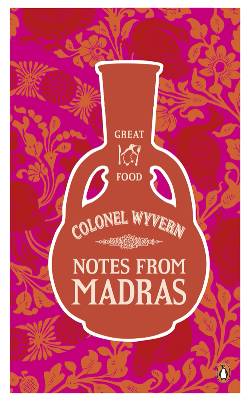
Last Saturday I bought Notes from Madras, a digest of Colonel Wyvern’s classic Culinary Jottings from Madras (first published 1878 and substantially revised in 1885). I confess that I’d heard neither of the Colonel nor of Jottings before reading a review of the series, and I am so pleased that I’ve discovered him. Elizabeth David wrote: ‘I should recommend anyone with a taste for Victorian gastronomic literature to snap up [Wyvern’s recipes]. His recipes are so meticulous and clear that the absolute beginner could follow them, yet at the same time he has much to teach the experienced cook.’

Coralie Bickford-Smith's beautiful cover design for Notes from Madras
Colonel Arthur Robert Kenney-Herbert (1840-1916) was an officer in the British Indian Army who began to write about Indian cooking while stationed in the subcontinent during the second half of the nineteenth century. First published in newspaper articles, he went on to author a series of recipe books and found a cookery school in London. The purpose of his writing was to demystify cooking in India for the white, middle-class memsahibs who travelled to India with their husbands. Not only does Jottings provide recipes and menus, but detailed, practical advice about setting up and stocking a kitchen and training a servant.
David is entirely correct when she suggests that Wyvern be used by inexperienced or unconfident cooks. His recipes describe simply and precisely the ingredients and methods that go into preparing a range of dishes: from macaroni cheese to curries. He makes sure to explain the principles behind cooking: his instructions for boiling and preparing potatoes run to six pages; there are twelve steps for making the perfect fritter. Long-winded, perhaps. But fool-proof? Definitely.
Jottings from Madras has a number of surprising features. For the contemporary reader, the most striking is Wyvern’s enthusiasm for parmesan cheese, basil, and minimally-cooked vegetables. His writing runs counter to all the things we believe about heavy, bland, and overcooked Victorian meals. Partly as a result of this, Wyvern’s views on Indian servants and cooks seem of place. Although Jottings advises colonial wives to treat their cooks with patience and respect, and to address them directly – not via a butler – in whichever pidgin English was spoken in their region, he believes that the country’s indigenous people are fundamentally inferior to himself and other Europeans:
There can be no doubt that in our Ramasámy we possess admirable materials out of which to form a good cook. The work comes to him, as it were, of its own accord. But we should take heed lest he grow up at random, clinging affectionately to the ancient barbarisms of his forefathers. We should watch for his besetting sins, and root them out whenever they manifest themselves.
This paternalistic – racist, certainly – attitude towards ‘Ramasámy’, his typical Indian cook, helps, I think, to account for Wyvern’s views on Indian cuisine. In terms of recipes, the primary aim of Jottings from Madras is to teach and assist readers to cook the standard, heavily Francophile food popular in Europe during the period. The genius of the book is Wyvern’s practical approach to cooking northern European cuisine in hot, humid south Asian conditions where many ingredients on which French cooking relies were not freely available.
Wyvern was not unusual in his assertion that most Europeans in India would want to eat primarily European dishes. One of my favourite sections of EM Forster’s A Passage to India (1924) describes an attempt to replicate the cooking of ‘home’ in a household in India with an Indian cook wholly unfamiliar with British and French cuisines:
the menu was: Julienne soup full of bullety bottled peas, pseudo-cottage bread, fish full of branching bones, pretending to be plaice, more bottled peas with the cutlets, trifle, sardines on toast: the menu of Anglo-India. A dish might be added or subtracted as one rose of fell in the official scale, the peas might rattle less or more, the sardines and the vermouth be imported by a different firm, but the tradition remained: the food of exiles, cooked by servants who did not understand it.
In the future I’ll discuss the ways in which this insistence upon serving and eating a British menu in India – and, indeed, elsewhere in the Empire – were connected to the construction and maintenance of ‘civilised’ European identities, but, for the moment, I’d like to focus on Wyvern’s attempts to find a happy medium between Indian and English cooking.
In Jottings he expressly advises against stocking up with too many bottled and tinned fruit, vegetables, and meat, arguing that wives should acquaint themselves with the fresh produce on offer at local markets. Wyvern makes the reasonable point that there is little point in trying to cook simple, yet delicious, French-style meals with inferior ingredients.
There are many ladies who, when giving out stores for a dinner party, have no hesitation in issuing ‘tins’ to the value of many rupees, but if asked for extra cream, butter, eggs, and gravy-meat, – the true essentials of cookery, – begin to consider themselves imposed upon. The poverty of our cookery in India results almost wholly from our habit of ignoring these things, the very backbone, as it were, of the cook’s art. If an English cook, surrounded with the best market supplies in the world, be helpless without her stock, her kitchen butter, and her cream and eggs, how much more should Ramasámy be pitied if he be refused those necessaries, for his materials stand in far greater need of assistance.
Wyvern also suggests that curries and aspects of Indian cuisine be incorporated into everyday menus. In fact, he writes that curries should feature as the centrepiece of formal dinners, lamenting that this practice had fallen out of fashion since the formalising of British rule in the middle of the century. (Before then, the British East India Company had constituted Britain’s presence in India. British wives, families, and domesticity arrived with the Raj.) Like other British authors, Wyvern refers to a range of Indian dishes as ‘curry’, but he does recognise that Indian cooking is heavily regionalised – and not all of it is ‘curry’. He provides a collection of recipes for Madras and Sri Lankan curries, using ingredients and flavours specific to these areas.
However, as in the case with Ramasámy, while he acknowledges that the curries are good to eat using traditional methods, they can, nevertheless, be improved upon using European methods and ingredients:
Among other adjuncts that may be written down as indispensable are the ingredients needed to produce that suspicion of sweet-acid which it will be remembered, forms a salient feature of a superior curry. The natives of the south use a rough tamarind conserve worked, sometimes, with a very little jaggery or molasses, and a careful preparation of tamarind is decidedly valuable. Why, however, should we not improve upon this with red currant jelly and if further sharpness be needed, a little lime or lemon juice? In England, and I daresay in India also, chopped apple is sometimes used, and perhaps chopped mango, in the fool-days of the fruit, would be nice.
Curries cannot afford to dispense with the assistance of some stock or gravy. It is not uncommon to hear people say that they have eaten far better curries in England than in India, the chief reason being that Mary Jane will not undertake to make the disk without at least a breakfast-cupful and a half of good stock.
So in go red currant jelly and stock – two ingredients which could not be more remote from the cooking of south India. Wyvern also devotes some space to mulligatawny, a soup which seems to have originated in Victorian Madras when Indian cooks were asked to invent a soup for their British employers. They based it on the Tamil molo tunny, or pepper water, a medicinal preparation for curing stomach ailments. To the original recipe of water, black pepper, chillies, and tamarind were added the inevitable chicken stock, fried onions, chicken, and, depending on taste, rice. This mulligatawny was, as Lizzie Collingham notes in Curry: A Tale of Cooks and Conquerors (2005), one of the first examples of a hybrid Anglo-Indian cuisine which developed in British settlements in the subcontinent. Others include kedgeree and new versions of curry – which were not only exported to Britain, but spread around India.
One of the most important products to emerge from this new Anglo-Indian cooking was ‘curry powder’. As I noted a fortnight ago, the idea of ‘curry powder’ is a British one. In south Asia, garam masala is a mix of spices which differs across regions, shops, and households. There is no single, correct recipe for it. Curry powder is a product blended by businesses for mass consumption. Wyvern believed strongly that the basis for any good curry was a good curry powder, but acknowledged that not every housewife had the skill, confidence, or time to produce her own:
I shall presently give a very valuable receipt for a stock household powder, one that was surrendered to me by an accomplished chatelaine, on the eve of her departure from India, as a token of the sincerest friendship. But for those who wish to avoid trouble and yet to have good curries, I strongly advocate the use of Barrie’s Madras curry-powder and paste. I am not employed as an advertising medium. My advice is not the advice of a ‘gent’ travelling for Messrs. Barrie and Co., it is the honest exhortation of one, my friends, who has the success of your curries very closely at heart. After more than twenty years’ experience of Barrie’s condiments, I say boldly, that I am aware of no preparations in the market that can equal them.
However much I do believe that Colonel Wyvern held the success of his readers’ curries ‘very closely at heart’, I wonder how much he did Barrie’s profit margins as well: Barrie’s appears frequently in Jottings. But Barrie’s was only one product in a very crowded market. The first British-produced curry powder was marketed at the end of the eighteenth century, and local as well as imported brands jostled for attention on the shelves of grocers around Britain by the late 1800s. These were blander and less fiery than Indian garam masala, but found an enthusiastic audience in Britain.
Collingham laments the Anglicisation of Indian cooking in British kitchens in both India and Britain, seeing it as a distinctly poor cousin to the original (or originals). I’m sure that many of the curries prepared in officers’ bungalows in Hyderabad and in suburban London weren’t terribly good, but I think it’s more useful to think of them as a kind of nineteenth-century imperial cuisine: the curries eaten by the British in India and in Britain in the nineteenth and early twentieth centuries were, really, British. Collingham demonstrates:
On arrival in Bombay in 1858 as the bride of a British army officer, Matty Robinson discovered that Anglo-Indian curries were quite unlike the British ones she was used to: ‘I can’t touch the Indian fruits or the fish which they say is so delicious, and as to the curries it makes me sick to think of them; give me an English one!’
In recent – and entirely laudable – efforts to replicate the more nuanced nature of regional Indian cooking, these curries – the Madras curries of British invention – have been sidelined and even ridiculed. They are held up to illustrate the unsophisticated nature of the British palate. I think it’s a pity because these are truly delicious dishes.
But it would seem that they might be heading for a revival. Marcus Wareing has recently opened The Gilbert Scott, the new restaurant at the magnificently renovated and refurbished St Pancras Hotel in London. Like Heston Blumenthal at Dinner, Wareing has drawn inspiration from old, British recipe books, and particularly those from the period in which the St Pancras Hotel was built. He includes, of course, a mulligatawny soup. In this BASTARD video WHICH REFUSES TO EMBED (sorry, long day), the Guardian’s Tim Hayward waxes lyrical on the St Pancras Hotel, the Gilbert Scott, and Wareing’s menu. He samples the mullgatawny, and approves of it mightily on the grounds that it tastes ‘authentically’ of…curry powder. This, he suggests, is an example of proper, British cooking. Curry powder, a strange hybrid of British and Indian cuisines, has now become a ‘classic’ and, ironically, ‘authentic’.
Further Reading
Texts quoted here:
Lizzie Collingham, Curry: A Tale of Cooks and sConquerors (London: Vintage, [2005] 2006).
EM Forster, A Passage to India (London: Penguin, [1924] 1989).
Colonel Wyvern, Culinary Jottings: A Treatise in Thirty Chapters on Reformed Cookery, 5th ed. (Madras: Higginbotham and Co., 1885).
—-, Notes from Madras (London: Penguin, 2011).
Other sources:
K.T. Achaya, The Food Industries of British India (Delhi: Oxford University Press, 1994).
David Burton, French Colonial Cookery (London: Faber and Faber, 2000).
Lizzie Collingham, Imperial Bodies: The Physical Experience of the Raj, c.1800-1947 (Cambridge: Polity Press, 2001).
James E. McWilliams, A Revolution in Eating: How the Quest for Food Shaped America (New York: Columbia University Press, 2005).
Sidney W. Mintz, Sweetness and Power: The Place of Sugar in Modern History (New York: Penguin, 1985).
—-, Tasting Food, Tasting Freedom (Boston: Beacon Press, 1996), pp. 67-83.
Wolfgang Schivelbusch, Tastes of Paradise: A Social History of Spices, Stimulants, and Intoxicants, trans. David Jacobson (New York: Random House, 1992).
James Walvin, Fruits of Empire: Exotic Produce and British Taste, 1660-1800 (Basingstoke and London: Macmillan, 1997).
 Tangerine and Cinnamon by Sarah Duff is licensed under a Creative Commons Attribution-ShareAlike 3.0 Unported License.





 Tangerine and Cinnamon

May 21
Ladyfood
Like all fashions, food fads are by their nature transient. The Atkins diet enjoyed a mercifully brief vogue during the early 2000s; and in 1997 Britain’s supply of cranberries was totally depleted when Delia Smith cooked with them in that year’s Christmas special for her television series. (Something similar happened when Nigella Lawson professed a weakness for frozen peas. Truly, the British are mad.)
Inevitably, after a surge in popularity, these diets or ingredients are either dropped or supplanted by new fashions, or incorporated into our diets to such an extent that we wonder why we were ever so mad about them in the first place (I think of sundried tomatoes, balsamic vinegar, smoked paprika….). It’s not often, though, that people declare themselves ‘sick’ of a particular product – or ask that there be a ‘backlash’ against it. But this has happened, and also fairly recently.
In the past fortnight or so I’ve read a range of articles calling for an end to…cupcakes. Yes, this most mini member of the cake family seems to be facing a kind of culinary doom. But why? What could be so appalling about a dab of Victoria sponge topped with either royal icing, or a blob of butter cream? They were the first cakes my sister and I baked on our own, and I made some last week for an indoor birthday picnic.
Valentine Warner writes in this month’s Delicious:
In the recent tenth anniversary edition of Observer Food Monthly, an article lists the top ten food trends of the past decade. Among its five worst are supermarket vegetable boxes (a genuinely daft idea, I agree) and cupcakes. Why? Because ‘these twee treats have had their day.’ Are cupcakes really as bad as genetically modified food – another of the Observer’s five worst food trends since 2001?
I think that it’s worth thinking about the vehemence of the anti-cupcake lobby. Food, as I have noted before, represents considerably more than simply nourishment. We attach a range of assumptions, prejudices, and meanings to food. These change over time and vary according to context, but remain a potent influence over how – and what – we eat. Importantly, they also shape our identities: food contributes to the construction of national, social, racial, and gendered identities. Cupcakes aren’t simply cupcakes. They are more than sponge cake and icing.
Cupcakes were not always fashionable. Warner writes:
I know exactly what he means. When I was a little girl in Paarl in the late 1980s and early 90s, cupcakes – or fairy cakes as we tended to call them – were birthday party food. They were dyed pink and lilac to go with our fairy dresses and decorated liberally with hundreds and thousands, glace cherries, silver balls, and whatever else we found in the baking cupboard. Woeker en Woel, Paarl’s biggest tuisnywerheid (a cooperative selling food, needlework, and other things made by women at home) used to sell them in batches of twelve in beer boxes. They were iced in green and pink and I remember them as being enormous – about the same size as flat, brown mushrooms. By no stretch of the imagination could these be considered elegant.
The rise of the cupcake began during the late 90s, and many pin this to the opening of the Magnolia Bakery in New York City in 1996. The Bakery sells individual, beautifully-decorated cupcakes alongside its more usual selection of cakes and pastries. Of course, other bakeries may well have been doing this for decades, but what makes Magnolia different is that it is in Manhattan, and that it is fashionable. The ascendancy of the cupcake was confirmed in 1998 when a couple of episodes of the then wildly popular HBO series Sex and the City depicted Carrie and her friends scoffing cupcakes in the Bakery.
Adre Meyer's Cupcakes at the Hope Street Market in Cape Town
Since then, macaroons, pies, and whoopie pies have been dubbed the ‘new cupcake’, but to little effect. Even with the apparent current backlash, cupcakes appear still to sustain a baking industry: there are legions of recipe books (even Martha Stewart deigned to write one), blogs, websites, market stalls, bakeries, and cafes dedicated solely to cupcakes. This is also a global fashion which spread quickly from the eastern seaboard of the United States to the rest of the world.
In Britain, the cupcake was popularised by Nigella Lawson’s How to be a Domestic Goddess (2000). Unlike other food writers, she acknowledges that their appeal is based on a nostalgia for childhood. She notes: ‘At about the same time I started getting into top cupcake and fairy-cake mode, ostensibly for children, I noticed that the people who really seemed to get excited by them were the children’s parents. I think it’s not till you hit 30 that nostalgia is even a remotely comforting option.’
In contrast, the Telegraph’s Xanthe Clay writes, in all seriousness, that her favourite cupcake decoration is ‘summer berries whose freshness cuts the sugary icing. Perched atop each cupcake like a Philip Treacy hat, they’re as exuberant as Carrie’s wardrobe and they taste fabulous.’ This is food – almost literally – as fashion. Valentine Warner adds:
Cupcakes are associated with women. They’re girly. They’re ladyfood. And this isn’t inherently problematic. In fact, some contemporary feminists argue – rightly – that the labelling of cooking, baking, knitting, needlework, and other ‘feminine’ pursuits as being silly, frivolous, or demeaning is sexist. They point out that all over the world, suffragettes embroidered banners and other protest material, and held tea parties and cake sales to raise funds for the campaign for women’s right to vote.
I’m not, of course, accusing Valentine Warner of misogyny – although I do feel that some of the anti-cupcake movement is informed by a dislike of things associated with women – and I think his point that cupcakes are simply glorified children’s food is important. Cupcakes are marketed to women on the grounds that these little treats are dainty, pink, and pretty – like women (or, rather, girls, or ladies). They are safe for slim, demure ladies to eat: they contain fewer calories than a wedge of cake, and they’re easy to pick at with a (mini) cake fork. When Warner describes the cupcakes as ‘mouse-sized’, he could as easily be referring to the women who buy them.
Like cupcakes, this gendering of food isn’t anything new. As I noted a few weeks ago, some Victorian doctors advised that women, children, and invalids be fed carbohydrate-heavy, bland food to ensure that their delicate systems remained calm: too much red meat, fruit, or spice would upset them and cause them to behave inappropriately.
What concerns me is that we’re still associating children’s food with a particular kind of childlike femininity. Why are cupcakes marketed so successfully to well-off, educated middle-class women? (And cupcakes are often exorbitantly expensive so it’s only well-off women who can afford them.) In a nasty irony, when Sex and the City depicts Carrie eating cupcakes it isn’t to emphasise her healthy attitude towards food (that we should eat everything in moderation), but, rather, to indicate that even when she does eat cake, it’s small, childlike, and entirely unthreatening (as she is).
Further Reading
Texts quoted here:
Judith Flanders, The Victorian House (London: Harper Perennial, 2003).
Nigella Lawson, How to be a Domestic Goddess (London: Chatto and Windus, [2000] 2003).
Valentine Warner, ‘Valentine’s Notebook,’ Delicious, May 2011, p. 49.
Other sources:
Sander L. Gilman, Fat: A Cultural History of Obesity (Cambridge: Polity, 2008).
Harvey A. Levenstein, ‘Scientists, Pseudoscientists, and Faddists’ and ‘Too Rich and Too Thin?’, in Revolution at the Table: The Transformation of the American Diet (New York: Oxford University Press, 1988), pp. 86-97, 194-211.
Susie Orbach, ‘Interpreting Starvation,’ in Consuming Passions: Food in the Age of Anxiety, eds. Sian Griffiths and Jennifer Wallace (Manchester: Mandolin, 1998), pp. 133-139.
Kerry Segrave, Obesity in America, 1850-1939: A History of Social Attitudes and Treatment (Jefferson, NC,: McFarlane, 2008).
Peter N. Stearns, Fat History: Bodies and Beauty in the Modern West (New York: New York University Press, 1997).
Doris Wit, ‘“How Mama Started to Get Large”: Eating Disorders, Foetal Rights, and Black Female Appetite,’ in Black Hunger: Food and the Politics of US Identity (New York and Oxford: Oxford University Press, 1999), 183-210.
Tangerine and Cinnamon by Sarah Duff is licensed under a Creative Commons Attribution-ShareAlike 3.0 Unported License.