
Breaking Bread
In Montreal, I ate bagels instead of poutine. I had planned on visiting Mile End – the suburb described as the city’s coolest quarter – because my friend Susan lives there, I wanted to go to Drawn and Quarterly, and I continue to add to my (as yet unwritten) international taxonomy of hipsters. If Mile End is supposed to be the hipster capital of Canada, then I needed to see it.
It was described to me as the Montreal equivalent of Williamsburg: a formerly poor and fairly run-down, largely immigrant suburb, popular with artists, slowly being encroached upon by students, young middle-class families in search of beautiful but affordable homes near the city centre, and hipsters. It also has a substantial population of Orthodox Jews.
My friend Carina and I took the bus from Westmount – where we were staying with our friend, the bride-to-be – and walked up St-Laurent, all the way up the Plateau. It was early on Saturday morning, so we arrived in Mile End in search of breakfast. Having heard about the wars between two rival bagel bakeries in the area, we bought breakfast at Fairmount Bagel. It was, incidentally, the place recommended to us as the superior bakery.

Fairmount Bagel.
And the bagels were delicious. I now know that the traditional Montreal bagels are white (with sesame seeds) or black (with poppy seeds), but our cinnamon and raisin bagels, fresh from the oven, were some of the best I’ve ever had. I was also starving and frozen by the time, so that may also have influenced my verdict. In contrast, the bagel I tried a few hours later – for the purposes of science, you understand – from the rival St-Viateur bakery, seemed not as good. St-Viateur is also the subject of Donald Bell’s comic novel Saturday Night at the Bagel Factory (1973).
These Mile End institutions are testimony to the many groups of immigrants who settled in Canada, particularly during the early twentieth century. Jewish immigrants fleeing persecution in Central and Eastern Europe settled in Montreal partly because it offered jobs and security. The city’s Jewish population grew from around 7,000 in 1900, to nearly 64,000 in 1941, with many of them settling in Mile End and surrounds. The Orthodox Jewish community began to grow there during the 1980s.

St-Viateur Bagel
Until this visit, I didn’t know that Montreal bagels are distinct from other varieties: they are smaller, flatter, with bigger holes, and are baked in wood-fired ovens. They have a complex, sweeter flavour, and a drier, more chewy texture. In fact, there is now a restaurant in New York which sells Montreal bagels.
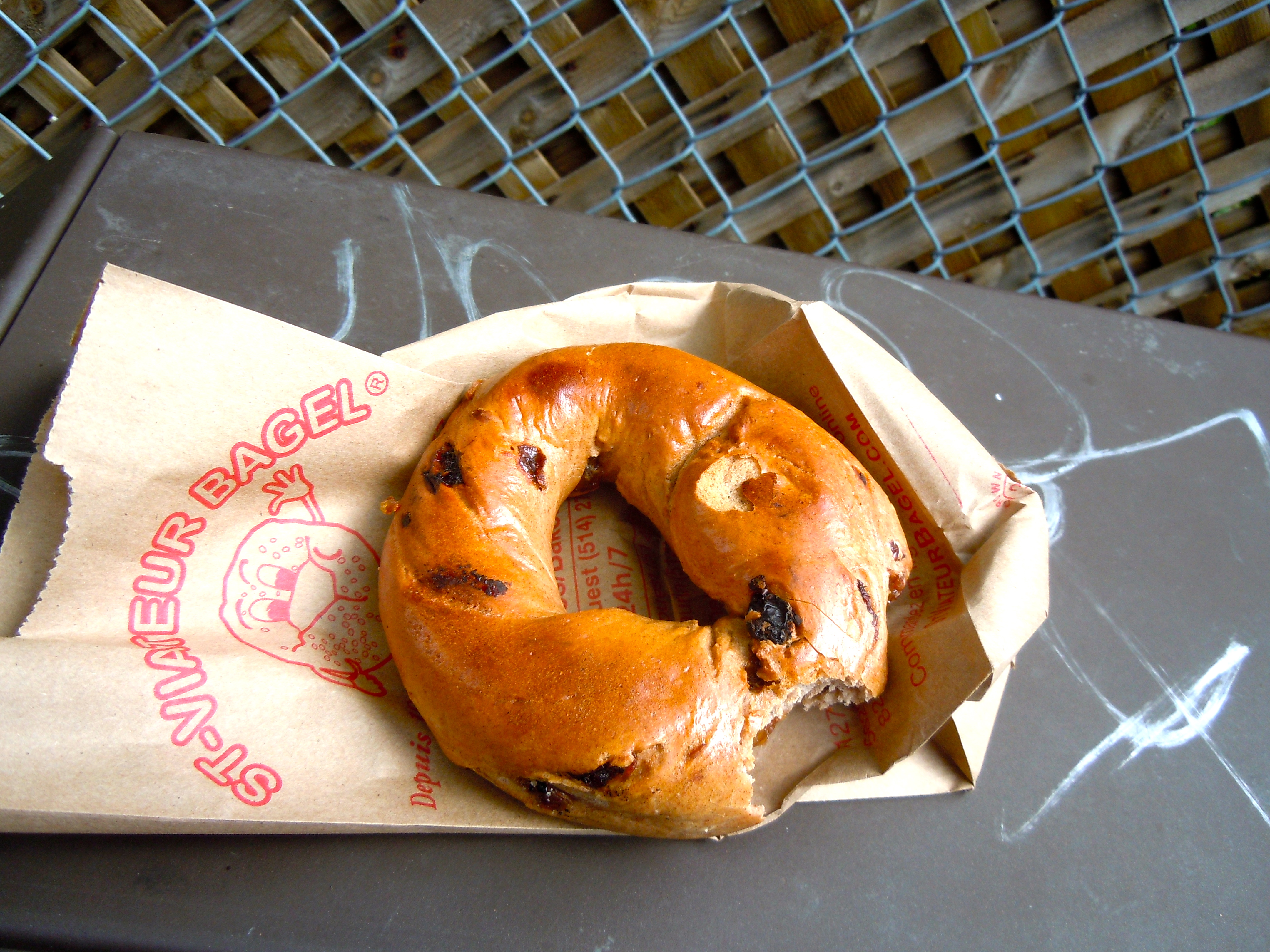
Alas, the slightly inferior bagel from the St-Viateur bakery. (I ate the one from Fairmount Bagel too quickly to photograph.)
In her excellent We are what we eat: Ethnic Food and the Making of Modern Americans, Donna R. Gabaccia explores the evolution and changing of immigrant cuisines in the nineteenth- and twentieth-century United States. She traces the history of the bagel there: how it shifted from being made almost exclusively by Jewish delis for Jewish customers in the 1890s, to being a ubiquitous snack food available throughout the country by the 1970s and 1980s. She writes:
The bagel was not a central culinary icon for Jewish immigrants; even before Polish and Russian Jews left their ethnic enclaves or ghettoes, their memories exalted gefilte fish or chicken soup prepared by their mothers, but not the humble, hard rolls purchased from the immigrant baker. As eaters, Jewish immigrants were initially far more concerned with the purity of their kosher meat, their challah, and their matzos, and with the satisfactions of their Sabbath and holiday meals, than with their morning hard roll.
However, bagels found an enthusiastic audience among other immigrant communities, particularly in New York, where the bagel came gradually to symbolise the city. Eating cream cheese and smoked salmon on these bagels transformed them from being a part of a Jewish baking tradition, to signifying its multicultural heritage.
I wonder to what extent the same is true for Montreal? And it feels likely that this city in a country with an official policy of multiculturalism – although in a province which has a far more conflicted attitude towards this policy – would embrace this immigrant food as one symbol of what it means to be from Montreal. (In much the same way that a café near to these bakeries sells a souvlaki version of poutine.)

Multiculturalism?
I think, though, that these bagels are also taking on a new meaning. Gabaccia notes that the mass production of bagels from the 1970s made them more widely available, but also turned them into an altogether softer, sweeter, and easier bread to snack on. Bagels made in factories by Kraft – and not hand-rolled in small bakeries – lacked the texture, crust, and savouriness of the product first made in the northeast.
Perhaps unsurprisingly, there has recently been a renewed enthusiasm for Jewish deli foods. Julia Moskin writes in the New York Times:
Artisanal gefilte fish. Slow-fermented bagels. Organic chopped liver. Sustainable schmaltz.
These aren’t punch lines to a fresh crop of Jewish jokes. They are real foods that recently arrived on New York City’s food scene. And they are proof of a sudden and strong movement among young cooks, mostly Jewish-Americans, to embrace and redeem the foods of their forebears. That’s why, at this moment in 21st-century New York, the cutting edge of cuisine is the beet-heavy, cabbage-friendly, herring-loving diet of 19th-century Jews in Eastern Europe.
Much of the recent enthusiasm around the rediscovery of the hand-made and the artisanal (whatever we may mean by that) has been driven by hipsters (whatever we may mean by them). In a series of posts about the anthropology of hipsters – and the hipsterdom of anthropologists – Alex Posecznick notes that one of the defining features of ‘the hipster population’ is a rejection of ‘mainstream, capitalist and individualist norms in favour of tactile crafts, free-trade coffee and styles that physically mark that rejection.’
For the hipsters of Mile End, the Fairmount and St-Viateur bakeries exemplify this refusal of the mass-produced, and the adoption of the local, the ethical, and the somehow ‘real.’ But, as Posecznick acknowledges, this never-ending search for cool in the form of the authentic can also been seen as representing no real break from other forms of capitalist consumption:
They have turned consumption itself into an art, where the fine distinction of this hat over that invests cultural capital, and where although it is used and battered, it can be sold for four times the value of a new hat.
My point is that the bagel’s meanings have changed once again: those produced in small quantities in small bakeries now suggest gritty, cool urban living, as well as a return to old-fashioned, wholesome ways of making food. The irony, though, is that this shift of meaning has occurred within the context of the gentrification of once-poor, often (Orthodox) Jewish, neighbourhoods, where rent increases have meant that their populations are becoming increasingly homogenous: largely middle-class, mostly white.

Tangerine and Cinnamon by Sarah Duff is licensed under a Creative Commons Attribution-ShareAlike 3.0 Unported License.








 Tangerine and Cinnamon
Apr 11
Modern Times
A month or so ago, the food writer Todd Kliman was criticised for publishing an article in the Washingtonian titled ‘Can Ethiopian Cuisine become Modern?’ Although much of the response to the headline was, I agree, entirely justified – this is a silly, insulting question which invokes a stereotype about Africans being forever stuck in pre-modernity – Kliman’s article presents a considerably more nuanced argument. He is interested in why the Ethiopian food which he eats enthusiastically in Washington DC – a city famous for its Ethiopian restaurants – has changed relatively little in the past few decades. He writes:
Put another way, Kliman investigates why Ethiopian food – particularly as it is prepared in the US – has not been made cosmopolitan. He acknowledges that what we now define as Ethiopian cuisine has only been so since the 1970s, when refugees fleeing the civil war opened restaurants selling cheap, delicious, and exotic-yet-familiar food to curious eaters in the West:
These restaurants included special, vegetarian feast dishes on ordinary menus. They prepared puddings, added raw vegetables to salads, and cooked with boneless meat. Ethiopian cooking needed to be made palatable to foreign audiences. A good comparison to Ethiopian food in the US is Indian food in Britain. There, after the Second World War, largely Bengali cooks remade some of the dishes of the region to British tastes: not as hot, richer, and with a greater proportion of gravy to meat. The difference between these two cuisines, though, is that while it’s still possible to find old-fashioned curry houses across Britain, the numbers of restaurants specialising in regional cuisines and in remaking Indian cooking traditions have also proliferated. Kliman suggests that one reason for Ethiopians’ hesitancy to embrace change – both in the US and, interestingly, in Ethiopia – has to do with the country’s fraught politics. One diner in Addis Ababa explained:
Ethiopian cuisine has long been shaped by nationalism. During the late nineteenth century, at a time when a national identity and the idea of an Ethiopian state were being forged, the Ethiopian court pioneered a kind of cooking which it described as the national cuisine. This was a selective vision of what the majority of Ethiopians ate, but, nonetheless, became the basis of the cooking in cafes and restaurants that began to open in the early 1900s. In the past three decades or so, this national cuisine has been adopted as somehow encapsulating Ethiopia’s national identity – despite the fact that it bears little resemblance to what nomads would have eaten even in the recent past.
Arts on Main, Johannesburg.
But even if Kliman isn’t really interested in Ethiopian food becoming ‘modern,’ this question about diet and modernity is an important one. The appeal of Ethiopian restaurants to leftwing Americans in the 1970s (ironically in Washington DC, one of the key cities of the Enlightenment) was precisely because it seemed to speak to their anxieties about modernity in an era of oil crises, rising anxiety about ecological disaster, and the slow emergence of finance capital. This was – they believed – food from a simpler, gentler, pre-modern time.
But American progressives have not always been so enthusiastic about immigrant cooking. In his wonderful book Revolution at the Table: The Transformation of the American Diet (1988), Harvey Levenstein devotes a chapter to the New England Kitchen (NEK), a project established in Boston in 1890 by Edward Atkinson, Wilbur Atwater, and Ellen Richards. Concerned about the growing potential for strikes and other forms of collective action in American industry, Atkinson, a prosperous Boston businessman, was interested in ways of improving the living conditions of his employees without raising their wages. Nutrition seemed to offer one way of solving this conundrum – an impression confirmed by the hugely influential scientist of nutrition, Wilbur Atwater. Ellen Richards, a chemist and the first woman graduate of the Massachusetts Institute of Technology, argued that ways needed to be found to apply scientific research and principles to the improvement – the modernising – of American households.
The result of this collaboration was the NEK, which was intended both as a research institute and as a school where working people could learn to prepare simple, nutritious meals. Initially, it appeared to be a raging success, attracting funding from Andrew Carnegie, and with branches soon opening in New York, Chicago, and Philadelphia. But the NEK model failed quickly, and largely because it could not attract adequate numbers of the urban poor to attend classes. This was due in part to the fact that the diet recommended by the NEK was distinctly dull, heavy in refined carbohydrates, and sparingly flavoured. (This was in a time before the discovery of vitamins, so NEK staff were dismissive of the usefulness of fruit and vegetables.)
The ethnically varied working poor – constituted mainly of Italians, French Canadians, the Irish, and Jews from eastern and central Europe – apparently served by the NEK were not interested in this bland, heavy ‘American’ cooking. Moreover, as Levenstein makes the point, the cuisines brought by these immigrants was far more than simply sustenance: they were the basis for new identities in a foreign land, they created social cohesion, and they were closely intertwined with women’s own positions within both families and communities. Although the NEK project failed in some ways, its work was picked up in the early twentieth century by nutritionists who campaigned for the ‘Americanisation’ of immigrant diets, arguing that the strong flavourings of foreign diets served only to overwork digestive systems and encourage drinking. Meals had to be eaten on plates, rather from bowls, and with knives and forks. Spaghetti was not deemed an appropriate dinner. This was modern eating for modern Americans.
This process was not particular to the US. Missionaries in nineteenth- and twentieth-century Africa taught converts on mission stations to eat with knives and forks, instead of communally, with hands. Home economics classes, the homecraft and Jeanes movements, and other interventions were intended to teach African women how to run modern, civilised homes shortly before and after independence.
But this suspicion of immigrant food and eating as being somehow both anti-modern and unpatriotic is worth considering. American nutritionists in the early decades of the twentieth century were also suspicious of how immigrant women bought their food, choosing to go to small delis owned by other immigrants, instead of larger grocery stores. South Africa is experiencing yet another wave of xenophobic violence again – attacks on foreigners, most of them from the rest of the continent, as well as China and south Asia, never really cease, but we’re witnessing a moment of particularly heightened violence – and targets are often small spaza shops in informal settlements. Locals accuse foreigners of buying stock in bulk, thus undercutting South African businesspeople. One of the implications of the closure of these businesses is hunger: they sell food at much lower prices than the big supermarkets, which also tend to be taxi- and bus-rides away.
Apartheid’s project of race classification insisted that the race categories into which the population was divided were culturally defined: Indian people in Durban ate curry, ‘Malay’ people in Cape Town cooked bredie. Apartheid ideologues went out of their way to erase centuries of entangled histories. A refusal to engage with others – a refusal to understand our reliance on others – simply continues that project.
Sources
Timothy Burke, Lifebuoy Men, Lux Women: Commodification, Consumption, and Cleanliness in Modern Zimbabwe (Durham, NC: Duke University Press, 1996).
Nancy Rose Hunt, ‘Colonial Fairy Tales and the Knife and Fork Doctrine in the Heart of Africa,’ in African Encounters with Domesticity, ed. Karen Tranberg Hansen (New Brunswick, New Jersey: Rutgers University Press, 1992).
Harvey A. Levenstein, Revolution at the Table: The Transformation of the American Diet (Berkeley: University of California Press, 1988).
James C. McCann, Stirring the Pot: A History of African Cuisine (Athens, OH.: Ohio University Press, 2009).