
Good Neighbours
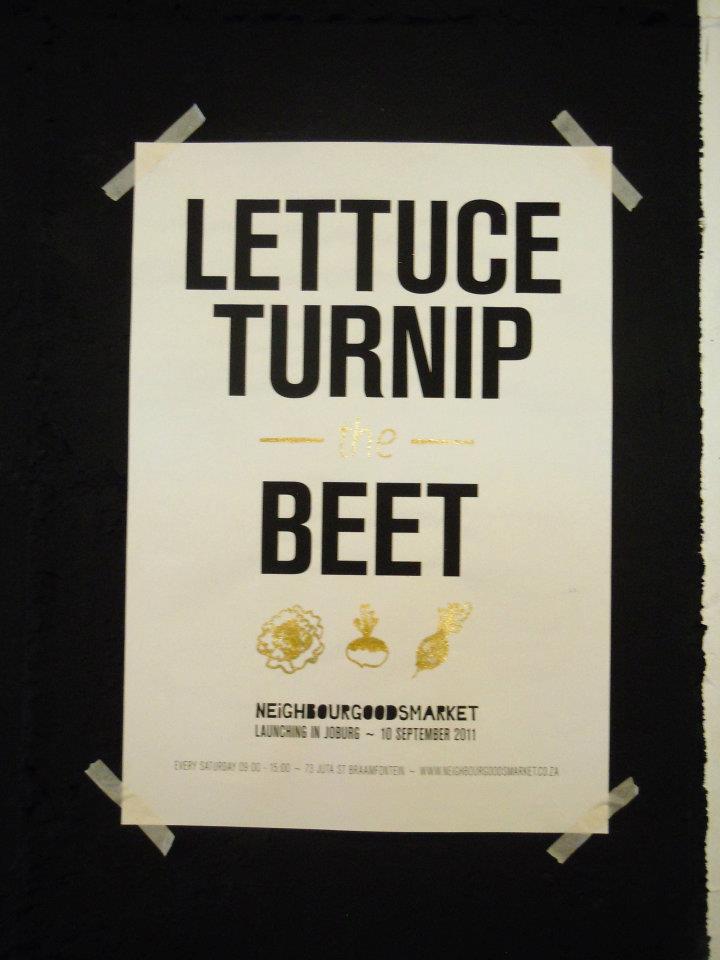
At the beginning of this year Michael Olivier asked me to contribute an article to his online magazine Crush!. It could be on whichever topic I fancied, and because I had recently spent rather a lot of time at food markets both abroad and in South Africa, and had been thinking a great deal about the relationship between these markets and the communities in which they were held, I decided to write about Woodstock.
The point that I wanted to make in the piece is that there is considerably more to Woodstock than the Neighbourgoods Market at the Old Biscuit Mill: that this multiracial inner-city suburb has a long and complicated history, and that its transformation into the embodiment of Capetonian hipster cool is not only a relatively recent phenomenon, but has profound implications for the community who lives there.
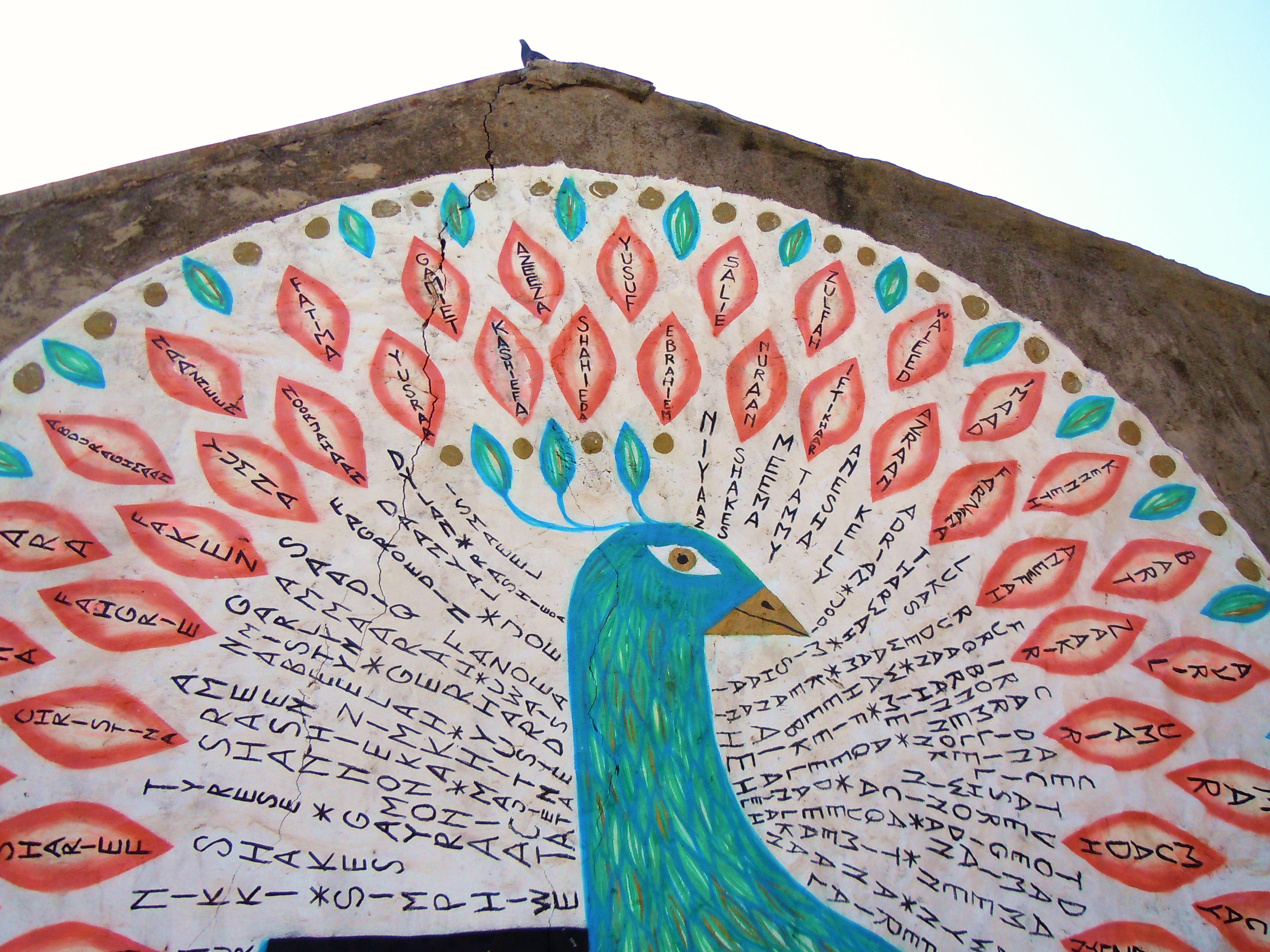
Woodstock – originally called Papendorp after the farmer on whose land it was founded – has never been a wealthy suburb. Situated in the teeth of the Cape Doctor – the southeasterly wind which blasts the city during summer – its population has tended to be poor and working class. With its low rents and easy proximity to the city’s industrial and business districts, it drew many of the thousands of immigrants who arrived in Cape Town from southern Africa and the rest of the world during South Africa’s industrial revolution at the end of the nineteenth century.
Cape Town’s first factories – which manufactured jam, matchsticks, artificial feathers and flowers, sweets, and cigars – were established in Woodstock, and employed a large proportion of the people who lived in the suburb’s growing slums. In the 1880s and 1890s, a collection of ministers, city councillors, and philanthropic organisation launched a campaign to clean up the appalling conditions in which people lived in Woodstock – with many calling it Cape Town’s ‘East End’.
Given the racial politics of nineteenth- and twentieth-century South Africa, much of the concern about Woodstock stemmed from the fact that it was racially mixed. As a result of the Group Areas Act (1950), one of the keystones of apartheid legislation, black and coloured (or racially mixed) people were forced to move out of the parts of Woodstock which were declared ‘white’. Those people who, according to the Population Registration Act (1950), were not white, were required to move to areas classified ‘black’ or ‘coloured’.
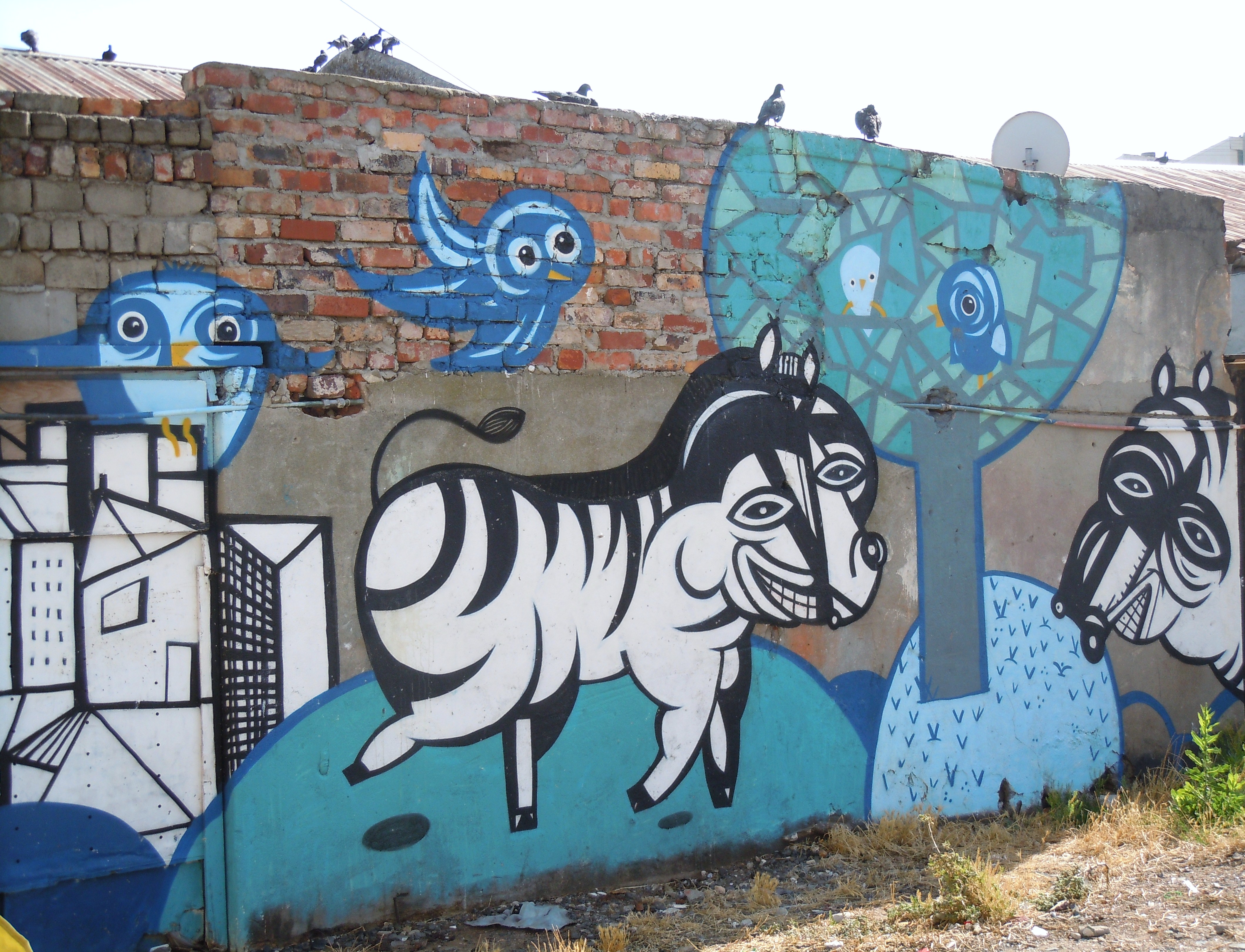
My mother grew up in Fairview Avenue, which was part of an area zoned as white. During the early 1960s, several families in her street left for other parts of Cape Town, or immigrated to other countries, because they were deemed officially to be black or coloured. But other parts of Woodstock were allowed to remain racially mixed. It’s worth understanding the social make-up of Woodstock geographically: above the Main Road – where Fairview Avenue is located – it is lower-middle- to middle-class with a largely white population which includes many Portuguese and Jewish families.
Below Main Road and above the railway, Woodstock becomes poorer and more racially mixed. And it is lower Woodstock which has experienced the brunt of the recent gentrification of the suburb. The revitalising of the businesses along Sir Lowry Road – developments like the Palms Centre and Buchanan Square, and the cluster of cafes, restaurants, and shops which have emerged between these two business hubs – have drawn relatively little criticism, as far as I can see (although do please let me know if it has).

Most criticism has been levelled at the Biscuit Mill development in Albert Road in lower Woodstock. The consortium responsible for the development, Indigo Properties, has recently come under fire for its revamp of the Woodstock Industrial Centre, which provided cheap rents and space for the small collective of artists who work in the suburb. On the one hand, the restoration of buildings – and Woodstock has some lovely, albeit crumbling, Victorian and Edwardian architecture – and the attraction of business to an otherwise poor area could be seen as a Good Thing. In Sir Lowry Road, for instance, the increase of pedestrian traffic between the Kitchen, the Deli, and the various agencies and offices along the road has made the area feel decidedly safer.
But on the other, it is questionable whether the Biscuit Mill and, now, the Industrial Centre developments benefit the community who lives in lower Woodstock.
On a ferociously hot Saturday towards the end of January, I parked as near to the Neighbourgoods Market at the Biscuit Mill – as near as I could, given its phenomenal popularity on weekends – and then made my way down Albert Road. Cars of eager market-goers zip down Albert Road on Saturdays, making only for the Biscuit Mill and the shops and restaurants which have opened around it. They ignore the large section of lower Woodstock which they pass through to get to the end of Albert Road.
My aim was to talk to the owners of the cafes and corner shops who actually sell to the people who live in lower Woodstock. I asked several what they thought about the Neighbourgoods Market and the response was similar: a shrug, followed by a comment that the people who go to the Market don’t really seem to be all that interested in the rest of the suburb. One or two laughed when I asked if they had benefitted from the opening of the development.
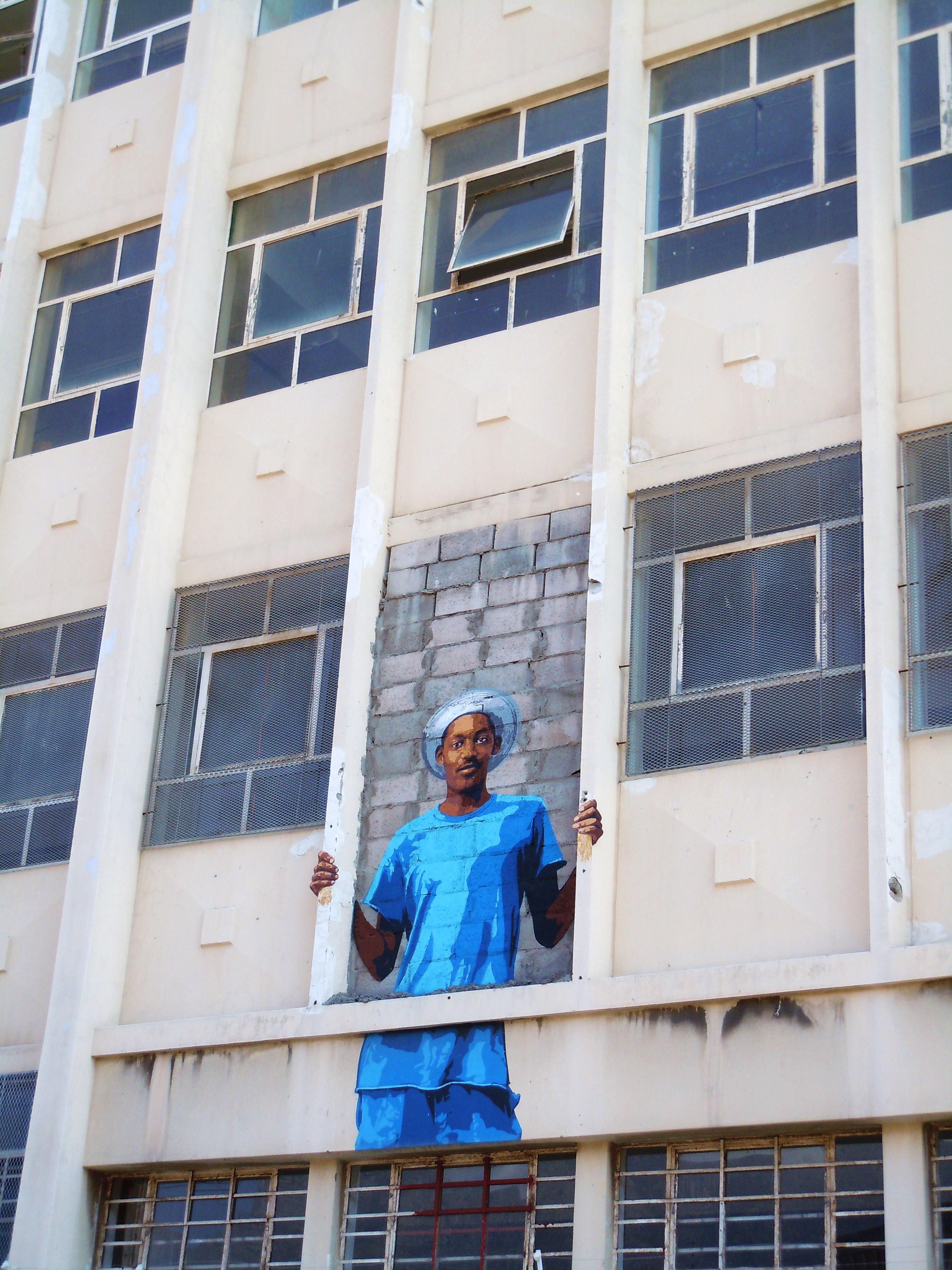
Just as I was nearing Gympie Street – infamous for its association with the gangs which have long blighted life in lower Woodstock – a man standing outside Saleem’s Café beckoned to me. He was Rashied, the brother-in-law of the owner of the café, and seated comfortably indoors on upturned plastic crates, we had a chat about the development on the area. Rashied was deeply critical of the Neighbourgoods Market and the Biscuit Mill, making the point that they had done little to regenerate an extremely poor suburb. What profits they do make – and there is good reason to believe that the development is lucrative – benefit the shopkeepers, stall owners, and, of course, Indigo Properties.
Rashied is involved with I Art Woodstock, a project launched by Ricky Lee Gordon of A Word of Art last year. I Art Woodstock brings artists from around the world to paint murals in lower Woodstock. The project involves the suburb’s children, and it aims partly to encourage more people to visit the area, to look at the murals – and they are truly magnificent. Rashied invited me to take a look at the murals with him: he was due to check up on two artists, one from Sao Paulo, the other from New York, who were at work on a new mural, and he wanted to distribute yogurts to the area’s children.
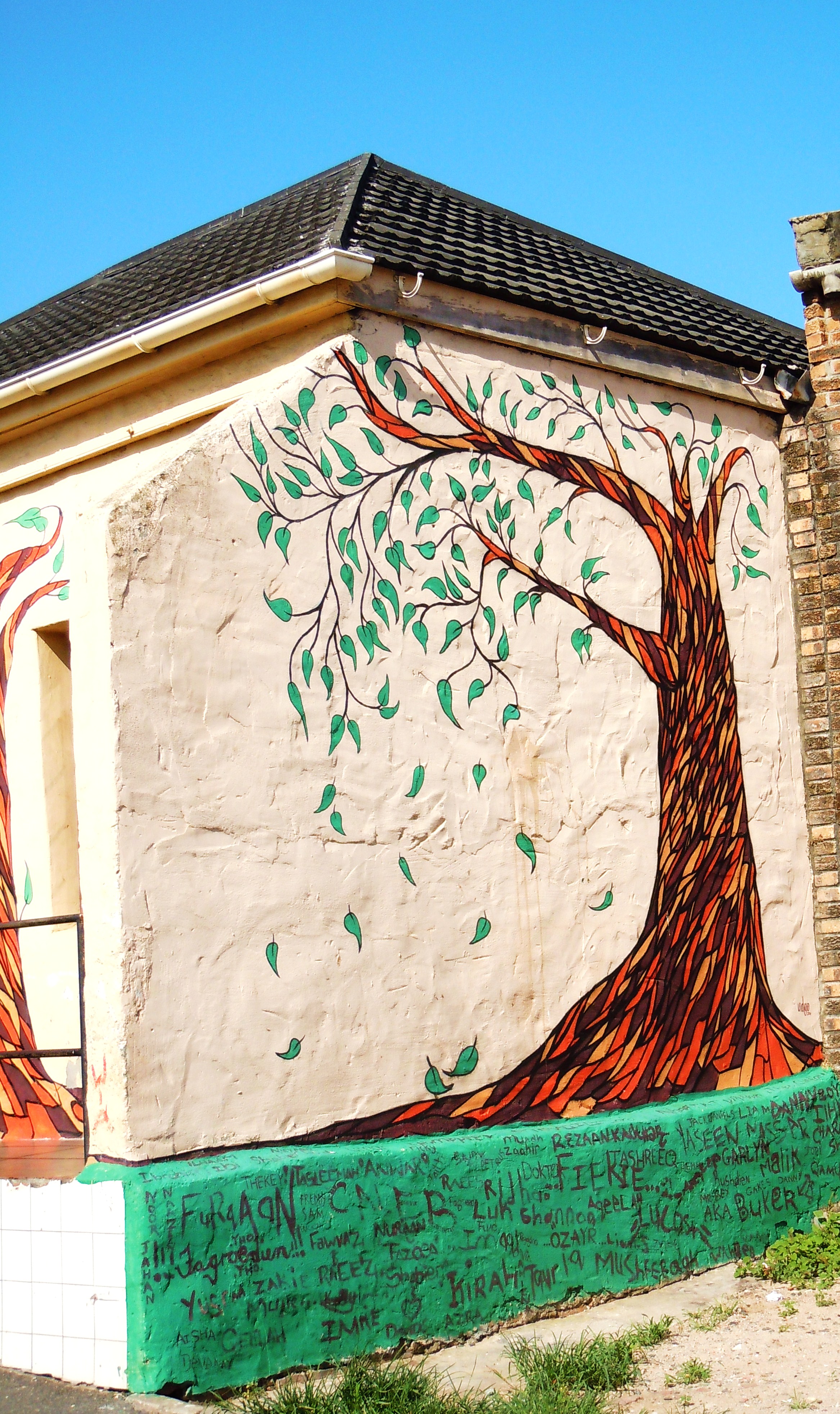
The state does not exist in lower Woodstock. There are houses owned by gangs where drugs are sold and taken. There are people who live in shacks, with no hope of ever moving into houses with electricity and plumbing. It is unlikely that most of the children playing in the streets are attending school. These streets are dirty and unkempt. When incidences of domestic violence occur, the chances of police being called – or, if they are called, of arriving – are very slim.
As a recent, powerful editorial in the Mail and Guardian argued, South Africa’s policy makers and politicians must recognise the link between the appalling conditions in which people live, and the very high rates of violent crime which characterise so many poor communities:
we are building settlements that reproduce sexual violence, crime and xenophobia: shoddily constructed, disconnected from economic opportunity, home to failing schools that sit cheek by jowl with shebeens on shit-soaked streets.
It is certainly true that there are people in lower Woodstock who are employed, who send their children to school, and who manage to save a little towards their retirement. Their children will go on to tertiary education and to employment. They will move out of lower Woodstock and join South Africa’s growing middle class. But these constitute only one, small group of people within a much larger population, most of whom live in desperate poverty.
And within ten minutes’ walk of lower Woodstock – with its murals, yes, but also with its population of shack dwellers who do not have access to flushing toilets – is the incredible wealth and luxury of the Neighbourgoods Market, and the thousands of wealthy Capetonians who drive past lower Woodstock every Saturday morning to buy ice cream and artisanal, free-range bacon.

I don’t object to gentrification per se. Salon has reported recently on the so-called ‘Whole Foods effect’, where the opening of a new branch of Whole Foods – the US-based chain of organic supermarkets – is an indicator, and also cause, of the revitalisation of suburbs which have become crime-ridden, grimy, and run-down. The business is about to open a Whole Foods store in Midtown Detroit – signalling to many that the city’s long decline is now in reverse.
As Will Doig writes:
the Whole Foods Effect isn’t caused by the store itself, it’s caused by the events it sets into motion. And one thing Whole Foods does is stay open later than a lot of the other shops around it, laying the groundwork for expanding the length of that neighbourhood’s day.
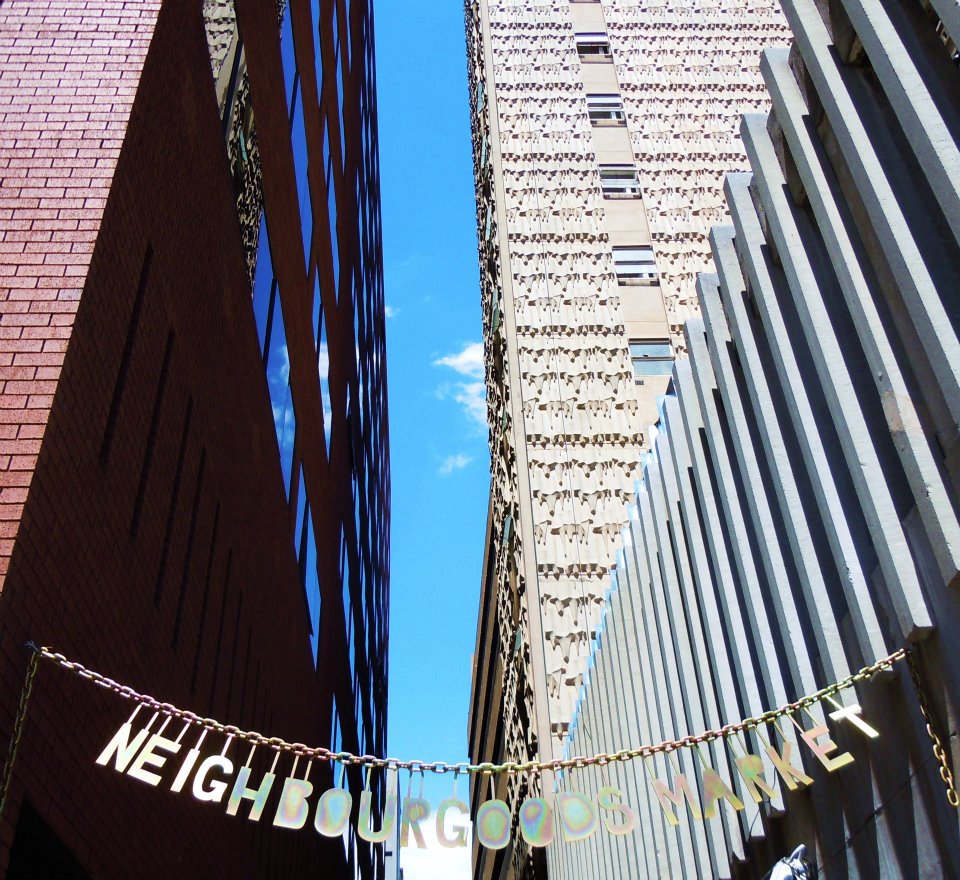
The Neighbourgoods Market in Braamfontein – the sister of the market in Woodstock – is doing precisely this in Joburg. Situated in the parking lot of a skyscraper, that Neighbourgoods Market attracts footfall to an inner-city suburb which would usually be deserted – and dangerous – over the weekend. Similarly, the Hope Street Market in Cape Town brings life into an otherwise quiet corner of the CBD on Saturdays.

What angers me about the Biscuit Mill and the Neighbourgoods Market in Woodstock is that they exist within a community which desperately needs investment: which needs housing, plumbing, and, above all, jobs. Of course, it is primarily the function of the state to provide basic services, policing, and social welfare – but where there is so much wealth, there is a moral imperative to improve the lives of so many who have so little.
The Neighbourgoods Market’s success has grown partly as a result of an increased interest in the provenance and production of good, ‘whole’, food among Cape Town’s middle classes. This is excellent. But how do these customers – who desire to live and eat ethically – drive past such incredible poverty every Saturday, without thinking twice about the people who live there?

Tangerine and Cinnamon by Sarah Duff is licensed under a Creative Commons Attribution-ShareAlike 3.0 Unported License.








 Tangerine and Cinnamon
May 21
National Kitchens
It was my birthday a couple of weeks ago and my parents gave me a copy of the new revised English edition of that Bible of Afrikaans cooking, Cook and Enjoy. It’s testimony to the ubiquity of the book that I find myself referring to it by its Afrikaans title Kook en Geniet, rather than its English name.
Kook en Geniet is the Afrikaans Mrs Beeton’s Book of Household Management. Published as a guide to housekeeping and cooking for young brides in 1951 by Ina de Villiers, a Stellenbosch-based home economist, it has never been out of print. There are very few Afrikaans households which do not possess at least one copy of the book – and, like Mrs Beeton, its success lies partly in the fact that it is regularly updated.
De Villiers herself was responsible for testing and re-testing recipes, and for producing new editions of Kook en Geniet. Her long-standing association with the book helped Kook en Geniet to gain its reputation for being a fail-proof authority on Afrikaans cooking. Since her death in 2010, her daughter, Eunice van der Berg, who also happens to be a home economist, has taken over responsibility for it.
There is no single version of Kook en Geniet. Each edition retains a core of essential recipes, but methods and ingredients change as new products appear. Dishes are added and, less frequently, subtracted as culinary fashions evolve. De Villiers wrote in the preface to the 1992 edition:
My edition contains recipes for moussaka and lasagne. But it’s not for these that I use Kook en Geniet: it’s for staples of Afrikaans cuisine, like buttermilk rusks, Hertzoggies, quince chutney, vinegar pudding, and prickly pear jam. It’s a supremely practical recipe book. Helping out at the pancake stall which seems to accompany every major event – from agricultural shows to local government elections – in small town life? There’s a recipe to make enough batter for a hundred pancakes. Need to make bobotie for fifty at the church fete? Serving sosaties to eighty people at a barbeque? Kook en Geniet will come to the rescue with sensible, authoritative advice.
For anthropologists and historians interested in food, the value of Kook en Geniet lies in the fact that it changed as tastes evolved. It does not present readers with a static, inflexible view of ‘Afrikaner cuisine’. It acknowledges – tacitly – that cooking alters over time.
It’s not, though, the only source on what I’ve called Afrikaans or Afrikaner cuisine – more frequently referred to as boerekos, which translates literally as ‘farmers’ food’, but signifies considerably more than that. Boerekos is the homely, comfort cooking associated particularly with rural Afrikaans living. A wildly popular new series on the Afrikaans cable channel Kyknet, titled simply Boerekos, interviews a collection of Afrikaans women cooking their favourite, old-fashioned boerekos, from mosbolletjies to pie.
Programmes like this one, as well as other books on boerekos, seek to frame it as an unchanging cuisine: as a form of cooking which has remained reassuringly the same during a century of tumultuous change. For Afrikaner nationalists before and during apartheid, food was a useful way of forging a new, unified and distinct Afrikaner identity. As they codified and regularised Afrikaans, so they sought to create a unique Afrikaner cuisine.
C. Louis Leipoldt, culture broker, poet, journalist, doctor, Buddhist, and eugenicist, filled several journals with recipes he collected from friends, acquaintances, and people whom he came across while working during the 1920s and 1930s. (These are now held by the National Library in Cape Town.) He wrote about these recipes and rural cooking for Die Huisgenoot, a popular magazine with a distinct enthusiasm for nationalism, between 1942 and 1947. In 1933, at the height of the Afrikaner nationalist revival, he published Kos vie die Kenner (Food for the Expert), a collection of a more than a thousand recipes. Polfyntjies vir die Proe, Three Hundred Years of Cape Wine, and Leipoldt’s Cape Cookery appeared posthumously.
One of the ironies of boerekos is that so much of it is derived from the cooking of the slaves who were transported to the Cape from southeast Asia during the seventeenth, eighteenth, and early nineteenth centuries. The sambals, atchars, and chutneys of Afrikaner cooking are a particularly obvious debt to the food traditions imported to South Africa from present-day Indonesia and Malaysia.
Although Leipoldt, an unusually thoughtful nationalist, acknowledge that many of the recipes he found were cooked and invented by ‘Malay’ women – a term which he used to describe the largely Muslim and Afrikaans-speaking descendants of slaves who lived in the Cape –their presence gradually disappeared in other, later boerekos recipe books.
There is no neat boundary between Afrikaner cuisine and what most South Africans dub ‘Cape Malay’ cooking: there are recipes for bredie (mutton stew), bobotie, and sosaties (kebabs) in both boerekos and Malay recipe books. But in order to use food to construct distinct, discrete national or group identities, the differences between these two cuisines had to be emphasised over their similarities.
Nationalisms have long co-opted food and cooking to construct national identities. Leipoldt’s recipe books are the first in an extensive literature which seeks – both overtly and inadvertently – to construct an Afrikaner cuisine. It’s telling that the Afrikaanse Taal en Kultuur Vereeniging (Afrikaans Language and Culture Organisation), once strongly allied to the National Party but now a society which works towards the promotion of Afrikaans as a language, bestowed Ina de Villiers with its Afrikoon prize in 2010 for furthering the cause of Afrikaans.
But minority groups use food and recipes in similar ways – to construct, maintain, and assert identities, often in the face of discrimination and social and political marginalisation. Cass Abrahams as well as other Cape-based women have created a rich literature on ‘Cape Malay’ cooking, often basing their writing on recipes collected from, and donated by, local women. These are as much social histories as they are cookery books.
Similarly, one of my favourite South African recipe books, Indian Delights, was compiled by a community organisation, the Women’s Culture Group in Durban. First published in 1961, the book has been revised several times. My mother’s copy – which I covet – is the 1982 ‘Enlarged Super Edition.’ As the editor, Zuleikha Mayat, writes in the introduction, the recipes were
The book is as much an assertion of a distinct form of South African Indian cooking as it is a record of how a group of women cooked for their families in Natal during the second half of the twentieth century. But it is also an attempt to preserve a culinary tradition at risk of being forgotten as family life changed:
As a result of this ‘a good reliable cookery book has become essential’.
It’s partly because of this extensive collection of recipe books – from Indian Delights to Kook en Geniet – that it’s particularly obvious that there is no, single homogenous South African cuisine. One of the best collections of South African recipes, African Salad demonstrates this particularly well: it’s a series of photographs and short interviews with of a more-or-less random selection of South Africans on their favourite meals. The recipes are as varied as the interviewees.
I’ve been struck while watching the South African version of the MasterChef franchise by the absence of references to the African cuisines of South Africa. During one episode in which the contestants were required to barbeque, one (black) Twitter user commented jokingly that the black contestants would struggle because they would prefer over- rather than underdone meat.
So far the dominant cuisine (the meta-cuisine?) of the show has been broadly western. It is this which is most closely associated with ‘fine dining’ (hateful phrase). Indeed, I was annoyed when a black contestant was criticised for cooking a steak too well: a liking for pink, lightly cooked meat is both a relatively recent phenomenon and culturally specific. Why should someone be penalised if she has cooked meat according to the dictates of another cuisine?
A couple of contestants have cooked African dishes and I’ve watched those with the most curiosity: as a white South African raised in the Western Cape, I feel that I have a fairly good grasp of Afrikaans and Malay cooking, but African cuisine still eludes me. I know of certain dishes and have seen sheep heads and walkie talkies (chicken heads and feet) being sold, but this is as far as my knowledge goes.
I know that there probably isn’t a single ‘African cuisine’ or African culinary tradition in South Africa – that it must differ between regions and has changed over time. There are, to my knowledge, no substantial recipe books dedicated to this country’s African cuisines – although do please feel free to enlighten me if there are.
With the current wave of enthusiasm for local producers, it’s striking that the various markets which have sprung up around South Africa have tended to model themselves on a foreign – mainly European – model. They are Borough Markets in miniature. These new ingredients – these cheeses, sausages, and free-range duck and chicken – are sold to be used in cassoulet, poule au pot, and arrosto di maiale al latte. We use local products for overseas cuisines.
I’m not some mad nationalist loon who advocates that we only eat local cuisines, but as South African society changes during the early twenty-first century – as urbanisation increases and as our middle class expands – we are, as in the case of any rapidly evolving society, in danger of losing a lot of culinary knowledge. This is a pity: not only do food and cooking provide useful ways of understanding how societies function, but it also strikes me as deeply strange that the white, middle-class customers of the Neighbourgoods Market in Cape Town know more about the cooking of northern Italy than they do of the Eastern Cape. Or Langa, which is right next door.
Tangerine and Cinnamon by Sarah Duff is licensed under a Creative Commons Attribution-ShareAlike 3.0 Unported License.