
One Nation?
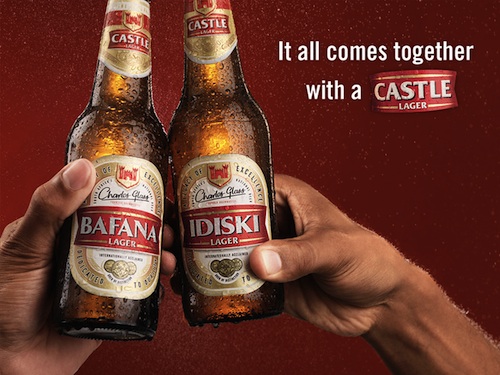
One of the oddest features of the transition from apartheid to democracy was the slew of beer advertisements, proclaiming the unity of the nation on the grounds of a shared enthusiasm for Castle Lager or Carling Black Label. There is a generation of South Africans who can chant South African Breweries’ slogan, ‘One Nation, One Soul, One Beer, One Goal,’ based entirely on having watched the 1998 Soccer World Cup on television.
This use of beer as a unifier which cut across boundaries of both race and class – although not, interestingly, gender (these advertisements celebrate a kind of hypermasculinity associated with the mining or construction industries) – was supremely ironic given the apartheid state’s attempts to control Africans’ consumption of alcohol, and particularly beer.
I’ve been thinking about the long, fraught politics of beer in South Africa as a furore has erupted over new attempts to limit alcohol sales, particularly in Gauteng and the Western Cape. Because municipalities and provinces control the terms according to which alcohol can be sold, rules around buying alcohol are complex. In the Western Cape, the new regulations will outlaw the sale of alcohol to be consumed offsite on Sundays and on all days after 18:00. No alcohol may be consumed at school functions, and in vehicles, and no person may buy or possess more than 150 litres of alcohol (that’s around 200 bottles of wine).
In Gauteng, draft legislation will make all sales of alcohol on Sundays illegal. Although these two provinces have received most attention from the media – partly because the country’s national newspapers and broadcasters are based in Cape Town and Johannesburg – there are attempts all over South Africa to limit how South Africans buy booze: the George municipality is considering outlawing the sale of all alcohol after 20:00 on Sundays; KwaZulu-Natal province may ban anyone under the age of eighteen from liquor aisles, and require supermarkets to devote a cashier specifically to alcohol sales. The Minister for Health, Aaron Motsoaledi, has even floated raising the legal age of drinking from eighteen to twenty-one.
This is all very confusing, and some shops have complained that this legislation hinders their business, and it’s doubtful that the police will be able to enforce these regulations. Many South Africans have questioned the efficacy of this legislation in reducing violent crime and road accidents – which is what these new regulations are intended to do. Although provincial governments and municipalities have cited studies which demonstrate the social and health benefits of limiting alcohol sales, there are, equally, others which suggest that higher liquor prices and taxes have little effect on the buying habits of heavy drinkers (meaning that they’re more likely to spend less on food or other essentials). Indeed, it’s probable that a black market may develop for illegal alcohol – causing drinkers inadvertently to consume poisonous liquor.
This impulse to control how much people drink in the name of preserving order and protecting the vulnerable is nothing new. The global temperance movement which emerged during the final decades of the nineteenth century, lobbied for limiting alcohol sales to men to reduce levels of domestic violence. The Cape Colony’s chapter of the Women’s Christian Temperance Union, established in Wellington, in the heart of the Cape winelands, in 1889, encouraged children, in particular, to take the temperance pledge, opened coffee shops to lure men away from canteens (or bars), and petitioned the colonial government to raise the price of liquor and reduce its availability. The WCTU distributed pamphlets, describing the apparently appalling consequences of the ‘demon drink’ for physical and mental health. People who drank had low morals, the ladies of the WCTU argued, and were at risk of falling into destitution. Members of the Myrtle branch, a temperance society for children in Wellington, were informed in 1896 ‘that strong drink leads to anger, debt, despair, destruction, and death’.
Although the WCTU encouraged middle-class men to become teetotal, its efforts were aimed overwhelmingly at men who were working-class and poor. These men – less ‘civilised’ then their middle-class betters – were characterised as uniquely prone to violence and, thus, in greater need of supervision.
Other than the fact that prohibition has never really stopped people from drinking, I think it’s worth thinking twice about limiting access to liquor because this has usually been the product of wider, social anxieties rather than of any real concern about the effects of alcohol on human bodies.
The 1928 Liquor Act was an attempt to shape how African men would consume alcohol. But, as Anne Mager explains, it was a nightmare to implement:
Exemptions to prohibition were granted in the Cape Province and Natal to African men deemed to have attained a certain ‘standard of civilization’. Permits were conditional on two years of good behaviour under the Liquor Act, a clean criminal record and permanent employment. African permit holders were limited to eight bottles of malt beer, four bottles of natural wine or two fortified wines and one bottle of spirits per month. Nevertheless, the privilege of education, property and professional status did not entitle exempted African men to enter bars and public houses frequented by whites or to drink in a friends’ home. Beyond the Cape and Natal, Africans were restricted to ‘kaffir beer’.
This was legislation driven by fear of ‘subjects perceived as immature and dangerously close to barbarism.’ However, they were also subjects from whom the state could profit. From 1937 onwards, a model of municipal beer production pioneered in Durban in 1908, was adopted around South Africa. Municipal beer halls, which had a monopoly on the sale of beer in these areas, with were established in townships and other informal settlements, providing intense competition for the existing shebeens. The profits raised by the halls went back to the municipality, and this was why so many towns and cities adopted this very lucrative scheme. It not only controlled African consumption of alcohol, but it made municipalities rather a lot of money. By the mid-1960s, more than sixty municipalities were operating beer halls.
These beer halls posed a significant threat to African brewers. CM Rogerson writes:
The introduction of municipal beer monopoly and beer halls occasioned considerable response from the community of shebeeners and home brewers, whose livelihood was threatened by the ending of prohibition and competition from municipal beer. Resistance towards municipal monopoly was manifested in various ways, including mass organised boycotts on new beer halls, rioting and the destruction of beer halls and the spreading of rumours by women shebeeners that municipal beer was making their menfolk sterile. For example, at Welkom in the Orange Free State the opening in 1956 of a municipal brewery and the withdrawal of home brewing permits sparked township rioting and attacks on the new beer hall.
As Rogerson implies, the people who had the most to lose from the municipal beer halls were African women, who controlled much of the production of beer in the ‘locations’ on the edge of towns and cities. Women were at the centre of beer production and selling. They tended to be unmarried, and could become relatively powerful. The figure of the ‘shebeen queen’ recurs in many of the novels depicting life in South African cities during the first half of the twentieth century.
It was women, too, who controlled the flourishing illegal production of alcohol. At the end of 1960, there were 30,000 illegal brewers in the Western Cape, and more than 10,000 shebeens in Soweto. But this was a business carried out in constant threat: women bore the brunt of police crackdowns on the trade. Unsurprisingly, then, women brewers and shebeen owners were often on the forefront of anti-government protest too. Most famously, they had a key role in the Cato Manor Beer Hall riots in 1959. Not only did these women berate men for drinking at municipal beer halls, but they resisted police raids on their shebeens.
Illegal beer brewing became, then, for African women both an act of political resistance, as well as a means of supporting themselves in a heavily patriarchal society.
All of this changed in 1962 when the apartheid state agreed – partly as a result of intense lobbying from industry – to open up sales of alcohol to Africans. However, this sale was still tightly controlled by the state, as Mager writes:
Since they were permitted to purchase but not consume liquor in town, Africans were effectively restricted to buying liquor at outlets (on- and off-consumption) run by the Bantu Areas Administration Boards (BAAB) in prescribed African townships. These outlets were built adjacent to the beer halls that supplied sorghum beer to working men. They comprised bars for women and men and ‘off-sales’ bottle stores. The consolidated infrastructure facilitated government monopoly in the distribution of European liquor. Local BAABs retained 20 per cent of the profits on liquor sales for the development of township amenities; 80 per cent went to the Department of Bantu Administration (BAD) head office for the financing of apartheid.
African alcohol consumption helped to fund the apartheid state. It also swelled the profits of South African Breweries, which supplied both state-run outlets as well as the illegal shebeens.
The sale of alcohol in South Africa has, then, a complex and fraught history. It is intertwined with anxieties about the control of black people in ‘white’ cities: by bringing alcohol provision within the ambit of the state, Africans’ consumption of alcohol could (in theory) be regulated, but they were, unwittingly, contributing to their own continued subordination by the apartheid regime.
Trying to manage people – either as a result of fear or out of a desire to eradicate social ills – through limiting the control of alcohol will never be fully successful. In fact, trying to stop people from drinking on Sundays or in the evenings just prevents them from drinking on Sundays or in the evenings – it doesn’t actually address the problems which cause people to drink in excess, or which cause men to beat up their wives and children.
Sources
Iain Edwards, ‘Shebeen Queens: Illicit Liquor and the Social Structure of Drinking Dens in Cato Manor,’ Agenda, no. 3 (1988), pp. 75-97.
Anne Mager, ‘“One Beer, One Goal, One Nation, One Soul”: South African Breweries, Heritage, Masculinity and Nationalism 1960-1999,’ Past and Present, no. 188 (Aug. 2005), pp. 163-194.
Anne Mager, ‘The First Decade of “European Beer” in Apartheid South Africa: The State, Brewers, and the Drinking Public, 1962-1972,’ Journal of African History, vol. 40 (1999), pp. 367-388.
Gary Minkley, ‘“I Shall Die Married to the Beer”: Gender, “Family” and Space in the East London Locations, c.1923-1952,’ Kronos, no. 23 (Nov. 1996), pp. 135-157.
CM Rogerson, ‘A Strange Case of Beer: The State and Sorghum Beer Manufacture in South Africa,’ Area, vol. 18, no. 1 (1986), pp. 15-24.

Tangerine and Cinnamon by Sarah Duff is licensed under a Creative Commons Attribution-ShareAlike 3.0 Unported License.






 Tangerine and Cinnamon
Jan 6
Orientalism
Just before Christmas, the Mount Nelson – Cape Town’s grandest hotel – caused a minor kerfuffle on social media after posting a photograph of its latest confection: a corrugated iron shack made out of gingerbread. When several people pointed out that this was, at best, a stunningly insensitive gesture, the hotel’s representative replied that its purpose was partly ‘educational’: that it was to ‘raise awareness’ among hotel guests, most of whom are foreign, of the Mount Nelson’s ‘township projects’. As the uproar grew, the hotel deleted the photograph, then denied deleting the photograph (arguing that it was trying to ‘control’ the outcry), and finally apologised – blaming the gingerbread house on a ‘staff initiative’.
This is not the first – and will certainly not be the last – example of crass, thoughtless behaviour in the food world. A couple of years ago I attended part of a conference-cum-festival in the Cape Town City Hall where an installation attempted to impress on punters how many South Africans are illiterate, use latrines, are HIV positive, and are unemployed through the medium of cake decorations. (The same event included a talk on Nelson Mandela’s life understood through food, during which members of the audience were served versions of the meals that he ate at key moments…supplied by posh supermarket Woolworths.)
Earlier this year, a group of Hackney hipsters were forced to defend their decision to open an advice centre-themed café on the former site of the Asian Women’s Advisory Service. The Advisory – as it is called – seemed to many to crystallise all the worst aspects of the gentrification of one of London’s poorest boroughs.
The Advisory and that Cape Town food conference are the products of an industry dominated by the privileged. The Mount Nelson’s defence of its gingerbread house could only, I imagine, be made by someone who had never had to think too deeply about the circumstances which force people to live in informal settlements.
So far, so obvious. But I think it’s worth paying attention to the Mount Nelson debacle, in particular, because it draws our attention to the problematic ways in which the food industry – or the collective writers, broadcasters, restaurateurs and others involved in the food world – deals with race.
Recently, and most noticeably since Time’s disgraceful male-only list of the world’s top chefs, there has been a lot of excellent discussion about why women’s contribution to the food industry goes unnoticed. But we have to ask another question just as urgently: why is it that the majority of people usually listed as ‘top chefs’ (whatever we may mean by that) are white? Why is it that someone like David Chang is a notable exception in a long parade of white men?
It certainly isn’t the case that kitchens don’t employ black people. The report Fast Food, Poverty Wages: The Public Cost of Low Wage Jobs in the Fast Food Industry (2013), demonstrates not only that Americans employed in fast food jobs are more likely to live in poverty, but also that ‘[m]ore than two out of five front-line fast-food workers are African American (23 per cent) or Latino (20 per cent)’. More generally, the majority of people employed in low-paid, but essential, jobs over the extent of the food chain – from agricultural and abattoir work, to shelf packing and restaurant serving – and in the US and elsewhere, are people of colour.
The invisibility of this workforce in most food writing is indicative, I think, of the, often problematic, ways in which food writers deal with race. Food writing is one of the few genres where it’s still possible to describe Middle Eastern or south Asian food in terms which would keep the average eighteenth- or nineteenth-century orientalist happy. This post on how to write about African food – inspired by Binyavanga Wainaina’s essay ‘How to Write about Africa’ – nails this:
My point is that the kind of bad food writing this post parodies, is indicative of a set of deeply concerning attitudes towards race: that Africans (or Asians, or South Americans…) conform to a set of exotic stereotypes that render them less fully human than the white, western writers who encounter them. One of the effects of this writing – which has a tendency to describe all non-western food as ‘ethnic’, as if whiteness absolves one of ethnicity – is to draw attention away from the material circumstances in which Ethiopians, Iranians, and Mexicans, for example, actually go about producing food, either for themselves, or as immigrants in other societies.
Put another way, this food orientalism serves to depoliticise writing on food, and to distract from the inequalities and exploitation which occurs along the length of the food chain.
Tangerine and Cinnamon by Sarah Duff is licensed under a Creative Commons Attribution-ShareAlike 3.0 Unported License.