Foodie Pseudery (49)
I don’t even know where to begin with this.

Jan 17
I don’t even know where to begin with this.
Jan 15
Jan 13
Every summer my mother and I make preserves. We have two staples – Christmas chutney and red pepper relish – which, occasionally, we’ve augmented with piccalilli, boerenjongens (currants in brandy), and pickled pears. When we started this more than a decade ago, chutney- and jam-making was seen as the sort of thing that grandmothers did, and this despite the long tradition of preserving and pickling in South Africa’s fruit growing regions.
More recently, though, preserving has become fashionable. Recipes for chutneys abound on hipster blogs and cooler recipe sites; Punk Domestics has an enormous following; and even Girls features a maker of ‘artisanal mustard’ (Charlie’s profoundly irritating girlfriend, Audrey). This, though, is part of a wider trend: a rediscovery of domesticity, particularly – although not exclusively – among young women in their 20s and 30s. The existence of a café specialising in crafts – Drink, Shop, Do – in London’s Kings Cross, points to the numbers of people who are part of this trend.

Their enthusiasm for cooking-from-scratch, sewing, knitting, gardening, and other domestic activities is the product of a range of factors (many of them explored in Emily Matchar’s Homeward Bound: Why Women are Embracing the New Domesticity (2013)). These include the evolution of feminism to reclaim work once dismissed as feminine and, thus, unimportant; a shift in values as Generation Y attempts to carve out new, meaningful forms of employment; and the 2008 financial crash. Austerity has played out culturally: in a new interest in mending and making-do.
Most obviously, a willingness to make ketchup and bread and mayonnaise is part of a backlash against Big Food: as revelations around, among other things, food contamination, the exploitation of workers, and cruelty to animals continue to emerge, there has been a gradual turning-away from processed food. This, though, is nothing new (there was a similar whole food movement in the 1970s), nor particularly prevalent beyond the affluent middle classes.
Unsurprisingly, this backlash against the readymade has been accompanied by a fascination for the post-war cooking which relied heavily on processed food. The Internet abounds with lists of appalling recipes containing instant jelly, fizzy soft drinks, and canned meat. Nigella Lawson devoted a section to ‘trashy’ food in Nigella Bites, explaining that she defines ‘trashy’ as any food relying on at least one readymade ingredient: Maryland cookies in her chocolate and lime cheesecake, for instance.

There is some justification for this ridicule – so many of these dishes range from the bizarre to the mildly pornographic. Adding lime jelly to tinned tuna, or turning Vienna sausages into fondue, suggests that some home economists employed by food companies in the 1950s and 1960s really did have cloth palates.
But it’s worth taking enthusiasm for the readymade seriously. In his excellent – and deeply funny – blog Caker Cooking, Brian Francis cooks his way through the community, school, and church recipe books constituted of the kind of everyday dishes made by, largely, middle-class families. (And although his blog is Canadian, I’ve encountered similar pamphlets and recipes in South Africa and Australia.) This is his definition of caker cooking (and he is being satirical, so his third point is not meant to offend):
1. A ‘magic’ ingredient. We cakers love to think we’ve discovered some sort of short cut. Usually, this short cut requires a can opener.
2. Ease. The recipe has to have as few steps and as few ingredients as possible.
3. Frugality. There’s nothing more wasteful than spending good money on food.
Indeed, it is for these reasons that processed food held such appeal to women – many of them entering the workplace in greater numbers – from the middle of the twentieth century to the present: that this food is quick and easy to prepare, and it’s cheap. It’s difficult to imagine, now, the amount of labour that used to go into the preparation of food. And, as the food writer and anti-poverty campaigner Jack Monroe has noted over and over again, tinned food is considerably cheaper than fresh.
Calvin Trillin is one of the few food writers who recognises that the only way of describing honestly about how people eat is to acknowledge that processed food is integral to the way most of us cook. (Try cooking through a winter without tinned tomatoes.) That cream of mushroom soup is a vital ingredient in so many distinctive regional dishes; that Texas barbeque is served with cheap, white processed bread and that’s ok.
My point is that however wonderful it is that there has been a rediscovery and re-embrace of old-fashioned forms of cookery – and as one who makes her own granola, bakes her own bread, and who has dried her own tomatoes, I am part of this too – this movement is small, and one limited to those who have the time and resources to spend hours making pickles or fruit leather. Instead of arguing for a wholesale rejection of all forms of processed food, what we should focus on is ensuring that it is better: that it is healthier, properly labelled, and produced in humane, fair conditions.

Tangerine and Cinnamon by Sarah Duff is licensed under a Creative Commons Attribution-ShareAlike 3.0 Unported License.
Jan 6
Just before Christmas, the Mount Nelson – Cape Town’s grandest hotel – caused a minor kerfuffle on social media after posting a photograph of its latest confection: a corrugated iron shack made out of gingerbread. When several people pointed out that this was, at best, a stunningly insensitive gesture, the hotel’s representative replied that its purpose was partly ‘educational’: that it was to ‘raise awareness’ among hotel guests, most of whom are foreign, of the Mount Nelson’s ‘township projects’. As the uproar grew, the hotel deleted the photograph, then denied deleting the photograph (arguing that it was trying to ‘control’ the outcry), and finally apologised – blaming the gingerbread house on a ‘staff initiative’.

This is not the first – and will certainly not be the last – example of crass, thoughtless behaviour in the food world. A couple of years ago I attended part of a conference-cum-festival in the Cape Town City Hall where an installation attempted to impress on punters how many South Africans are illiterate, use latrines, are HIV positive, and are unemployed through the medium of cake decorations. (The same event included a talk on Nelson Mandela’s life understood through food, during which members of the audience were served versions of the meals that he ate at key moments…supplied by posh supermarket Woolworths.)
Earlier this year, a group of Hackney hipsters were forced to defend their decision to open an advice centre-themed café on the former site of the Asian Women’s Advisory Service. The Advisory – as it is called – seemed to many to crystallise all the worst aspects of the gentrification of one of London’s poorest boroughs.
The Advisory and that Cape Town food conference are the products of an industry dominated by the privileged. The Mount Nelson’s defence of its gingerbread house could only, I imagine, be made by someone who had never had to think too deeply about the circumstances which force people to live in informal settlements.
So far, so obvious. But I think it’s worth paying attention to the Mount Nelson debacle, in particular, because it draws our attention to the problematic ways in which the food industry – or the collective writers, broadcasters, restaurateurs and others involved in the food world – deals with race.
Recently, and most noticeably since Time’s disgraceful male-only list of the world’s top chefs, there has been a lot of excellent discussion about why women’s contribution to the food industry goes unnoticed. But we have to ask another question just as urgently: why is it that the majority of people usually listed as ‘top chefs’ (whatever we may mean by that) are white? Why is it that someone like David Chang is a notable exception in a long parade of white men?
It certainly isn’t the case that kitchens don’t employ black people. The report Fast Food, Poverty Wages: The Public Cost of Low Wage Jobs in the Fast Food Industry (2013), demonstrates not only that Americans employed in fast food jobs are more likely to live in poverty, but also that ‘[m]ore than two out of five front-line fast-food workers are African American (23 per cent) or Latino (20 per cent)’. More generally, the majority of people employed in low-paid, but essential, jobs over the extent of the food chain – from agricultural and abattoir work, to shelf packing and restaurant serving – and in the US and elsewhere, are people of colour.
The invisibility of this workforce in most food writing is indicative, I think, of the, often problematic, ways in which food writers deal with race. Food writing is one of the few genres where it’s still possible to describe Middle Eastern or south Asian food in terms which would keep the average eighteenth- or nineteenth-century orientalist happy. This post on how to write about African food – inspired by Binyavanga Wainaina’s essay ‘How to Write about Africa’ – nails this:
It is best practice to include the word ‘Africa; plus a positive descriptor in your headline. If you must be more specific, whole regions like West Africa, Southern Africa, East Africa, West Africa or Central Africa will do. Always keep the headline of your article broad, even when writing about the food of a specific country.
…
Remind the reader that Africa is not a country, but still do not offer specifics.
…
Introduce the owner of the restaurant. If male, he moved to the country 10 years ago and learned to cook by working in the restaurant of a hotel. Another option is that he had no idea how to cook upon arrival and taught himself everything he knew after a bout of severe homesickness. His name is Chuck.
If female, she is a motherly figure who walks round greeting customers as if they were family. Think Mother Africa. She has a twinkle in her eye. She is plump. Everyone calls her Mama O.
Ask Chuck or Mama O why they chose to open a restaurant. Ask about the name of the restaurant and what it means.
Discuss the menu and gloss over the regular dishes… Focus on the most exotic-sounding foods.
Point out that Mama O brought out a knife and fork for you, but you endeavored to go ahead and eat with your hands. Mention that you cleared your plate. Don’t offer criticism.
My point is that the kind of bad food writing this post parodies, is indicative of a set of deeply concerning attitudes towards race: that Africans (or Asians, or South Americans…) conform to a set of exotic stereotypes that render them less fully human than the white, western writers who encounter them. One of the effects of this writing – which has a tendency to describe all non-western food as ‘ethnic’, as if whiteness absolves one of ethnicity – is to draw attention away from the material circumstances in which Ethiopians, Iranians, and Mexicans, for example, actually go about producing food, either for themselves, or as immigrants in other societies.
Put another way, this food orientalism serves to depoliticise writing on food, and to distract from the inequalities and exploitation which occurs along the length of the food chain.
Tangerine and Cinnamon by Sarah Duff is licensed under a Creative Commons Attribution-ShareAlike 3.0 Unported License.
Dec 27
Earlier this year I went to the launch of Elizabeth van Heyningen’s The Concentration Camps of the Anglo-Boer War: A Social History at the Book Lounge in central Cape Town. The result of years of hard work in archives scattered around South Africa and Europe, this book has become – and will remain for some time – the standard history of the camps established for Boer and black civilians during the South African War (1899-1902).
Instead of the usual collection of hipsters in search of free food, academics in need of free wine, and people from the publishing world, this was attended by a largely elderly, white and Afrikaans audience. (I was easily the youngest person there. I am 31.) When Elizabeth and Albert Grundlingh, who hosted the event, opened the floor to questions, she received question after question about why she does not describe the deaths of so many Boer women and children in the camps as genocide.
There were 14,154 officially recorded deaths in the camps for black civilians, but it is likely that the number was closer to 20,000. Estimates of deaths in Boer camps range from 25,000 to 34,000. In these camps, 81 per cent of deaths were children. Despite these incredibly high numbers, as Van Heyningen explained, the camps were not part of a deliberate British policy to exterminate the Boer population. (In contrast, for example, to the genocide of the Herero in German South West Africa between 1905 and 1906.)
The tragedy of the camps was that people died as a result of chaotic and negligent mismanagement and poor provisioning. Inmates arrived usually in poor health, and were victims of the epidemics of measles and typhoid, for instance, which swept the camps. In fact – and this is one of the most important arguments in Van Heyningen’s scholarship on the camps – the British saw them as a means of transforming the white populations of the two Boer Republics into the future subjects of a united South Africa firmly under British rule.
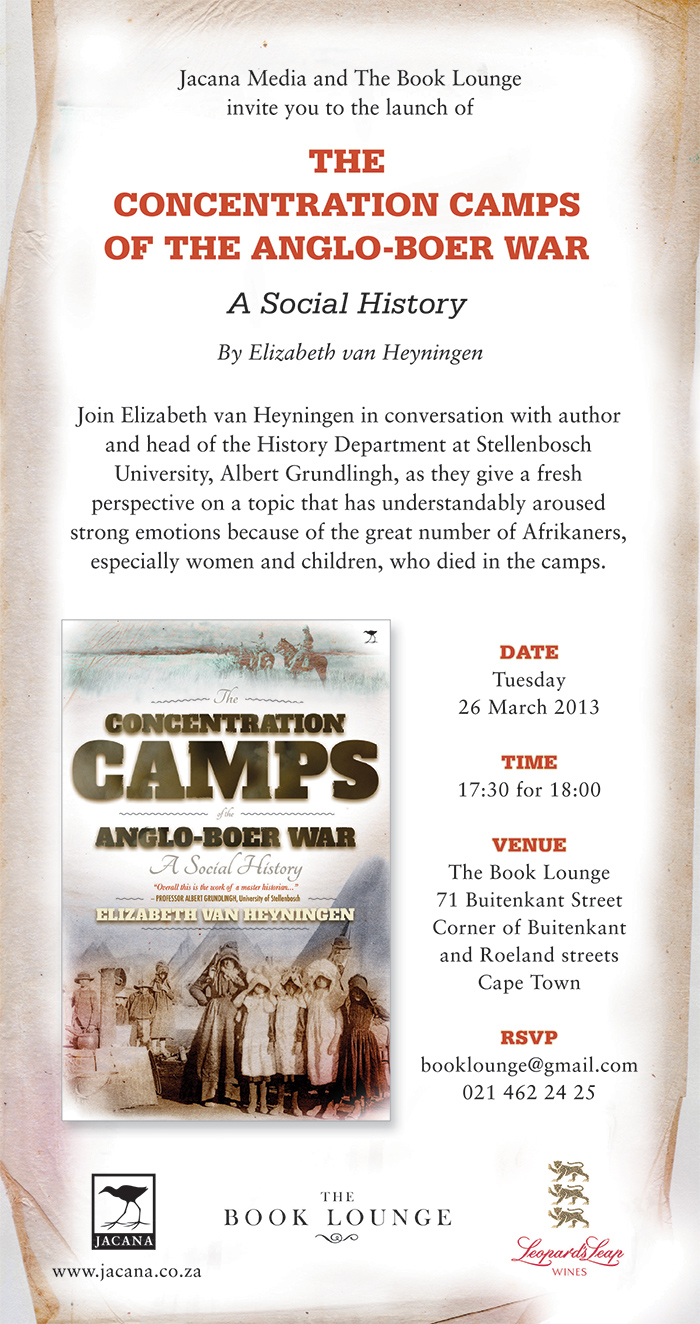
This interpretation of the camps almost caused a riot in the Book Lounge. I was almost, but not entirely, surprised. Firstly, because it underscored – again – the gulf between debates among guild historians and the reading public. And, secondly, because Boer suffering in the concentration camps was one of the most powerful strands within a historiography constructed in the 1920s and 1930s to bolster Afrikaner nationalism.
The point is not to deny that people – both black and white – suffered both physically and psychologically in the camps, but, rather, to argue that camps deserve more detailed and nuanced study as a result of the fact that British authorities saw them as being crucial to the making of a modern South Africa. Hospitals and schools, in particular, were used to pull Boer families into what Alfred, Lord Milner, and other officials believed to be the light of British rationality, order, and civilisation.
Which brings me to Christmas parties. In December 1901, around a year after the first camps for civilians were established and when mortality rates had begun to stabilise and decline in response to a raft of reforms, camp superintendents were ordered, and were provided with the means, to organise treats and celebrations for the inmates of the Boer camps. During the weeks leading up to Christmas, at the Belfast Camp, women in sewing circles and schoolchildren were encouraged to make ‘toys and useful articles’ for presents. On the 25th:
the tree was erected in a large room, and, after partaking of refreshments, the little ones were filed through the room containing the Tree and each drew a number from a bag on entering and received small garment or toy – and on leaving each got in addition a bag containing cake, sweets and dates.
At the Heidelberg Camp, ‘all children in the Camp under the age of 12’ were given ‘1 small jam-tart, 1 parcel sweets dates and biscuits.’ There were sports days with prizes, and lots and lots to eat – in contrast to the usually monotonous rations of camp living. The Irene Camp’s Christmas picnic – held for the schoolchildren – was particularly lavish:
On the day fixed, that is Friday the 20th December, all the Teachers and all the children assembled on the School grounds at 5.30 in the morning and the roll was called, when 900 answered their names. All the wagons in Camp has been requisitioned and every available ox, mule and donkey was inspanned and these wagons with their respective teams conveyed all the School children with their Teachers to the spot where several large Store tents had been pitched the day before, and where 100 men and women helpers were waiting in readiness at the 6 large Army Camp boilers and various numbers of large pots and kettles etc. to do the necessary waiting and cooking. A huge supply of bread and cakes had been baked… An ox had been killed by me the day before and the whole of it was cooked during the day on the spot. The children were served three meals during the day, exclusive of sweets and fruit and coffee, tea etc. and enjoyed themselves by playing games of all kinds and competitive sports amongst themselves.
In other camps, there were full Christmas dinners, with roast chicken, plum puddings, and fruit.
So how to interpret these Christmas parties? All superintendents reported (unsurprisingly) that children appreciated the parties and presents, and games and sports days were well attended. It also appears that some officials went out of their way to provide dinners and picnics which inmates would enjoy and remember. But interpreting these Christmas parties as a moment of happy wartime friendship across enemy lines – as a kind of South African version of the 1914 Christmas truce – would be glib. Although not denying the genuine altruism of some superintendents, these Christmas parties had a series of political and cultural functions.
Funded handsomely by the British administration, the parties were an attempt to foster goodwill: to demonstrate to Boer civilians that the camps were being run in their best interests by a benevolent administration. They were also intended to show to an international media – and newspapers did report on the parties – that the camps for Boers had improved since the outcry abroad earlier that year over the high mortality rates.
Perhaps more subtly, these parties also introduced Boer civilians to a tradition which officials believed to be entirely British: to a Christmas with a tree, a roast dinner, plum puddings, and games. Ironically, though, the Christmas traditions replicated in the camps had been invented as recently as the 1840s. Decorated Christmas trees, crackers, and cards had all become popular during the middle of the century, helped along by the increasing buying power of the British middle classes. Carol singing was revived; the Christmas dinner as we know it today emerged in this period. Although some of these rituals were already present in the British religious calendar – gift giving, for instance – they were moved closer to Christmas, and were augmented with borrowed traditions, most notably the tree, from Germany. Christmas was associated with the Victorian cult of domesticity: it was the moment of the year which celebrated the closeness of the family.
This supremely invented tradition was introduced to the camps for Boer civilians as one strategy – among many – for remaking them British. There were no such parties in camps for black civilians – or, at least, there are no records of them. Most of the reports on these camps were destroyed shortly after the war, but it is probable that British authorities balked at the thought of spending more money on black camps, which were already run on the cheap. Their inmates were made to grow their own food, for instance. Whereas Boer children were sent to school, to be educated to be future subjects of the British Empire, black children were to be taught how to work – and performed manual labour alongside their parents, while some were hired out as domestic servants in towns and cities. In this way, Christmas parties assisted in the moulding of white, imperial identities.
Tangerine and Cinnamon by Sarah Duff is licensed under a Creative Commons Attribution-ShareAlike 3.0 Unported License.
Dec 18
On late Thursday afternoon I drove through pouring rain to Wits University’s memorial service for Nelson Mandela. The rain fell in sheets across the road and hailstones pinged off my car’s bonnet. When I arrived on campus, I had to navigate paths and walkways which had become ankle-deep, swiftly running streams. I had to wring the water out of the pair of ballet flats I was wearing.
The storm was not particularly unusual for early December. Johannesburg receives most of its annual rainfall during the summer, transforming the city’s dusty, brown winter ugliness into a riot of purple and green leaves and flowers in October and November. But in some ways this week’s rain has been remarkable.
On Tuesday, it rained steadily for almost twenty-four hours. This would be entirely normal in Cape Town in the depths of winter, but is almost unheard-of in a Johannesburg nearing midsummer. While some suggested that the heavens were weeping for Madiba, others, like Cyril Ramaphosa at the official memorial service in Soweto, argued that the rain signalled the afterlife’s preparation for Mandela’s arrival. As a shop assistant at my local Pick ‘n Pay remarked, if this was true, then we should expect floods on Sunday.
The rain was not the only unplanned, ungovernable feature of Tuesday’s service: chaotic public transport; world leaders taking selfies at inappropriate moments; a bizarre, and apparently criminal, sign language interpreter; and an audience who booed the State President. As Ramaphosa and, later, Archbishop Tutu tried to threaten and cajole the audience into silence, the pouring, soaking rain seemed to re-emphasise the futility of their efforts: as they could not stop the clouds, so they could not stop the South Africans assembled in FNB stadium.

Tributes at Mandela’s home in Houghton.
Several writers have pointed out that the official events organised to mourn Mandela’s death have been at odds to the ways in which South Africans have been celebrating his life. The long speeches and tedium of Tuesday’s events contrasted with the singing and dancing at Mandela’s homes in Houghton and Soweto. The time allowed to celebrities – like Bono – to mourn at Mandela’s coffin as he lay in state at the Union Buildings was deeply resented by the many thousands who were denied access because of overcrowding.
Although delayed by the storm, the Wits memorial managed a balance of song and joy, of commemoration, and pointed discussion of how Mandela’s own commitment to public service – his decision not to run for a second term as president – contrasts with the venal, corrupt behaviour of many present office bearers in his own party. Its centrepiece was a conversation between Ahmed Kathrada, George Bizos, and Dikgang Moseneke. It was a reminder of the degree of the suffering that these – and many others – endured during the struggle.
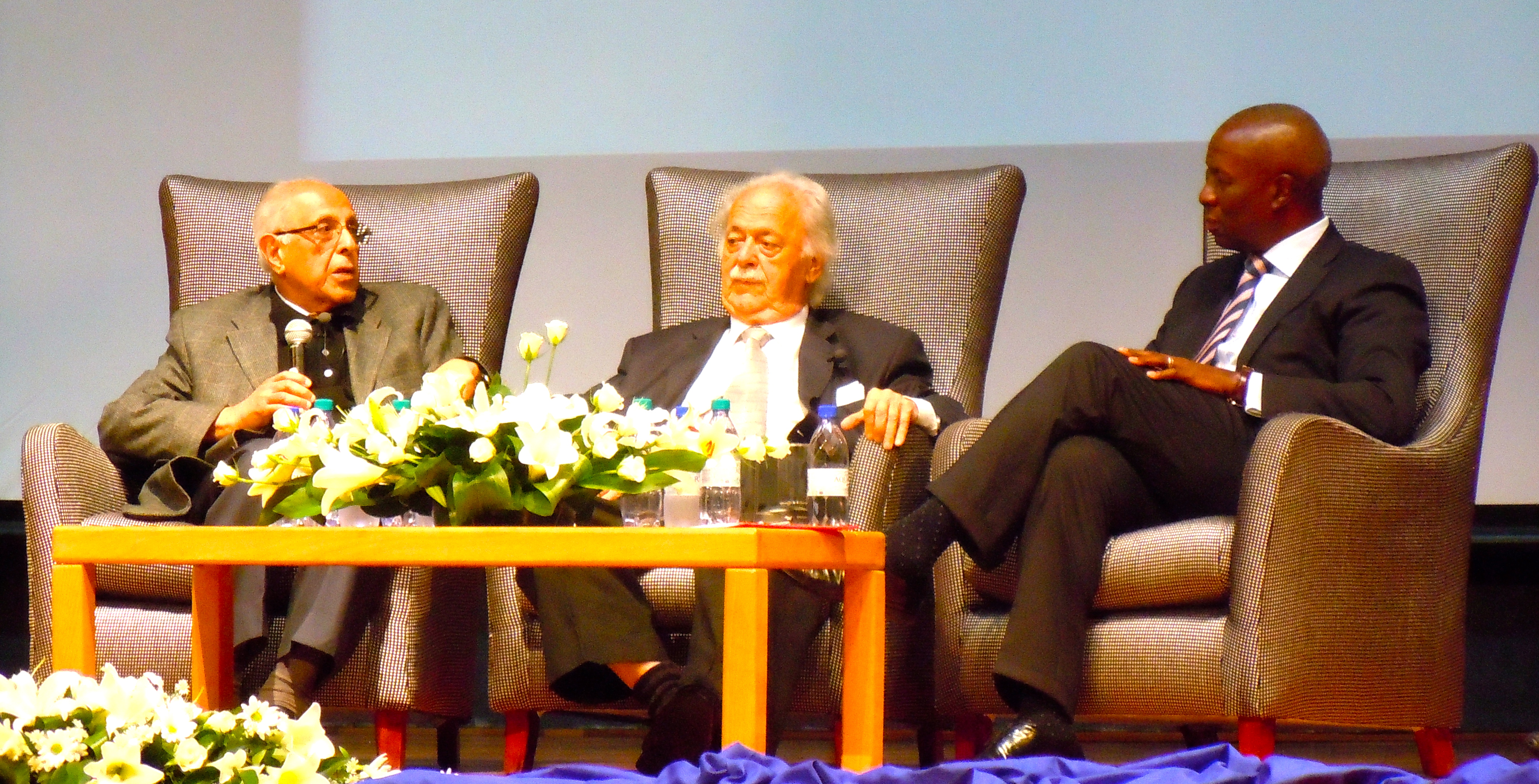
Ahmed Kathrada, George Bizos, and Dikgang Moseneke.
It demonstrated that the official memorialising of Mandela has profoundly missed the point: that the best way of paying tribute to Mandela and his generation is to work hard at making South Africa more free. And to think more carefully about what it means to be free. Lira, who performed at the end of the service, put this particularly eloquently: ‘My generation was taught to survive the struggle,’ she said. ‘But we were not taught to be free. We had to work that out for ourselves.’
I think it was partly this tension between differing definitions of freedom – which understand Mandela and his legacy in occasionally divergent ways – which contributed to the standoff between citizenry and state on Tuesday. Thinking about this past week, I realise that my most significant moments of reflection on, and commemoration of, Mandela’s legacy have been far away from official acts of remembrance: with throngs of people outside his Houghton home; lighting prayer lanterns with friends in Melville, late at night and after a long dinner; at tea with colleagues to celebrate the end of the year; listening to three struggle heroes discuss the future of the country.

Houghton.
These acts made sense to my understanding of what it means to be free in post-apartheid South Africa. That nearly twenty years after the transition to democracy, we’re still arguing and debating what it is to be free – and any attempt to silence this is like trying to stop the rain.
Tangerine and Cinnamon by Sarah Duff is licensed under a Creative Commons Attribution-ShareAlike 3.0 Unported License.
Dec 4


