Skip to content

Posts tagged ‘agriculture’

Food Links, 14.11.2012

The political implications of food shortages.

Cargill’s profits are up 300%.

It’s time to rethink our food system.

Can only organic farming feed the world?

Can Britain farm itself?

Global wheat and maize stocks are set to fall next year.

War rations.

Rising food prices are changing shopping habits.

How not to feed the world.

Mark Bittman’s dream food label.

On healthy school meals: rejected by pupils, and far too good. (Thanks Lindie and Lize-Marie!)

Sustainable food in hospitals.

There’s a shortage of yams in Lagos.

Literature and carbohydrates.

The most astonishing interview with Christopher Kimball of Cook’s Illustrated.

The long history of chicken soup.

Favourite meals of famous writers.

AA Gill is magnificent on the Michelin guide. (Thanks, Jane-Anne!)

Five steps to teetotalitariansim.

A cultural history of the whisk.

How good are Heston Blumenthal’s ready meals?

Flying frozen chicken.

What to eat on the frozen tundra.

Sylvia Plath’s recipe for tomato soup cake.

How to cope with the bacon shortage.

Where to find truffles in England.

On tipping.

Bizarre new flavours for Pringles.

Japanese chewing gum wrappers.

The legend of the potato king.

Jean-Christophe Novelli goes after Nigella Lawson.

It’s time for the spaghetti harvest.

These are courtesy of my Mum:

Outrage about the exclusion of pizzerias in Naples from Italy’s most influential food guide.

General Tso’s chicken by Fuchsia Dunlop.

Food Links, 24.10.2012

How healthy is raw milk?

Pesticides, bees, and governments’ unwillingness to introduce regulations.

A debate on the origins of opposition to GM crops.

Global warming has changed the fishing industry in southern Greenland.

Are lower pesticide residues a reason to buy organic?

Arguments in favour of national grain reserves.

Reclaiming our seed culture.

The world faces a steep decline in fish stocks.

Colin Tudge on small farms.

Using mushrooms to build cities.

How diseases are spread via the food chain.

Pigs are in crisis.

American fast food chains that don’t support the Republicans.

How long do you need to work before you can afford to buy a beer?

Crispin Odey, banker, plans on building a neo-Classical chicken coop.

Why fish need exercise.

The US election and the snack onslaught.

Crisis in the Greek food and olive oil industries.

Nathaniel Bacon’s ‘Cookmaid with Still Life of Vegetables and Fruit‘.

What is okonomiyaki? (Thanks, Mum!)

On misophonia. (I have this. It’s hell.)

The world’s fastest one-litre engine vehicle runs on cheese.

Ladies who drink.

The extraordinary invention of tabs on cans.

Vagina cupcakes.

Food typography.

Pumpkin pancakes.

Three burning questions about salt.

A new blog on pickling and preserving.

Cheese smuggling in Canada.

Christina McDermott on favourite food blogs.

A brief history of drinking and reading.

Delicious dishes with revolting names.

Berger & Wyse’s food-themed cartoons.

What’s the best shot for photographing food?

On dashi.

Bologna’s new ice cream museum. (Thanks, Catherine!)

Sam Woollaston cooks along to Nigellissima.

Cows respond to the Tim Noakes diet.

A recipe for pudding in verse, from Jane Austen’s family.

How to keep spices fresh.

Fashionable cafes in Paris.

How to eat breakfast cereal.

A recipe for challah.

Vogue plans to open a cafe in Dubai.

A reading of the ingredients in Kraft Dinner. (Thanks, Kelsey!)

Green Revolutions

Recently, there’s been a lot of debate generated by a study done by a research team at the University of Caen in France. Last month, they published a paper in the peer-reviewed journal Food and Chemical Toxicology, in which they alleged that rats fed Monsanto’s genetically modified maize and exposed to the herbicide Roundup – also produced by Monsanto – over the course of a lifetime, developed tumours and suffered multiple organ damage.

Terrible photographs of some alarmingly lumpy rats circulated around the internet, and it seemed that the green movement’s vociferous opposition to GM crops was vindicated. But almost as soon as the study’s findings were announced, doubts – around the validity of the research itself and the way it had been communicated – began to emerge.

Not only have similar, more rigorous tests, demonstrated that GM crops had no impact on health, but, as the New Scientist reported:

the strain of rat the French team used gets breast tumours easily, especially when given unlimited food, or maize contaminated by a common fungus that causes hormone imbalance, or just allowed to age.

Moreover:

Five of the 20 control rats – 25 per cent – got tumours and died, while 60 per cent in ‘some test groups’ that ate GM maize died. Some other test groups, however, were healthier than the controls.

…the team claims to see the same toxic effects both with actual Roundup, and with the GM maize – whether or not the maize contained any actual herbicide. It is hard to imagine any way in which a herbicide could have identical toxic effects to a gene tweak that gives the maize a gene for an enzyme that actually destroys the herbicide.

This research isn’t entirely without value: it could suggest that even the smallest dose of weed killer or GM maize has the potential to cause physiological harm.

But even this conclusion is undermined by the circumstances in which the study was produced. The research team at Caen is open about its opposition to GM crops; and the anti-GM organisation which orchestrated the publicity around the release of the report, refused to allow journalists to consult other scientists about the paper.

As we’re right to be suspicious of studies undertaken by scientists affiliated to industry – the implications of which Ben Goldacre explores in his latest book on Big Pharma – so we must question the motives, however noble they may be, of this research team funded by anti-GM groups.

What I found so interesting about the response to the study was the vehemence of the anti-GM crop lobby. Like the debates around nuclear energy and, even, animal testing, it seems to me that the strength of feeling – on both sides – has a tendency to shut down all reasonable discussion. I was appalled when, earlier this year, a group of anti-GM activists threatened to destroy a field of GM wheat planted by scientists at the publicly-funded Rothamsted Research. Their work aimed partly to reduce pesticides sprayed on crops.

On the other hand, though, pro-GM scientists, economists, and others seem to be too quick to label those with – legitimate – concerns about the genetic modification of plants and animals as ‘anti-science.’ In an article from 2000, Norman Borlaug argued:

Extremists in the environmental movement, largely from rich nations and/or the privileged strata of society in poor nations, seem to be doing everything they can to stop scientific progress in its tracks. It is sad that some scientists, many of whom should or do know better, have also jumped on the extremist environmental bandwagon in search of research funds. …

We all owe a debt of gratitude to the environmental movement that has taken place over the past 40 years. This movement has led to legislation to improve air and water quality, protect wildlife, control the disposal of toxic wastes, protect the soils, and reduce the loss of biodiversity. It is ironic, therefore, that the platform of the antibiotechnology extremists, if it were to be adopted, would have grievous consequences for both the environment and humanity.

His point is that GM crops have the potential to end world hunger. As the Nobel Peace Prize winner credited with originating the Green Revolution during the 1950s and 1960s, Borlaug was in a position to argue– with some validity – that selective plant breeding had helped to feed a world of, now, seven billion people.

In 1943, concerned about the link between food shortages and political upheaval – particularly as the Cold War loomed – the Rockefeller Foundation began sponsoring research into the development of new drought-resistant and higher yielding plant species in Mexico.

Focussing on wheat, maize, and rice, Borlaug and other scientists affiliated with the programme cross-bred higher-yielding species. These new seeds were distributed at first in Mexico, India, and the Philippines. It’s difficult to underestimate the impact of this research, as Gordon Conway explains:

Cereal yields, total cereal production and total food production in the developing countries all more than doubled between 1960 and 1985. Over the same period their population grew by about 75 per cent. As a result, the average daily calorie supply in the developing countries increased by a quarter, from under 2,000 calories per person in the early 1960s to about 2,500 in the mid-80s, of which 1,500 was provided by cereals.

The Green Revolution has made it possible to feed a population of seven billion people. But it had substantial drawbacks. Conway writes that the ‘potential’ of the Green Revolution crops

could only be realised if they were supplied with high quantities of fertiliser and provided with optimal supplies of water. As was soon apparent, the new varieties yielded better than the traditional at any level of fertiliser application, although without fertiliser they sometimes did worse on poor soils. Not surprisingly, average rates of application of nitrogen fertilisers, mostly ammonium sulphate and urea, doubled and redoubled over a very short period.

We know now that we need a new Green Revolution – one which is not as heavily reliant on water, and which does not poison and destroy ecosystems. There’s a certain logic, then, to many activists’ arguments that it’s ‘science’ which is to blame for present food insecurity: that a return to small-scale peasant farming offers the best means of supplying food to an ever-growing population.

This suspicion of ‘science’ – whatever we may mean by this – is nothing new. During the 1970s, for instance, the green movement emerged partly in response to concerns about the implications of the Green Revolution for human health, biodiversity, and water supplies. Much of this early environmentalism advocated a return to nature, and a rejection of technology.

I haven’t made up my mind about the usefulness or otherwise of GM crops, but I hesitate over the whole-hearted embrace of ‘traditional’ methods of farming. It’s worth remembering that pre-industrial agriculture required the majority of the world’s population to be involved in food production in order to stave off hunger. Now, in developed nations, this number has plummeted to only a couple of per cent. In sub-Saharan Africa, seventy per cent of the population remains in engaged in agriculture, although this is also likely to decline.

Better technology and higher-yielding plant varieties have freed up the majority of the world’s population to do other forms of work. The world has changed a great deal since the eighteenth century.

What concerns me more, though, are the businesses which push GM crops – those which are at the receiving end of European and African bans on the planting of genetically modified wheat, maize, and other plants. Monsanto and Cargill are currently the target of a campaign to end the patenting of seeds – making them cheaper and more freely available to small farmers in the developing world.

These two companies, in particular, have a growing control over the world’s food supply. Not only do they own seed patents, but they provide pesticides and fertilisers. Cargill produces meat and grows grain – in fact, no one knows how much grain it has stored in its silos. Given that Cargill and the commodities trader Glencore have both admitted that their profits have increased as a result of the drought in the US and the resultant rise in food prices around the world, it’s exceptionally worrying that these organisations have so much control over our food chain.

What the GM debate reveals is a set of complex and shifting attitudes around the relationship between food, farming, and science – and around how we define what is ‘natural’. Instead of rejecting the potential benefits of GM crops out of hand, I think it would be wise to encourage more research into their implications both for human health, and for the environment. Moreover, I think we need to scrutinise and hold to account big businesses like Monsanto, Glencore, and Cargill. They represent a far greater threat to our ability to feed ourselves.

Further Reading

Norman Borlaug, ‘Ending World Hunger: The Promise of Biotechnology and the Threat of Antiscience Zealotry,’ Plant Physiology, vol. 124 (Oct. 2000), pp. 487-490.

Gordon Conway, The Doubly Green Revolution (London: Penguin, 1997).

Joseph Cotter, Troubled Harvest: Agronomy and Revolution in Mexico, 1880-2002 (New York: Praeger, 2003).

John H. Perkins, Geopolitics and the Green Revolution: Wheat, Genes, and the Cold War (New York: Oxford University Press, 1997).

Himmat Singh, Green Revolutions Reconsidered: The Rural World of Contemporary Punjab (New Delhi: Oxford University Press, 2001).

Creative Commons License
Tangerine and Cinnamon by Sarah Duff is licensed under a Creative Commons Attribution-ShareAlike 3.0 Unported License.

Food Links, 03.10.2012

Mexico’s small-scale maize farmers are under threat.

Tom Philpott considers the recent Stanford report on organic produce.

More reflection on the latest pro/anti-organics bunfight.

Water and meat consumption.

The history of the lunchbox.

Harvesting a climate disaster.

Chinese farmers in Russia.

A journey along the Silk Road helps to explain the genetic influence over food preference.

The science behind flavour combinations.

The names of pasta shapes. (Thanks, Mum!)

The Royal Society’s top twenty inventions in the history of food and drink.

The journey of a wheel of cheese, from Spain to New York.

Eating in Moscow.

The problem with TV cookery.

A socialist’s guide to drinking.

Re-imagining the ice cream shop.

In praise of buttermilk.

Three good things on a plate.

What it’s like being a chef in Silicon Valley.

The Zagat guide gets London badly wrong.

How to make bourbon salt.

A guide to African cuisine in Paris.

Ruth Bourdain remains at large.

Puddings made with berries.

The rise and rise of Peruvian cuisine.

Calvin Trillin on ceviche.

Food-based art.

Will Self on Garfunkel’s.

George Washington’s small beer.

Lebanese steak tartare.

Food future.

The Renaissance of Nigerian Cuisine.

Brooklyn Blackout Cake.

Seven things to do with apples.

Escher-inspired food art.

Fuck Yeah Biscuits.

What couscous to buy.

Eating fish in Greece.

Lausanne‘s weekend market.

A man drives across the US, using only bacon as currency.

The Onion on Hostess‘s bankruptcy.

African Rice

I’ve recently finished lecturing an undergraduate course on African history up until 1914. It’s one of my favourite areas to teach, partly because students – even South African ones – tend to have very little knowledge about the continent’s past.

In fact, it’s often quite difficult to persuade them that there is a pre-colonial African history to study and teach. Now, most people would be horrified by the racism which underpinned Hugh Trevor-Roper’s 1963 assertion that

Perhaps in the future there will be some African history to teach. But at present there is none, or very little: there is only the history of Europe in Africa. The rest is largely darkness.

But there’s still a relatively widespread belief that not only were African societies not subject to change over time – that their ways of life remained static over the course of several centuries – but that only anthropologists have the requisite skills to study Africans and their past.

This is all nonsense, of course. Since the early 1960s, an extraordinarily rich and varied body of work on African history has been produced by scholars working all over the world. More recently, and particularly as global history has emerged as a popular field, historians have begun to examine the links between the continent and other parts of the world.

Far from being isolated until the arrival of Portuguese traders in the fifteenth century, Africans have long had contact with foreigners. For instance, the trade in gold and salt across the Sahara from around the second and third centuries onwards, connected African kingdoms in the Sahel with the Islamic world.

Too often accounts of, particularly European, contact with Africa describe this trade as benefitting only one side of the exchange: that a plundering of Africa’s natural resources in exchange for beads, alcohol, or muskets deliberately bamboozled Africans into giving up incredibly precious ivory or gold for objects of considerably lesser value.

This was not entirely the case. One of the best ways to understand the complex history of exchange between Africans and traders and other visitors from Europe and Asia is – naturally, dear readers – through food.

Since the second and third centuries AD, the east coast of Africa was part of an international trading network which extended around the Indian Ocean. As Africans came into contact with Arab traders, goods, languages, ideas, and people arrived and left this long coastline over the course of nearly a millennium. During this period, African crops – including millet, sorghum, okra, and watermelon – were taken to the Middle East, India, and beyond. In return, coconut palms, sugarcane, and bananas were introduced to the continent.

Coffee from Ethiopia probably reached Yemen – via the port of Mocha – during the sixth century. Here, Yemenis roasted, rather than fermented, coffee beans, and the drink spread slowly around the Middle East, Turkey, and North Africa. When Europeans discovered that it could be made more palatable with the addition of milk and sugar, it became popular in Europe in the fifteenth and sixteenth centuries. Coffee plantations established in Dutch and French colonies in southeast Asia and the Caribbean during the seventeenth and eighteenth centuries helped to fuel the growth of these European economies.

Sometime between the eighth and twelfth centuries, Oryza sativa, or Asian rice, was introduced to east Africa from India. Muslim traders were probably responsible for the earliest cultivation of rice in Kenya, and migrants from Malaysia and Indonesia brought rice to Madagascar.

All this occurred long before 1492, the year of Christopher Columbus’s crossing of the Atlantic to the Americas, and the beginning of the Columbian exchange. Although there was a significant circulation of crops around the Indian Ocean and Mediterranean worlds, the Columbian Exchange holds a particular significance in histories of food and medicine: it describes the introduction of livestock, European and Asian crops – predominantly wheat – and diseases like syphilis and smallpox to the Americas, and the gradual cultivation of New World staples – maize, potatoes, tomatoes, squash, beans – in Europe, Asia, and Africa.

Judith A. Carney writes:

Within decades of the arrival of Columbus in the Americas, the New World domesticate, maize, was being planted in West Africa. Other Amerindian staples soon followed, such as manioc, sweet potatoes, capsicum peppers, tomatoes, peanuts, cashew nuts, pineapple, pumpkins, squash, and tobacco. The early establishment of maize as a food staple in West and Central Africa illuminates the radical transformation of African agricultural systems wrought by the Columbian exchange.

By the time that the transatlantic slave trade reached its height during the eighteenth century, maize cultivation was widespread throughout west Africa, and was a staple for slaves shipped across to the Americas.

Slaves took with them not only their own languages, cultural practises, and social structures – but also their knowledge of agricultural production. African rice, Oryza glaberrima, had been grown in west Africa since long before the arrival of Asian rice on the east coast of the continent. Carney explains:

Muslim scholars reaching the western Sudan from North Africa in the eleventh century found an already well developed system of rice cultivation in the inland delta of the Niger Delta and a robust regional trade in surpluses. The domestication of glaberrima rice in West Africa was thus established centuries before Asian sativa arrived in East Africa.

It was slaves taken from these regions who used their expertise in rice production in the Americas, and particularly successfully in South Carolina. The cultivation of rice had begun there in the 1690s, and by the eighteenth century, was the source of significant revenue for the colony. There is compelling evidence to suggest that African slaves used the same irrigation and planting systems that they had in west Africa, in South Carolina. Far from being only the labour which worked the plantations in the Americas, they were also responsible for establishing a successful system of rice cultivation.

Labourers on a rice plantation, South Carolina, 1895 (http://www.niu.edu/~rfeurer/labor/chronological.html)

African slaves also pioneered the cultivation of a range of other crops, including black-eyed peas, okra, yams, and watermelons. Perhaps the best example of the circulation of crops around the Atlantic world was the peanut: introduced to west Africa from South America by the 1560s, it was taken to North America by African slaves during the eighteenth century.

What all of this demonstrates is not only that Africa and Africans have participated in global trading networks for centuries, but that they shaped food production in the Americas.

One of the many narratives peddled by foreign coverage of Africa is that the continent’s salvation – whatever we may mean by that – lies in outside intervention: in Nicholas Kristof’s ‘bridge characters’ (foreign aid workers, volunteers), or in elaborate packages created by the IMF or other international organisations.

This narrative is predicated on the wholly incorrect belief that Africans have, historically, been acted upon – have had change thrust upon them – rather than being actors themselves. As an understanding of the transfer of agricultural knowledge and produce across the Atlantic from the seventeenth century onwards demonstrates, this could not have been further from the truth.

Sources

Judith A. Carney, ‘African Rice in the Columbian Exchange,’ Journal of African History, vol. 42, no. 3 (2001), pp. 377-396.

Judith A. Carney, ‘From Hands to Tutors: African Expertise in the South Carolina Rice Economy,’ Agricultural History, vol. 67, no. 3 (Summer 1993), pp. 1-30.

Judith A. Carney, ‘The Role of African Rice and Slaves in the History of Rice Cultivation in the Americas,’ Human Ecology, vol. 26, no. 4 (Dec. 1998), pp. 525-545.

Creative Commons License
Tangerine and Cinnamon by Sarah Duff is licensed under a Creative Commons Attribution-ShareAlike 3.0 Unported License.

The Root of the Evil

Over the past few weeks I’ve been watching with barely-disguised glee, the evisceration of a recent Newsweek article by Niall Ferguson – pet historian of the American right – in which he provides a deeply flawed analysis of Barack Obama’s past four years in power. As Matthew O’Brien notes, before systematically working through Ferguson’s argument (or, indeed, ‘argument’), ‘He simply gets things wrong, again and again and again.’

I’m no fan of Ferguson’s. This has less to do with our political differences – in relation to him, I’m so left-wing I should be living in a Himalayan hippy commune practising an obscure form of yoga while teaching Capital to peasants – but because of the way he shapes his interpretations of the past to suit a particular neoliberal agenda.

Of course, no historian is capable of writing an absolutely objective history of anything – nor would we want to because it would be dreadfully boring – but Ferguson presents, and defends, his arguments on the grounds that they are absolute truth.

He was called out on this last year by Pankaj Mishra, in a fantastic review of Civilisation: The West and the Rest for the London Review of Books. In Civilisation, Ferguson argues that

civilisation is best measured by the ability to make ‘sustained improvement in the material quality of life’, and in this the West has ‘patently enjoyed a real and sustained edge over the Rest for most of the previous 500 years’. Ferguson names six ‘killer apps’ – property rights, competition, science, medicine, the consumer society and the work ethic – as the operating software of Western civilisation that, beginning around 1500, enabled a few small polities at the western end of the Eurasian landmass ‘to dominate the rest of the world’.

Leaving aside the strange question of why an historian writing in the twenty-first century thinks that it’s possible to divorce the ‘West’ (whatever we may mean by that) from the rest of the world – and even why an historian feels like writing a triumphalist history of Europe and North America (I thought we stopped doing that in the sixties?) – this is a history which largely ignores, or plays down, the implications of modern capitalism and globalisation for those people outside of the West.

As in his writing on the creation of European empires, Ferguson has a problem with accounting for the widespread resistance of Africans, Asians, and others to European conquest – and the violence and exploitation which followed colonisation. Mishra writes:

he thinks that two vaguely worded sentences 15 pages apart in a long paean to the superiority of Western civilisation are sufficient reckoning with the extermination of ten million people in the Congo.

Recently I’ve been thinking a great deal about a comment which Roger Casement made in a report for the British government about atrocities committed in the Congo Free State during the late nineteenth century. Writing in 1900, he concluded:

The root of the evil lies in the fact that the government of the Congo is above all a commercial trust, that everything else is orientated towards commercial gain….

The Congo Free State came into being at the 1884-1885 Berlin West Africa Conference, where the assembled representatives of European states acknowledged the Belgian king’s right to establish a colony in central Africa. Leopold II’s International Association – a front organisation for his own commercial interests – was allowed to operate in the region.

There were strings attached to the deal – Leopold had to encourage both humanitarianism and free trade, for instance – but with the sharp increase in international demand for rubber in the 1890s, after JB Dunlop’s invention of inflatable rubber tyres, Leopold’s interest in the Congo, which had only ever extended to exploiting the country for its natural resources, narrowed even further. Leopold operated his own monopoly on the rubber trade, leasing some land to other companies on the proviso that they pay him a third of their profits.

The ‘evil’ to which Casement referred was the transformation of the Congolese population into a mass of forced labourers compelled to contribute quotas of rubber to the various businesses operating in the Free State. Those who failed to do so, those who refused to do so, or those who were suspected of not doing so, faced brutal reprisals from the State’s Force Publique, including being killed, often along with their families; having their hands cut off; and seeing their villages and property burned and destroyed.

It’s estimated that ten to thirteen million Congolese died as a result of murder, starvation, exhaustion, and disease between 1885 and 1908, when international condemnation of Leopold’s regime forced the Belgian government to take control of the Free State.

Although other colonial regimes in Africa could be brutal, violent, and unjust, none of them – with the possible exception of Germany in (what is now) Namibia – managed to commit atrocities on the scale that Leopold did in the Congo. As Casement makes the point, ‘the root of the problem’ was that the Congo was run entirely for profit, and that the businesses which operated in the region were not regulated in any way. This was capitalism at its most vicious.

But what does this all have to do with food? Well I was reminded of Casement’s comment when reading about Glencore’s response to the current droughts – chiefly in the US, but also elsewhere – which are partially responsible for global increases in food prices:

The head of Glencore’s food trading business has said the worst drought to hit the US since the 1930s will be ‘good for Glencore’ because it will lead to opportunities to exploit soaring prices.

Chris Mahoney, the trader’s director of agricultural products, who owns about £500m of Glencore shares, said the devastating US drought had created an opportunity for the company to make much more money.

‘In terms of the outlook for the balance of the year, the environment is a good one. High prices, lots of volatility, a lot of dislocation, tightness, a lot of arbitrage opportunities [the purchase and sale of an asset in order to profit from price differences in different markets],’ he said on a conference call.

This weekend, it was revealed that Barclays has made more than £500 million from food speculation:

The World Development Movement report estimates that Barclays made as much as £529m from its ‘food speculative activities’ in 2010 and 2011. Barclays made up to £340m from food speculation in 2010, as the prices of agricultural commodities such as corn, wheat and soya were rising. The following year, the bank made a smaller sum – of up to £189m – as prices fell, WDM said.

The revenues that Barclays and other banks make from trading in everything from wheat and corn to coffee and cocoa, are expected to increase this year, with prices once again on the rise. Corn prices have risen by 45 per cent since the start of June, with wheat jumping by 30 per cent.

What bothers me so much about these massive profits is partly the massive profits – the fact that these businesses are actually making money out of a food crisis – but mainly it’s that these monstrously wealthy businessmen are so unwilling to admit that what they’re doing is, even in the most charitable interpretation, morally dubious.

Barclays’s claim that its involvement in food speculation is simply a form of futures trading is disingenuous: futures trading is an entirely legitimate way for farmers to insure themselves against future bad harvests. What Barclays and other banks, as well as pension funds, do is to trade in agricultural commodities in the same way as they do other commodities – like oil or timber.

In 1991, Goldman Sachs came up with an investment product – the Goldman Sachs Commodity Index – which allowed for raw materials, including food, to be traded as easily as other products. When the US Commodities Futures Trading Commission deregulated futures markets eight years later, for the first time since the Great Depression, it became possible to trade in maize, wheat, rice, and other foodstuffs for profit.

The current food crisis has been caused by a range of factors – from the drought, to the excessive use of maize and other crops for biofuel – and exacerbated by climate change and pre-existing conflicts, corruption, inequalities, and problems with distribution. In Europe, unemployment and low wages will add to people’s inability to buy food – hence the rise in demand for food banks in Britain, for example.

Food speculation has not caused the crisis, but it does contribute to it by adding to food price volatility. I’m not – obviously – comparing Glencore or Barclays to Leopold II’s International Association, but the atrocities committed in the Congo Free State provide an excellent example of what happens when capitalism is allowed to run rampant. Let’s not make that mistake with our food supply.

Creative Commons License
Tangerine and Cinnamon by Sarah Duff is licensed under a Creative Commons Attribution-ShareAlike 3.0 Unported License.

A Hungry World

One of the best parts of teaching a course on African history is being able to introduce students to Binyavanga Wainaina’s amazing essay ‘How to Write about Africa’. In my first lecture, I wanted to emphasise the disconnect between the (powerful) narratives which have been developed about the continent – by travellers, politicians, journalists – and its history, societies, politics, and economics. Wainaina’s achievement is that he draws attention to a range of usually unchallenged assumptions about Africa, and shows them to be ridiculous:

Never have a picture of a well-adjusted African on the cover of your book, or in it, unless that African has won the Nobel Prize. An AK-47, prominent ribs, naked breasts: use these. If you must include an African, make sure you get one in Masai or Zulu or Dogon dress.

In your text, treat Africa as if it were one country. It is hot and dusty with rolling grasslands and huge herds of animals and tall, thin people who are starving. Or it is hot and steamy with very short people who eat primates. Don’t get bogged down with precise descriptions. Africa is big: fifty-four countries, 900 million people who are too busy starving and dying and warring and emigrating to read your book. …

Taboo subjects: ordinary domestic scenes, love between Africans (unless a death is involved), references to African writers or intellectuals, mention of school-going children who are not suffering from yaws or Ebola fever or female genital mutilation.

Recently, there has been a lot of discussion, particularly in the United States, about how the western media covers Africa. Laura Seay writes in an excellent article for Foreign Policy:

Western reporting on Africa is often fraught with factual errors, incomplete analysis, and stereotyping that would not pass editorial muster in coverage of China, Pakistan, France, or Mexico. A journalist who printed blatantly offensive stereotypes about German politicians or violated ethical norms regarding protection of child-abuse victims in Ohio would at the least be sanctioned and might even lose his or her job. When it comes to Africa, however, these problems are tolerated and, in some cases, celebrated. A quick search of the Google News archives for ‘Congo’ and ‘heart of darkness’ yields nearly 4,000 hits, the vast majority of which are not works of literary criticism, but are instead used to exoticise the Democratic Republic of the Congo while conjuring up stereotypes of race and savagery. Could we imagine a serious publication ever using similar terminology to describe the south side of Chicago, Baltimore, or another predominately African-American city?

Similarly, Jina Moore makes the point in the Boston Review that believing that journalists should only report incidents of violence or suffering, instead of other aspects of life on the continent, is

a false choice. We can write about suffering and we can write about the many other things there are to say about Congo. With a little faith in our readers, we can even write about both things – extraordinary violence and ordinary life – in the same story.

These narratives – these stories, these reports and articles about Africa – have a measurable impact on the ways in which the rest of the world interacts with the continent. Tracing a shift in American attitudes towards Africa from around 2000, when concern about the AIDS epidemic was at its height, Kathryn Mathers writes:

Suddenly there were no conversations about new democracies in Africa, or investment opportunities; the potential consumers were represented as too sick to labour, let alone to shop. This became the burden of caring Americans whose consumption practices can give a sick child in Africa ARVs or provide mosquito nets against the ravages of malaria.

To coincide with the final day of the 2012 Olympics, David Cameron and the Brazilian vice-president Michel Temer will host a summit on hunger and malnutrition in the developing world. It will be attended by officials from the US Department of Agriculture and the UK Department of International Development, as well as a clutch of celebrities. As an editorial in the Guardian puts it, ‘when tackling malnutrition involves photo-opportunities with icons such as Mo Farah and David Beckham, it’s hard not to be sceptical’ about the impact that this summit will have.

Although the summit was planned months ago, its timing is particularly apt: the world is facing another food crisis. Since the end of July, it’s become clear that the bumper harvest predicted, globally, for 2012 was not to be – in fact, maize and wheat yields are down. This year’s soybean crop is the third worst since 1964. Reading about this crisis, you’d be forgiven for thinking that it is exclusively the problem of poor nations: we know that Zimbabwe, the Sahel region, the Horn of Africa, and Yemen all face severe food shortages, and that the price of food is increasing in Egypt, Mexico, South Africa, and other middle-income nations.

However, the immediate cause of this food crisis lies far away from the regions worst affected by malnutrition and high food prices: in the United States, which is currently experiencing its worst drought in almost a century. More than half the country’s counties – 1,584 in 32 states, including Iowa, Indiana, Oklahoma, and Wyoming – have been declared disaster areas.

It’s difficult to underestimate just how devastating this drought has been (and is):

Wherever you look, the heat, the drought, and the fires stagger the imagination.  Now, it’s Oklahoma at the heart of the American firestorm, with ‘18 straight days of 100-plus degree temperatures and persistent drought’ and so many fires in neighbouring states that extra help is unavailable. It’s the summer of heat across the U.S., where the first six months of the year have been the hottest on record…. More than 52% of the country is now experiencing some level of drought, and drought conditions are actually intensifying in the Midwest; 66% of the Illinois corn crop is in ‘poor’ or ‘very poor’ shape, with similarly devastating percentages across the rest of the Midwest.  The average is 48% across the corn belt, and for soybeans 37% – and it looks as if next year’s corn crop may be endangered as well. …according to the Department of Agriculture, ‘three-quarters of the nation’s cattle acreage is now inside a drought-stricken area, as is about two-thirds of the country’s hay acreage.’

There are suggestions that the Midwest is in danger of experiencing a second Dust Bowl. But the drought is not limited to the US: unusually dry summers have reduced harvests in Russia, the Ukraine, and Kazakhstan. And the effects of these poor yields will be felt around the world. Even if, as the Financial Times reports, the drought will push up prices of beef, pork, and chicken in the United States and Europe, the countries most at risk of food shortages, and, indeed, of social unrest, are those which rely on food imports to feed their populations.

If rates of malnutrition are to be reduced and food shortages, addressed, then politicians will have to consider them in global context. They will have to rethink America’s energy policies, which have allowed for almost forty per cent of the country’s corn crop to be devoted to ethanol production. They will have to address the impact that financial speculation has on the price of food commodities. A report published by the New England Complex Systems Institute suggests that food price increases are likely to be exacerbated by the unregulated trade in staples like maize and wheat.

Even these measures will not be enough to ensure adequate access to food for all people: we need to find strategies to slow down and mitigate the effects of climate change; social and economic inequality in the developing world must be addressed; land grabs need to be halted; and agricultural policies in sub-Saharan Africa and elsewhere need to favour small farmers.

In the same month in which the tofu industry in Indonesia has threatened to down tools over rising soybean prices, the cost of maize meal is increasing in Mexico, and there were protests in Iran over price of chicken, the grain trader Cargill announced revenues of $134 billion. This state of affairs is not sustainable.

While it’s certainly the case that famine and malnutrition in parts of sub-Saharan Africa are the products of dysfunctional and corrupt governments, it’s also true that as part of a globalised food system, food insecurity in Africa – and the rest of the developing world – is connected to a set of problems which can only be solved on an international scale.

This is, then, a global crisis. But reporting has tended to disassociate its cause and effects: hunger in Africa is reported separately from the drought in the northern hemisphere and the spike in food prices. Cameron’s summit on malnutrition focuses exclusively on the developing world. I think that this is partly as a result of the narratives which inform reporting on these regions: America is an agricultural superpower, while Africa is a site of terminal decline and disaster. It’s worth noting that America’s poor harvest tends to be reported on in the environmental or financial sections of newspapers and websites, while hunger and malnutrition in sub-Saharan Africa and south Asia are relegated to the sections dealing with aid or development. Linking malnutrition in South Sudan to the maize harvest in Indiana would upset these ways of thinking about Africa and the United States.

Creative Commons License
Tangerine and Cinnamon by Sarah Duff is licensed under a Creative Commons Attribution-ShareAlike 3.0 Unported License.

Food Links, 08.08.2012

The corn harvested in the US for biofuel could feed 412 million people.

Raj Patel’s new project: Generation Food.

Americans drink more fizzy soft drinks than anyone else.

Why Britain’s food ‘traffic light‘ labels were never implemented.

The link between food and addiction.

Why does fast food love Mitt Romney?

The battle for London’s markets.

Cooking along with Elizabeth Ellicott Lea’s Domestic Cookery (1845).

Food at the Olympics.

Sean Brock, the tattooed chef who’s reinventing southern cuisine.

An interview with Michael Pollan.

How to explode a watermelon with rubber bands.

The UnFancy Food Show.

All about hummus.

Why do some restaurants fear the number thirteen?

Stick twist bread.

Darina Allen on collecting sea urchins.

Marion Cunningham’s baking powder biscuits (scones to the rest of us).

Freezing herbs in olive oil preserves them.

How to make your own creme de cassis.

Looking for loganberries.

Papercraft food.

Has the mania for bacon gone too far?

Eat more beetroot.

Maslow’s hierarchy of coffee chains.

Recipes for blueberries.

A tablecloth which turns the table into a fort.

An advertisement for coffee from the 1650s.

Henna-patterned spiced cream cheese.

An interview with James Ramsden.

Food t-shirts.

Photographs of meals in literature.

How to make perfect rice.

Cupcakes vs pie.

Dead celebrities reborn in food.

Food Links, 18.07.2012

Rebuilding agriculture in Egypt.

The launch of the Global Food Security Index.

How the size of fizzy drinks has increased in the US.

The rise of ‘single estate milk‘ in Ireland.

The cost of coffee.

Why British dairy farmers are protesting at a drop in the price of milk.

How Kraft tests its products on children. (Thanks, David!)

Fake meat comes ever closer to being a reality.

No chips other than McDonald’s chips are to be allowed in the Olympic park. Madness.

The politics of free milk.

The worryingly high incidence of bisphenol A in humans.

Constructing Korean identity and food.

Marcella Hazan, Facebook enthusiast.

A riposte to ‘self-righteous vegetarianism.’

What criticism of fast food says about our relationship with food.

An interview with Jay Rayner.

Who’s caused the elderflower shortage?

Surströmming.

A lovely article about Escape Caffe in Cape Town.

On the continuing success of Coca-Cola.

Reading and eating.

A girl and her pig.

Hints and tips for dining etiquette.

Fuchsia Dunlop on the pungent cuisine of Shaoxing (and more pictures here).

A guide to Greek cooking.

The Ideal Cookery Book, by Margaret Alice Fairclough.

The Coalition against Brunch.

Five of the best trattorias in Rome.

Vegan taxidermy.

Margarine and fizzy drinks. (Thanks Dan!)

Kenyan tea.

How to get people to shop for groceries in the nude.

The world’s largest coffee mosaic.

The trend for bitters in cocktails.

Fried sage leaves.

Recipes for blueberries. (Thanks, Simon!)

Britain’s changing food scene and the London Olympics.

Supermarkets and the threat to the Amazon. (Thanks, David!)

Are all calories the same?

How to chop an onion.

Hyper-real paintings of puddings.

The history of the fork.

Ten made-up food holidays.

Can food photography make you hungry?

Japan rethinks its relationship with food. (Thanks, Mum!)

Urgh: the cheeseburger-crust pizza.

How to eat cheese and biscuits.

Breakfast-shaped earphones.

A poem about olives.

Why wasting food is bad for the environment.

The Cake Museum in Los Angeles is under threat.

How cupcakes may save NASA. (Thanks, Jane-Anne!)

Aussie Rules?

A month ago I had the pleasing experience of packing for Perth. In South African slang, ‘packing for Perth’ means immigrating to Australia. In the decade that followed the transition to democracy, around 800,000 mainly white South Africans left – some for New Zealand, Britain, and the United States, but the bulk went to Australia.

Australia’s appeal to these South Africans was based on its political and economic stability, its relatively low crime rate, and also on its familiarity. Its landscape and cities feel similar to some parts of South Africa, and white, middle-class South Africans seemed have little difficulty assimilating into life in white, middle-class Australia.

Shortly after beginning university, my best friend’s family moved to Tasmania; and we knew of others who settled in Perth, where the majority of South Africans seeking permanent residence were directed. At the time, I was mystified about this enthusiasm for a country about which I knew relatively little. Neighbours and Home and Away having passed me by, when I thought of Australia I imagined the worlds of Picnic at Hanging Rock and My Brilliant Career – and also of The Castle and Strictly Ballroom. It was a rather confusing picture.

Then more recently, I became aware of Australia as a country with an enthusiasm for good food: in television series like My Restaurant Rules and MasterChef, and in the recipes books and magazines of people like Maggie Beer, Stephanie Alexander, Bill Granger, and Donna Hay. Particularly on MasterChef, Australian cooks and chefs speak often – and approvingly – of something called ‘modern Australian cooking’. I went to Australia in the hope of identifying this new cuisine. But I returned none the wiser.

I ate extremely well in Australia. I am very lucky to have friends who not only let me stay with them, but who are also amazingly good cooks. The meals I had at cafes and restaurants were excellent, and even the conference food was the best I have ever eaten. (There were spring rolls for lunch and lamingtons for tea. Enough said.)

Yet in all this, I struggled to find something that was uniquely, and particularly ‘modern Australian’ about the food I ate. I did go out of my way to consume those delicacies and dishes which either originated there or have come to be associated with the country: lamingtons and Anzac biscuits (a revelation), friands (I ate my weight’s worth in them), burgers with beetroot (up to a point), and litres and litres of flat whites, especially in Melbourne. Fruit bread is a fantastic invention. I tried Vegemite in London and decided that once was enough. And, alas, I forgot to eat a pavlova, but given the amount I did manage to consume, it was probably just as well.

A flat white in Fremantle.

I also ate an incredible omelette at a Vietnamese restaurant in Marrickville in Sydney, and a pleasingly thin-crusted pizza at an Italian joint in Melbourne’s Yarraville. Australian food is also immigrant food: it’s comprised of the cuisines of the Greeks, Italians, Vietnamese, Chinese, and others who settled in the country over the past century or so.

But ‘modern Australian’? I’m not sure that I ate that – possibly it’s only to be found in high-end restaurants, none of which I could afford. One culinary tradition which I did not see – at restaurants or in the cookery sections of bookshops – was Aboriginal cooking. Although Colin Bannerman identifies a small resurgence of interest in ‘bush tucker’, it’s telling that this cuisine is not included in mainstream Australian recipe books or cookery programmes. It isn’t modern Australian.

I don’t want to draw the obvious – glib – conclusion that this is suggestive of how Aboriginals have been ostracised from Australian society. Aboriginals are socially and economically marginalised, and suffer disproportionately from appallingly high rates of alcoholism, domestic violence, drug abuse, and other social problems, but I don’t think that Australian cooks and chefs ignore their cuisine out of a desire to exclude them further (unless I’m being stunningly naïve).

I think that this unwillingness to explore Aboriginal cooking stems from ignorance and a wariness of the complicated politics of engaging with a different society’s culinary traditions. More importantly, it’s also the product of how a twenty-first century Australianness is being constructed in relation to food and cooking. It’s for this reason that I’m interested in this idea of modern Australian cuisine.

Australian cooking queen Maggie Beer is fulsome in her praise of Australia. In her recipe books, which tend to focus on her farm in South Australia’s Barossa Valley, she argues that fresh Australian produce is key to the success of not only her recipes, but also her restaurant and food business. Her understanding of an Australian culinary tradition does not include Aboriginal cuisine, but is, rather, rooted in an appreciation for the country’s landscape and agriculture.
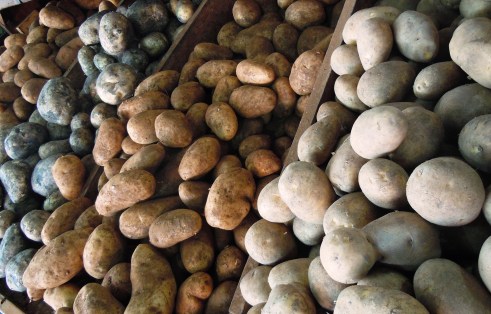
Organic potatoes in Melbourne’s Victoria Market.

Although she may use ingredients which are unique to Australia – like yabbies – or which grow there in abundance – such as quinces – her cooking is overwhelmingly European in nature: it draws its inspiration from the culinary traditions of France and Italy. Adrian Peace sums up this rethinking of an Australian food heritage particularly well in an article about the Slow Food Movement’s popularity in the Barossa Valley:

Both ‘tradition’ and ‘heritage’ became intrinsic to Barossa Slow’s discourse: ‘The Barossa is the heart of Australian wine and home to the country’s oldest and richest food traditions. The combination of this rich European heritage and the fresh vitality of Australia is embodied in its lifestyle and landscape.’ Aboriginal settlement and indigenous food were thus instantly erased in favour of a historical perspective in which nothing of cultural consequence preceded the arrival of Europeans and their imported foodstuffs. With this historical baseline in place, an avalanche of terms and phrases could be unleashed to drive home the idea of a historically encompassing regional culture in which food had played a prominent part. ‘Oldest food traditions,’ ‘rich in food traditions,’ ‘the heritage of food,’ ‘rich European heritage,’ and (of particular note) ‘the preservation of culinary authenticity’ were some of the phrases that entered into circulation.

Younger, city-based food writers like Donna Hay and Bill Granger place as much emphasis on buying local Australian produce, even if their recipes draw inspiration from more recent immigrant cuisines, primarily those of southeast Asia – Melbourne and Sydney have substantial Chinatowns – and the southern Mediterranean.

All of these writers claim that their cooking, which is drawn from the cuisines of the immigrants who’ve settled in Australia, is ‘authentically’ Australian partly because they use local produce and advocate seasonal eating.

Australian garlic at Victoria Market.

Ironically, if this is modern Australian cooking, then it is very similar to the Australian cuisine of the early twentieth century, during a period in which Australia was formulating a new, united identity after federation in 1901. The Anzac biscuit – a delicious combination of oats, golden syrup, butter, and desiccated coconut – can be seen as symbolic of this early Australian identity. Baked by the wives, sisters, and mothers of the members of the Australian and New Zealand Army Corps during the first world war, the biscuits became closely associated with the disaster at Gallipoli in 1915, when 8,141 Australian troops were killed in what was, in retrospect, a pointless battle. Sian Supski explains:

The biscuits have come to represent the courage of the soldiers at Gallipoli and to signify the importance of the role women played on the homefront. However, within this narrative is also a sleight of hand: Anzac biscuits link Australians to a time past, to a time that is regarded as ‘the birth of our nation’. In this sense, Anzac biscuits link Australians powerfully and instantly to a time and place that is regarded as the heart of Australian national identity. In the words of Graham Seal, ‘Anzac resonates of those things that most Australians have continued to hold dear about their communal sense of self.’

Anzac biscuits are a kind of culinary symbol of Australia – a foodstuff connected to the forging of the Australian nation. But for all their Australianness, they are also strongly suggestive of Australia’s immigrant roots and global connections: there is some evidence to suggest that they were based on Scottish recipes, and they were sent to soldiers fighting what was, in many ways, an imperial conflict.

Australian cooking during the nineteenth and early twentieth centuries emphasized the country’s position within the Empire: the country cooking described in early recipe books was British cuisine adapted, to some extent, for Australian circumstances. Publications like Mina Rawson’s Queensland Cookery and Poultry Book (1878) did acknowledge the quality of local produce, and even included recipes for jams made from indigenous berries. Although, like elites all over the world, the Australian upper middle-classes aspired to eat a rarefied French cuisine, everyone else cooked an approximation of what they ate at ‘home’ (or ‘Home’). The Sunday roast remained the highlight of the week’s eating; heavy puddings featured even in summer; and teatime was a significant moment in the day.

At the same time, Australia’s economy was becoming increasingly dependent on the export of food: innovations in refrigeration meant that fresh produce could be shipped around the world. Australia sent meat, fruit, and vegetables to Britain. The posters of the Empire Marketing Board – which was established in 1926 to promote trade within the British Empire – portrayed Australia as a land of abundance. The British children sent to Australia between the second world war and 1967 were told that they were going to a land of ‘oranges and sunshine’.

So this earlier Australian culinary tradition also mingled Australian produce with a foreign – this time British – culinary tradition in the name of producing something ‘authentically’ Australian.

In Sydney’s Chinatown.

For all its attempts to associate a modern Australianness with a cosmopolitan and sophisticated liking for, and knowledge of, the cooking of southeast Asia and other regions, modern Australian cooking is very similar to that of the Australian cuisine of the early twentieth century – of an Australia anxious to assert its position within the Empire and to prove its status as a ‘civilised’ nation through ‘civilised’ eating.

Both of these traditions ground themselves in an appreciation for an empty landscape: one that is devoid of human – particularly Aboriginal – life, but that is bursting with good quality fresh produce, most of which was, ironically, introduced from abroad.

Further Reading

I am very grateful to Alex Robinson who recommends two particularly good histories of food and cooking in Australia:

Barbara Santich, Bold Palates: Australia’s Gastronomic Heritage (Adelaide: Wakefield Press 2012).

Michael Symons, One Continuous Picnic: A Gastronomic History of Australia (Melbourne: Melbourne University Press, 2007).

Sources cited here:

Colin Bannerman, ‘Indigenous Food and Cookery Books: Redefining Aboriginal Cuisine,’ Journal of Australian Studies, vol. 30, no. 87 (2006), pp. 19-36.

Adrian Peace, ‘Barossa Slow: The Representation and Rhetoric of Slow Food’s Regional Cooking,’ Gastronomica: The Journal of Food and Culture, vol. 16, no. 1 (Winter 2006), pp. 51-59.

Barbara Santich, ‘The High and the Low: Australian Cuisine in the Late Nineteenth and Early Twentieth Centuries,’ Journal of Australian Studies, vol. 30, no. 87 (2006), pp. 37-49.

Sian Supski, ‘Anzac Biscuits – A Culinary Memorial,’ Journal of Australian Studies, vol. 30, no. 87 (2006), pp. 51-59.

Creative Commons License
Tangerine and Cinnamon by Sarah Duff is licensed under a Creative Commons Attribution-ShareAlike 3.0 Unported License.