Skip to content

Posts tagged ‘New York’

Food Links, 01.08.2012

Big Food battles over potential market share in the developing world.

Why doesn’t the USDA support Meatless Monday?

American meat consumption.

Food security is linked to the availability of water for irrigation.

Should food be banned from landfill?

Gareth Jones, the journalist who reported on famine in the USSR under Stalin.

Thoughts on preventing obesity.

Suggestions for taking a picnic to the Olympics.

An urban farm in Harlem, New York.

Why can some people eat as much as they like, and never put on weight?

British farmers are being urged to grow the ingredients for curry.

The favourite dishes of American presidents.

The rediscovery of traditional southern cooking in the US.

Jay Rayner praises Jamie Oliver.

America: understood in terms of beer and religion.

How to make your own sparkling wine.

The most interesting food trucks.

Everyday things, made out of food.

Desperate Chefs’ Wives. (No, really.)

Claudia Roden’s favourite London restaurants.

Sweden‘s rising culinary scene.

The pleasures of eating. (Thanks, Murray!)

A rant against knowing everything about where our food comes from.

David Mitchell on wine tasting.

A pulled pork…cupcake.

Songs about food. (With thanks to David Worth.)

The revival of interest in English food from the 20s and 30s.

The kebab combination generator.

Trace the journey of one dish of food.

How to make your own soft serve ice cream.

The mango nectarine.

Photographs of the 2012 Mad Camp.

Food in space.

How to make a cup of tea – as a poem.

On Edible Arrangements.

The world’s rudest chef.

What Michael Phelps eats for breakfast.

Popcorn with milk?

How to make a hedgehog.

Introducing Bandar Foods.

The world’s oldest wine.

All about choux.

Food Links, 02.05.2012

Books on booze.

As London prepares to vote for its new mayor, consider Ken Livingstone’s enthusiasm for breakfast.

Twenty ways to change the way we eat.

Five foods to save the world.

The latest craze in the food world: tattoos for chefs.

How coffee helps to revitalise cities.

Read more

Brain Food

Recently I’ve been mildly obsessed with Elif Batuman’s The Possessed: Adventures with Russian Books and the People who Read Them (2011). It’s a collection of essays about Russian literature and her experiences as a PhD student at Stanford. In the first chapter, ‘Babel in California,’ Batuman describes a conference at Stanford, dedicated to the analysis of the work of Isaak Babel. Like so many academic conferences, it is simultaneously enlightening and farcical.

Read more

Food Links, 25.04.2012

Famous explosions recreated with cauliflower.

Bertha Haffner-Ginger, godmother of the Mexican food craze.

How climate change is transforming the wine industry in the Old World.

How agriculture and the food industry are responding to Ireland’s high levels of unemployment.

An egg sandwich.

Read more

Food Links, 18.01.2012

Why pupils at a Los Angeles rejected new, healthy school dinners.

Three utopian feasts at the School of Life.

America: the land of the free and the hungry.

Food trends that fizzled out. (I’m particularly sorry about Mupcakes.)

Bizarre: a Russian ad for Burger King.

The history of the Chinese take-away container.

A taxonomy of bread in New York.

The guerilla grafters.

Hmmm…. I’m not all that sure about this, but it’s interesting: the difference between ‘Western’ and ‘Asian’ food flavours.

Slow Food USA appears to have gone into meltdown. (Unsurprisingly: it’s based on an entirely misguided set of principles.)

Occupy the food system.

The making of Italian American cuisine. (Thanks, Mum!)

On the mallow plant.

Are supper clubs the future of the restaurant?

The shady world of sugar substitutes.

Paintings made out of spices and salt.

Kitchens from the 1950s.

January is be kind to food servers month.

The ten best non-burger fast food dishes.

The Philosophy of Food Project.

Tips for freezing stock.

In search of the endangered Melipona beecheii bee.

Introducing LUPEC, Ladies United for Preservation of Endangered Cocktails.

The most dangerous tea in the world.

This is really, really good: testing the belief that McDonald’s burgers don’t rot.

A toaster made from cinderblock.

Free Markets

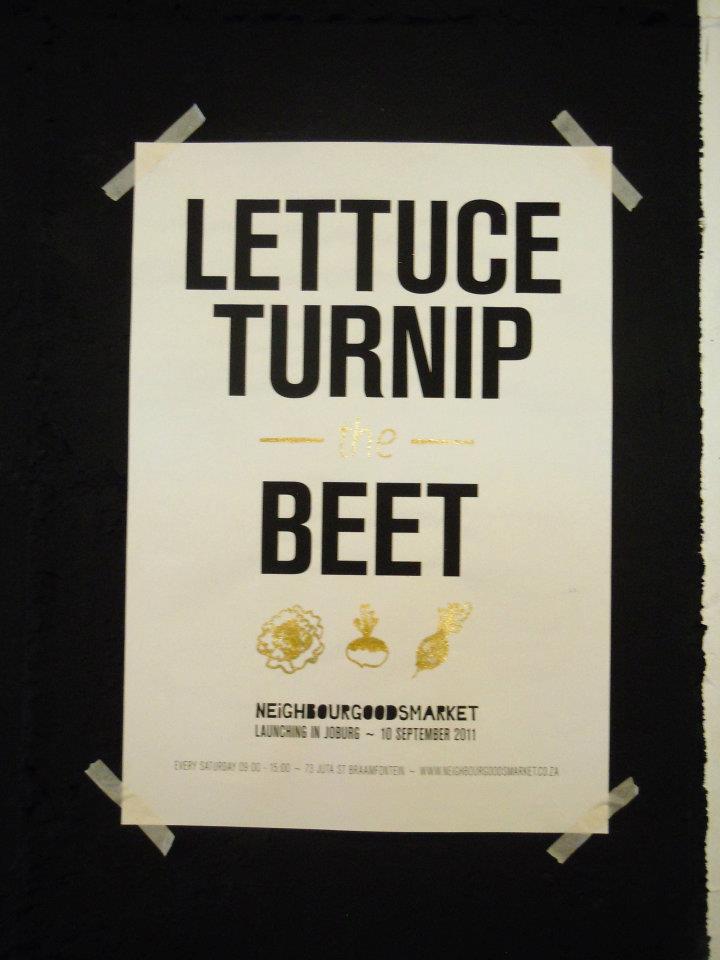
A couple of months ago I spent a weekend in Johannesburg to celebrate my friend Kate’s thirtieth birthday. Knowing me well, she suggested that we have lunch at the newish Neighbourgoods Market in Braamfontein, a neighbourhood which has been included in Joburg’s inner city improvement district scheme. Alongside 70 Juta, a small row of shops (one, inevitably, devoted to lomography), galleries, and cafes, the Neighbourgoods Market is part of a wider effort to attract people – and particularly those with disposable income – back into the city’s centre.

The decline of the Joburg CBD since mid-90s has been well documented: the flight of businesses to suburbs like Sandton and developments such as Melrose Arch means that the old city centre has changed beyond recognition. Buildings are derelict and crumbling, and crime is a significant problem. To my shame, I don’t know Joburg terribly well, even though I enjoy visiting it enormously. What struck me was not that the city centre has ‘died’, but, rather, that it is vibrantly alive, albeit – with the abundance of cheap Chinese shops, fast food joints, and street stalls – not in ways we would usually define a bustling, ‘healthy’ CBD.

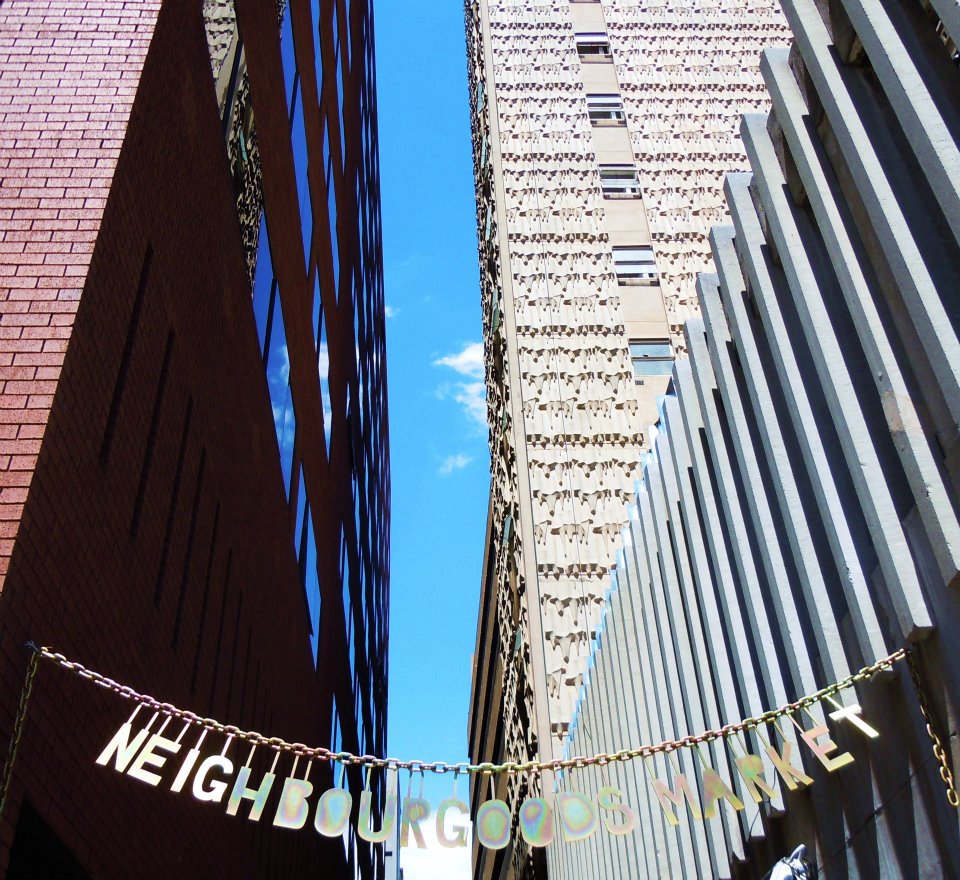
The entrance to Braamfontein's Neighbourgoods Market

The point is that something needs to be done to bring businesses back to central Johannesburg, crime and grime must to be brought under control, and the city’s amazing mid-century architecture should be restored. The Neighbourgoods Market is in the parking lot of the most incredible brutalist skyscraper, the façade of which was designed by Eduardo Villa. Open on Saturday mornings, it brings people in to an area which would be otherwise deserted – and dangerous – on weekends. I really, really enjoyed it: the food was great and, as is usually the case in Joburg, both punters and stall holders were fantastically friendly.

Inside Braamfontein's Neighbourgoods Market

In fact, I liked it rather more than the original Neighbourgoods Market in Cape Town. Established for similar reasons as the Joburg incarnation, the Market in Cape Town is located in a newish redevelopment of an old biscuit mill in the traditionally working- and lower middle-class suburb of Woodstock – although this area is now achingly cool, having been dubbed ‘Cape Town’s Manhattan’ by the New York Times. The more gentrified sections of Woodstock are now awash with vintage stores, bicycle shops, and Michelle Obama-attracting organic lunch cafes. Particularly on the main road, it’s all beginning to look like a set for a Wes Anderson movie.

At the Woodstock Neighbourgoods Market

There’s been a fair amount of debate about the gentrification of Woodstock, and much as I find the Neighbourgoods Market unpleasantly overcrowded and many of the people it attracts deeply annoying, I am less unsettled by its effects on the suburb than the wholesale transformation of the Bo-Kaap, near the centre of Cape Town, where a very poor group of people – many of them descendants of slaves – have slowly been evicted from their picturesque, brightly-painted cottages by landlords keen to attract yuppies in their massive Chelsea tractors.

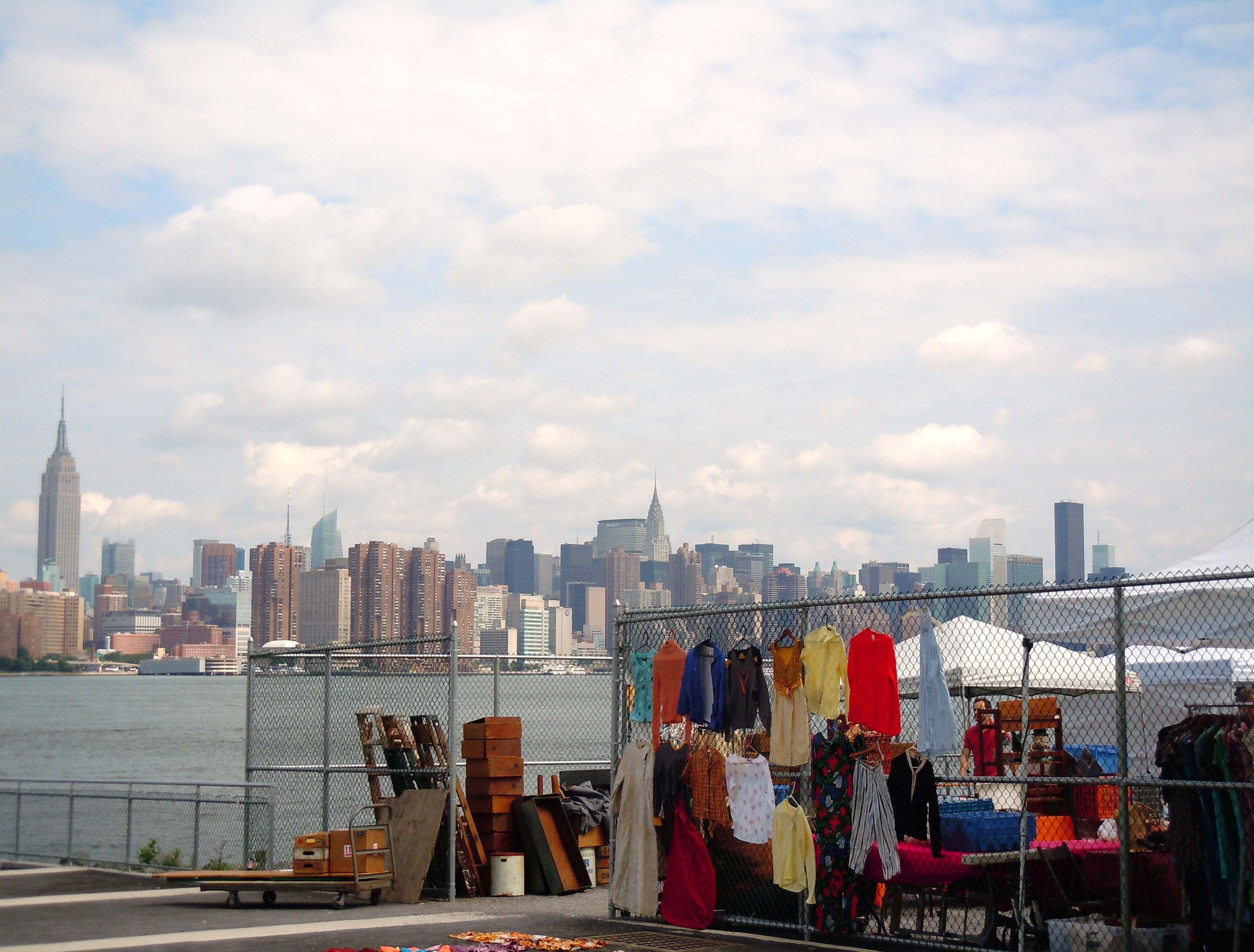
The view from the Williamsburg Flea

The debates we’re having in Cape Town about gentrification are by no means particular to South Africa. In New York last year, my friend Geoff commented that he found the new-found coolness of Brooklyn’s Williamsburg – a working-class suburb once dominated by Orthodox Jews – baffling. I went to the Williamsburg Flea, a market selling food, craft, and an assortment of handmade and vintage clothes and furniture. My friends and I enjoyed it enormously – as much as we did exploring Bedford Avenue – but I could understand the original inhabitants’ unhappiness at how much this hipster invasion has changed the neighbourhood.

At the Williamsburg Flea

The point about the Neighbourgoods Market and the Williamsburg Flea is that they both attract people who are either new to those suburbs, or who don’t live there at all: they’re not aimed at the existing communities. (They’re too expensive, to begin with.) At a hipster night market in Dalston in December – it sold food, not hipsters because that would be illegal – I stood for a half an hour in a queue, risking hypothermia to buy supper at a food market in a covered parking lot near the Dalston Kingsland overground station.

At the Long Table night market in Dalston

Dalston has followed on from Islington, Shoreditch, and Stoke Newington as being the favoured spot for not-particularly-wealthy lefties looking for somewhere cheap and central to stay. It’s in Hackney, one of the poorest boroughs in Britain, and not overwhelmingly picturesque, but it’s now overrun with hipsters and Guardian-reading lefties (I count myself as one of these, obviously, I mean obviously). I didn’t see any members of Dalston’s original community at the night market – which included a stall run by Moro.

More of the Dalston night market

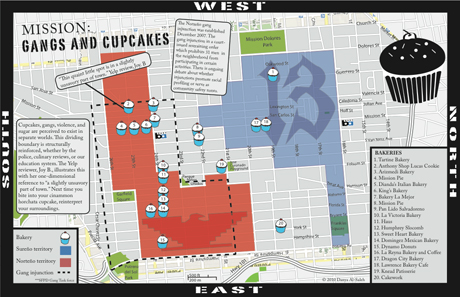
As I’ve noted before, this link between food and gentrification is nothing new. Kathe Newman has argued that ‘cupcake shops can provide a more accurate and timely guide to the frontiers of urban gentrification than traditional demographic and real estate data sets.’ Danya al-Saleh demonstrates this particularly well in her map of the slow encroachment of cupcake bakeries in San Francisco’s gang territories (click here for a bigger version):

As one commentator explains:

In the 1990s, it might have been the proliferation of Starbucks coffee houses that indicated gentrifying neighbourhoods, and in the 1980s, perhaps gourmet yoghurt shops moving into an area, etc. I don’t know about other cities, but in NYC where I live, right now it would be the new doggie day care centres that are springing up in many places that appear to designate a change to a more affluent, up-and-coming hipster-ish nabe.

Markets, cafes, and restaurants increase footfall in cities. I had breakfast at the newly-opened Clarke’s in the Cape Town CBD yesterday morning (it was fantastic – go), and was struck by how busy the area was: aside from the tourist traps around Greenmarket Square (not a green market) and Long Street, the CBD used to be deserted over weekends. Now, though, Capetonians are flocking to Jason’s, Skinny Legs & All and other places. The city feels safe, and alive again. The Cape Town Partnership, which has driven much of this renewal, has recognised the power of coffee shops in attracting pedestrians into the city.

At the furthest extreme, there is the urban farming which is seeking to transform Detroit, a city brought to the edge of collapse by bad urban planning and, more recently, the 2008 recession. But Detroit is a deeply unusual case. What’s happening in Braamfontein, Woodstock, Williamsburg, Dalston, and elsewhere is part of a trend which began in the 1990s: the connection between the, then, new-found enthusiasm for whole, ‘real’ food  brought into city markets by farmers and small producers, and the regeneration and gentrification of poor or decayed urban districts. Visiting the Union Square farmers’ market now, it’s difficult to imagine that Union Square used to be extremely dangerous.

At the Union Square farmers' market

These are markets for the middle classes, and it’s easy to criticise them for not doing more to integrate wealthy newcomers and less well-off original inhabitants – which is why, I think, the Joburg Neighbourgoods Market is a potentially less awkward experience than the Woodstock version. There aren’t very many people actually living in Braamfontein.

But I’m interested in the continuing success of these markets – and they’ve proliferated – in a time of economic downturn. They’re sustained by gentrification, but why their continuing success during times of financial insecurity? Will they continue to flourish as the tide of gentrification begins to recede? Are they sustainable?

As sales of organic vegetables in supermarkets have plummeted during the recession, there are more food and farmers’ markets than ever before. Last week’s coverage of Tesco’s extraordinarily bad performance over Christmas in the UK referred to the fact that part of the business’s problem is that it hasn’t responded adequately to changing patterns in consumer culture. As one article noted, people are relying increasingly on the internet for basic food shopping because it’s convenient and also allows them to compare deals and prices more efficiently. Shoppers are savvier in the recession.

But they still buy treats and luxuries – hence the success of Marks & Spencer, Waitrose, and John Lewis. Waitrose has been particularly clever in opening convenience stores in city centres: they’re certainly pricier than the ubiquitous Tesco Metro, but shoppers seem to be willing to fork out cash to shop in bright, clean, and, yes, convenient shops. The Tesco model of establishing enormous, town centre-decimating, and car-reliant hypermarkets on the edge of urban developments no longer appears to be successful. Tesco CEO Philip Clarke

was not sure Tesco needed any more of the sprawling out-of-town Extra stores it has spent so long battling planners to build – and that were vital in its conquest of Britain’s retail sector in the 1990s. He didn’t want to go as far as to label its more than 200 out-of-town hypermarkets as ‘white elephants’ but said they were now a ‘less potent force’ as electricals and clothing sales shifted online.

I think we can account partly for farmers’ markets’ continued success in similar ways. Even if very few people can afford to do a weekly shop at them, many will buy small luxuries to perk up meals in a time of financial insecurity: nice chunks of unusual cheese, proper bread, and handmade sausages. I wonder, though, if this change in shopping patterns indicates a fundamental shift in the functioning of consumerism – and in attitudes towards food.

At the Braamfontein Neighbourgoods Market

Creative Commons License
Tangerine and Cinnamon by Sarah Duff is licensed under a Creative Commons Attribution-ShareAlike 3.0 Unported License.

Food Links, 11.01.2012

Capetonians! Worried about the rolling blackouts threatened by Eskom over the next few weeks? Fear not, and join this amazing workshop on Sunday to learn how to make your own hot box.

A Child’s Larder of Verse.

Matthew Fort demonstrates why the UK government’s Change for Life programme is serious bollocks.

Thanksgiving-like holidays around the world.

What do we really mean by ‘organic’ food? (Thanks Mum!)

How the meat industry re-brands itself.

How British supermarkets fare abroad. (Not well.)

Food and provenance.

A poem about cheese. And a woman.

Tea in Britain and the thirteen colonies – with lovely pictures.

Behind the scenes at a flavouring factory.

How the Obamas are changing the way Americans eat.

Eat leftovers and save the world.

Producing food from waste.

The ten best food moments from film.

Extreme locavore-dom.

Diners and American politics.

New York’s juice bar craze.

How to shuck an oyster.

A project to rehabilitate prisoners by teaching them how to cook.

Eat more kale.

Food Processes

A fortnight ago my mother and I devoted a day to our annual chutney making, and we spent the evening recovering from the inhalation of vinegar fumes, in front of the television. We watched the first episode of the new series of Nigel Slater’s Simple Suppers. Being fans of Slater’s recipe books, we had high hopes, but these began to crumble when he remarked conspiratorially to the camera that ‘some people buy jars of pesto.’

We groaned. Of course, pesto out of a bottle is never going to be quite as amazing as pesto made freshly. (I’m not going to wade into the tiresome debate over whether pesto made in a food processor is better than that made with a pestle and mortar.) But it’s fine. Really: for a quick, warming supper, it’s absolutely delicious. And, as my father pointed out as he walked past to switch the kettle on, it’s great to be able to support businesses which train people and provide employment.

As an antidote to Slater’s preciousness, I read a couple of Calvin Trillin’s essays from Eating with the Pilgrims, a collection published in Penguin’s newish Great Food series (the one with the beautiful covers). Although he’s also a poet and journalist, Trillin is probably best known for his food writing in the New Yorker. His writing is clear, clever, and deeply sympathetic to others who, like him, love eating. Trillin tends not to write about food itself, but, rather about how people think about it, as he remarked in an interview: ‘I’m not interested in finding the best chilli restaurant in Cincinnati. I’m interested in Cincinnatians fighting about who has the best chilli.’

What I like about Trillin is that he writes about buffalo wings and barbeque with the same seriousness that other writers devote to stilton or cassoulet:

The sort of eating I’ve always been interested in is what I guess you’d call vernacular eating. It has something to do with a place. Buffalo chicken wings have something to do with Buffalo. The fact that people in Cincinnati have something they call authentic Cincinnati chilli, and seem unaware that people in the Southwest eat chilli, let alone Mexicans, and think that chilli is made by Macedonians and served on spaghetti, that’s interesting to me. Whether Skyline chilli is better than Empress chilli I don’t really care about.

This is Trillin on fried chicken:

Because a superior fried-chicken restaurant is often the institutional extension of a single chicken-obsessed woman, I realize that, like a good secondhand bookstore or a bad South American dictatorship, it is not easily passed down intact. Still, in sullen moments I blame these lamentable closings on the agribusiness corporations’ vertical integration of the broiler industry. In fact, in sullen moments I blame almost everything on the vertical integration of the broiler industry – the way some people trace practically any sort of mischief or natural disaster back to the Central Intelligence Agency, and some people, presumably slightly more sophisticated, blame everything on the interstate-highway program. If the civilisation really is about to crumble, everybody is entitled to his own idea of which is the most significant crack. Which brings us to Kentucky Fried Chicken.

I urge you to read Trillin’s excellent cultural history of buffalo wings and his fantastic account of seeking the best barbequed mutton in Kentucky. My favourite essay, other than his celebration of Shopsin’s, the legendary-despite-its-best-efforts New York restaurant, is about boudin, a staple of Cajun cuisine which is, in its purest form, a kind of sausage made out of pork meat, rice, and liver. (I wish I could provide a link, but the New Yorker has an unfriendly unwillingness to open up its archives.)

These are not particularly sophisticated dishes, and they’re often produced with a heavy reliance on processed foods – pre-packaged seasonings, the inevitable Campbell’s mushroom soup – whose flavours become as important to the finished product as those elements which make boudin or buffalo wings unique. In fact, in between Slater’s snobbery and Trillin’s celebration of deliciousness is a useful way of thinking about what we mean by processed food.

We know that the cheapness and easy availability of processed food has been blamed, rightly, for facilitating a global obesity epidemic. (Even if the increasing prevalence of obesity can’t logically be described as an ‘epidemic’. Obesity isn’t really catching.) High in salt, preservatives, and calories, most processed food provides eaters with meals which are temporarily filling and satisfying, but without much beneficial nutritional content. In food deserts – areas where low incomes, and poor transport infrastructure and distribution networks make access to fresh food very difficult – it’s usually only processed food which is available at corner shops and discount supermarkets.

But, technically, most food that we eat – even ‘good’ food – is processed. I know that blogs have been criticised for simply listing the contents of bloggers’ fridges, but I’m doing this for a reason: with the exception of the eggs, lettuce, leeks, herbs, and cherries in my fridge, the rest of it is processed. This includes the milk and cream (nearly all dairy products are pasteurised and homogenised before they’re sold to the public), blackberry jam, sun dried tomatoes (laugh if you must), butter, Colman’s and Pommery mustard, mum’s and Mrs Ball’s chutney, salami, tomato paste, and the tube of sweetened chestnut puree.

By ‘processed food’ we mean food that is prepared in some way before it’s sold: from the most severely limited run of cured hams, to the strangest possible non-food imaginable. So it’s not all bad. In fact, I’m not sure that most of us would cope without processed food of some variety: I can’t buy raw milk in Cape Town, and I rely on tinned tomatoes and frozen peas. I am not about to make my own couscous, or knit my own yogurt, despite being politically left-wing.

We do, though, eat more processed food than ever before. Since the beginning of the nineteenth century as food production became increasingly industrialised, first in the United States and then in the rest of the world, our diets have changed. We eat more of those products which are difficult or time-consuming to prepare at home (bread, pasta), and mass production has made formerly expensive, ‘artisan’ items (Parmesan cheese, chocolate) cheaper and more readily available.

I think that that one of the reasons why I was surprised by Slater’s snobbery was because of the lengthy and often quite nostalgic descriptions of the processed food of the 1960s in his memoir Toast. We tend to associate the rise of processed food with the post-war boom: with bizarre recipes for spam fritters, and a hundred and one ways with Angel Delight. In the modernist 1950s, this was the sophisticated food of the future – the food of the newly prosperous middle classes. Michael Pollan remembers:

The general consensus seemed to be that ‘food’ – a word that was already beginning to sound old-fashioned – was destined to break its surly bonds to Nature, float free of agriculture and hitch its future to Technology. If not literally served in a pill, the meal of the future would be fabricated ‘in the laboratory out of a wide variety of materials,’ as one contemporary food historian predicted, including not only algae and soybeans but also petrochemicals. Protein would be extracted directly from fuel oil and then ‘spun and woven into “animal” muscle – long wrist-thick tubes of “fillet steak.”‘

By 1965, we were well on our way to the synthetic food future. Already the eating of readily identifiable plant and animal species was beginning to feel somewhat recherche, as food technologists came forth with one shiny new product after another: Cool Whip, the Pop-Tart, nondairy creamer, Kool-Aid, Carnation Instant Breakfast and a whole slew of eerily indestructible baked goods (Wonder Bread and Twinkies being only the most famous).

The appeal of cake mixes, tinned macaroni cheese, and, later, boil-in-the-bag meals was that these were quick, labour-saving dinners. As middle-class women entered the workforce in ever-increasing numbers, so eating habits adapted to new work patterns.

The backlash against processed food and industrialised agriculture of the 1970s – in the United States, the largely California-based counter-cuisine, for example – associated the mass production of food with environmental destruction and social inequality. (Poorer people tend to eat the worst processed food.) We’ve since begun to associate the idea of processed food with strange non-foods – with turkey twizzlers and cheese strings – rather than think of it as food which has been prepared in some way, and usually in large quantities, before being sold.

I know that this may seem like a fairly nitpicky point, but we need to acknowledge the extent to which we rely on processed food in order to feed ourselves. Most of us eat better and a greater variety of things because of the mass production of food. To my mind, the more pertinent question is not how we should prevent people from eating processed food, but, rather, how we can make this food better and healthier. Obviously, we need to teach people how to cook healthily – and we have to consider the relationship between eating patterns and the hours that people work. Middle-class foodies and other well-meaning campaigners around nutrition must realise that their anti-processed food stance is not only a kind of snobbery, but entirely impractical.

Creative Commons License Tangerine and Cinnamon by Sarah Duff is licensed under a Creative Commons Attribution-ShareAlike 3.0 Unported License.

Eat the Rich

Today’s City Press includes a fantastically interesting article about the increased incidence of obesity in post-1994 South Africa. The piece explores the links between the country’s transition to democracy and the fact that 61% of all South Africans – 70% of women over the age of 35, 55% of white men 15 years and older, and a quarter of all teenagers – are obese or overweight.

The reasons for these incredibly high levels of obesity are, as the article acknowledges, complex. In many ways, South Africa conforms to a pattern emerging throughout the developing world. In a report published a few months ago, the World Health Organisation noted that lifestyle-related diseases – like diabetes, high blood pressure, heart disease, and obesity – are now among the main causes of death and disease in developing nations. These diseases of affluence are no longer limited to the West.

For the new South African middle classes, fast food and branded processed products, like Coke, are markers of sophistication: of having ‘made it’ in this increasingly prosperous society. But, as in the rest of the world, those at the top of the social scale tend not to be overweight:

contrary to popular myth, obesity is not a ‘rich man’s disease’.

Indeed, the most affluent urbanites can get into their SUVs and drive to gym or to Woolies food hall where, for a price, they can load up their trolleys with fresh, top-quality groceries – from free-range chickens to organic lemons.

This means, says [Prof Salome] Kruger, that ‘the highest income earners are thinner’.

For urban dwellers who earn less, fresh food is usually more difficult, and expensive, to buy than processed non-food:

But for your average city dweller – earning money, but not necessarily enough to own a car to get them out to the major supermarket malls – food is where you find it.

Typically, this is in small corner shops selling a limited, and often more expensive, range of fresh foods. Fruit and veg can be hard to find among the toothpaste and toilet paper spaza staples.

‘R15!’ It’s taxi fare from Orlando to the Pick n Pay in Soweto’s Maponya Mall – and it was 25-year-old road worker Lindiwe Xorine’s reply when City Press asked her how far it was to the nearest supermarket.

We call these areas where access to fresh food is limited, ‘food deserts’. It’s entirely possible to buy fruit, vegetables, and free-range meat in South African cities, but high prices and bad transport infrastructure limit people’s ability to purchase these products.

We’re dealing, effectively, with the effects of mass urbanisation since the ending of influx control in the mid-1980s and the 1994 elections.

The migration of South Africans from rural to urban areas has been a key factor in the nation’s radical change of lifestyle habits.

Twenty years ago, restricted by apartheid laws, just 10% of black South Africans lived in urban areas. Today, more than 56% do.

Alison Feeley, a scientist at the Medical Research Council, says this massive shift to a fast-paced urban life has resulted in dietary patterns shifting just as dramatically from ‘traditional foods to fast foods’.

But this isn’t the first time that South Africa, or indeed other countries, has had to cope with the impact of urbanisation on people’s diets. During the nineteenth century, industrialisation caused agricultural workers to abandon farming in their droves, and to move to cities in search of employment, either in factories or in associated industries. In Britain, this caused a drop in the quality of urban diets. Food supplies to cities were inadequate, and the little food that the new proletariat could afford was monotonous, meagre, and lacking in protein and fresh fruit and vegetables.

One of the effects of this inadequate diet was a decrease in average height – one of the best indicators of childhood health and nutrition – among the urban poor in Victorian cities. In fact, British officers fighting the South African War (1899-1902) had to contend with soldiers who were physically incapable of fighting the generally fitter, stronger, and healthier Boer forces, most of whom had been raised on diets rich in animal protein.

This link between industrialisation, urbanisation, and a decline in the quality of city dwellers’ diets is not inevitable. For middle-class Europeans in cities like London, Paris, and Berlin, industrialised transport and food production actually increased the variety of food they could afford. In the United States, from the second half of the nineteenth century onwards, a burgeoning food industry benefitted poorer urbanites as well. Processed food was cheap and readily available. Impoverished (and hungry) immigrants from Eastern Europe, Ireland, and Italy were astonished by the variety and quantity of food they could buy in New York, Detroit, and San Francisco.

It’s difficult to identify similar patterns in South Africa. We know that the sudden growth of Kimberley and Johannesburg after the discovery of diamonds (1867) and gold (1882) stimulated agriculture in Griqualand West and the South African Republic. Farmers in these regions now supplied southern Africa’s fastest growing cities with food. The expansion of Kimberley and Johannesburg as a result of the mineral revolution was different from that of London or New York because their new populations were overwhelmingly male – on the Witwatersrand, there were roughly ninety men for every woman – and highly mobile. These immigrants from the rest of Africa, Europe, Australia, and the United States had little intention of settling in South Africa. As a result of this, it’s likely that these urban dwellers weren’t as badly effected by poor diets as their compatriots in the industrialised cities of the north Atlantic.

Cape Town’s slums and squatter settlements were, though, populated by a new urban poor who migrated with their families to the city during the final three decades of the nineteenth century. Most factory workers were paid barely enough to cover their rent. Mr W. Dieterle, manager of J.H. Sturk & Co., a manufacturer of snuff and cigars, said of the young women he employed:

It would seem incredible how cheaply and sparsely they live. In the mornings they have a piece of bread with coffee, before work. We have no stop for breakfast, but I allow them to stand up when they wish to eat. Very few avail themselves of this privilege. They stay until one o’clock without anything, and then they have a piece of bread spread with lard, and perhaps with the addition of a piece of fish.

This diet – heavy on carbohydrates and cheap stimulants (like coffee), and relatively poor in protein and fresh produce – was typical of the city’s poor. It wasn’t the case that food was unavailable: it was just that urban workers couldn’t afford it.

In fact, visitors to the Cape during this period commented frequently on the abundance and variety of fruit, vegetables, and meat on the tables of the middle classes. White, middle-class girls at the elite Huguenot Seminary in Wellington – a town about 70km from Cape Town – drank tea and coffee, ate fruit, and smeared sheep fat and moskonfyt (syrupy grape jam) on their bread for breakfast and supper. A typical lunch consisted of soup, roasted, stewed, curried, or fried meat (usually mutton), three or four vegetables, rice, and pudding.

It’s also worth noting that the Seminary served its meals during the morning, the middle of the day, and in the evening – something which was relatively new. Industrialisation caused urban workers’ mealtimes to change. Breakfast moved earlier in the day – from the middle of the morning to seven or eight o’clock – lunch (or dinner) shifted to midday from the mid-afternoon, and dinner (or tea) emerged as a substantial meal at the end of the day.

Factory workers in Cape Town ate according to this new pattern as well. The difference was the quality of their diet. A fifteen year-old white, middle-class girl in leafy Claremont who had eaten an ample, varied diet since early childhood was taller and heavier than her black contemporaries in Sturk’s cigar factory. In all likelihood, she would have begun menstruating earlier, and would have recovered from illness and, later, childbirth far more quickly than poorer young women of the same age. She would have lived for longer too.

Urbanisation changes the ways in which we eat: we eat at different times and, crucially, we eat new and different things. By looking at a range of examples from the nineteenth century, we can see that this change isn’t necessarily a bad thing. The industrial revolution contributed to the more varied and cheaper diets of the middle classes. Industrialised food production and transport caused the urban poor in the United States to eat better than many of those left behind in rural areas, for example. But it’s also clear that it exacerbates social inequality. In the 1800s, the poor had too little to eat and that which they did have was not particularly nutritious. Children raised on these diets were shorter and more prone to illness than those who ate more varied, plentiful, and protein-rich food. Now, the diets available to the poor in urbanising societies are as bad, even if the diseases they contribute to are caused by eating too much rather than too little.

Most importantly, we have an abundance of food in our growing cities. Just about everyone can afford to eat. The point is that only a minority can afford good, fresh food, and have the time, knowledge, and equipment to prepare it. Food mass produced in factories helped Europe and North America’s cities to feed their urban poor a hundred years ago. I’m not sure if that’s the best solution for the twenty-first century.

Creative Commons License Tangerine and Cinnamon by Sarah Duff is licensed under a Creative Commons Attribution-ShareAlike 3.0 Unported License.

Psychofood

This week, two people forwarded me the same article. And in a pleasing coincidence, it happens to relate to something I’ve been thinking about a great deal recently. The piece is by the New York Times food writer Frank Bruni and is titled ‘Dinner and Derangement’. It’s a review of Romera, a restaurant which has recently opened in New York and serves food based on the principle of ‘neurogastronomy’. Its chef patron is Miguel Sánchez Romera, a former neurologist who seeks to cook food which ‘embodies a holistic approach to food by means of a thoughtful study of the organoleptic properties of each ingredient’. So what does this mean? Bruni explains:

My server explained that each dish’s palette and aroma, as well as its flavour, were supposed to prompt a ‘sense memory.; He said that the tuna tartare with coconut, jasmine and orange blossom had brought him ‘straight back to Cape Cod when I was 8 years old and I tasted my first virgin piña colada.’

All of that from the tiny, six-bite portion? I must be a sense-memory slacker. I was brought back only to other, more voluminous tuna tartares, which I suddenly and sorely missed.

That tuna dish is called Cloris, after a Greek goddess of flowers. A subsequent dish of 12 kinds of grains encircling a black olive jam is called Omnium, a Latin term for the whole of something.

Euterpes is the name for the foie gras with white chocolate, referring to a muse of lyric poetry.

Each dish is accompanied by a kind of crib note which guides the diner

through the Romera phantasmagoria. The cards, with a butterfly illustration on one side and text on the other, delve verbosely into etymology, ecology, horticulture, philosophy. ‘The objective of any pre-appetizer,’ says one, is to ‘prepare the guest for the degustation that will follow.’ Another: ‘By looking at nature with eyes of solidarity we will see that it is always expressing something to us.’

This is, indeed, deranged dining. Other than their unbearable pretentiousness and incredible expense – $245 per person, not including drinks or tip – this restaurant and its conceit are indicative of a wider psychosis, as Bruni describes it, around food:

While blazers are optional at Romera, straitjackets would be a fine idea.

It’s the craziest example I’ve encountered of the way our culture’s food madness tips into food psychosis, at least among those with keen appetites and the means to indulge them.

But it’s hardly the only illustration. Surf the cable channels and clock the time before you spy a spatula, a strainer, someone chewing, someone oohing or Gordon Ramsay. I bet it’s less than 11 seconds.

Diners at the latest hot bistro or trattoria snap loving pictures of everything they eat, seeming to forget that it’s dinner, not ‘America’s Next Top Chicken Breast.’ In New York, even the meatballs have paparazzi.

Steaks come with discourses on breed, feed and dry versus wet aging; coffee with soliloquies about growing regions, grinding methods and the optimal pour-over technique; beer with overwrought tasting notes.

I’ve written before about the origins of the term ‘foodie’: it was coined by Ann Barr and Paul Levy in The Official Foodie Handbook (1984), at a time when food was co-opted into the construction of yuppie identities. As cars and clothes were markers of middle-class status, so now was owning the right kind of balsamic vinegar. There have always been people who have had a more than normal interest in food – gastronomes, gourmands, epicures – but foodie-ism is a form of snobbery.

There has been a shift in the nature of foodie-ism since the mid-1990s. In a now notorious, yet absolutely spot-on, article about foodies for The Atlantic, BR Myers explains:

Even if gourmets’ rejection of factory farms and fast food is largely motivated by their traditional elitism, it has left them, for the first time in the history of their community, feeling more moral, spiritual even, than the man on the street. Food writing reflects the change. Since the late 1990s, the guilty smirkiness that once marked its default style has been losing ever more ground to pomposity and sermonizing. References to cooks as ‘gods,’ to restaurants as ‘temples,’ to biting into ‘heaven,’ etc., used to be meant as jokes, even if the compulsive recourse to religious language always betrayed a certain guilt about the stomach-driven life. Now the equation of eating with worship is often made with a straight face.

Foodie-ism has become snobbery dressed up as ethical behaviour. Deciding to roast organic, purple-sprouting broccoli with locally-pressed rapeseed oil not only demonstrates that the foodie is entirely up to speed with recent food trends, but that she is a Good Person: she has made the ethical choice. This isn’t to say that we shouldn’t eat well, and that we shouldn’t be concerned about where our food comes from, who produces it, and who sells it – far from it: my point is that foodie-ism is inherently exclusive.

So far, so obvious. Foodie-ism is another form of the disorder described by Bruni as food psychosis. Two things struck me about Bruni’s article: the first was that for all the fawning and obsessing, food psychosis is not so much about food as those who eat it. (And Bruni emphasises how bad the food at Romera is.) Secondly, and connected to this point, food psychosis or foodie-ism emerged at the same time as a gradual rise in global food prices and a startling increase in rates of obesity, first in the West and then gradually throughout the developed and the developing world.

Obesity disproportionately effects those who are poor – those who rely on cheap, calorie-rich foods because they can’t afford better quality food, lack the knowledge or time to cook healthily, or don’t have access to shops which sell fresh food (we say that these people live in ‘food deserts’). There is even some research, quoted by Richard Wilkinson and Kate Pickett in The Spirit Level (2009), to suggest that children born to mothers who were stressed and anxious during pregnancy and who had stressful childhoods – for whatever reason – have a greater likelihood of putting on weight and becoming obese.

The Spirit Level’s central argument is that the root cause of most social problems is inequality: countries which are more unequal tend to have more obese people, higher crime rates, a greater number of teenage pregnancies, lower educational attainments, and an increased incidence of mental illness. It seems trite to say so, but it’s true that more equal societies tend to be happier societies.

So what does this have to do with foodie-ism, you ask? Well consider: foodie-ism has existed since the early 1980s, and the obesity ‘epidemic’ (as it’s often called, even though, technically, it can’t really be an epidemic) dates from around then too. Food prices began rising in the late 70s. All of this happened as the commodity derivatives markets were deregulated, allowing food to be traded freely – and for speculation on food to drive up food prices.

As these graphs from the New York Times demonstrate, the world has become progressively more unequal since the 1980s:

I don’t think that it’s a coincidence that our ideas about food as a consumer product have changed since the shift in our global economic system in the late 70s – which was partly responsible for fuelling increasing social inequality around the world. As middle-class foodies worship food, the trading of food as simply another resource – like timber and oil – has contributed to a gradual increase in food prices so that those on the bottom of the social scale – and, indeed, now too the middle classes – eat cheaper, calorific, and more highly-processed foods.

My point is that we can’t disentangle changes in the way in which we see food as a consumer product from a major shift in the economic system. Also, and equally importantly, however much foodies may disdain supermarkets and other markers of consumer culture, foodie-ism is a form of consumerism too.

Further Reading

Texts quoted here:

Sander L. Gilman, Fat: A Cultural History of Obesity (Cambridge: Polity, 2008).

Tim Jackson, Prosperity without Growth: Economics for a Finite Planet (London: Earthscan, 2009).

Richard Wilkinson and Kate Pickett, The Spirit Level: Why Equality is Better for Everyone (London: Penguin, [2009] 2010).

Other sources:

Warren Belasco and Philip Scranton (eds.), Food Nations: Selling Taste in Consumer Societies (New York: Routledge, 2002).

Harvey A. Levenstein, ‘The Perils of Abundance: Food, Health, and Morality in American History,’ in Food: A Culinary History from Antiquity to the Present, eds. Jean-Louis Flandrin and Massimo Montanari, English ed. by Albert Sonnenfeld (New York: Columbia University Press, 1999), pp. 516-529.

Harvey A. Levenstein, Revolution at the Table: The Transformation of the American Diet (New York: Oxford University Press, 1988).

Kerry Segrave, Obesity in America, 1850-1939: A History of Social Attitudes and Treatment (Jefferson, NC,: McFarlane, 2008).

Peter N. Stearns, Fat History: Bodies and Beauty in the Modern West (New York: New York University Press, 1997).

Peter N. Stearns, ‘Stages of Consumerism: Recent Work on the Issues of Periodisation,’ The Journal of Modern History, vol. 69, no. 1 (Mar., 1997), pp. 102-117.

Susan Strasser, Customer to Consumer: The New Consumption in the Progressive Era,’ OAH Magazine of History, vol. 13, no. 3, The Progressive Era (Spring, 1999), pp. 10-14.

Susan Strasser, ‘Making Consumption Conspicuous: Transgressive Topics Go Mainstream,’ Technology and Culture, vol. 43, no. 4, Kitchen Technologies (Oct., 2002), pp. 755-770.

Frank Trentmann, ‘Beyond Consumerism: New Historical Perspectives on Consumption,’ Journal of Contemporary History, vol. 39, no. 3 (Jul., 2004), pp. 373-401.

Creative Commons License
Tangerine and Cinnamon by Sarah Duff is licensed under a Creative Commons Attribution-ShareAlike 3.0 Unported License.