Despite not being at all religious, I seem to have spent quite a lot of time reading and writing about very religious people. I wrote my PhD – which I’m turning into a book at the moment – on Dutch Reformed evangelicals and their interest in childhood in the late-nineteenth-century Cape Colony. Want to know about the surprisingly complicated theological battles that raged, viciously, between warring factions of Dutch Reformed ministers in the 1850s and 1860s? Then I’m your woman.
One of the most interesting diaries I came across during my research was written by Caroline Molteno (1853-1937), the daughter of the Cape Colony’s first Prime Minister. (The Cape was granted responsible government in 1872, and John Molteno served as Prime Minister until 1878). Caroline was not a member of the DRC, but her journals written during her early- and mid-teens opened up the world of white, middle-class girls and young women in Cape Town in the 1860s and 1870s.
Caroline’s diary was useful because she was deeply conventional. She worked hard at school, left when it was socially appropriate to do so (shortly before her seventeenth birthday), travelled to Europe with her father, and attended the round of balls, parties, teas, and cricket matches which helped her to find an eligible husband. She married Charles Murray – the future president of the South African Medical Association – in 1876, and they had eight children. She devoted herself to her family and good works.
Caroline wanted desperately to fit in to white, middle-class Capetonian society. Her older sister Betty (1852-1927), though, did not. Betty was as prolific a diary- and letter-writer, but fought against the life path that her sisters followed, apparently, so meekly. (Alongside Caroline there was another sister, Maria, and seven brothers, three of whom followed their father into politics.)
Betty refused to leave school, choosing to board at their girls’ institution in the city centre, rather than returning to the Molteno home in the leafy, prosperous suburb of Claremont. She trained as a teacher and, after some opposition from her family, travelled to Britain, where she studied at Newnham College, Cambridge. On her return to South Africa she met her partner Alice Greene (a relative of the better known Graham Greene), and the two spent a long, shared life in teaching – they worked at Collegiate School in Port Elizabeth – and activism. They were friends with Olive Schreiner, knew Emily Hobhouse, and were close associates of Gandhi.
These two peripatetic feminists – they returned, eventually, to the UK and are buried side-by-side in Cornwall – were also members of the Theosophical Society. Founded in New York in 1875 by the Russian-born spiritualist Helena Blavatsky, Theosophy was, in many ways, part of the broader Victorian interest in the occult. But its interests extended beyond séances and efforts to contact the other side. Mark Bevir explains:
The theosophists adopted three basic aims: to promote the brotherhood of man, to investigate the hidden powers of life and matter, and to encourage the study of comparative religion.
So for all its interest in belief and the unseen, Theosophy encourages greater contact and understanding between people of all faiths. Its maxim, ‘There is no religion higher than truth,’ captures, I think, the path it walks between the spiritual and the temporal.
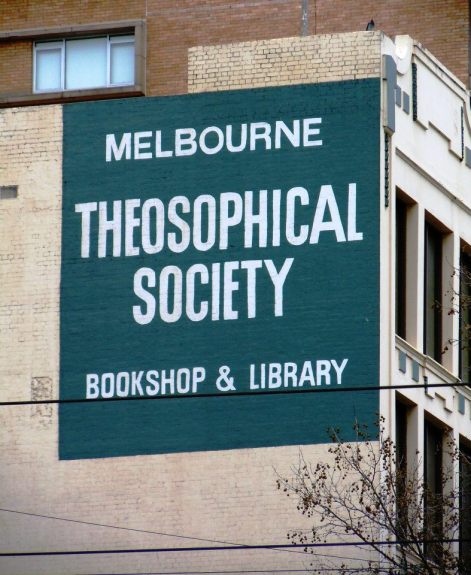
The Melbourne Theosophical Society.
Perhaps unsurprisingly, Theosophy was attractive to a disparate group of nineteenth-century radicals, the best-known being Rudolf Steiner and Annie Besant, both of whom held prominent positions within the organisation. Besant led Theosophy after Blavatsky’s death in 1891. In fact, Besant is a prime example of how, as Sheila Rowbotham writes in her biography of Edward Carpenter, ‘left politics and lifestyle were inclined to fuse.’ These ‘alternate lifers – socialists, anarchists, Theosophists, vegetarians’ – clustered together, joining one another’s societies and supporting one another’s causes.
Besant, like GB Shaw, was a member of the Vegetarian Society and a suffragette. Leah Leneman has written about the surprisingly high numbers of vegetarians in the British women’s suffrage movement. She argues that feminists’ interest in vegetarianism stemmed partly from their opposition to animal cruelty and vivisection, but was also the product of the Theosophical Society’s influence over so many late-Victorian women. Theosophy’s willingness to countenance sexual equality and to allow women to occupy important positions within the movement, made it attractive to educated, politically left-leaning women.
Although vegetarianism is not a prerequisite for membership of the Theosophical Society, it certainly promotes vegetarianism – and this is partly a result of Blavatsky’s interest in Hinduism. Indeed, one particularly prominent member of the London Vegetarian Society was Gandhi, who joined while a student in the UK between 1888 and 1891. He also became interested in Theosophy. Stephen Hay explains:
After a year or so in London the young Hindu made the acquaintance of a number of Europeans deeply interested in the culture of ancient India. The first two were members of the newly founded Theosophical Society… [and they] took Gandhi to meet Madame Blatavsky and her recent convert from atheism, Annie Besant. He subsequently read Blavatsky’s Key to Theosophy which ‘stimulated in me the desire to read a book on Hinduism and disabused me of the notion fostered by the [Christian] missionaries … that Hinduisim was rife with superstition.’
These British theosophists and members of the Vegetarian Society were, through their interest in Indian society and religion, early supporters of Indian nationalism. Besant had a long and complicated relationship with this movement: she founded the Indian Home Rule League in 1916 and was a member of the Indian National Congress.
What she and her fellow vegetarians and theosophists opened up to Gandhi and other western-educated Indians was a new way of understanding India: one that embraced Hinduism as a sophisticated set of beliefs, and which celebrated India’s rich and ancient history.
As Theosophy drew on a range of belief systems, it spread outwards from the United States and Britain. Theosophical Societies were established in South African cities too. As far as I can see, there were branches in Cape Town, Pretoria, and Johannesburg by the early years of the twentieth century – and they are still in existence.
Betty Molteno and Alice Greene – feminists, vegetarians, political radicals – were early South African Theosophists too. When Gandhi lived in South Africa (1893-1914), he seems to have been involved in the Johannesburg Lodge’s activities, reading occasionally from the Bhagavad Gita – a text which he had first read in translation while in England.

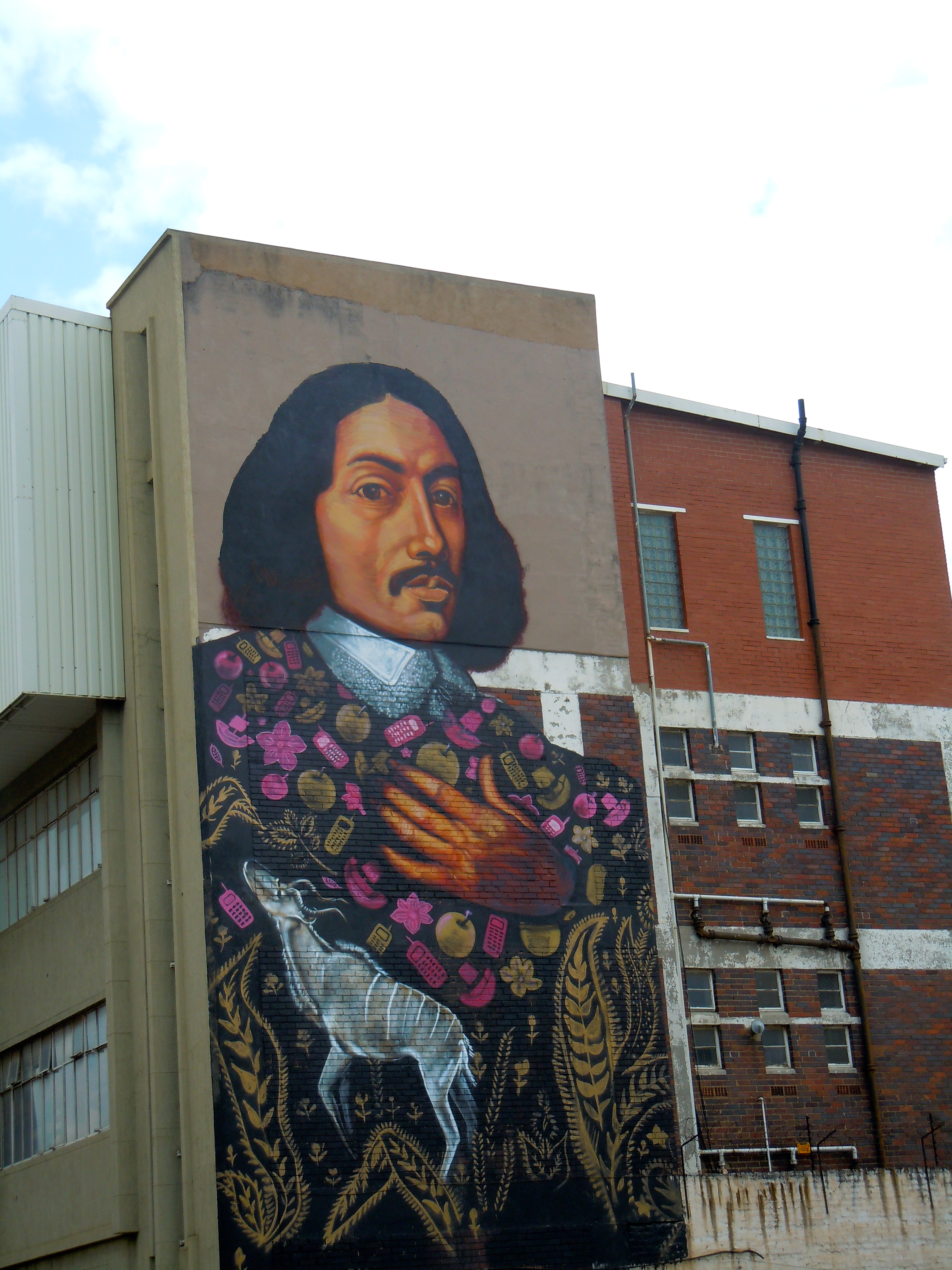
The Cape Town Theosophical Society.
Theosophy helped, then, to reframe Gandhi’s understanding of India – not as a place needing reform from civilised foreigners, but, rather, as a nation which could draw on its own histories and traditions. (Of course, this new idea of India was as heavily constructed as that taught to Gandhi and other western-educated Indians.) Vegetarianism did something similar: associated with self-control, purity, and a profoundly ethical relationship with the world, vegetarianism became symbolic of Gandhi’s own form of political struggle and vision for a free India.
What understanding the origins of the vegetarian movement and other, related organisations – like Theosophy – demonstrates, is that choices around what we eat have long been political: they are connected with the ways in which we choose to think about and wield power.
Sources
Mark Bevir, ‘Theosophy and the Origins of the Indian National Congress,’ International Journal of Hindu Studies, vol. 7, nos. 1-3 (2003), pp. 99-115.
Stephen Hay, ‘The Making of a Late-Victorian Hindu: MK Gandhi in London, 1888-1891,’ Victorian Studies, vol. 33, no. 1 (Sept. 1989), pp. 75-98.
Baruch Hirson, The Cape Town Intellectuals: Ruth Schechter and her Circle, 1907-1934 (Johannesburg: Witwatersrand University Press, 2001).
Isabel Hofmeyr, Gandhi’s Printing Press: Experiments in Slow Reading (Cambridge, Mass.: Harvard University Press, 2013).
Leah Leneman, ‘The Awakened Instinct: Vegetarianism and the Women’s Suffrage Movement in Britain,’ Women’s History Review, vol. 6, no. 2 (1997), pp. 271-287.
Sheila Rowbotham, Edward Carpenter: A Life f Liberty and Love (London: Verso, [2008] 2009).

Tangerine and Cinnamon by Sarah Duff is licensed under a Creative Commons Attribution-ShareAlike 3.0 Unported License.
















 Tangerine and Cinnamon
Feb 4
Troubled Waters
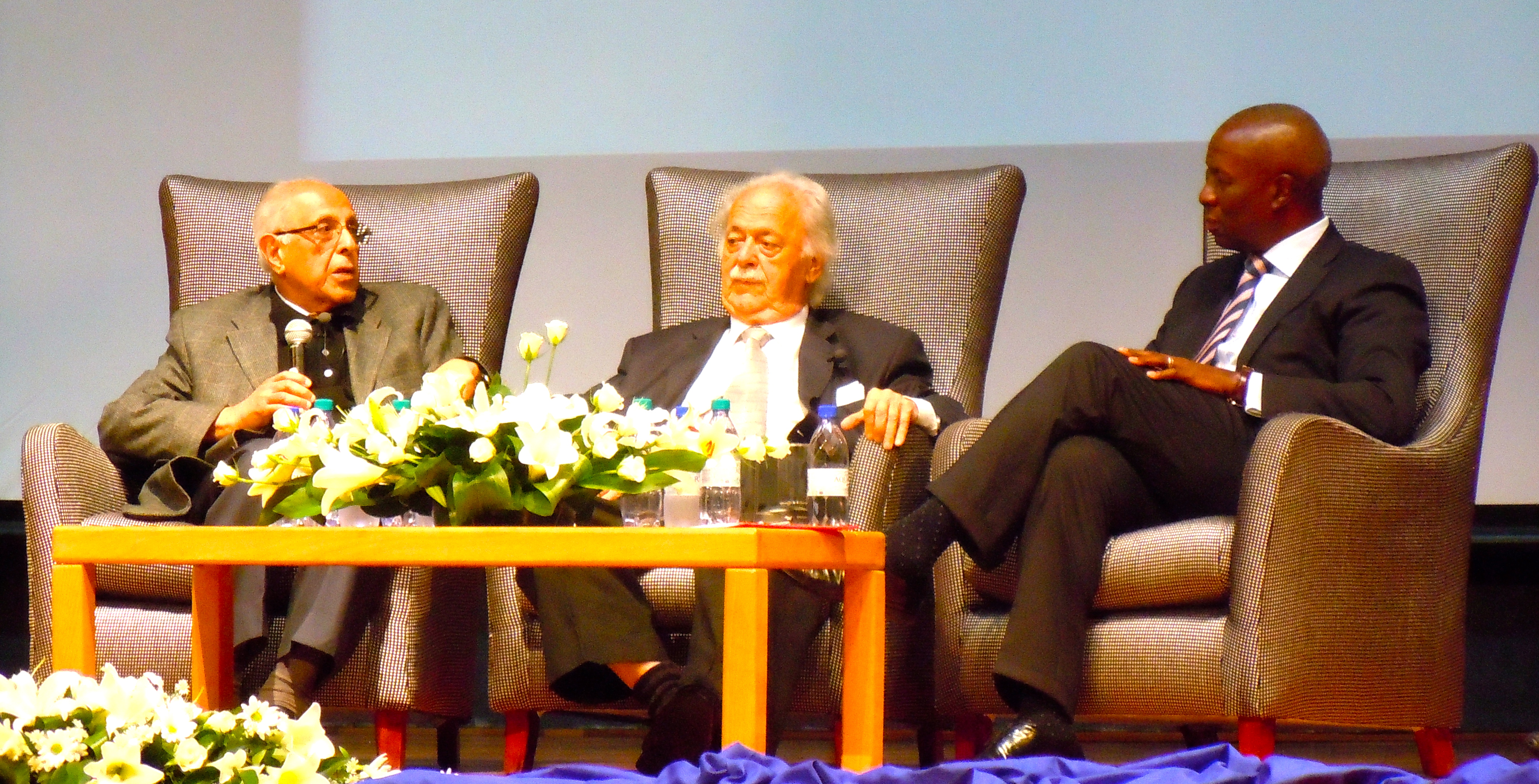
In April last year I went to a public meeting convened by the NGO Equal Education in Cape Town’s best bookshop, the Book Lounge. I have been to dozens of launches and readings and comic book swaps at the Book Lounge, but none of them was as packed as this. There were people squeezed on the floor in between chairs; the crowd was four-people deep in standing room-only areas; people on the pavement outside listened in through the open doors. I climbed up part of a bookshelf to see what was going on. It was so hot and damp with more than a hundred bodies crammed tightly together, that it felt that the shop had developed its own tropical ecosystem.
It says a great deal about the state of South Africa’s education system that a panel discussion about schools in the Eastern Cape – one of the country’s least effectively run provinces – could draw such a large and enthusiastic crowd. Equal Education had recently sent a group of South African luminaries – including constitutional law professor Pierre de Vos, writers Zakes Mda and Njabulo Ndbele, Archbishop Thabo Makgoba, and activists Elinor Sisulu and Sindiwe Magona – on a Solidarity Visit to draw attention to the appalling state of school infrastructure.
They described collapsing mudwalled classrooms; inadequate supplies of books and stationery; children without desks; and, most memorably, the disgusting state of school toilets. Children complained of contracting diseases from filthy, broken latrines, and many of them chose rather not to use them at all – either risking their health or relieving themselves in the veldt. It was the toilets that seemed to many to sum up the Department of Basic Education’s lack of respect for the children it is supposed to educate.
It’s been difficult not to think about the Solidarity Visit and its report fairly recently. Last week, a little boy was killed when he fell into a pit toilet at a primary school in Chebeng, a village in Limpopo Province. Referring to a 2011 survey, Equal Education noted:
This death coincided with a series of protests in the Madibeng municipality in the North West, over water shortages, which led to the deaths of three protestors. After an outcry over both alleged police brutality, as well as revelations as to the mismanagement of the municipality, the mayor resigned and water was restored. Residents say, though, that the water remains too dirty to use.
These protests are nothing new. Residents of this and other municipalities in the North West have been demanding a clean, reliable water supply – and it’s worth emphasising that they’re billed for water regardless of whether it flows or not – since at least 2011. As even ANC stalwart Trevor Manuel has admitted, the problem in Madibeng is that a dysfunctional, corrupt local government cannot provide basic services. In 2010, the municipality was placed under administration:
The violence of these protests has drawn attention to crises not only in policing (and it would seem that some of the police who were present at the Marikana massacre were at Madibeng too), but also in the regular provision of clean water to South Africans. As both Eyewitness News and an Africa Check have demonstrated, the Department of Water and Environment Affairs’ claim that 94% of South Africans have access to safe drinking water doesn’t, well, hold any water. A 2011 general household survey published by Statistics South Africa reports that:
Moreover, South Africans have reported declining satisfaction with the quality of water provided, complaining that in some municipalities it is not clean enough to drink and cook with.
A protestor holds aloft a copy of the constitution. Taken at the Right2Know campaign’s march to Parliament, October 2010.
It is not difficult to understand why communities living in rural areas and informal settlements – those usually with the least access to basic services – protest poor and irregular water supplies with such anger. Usually described as ‘service delivery protests,’ demonstrations over poor municipal governance have, over the past few years, become ever more frequent and violent. But they are more than protests over bad service delivery.
The idea of water as a public good dates from around the mid-nineteenth century, when local governments became interested in ensuring clean water supplies as a way of combating the spread of disease. South Africa is one of the few countries in the world which enshrines the right to access clean, safe water in its constitution. Citizenship is, then, closely connected to being able to fill a pot with clean water from a kitchen tap; to take a shower in a bathroom; and to flush a porcelain toilet. In a country where access to water was, under apartheid, determined by a racist urban planning system, these current service delivery protests are a revolt around the denial of citizenship.
Tangerine and Cinnamon by Sarah Duff is licensed under a Creative Commons Attribution-ShareAlike 3.0 Unported License.