Skip to content

Posts tagged ‘United States’

From Customers to Consumers

I love this video – it’s an overview of a century of fashion, music, and dance in London’s East End:

It’s not an art installation. It’s not part of a community project. It’s an ad. For a shopping mall. And this isn’t any mall – it’s Europe’s biggest, and one of the key developments in the Olympic site in Stratford. In fact, it seems that most of the spectators attending next year’s Summer Olympics will enter the games through Westfield Stratford City: its casino, 300 shops, 50 restaurants, three hotels, and 17 cinema screens.

I’m not a massive fan of shopping malls, and said as much when I posted this video on Facebook. And then my friend Jean-François, who’s an architect, made the point that the development will create a massive 10,000 jobs, and has funded literacy classes for the astonishingly high number of applicants who seemed to be illiterate. In an area as deprived as Stratford, surely this shopping centre could only be a Good Thing?

There has been a great deal of criticism of the way in which Stratford has been transformed by the Olympic site. I don’t want to romanticise life in a very poor borough of London, and I’m not sure that commentators like Iain Sinclair – who has been vociferous in his opposition to the 2012 Olympic bid – offer much in the way of ideas for providing jobs, decent housing, and education for the area. But I feel uncomfortable about the way that a temple to consumerism seems to be offered up as the only possible way of raising living standards in Stratford. As Suzanne Moore – not, admittedly, my favourite columnistwrote in yesterday’s Guardian:

Next week a new Westfield opens. It’s not in west London, it’s in the east, in Stratford. It will cash in on the Olympics. Is this what this deprived area really needs? Another giant, weatherless mall that has exactly the same shops as everywhere else? Maybe this deliberately disorientating social space will be a place of connection and hope. Maybe it will offer the local youth something other than an expensive bowling alley, a multiplex and some minimum-wage jobs.

But is this just a case of lefty, middle-class squeamishness? When I buy a Margot Molyneux blouse from Mungo & Jemima, or even a dress from an upmarket chain like White Stuff or online store like Toast, it’s not any ‘better’ than purchasing a t-shirt from Mr Price. Both decisions support people who designed and made the garment. When I buy from small, local grocers and food shops, it’s partly because of a belief that this is good for our food system, but it also says something about me – about how I choose to constitute my identity in relation to a particular way of thinking about being an ‘ethical’ shopper. However critical I may be of consumerism, I am, inevitably, bound up in it.

I am interested in the shift from defining people who buy things from shops as ‘customers’ to being described as ‘consumers’. There’s a growing collection of historians interested in tracing and analysing this transition. One of the reasons why I’m so interested in it is because of the pivotal role played by the food industry in creating consumers.

Given the dire state of the average American diet, it probably comes as no surprise to learn that the United States was the first country to witness the rise of a food industry reliant on consumers who had begun to buy an increasing number of good produced in factories by big food companies towards the end of nineteenth century. Consumerism is inextricably linked to the industrialisation of food production.

The first people to benefit from the Industrial Revolution were the middle classes. In Britain, Europe, America and elsewhere, the newly-wealthy bourgeoisie could afford to buy more food, and employed more servants to prepare it. They had leisure in which to enjoy the eating of this food – and it became a way of marking newly-acquired middle-class status.

Until 1850 in Europe, and 1830 in the US, the diets of the urban poor actually deteriorated. The average height of working-class people living in the rapidly expanding cities of the industrialised world actually declined – one of the most potent indicators of the levels of deprivation experienced by this new proletariat. This was the first generation of workers to be disconnected from food production: these were people who no longer grew their own food, and were dependent on inadequate and expensive food systems to supply towns and cities. Poor diets were centred around starches and cheap, poor-quality food.

But from the mid-nineteenth century onwards, food became progressively cheaper, more plentiful, and varied – and this happened earlier and more quickly in the United States. So what caused this drop in price and greater availibility in cities? A revolution in transport made it easier to take produce from farms to urban depots by rail, and shipping brought exotic fruit and vegetables from the rest of the world to Europe and the United States. When Europe’s grain harvest failed during the 1870s, the continent was fed with wheat imported by steam ship from Canada. Farmers now began to cultivate land which had previously been believed to be inaccessible – and to grow market-oriented produce. The rise of the iceberg lettuce – which could cope with being transported over vast distances with little bruising – is directly attributable to this.

The agricultural revolution of the eighteenth century made farming more productive. New systems of crop rotation, the use of higher-yielding plant hybrids and improved implements, and the enclosure movement in Britain meant that fewer farmers were producing more food than ever before. And this produce was processed far more quickly, and cheaply. With innovations in the preservation of food through refrigeration, bottling, and canning, food could be transported over greater distances, but also, and crucially, manufactured in larger quantities and then kept before distribution on a mass scale.

Food companies began to control nearly every aspect of the newly industrialised food chain: businesses like Heinz formed alliances with farmers and transportation companies which supplied their factories with meat, fruit, and vegetables. Increasingly, they also began to advertise their products. The rise of these ‘food processors’, as they’re often called, caused a fundamental change in the way in which people ate. Most Americans began to eat similar diets based around processed food produced in factories.

Americans weren’t, of course, compelled to eat processed food. They did so for a number of reasons. Factory-baked bread, tinned vegetables, and processed meat were cheap, easy to prepare, and, importantly, believed to be free from contamination and disease. But with most people’s basic nutritional and calorific needs now met, food processors began to use advertising and brands to a far greater extent to encourage customers – dubbed ‘consumers’ – to buy more and that which they didn’t need. Susan Strasser explains:

Formerly customers, purchasing the objects of daily life in face to-face relationships with community-based craftspeople and store keepers, Americans became consumers during the Progressive Era. They bought factory-produced goods as participants in a complex network of distribution – a national market that promoted individuals’ relationships with big, centrally organised, national-level companies. They got their information about products, not from the people who made or sold them, but from advertisements created by specialists in persuasion. These accelerating processes, though by no means universal, had taken firm hold of the American way of life.

Food processors needed to persuade consumers to buy their products, and in greater quantities:

People who had never bought cornflakes were taught to need them; those once content with oats scooped from the grocer’s bin were told why they should prefer Quaker Oats in a box. Advertising, when it was successful, created demand…. Advertising celebrated the new, but many people were content with the old. The most effective marketing campaigns encouraged new needs and desires…by linking the rapid appearance of new products with the rapid changes that were occurring in all areas of social and cultural life.

We have always attached a variety of meanings to food, but within a consumer society, the decisions we make about what to buy and eat are shaped to a large extent by the desires and needs manufactured by a massive advertising industry.

The industrialisation of food production has, as I noted last week, allowed more people to eat better than ever before. But this has come at a cost: we know that many food companies engage in ecologically unsustainable practices, mistreat their employees, hurt animals, and occasionally produce actively harmful food. Moreover, it was part of a process which transformed people from customers into consumers – into individuals whose happiness is linked to what and how much they buy. This does not make us happy – nor is it environmentally or economically sound. Justin Lewis writes:

the promise of advertising is entirely empty. We now have a voluminous body of work showing that past a certain point, there is no connection between the volume of consumer goods a society accumulates and the well-being of its people.

The research shows that a walk in the park, social interaction or volunteering – which cost nothing – will do more for our well-being than any amount of ‘retail therapy’.  Advertising, in that sense, pushes us towards maximising our income rather than our free time.  It pushes us away from activities that give pleasure and meaning to our lives towards an arena that cannot – what Sut Jhally calls ‘the dead world of things’.

As customers were made consumers, so it is possible for us to change once again. How we are to achieve this, though, is difficult to imagine.

Further Reading

Texts quoted here:

Harvey A. Levenstein, Revolution at the Table: The Transformation of the American Diet (New York: Oxford University Press, 1988).

Susan Strasser, Customer to Consumer: The New Consumption in the Progressive Era,’ OAH Magazine of History, vol. 13, no. 3, The Progressive Era (Spring, 1999), pp. 10-14.

Other sources:

Warren Belasco and Philip Scranton (eds.), Food Nations: Selling Taste in Consumer Societies (New York: Routledge, 2002).

Jack Goody, ‘Industrial Food: Towards the Development of a World Cuisine,’ in Cooking, Cuisine, and Class: A Study in Comparative Sociology (Cambridge: Cambridge University Press, 1982), pp. 154-174.

Roger Horowitz, Meat in America: Technology, Taste, Transformation (Baltimore: Johns Hopkins University Press, 2005).

Tim Jackson, Prosperity without Growth: Economics for a Finite Planet (London: Earthscan, 2009).

Nancy F. Koehn, ‘Henry Heinz and Brand Creation in the Late Nineteenth Century: Making Markets for Processed Food,’ The Business History Review, vol. 73, no. 3 (Autumn, 1999), pp. 349-393.

Rebecca L. Spang, The Invention of the Restaurant: Paris and Modern Gastronomic Culture (Cambridge: Harvard University Press, 2000).

Peter N. Stearns, ‘Stages of Consumerism: Recent Work on the Issues of Periodisation,’ The Journal of Modern History, vol. 69, no. 1 (Mar., 1997), pp. 102-117.

Susan Strasser, ‘Making Consumption Conspicuous: Transgressive Topics Go Mainstream,’ Technology and Culture, vol. 43, no. 4, Kitchen Technologies (Oct., 2002), pp. 755-770.

Lorine Swainston Goodwin, The Pure Food, Drink, and Drug Crusadors, 1879-1914 (Jefferson: McFarland & Co., 1999).

Frank Trentmann, ‘Beyond Consumerism: New Historical Perspectives on Consumption,’ Journal of Contemporary History, vol. 39, no. 3 (Jul., 2004), pp. 373-401.

Creative Commons License Tangerine and Cinnamon by Sarah Duff is licensed under a Creative Commons Attribution-ShareAlike 3.0 Unported License.

Food Links, 07.09.2011

Eating with our eyes.

On the link between food insecurity and conflict.

Pret a Manger seems set to stay in the US.

Will Self considers his local Sainsbury’s supermarket cafe.

America’s favourite foods, state by state (fun, but probably spurious).

Where do whoopie pies come from? (Thanks Mum!)

Ferran Adria visits China.

How pricey farmers’ markets threaten food reform – and this is Tom Philpott’s response.

George Monbiot evaluates Hugh’s Fish Fight.

How did granite become the kitchen counter standard?

This is fantastic: the South African Post Office promotes the consumption of vegetables with some lovely new stamps, and a handy recipe book.

A guide to New York City’s pizzas.

Wonderfully, C. Louis Leipoldt’s Polfyntjies vir die Proe (a history of eating in the Cape) is now online.

The real ale renaissance (hurrah! I love ale).

Food Links, 24.08.2011

David Chang’s new food magazine, Lucky Peach, looks absolutely amazing.

Spain’s gastro burglars strike again!

Photographs of the last meal ever served at El Bulli. (It reopens in 2014 as a think tank.)

Niger and Somalia: A Tale of Two Famines.

On Beekeeping without Borders in Afghanistan.

Participation in the United States’s food stamp programme is at a record high.

American bread packaging from the 1940s and 1950s.

This is such a brilliant idea: Eat Your Books helps you to find recipes in your cook book collection.

Consider pasta.

The El Bulli dish name generator.

On the American government’s efforts to regulate the food industry.

This is fascinating: a new study published by the FAO argues that global demand for edible oils and cereals is actually slowing down. This means that high food prices are not the result of increased demand from China and India.

How to make Viking heather beer. (I imagine that one could use fynbos in South Africa?)

Food Links, 10.08.2011

‘the discerning and liberal media consumer prefers: ginger and chocolate cookies; amaretti; shortbread; butter thins, and almond florentines.’ This is the study of the year.

Take a look at urban farming around the world.

On the rise of ‘White People Food’.

These are the five best and five worst proteins for our and the planet’s health (although I assume the study is US-based).

Jay Rayner asks if farmers’ markets will really change the world.

High food prices have caused an increase in the numbers of Americans eligible for food stamps.

Close-ups of food.

Here’s more on bread prices and the Arab Spring.

Will placing a tax on junk food change eating habits?

Olivier the Schutter, the UN’s Special Rapporteur on the Right to Food, argues after a visit to South Africa that the country must ‘build a food economy that benefits the majority of the population.’ The report is really worth a read.

High food prices won’t be dropping anytime soon.

Hippy kitchens.

Russia has now classified beer as alcoholic. Better late than never.

Another study shows up the link between high food prices and food-based biofuels.

No Famine is Inevitable

Last week there was a flurry of excitement as commentators compared the R1 million pledged by the South African government to aid the victims of the famine in the Horn of Africa, and the potential billion rand loan which it is currently considering for Swaziland. Not only could Africa’s economic powerhouse donate considerably more than a million rand (about £90,000 or US$150,000) to Somalia, but granting a conditions-free loan to King Mswati III’s dysfunctional kingdom would serve only to prop up the continent’s last absolute monarch.

Although I was as outraged by my government’s apparent indifference to the plight of Somalis, I did begin to wonder if that money could be used more wisely. Of course, South Africa must – and can – contribute to the international effort to distribute food in Somalia. Given the scrutiny of aid agencies working in the region, as well as the awareness of how aid money has been channelled to elites over the past few decades, it’s likely that South Africa’s donation will go to those who need it. But giving money to alleviate the famine is a short-term fix.

Possibly because of the way it echoes Africa’s other best-known famine, the Live Aid-engendering Ethiopian famine of 1984-1985, the famine in the Horn of Africa has generated an enormous amount of coverage in the international press. More information and analysis can only ever be a good thing, but much of the discussion around the famine suggests that it’s a crisis which emerged suddenly and without any warning. As the Guardian’s John Vidal put it, ‘A massive drought, as if out of nowhere, has settled over the Horn of Africa’. Moreover, some commentators, like Vidal, have blamed the famine on only one or two factors, usually climate change or Western indifference to African suffering.

The causes of famines are complex, but they are never entirely unpredictable. Counterintuitively, they are not necessarily caused by a lack of food, but are, rather, the result of long-term systemic failure: in agriculture, trade, and, most importantly, in government. By suggesting that South Africa’s paltry million rand donation would be better spent, my point is that South Africa’s involvement in the Somali crisis should go beyond giving money for food. It needs to stop famines from happening in the first place, and that is not impossible.

We have managed largely to eradicate famine in the twentieth century. Before then, food shortages and famines were part of the rhythms of everyday life. In societies where food production was inefficient both in terms of labour and technology – and until the eighteenth century, eighty per cent of the population of Europe was engaged in agriculture – frequent crop failures meant that famine occurred often. But during the 1700s, an agricultural revolution allowed greater, more regular, and, crucially, more reliable yields to be produced by smaller numbers of people. International trade also meant that countries could buy food to supplement local shortfalls. For example, during the 1870s, the failure of the European grain crop boosted Canadian and American wheat exports, as these two countries fed Europe for almost a decade.

Although initially developed in the Netherlands and Britain (and there is a strong link between the development of capitalist economies and efficient food systems), the methods pioneered during this green revolution of the eighteenth and nineteenth centuries spread around the globe. By the early 1900s, famine was caused increasingly by people, rather than only by nature. That said, the Great Famine in Ireland (1845-1852) was certainly the product of the potato blight, but it also occurred at a time when Ireland was an exporter of wheat: there was enough food to go around, it was just that those who were starving couldn’t afford to buy bread. The Cattle Killing Movement in South Africa (1856-1857) caused widespread famine among the Xhosa. Around 40,000 people died of starvation, 33,000 moved away from the eastern Cape to seek work, and the authority of the Xhosa polity was fatally undermined. But this was caused by a decision to slaughter cattle and destroy crops on a mass scale.

Equally, some twentieth-century famines were caused partly by crop failure, but were also the product of bad governance and ineffective systems of food distribution. As Cormac Ó Gráda explains:

Wars, blockades, poor governance, and civil unrest can also lead to famines; panics about the food supply and poorly performing markets can exacerbate them. In such cases…factors other than crop shortfalls reduce the purchasing power or ‘entitlements’ of vulnerable sections of the population: the size of the loaf matters less than its distribution.

The Nobel Prize-winning economist Amartya Sen argued in Poverty and Famines (1981) that – contra Thomas Malthus who suggested that exponential population growth would result inevitably in famine – famines can occur in times of peak food production. Why? I think it’s worth quoting Sen in full:

In every society that exists, the amount of food that a person or a family can command is governed by one set of rules or another, combined with the contingent circumstances in which that person or that family happens to be placed vis-à-vis those rules. For example, in a private ownership market economy, how much food a person can command will depend on (1) what he owns, and (2) what he can get in exchange for what he owns either through trade, or through production, or some combination of the two. Obviously, in such an economy a person may suddenly face starvation either because his ownership bundle collapses (e.g., through alienation of land to the money lenders), or because the ‘exchange entitlement’ of his ownership (i.e., the command of what he owns) collapses (e.g., through his becoming unemployed and not being able to sell his labour power, or through a decline in his terms of trade vis-à-vis food).

In other words, people starve when they can’t buy food – either because they no longer have the money to exchange for food (as a result of unemployment, for example) or because food prices become prohibitively high. Peaks in food prices could be due to droughts and other ecological factors, conflict, and speculation.
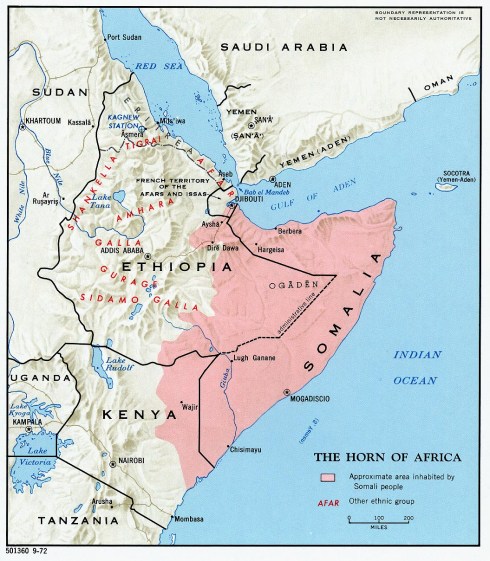
The crisis in Somalia demonstrates particularly well how state intervention can prevent or cause famine. In 1960, British Somaliland and Italian Somalia became the independent Republic of Somalia. Nine years later, Major-General Mohamed Siad Barre seized power in a bloodless coup and ruled Somalia through a military dictatorship until the collapse of his government in 1991. Somalia’s experience of food shortages and famine must be understood in this context of Barre’s government (or lack thereof) and economic policies. In 1970, he announced the implementation of ‘scientific socialism’, introduced strict central planning, and viciously stamped out all forms of opposition. Peter T. Leeson writes:

The government slaughtered civilians who posed threats to the government’s plans or political power, used coercive intimidation to create artificial support for its activities, and forcibly relocated others to further the political or economic ends of Barre and his cronies. ‘Both the urban population and nomads living in the countryside [were] subjected to summary killings, arbitrary arrest, detention in squalid conditions, torture, rape, crippling constraints on freedom of movement and expression and a pattern of psychological intimidation’. The state ruthlessly suppressed free speech and controlled all forms of information reaching Somalis. Newspapers (only one was officially permitted by the government), radio, and television were fully censored and dissent in any form squelched with force. Under Somalia’s National Security Law No. 54, ‘gossip’ became a capital offense. Twenty other basic civil freedoms involving speech, association and organisation also carried the death penalty.

Funds were diverted from public works, education, healthcare, and infrastructure to the military, on whose support and ability to terrify and brutalise the Somali population Barre depended. The nationalisation of land and industry in 1975 was, predictably, a disaster. The abandonment of socialism at the end of the 1970s in order to attract assistance from the International Monetary Fund made very little difference either. Somalia was heavily dependent on international food aid during the 1970s and 1980s. The Horn of Africa is prone to drought, but it’s worth noting that despite catastrophic droughts in the mid-1970s and mid-1980s, Somalia managed to avoid famine – unlike its war-torn neighbour, Ethiopia, whose government ignored the plight of its population.

As Abdi Ismail Samatar notes,

Somalia’s last major famine was in 1992 and was not caused by drought. Nearly 300,000 innocent people starved to death because of sectarian politics. The epicentre of that famine was in Bay, one of the country’s most productive agricultural regions, and starvation was induced by warlords who used food as a weapon against farmers and pastoralists.

Barre’s government collapsed in 1991, plunging Somalia into civil war and a chaos from which it has yet to emerge. It’s telling that a country which had managed to avoid famine for over half a century, despite drought, food shortages, and incredible food insecurity, saw widespread famine only after food supplies were disrupted by war.

So why famine now? Over the course of sixteen years, Somalia has been the subject of fourteen reconciliation conferences, none of which managed to produce a stable government. In 2004, the Transitional Federal Government (TFG), an anti-Islamist, pro-Ethiopian political grouping, was put into power in Somalia under the leadership of Abdullahi Yusuf and with the support of the United Nations. However, the TGF was neither popular nor effective as a government. In the absence of effective leadership, a number of attempts were made by Islamic groups, war lords, civil society organisations, and others to create some sort of order in Somalia, and particularly in Mogadishu. One of these, the Alliance for the Restoration of Peace and Counter-Terrorism, was formed by a group of war lords in February 2006. They were backed by the United States who saw them as allies against Islamic groups in the region.

Armed clashes between the Alliance and Islamist groups soon broke out and developed into a war which the Islamists won decisively. By the middle of 2006, they had taken control of Mogadishu as well as central and southern Somalia. Not only was this an embarrassment to the United States and its ally Ethiopia, but for the first time it seemed that Somalia was offered the possibility of a relatively popular and effective government in the hands of the Islamists, who quickly organised themselves into the Council of Islamic Courts (CIC). However, an invasion by Ethiopia at the end of 2006 caused the collapse of the CIC, the reinstallment of the almost entirely ineffective TFG, and the beginning of a new civil war between the Government and opposition groups. The most successful of these was Al-Shabab. Originally the CIC’s youth wing and affiliated with al-Qaeda, Al-Shabab is an Islamist group which now controls most of southern Somalia.

Years of political uncertainty, conflict, and chaos (best exemplified by the way piracy has flourished along the Somali coast) have left Somalis particularly vulnerable to drought and the less predictable effects of climate change. A combination of a US- and UN-backed blockade of the parts of Somalia controlled by Al-Shabab, as well as this organisation’s unwillingness to allow the World Food Programme to deliver food to southern Somalis has caused the famine. Samatar explains:

Normally, societies have three lines of defence against mass starvation: local capacity, national government and the international community. When a disaster hits a region, the first help comes from local administrations and the communities themselves. If events overwhelm the first responders, then the national government takes charge of operations; and when the crisis exceeds the wherewithal of the nation, international actors come to the rescue.

It is clear that all three levels of livelihood protections have failed in Somalia. Al-Shabab has prohibited the local population from organising their municipal governments and charities to fend off the disaster. Similarly, Somalia’s national government, which is beholden to sectarian leadership and international patrons, has been oblivious to the emerging calamity, and has thwarted the international community from coming to its aid

This was a famine which could have been avoided had order been established in Somalia. Here, Somali politicians and war lords are as much to blame as the international community, East Africa’s Intergovernmental Authority on Development, the UN, and, crucially in my view, the African Union. This famine is not the result solely of dastardly foreign countries plundering Africa, nor can blame be laid entirely on Somalis themselves. But after the effort to feed Somalis has ended, reconstruction needs to begin. And it’s here where South Africa must – and I think is obliged to – take a leading role.

Somalia also demonstrates the extent to which food security is linked to strong, functioning governments. Countries which are badly run, have weak economies, and, most importantly, are authoritarian, are the most strongly disposed towards famine. Last year’s narrowly-avoided famine in West Africa was due largely to the incompetence of Niger and Chad’s malfunctioning, undemocratic political dispensations. Only the spread of democratic and open government, with, crucially, a free flow of information, will prevent famines from happening in Africa. As Sen remarked, ‘There is, indeed, no such thing as an apolitical food problem.’

Note: I try to use sources which are easily available, but for this post I’ve relied on articles from academic journals. Unfortunately, these are securely behind paywalls. If you’d like copies of them, let me know.

Further Reading

Texts cited here:

Joyce Appleby, The Relentless Revolution: A History of Capitalism (New York and London: W.W. Norton, [2010] 2011).

Cormac Ó Gráda, ‘Making Famine History,’ Journal of Economic Literature, vol. 45, no. 1 (Mar., 2007), pp. 5-38.

Peter T. Leeson, ‘Better off stateless: Somalia before and after government collapse,’ Journal of Comparative Economics, vol. 35 (2007), pp. 689-710.

Ken Menkhaus, ‘The Crisis in Somalia: Tragedy in Five Acts,’ African Affairs, vol. 106/204 (2007), pp. 357-390.

Amartya Sen, ‘The Food Problem: Theory and Policy,’ Third World Quarterly, vol. 4, no. 3 (Jul., 1982), pp. 447-459.

Other sources:

L.A. Clarkson and E. Margaret Crawford, Feast and Famine: Food and Nutrition in Ireland 1500-1920 (Oxford: Oxford University Press, 2001).

Jean Drèze and Amartya Sen (eds.), The Political Economy of Hunger, 3 vols. (Oxford: Clarendon Press, 1990).

Cormac Ó Gráda, Black ’47 and Beyond: the Great Irish Famine in History, Economy and Memory (Princeton: Princeton University Press, 1999).

Cormac Ó Gráda, Famine: A Short History (Princeton: Princeton University Press, 2009).

Cormac Ó Gráda, ‘Revisiting the Bengal Famine of 1943-4,’ History Ireland, vol. 18, no. 4, The Elephant and Partition: Ireland and India (July/August 2010), pp. 36-39.

Cormac Ó Gráda, ‘The Ripple that Drowns? Twentieth-Century Famines in China and India as Economic History,’ Economic History Review, vol. 61, (2008), pp. 5-37.

C.P. Melville, ‘The Persian Famine of 1870-72: Prices and Politics,’ in Food, Diet, and Economic Change Past and Present (Leicester: Leicester University Press, 1993), pp. 133-150.

Amartya Sen, ‘Famines as Failures of Exchange Entitlements,’ Economic and Political Weekly, vol. 11, no. 31/33, Special Number: Population and Poverty (Aug., 1976), pp. 1273-1280.

Amartya Sen, Poverty and Famines: An Essay on Entitlement and Deprivation (Oxford: Clarendon Press, 1981).

Anne M. Thompson, ‘Somalia: Food Aid in a Long-Term Emergency,’ Food Policy (Aug. 1983), pp. 209-219.

C. Paul Vincent, The Politics of Hunger: The Allied Blockade of Germany, 1915-1919 (Athens: Ohio University Press, 1985).

Christian Webersik, ‘Mogadishu: An Economy without a State,’ Third World Quarterly, vol. 27, no. 8 (2006), pp. 1463-1480.

S.G. Wheatcroft, ‘Famine and Food Consumption Records in Early Soviet History, 1917-25,’ in Food, Diet, and Economic Change Past and Present (Leicester: Leicester University Press, 1993), pp. 151-174.

Creative Commons License Tangerine and Cinnamon by Sarah Duff is licensed under a Creative Commons Attribution-ShareAlike 3.0 Unported License.

Food Links, 20.07.2011

How will fracking impact on our food supply?

Partly because of its emphasis on increasing yields, the Gates Foundation, in partnership with the evil empire Monsanto, is pushing genetically engineered crops in Uganda, Tanzania, Kenya, and Malawi.

Seven food and drinks trends in the US for 2011.

Famine looms in the Horn of Africa. This is why.

Sarah Lohman cooks ‘temporal fusion cuisine’ and keeps an amazing website called Four Pounds of Flour. Here she plots changing tastes in America.

Chefs go wild about Nathan Myhrvold and Chris Young’s Modernist Cuisine: The Art and Science of Cooking.

Tom Philpott discusses the link between catastrophic flooding and industrial agriculture.

Consider corn.

There’s recently been a gloriously self-important spat between (some) South African food bloggers and food writers. This is Mandy de Waal’s excellent article for the Mail and Guardian which started it, and this is the hilariously bonkers response from one blog.

Jay Rayner considers the latest research into the relationship between meat consumption and cancer.

The UN’s Food and Agriculture Organisation reports that the world wastes or loses 1.3 billion tons of food per year – that’s a third of the total supply.

Donald Paul for the Daily Maverick discusses South Africa’s food security.

How to make Cornish pasties. (And flapjacks – crunchies to South Africans.) And in praise of sandwiches.

In whose hands?

I am not by nature a joiner. I became a member of the Green Party in the UK mainly to spite Phil Woolas after he made some more than usually daft comments about non-EU immigrants. That the Green Party did exceptionally well in the last general election and seems, to me, to offer the only credible way out of the global recession were pleasing perks of membership, but otherwise I didn’t appreciate being told to toe the party line on a few issues, sugar pill-based quackery homeopathy being one of them. I suppose that I don’t particularly enjoy being told what to think. This is why I’m in academia which is, as a friend put it, the last refuge of the sociopathic.

It’s partly for this reason that I’m fascinated by groups of people who set out, purposefully, to create alternative communities away from mainstream society: people who base these experiments in new living on complex rules for behaviour and thought. It’s something I would never do, and I am curious as to why others find it so attractive. I wrote my MA thesis about the first boarding school for the daughters of the Cape Colony’s Dutch-Afrikaner middle classes in the nineteenth century. This institution was a secluded, strictly evangelical retreat from colonial society for the pupils who lived there, many of whom complained that they found it difficult to return to the habits and routines of normal family life. Mission stations run by societies like the Moravian Brotherhood were similar. There, at places like Genadendal and Elim, residents were required to adhere to strict rules regarding work, dress, and speech.

The best known of these retreats were Robert Owen’s utopian socialist communities in the United States during the 1820s. The first of these, New Harmony, lasted only a few years. But there have been hundreds of similar examples, most of them unsuccessful. It seems that nearly every generation of reformers has a fringe which believes that the best way to reform society is to leave it, and construct a new way of living on its fringes. There are elements of this in the recent Dark Mountain Project founded by Paul Kingsnorth and Dougald Hine. They argue that the best way to prepare for a post-peak oil world and catastrophic climate change is to retreat, and to learn how to live sustainably and self-sufficiently away from society.

One of the most striking features of these experiments is the primacy they give to food. The cultivation of crops and, less frequently, the care of animals (and it’s interesting, although not surprising, how many alternative communities were vegetarian) were central to life in these societies. Not only was this importance due to practical reasons – before the beginning of the twentieth century, at least, it would have been too expensive to buy in adequate food supplies in rural areas – but for symbolic ones: ‘pure’ food produced by hardworking and hardthinking workers was bound to be better than that grown by exploited wage labourers.

I’ve recently finished reading This Life is in Your Hands, Melissa Coleman’s gripping memoir of her early childhood on the homestead established by her father, Eliot Coleman, a man believed by many to be the father of the modern organic movement in the United States. In 1968, Eliot and is wife Sue packed their belongings into a VW van and travelled to rural Maine – five hours from Boston, and three from Portland – to a plot of land on which they intended to build a homestead and grow enough vegetables and fruit for their own consumption. They had been inspired by the experiences of an older generation of ‘homesteaders’, Helen and Scott Nearing. Indeed, the idea of modern homesteading – living entirely self-sufficiently – was popularised by the Nearings’ book Living the Good Life: How to Live Simply and Sanely in a Troubled World (1954) in which they described a lifestyle in which was independent from the economy; healthy; and completely ethical. It was a life sustained by work done by their own hands.

The Colemans bought their land from the Nearings, and, using Living the Good Life as their Bible, set about living in accordance to the rules established by the Nearings. Eliot built their wooden cabin himself; they lived without electricity and running water; they cultivated most of their food themselves; and they bought as little as possible from the local shopkeepers. However idyllic this life may have appeared, it was precarious and dependent on backbreaking labour:

That my parents had chosen this lifestyle over an easier one wouldn’t matter in the moment when the goats had eaten the spring lettuce, there was nothing left in the root cellar, the drinking water was muddy with runoff, and there was no money under the couch for gas to get to town – not to mention that Jeep’s registration had expired, and we had no savings account, trust fund, or health insurance policy, no house in town to fall back on.

They soon realised that complete self-sufficiency was impossible. The Nearings, for all their status as homesteading gurus, bought in a range of luxuries, and the Colemans had to purchase oats and other grains, yeast, seeds, bacteria for making yogurt, and vitamin B supplements for their diet. And the absolute seclusion they enjoyed during their first year or two of homesteading – when Melissa was born – came to an abrupt end as a result of an article in the Washington Post by a sympathetic journalist, and Eliot’s ambitions to spread the gospel about organic gardening. He was already selling the surplus from their garden, and believed that organic methods offered an alternative to the new farming orthodoxy espoused by Nixon’s Secretary for Agriculture, Earl Butz, who advised farmers to plant maize ‘from fence row to fence row’.

Eliot’s increasing renown, his ever longer absences to study and lecture, as well as the numbers of enthusiastic students who came to work on the garden in the summer – often in the nude – put strain on the Colemans’ marriage. And it’s here that one of the main problems of these alternative communities becomes especially apparent. For all their desire not to replicate the power structures of mainstream society, they invariably do. Women continue to undertake the burden of domestic labour. Eliot Coleman worked unbelievably hard – to the extent that he developed hyperthyroidism as a result of stress and exhaustion – but, as a contemporary article on homesteading makes the point, he did the ‘fun’ bit: the growing. When he finished his work in the garden at night, he could rest. Sue, though, was responsible for keeping house and doing laundry without soap, detergent, or appliances. She ground their own flour, made yogurt, sewed and mended their clothes, and bottled, canned, and preserved food to see them through the winter. She had three daughters under the age of seven to care for. Oh, and she ran their vegetable stall too. Her work – invisible and largely unappreciated – was unremitting.

Michelle Nijhuis suggests that one of the reasons why women find homesteading so difficult is because of the absence of labour saving devices like washing machines and vacuum cleaners: without them, otherwise easy chores become difficult, time consuming, and very, very boring. But I’m not so sure about this argument. (Although who am I to disagree? I wouldn’t touch homesteading with a bargepole and she’s a paid-up member of the movement.)

Much of This Life is in Your Hands reminds me of John Matteson’s Pulitzer Prize-winning double biography of Louisa May and Bronson Alcott, Eden’s Outcasts (2007). Louisa May is now best remembered as the author of Little Women (1868), but during the mid-nineteenth century her father, Bronson, was a well-known and controversial educationalist and philosopher with strong links to the Transcendentalists. He also experimented with living away from society and, like the Colemans, his and his family’s time at Fruitlands, a commune in Massachusetts, ended in disaster. Established in 1843, Fruitlands lasted slightly more than a year, and Bronson was largely responsible for this: he and his small group acolytes planted the fields too late, ran out of money, and constructed a set of rules which actively hindered work on the farm. All animal products and labour were banned, and the members spent as much time raising funds and discussing whether or not they should drink coffee, as they did actually working the land.

Indeed, most of the work was done by Abba Alcott, Bronson’s long-suffering wife. She cared for their four young daughters, cooked, sewed, cleaned, chopped wood, and washed laundry. This was not an unusual lot for a women in nineteenth-century America, but it was made worse by their poverty, and wilful refusal to use ‘luxuries’ – warm clothes, hot water, a greater range of foodstuffs – which would have made the work any easier or, at least, more interesting. And, of course, the point of the commune was that it was meant to be wholly egalitarian. In the end, Abba did the same work – in possibly worse conditions – as women living in nearby Concord.

Towards the end of her memoir, Melissa Coleman describes her mother’s mental breakdown after the drowning of Melissa’s little sister, Heidi. But she makes it clear that this was the trigger for something which had long been developing:

Just that morning the gardens were bustling as usual with apprentices and customers and vegetables needing to be picked. It was a humid-hot day, a Saturday near the end of July. Baby Clara was strapped to Mama’s back in Heidi’s old sling, sleeping mouth-open as Mama cooked lunch, skin glowing and tan from summer. Skates was coming to visit, and Mama needed time to clean the house, to hide from her mother-in-law the chaos her life had become: Bess and Papa having breakfast together that morning, mud tracked in from the gardens, piles of laundry to be washed by hand, Heidi and I running around the small kitchen pulling each other’s hair and screaming.

In a recent post for Grist, Tom Laskawy makes the point that the longer hours worked by Americans – and I think that this is true elsewhere as well – have been sustained by the greater availability of cheap food – food which is not necessarily nutritionally sound, nor ethically produced.         On the other hand, appliances and a greater variety of food available at affordable prices in supermarkets have facilitated women’s greater entry to the workplace in greater numbers. We know, nonetheless, that this is part of a food system which is entirely unsustainable.

So what do we do? I certainly don’t want a retreat into homesteading. I suggest that we take another look at the ways in which we work: both at home and outside it. There is a significant body of work which suggests that a reduction in the numbers of hours we work would not only be good for our and the planet’s wellbeing, but also for the economy. If we had more time to cook and to grow our own food – although within reason – we would have the beginnings of a more stable food system. Importantly, most of the labour performed in the home is still by women and, clearly, men need to share more of it. The burden of ensuring a shift to more sustainable lifestyles cannot be women’s responsibility alone.

Creative Commons License Tangerine and Cinnamon by Sarah Duff is licensed under a Creative Commons Attribution-ShareAlike 3.0 Unported License.

Food Links, 13.07.2011

This is possibly the best blog ever (other than this one, obviously): a guide to historic bars.

Ella McSweeney reports on proposed legislation in Ireland to ban the sale of raw – or unpasteurised – milk.

Ferran and Albert Adrià have opened tapas and cocktail bars in Barcelona: ‘We’ll do the impossible right away. For the miracles we need a little more time.’

This is a fantastic interview with food historian Steven Kaplan on food history.

Some lovely-looking American pie recipes.

Consider the bagel. Or the beigel.

How long can humans survive without food and water?

The Observer Food Monthly takes a look at a decade of eating in Britain – and at the top ten trends in food.

Madhur Jaffrey talks about her career.

The New York Times unpacks the marketing behind ‘functional foods’.

Wow, Georgia O’Keeffe had a taste for utterly revolting cooking.

Exploding watermelons demonstrate particularly well why it’s a generally a good idea to regulate properly what farmers may and may not use to fertilise their crops.

Food Links, 06.07.2011

Gordon Conway considers the global food crisis.

The Guardian lists the ten best literary picnics.

Although hugely successful, organic farming faces a range of challenges in India – despite the growing  evidence that organic farming can feed the world.

On Thomas Jefferson, food, and slavery.

How can cruelty to animals in American factory farms be prevented?

Border conflicts – between Isreal and Palestine, Mexico and the United States – are made worse by competition over water and food insecurity.

Behold Coralie Bickford-Smith’s beautiful covers for Penguin’s Great Food series.

One third of the world’s food is wasted.

‘Sponge cakes for all!’ Is baking a feminist act?

Why do Americans insist upon not using scales to measure ingredients when cooking?

We could be anywhere

I’ve spent the past fortnight in New York – mainly for a conference at Columbia – and on my last morning had breakfast at a restaurant which could only have been in New York, and, more specifically, in Morningside Heights. The Hungarian Pastry Shop is a shabby, comfortable, and much adored cafe among local residents and Columbia’s students and academics. It serves a range of unbelievably good cakes and pastries, the menu for which is an ancient and faded handwritten banner above the counter. Mothers with small children munch apple strudel alongside workmen in overalls, lecturers with textbooks, and small old ladies with thick foreign accents.

The Hungarian Pastry Shop in Morningside Heights, New York

Founded by immigrants, this could only be called The Hungarian Pastry Shop outside of Hungary. Over the years, it’s been tweaked to satisfy the demands of now elderly mittel-European customers, a group of whom was sitting in the sunshine when I arrived, as well as the undergraduates who spend long hours reading over its big mugs of strong coffee. The Shop has a menu in German and table service, as well as an exterior decorated with murals, a graffiti-covered loo, and posters advertising digs, extra tuition, and auditions for student productions.

Breakfast at the Hungarian Pastry Shop

Over a cherry danish, orange juice, and iced coffee, I considered a comment made by my friend Ester a few weeks ago when we had lunch at a new cafe which has recently opened in Cape Town. Skinny Legs and All (yes, as in the novel by Tom Robbins) in Loop Street serves ‘real food, unadulterated, and unadorned’. We had homemade lemonade, soup, and excellent coffee.

As we were admiring the cafe’s interior, Ester noted perceptively that we could have been anywhere – that we could have found this restaurant and eaten similar food, underpinned by the same values and ideas about cooking, in any other city with a demand for sophisticated good food, be it Melbourne, San Francisco, or London. I think that this is a point worth exploring.

The menu at the Hungarian Pastry Shop

In New York I had coffee and lunch in cafes which I could have described in precisely the same terms. At Bubby’s in Brooklyn’s Dumbo, Tablespoon in the Flatiron District, and the City Bakery off Fifth Avenue I could have been anywhere. Of course, all of these restaurants say a great deal about New York, its gentrification and the role of food and restaurants in this process. The City Bakery was founded in 1990, at a time when the slow regeneration of Manhattan was nearing completion and when enthusiasm for artisan bread (best exemplified by the craze for sourdough in San Francisco) was beginning to peak. Bubby’s and Tablespoon – both of which emphasise the extent to which they source seasonal ingredients locally – ride on the City Bakery’s success. In a similar way, Skinny Legs and All is an indicator of the success of Cape Town’s central city improvement district, and also of the very, very slow emergence of a food-focussed South African green movement.

For all their localism, these restaurants are very similar: they serve similar food, they’re influenced by the same collection of chefs and food writers, their attitude towards cooking is based on an understanding of the value of seasonality, and they are influenced by global fashions in decor. Even the cafe I went to in achingly cool Williamsburg – populated by hipsters who conformed pleasingly to type with oversized sunglasses, topknots (for the girls), v-necked t-shirts (for the boys), and MacBooks – could as easily operate in Cape Town’s Woodstock, or in the trendier parts of east London.

Tablespoon in the Flatiron District

To note this similarity isn’t a criticism – it’s simply to point out that these cafes are local manifestations of a global phenomenon. But not all aspects of globalised eating are seen in such positive terms. Since the 1980s at least, there has been a heightened concern that globalisation is causing diets to become homogenised: that the international popularity of fast food chains, supremely McDonald’s, signals the end of discrete, local food cultures.

The apparent ubiquity of the golden arches seemed to indicate a kind of culinary ‘end of history’: as liberal democracy appeared to triumph with the collapse of the Soviet Union, so did the eating habits of the West. The opening of a branch of McDonald’s in Red Square in Moscow in 1990 was the final nail in communism’s coffin. I remember clearly going to eat at one of the first McDonald’s to open in South Africa after the end of the international business boycott. Eating there was as much an affirmation of South Africa’s re-entry into the world as was the country’s participation in the 1992 summer Olympics.

I think it’s fair to say, though, that McDonald’s no longer means these things – which isn’t to suggest that it’s not doing well. A recent article in the Economist predicts that McDonald’s and other budget chains, like Aldi, are set to profit out of a world in recession. However much revelations about the chain’s profoundly unhealthy products and poor environmental and labour practices have dented its apparent invincibility, it is still believed to be part of a broader shift in an international Westernisation of diet. This was confirmed, apparently, by Oxfam’s recent report on the global food crisis, Growing a Better Future, which claims that pasta is the world’s favourite food.

The City Bakery, off Fifth Avenue

But is this anything new? And it is possible for all of us, truly, to eat the same diet? As I wrote a few weeks ago, the survey on which Oxfam bases its report on favourite foods seems to be pretty dubious to me. It’s also worth noting that the success of global brands depends on their ability to ‘localise’ their products. McDonald’s has diversified its menu to appeal to local tastes, with a greater number of vegetarian options in Indian branches, smaller portions in Japan, rice products in Singapore and Taiwan, kebabs in Isreal, and pita bread in Greece. In other words, the success of McDonald’s lies not in the imposition of a foreign brand, but in its ability to make its products at once familiar and enticingly exotic.

Restaurants on the upper end of the scale use precisely the same strategy. Writing about the opening of a branch of Les Halles in Tokyo, Anthony Bourdain describes how he adapted his French bistro cuisine to suit Japanese tastes:

I…scale[d] down the portions and [prettied] up the presentations. …I rearranged plates to resemble smaller versions of what we were doing in New York: going more vertical, applying some new garnishes, and then observing customer reactions. I looked for and found ways to get more colour contrast on the plates, moved the salads off to separate receptacles, stuck sprigs of herb here than there.

At Gordon Ramsay’s restaurant Verre in Dubai, the head chef had to become accustomed to cooking halal meat, which is drained of much of its blood and can’t be aged. Jay Rayner writes:

Then there was local taste. Some ingredients simply didn’t sell. If he brought in pigeon, he told me, they would lie in the fridge for a week, neglected by the customers, until, in desperation, he would turn them into a terrine. ‘And then I would eat the terrine.’ He also found himself serving a lot of meat well done.

On a domestic scale, the middle classes have eaten strikingly similar things all over the world since at least the nineteenth century. The movement of people within the British Empire caused the same dishes and menus to be served up on at last four different continents. When Abbie Ferguson and Anna Bliss arrived at the Cape from Connecticut in 1873 to establish an elite girls’ school, they were pleased – and relieved – to find that their middle-class Dutch-Afrikaner hosts ate the same meals, and in the same way, as they had done in the United States. Bliss wrote to her mother:

thus far I have seen quite as well regulated families & as much attention paid to ‘propriety’ as in America. … Wherever I have taken a meal there has been a servant in the room to wait on table or one has come at the tap of the bell, & all done so quietly & orderly.

The circulation of recipe books and advice on cookery in newspapers and in private correspondence around the Empire demonstrates the extent to which these diets remained fairly similar. They were, as today, inflected by local tastes and produce. In the Cape, the American teachers commented on the colonial habit of eating ‘yellow rice’ (rice cooked with turmeric and raisins and flavoured with cinnamon and bay) with every meal – something introduced by slaves from southeast Asia during the seventeenth and eighteenth centuries.

The City Bakery, New York

In other words, the diets of the wealthy have tended to be fairly globalised since international travel was made easier, and more common, from around the beginning of the nineteenth century. With the invention of the jet engine in the mid-twentieth century and, latterly, the internet, these trends have moved around the world more quickly and we’re also considerably more aware of them. It’s the poor – those whose diets we have an unfortunate tendency to romanticise – who have historically tended to eat a fairly limited range of things.

The difference now is that there are far more middle class people wanting to eat similar diets. Oxfam also notes that the newly-affluent Indian and Chinese middle classes consume more meat and dairy products than ever before. Exactly the same trend occurred in Europe during the 1950s and 1960s, but this was a shift on a far smaller scale and in a world where food systems were not as globalised as they are today.

How to find the City Bakery

I think that it’s misleading to suggest that diets are becoming progressively more Western. Rather, particular ingredients – meat and dairy above all – are increasingly popular in societies which, traditionally, have tended to eat more fish, vegetables, and other starches. Our planet simply can’t sustain meat- and dairy-heavy diets. Refocusing our attention to responding to the demand for these foodstuffs would be considerably more effective than simply bemoaning the Westernisation and homogenisation of global diets. This is an argument which not only draws an impossible distinction between ‘bad’ global and ‘good’ local diets, but also ignores a long history of global culinary exchange which has been mitigated by local tastes and preferences.

Further Reading

Texts quoted here:

Anthony Bourdain, Kitchen Confidential: Adventures in the Culinary Underbelly (London: Bloomsbury, [2000] 2001).

Sarah Emily Duff, ‘Head, Heart, and Hand: The Huguenot Seminary and College and the Construction of Middle-Class Afrikaner Femininity, 1873-1910’ (MA thesis, Stellenbosch University, 2006).

Jay Rayner, The Man Who Ate the World: In Search of the Perfect Dinner (London: Headline Review, 2008).

James L. Watson (ed.), Golden Arches East: McDonald’s in East Asia (Stanford: Stanford University Press, 1997).

Other sources:

Warren Belasco, Meals to Come: A History of the Future of Food (Berkeley: University of California Press, 2006).

Rick Fantasia, ‘Fast Food in France,’ Theory and Society 24 (1995), pp. 201-243.

Claude Fischer, ‘The “McDonaldisation” of Culture,’ in Food: A Culinary History from Antiquity to the Present, eds. Jean-Louis Flandrin and Massimo Montanari, English ed. by Albert Sonnenfeld (New York: Columbia University Press, 1999), pp. 530-547.

Brian Harrison, ‘The Kitchen Revolution,’ in Consuming Passions: Food in the Age of Anxiety, eds. Sian Griffiths and Jennifer Wallace (Manchester: Mandolin, 1998), pp. 139-149.

Harvey A. Levenstein, ‘The Perils of Abundance: Food, Health, and Morality in American History,’ in Food: A Culinary History from Antiquity to the Present, eds. Jean-Louis Flandrin and Massimo Montanari, English ed. by Albert Sonnenfeld (New York: Columbia University Press, 1999), pp. 516-529.

Creative Commons License Tangerine and Cinnamon by Sarah Duff is licensed under a Creative Commons Attribution-ShareAlike 3.0 Unported License.