Skip to content

Posts from the ‘comment’ Category

Chop Suey in Barberton

A few weeks ago I was accepted on a writing retreat held periodically at Pullen Farm, a facility owned by Wits University about five hours’ drive northeast of Johannesburg. One afternoon we made the short journey to Barberton, a small town whose chief attraction is that there was a short-lived gold rush there more than a century ago.

Like other countries with vast, sparsely populated interiors – I think of Australia and the US – South Africa does weird towns very well. I’d visited Barberton once before, on an epic family road trip in the late-1990s, and we’ve all since remembered it as epitomising rural South African strangeness.  In some ways we’d been primed to look out for the odd, having seen a newspaper headline which screamed ‘Vampire Mermaid Strikes Again!’ in nearby White River. (It’s the ‘again’ which I find so intriguing.)

It’s difficult to pin down exactly what made Barberton so strange: the quiet, deserted town centre in the middle of the day; the old-fashioned shops selling unusual combinations of things (kitchen utensils with shoes, for instance); or the unfriendly townspeople.  It has some magnificent, deserted, Victorian buildings, which sit side-by-side with Art Deco and 1970s brutalist municipal offices.

Now, Barberton has a new shopping centre which seems to be pulling people away from the rather dilapidated main road. But there is still a general dealer there that buys everything ‘from teaspoons to your mother-in-law.’ I found a copy of Die Volkome Huwelik (The Complete Marriage), the Dutch Reformed Church-endorsed sex manual of the 1970s, for R5 at a junk shop also selling mannequins, a till, and a couple of washing machines.

A Barberton junk shop.

A Barberton junk shop.

Barberton seems to be trying harder to make something of its brief moment of international significance in the 1880s, with a collection of museums relating to the gold rush. We had lunch at the Phoenix Hotel, established in 1886 to provide accommodation to visiting mine magnates and better-off prospectors hoping to find their fortunes in the newly discovered gold deposits near the town. With the opening up of richer gold seams on the Witwatersrand, these wealthy investors packed up and moved to Johannesburg.

It is now a Chinese restaurant and sushi bar. The menu – which is extensive, and split between the staples of mid-market South African dining and some ‘Chinese’ dishes and sushi – provides diners with a handy guide to using chopsticks. There are lanterns and banners with shiny lettering draped around the restaurant, which was mainly empty.

DSCN9043

I had vegetables and stir-fired noodles, and others had Szechuan beef, prawns with rice, spring rolls, and sushi. I’ve certainly eaten more interesting Chinese food elsewhere, but this certainly counts as one of the most unexpected Chinese meals I’ve ever had.

In some ways, though, the presence of a Chinese restaurant – and one run by a Chinese family – in Barberton should not be at all surprising. In the light of China’s growing investment in Africa, recent immigrants from China have settled across the country, mostly opening small businesses. Along with the inevitable Pep Stores, Sasko bread truck, and branch of Absa bank, the Chinese shop is becoming a feature of rural towns and villages.

DSCN9045

Johannesburg now has two Chinatowns. There has been a small Chinese-South African population, based mainly in the country’s larger cities, since at least the nineteenth century. Between 1904 and 1907, around 63,000 Chinese indentured labourers were brought to the Witwatersrand to work on the mines, but the vast majority of these men returned home afterwards.  Under apartheid, there was an influx of people from Taiwan after it was recognised by the National Party over mainland China.

In 2008 the Chinese Association of South Africa succeeded in compelling the government to reclassify Chinese South Africans as ‘black’ so that they, too, can benefit from post-apartheid black economic empowerment and affirmative action policies. This was in recognition of the fact that Chinese people also were discriminated against on the grounds of their race before 1994.

DSCN9044

There are around 200,000 Chinese people living in South Africa at the moment. The increase in this small population – since the early 2000s, around 24,000 Chinese have settled in South Africa (and I’m not absolutely certain of that figure) – has given rise to warnings of a ‘yellow peril’. Chinese people have been victims of xenophobic attacks, and last year the investigative magazine Noseweek published a disgraceful article alleging that, among other things, Chinese shopkeepers deliberately drive South African businesses into the ground.

This suspicion of recent Chinese immigrants would be interesting were it not quite so old. Similar allegations were levelled against the Chinese in early twentieth-century California and New York, for instance, and particularly on the grounds that Chinese refused, apparently, to integrate socially and culturally.

Ironically, though, the food served so successfully by Chinese cooks to Californian gold diggers or New York construction workers was a kind of hybrid of Chinese – and given the heavily regionalised nature of China’s cooking, there isn’t really a single ‘Chinese’ cuisine – and American cooking. Chop suey and other dishes were invented to use ingredients Chinese chefs could find in the US, as well as to appeal to American tastes.

Having become increasingly accustomed to the more sophisticated Chinese food now fairly easily available outside of China, the menu at the Phoenix Hotel, along with the dragons and fans of the décor, felt strangely retro. It listed the amalgam, ‘Western-Chinese’ dishes – including chop suey – which can be found just about wherever Chinese cooks have set up shop.

Sitting in this small, depressed mining town – there is still a gold mine and a prison, but unemployment is very high – despite the incongruity of eating Chinese food in the Phoenix Hotel, I was struck by the continuities of this situation. The family running the restaurant are part of yet another wave of immigrants – following on from the prospectors and diggers of the late nineteenth century – drawn to a country which seems to offer them a better chance, and certainly more political freedom, than does their homeland. And they continue to serve a cuisine which attempts to be both exotically enticing and comfortably familiar to their customers.

Creative Commons License
Tangerine and Cinnamon by Sarah Duff is licensed under a Creative Commons Attribution-ShareAlike 3.0 Unported License.

The Food Writer as Culture Broker

I first came across Marcella Hazan’s tomato and onion pasta sauce on Molly Wizenberg’s blog Orangette. I remembered it – like so many people, I imagine – because of its odd method: simmer a large tin of plum tomatoes in a pan with a peeled, halved onion, and five tablespoons of butter. This sounded so unlikely – so unlike any other recipe I’d ever read for tomato-based pasta sauce – that I was sceptical as to whether it would work. And since then I’ve found the same recipe on nearly every other decent food blog I tend to visit.

I got round to making it last week, after reading so much about Hazan’s life in the incredible number of respectful, and even loving, obituaries and articles written after her death a week ago. The sauce is unbelievably good: it is rich without being sickly, fresh without being too sharp. My only suggestion is that you make it with very, very good tinned, or slightly overripe fresh, tomatoes.

Probably because my knowledge of Italian cooking comes through British sources, Marcella Hazan never featured for me in the same way as did Anna del Conte. The most I’d read about her was in The Pedant in the Kitchen by Julian Barnes:

The writer I find most reassuring … is Marcella Hazan. This came as a surprise when I first started cooking from her. I had always imagined that since Italian cuisine, of all the major European styles, depends on pure and often speedy handling of the freshest ingredients, there was little room for manoeuvre.

Hazan freely lists plausible alternatives; is indulgent about dried herbs; actively recommends tinned tomatoes as tasting better than most fresh; often prefers dried porcini and bottled clams to their fresh equivalents. She spares you suffering by noting which dishes can be cooked to which stage ahead of time.

He concludes:

Marcella Hazan was beatified. Her recipes not only give the anxious Pedant as much latitude as possible, they also produce, in my experience, a higher percentage of successes, and a truer authenticity of taste, than any I know.

High praise indeed.

What struck me in so much of what I read about her – other than her two doctorates, one in biology and natural sciences – is how often she was described as translating Italian cooking for American kitchens.

When she moved to the United States with her husband in 1955, Hazan not only needed to learn how to cook, but she had to find ways of recreating the dishes of her native Italy in a country which didn’t sell the ingredients she needed. Combined with formidable teaching skills and a deeply practical attitude towards cooking, the knowledge she acquired while teaching herself to make familiar foods in an unfamiliar culture, transformed her into an authority on Italian cooking for American audiences.

The reason for her success – which began with the publication of The Classic Italian Cook Book: The Art of Italian Cooking and the Italian Art of Eating in 1973 – was not that she wrote down recipes as she would have cooked them in Italy, but that she adapted them for how Americans shopped and cooked. It is this which Barnes praises: her willingness to use a range of processed or not-particularly-Italian foods which, she felt, recreated the ‘authentic’ (whatever we may mean by that) taste of home.
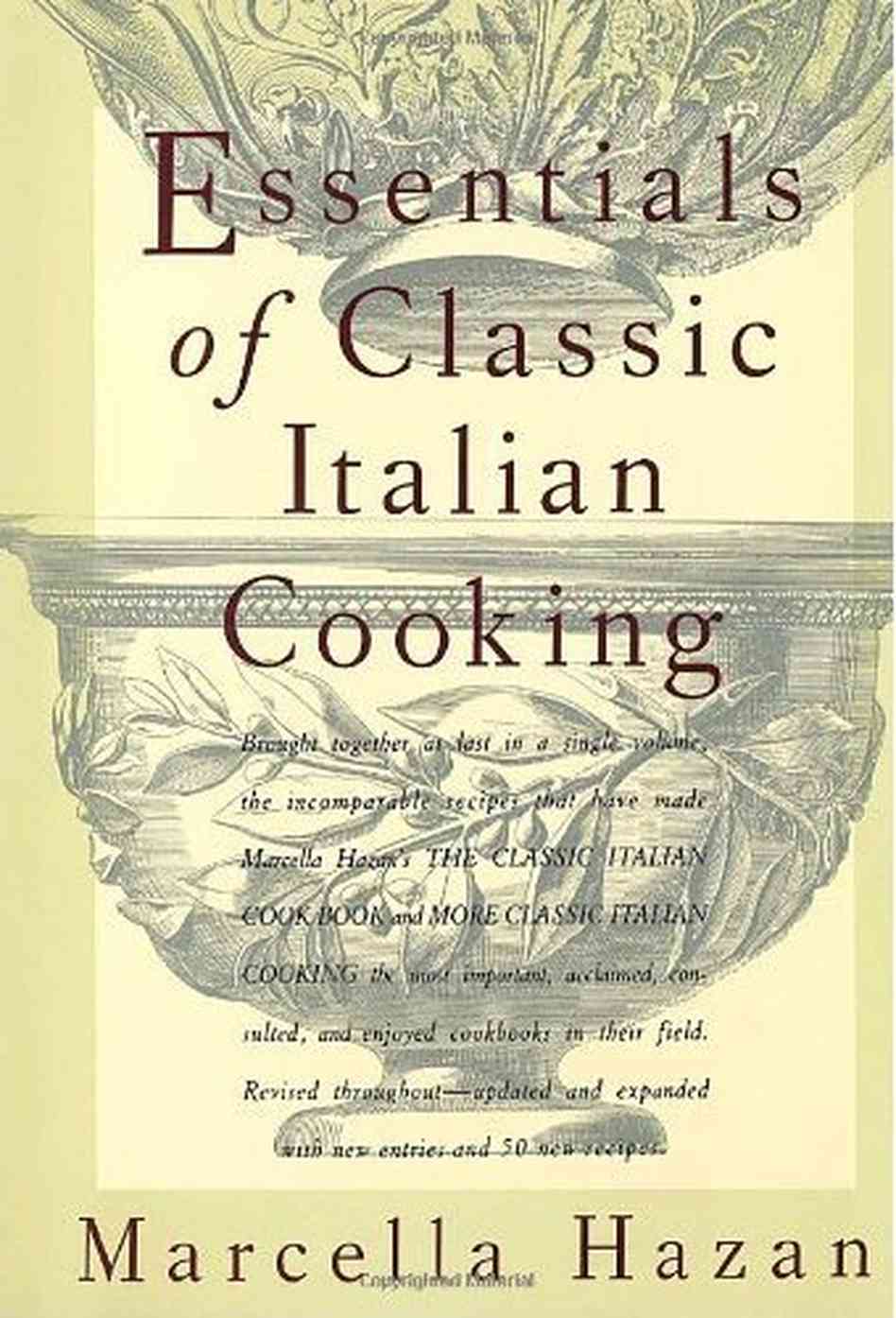
ecic_custom-s6-c30

Cooks have long been involved in making national identities. Encarnación Pinado’s El cocinero español (The Spanish Chef), published in 1898, was an attempt to establish an ‘authentic’ Mexican cuisine. Similarly, shortly after Italian union, Pellegrino Artusi manufactured a ‘real’ Italian food culture in his 1891 book La scienza in cucian e l’arte di mangier bene (The Science of Cooking and the Art of Eating Well).

These recipe books were intended partly to explain to Mexicans and Italians what constituted their national cuisines. Food is a potent means of uniting a nation, particularly if that nation happens to have been recently made. As obvious as it sounds, it’s worth paying attention, too, to those food writers who translate their cuisines mainly for foreign audiences.

In a way, food writers become culture brokers: the people who mediate between different cultures, who explain and translate one group to another.  Although Hazan found an enthusiastic audience of Italians at home, she is remembered for having introduced America to ‘real’ Italian cooking.

I think, though, that she mediated far more than food. As Elizabeth David and Julia Child did for France, Claudia Roden did for the Middle East and Mediterranean, Madhur Jaffrey did for India, and Ken Hom did for China, she introduced Americans to a version – to her version – of Italy. When they read her books or watched her on television, they also learned something about Italy.

So when we think of the complicated ways in which national identities are created – and these are made in a tension between internal and external perceptions of a particular country or political entity – we need also to include those food and recipe book writers who translate and mediate the cooking of one group of people to another. How do they represent one nation to another? Why do they emphasise some aspects of a nation’s cooking, and not others? And to what extent do they tailor their writing to fit or complement pre-existing stereotypes about other countries?

Creative Commons License
Tangerine and Cinnamon by Sarah Duff is licensed under a Creative Commons Attribution-ShareAlike 3.0 Unported License.

On Books

I am interested in the histories and (possible) futures of books and reading. In lieu of a post this week – I’m knee-deep in manuscript at the moment – here are two recent posts on print cultures in South Africa:

On the Matter of Books

The Futures of Books

Detail from William Kentridge, 'Universal Archive (Nine Typewriters'

Detail from William Kentridge, ‘Universal Archive (Nine Typewriters)’

Whose Heritage, Again

Today is Heritage Day and I tried to visit a museum. The museum was closed, so I took photographs of its façade and the surrounding suburb instead. Or, rather, the museum was open, but not to members of the public. Its opening ceremony was limited to members of the community and officials from the Department of Arts and Culture.

At the Fietas Museum.

At the Fietas Museum.

I’ll return at some stage in the future, but I think that this museum in Fietas – a working-class suburb near the Johannesburg CBD – says a great deal about the complicated ways in which South Africans are reflecting on their past.

The Fietas Museum

The front of the Fietas Museum.

I have very mixed feelings about Heritage Day. A lot of the debate about this public holiday on social media and local radio stations circles around – although never really articulates – its most problematic and unresolved feature: ‘heritage’ is a construct. Put simply, heritage is constituted of whatever parts of our past we choose to remember.

Partly because it is so difficult to define what exactly a South African heritage is, there have been various attempts to recast this holiday in ways which make it easier and less controversial to celebrate. The campaign to reinvent Heritage Day as a depoliticised National Braai Day emphasises most South Africans’ shared enthusiasm for barbecue.

In Fietas/Pageview/Vrededorp.

In Fietas/Pageview/Vrededorp.

On the other end of the scale, the recent launch of Freedom Fridays by LeadSA – a fairly socially conservative campaign led by media outlets to encourage South Africans to be better citizens (whatever they may mean by that) – and the Department of Arts and Culture exhorts South Africans to wear something every Friday that symbolises their love for the country.

Both Braai Day and Freedom Day are problematic. Whatever the good intentions of its founders, Braai Day transforms Heritage Day into yet another opportunity for supermarkets to make quite a lot of money (in much the same way that Women’s Day has become another version of Mothers’ Day). And Freedom Friday promotes an unthinking patriotism which ignores South Africa’s far-from-uncomplicated political and social trajectory post-1994. The fact that it was launched six months before a general election can’t be harmful either.

Indeed, both elide South Africa’s deeply conflicted past: for all their enthusiasm for ‘heritage’, there’s very little history in how these two initiatives explore and redefine what it is to be South African.

One of the remaining shops in Fietas.

One of the remaining shops in Fietas.

What discomforts me about Heritage Day is that it attempts to use South Africa’s past in much the same way as did the National Party during apartheid. In fact, Heritage Day is a renamed Shaka Day (instituted to pay homage to Shaka kaSenzangakhona, the most significant leader of the Zulu kingdom) which was co-opted by the apartheid state in an effort to invent a separate, distinct heritage for each of the race groups into which South Africans were divided.

Buying food in Fietas.

Buying food in Fietas.

Over the weekend I visited another apartheid-era attempt to construct a discrete ethnic identity, and partly in the service of segregated city planning: the Oriental Plaza. Based in Fordsburg – a predominantly Indian suburb – the Plaza was created by the state in the mid-1970s as a kind of shopping mall for Indian traders. As the Plaza’s domes, décor, and palm trees suggest, it was designed with a kind of stereotyped Arab bazaar in mind – its architecture owes more to The Thief of Baghdad than to any knowledge of Middle Eastern or south Asian architecture.

Many of the shop owners were there because they had been forced out of various Johannesburg suburbs. One of these was Fietas – consisting of Pageview and Vrededorp – an inner-city area of Johannesburg which had been settled by Indians since at least the beginning of the twentieth century. Fourteenth Avenue – where the Fietas Museum is now situated – was the area’s main shopping street, and was dominated by Indian-owned shops. In 1968, Vrededorp was rezoned as ‘white’ under the Group Areas Act, and in 1975, Indian shop owners were given notice that they had to leave – and many of them to the Oriental Plaza.

DSCN8836

The Plaza was an attempt to contain Indian traders within a part of the city designated as ‘Indian’, and in a space which evoked a particular interpretation of their ‘Indian-ness’. My point here is not to criticise the shopkeepers and shoppers who chose – and still choose – to work and shop there. But, rather, to make the point that Johannesburg’s landscape is constituted of various attempts to define people’s heritage for them.

In the Oriental Plaza.

In the Oriental Plaza.

It’s for this reason that I find the Fietas museum so interesting: I hope that it will retrieve the profoundly traumatic history of the destruction of the suburb: of the people forced to move, of the lives and livelihoods destroyed, and of the homes and businesses bulldozed in an effort to make Fietas ‘white’.

In fact, I hope it will begin to answer a question that Teju Cole posed last week at a talk at the Troyeville Hotel. Referring to the ways in which we write about cities, he asked:

Cities are built on people’s bones. How, then, do we tell stories about cities so that those who have died, do not die a double death through forgetting? Below us, on street corners, are people’s dreams.

The problem with any attempt to define a specific South African heritage is that it tends to be a triumphalist retelling of the country’s past. It has, then, the potential to ignore ordinary struggles and ordinary lived realities: the lives of people who just got by under extraordinarily difficult conditions.

We need to tell those stories too.

Creative Commons License
Tangerine and Cinnamon by Sarah Duff is licensed under a Creative Commons Attribution-ShareAlike 3.0 Unported License.

Body Knowledge

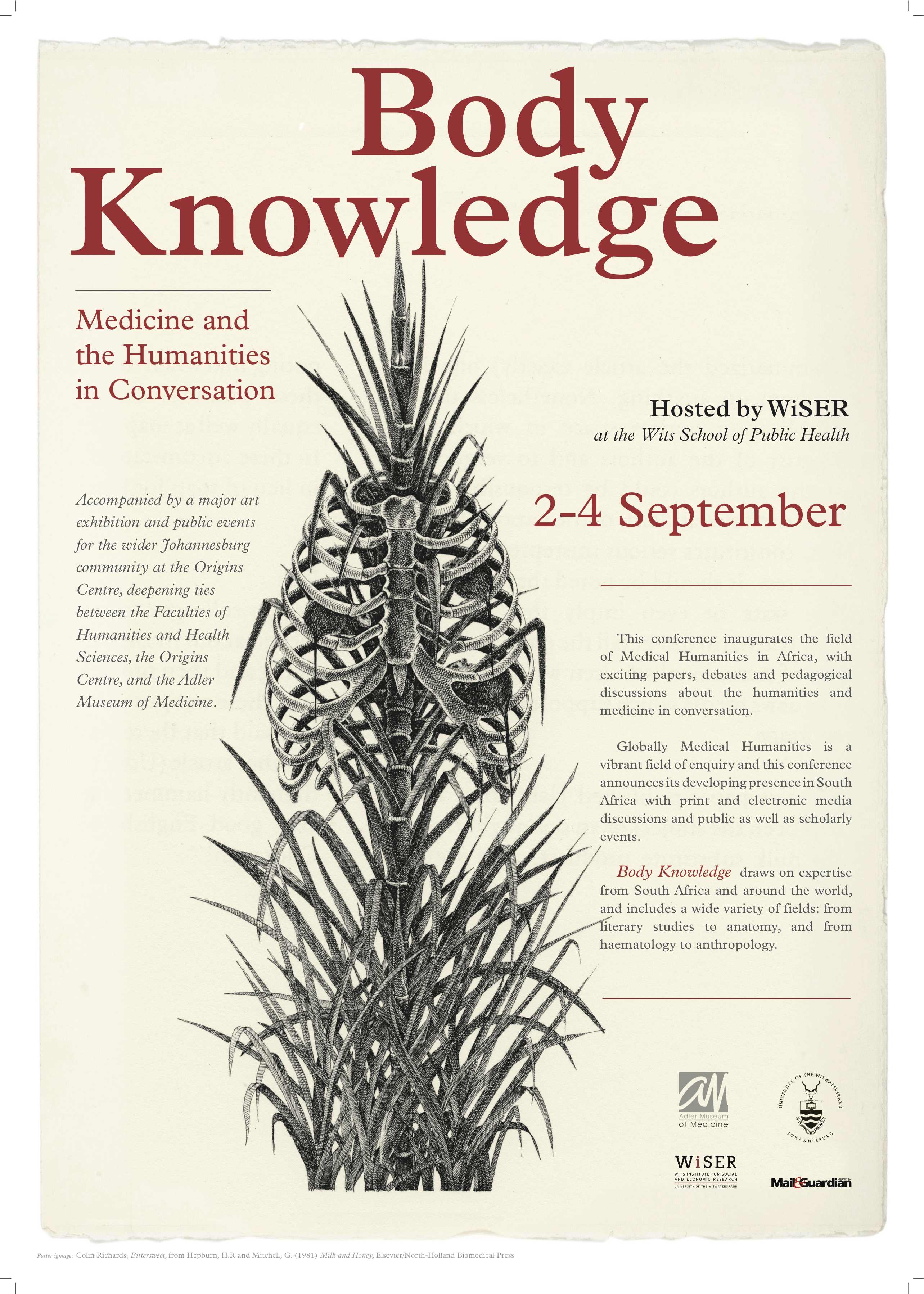
Over the past month I’ve helped to organise the first major conference on the medical humanities in southern Africa. Titled Body Knowledge, and hosted by the Wits Institute of Social and Economic Research earlier this week, the conference brought together a disparate group of academics from all over the world, and specialising in a variety of disciplines: from anthropology to nursing, and from epidemiology to cultural studies.

I think we pulled it off too. It was certainly a fun conference: the food was excellent, I learned a great deal – about my own area of specialisation and others – and was surprised by how frequently papers presented from wildly different disciplines spoke to each other in interesting and quite thought-provoking ways. We’re keen for this new field of the medical humanities not only to encourage collaboration and contact between the arts, humanities, social sciences, and natural and medical sciences, but also to be communicated to those outside of the academy. The Mail and Guardian has published a collection of articles drawn from the conference:

Catherine Burns and Ashlee Masterson discuss art, science, the medical humanities and the Body Knowledge conference.

Susan Levine and Steve Reid argue for the significance of the arts in the practice of medicine.

Jane Taylor looks at the long history of collaboration between the arts and medical sciences.

Patrick Randolph-Quinney describes how art has enriched anatomy.

Raimi Gbadamosi examines the social and cultural construction of albinism.

Because I was part of the group keeping the conference running, I didn’t attend many sessions, but I did get to the two on medicine and nutrition (partly because I chaired one of them). The first included two papers: Kristen Ehrenberger (who’s enrolled for both a medical degree and a PhD in History at the University of Illinois) discussed how Germans’ ideas around ‘healthy’ food shifted during the Allied blockade of the First World War; and Thomas Cousins, an anthropologist at Stellenbosch University, argued for the necessity of a cultural and social study of the gut.

In the second session, Louise Vincent and Chantelle Malan from Rhodes University questioned the ways in which the obesity ‘crisis’ has been framed by both medical professionals and organisations with a vested interest in controlling people’s weight. Similarly, Michelle Pentecost – a medical doctor who’s completing an MA in anthropology at Oxford – pointed out that obesity is caused less by individual sloth and lack of self-control, than is the outcome of a complex set of social, political, and economic processes which shape people’s health over long periods of time.

Catherine Burns, my colleague at WiSER, spoke about the need to write histories of breastfeeding in South Africa (she’s written about histories of sex in South Africa too), and Vashna Jagarnath, also of Rhodes, presented a fascinating paper on Gandhi’s shifting attitudes towards diet after his move to London in 1881. She made the point that his embrace of vegetarianism was the product of an association with the Vegetarian Society and with the social and political radicals, many of them early supporters of Indian nationalism, who were part of the Society (people like Annie Besant, for instance). He went on to publish extensively on how best to eat, and, as Vashna noted, his views on diet were increasingly tangled with his politics.

Body Knowledge Poster HR copy

Although on a wide range of subjects, these papers made a few key points: people’s decisions what and how to eat are shaped by a variety of factors, only some of which they are aware; food and nutrition are always political (they are implicated in the ways in which power functions); and our ideas about what is ‘good’ to eat have changed – and are changing – over time and place. In other words, there was no particular moment, or there is no specific place, where people ate, or are eating, a ‘perfect’ diet (whatever we may mean by that).

Although histories of food and nutrition have attracted scant attention from southern African scholars, the field is growing, both in size and prominence, internationally. I think the best indicator of its growing academic respectability is the fact that the theme of this year’s Anglo-American Conference at the Institute of Historical Research in London, was Food in History.

Histories of food have the potential to descend into a kind of pedantic, irritating antiquarianism, but they are also crucial to understanding histories of consumerism, agriculture, the body, and medicine. Indeed, anyone interested in medical histories of childhood has to focus on the significance of nutrition in efforts to improve children’s health during the early twentieth century.

We are – and have been for a very long time – what, how, and why we eat.

Creative Commons License
Tangerine and Cinnamon by Sarah Duff is licensed under a Creative Commons Attribution-ShareAlike 3.0 Unported License.
Observations

I’ve been in Johannesburg for nearly a month now. And although I’ve hardly even begun to explore one of the biggest cities in the world, it’s beginning to feel like home. Despite being a comparatively young city – it’s the product of the discovery and mining of the significant deposits of gold beneath the Witwatersrand during the late 1880s – partly because it’s had such a transient population since its founding, and has changed so profoundly over the past century (and continues to change), the city feels composed of layers of work, and experience, and change. In other words, for a newish city, it has a lot of history.

The city itself is often a strange – and rather ugly – mishmash of old and new buildings, businesses, houses, and developments. But I like how older ways of living often exist side-by-side with the new. What I mean is that for all of Joburg’s malls – and there are a lot of malls and they are very, very big – for instance, there are still surprising numbers of small, independent shops which seem, to me, to be very well patronised.

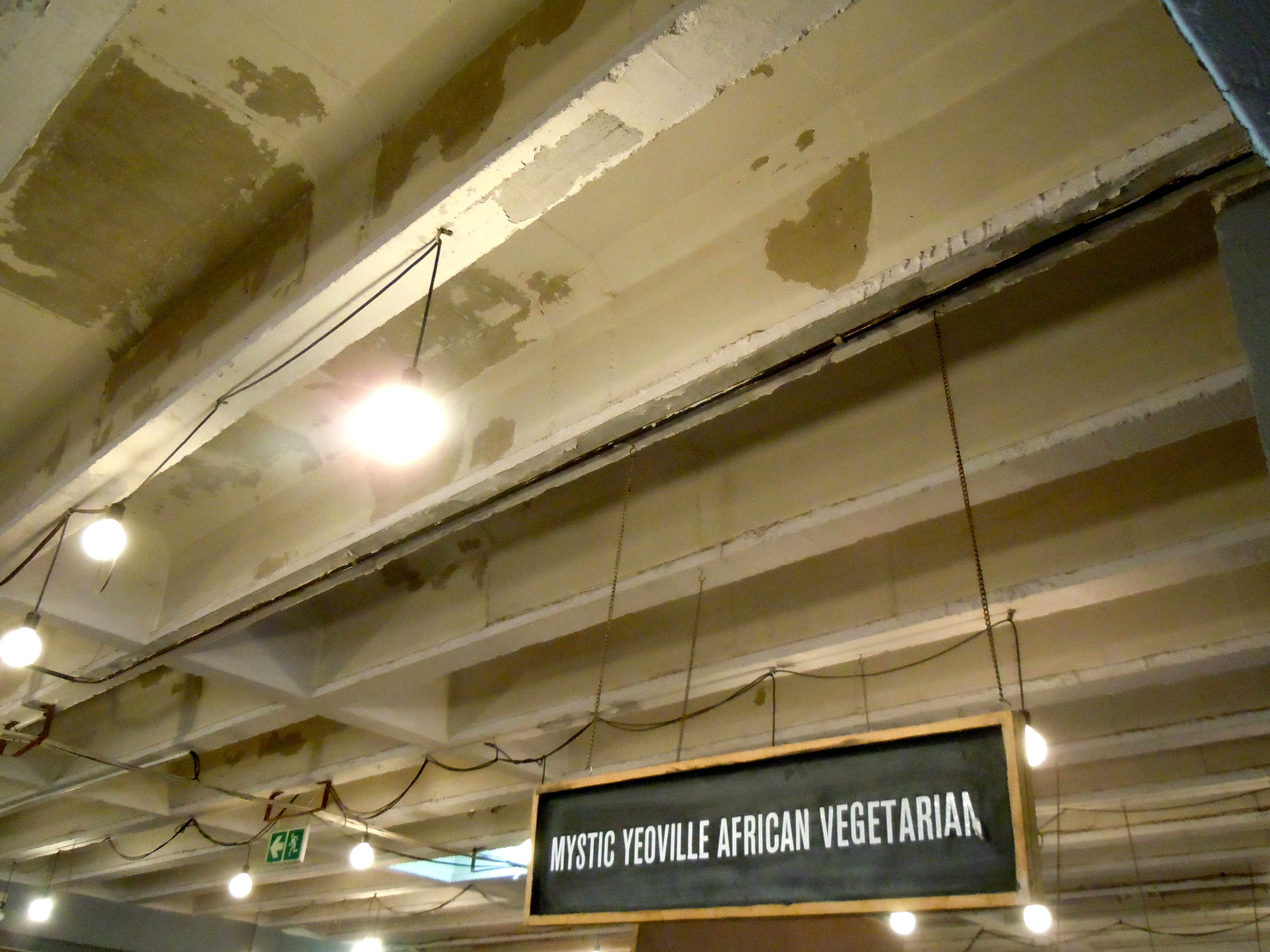
In Braamfontein.

In Braamfontein.

So here are a few food-related observations, made by a new, often ignorant, and probably over-optimistic resident:

1. There are so many lovely cafes and places to eat. I can’t comment about the fine dining scene – I don’t have enough money to eat in those kinds of restaurants – but it’s easy to eat well here, I think.

At the Neighbourgoods Market in Braamfontein.

At the Neighbourgoods Market in Braamfontein.

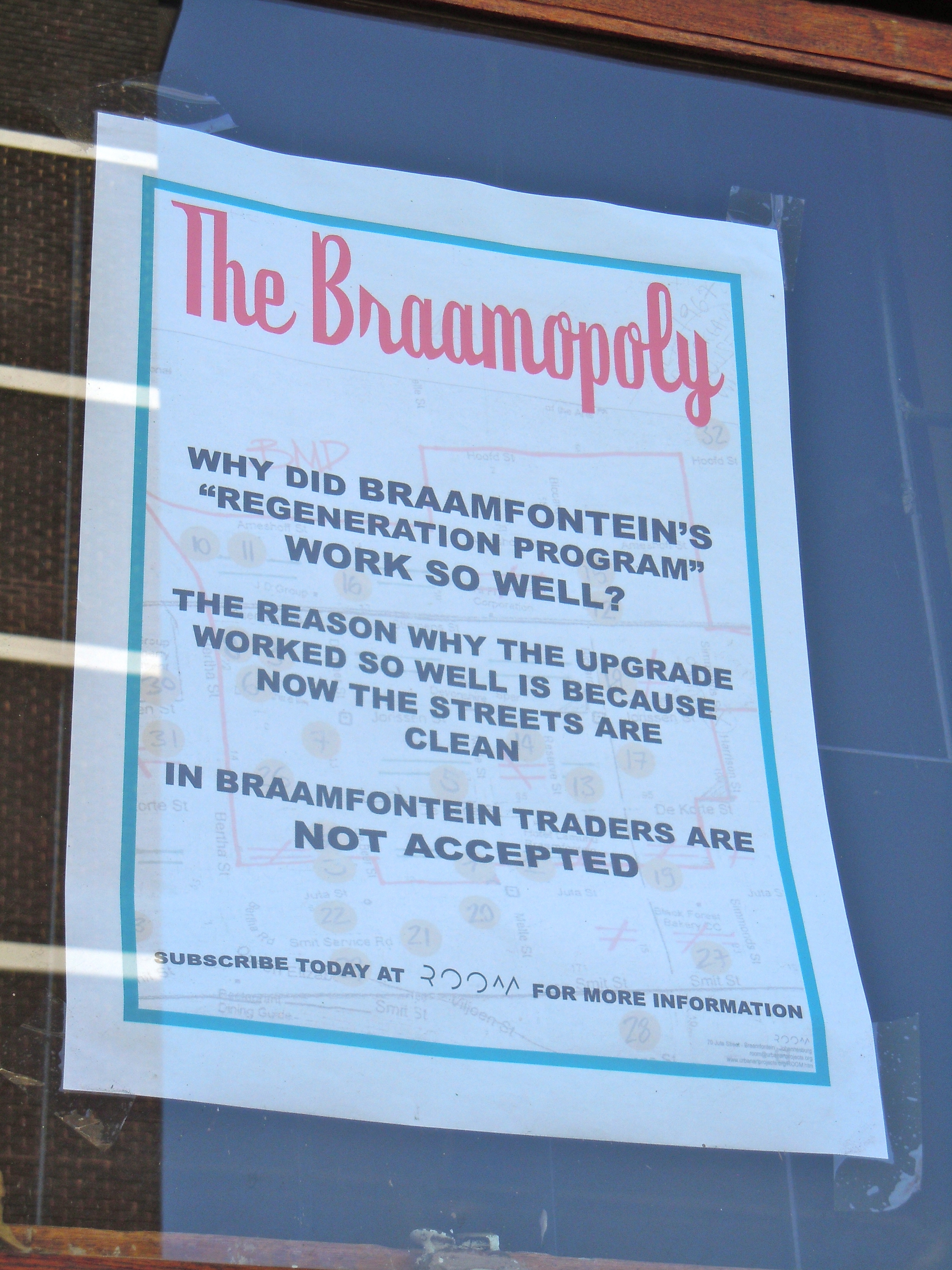
2. Also, as is the case all over the world, these cafes and restaurants are agents of change and gentrification. I spend a lot of time in Braamfontein – I work near there – and have been struck how much this inner-city suburb has changed since I visited at the end of 2011, when it still felt distinctly dodgy during the day. There is now a hipster café with either flat whites or burgers (obviously) on practically every corner.

Debating the gentrification of Braamfontein.

Debating the gentrification of Braamfontein.

3. I’ve yet to visit Arts on Main in the city centre. Just about every person I’ve asked about it has a different opinion of the development. Broadly, half say it’s a deeply problematic gentrification of a desperately poor area which serves only further to marginalise the residents of inner-city Joburg. The other half argue that it’s bringing the middle classes back to old Joburg, after the long flight northwards to Sandton.

4. The Spur in Braamfontein, a quick stroll from Cosatu House, must be the most politically influential steakhouse in South Africa.

Debating the gentrification of Tyrone Avenue in Parkview, on a public noticeboard.

Debating the gentrification of Tyrone Avenue in Parkview, on a public noticeboard.

5. There are so many markets. So far, I’ve been to the Neighbourgoods Market in Braamfontein (and I’m still trying to understand how that stands in relation to Braamfontein’s gentrification) and the organic market in Bryanston. But there’s also the boeremark in Pretoria, the market at the Pirates Sports Club, and the farmers’ market in Fourways. And others.

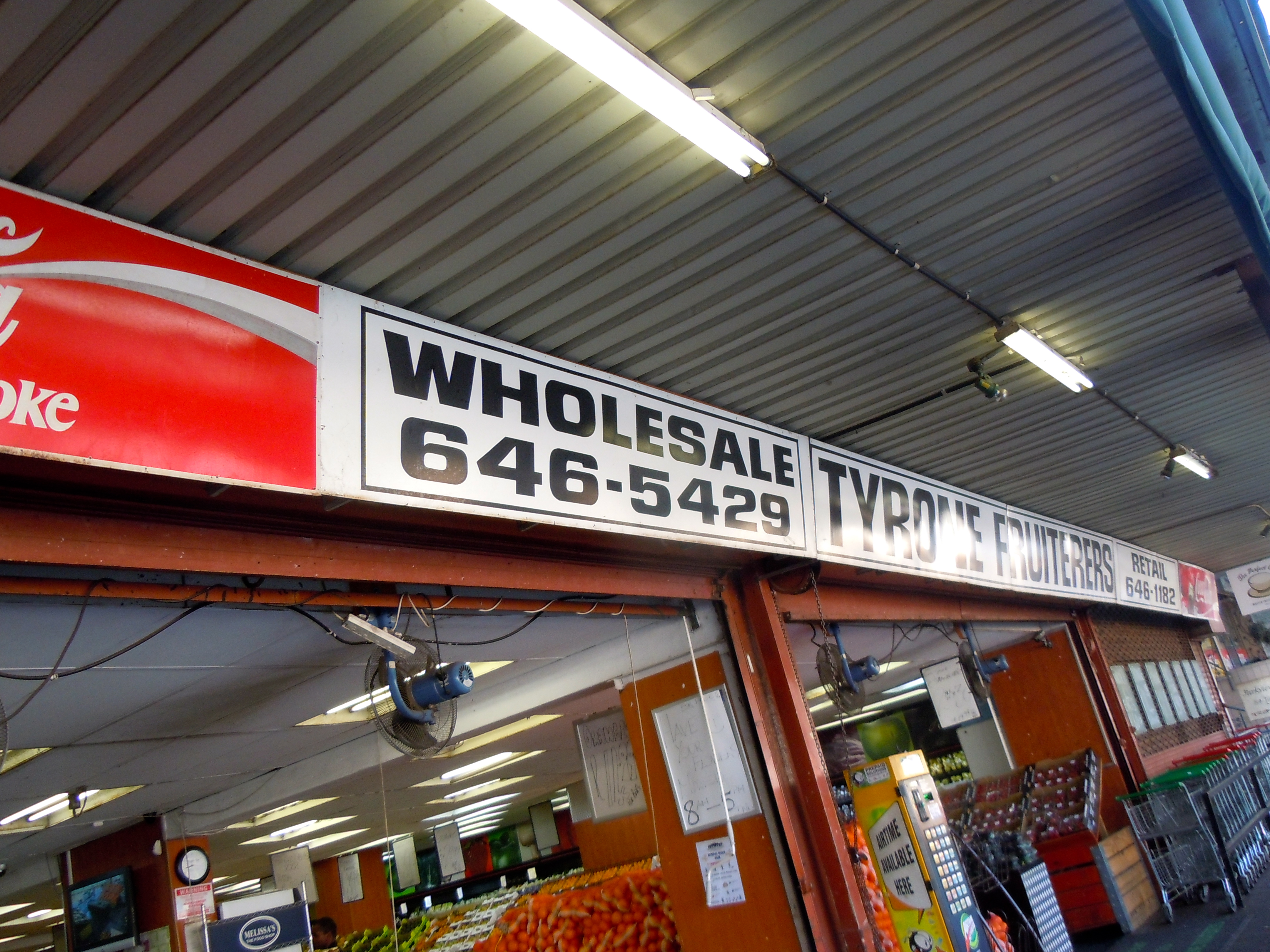
6. In this city of malls – and I have yet to visit that ur-mall, Sandton City – it’s more possible for me to shop locally and from independent businesses than it was in Cape Town. There’s a butcher in Parkhurst, and my amazing fruiterer in Tyrone Avenue – one of dozens across the city – sell fresh produce, meat, cheese, milk, flowers, polenta, pasta, tinned tomato, and fish sauce. And the FT Weekend. And soap. I love it with an intensity which borders on the unreasonable.

The fruiterer on Tyrone Avenue.

The fruiterer on Tyrone Avenue.

I have yet to sample the delights of Fordsburg, Rosettenville, and the new and old Chinatowns. There are still the vast, sprawling worlds of Soweto, and the East and West Rand to explore. But as the city changes, I know I’ll enjoy visiting and revisiting areas that feel at once familiar and new.

Creative Commons License
Tangerine and Cinnamon by Sarah Duff is licensed under a Creative Commons Attribution-ShareAlike 3.0 Unported License.

Political

Last week I wrote a post outlining the threat to the Philippi Horticultural Area (PHA) in Cape Town, asking why the city’s food bloggers and foodies – its chefs, restaurateurs, and writers – seemed to have such little interest in the proposed development of a piece of land which grows half of Cape Town’s fresh produce.

The response has been fantastic: Food24 picked up the post, and some magnificent people got in touch with ideas. (I’ll tell you more about them in due course.) More importantly, and not related to my post, the campaign to save the PHA has stepped up. Other than signing the Avaaz petition, do please watch and share this excellent short documentary about the PHA:

Anyone keen to help out with the Save the PHA Campaign should email Nazeer Sonday, nasonday@gmail.com, or Rob Small, rob@farmgardentrust.org.

With a few exceptions, though, the majority of people who have expressed dismay at the development of the PHA and who have offered to do something about it, have not been involved in Cape Town’s food world. In fact, again with a few exceptions, it seems to me that the city’s foodies remain unmoved about the issue – which is quite an achievement given the amount of coverage the development of the PHA has received.

As I wrote last time, considering that these are people with an unusually intense interest in food and where it comes from, I would have thought that they’d be lining up to condemn the development of land which produces their vegetables. Moreover, some of them have such enormous readerships and access to the media, that their ability to communicate with large numbers of people would allow them to be exceptionally helpful to the campaign.

If a blogger with a fairly small readership (and I love each and every one of you) sitting in Joburg can help to get two projects off the ground in Cape Town, imagine what someone with a massive audience and the odd TV appearance could achieve?

In this post, though, I’m interested in why the city’s bloggers – and there are lots of them, and they wield some power – have displayed such little concern for the PHA. One of the excuses that readers of my post offered for not wanting to become involved in the campaign is that it’s toopolitical.’ This is an interesting comment, and worth unpacking.

I think that by ‘political’ respondents meant that they did not want to be associated with a campaign that confronts Patricia de Lille, the Mayor of Cape Town, and the members of the Mayoral Committee who took the decision to develop the PHA.* It’s more likely that bloggers would mobilise to raise funds and awareness around poor children or abused animals. My point is not that we shouldn’t support the SPCA or Nazareth House – far from it, and please do because they do vital work – but, rather, that these causes are more easily depoliticised.

The irony is that all food writing is political: it’s all implicated in the ways in which power works in society. There are few more potent indicators of inequality than access to food. Some of the most evocative reporting on the effects of Europe’s austerity regimes has focussed on the rise of food insecurity: from the organisations which have emerged to feed people in Greece, to the increasing numbers of food banks in the UK.

As a recent edition of BBC Radio 4’s excellent Food Programme reported, austerity eating has been reflected in a shift in food blogging too. Jack Monroe has documented, eloquently, her struggle to feed herself and her young son on almost no money at all:

Poverty is the sinking feeling when your small boy finishes his one weetabix and says ‘more mummy, bread and jam please mummy’ as you’re wondering whether to take the TV or the guitar to the pawn shop first, and how to tell him that there is no bread or jam.

Part of the appeal of Monroe’s blog is that she is able to connect her delicious, nutritious, and incredibly cheap recipes with, as she says to Sheila Dillon, ‘a political spike’: an awareness of the connection between what she eats and the social, political, and economic context in which she and her audience operate.

What Monroe, as well as the brilliant Skint Foodie and North/South Food, is doing is not anything new: there have been other attempts to describe budget cooking (I think of Catherine Whitehorn’s altogether frothier Cooking in a Bedsitter (1961)), and the best food writing and reporting connects what people eat with the circumstances in which they buy, cook, and consume food.  What these bloggers are achieving – articulately, effectively – is to demonstrate how the UK government’s attempts to dismantle the welfare state are causing an increasingly large number of people to go hungry in the eighth richest nation in the world.

Vegetables ready for packing at Harvest of Hope in Philippi.

Vegetables ready for packing at Harvest of Hope in Philippi.

I would not be surprised to see other, similar blogs being established over the coming few years. And I’m interested in answering why South African food blogging has not demonstrated a similar awareness of the country’s vast inequalities. A cursory reading of most South African food blogs would not reveal that they are written in a country where one fifth of children have stunted growth and one in ten children suffer from severe malnutrition.

I don’t want to suggest that every blog must be a worthy condemnation of the gap between South Africa’s very poor and very, very rich – continue to eat your cupcakes with impunity, please – but I’ve often been struck by just how incredibly unaware so many bloggers are of their privilege: that their ability to buy their food from upmarket supermarkets and cute urban markets is a very rare thing indeed in South Africa.

In some ways, this lack of awareness among Capetonian bloggers is particularly obvious because of the city’s affluence and its ‘whiteness’: because, unlike other South African cities, its middle-class suburbs, expensive food shops, farmers’ markets, and top-end restaurants remain overwhelmingly white.

I’m not really sure how to end this post. I think that some bloggers’ unwillingness to engage with the politics of cooking, eating, and growing food are probably the product of a range of anxieties around race, class, and an uncertainty about where to fit into post-1994 South Africa. But this is pretty obvious.

All comments welcome.

*I’d point out that one of the chief joys of democracy is that you can criticise the DA and still vote for it.

Creative Commons License
Tangerine and Cinnamon by Sarah Duff is licensed under a Creative Commons Attribution-ShareAlike 3.0 Unported License.

Occupy Philippi

Cape Town is unusual in that half of the fresh produce consumed by its residents is grown within the boundaries of the city. Cauliflower, lettuce, beetroot, onions, tomatoes, herbs, and other vegetables have been grown in the sandy soil of the Philippi Horticultural Area (PHA) since the end of the nineteenth century.

Today, the area encompasses about 2,370 hectares, and is split between smallholdings and larger commercial farms, which produce around 100,000 tonnes of produce every year. Some of these have embraced sustainable, organic farming. While most of the produce goes to supermarkets, a portion of it is sold to the surrounding, desperately poor communities who live in Philippi – to people who would not otherwise have access to fresh fruit and vegetables. In other words, the PHA is absolutely essential to ensuring that these households remain food secure:

According to a survey of 1 060 low-income households [in Cape Town] conducted by the African Food Security Urban Network in 2008, 80% of respondents were food insecure. The study looked at various indicators of food insecurity, such as whether respondents went to sleep hungry, or whether there were times when there was no food in the house.

A 2012 study by Rooftops Canada-Abri International and the African Food Security Network that examined the horticultural area’s significance in sustaining food security within the Cape Town municipality found that without it the city would be ‘place[d] in extreme risk’ of food insecurity, with low-income households suffering the most. A 2009 report commissioned by the city had similar findings.

As Rob Small of the respected urban farming project Abalimi Bezekhaya notes, Cape Town is ‘a farm with a city in it.’

A vegetable box packed at Harvest of Hope's shed in Philippi.

A vegetable box packed at Harvest of Hope’s shed in Philippi.

As I wrote a while ago, this farm is under threat. Last month, Cape Town’s Mayoral Committee (Mayco) approved an application from the private property developer MSP Planners to have 280 hectares of the PHA rezoned for housing. This isn’t the first time that parts of the PHA have been identified for rezoning: in 2011, an application from Rapicorp to develop 472 hectares of the PHA was also approved, but nothing came of this because the company soon went into administration.

There are compelling reasons to oppose this development. Two studies have demonstrated not only that local people depend on the produce grown in the PHA, but that farmers are keen to extend the area under cultivation. Investing in the PHA – helping to increase the number and size of farms instead of reducing or threatening them – would create jobs and attract business to the area. As a group of academics at the University of Cape Town’s School of Architecture, Planning, and Geomatics argue:

The decision to allow development represents the not-so-thin edge of the wedge. There are three aspects to this. First, remaining farmers are unlikely to invest in the land if there is a sense that they may have to move. Second, it will become increasingly difficult, on the ground of administrative fairness, to reject future speculative applications if this one is approved. Third, there is considerable evidence to suggest that the provision of extensive urban infrastructure in the area will attract further development, both formal and informal. Infrastructure has a strong ‘lock-in’ dimension. In short, it’s a poor, short-sighted and dangerous decision.

What are Captonians doing about this? There is an Avaaz petition – and it’s worth signing it. But other than lobbying from NGOs and some PHA farmers, the lack of interest from Cape Town’s bloggers and foodies is palpable.

I wonder why? I mean, after all, these are the people who profess to love local produce, and who argue that their interest in food and cooking has the potential to do good in the world. These are people with clout: who appear on television programmes, who write for newspapers and magazines with large circulations. These are the people who have the power to shame Patricia de Lille and other members of the Mayco into rethinking their decision. They have, I would argue, a moral duty to use their position to save the region that produces the vegetables they cook with, and which they eat at restaurants.

And what are they doing? Is their lack of interest in the PHA to do with the fact that it’s in a poor part of Cape Town? That there aren’t any high-end chefs with restaurants in Philippi? That they can’t find the same sort of meaning in the PHA as they do in baking brownies? If they’re really serious about supporting small agriculture in Cape Town, then, surely, they’ll pay as much attention to the PHA as they would to the garden at Babylonstoren.

So. Foodies and food bloggers of Cape Town. What are you going to do to save the PHA?

For more information on the Save the PHA Campaign, see here.

Creative Commons License
Tangerine and Cinnamon by Sarah Duff is licensed under a Creative Commons Attribution-ShareAlike 3.0 Unported License.

Eating Nando’s in Gaborone

I spent most of last week at the biennial gathering of historians organised by the Southern African Historical Society. The conference at the University of Botswana was fantastic. Gaborone was, well, less so.* I think that the city is best summed up by an exchange between a conference delegate and her husband, who had spent the morning exploring downtown Gaborone. When asked what he had discovered, he answered: ‘There’s a Nando’s.’

This comment is interesting for many reasons. One of the most striking features of Gaborone – other than the many posters for visiting gospel choirs and the absence of any form of newspaper advertising – is its malls. Having had lunch and dinner at two of them, it seems to me that most of the major shops and restaurants in the city are branches of South African chains: from Spur, that staple of middle South Africa, to the relatively upmarket Primi Piatti. Given the hostility which locals appear to reserve for South Africans – and relations between the two countries became particularly tense during the late 1980s, when ANC and Umkhonto we Sizwe exiles in Gaborone became the target of the apartheid state’s raids – this felt deeply ironic at the time.

Nando’s is an odd addition to the pantheon of South African culinary exports. In his speech delivered at the University of Cape Town during his recent visit to the country, Barack Obama referred to Nando’s – alongside the vuvuzela and Freshlyground – as prime examples of South African institutions. But like so many cultural icons which seem to embody national identity, Nando’s was founded by immigrants.

When I mentioned to friends in the UK that Nando’s is South African, I was often greeted with expressions of confusion. Surely, they argued, it’s Portuguese? Well, yes and no. Before its devastating civil war, Mozambique was a popular destination particularly for young, white South Africans. They visited its pristine beaches, its fun capital Maputo (Lourenço Marques before 1975), and ate its excellent and distinctive cuisine. Indeed prawns from Mozambique are still a regional delicacy. Radio Lourenço Marques – which could be picked up in South Africa – played the music banned by South African broadcasters. Mozambique represented, for young whites at least, relative freedom from the restrictions of a repressive and oppressive South African state.

For part of its civil war (1977-1992), South Africans escaping the country travelled to Mozambique to join up with the exiled ANC. Moving in the opposite direction, legions of whites migrated southwards to South Africa after Mozambique’s independence from Portugal in 1975. Two of these exiles founded Nando’s in Rosettenville, a Johannesburg suburb with large ex-patriot Portuguese populations from Mozambique and Madeira. Although by no means the first or only chicken fast-food restaurant in South Africa – local Chicken Licken (opened in 1981) and foreign KFC (introduced in 1971) do a roaring trade – Nando’s distinctiveness lies partly in its adaptation of the hybrid Afro-Lusophone cuisine which developed in Mozambique.

The chain is probably best known for popularising peri-peri – a sharp, spicy sauce which is a feature of both Portuguese and Mozambican cooking. Its name derives from the Swahili word for the African bird’s eye chilli – the pili pili – which was taken back to Portugal by traders who had been present along the east African coast since the sixteenth century. Portuguese piri piri sauce entered Mozambique with the advent of white settlement, where it was re-adapted by Africans.

Nando's comments on the Protection of State Information Bill.

Nando’s comments on the Protection of State Information Bill.

Following the first wave of white South Africans to leave the country during the transition, Nando’s opened its first overseas branch in Australia in 1990. Franchises in the UK (1992), Botswana (1993), Canada (1994), Malaysia (1998), Pakistan (2001), and elsewhere followed. It now operates in the United States and around southern Africa. It doesn’t, as far as I can tell, have a branch in Mozambique.

Nando’s menu is very obviously the product of the long interaction between Africans and Portuguese interlopers over the course of around four centuries. It purveys a global cuisine, and one which has become increasingly globalised as it adapts itself to the tastes and expectations of new countries and new customers. The restaurants in the UK, for instance, are noticeably more upmarket than the Nando’s outlets in South Africa. It’s also the product of the geopolitics of late twentieth-century southern Africa. It was founded as a result of white Mozambicans’ migration to South Africa in the mid-1970s, and catered to local enthusiasm for Mozambican cooking both among migrant Mozambican mine workers as well as those whites who had holidayed in Mozambique. Its first attempt at opening an international store accompanied white South Africans’ migration to Australia.

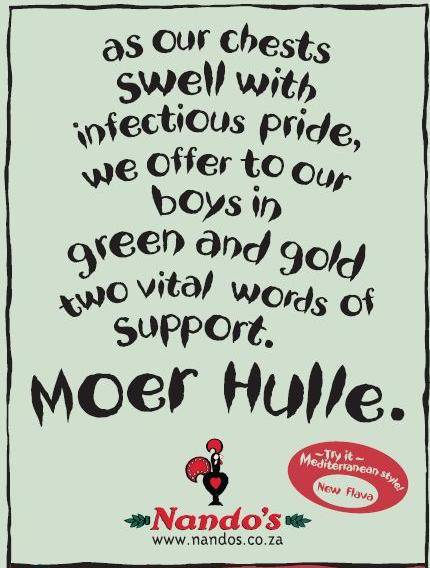
And yet, for all its hybrid identity, Nando’s identifies itself as a distinctively South African brand – and particularly through its advertising campaigns. Nando’s has a reputation for responding quickly and wittily to political controversies – like blacking out its ads during protests against the potentially oppressive Protection of State Information Bill in 2011. Although this is a strategy which backfires occasionally, it means that Nando’s can cash in – quite literally – by siding with (middle-class?) South Africans’ exasperation with the government and the country’s politicians.

Nando's expresses support for the Springboks, the national rugby team. 'Moer hulle' translates roughly as 'fuck them'. You wouldn't say this in front of your grandmother.

Nando’s expresses support for the Springboks, the national rugby team. ‘Moer hulle’ translates roughly as ‘fuck them’. You wouldn’t say this in front of your grandmother.

It was this which made Nando’s presence in Gaborone feel incongruous. Despite its expensive PR campaigns, Botswana has a deserved reputation for being one of the most secretive states in southern Africa. It’s particularly intolerant of dissent, and has expelled those who have challenged the political status quo. As a recipient of the Media Institute of Southern Africa’s Golden Padlock award in 2011, the real country is worlds away from Alexander McCall Smith’s sanitised and gently patronising depiction of Botswana’s people and politics. I doubt that Nando’s advertising would be legal in Gaborone.

*Never, ever trust the taxi drivers of Gaborone to get you to the airport in time for your early flight to Joburg. And particularly not those who congregate at the Gaborone Southern Sun at 4am. Trust me on this one.

Creative Commons License
Tangerine and Cinnamon by Sarah Duff is licensed under a Creative Commons Attribution-ShareAlike 3.0 Unported License.

Check Your Privilege

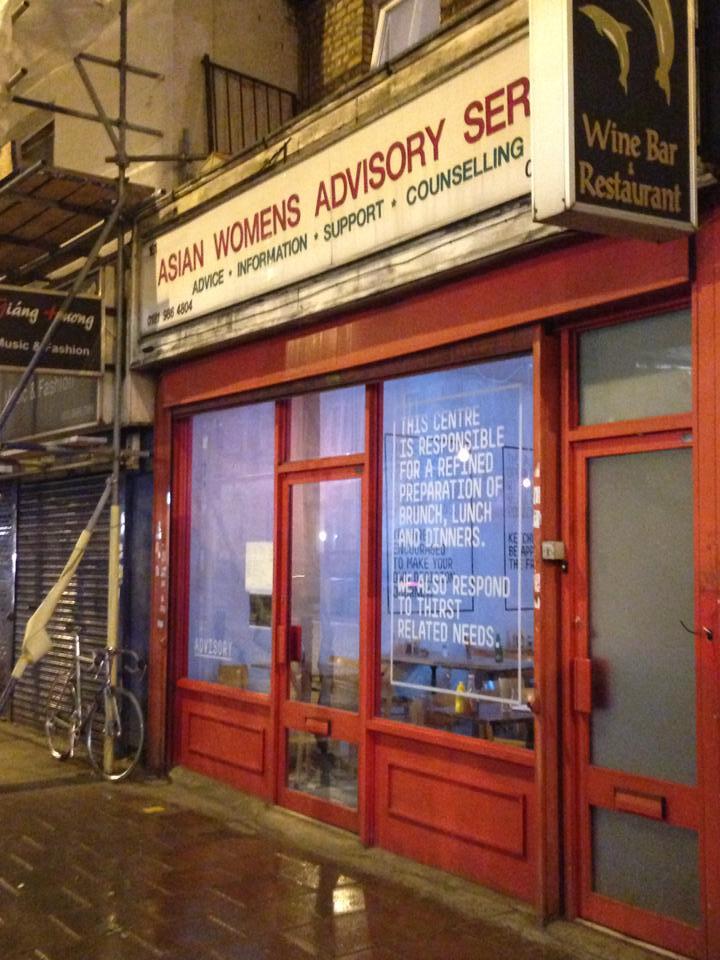
Yesterday, the circulation of a photograph of a new Hackney café, The Advisory, caused a minor flurry of controversy on social media. The restaurant has been established on the site of the – now closed – Asian Women’s Advisory Service. As many pointed out, its decision to retain the Service’s sign and to appropriate the language of the centre in the name of foodie-ism, is in exceptionally poor taste. A sign on its window advertises: ‘This centre is responsible for a refined preparation of brunch, lunch and dinners.’ It adds: ‘We also respond to thirst related needs.’

In response to this criticism, The Advisory has removed the sign and, in a statement, explained that the building had been derelict for several years. A review of the café on Cherie City – which praised its ‘rough-luxe feel’ – has also been taken down.

BNcDwnmCEAEfK07.jpg_large

Regardless of whether the building was empty or not, The Advisory’s decision to model itself as an advice centre in one of the UK’s poorest boroughs, and in the midst of debates over the effects of the ‘hipsterfication’ of east London, is deeply insensitive.

This certainly isn’t the only example of tone-deaf foodiesm that I’ve encountered. A couple of years ago, I attended an event in Cape Town where a well-meaning author attempted to recreate the life of Nelson Mandela for the audience by providing us with meals he ate at key moments, supplied by … Woolworths. (It’s rather like Marks & Spencer handing out packets of rice to help punters to understand Gandhi’s struggles better.)

These are, admittedly, particularly bad examples of foodie thoughtlessness. But I think that they point to a wider problem within the ‘food world’ (so to speak – I mean restaurateurs, food writers, and journalists). Since its emergence in the US and the UK, during the late 1960s, the food movement – which questions industrial agriculture, supports small farmers and co-operatives, opposes GM and buys organic – has remained largely middle class. There’s nothing inherently wrong with this, but it does mean that the movement has a tendency to ignore its own, vast privilege.

I’ve been thinking about this a lot recently, after having come across a new book on how Londoners can eat locally and sustainably. It’s called The Modern Peasant. I understand why Jojo Tulloh wanted to call her book that – she wanted to evoke the small, self-sufficient, self-contained world of the peasants of pre-industrial Britain – but I think it’s an immensely problematic choice, not least because it seems to imply that peasants no longer exist. They do. In their millions. The vast majority of farmers in Africa and south Asia are small farmers. These peasants produce 70% of the world’s food supply.

La Via Campesina celebrates the tenth anniversary of its founding this year. It is the largest peasant organisation in the world and is, arguably, one of the most significant forces within food politics at the moment. It originated the concept of food sovereignty, which puts power relations at the heart of creating a fair food system:

Unlike food security, often defined as ensuring people have enough to eat, food sovereignty zeroes in on questions of power and control.

‘Food sovereignty is the right of peoples to healthy and culturally appropriate food produced through ecologically sound and sustainable methods, and their right to define their own food and agriculture systems. It puts those who produce, distribute and consume food at the heart of food systems and policies rather than the demands of markets and corporations,’ reads the final declaration of the Forum for Food Sovereignty, held in 2007, held in 2007 in Sélingué, Mali. ‘Food sovereignty implies new social relations free of oppression and inequality between men and women, peoples, racial groups, social classes and generations.’

So calling a book about eating well in London ‘The Modern Peasant’, displays rather a lot of ignorance about how the world’s food systems operate.

My point is not to bash well-meaning, if occasionally tin eared, middle-class foodies who only want to encourage others to eat good, ethically-produced food. But, rather, to argue that they need to recognise that – by virtue of their whiteness and class – they operate from a position of power.

There has been a lot of debate among feminists over the past year or so about the usefulness of asking or telling straight, white, middle-class feminists to ‘check their privilege’ when addressing issues relevant to LGBT and working-class feminists, or women of colour. Although I have fairly mixed feelings about how ‘privilege checking’ has been used, it is a useful way of encouraging those in privilege to become aware of how powerful they are – and to recognise that any attempt to remedy broken food chains and to ensure that everyone has enough (of the right kind of) food to eat, is dependent on addressing power imbalances. And not only foraging for wild garlic in Hackney.

Creative Commons License
Tangerine and Cinnamon by Sarah Duff is licensed under a Creative Commons Attribution-ShareAlike 3.0 Unported License.