Skip to content

Truth and Vegetarianism

Despite not being at all religious, I seem to have spent quite a lot of time reading and writing about very religious people. I wrote my PhD – which I’m turning into a book at the moment – on Dutch Reformed evangelicals and their interest in childhood in the late-nineteenth-century Cape Colony. Want to know about the surprisingly complicated theological battles that raged, viciously, between warring factions of Dutch Reformed ministers in the 1850s and 1860s? Then I’m your woman.

One of the most interesting diaries I came across during my research was written by Caroline Molteno (1853-1937), the daughter of the Cape Colony’s first Prime Minister. (The Cape was granted responsible government in 1872, and John Molteno served as Prime Minister until 1878). Caroline was not a member of the DRC, but her journals written during her early- and mid-teens opened up the world of white, middle-class girls and young women in Cape Town in the 1860s and 1870s.

Caroline’s diary was useful because she was deeply conventional. She worked hard at school, left when it was socially appropriate to do so (shortly before her seventeenth birthday), travelled to Europe with her father, and attended the round of balls, parties, teas, and cricket matches which helped her to find an eligible husband. She married Charles Murray – the future president of the South African Medical Association – in 1876, and they had eight children. She devoted herself to her family and good works.

Caroline wanted desperately to fit in to white, middle-class Capetonian society. Her older sister Betty (1852-1927), though, did not. Betty was as prolific a diary- and letter-writer, but fought against the life path that her sisters followed, apparently, so meekly. (Alongside Caroline there was another sister, Maria, and seven brothers, three of whom followed their father into politics.)

Betty refused to leave school, choosing to board at their girls’ institution in the city centre, rather than returning to the Molteno home in the leafy, prosperous suburb of Claremont. She trained as a teacher and, after some opposition from her family, travelled to Britain, where she studied at Newnham College, Cambridge. On her return to South Africa she met her partner Alice Greene (a relative of the better known Graham Greene), and the two spent a long, shared life in teaching – they worked at Collegiate School in Port Elizabeth – and activism. They were friends with Olive Schreiner, knew Emily Hobhouse, and were close associates of Gandhi.

These two peripatetic feminists – they returned, eventually, to the UK and are buried side-by-side in Cornwall – were also members of the Theosophical Society. Founded in New York in 1875 by the Russian-born spiritualist Helena Blavatsky, Theosophy was, in many ways, part of the broader Victorian interest in the occult. But its interests extended beyond séances and efforts to contact the other side. Mark Bevir explains:

The theosophists adopted three basic aims: to promote the brotherhood of man, to investigate the hidden powers of life and matter, and to encourage the study of comparative religion.

So for all its interest in belief and the unseen, Theosophy encourages greater contact and understanding between people of all faiths. Its maxim, ‘There is no religion higher than truth,’ captures, I think, the path it walks between the spiritual and the temporal.

The Melbourne Theosophical Society.

The Melbourne Theosophical Society.

Perhaps unsurprisingly, Theosophy was attractive to a disparate group of nineteenth-century radicals, the best-known being Rudolf Steiner and Annie Besant, both of whom held prominent positions within the organisation. Besant led Theosophy after Blavatsky’s death in 1891. In fact, Besant is a prime example of how, as Sheila Rowbotham writes in her biography of Edward Carpenter, ‘left politics and lifestyle were inclined to fuse.’ These ‘alternate lifers – socialists, anarchists, Theosophists, vegetarians’ – clustered together, joining one another’s societies and supporting one another’s causes.

Besant, like GB Shaw, was a member of the Vegetarian Society and a suffragette. Leah Leneman has written about the surprisingly high numbers of vegetarians in the British women’s suffrage movement. She argues that feminists’ interest in vegetarianism stemmed partly from their opposition to animal cruelty and vivisection, but was also the product of the Theosophical Society’s influence over so many late-Victorian women. Theosophy’s willingness to countenance sexual equality and to allow women to occupy important positions within the movement, made it attractive to educated, politically left-leaning women.

Although vegetarianism is not a prerequisite for membership of the Theosophical Society, it certainly promotes vegetarianism – and this is partly a result of Blavatsky’s interest in Hinduism. Indeed, one particularly prominent member of the London Vegetarian Society was Gandhi, who joined while a student in the UK between 1888 and 1891. He also became interested in Theosophy. Stephen Hay explains:

After a year or so in London the young Hindu made the acquaintance of a number of Europeans deeply interested in the culture of ancient India. The first two were members of the newly founded Theosophical Society… [and they] took Gandhi to meet Madame Blatavsky and her recent convert from atheism, Annie Besant. He subsequently read Blavatsky’s Key to Theosophy which ‘stimulated in me the desire to read a book on Hinduism and disabused me of the notion fostered by the [Christian] missionaries … that Hinduisim was rife with superstition.’

These British theosophists and members of the Vegetarian Society were, through their interest in Indian society and religion, early supporters of Indian nationalism. Besant had a long and complicated relationship with this movement: she founded the Indian Home Rule League in 1916 and was a member of the Indian National Congress.

What she and her fellow vegetarians and theosophists opened up to Gandhi and other western-educated Indians was a new way of understanding India: one that embraced Hinduism as a sophisticated set of beliefs, and which celebrated India’s rich and ancient history.

As Theosophy drew on a range of belief systems, it spread outwards from the United States and Britain. Theosophical Societies were established in South African cities too. As far as I can see, there were branches in Cape Town, Pretoria, and Johannesburg by the early years of the twentieth century – and they are still in existence.

Betty Molteno and Alice Greene – feminists, vegetarians, political radicals – were early South African Theosophists too. When Gandhi lived in South Africa (1893-1914), he seems to have been involved in the Johannesburg Lodge’s activities, reading occasionally from the Bhagavad Gita – a text which he had first read in translation while in England.

Theosophical Society, Cape Town.

The Cape Town Theosophical Society.

Theosophy helped, then, to reframe Gandhi’s understanding of India – not as a place needing reform from civilised foreigners, but, rather, as a nation which could draw on its own histories and traditions. (Of course, this new idea of India was as heavily constructed as that taught to Gandhi and other western-educated Indians.) Vegetarianism did something similar: associated with self-control, purity, and a profoundly ethical relationship with the world, vegetarianism became symbolic of Gandhi’s own form of political struggle and vision for a free India.

What understanding the origins of the vegetarian movement and other, related organisations – like Theosophy – demonstrates, is that choices around what we eat have long been political: they are connected with the ways in which we choose to think about and wield power.

Sources

Mark Bevir, ‘Theosophy and the Origins of the Indian National Congress,’ International Journal of Hindu Studies, vol. 7, nos. 1-3 (2003), pp. 99-115.

Stephen Hay, ‘The Making of a Late-Victorian Hindu: MK Gandhi in London, 1888-1891,’ Victorian Studies, vol. 33, no. 1 (Sept. 1989), pp. 75-98.

Baruch Hirson, The Cape Town Intellectuals: Ruth Schechter and her Circle, 1907-1934 (Johannesburg: Witwatersrand University Press, 2001).

Isabel Hofmeyr, Gandhi’s Printing Press: Experiments in Slow Reading (Cambridge, Mass.: Harvard University Press, 2013).

Leah Leneman, ‘The Awakened Instinct: Vegetarianism and the Women’s Suffrage Movement in Britain,’ Women’s History Review, vol. 6, no. 2 (1997), pp. 271-287.

Sheila Rowbotham, Edward Carpenter: A Life f Liberty and Love (London: Verso, [2008] 2009).

Creative Commons License
Tangerine and Cinnamon by Sarah Duff is licensed under a Creative Commons Attribution-ShareAlike 3.0 Unported License.
Foodie Pseudery (45)

This is a tweet from 2013’s MAD Symposium:

‘You can do beautiful things with a knife,’ says Alex Atala. ‘Behind every dish, there’s death.’

Well, yes.

Food Links, 11.09.2013

Body Knowledge

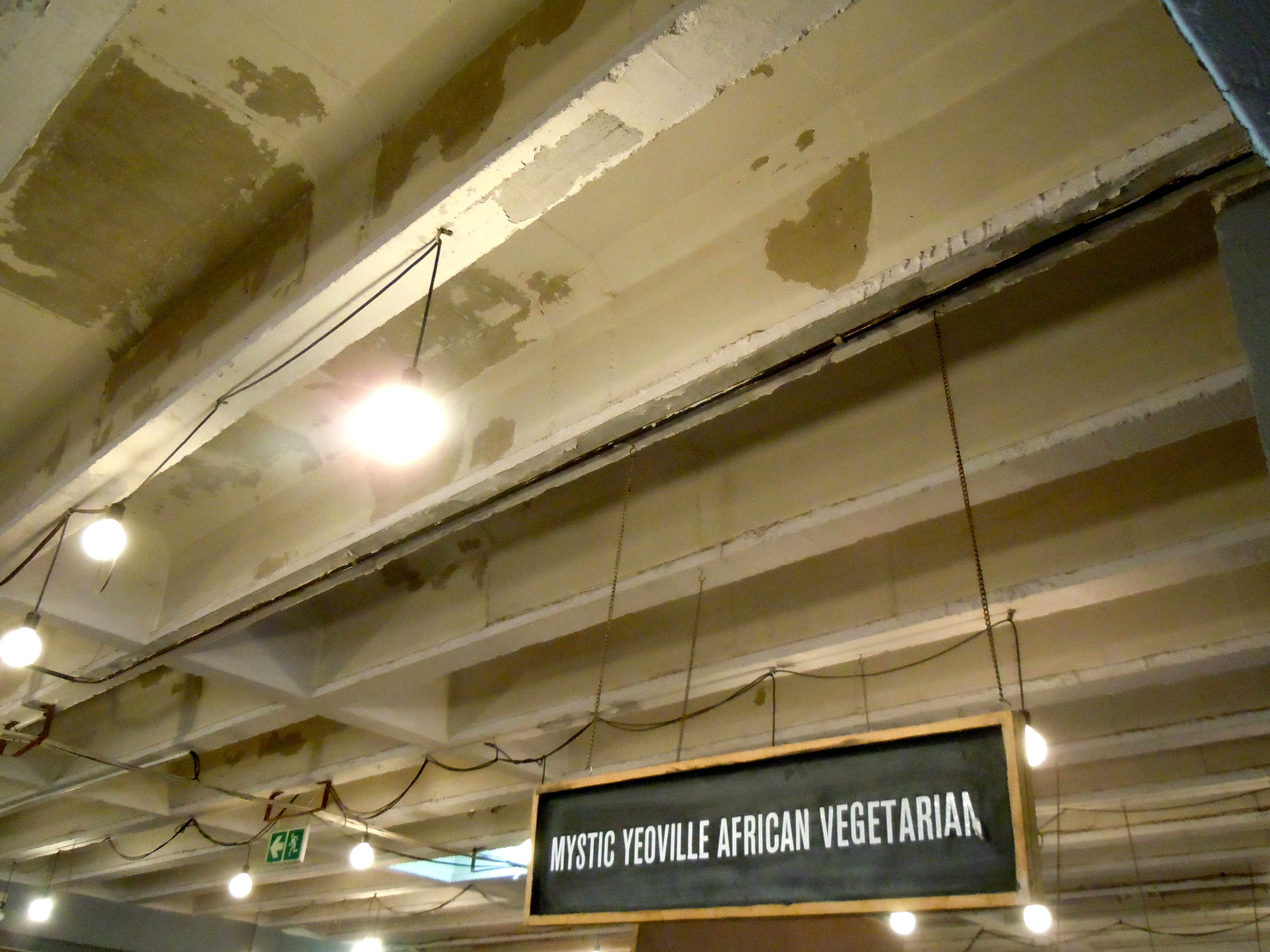
Over the past month I’ve helped to organise the first major conference on the medical humanities in southern Africa. Titled Body Knowledge, and hosted by the Wits Institute of Social and Economic Research earlier this week, the conference brought together a disparate group of academics from all over the world, and specialising in a variety of disciplines: from anthropology to nursing, and from epidemiology to cultural studies.

I think we pulled it off too. It was certainly a fun conference: the food was excellent, I learned a great deal – about my own area of specialisation and others – and was surprised by how frequently papers presented from wildly different disciplines spoke to each other in interesting and quite thought-provoking ways. We’re keen for this new field of the medical humanities not only to encourage collaboration and contact between the arts, humanities, social sciences, and natural and medical sciences, but also to be communicated to those outside of the academy. The Mail and Guardian has published a collection of articles drawn from the conference:

Catherine Burns and Ashlee Masterson discuss art, science, the medical humanities and the Body Knowledge conference.

Susan Levine and Steve Reid argue for the significance of the arts in the practice of medicine.

Jane Taylor looks at the long history of collaboration between the arts and medical sciences.

Patrick Randolph-Quinney describes how art has enriched anatomy.

Raimi Gbadamosi examines the social and cultural construction of albinism.

Because I was part of the group keeping the conference running, I didn’t attend many sessions, but I did get to the two on medicine and nutrition (partly because I chaired one of them). The first included two papers: Kristen Ehrenberger (who’s enrolled for both a medical degree and a PhD in History at the University of Illinois) discussed how Germans’ ideas around ‘healthy’ food shifted during the Allied blockade of the First World War; and Thomas Cousins, an anthropologist at Stellenbosch University, argued for the necessity of a cultural and social study of the gut.

In the second session, Louise Vincent and Chantelle Malan from Rhodes University questioned the ways in which the obesity ‘crisis’ has been framed by both medical professionals and organisations with a vested interest in controlling people’s weight. Similarly, Michelle Pentecost – a medical doctor who’s completing an MA in anthropology at Oxford – pointed out that obesity is caused less by individual sloth and lack of self-control, than is the outcome of a complex set of social, political, and economic processes which shape people’s health over long periods of time.

Catherine Burns, my colleague at WiSER, spoke about the need to write histories of breastfeeding in South Africa (she’s written about histories of sex in South Africa too), and Vashna Jagarnath, also of Rhodes, presented a fascinating paper on Gandhi’s shifting attitudes towards diet after his move to London in 1881. She made the point that his embrace of vegetarianism was the product of an association with the Vegetarian Society and with the social and political radicals, many of them early supporters of Indian nationalism, who were part of the Society (people like Annie Besant, for instance). He went on to publish extensively on how best to eat, and, as Vashna noted, his views on diet were increasingly tangled with his politics.

Body Knowledge Poster HR copy

Although on a wide range of subjects, these papers made a few key points: people’s decisions what and how to eat are shaped by a variety of factors, only some of which they are aware; food and nutrition are always political (they are implicated in the ways in which power functions); and our ideas about what is ‘good’ to eat have changed – and are changing – over time and place. In other words, there was no particular moment, or there is no specific place, where people ate, or are eating, a ‘perfect’ diet (whatever we may mean by that).

Although histories of food and nutrition have attracted scant attention from southern African scholars, the field is growing, both in size and prominence, internationally. I think the best indicator of its growing academic respectability is the fact that the theme of this year’s Anglo-American Conference at the Institute of Historical Research in London, was Food in History.

Histories of food have the potential to descend into a kind of pedantic, irritating antiquarianism, but they are also crucial to understanding histories of consumerism, agriculture, the body, and medicine. Indeed, anyone interested in medical histories of childhood has to focus on the significance of nutrition in efforts to improve children’s health during the early twentieth century.

We are – and have been for a very long time – what, how, and why we eat.

Creative Commons License
Tangerine and Cinnamon by Sarah Duff is licensed under a Creative Commons Attribution-ShareAlike 3.0 Unported License.
Food Links, 28.08.2013

The campaign to save the Philippi Horticultural Area is gathering pace.

Want to know more about the development of the PHA? Come to a public meeting in Cape Town TOMORROW at 17:30. For more information and to RSVP, click here. It’s been organised by the amazing Greenpop.

Anyone interested in helping out with the campaign should click here, and get in touch with Nazeer Sonday, nasonday@gmail.com, or Rob Small, rob@farmgardentrust.org.

Please also sign the Avaaz petition, and share this excellent short documentary.

And back to these week’s food links:

  • Why it’s so difficult to attract young people to farming in the UK.
  • ‘Like steroid use in baseball, food safety will not change until those with the most power have the incentive to change behaviour.’
  • Why is the price of farmland rising in the US?
  • Jamie Oliver criticises poor people for eating badly. And why this criticism is misguided.
  • ‘The goal is to put the burger before the cow.’
  • The rise and rise of food banks in Britain.
  • Doctors in New York City are prescribing fruit and vegetables.
  • When will the American West run out of water?
  • Should we be eating chickens?
  • ‘Sustainable’ palm oil and the politics of eating Nutella.
  • America’s fifty most powerful people in food.
  • ‘at the 1904 World’s Fair, Anderson débuted puffed rice, shot out of eight bronze tubes into a giant cage.’
  • The British obsession with pigs.
  • Are bottomless drinks good for business?
  • The most frequently adulterated foods.
  • How the New Yorker Hotel’s menus tell the story of mid-century eating.
  • True vegans, fake vegans, and ex-vegans.
  • The cronut burger.
  • Baking the earth.
  • Cooking from an LA Times recipe book published in 1905.
  • Questions never to ask at a farmers’ market.
  • ‘The only reasonable explanation for drinking Budweiser is to get drunk.’
  • A blog on Somali cuisine.
  • How to make money out of your vegetable patch.
  • This Twinkie is older than I am.
  • The art of the menu.
  • A visit to the Tabasco sauce factory.
  • The agony of following Madonna’s diet.
  • Wine flour.
  • Cooking in the dishwasher.
  • ‘Mr Neale, 70, of Langstone, Newport, who lovingly nurtured a mammoth 85.5lb vegetable to claim a Guinness World Record, met the hip-hop star Snoop Dog in Cardiff two years ago, who asked the gardener to tell him the secrets if his success.’
  • Will a sheep’s wool keep growing forever? And other pressing, ovine-related questions.
  • Jay Rayner is very, very cross indeed. (Thanks Dad!)
  • How to make barbecued pizza.
  • ‘there is what we might call the gluttony of delicate souls.’

Observations

I’ve been in Johannesburg for nearly a month now. And although I’ve hardly even begun to explore one of the biggest cities in the world, it’s beginning to feel like home. Despite being a comparatively young city – it’s the product of the discovery and mining of the significant deposits of gold beneath the Witwatersrand during the late 1880s – partly because it’s had such a transient population since its founding, and has changed so profoundly over the past century (and continues to change), the city feels composed of layers of work, and experience, and change. In other words, for a newish city, it has a lot of history.

The city itself is often a strange – and rather ugly – mishmash of old and new buildings, businesses, houses, and developments. But I like how older ways of living often exist side-by-side with the new. What I mean is that for all of Joburg’s malls – and there are a lot of malls and they are very, very big – for instance, there are still surprising numbers of small, independent shops which seem, to me, to be very well patronised.

In Braamfontein.

In Braamfontein.

So here are a few food-related observations, made by a new, often ignorant, and probably over-optimistic resident:

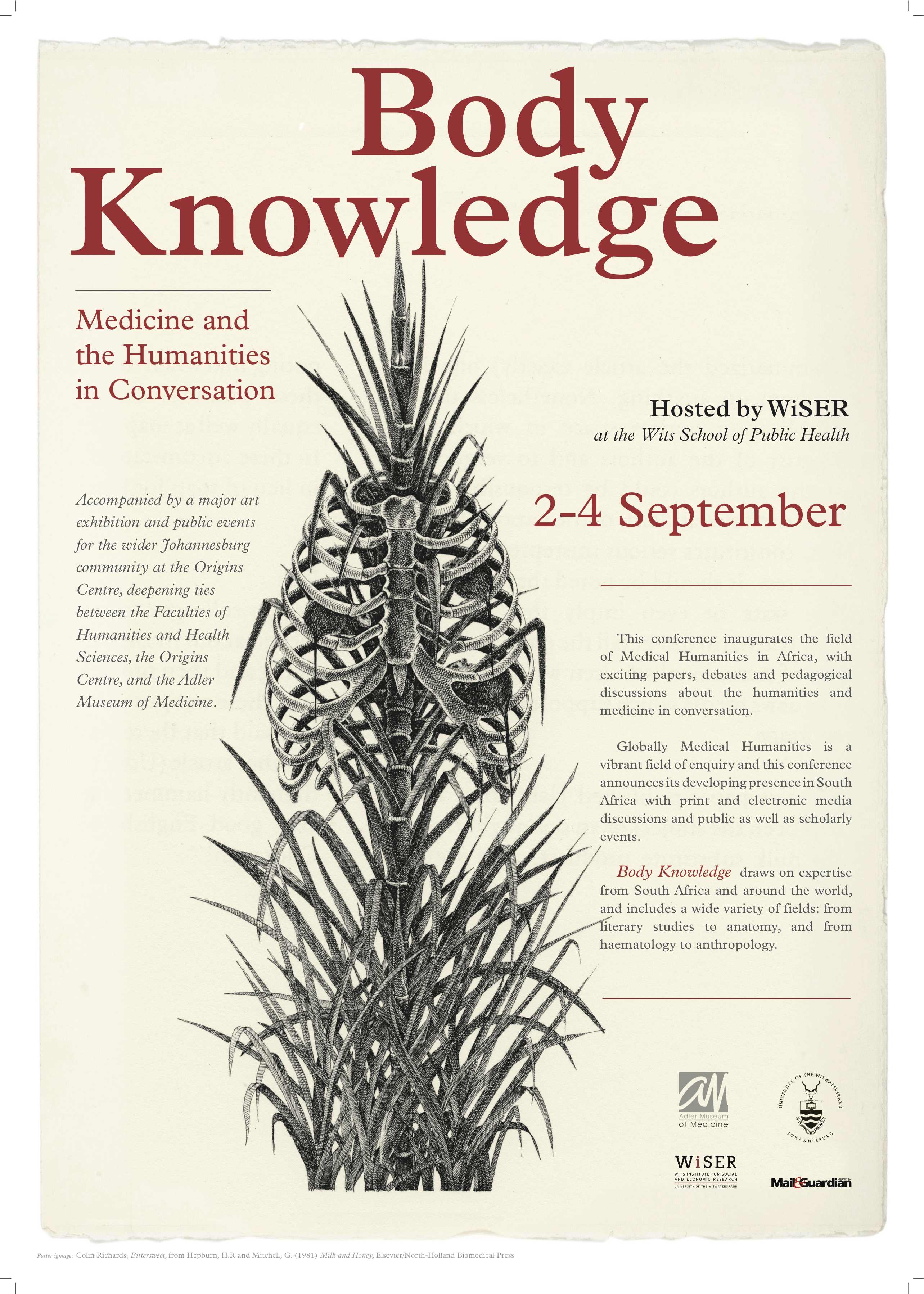
1. There are so many lovely cafes and places to eat. I can’t comment about the fine dining scene – I don’t have enough money to eat in those kinds of restaurants – but it’s easy to eat well here, I think.

At the Neighbourgoods Market in Braamfontein.

At the Neighbourgoods Market in Braamfontein.

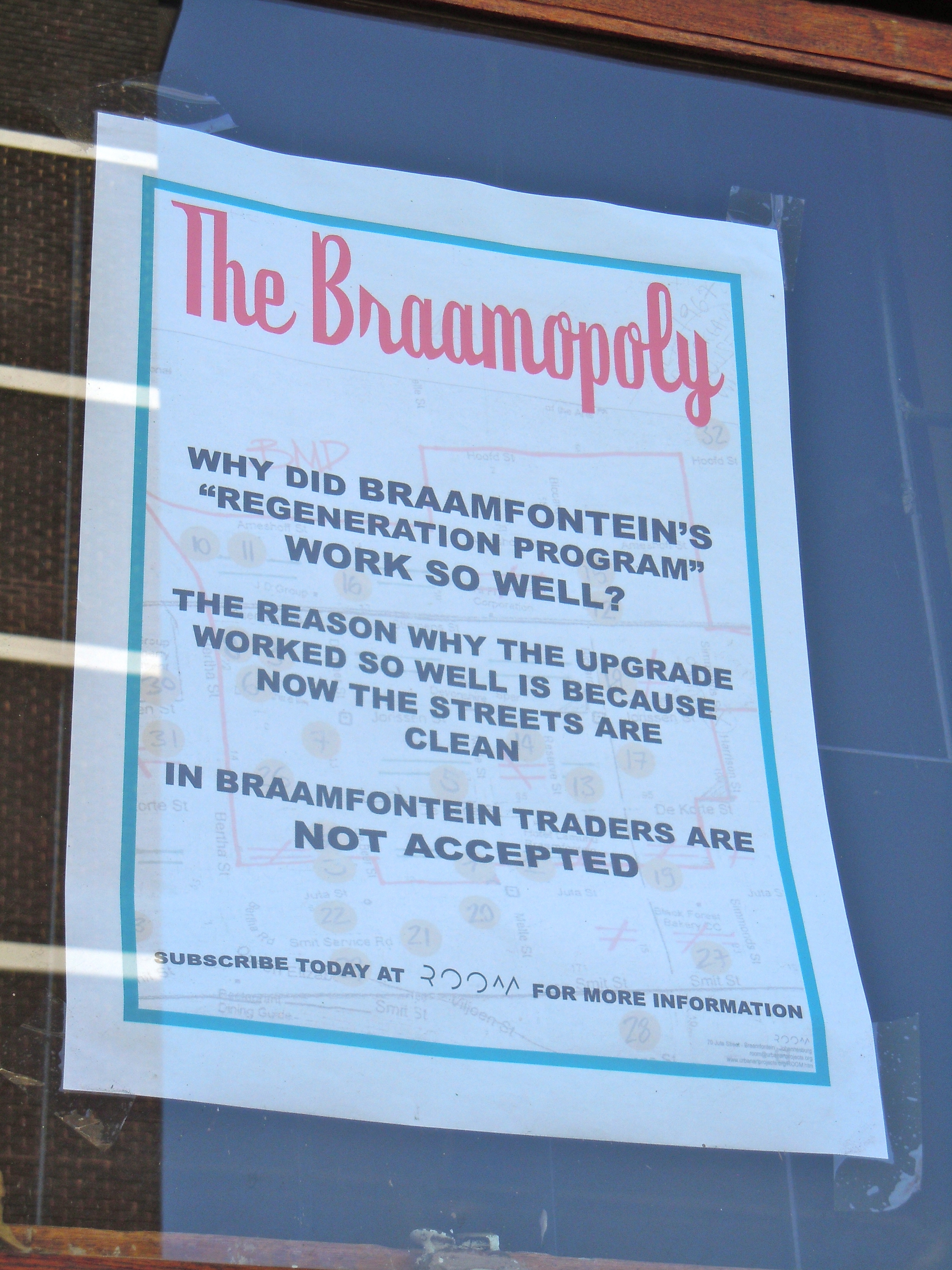
2. Also, as is the case all over the world, these cafes and restaurants are agents of change and gentrification. I spend a lot of time in Braamfontein – I work near there – and have been struck how much this inner-city suburb has changed since I visited at the end of 2011, when it still felt distinctly dodgy during the day. There is now a hipster café with either flat whites or burgers (obviously) on practically every corner.

Debating the gentrification of Braamfontein.

Debating the gentrification of Braamfontein.

3. I’ve yet to visit Arts on Main in the city centre. Just about every person I’ve asked about it has a different opinion of the development. Broadly, half say it’s a deeply problematic gentrification of a desperately poor area which serves only further to marginalise the residents of inner-city Joburg. The other half argue that it’s bringing the middle classes back to old Joburg, after the long flight northwards to Sandton.

4. The Spur in Braamfontein, a quick stroll from Cosatu House, must be the most politically influential steakhouse in South Africa.

Debating the gentrification of Tyrone Avenue in Parkview, on a public noticeboard.

Debating the gentrification of Tyrone Avenue in Parkview, on a public noticeboard.

5. There are so many markets. So far, I’ve been to the Neighbourgoods Market in Braamfontein (and I’m still trying to understand how that stands in relation to Braamfontein’s gentrification) and the organic market in Bryanston. But there’s also the boeremark in Pretoria, the market at the Pirates Sports Club, and the farmers’ market in Fourways. And others.

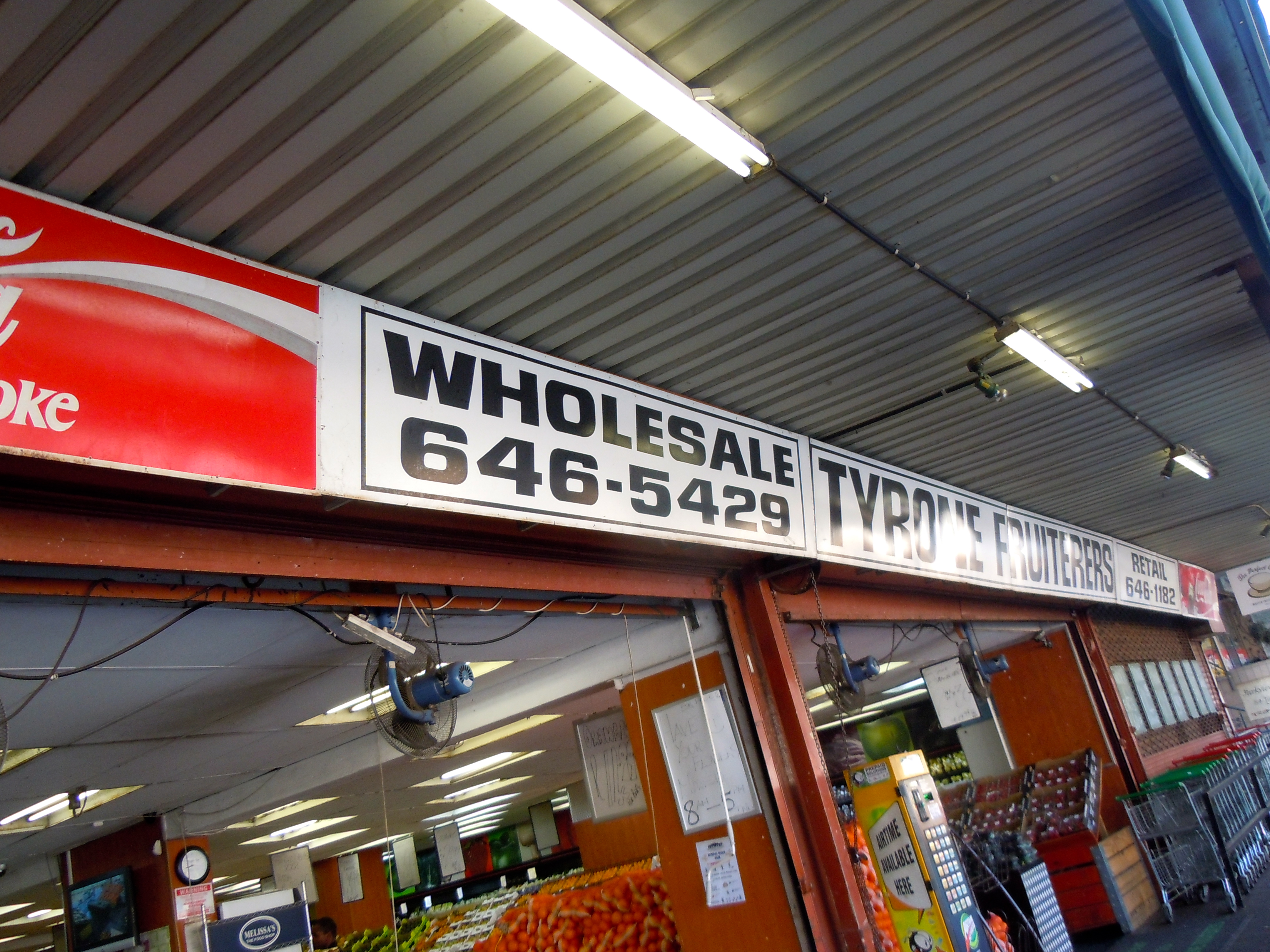
6. In this city of malls – and I have yet to visit that ur-mall, Sandton City – it’s more possible for me to shop locally and from independent businesses than it was in Cape Town. There’s a butcher in Parkhurst, and my amazing fruiterer in Tyrone Avenue – one of dozens across the city – sell fresh produce, meat, cheese, milk, flowers, polenta, pasta, tinned tomato, and fish sauce. And the FT Weekend. And soap. I love it with an intensity which borders on the unreasonable.

The fruiterer on Tyrone Avenue.

The fruiterer on Tyrone Avenue.

I have yet to sample the delights of Fordsburg, Rosettenville, and the new and old Chinatowns. There are still the vast, sprawling worlds of Soweto, and the East and West Rand to explore. But as the city changes, I know I’ll enjoy visiting and revisiting areas that feel at once familiar and new.

Creative Commons License
Tangerine and Cinnamon by Sarah Duff is licensed under a Creative Commons Attribution-ShareAlike 3.0 Unported License.
Food Links, 21.08.2013

In addition to this week’s round-up of links, here are some about the development of the Philippi Horticultural Area, and the campaign to stop this:

Kit has written an amazing post about why we need to preserve this precious resource.

Anyone interested in helping out with the campaign should click here, and get in touch with Nazeer Sonday, nasonday@gmail.com, or Rob Small, rob@farmgardentrust.org.

Please also sign the Avaaz petition, and share this excellent short documentary.

The proposed development has been covered in the media over the past few years: by the the New Age, Mail and Guardian, ENews, the Daily Maverick, MoneyWeb, and, more recently, in the Cape Times (see here, here, here, and here). It’s been written about on blogs – mine and over at Food Jams – and I wrote about it for Eat Out too. Future Cape Town’s coverage of the PHA is predictably excellent: see here, here, here, and here.

Do please send me any posts, articles, and columns on the development, and I’ll list them here next week.

And back to our scheduled programming:

Political

Last week I wrote a post outlining the threat to the Philippi Horticultural Area (PHA) in Cape Town, asking why the city’s food bloggers and foodies – its chefs, restaurateurs, and writers – seemed to have such little interest in the proposed development of a piece of land which grows half of Cape Town’s fresh produce.

The response has been fantastic: Food24 picked up the post, and some magnificent people got in touch with ideas. (I’ll tell you more about them in due course.) More importantly, and not related to my post, the campaign to save the PHA has stepped up. Other than signing the Avaaz petition, do please watch and share this excellent short documentary about the PHA:

Anyone keen to help out with the Save the PHA Campaign should email Nazeer Sonday, nasonday@gmail.com, or Rob Small, rob@farmgardentrust.org.

With a few exceptions, though, the majority of people who have expressed dismay at the development of the PHA and who have offered to do something about it, have not been involved in Cape Town’s food world. In fact, again with a few exceptions, it seems to me that the city’s foodies remain unmoved about the issue – which is quite an achievement given the amount of coverage the development of the PHA has received.

As I wrote last time, considering that these are people with an unusually intense interest in food and where it comes from, I would have thought that they’d be lining up to condemn the development of land which produces their vegetables. Moreover, some of them have such enormous readerships and access to the media, that their ability to communicate with large numbers of people would allow them to be exceptionally helpful to the campaign.

If a blogger with a fairly small readership (and I love each and every one of you) sitting in Joburg can help to get two projects off the ground in Cape Town, imagine what someone with a massive audience and the odd TV appearance could achieve?

In this post, though, I’m interested in why the city’s bloggers – and there are lots of them, and they wield some power – have displayed such little concern for the PHA. One of the excuses that readers of my post offered for not wanting to become involved in the campaign is that it’s toopolitical.’ This is an interesting comment, and worth unpacking.

I think that by ‘political’ respondents meant that they did not want to be associated with a campaign that confronts Patricia de Lille, the Mayor of Cape Town, and the members of the Mayoral Committee who took the decision to develop the PHA.* It’s more likely that bloggers would mobilise to raise funds and awareness around poor children or abused animals. My point is not that we shouldn’t support the SPCA or Nazareth House – far from it, and please do because they do vital work – but, rather, that these causes are more easily depoliticised.

The irony is that all food writing is political: it’s all implicated in the ways in which power works in society. There are few more potent indicators of inequality than access to food. Some of the most evocative reporting on the effects of Europe’s austerity regimes has focussed on the rise of food insecurity: from the organisations which have emerged to feed people in Greece, to the increasing numbers of food banks in the UK.

As a recent edition of BBC Radio 4’s excellent Food Programme reported, austerity eating has been reflected in a shift in food blogging too. Jack Monroe has documented, eloquently, her struggle to feed herself and her young son on almost no money at all:

Poverty is the sinking feeling when your small boy finishes his one weetabix and says ‘more mummy, bread and jam please mummy’ as you’re wondering whether to take the TV or the guitar to the pawn shop first, and how to tell him that there is no bread or jam.

Part of the appeal of Monroe’s blog is that she is able to connect her delicious, nutritious, and incredibly cheap recipes with, as she says to Sheila Dillon, ‘a political spike’: an awareness of the connection between what she eats and the social, political, and economic context in which she and her audience operate.

What Monroe, as well as the brilliant Skint Foodie and North/South Food, is doing is not anything new: there have been other attempts to describe budget cooking (I think of Catherine Whitehorn’s altogether frothier Cooking in a Bedsitter (1961)), and the best food writing and reporting connects what people eat with the circumstances in which they buy, cook, and consume food.  What these bloggers are achieving – articulately, effectively – is to demonstrate how the UK government’s attempts to dismantle the welfare state are causing an increasingly large number of people to go hungry in the eighth richest nation in the world.

Vegetables ready for packing at Harvest of Hope in Philippi.

Vegetables ready for packing at Harvest of Hope in Philippi.

I would not be surprised to see other, similar blogs being established over the coming few years. And I’m interested in answering why South African food blogging has not demonstrated a similar awareness of the country’s vast inequalities. A cursory reading of most South African food blogs would not reveal that they are written in a country where one fifth of children have stunted growth and one in ten children suffer from severe malnutrition.

I don’t want to suggest that every blog must be a worthy condemnation of the gap between South Africa’s very poor and very, very rich – continue to eat your cupcakes with impunity, please – but I’ve often been struck by just how incredibly unaware so many bloggers are of their privilege: that their ability to buy their food from upmarket supermarkets and cute urban markets is a very rare thing indeed in South Africa.

In some ways, this lack of awareness among Capetonian bloggers is particularly obvious because of the city’s affluence and its ‘whiteness’: because, unlike other South African cities, its middle-class suburbs, expensive food shops, farmers’ markets, and top-end restaurants remain overwhelmingly white.

I’m not really sure how to end this post. I think that some bloggers’ unwillingness to engage with the politics of cooking, eating, and growing food are probably the product of a range of anxieties around race, class, and an uncertainty about where to fit into post-1994 South Africa. But this is pretty obvious.

All comments welcome.

*I’d point out that one of the chief joys of democracy is that you can criticise the DA and still vote for it.

Creative Commons License
Tangerine and Cinnamon by Sarah Duff is licensed under a Creative Commons Attribution-ShareAlike 3.0 Unported License.

Food Links, 14.08.2013

Occupy Philippi

Cape Town is unusual in that half of the fresh produce consumed by its residents is grown within the boundaries of the city. Cauliflower, lettuce, beetroot, onions, tomatoes, herbs, and other vegetables have been grown in the sandy soil of the Philippi Horticultural Area (PHA) since the end of the nineteenth century.

Today, the area encompasses about 2,370 hectares, and is split between smallholdings and larger commercial farms, which produce around 100,000 tonnes of produce every year. Some of these have embraced sustainable, organic farming. While most of the produce goes to supermarkets, a portion of it is sold to the surrounding, desperately poor communities who live in Philippi – to people who would not otherwise have access to fresh fruit and vegetables. In other words, the PHA is absolutely essential to ensuring that these households remain food secure:

According to a survey of 1 060 low-income households [in Cape Town] conducted by the African Food Security Urban Network in 2008, 80% of respondents were food insecure. The study looked at various indicators of food insecurity, such as whether respondents went to sleep hungry, or whether there were times when there was no food in the house.

A 2012 study by Rooftops Canada-Abri International and the African Food Security Network that examined the horticultural area’s significance in sustaining food security within the Cape Town municipality found that without it the city would be ‘place[d] in extreme risk’ of food insecurity, with low-income households suffering the most. A 2009 report commissioned by the city had similar findings.

As Rob Small of the respected urban farming project Abalimi Bezekhaya notes, Cape Town is ‘a farm with a city in it.’

A vegetable box packed at Harvest of Hope's shed in Philippi.

A vegetable box packed at Harvest of Hope’s shed in Philippi.

As I wrote a while ago, this farm is under threat. Last month, Cape Town’s Mayoral Committee (Mayco) approved an application from the private property developer MSP Planners to have 280 hectares of the PHA rezoned for housing. This isn’t the first time that parts of the PHA have been identified for rezoning: in 2011, an application from Rapicorp to develop 472 hectares of the PHA was also approved, but nothing came of this because the company soon went into administration.

There are compelling reasons to oppose this development. Two studies have demonstrated not only that local people depend on the produce grown in the PHA, but that farmers are keen to extend the area under cultivation. Investing in the PHA – helping to increase the number and size of farms instead of reducing or threatening them – would create jobs and attract business to the area. As a group of academics at the University of Cape Town’s School of Architecture, Planning, and Geomatics argue:

The decision to allow development represents the not-so-thin edge of the wedge. There are three aspects to this. First, remaining farmers are unlikely to invest in the land if there is a sense that they may have to move. Second, it will become increasingly difficult, on the ground of administrative fairness, to reject future speculative applications if this one is approved. Third, there is considerable evidence to suggest that the provision of extensive urban infrastructure in the area will attract further development, both formal and informal. Infrastructure has a strong ‘lock-in’ dimension. In short, it’s a poor, short-sighted and dangerous decision.

What are Captonians doing about this? There is an Avaaz petition – and it’s worth signing it. But other than lobbying from NGOs and some PHA farmers, the lack of interest from Cape Town’s bloggers and foodies is palpable.

I wonder why? I mean, after all, these are the people who profess to love local produce, and who argue that their interest in food and cooking has the potential to do good in the world. These are people with clout: who appear on television programmes, who write for newspapers and magazines with large circulations. These are the people who have the power to shame Patricia de Lille and other members of the Mayco into rethinking their decision. They have, I would argue, a moral duty to use their position to save the region that produces the vegetables they cook with, and which they eat at restaurants.

And what are they doing? Is their lack of interest in the PHA to do with the fact that it’s in a poor part of Cape Town? That there aren’t any high-end chefs with restaurants in Philippi? That they can’t find the same sort of meaning in the PHA as they do in baking brownies? If they’re really serious about supporting small agriculture in Cape Town, then, surely, they’ll pay as much attention to the PHA as they would to the garden at Babylonstoren.

So. Foodies and food bloggers of Cape Town. What are you going to do to save the PHA?

For more information on the Save the PHA Campaign, see here.

Creative Commons License
Tangerine and Cinnamon by Sarah Duff is licensed under a Creative Commons Attribution-ShareAlike 3.0 Unported License.