Skip to content

Food Links, 19.06.2013

Edible Animals

I have a weakness for strange novellas in translation, published by obscure imprints.* Last week I read Eat Him if You Like by Jean Teulé (Gallic Books, 2011). In slightly more than a hundred pages, Teulé describes a horrific incident which occurred in Hautefaye, a village in the Dordogne, during the summer of 1870. In the midst of drought, food shortages, and a disastrous conflict with Prussia, a mob of peasants turned on a young aristocrat, Alain de Monéys, and tortured him to death over the course of an afternoon.

In the evening, he was placed on a funeral pyre and set alight. His remains may have been eaten by his attackers.

The atrocity is the subject of Alain Corbin’s academic monograph, The Village of Cannibals: Rage and Murder in France, 1870 (1992). He demonstrates that although the people who carried out the torture were mainly peasants, figures of authority were well aware of what was being done to De Monéys, as John Merriman explains in a review:

The mayor, despite wearing the tricolour sash symbolising his authority, was not much help… After a clumsy, ineffective effort to calm the crowd, he shut his door, fearing that the mob would smash his dishes. Worse, a witness reported that he told the crowd: ‘Take Monsieur de Moneys away from the front of the inn. He’s blocking traffic!’ And when someone shouted, ‘We want to kill him, burn him, and eat him,’ the mayor replied, if not ‘A table!’ at least ‘Eat him if you like’…

Why did this happen? Why did a group of three to eight hundred otherwise reasonable people – who, afterwards, deeply regretted their behaviour – turn on an innocent fellow subject? The immediate reason for the lynching was that De Monéys was accused of being a ‘Prussian’ and had shouted ‘Vive la République!’ at a time when France was ruled by Napoleon III.

{13EFD649-B9DD-477D-82FF-8915FFEA0EE8}Img100

Corbin argues that a collection of factors converged in Hautefaye on 6 August 1870, each of which contributed to the summer afternoon’s madness: a combination of hunger and desperation caused by the drought, growing peasant hostility towards the aristocracy, and anxiety about the progress of the Franco-Prussian War. Merriman writes:

There can be no question about the intrusion of national politics in the world of these peasants… Corbin sees the event as reflecting an intensification of a nationalism in the wake of the war, extending even into a peasant community in one of France’s most ‘backwards’ regions. …Corbin sees the community as affirming its own identity by ‘expel[ling] the monster from its midst.’

There is no evidence, only rumour, to suggest that De Monéys was eaten. In the novella, Teulé implies that, Christlike, in consuming his body, the mob is able to rid itself of its sins:

His ashes rose higher, swirling around in the air above the crowd who were feasting as they did on the most important holidays. They devoured their cannibal sandwiches. … Eating this body would purge the community.

As several of the reviews of Corbin’s book note, his explanation for the torture and possible cannibalism is not entirely satisfactory. And Teulé, despite his depiction of De Monéys as a scapegoat, implies that not all of his torturers may have had such elevated motives. The problem is that cannibalism in these circumstances – where a group of people willingly choose to eat another – transgresses so many taboos and social and cultural boundaries, that it seems to defy all logical explanation.

It’s little wonder, then, that cannibalism was central to the justification for colonialism – and, indeed, the word emerged at the beginning of the colonial encounter. Shirley Lindenbaum writes:

The word cannibal is said to be a legacy of Columbus’s second voyage to the Caribbean in 1493. Referring originally to the Caribs in the Antilles who were identified as eaters of human flesh, the term was subsequently extended as a descriptive term for flesh eaters in other populations. The discourse of cannibalism, which began with the encounter between Europe and the Americas, was to become a defining feature of colonial encounters in the New World

With its association with savagery, cannibalism was bound up with the construction of the colonial other.

But however much we may be appalled by cannibalism, it is very, very rarely done without reason. It’s easier to understand this by looking at the several forms of cannibalism which exist. I think we’re most familiar with survivor cannibalism, which occurs when people eat others in the absence of any other food, like the case of the 1972 Andes plane disaster, when a group of sixteen Uruguayan rugby players ate their deceased fellow passengers to survive freezing conditions. Also, cannibalism occurs during times of famine. There were instances of cannibalism in Russia in 1921, and, allegedly, in China’s Great Famine between 1958 and 1962.

It’s used in rituals to strengthen bonds within groups or communities, and also as a weapon of terror in warfare. It’s a symptom of psychopathology – as excited reports of the ‘face-eating man’ in Miami last year confirmed. But it’s also been done for medical reasons:

Medicinal ingestion involving human flesh, blood, heart, skull, bone marrow, and other body parts was widely practiced throughout Europe from the sixteenth to the eighteenth centuries. Human flesh obtained from ‘mummy shops,’ where the remains of an embalmed, dried, or otherwise prepared human body that had met with sudden, violent death, was considered to be a ‘universal panacea’… Samuel Johnson’s 1785 dictionary of English includes a description for preparing mummy, indicating that it was still being sold at that date, and it was still available in 1909 from a reputable German pharmaceutical company.

Placentophagy – where mothers eat their new-born babies’ placenta – falls within this definition too.

Cannibalism is more familiar to us than we probably realise – and certainly to those of us who’ve been to church:

Sacrificial cannibalism, in which the victim is treated with solicitude and honour as a prelude to sacrifice to the gods, is a widely reported form of aggression. Aztec cannibalism in fifteenth-century Mexico, as well as nineteenth-century Fijian practises, belong in this category. The Christian ritual of the Eucharist is its symbolic extension.

Even the use of organs in transplants involves a recycling of body parts between different people.

I want to emphasise that my point in writing this is not to horrify – and I think it’s absolutely imperative for every adult to consider signing up as an organ donor. Rather, thinking about cannibalism helps to illuminate aspects of our relationship with food and eating.

Firstly, there is nothing ‘savage’ or ‘senseless’ about cannibalism. It occurs for a range of reasons and takes a variety of forms, only some of which I’ve mentioned here. When people consume other people, it is for specific, well thought-out reasons. In fact, the contexts which cause people to break this taboo are, I think, more interesting than the cannibalism itself.

Secondly, cannibalism is the supreme example of eating being done for reasons not connected to nutrition: it was and is done – either by literally eating bodies or consuming them symbolically – to create and maintain group identities.

But it also draws our attention – uncomfortably – to ourselves as animals. In Cormac McCarthy’s The Road, Soylent Green, and, even, Never Let Me Go by Kazuo Ishiguro, there are moments of profound – horrifying – realisation that humans are, like cattle or pigs, potentially edible, or (re)usable, animals. In other words, understanding how and why and what we ate – and eat – changes over time, is intertwined with histories of cannibalism, and of ourselves as members of the food chain.

* Have you read The little girl who was too fond of matches, Pereira Maintains, or The Marquise of O-? You really should.

Sources

Edward Berenson, Review of The Village of Cannibals: Rage and Murder in France, 1870 by Alain Corbin, The Journal of Modern History, vol. 66, no. 4 (Dec., 1994), pp. 815-818.

Rachel B. Herrmann, ‘The “tragicall historie”: Cannibalism and Abundance in Colonial Jamestown,’ The William and Mary Quarterly, vol. 68, no. 1 (January 2011), pp. 47-74.

Shirley Lindenbaum, ‘Thinking about Cannibalism,’
Annual Review of Anthropology, vol. 33 (2004), pp. 475-498.

John M. Merriman, Review of The Village of Cannibals: Rage and Murder in France, 1870 by Alain Corbin, The American Historical Review, vol. 98, no. 3 (Jun., 1993), pp. 883-885.

Creative Commons License
Tangerine and Cinnamon by Sarah Duff is licensed under a Creative Commons Attribution-ShareAlike 3.0 Unported License.

Food Links, 12.06.2013

1. It’s very, very hard to run a food truck in New York. | 2. ‘the bosses from Seoul began slipping their North Korean workers a Choco Pie or two as a perk.’ | 3. ‘The Chinese corporation Shuanghui International … has just bought US giant Smithfield, the globe’s largest hog producer and pork packer, in a $4.7 billion cash deal.’  | 4. Half a million Britons are using food banks. | 5. On granola. | 6. Jeppson’s Malort. | 7. Are wild, edible plants more nutritious than cultivate varieties? | 8. Espresso drinks, deconstructed. | 9. Gin does not make you sad. | 10. The new fashion for chocolate bags. | 11. The ramp harvest. | 12. ‘One day I will live like a vegan Gwyneth, another day I will eat like a child of Gwyneth.’ | 13. How to de-seed and juice pomegranates. | 14. Georgian pound cake. | 15. Japanese prison food. | 16. ‘Like tulips in Holland, chickens were once the subject of near-insane interest and wild financial speculation.’ | 17. The art of bees. | 18. 3D-printed sugar. | 19. How to brew coffee.

Foodie Pseudery (43)

The transcendence of onions – a discussion between Ruth Reichl and Michael Pollan:

R: In your new book, Cooked, you said, “There’s nothing ceremonial about chopping vegetables on a kitchen counter.” I have to tell you, I so don’t agree with you. For me, chopping onions, putting them in butter, the smells coming up, that’s all totally sensual, totally seductive. And truly ceremonial, in the best way. I built a kitchen so that people can stand around and watch me cook.

P: To me onions are the metaphor for kitchen drudgery. Cutting them is hard to do well and they fight you the whole way. But I worked at this for a long time, learned everything I could about onions—why they make us cry, how to prevent it, why they’re such a huge part of cuisine worldwide, and what they contribute to a dish. I finally learned this important spiritual truth, which is bigger than onions: “When chopping onions, just chop onions.” When I finally got into the zen of cutting onions, I passed over to another place. Part of the resistance to kitchen work like chopping is a macho thing. Men like the big public deal of the grill, the ceremonies involving animals and fire, where women gravitate toward the plants and pots inside.

R: Chopping is like a meditation.

P: A zen practice, I agree. I learned that from my cooking teacher Samin Nosrat, who is a serious student of yoga. She talked to me about patience, presence and practice. She thought they applied equally well to cooking and yoga. And they do.

Food Links, 05.06.2013

1. Why British fishermen cannot rely on the shellfish boom. | 2. Byron, BrewDog, and the recuperation of radical aesthetics. | 3. Michael Pollan’s rose-tinted view of domesticity. | 4. Eat less meat for the good of the planet..  | 5. The plight of the honeybee. (And how bumblebees – whose numbers are being boosted – can help to save this year’s UK strawberry crop.) | 6. On cast iron pans. | 7. The growing interest in brewed coffee. | 8. The taco waffle. | 9. Mumbai’s Parsi cafe culture. | 10. Urban chicken coops. | 11. The Global Soil Biodiversity Initiative. (And mapping Africa’s soil diversity.) | 12. A brief history of Angostura bitters. | 13. Collectable wedding cake. | 14. Blueberry tall pie. | 15. Hackney’s boutique spoon whittler. | 16. On #guardiancoffee. | The return of the prune.

Let them eat burgers

Earlier this month, Patricia de Lille – the former firebrand stalwart of the radical Pan Africanist Congresshanded over the key to Cape Town, to a man dressed up as a hamburger.

Now the mayor of the opposition-controlled City of Cape Town, De Lille met with the senior management of Grand Parade Investments, as well as the hamburger, to celebrate the opening of the first branch of Burger King in South Africa.

Since selling its first burger on 9 May, queues have snaked all the way down Heerengracht Street – not Cape Town’s loveliest quarter – as punters wait hours to try Whoppers and the chain’s other products.

So far the only controversy that the chain seems to have generated is a call from People against Gangsterism and Drugs (Pagad) to boycott Burger King because Grant Parade Investments also owns Grand West Casino – to which Pagad is opposed on the grounds that gambling further impoverishes the poor communities which surround Grand West.

There has been a lot of chatter about the opening of a new fast food chain in South Africa: will the 120 planned Burger King outlets contribute to the country’s increasingly high instance of obesity? How will existing brands respond to this new competition? And is Burger King’s arrival part of a ‘McDonaldisation’ of South African food? In other words, is a kind of globalised junk food changing the ways in which South Africans eat?

All of these are complex questions which are impossible to answer less than a month after the opening of one branch of Burger King. But we can begin to address the last because South Africa’s experience of global Big Fast Food is fairly similar to what has happened abroad, and in the past.

In the weeks preceding the opening of Burger King, Grand Parade Investment’s CEO, CFO, and Chairman lovebombed the South African media. In the several radio interviews that I heard, they reiterated over and over again that although the product they’re bringing into South Africa is the same as that served in the US – and of the same quality – it will be produced by well-trained South African employees, and made using ingredients processed locally. (Burger King will open a factory in Philippi.)

The flagship Burger King has a mural of Table Mountain and the Grand Parade in a prominent place. For all the fact that Burger King’s appeal is based on its status as an exotic foreign product, it’s been modified to appeal specifically to South African customers.

This, however, is not unique. One of the main reasons for the incredible success of McDonald’s all over the world is that while it maintains the pretence of selling precisely the same product in India, Belgium, and Argentina, each of those countries has both a menu and a dining experience which is – more or less – tailored to the expectations and preferences of local diners.

For instance: recently, there has been some coverage of McDonald’s attempt to add pasta to its menus in Italy. Although this has been greeted with derision, the chain has done similar things elsewhere. It tried to introduce falafel to its menu in Israel, and yak burgers in Mongolia.

One of the reasons for Taco Bell’s relative lack of success outside of the United States is its inability to adjust its model to local tastes. Indeed, McDonald’s isn’t the only chain to allow its menus and, even, restaurant design to be fairly flexible: Subway, for example, sells a Chicken Tikka sandwich – flatbread optional – in the UK.

In France, despite sustained opposition from anti-globalisation activists and the food movement, McDonald’s has more than 1,200 branches. In contrast, South Africa – considered to be one of McDonald’s most successful ventures – has only 161. Why? Because it uses ingredients popular with French customers – cheese, Dijon mustard – allows for diners to stay longer in their restaurants (French customers are more likely to eat full meals at McDonald’s rather than to snack), and it opened the McCafe, which sells patisserie.

I use the example of France deliberately, because it’s usually described as having an admirably distinct and healthy food culture (whatever we may mean by ‘food culture’). McDonald’s success there not only suggests that this reputation is based, to some extent, on myth and a lot of PR, but also that the implications of the presence of Big Fast Food for people’s diets, are complex.

Although the ‘South Africanisation’ of Burger King is interesting to explore, I think it might be more useful to understand the arrival of the chain in relation to the country’s shifting demographics and economic development. Arriving almost two decades after the dawn of democratic government, Burger King has certainly taken its time to get here.

McDonald’s opened its first branch in 1995, and, initially, exerted the same appeal in South Africa as it did in Russia during the late 1980s.  Similar to South Africa’s participation in the 1992 Summer Olympics in Barcelona, it symbolised the end of the country’s isolation.

In 2013, Burger King has arrived to take advantage of the growth of South Africa’s middle class. As Jonny Steinberg notes in a recent article:

It is true that our politics is increasingly corrupt, that people express discontent by throwing stones and burning things, that yawning inequalities cause much resentment. Less well known is that the income of the average black family has increased by about a third since the beginning of democracy; that 85% of homes are electrified compared with just over half on the last day of apartheid…

Despite the slowing down of economic growth – despite the fact that at the moment R10 will buy only $1 – there are still more South Africans to spend cash on fast food, and other consumer goods, than ever before. It’s telling that the malls and other locations at which the new Burger King branches will open tend towards the upper end of the market – and that the chain will focus its operations on the Western Cape and Gauteng, the country’s two wealthiest provinces.

In his study of the exponential success of McDonald’s in Japan, South Korea, Taiwan, and China, James L. Watson argues that McDonald’s took off at the same time that family structures in these countries changed: as the size of families shrunk, as women began, increasingly, to work outside the home, and as it became more common for nuclear families to live separately from grandparents, so McDonald’s found a market in these comparatively wealthy families with children to spoil. He writes:

American-style birthday parties became key to the company’s expansion policy. Prior to the arrival of McDonald’s, festivities marking youngsters’ specific birthdates were unknown in most of East Asia. … McDonald’s and its rivals now promote the birthday party – complete with cake, candles, and silly hats – in television aimed directly at kids.

As in China, Burger King is a treat for South Africa’s newly-affluent middle-class families, and not (yet) associated with absolutely cut-priced eating. The association of big fast food chains with poverty seems to remain limited to wealthier nations.

My point is that the arrival of Burger King now – in 2013 – says far more about South Africa than it does about Burger King.

I think one of the best examples of the massive change which the country has experienced, is the rise and rise of the current Deputy President of the ANC – and future Deputy President (and President?) of South Africa. In 1994 he was known as a founder of the National Union of Mineworkers, arguably South Africa’s most powerful union, and as a key figure in the negotiations which ended apartheid. Now Cyril Ramaphosa is one of South Africa’s wealthiest people. And, until recently, the owner of the local franchise for McDonald’s.

Sources

Ian Brailsford, ‘US Image but NZ Venture: Americana and Fast-Food Advertising in New Zealand, 1971-1990,’ Australasian Journal of American Studies, vol. 22, no. 2 (December 2003), pp. 10-24.

Rick Fantasia, ‘Fast Food in France,’
Theory and Society, vol. 24, no. 2 (Apr., 1995), pp. 201-243.

EU Igumbor, D. Sanders TR Puoane, L. Tsolekile, C. Schwarz C, et al., ‘“Big Food,” the Consumer Food Environment, Health, and the Policy Response in South Africa.’ PLoS Med, vol. 9, no. 7, (2012), e1001253.

John W. Traphagan and L. Keith Brown, ‘Fast Food and Intergenerational Commensality in Japan: New Styles and Old Patterns,’ Ethnology, vol. 41, no. 2 (Spring, 2002), pp. 119-134.

James L. Watson, ‘China’s Big Mac Attack,’ Foreign Affairs, vol. 79, no. 3 (May-Jun., 2000), pp. 120-134.

Jianying Zha, ‘Learning from McDonald’s,’ Transition, no. 91 (2002), pp. 18-39.

Creative Commons License
Tangerine and Cinnamon by Sarah Duff is licensed under a Creative Commons Attribution-ShareAlike 3.0 Unported License.

Food Links, 29.05.2013

1. Hunger in Malawi. | 2. Photographs of what families around the world eat in a week. | 3. German brewers object to fracking. | 4. The growing, global backlash against Monsanto. | 5. Fifty ways to close a food bank. (And the crisis in UK food banks.) | 6. ‘In the United States, domesticated bee populations have reached a 50-year low and keep dwindling.’ | 7. The revival of the Scottish beer industry. | 8. What is chicken fried steak? | 9. The mold which caused the Irish potato famine seems to have been eradicated. | 10. George Orwell makes tea, in a trench, in the Spanish Civil War. (Thanks, Joshua!) | 11. In praise of chickpeas. | 12. On Chardonnay. | 13. A banana-themed quiz in honour of the return of Arrested Development. | 14. Tamale Spaceship. | 15. Rainbow cheesecake.

Scandalous

Just as it appeared that the meat contamination scandal in the UK had come, if not to a resolution, then to a point where there were no new revelations of unlabelled horsemeat in ready meals, fast food, and other processed meat, the Guardian has released a report on the employment practices of one of the Dutch firms implicated in food adulteration.

Not only does the investigation reveal the appalling conditions in which a group of poorly-paid Polish immigrants were forced to work, but it demonstrates the extent to which the Willy Stelten factory mixed horsemeat as well as old and rotting meat into meat sold as beef. The owner of the business – the titular Willy Stelten – was arrested earlier this week for allegedly selling 300 tonnes of horsemeat as beef.

As the Guardian’s handy timeline of the scandal demonstrates, for all of the recent lull in new developments, it’s been in the news for nearly half a year. In contrast, South Africa’s contaminated meat scandal was reported widely in April but has since then largely disappeared from the headlines.

I think that it’s worth comparing the two scandals. These are my observations about the similarities and differences between them. If you’ve any to add, list them in the comments, below, and I’ll incorporate them into the post.

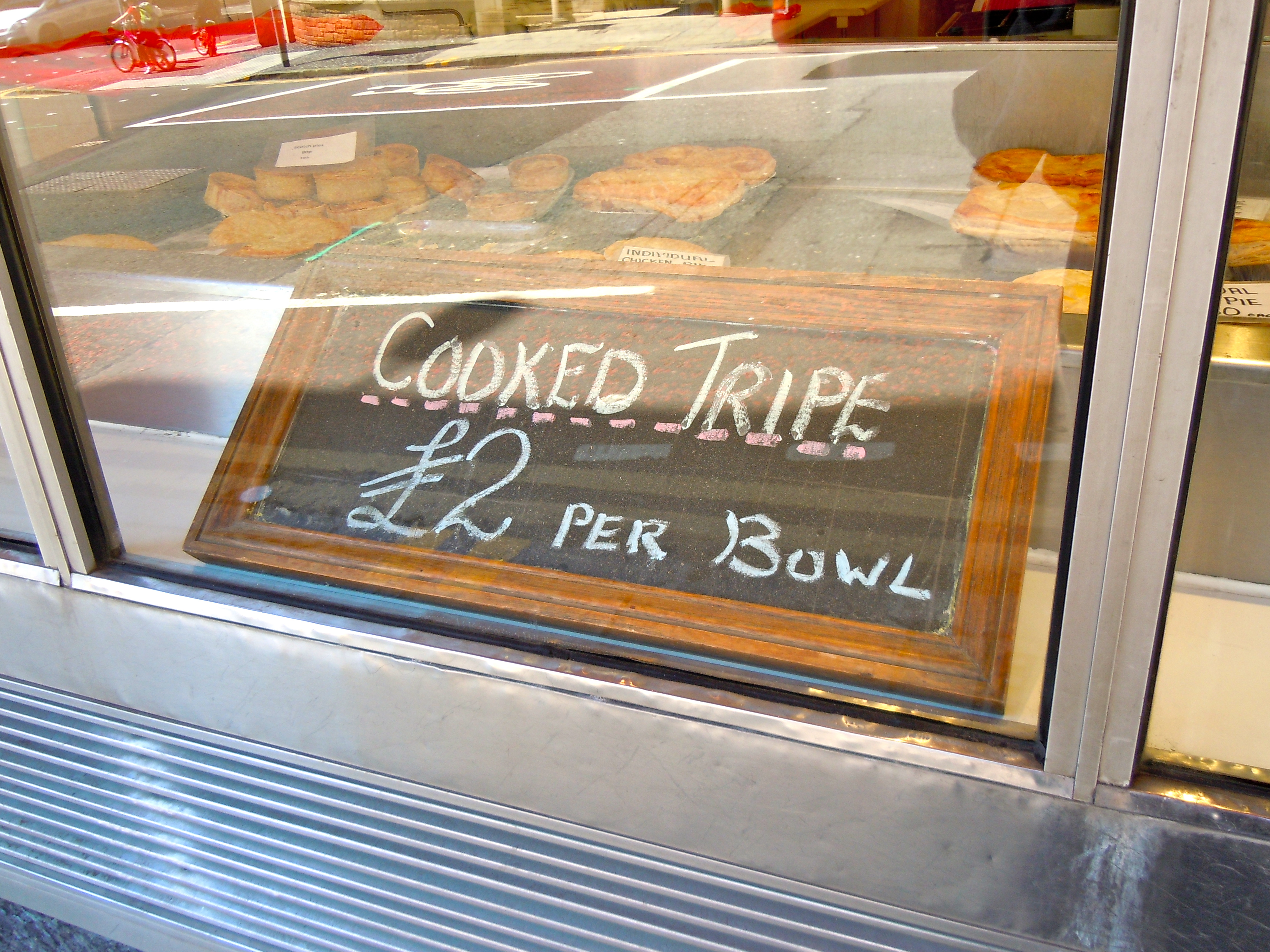
A butcher in Edinburgh.

A butcher in Edinburgh.

The most striking difference between the British and South African scandals was the ways in which they originated. In January, the Irish Food Standards Authority reported that it had found unlabelled horsemeat in burger patties sold by Tesco, Iceland, Aldi and Lidl. It implicated ABP Silvercrest, one of Europe’s biggest meat processors, in selling unlabelled horsemeat and pork to a range of factories and supermarkets, including, even, upmarket, ethical Waitrose.

As the UK Food Standards Authority began its investigation, an increasing number of food producers, supermarkets, and fast food chains have been accused of passing off horse- and other meats in food products labelled, usually, as beef. In fact, it now seems to be easier to identify those retailers not linked to the scandal, than those who are.

The South African food scandal was the product of a study carried out by meat scientists at Stellenbosch University. In February, they announced that they had found traces of horse, donkey, goat, and water buffalo meat in a range of products in supermarkets and butchers around the country. Because the researchers were unwilling to make their list of retailers public, City Press submitted an FOI request, and, in April, named all of South Africa’s major supermarkets, Food Lovers’ Market, and smaller, independent shops as guilty of mislabelling meat products.

In many ways, the two scandals are very similar. They occurred because of a failure of regulation; the contamination of meat was widespread (it wasn’t limited to one or two supermarkets, but occurred across the food industry); and there is evidence to suggest that some illegal meat entered both food chains because of criminal activity.

Also both scandals hit poorest customers the hardest: those people who buy the budget burgers and processed meat sold at massive, bargain supermarkets. Possibly because poverty is so obvious in South Africa, local commentators managed – mercifully – to avoid making silly, snotty arguments about having no sympathy for people who had been duped into buying horsemeat.

Indeed, it’s striking how frequently the South African scandal has been described as a crisis of mis-labelling. Retailers argued that the traces of donkey, horse, and other meats in products were very, very small, and probably the result of cross-contamination.  The Department of Trade and Industry ordered the National Consumer Commission – an agency of the Department – to investigate the issue.

South Africa has very strict laws which regulate the length of the food chain – from the slaughter of animals to the labelling of meat products in shops. In fact, the Consumer Protection Act is one of the strictest of its kind in the world. The problem lies in enforcing these rules. The three departments responsible for patrolling food safety – health, agriculture, and trade and industry – have, collectively, failed to do so adequately. Herman Blignaut, an attorney with copyright experts Spoor & Fisher, said to City Press:

The respective departments probably don’t have the manpower to sustain a firm hold on compliance of the requirements, so the policing is not what it should be.

Another factor that can make policing more difficult is the fact that slow, expensive and expert analysis is necessary to establish whether the meat claimed to be in the product actually is, and whether it could be contaminated by other meats.

But this focus on food labelling, while important, obscures some other, more fundamental questions. Most of the cases of contamination identified by the Stellenbosch report related to unlabelled chicken, mutton, and pork, and these can be dealt with through the enforcement of labelling regulations. But the report does not explain how and why water buffalo, donkey, and horsemeat entered the food chain.

Answering questions posed by the opposition Democratic Alliance in Parliament, Minister for Agriculture, Forestry and Fisheries Tina Joemat-Pettersson admitted that South Africa imported horse and water buffalo, as well as other meats, from Brazil and India:

According to the department, South Africa’s Brazilian meat imports included 61 tons of horse meat in 2011, 150 tons in 2012 and 49.8 tons this year. More than 460 tons of poultry and 45.5 tons of beef were imported from Brazil from 2011 to 2012.

South Africa imported 1 175 tons of water buffalo from India in 2011 until imports were suspended in May, 2011.

The reason why imports were suspended from both countries was because of the ‘significant risk’ their products posed to South Africans. Unfortunately, the Minister ‘declined to disclose the names of importers or give a reason why the department considered meat imports from these countries to be potentially harmful.’

In addition to this, a confidential police report from 2012 alleges that crime syndicates illegally import meat – including water buffalo meat from Asia. Jacques Pouw explains:

The crime intelligence report says the syndicates are also involved in money laundering, bribery and, in some cases, narcotics and trafficking.

The report was compiled after South Africa’s red meat industry bodies apparently warned authorities that water buffalo meat was being smuggled into the country.

The report, called ‘Criminal syndicates and the meat market’, reveals that an Interpol investigation has found South Africans are members of syndicates that smuggle meat from Asia, South America and our neighbouring states into the country.

It is not clear if police are currently investigating these syndicates. So the South African tainted meat scandal has not been resolved. Crucial questions have yet to be answered: what are the authorities doing to prevent the illegal import of meat? And why were legal meat imports from Brazil and India halted?

Creative Commons License
Tangerine and Cinnamon by Sarah Duff is licensed under a Creative Commons Attribution-ShareAlike 3.0 Unported License.
Food Links, 22.05.2013

Can you eat healthily on £1 a day? Yes, and no.

Eighty-four per cent of New York’s workers in fast food restaurants report wage theft.

The Zimbabwean government’s problem with Coke.

Eating insects to end world hunger.

The food industry should audit its supply chains to eliminate food waste.

Why there’s so much salt in processed food.

The restaurant industry is booming.

Food for the Pakistani election.

Fast food, lad culture, and gender.

How to stop wild pigs.

Egyptians become Italy’s pizza makers. (Thanks, Duane!)

The French government is auctioning off its wine collection.

What Coke contains.

The EU intends upon banning jugs and dishes of olive oil on tables in restaurants.

On Umbria.

Lionel Shriver on food and eating.

A review of two books on breakfast.

The Food Swap movement.

From chick-lit to farm-lit.

Sadie Jones‘s food memories.

George Orwell on how to make tea.

The best olive oil container designs for 2013.

The cronut.

Cats dressed up to look like sushi.

The cocktail chart of film and literature.

Cinnamon and Gunpowder.

Food sliced down the middle. (Thanks, Simon!)

Fry bread in New Mexico.

Strange flavours of ice cream.

These are courtesy of my mum:

Philip Pullman on bacon.

A French chef cooks more vegetables.

Whipped bread.

To Praise a Common Vegetable.’

The Crème de la Crème…

The first time I visited Scotland I stayed at a former hunting lodge near Montrose. A group of us spent Christmas there, and saw red squirrels, a haggis, and a ruined castle. It was tremendous fun. But on the nine-hour train journey back to London, the conductor decided to close the buffet car because the tea urn was broken.

We had no food for almost half a day’s travel on the grounds that it was impossible to make tea.

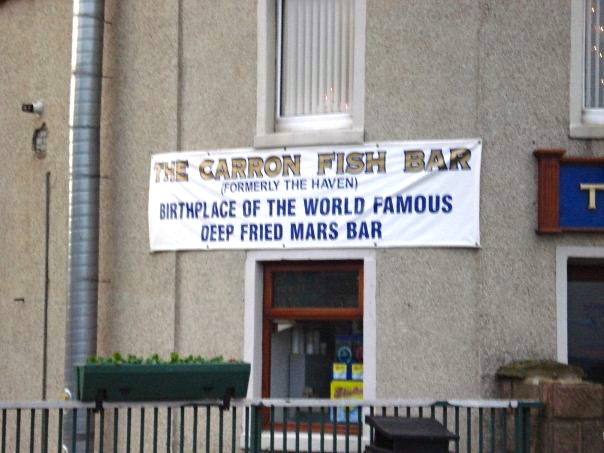
When I mentioned this to various friends, their response was to shrug and to comment that, well, did I expect anything better of Scottish attitudes towards food? This seemed only to have been confirmed by the fact that I had spotted a banner in Stonehaven, proudly proclaiming a local pub as the ‘birthplace’ of the deep-fried Mars bar.

The (alleged) home of the deep-fried Mars bar, in Stonehaven.

The (alleged) home of the deep-fried Mars bar, in Stonehaven.

With its reputation for heavy drinking, and enthusiasm for a cuisine that makes a virtue of the deep-fat fryer, Scotland is not usually held up as a paragon of culinary sophistication. But anyone who visits the country realises that it’s possible to eat well – very well – there: that there are interesting independent food shops, farmers’ markets, local producers of smoked fish, venison, biscuits, and other specialities, and plenty of excellent restaurants.

So why, then, this insistence that Scottish cuisine is best exemplified by White Lightening cider (which sold at around 8% alcohol per volume, before being discontinued by its producer for encouraging heavy drinking) and deep-fried fast food?

The idea of Scotland as a land of clans, tartan, country dancing, and highland games was invented during the late eighteenth and nineteenth centuries. As Hugh Trevor-Roper explains in Eric Hobsbawm and Terence Ranger’s classic The Invention of Tradition (1983), ‘the whole concept of a distinct Highland culture and tradition is a retrospective invention.’* Until the seventeenth and early eighteenth centuries, Scotland was connected, culturally, to Ireland. The construction of the ‘Highland tradition’ was an attempt to create a distinct, unique Scotland. It was adopted in three stages:

First, there was the cultural revolt against Ireland: the usurpation of Irish culture and the re-writing of early Scottish history… Secondly, there was the artificial creation of new Highland traditions, presented as ancient, original and distinctive. Thirdly, there was the process by which these new traditions were offered to, and adopted by, historic Lowland Scotland: the Eastern Scotland of the Picts, the Saxons and the Normans.

This process was consolidated in the early- to mid-nineteenth century, with the popularity of Sir Walter Scott’s novels about an idealised Scotland, and the Victorian ‘discovery’ of the country. As clothing, music, and language were co-opted in this remaking of Scotland, so was food: shortbread, oats, smoked fish, haggis, and neeps and tatties also became emblematic of this new, imagined nation.

Sometimes Scotland does itself no favours - in Edinburgh, near the Grassmarket.

Sometimes Scotland does itself no favours – in Edinburgh, near the Grassmarket.

These dishes and ingredients not only represented Scotland, but Scottish people themselves. Stereotyped as hardy, brave, and prudent, this was the frugal, healthy fare of a nation accustomed to preparing for hard times. Even the national drink – whiskey – was to be drunk slowly, and in small quantities. Advertisements for Scottish produce in the twentieth century urged mothers to buy Scottish oats so that their children would grow up to be as big and strong as Scotsmen wielding the cabers, stones, and hammers of the highland games.

So when, then, did Scotland’s reputation for bad eating originate? As far as I can see, over the course of the twentieth century, reports on Scotland’s bad eating habits have usually accompanied descriptions of poor, urban working-class life, particularly in Glasgow and Edinburgh. In the fiction boom of the late 1980s and early 1990s, best exemplified by Irvine Welsh’s Trainspotting (1993), the rural idyll of the highland myth, or the uptight, anxious middle-class hypocrisy described in Muriel Spark’s 1961 novella The Prime of Miss Jean Brodie, the desperation and dysfunction of Scotland’s junkies and addicts is held up as alternative way of understanding a nation coming to terms with the social and economic implications of the demise of its industries.

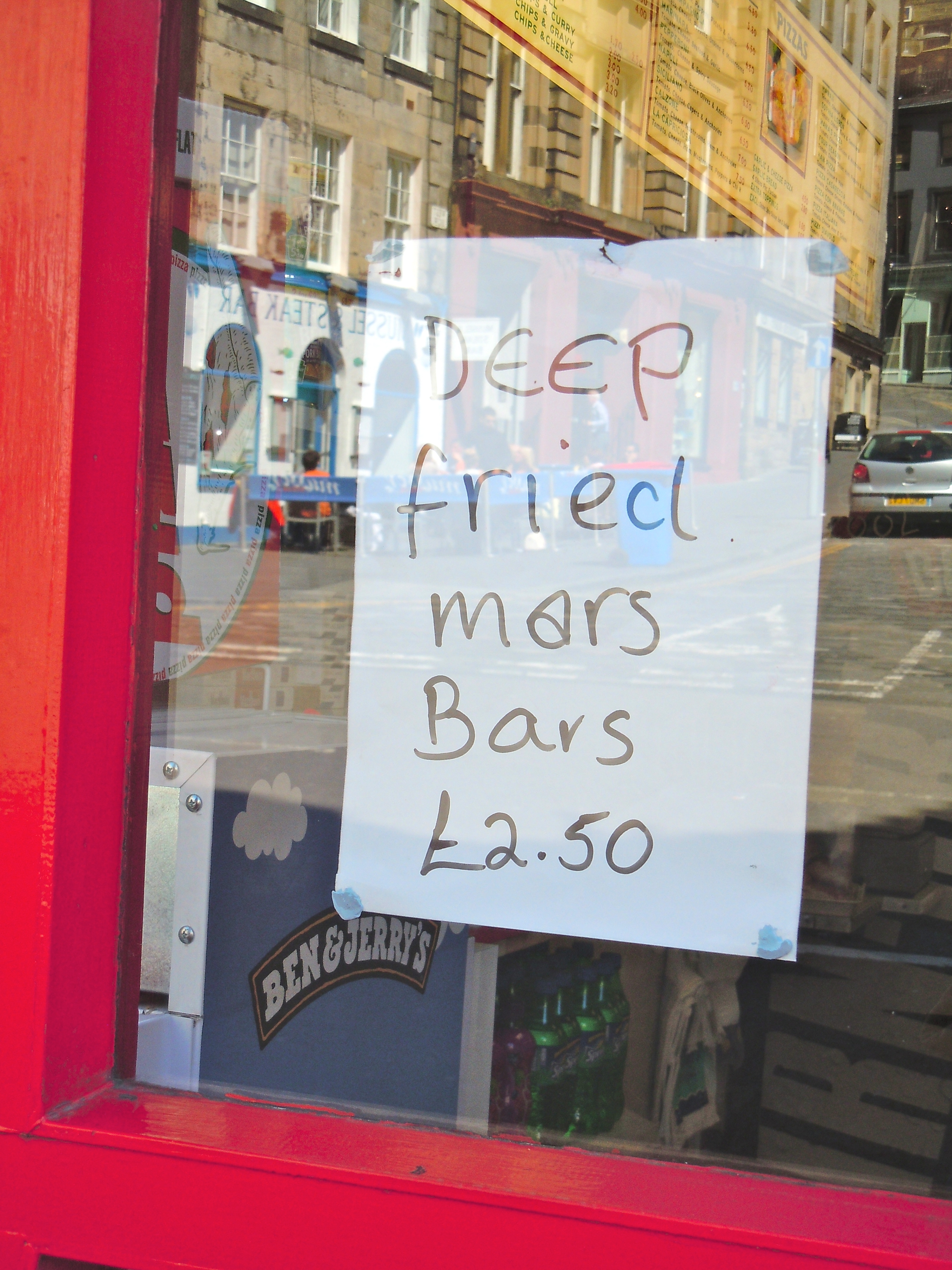
But the poking fun at deep-fried Mars Bars and the country’s heavy drinking is part of another set of attitudes to working-class people: as chavs (or ‘neds‘ as they’re called in Scotland) as people who are feckless, stupid, and self-indulgent. Their enthusiasm for deep-fried pizza, sausages, and chocolate is meant to suggest their lack of self-control and unwillingness to take responsibility for their own choices. These are the ‘scroungers’ of Tory legend.

In a review of Rian E. Jones’s new book Clampdown: Pop-cultural Wars on Class and Gender (2013), John Harris comments that the early 1990s saw a shift in British culture where working-class life became characterised – increasingly – in a set of deeply pejorative stereotypes:

The watershed in her story is the moment embodied by so-called Britpop, and lad culture, both of which encouraged a kind of class tourism, whereby many a young bourgeois could fake an interest in such totems of supposed proletarian authenticity as football, dog racing and greasy spoon cafés, all of which defined the tenor of British pop circa 1994-5… As Jones sees it, the way was thus opened for a horror show that arrived just under a decade later, when two former private schoolboys came up with the cheap and nasty cast of the hugely successful sketch show Little Britain, not least Matt Lucas’s Vicky Pollard, every right-wing trope about working-class women brought to life. Jones juxtaposes her with the infamous 1992 speech by the-then Tory minister Peter Lilley, who took aim at a ‘little list’ of ‘benefit offenders’ including ‘young ladies who get pregnant just to jump the housing list’.

Her point is that cultural expression can carry much political weight: as it turned out, the Little Britain worldview dovetailed conveniently with the programme of the current government.

Scotland’s transformation into the land of the deep-fried Mars Bar was part of this process: it was another manifestation of the ‘demonisation’ (not a term I particularly like) of the working class.

At the Edinburgh Farmers' Market.

At the Edinburgh Farmers’ Market.

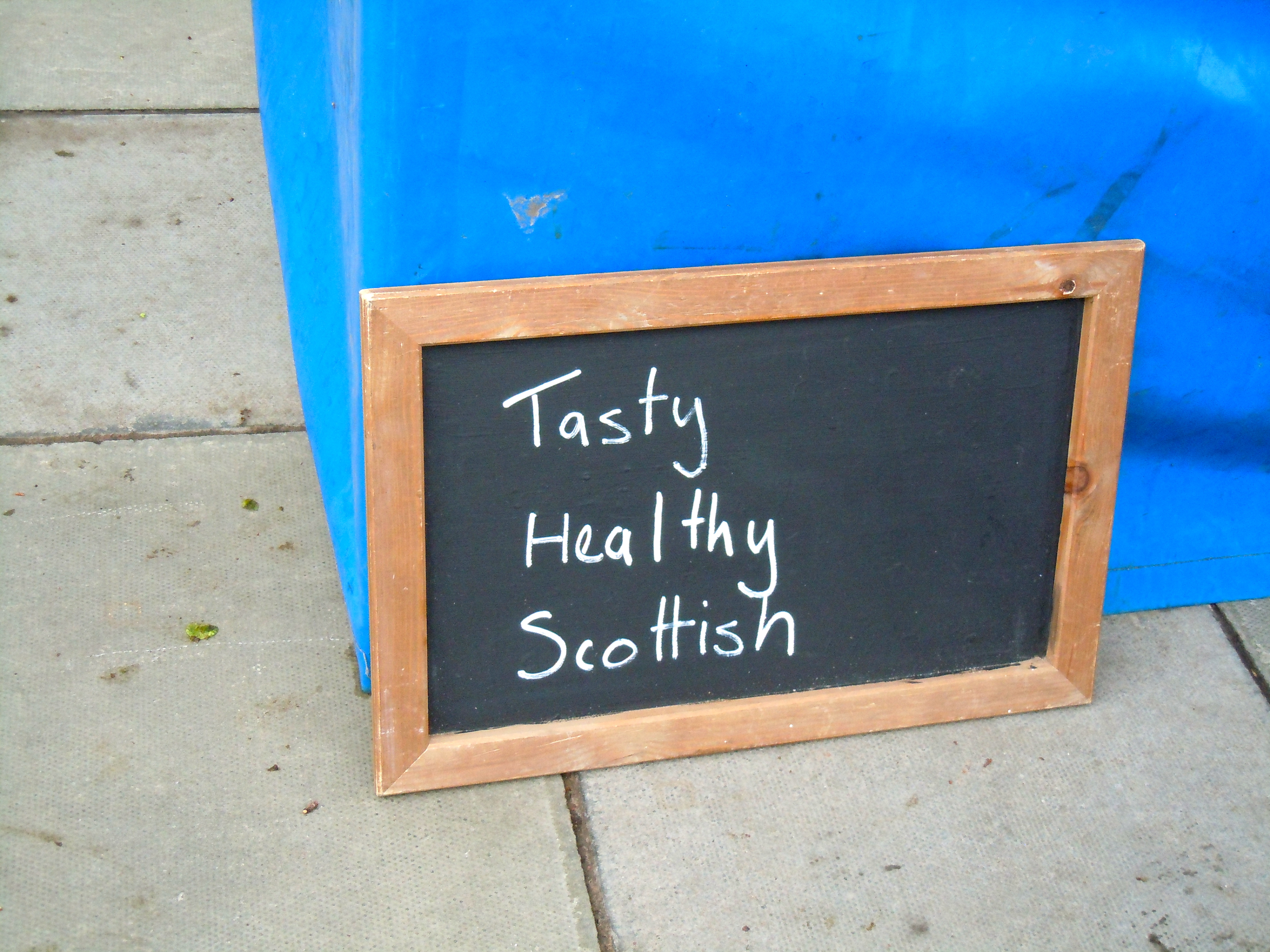
The current Scottish food revival, including even the enthusiasm for the strictly locavore ‘Fife diet,’ is also part of a process of re-imagining Scotland: one that privileges its landscape, and which positions it as a ‘green’ nation with a healthy respect for its environment, as well as its (invented) food traditions. But – and this is what, I think, prevents this outbreak of Scottish foodie-ism from being irredeemably middle-classScotland has introduced a National Food and Drink Policy, which aims to promote the sustainable production of food in the country, while ensuring that diets improve. (It’s even managed to introduce a minimum pricing law for alcohol.) It’s no use producing wonderful food, if most people can’t afford to eat it. The government in England should take note.

*This is also the Hugh Trevor-Roper who dismissed African history on the grounds that it described ‘the unrewarding gyrations of barbarous tribes in picturesque but irrelevant corners of the globe.’ So there’s that too.

Sources

Hugh Trevor-Roper, ‘The Invention of Tradition: The Highland Tradition of Scotland,’ in The Invention of Tradition, eds. Eric Hobsbawm and Terence Ranger (Cambridge: Cambridge University Press, 1983), pp. 15-41.

Creative Commons License
Tangerine and Cinnamon by Sarah Duff is licensed under a Creative Commons Attribution-ShareAlike 3.0 Unported License.