Skip to content

Posts tagged ‘Jay Rayner’

Food Links, 14.09.2011

The Observer profiles Britain’s new young farmers, Sarah Boden, Ed Hamer, and Richard Thomas.

Check out Sonia Cabano’s review of the Toffie Food Festival.

A slide show of New York’s hot dogs.

There is such a thing as honey laundering.

‘An additional Walmart Supercenter per 100,000 residents increases average BMI by 0.25 units and the obesity rate by 2.4%.’ And there are fifteen more amazing/appalling facts about Walmart here.

On changing attitudes towards restaurant staffs’ tattoos.

David Lebovitz discusses his favourite pudding recipe books – and is interviewed by the Financial Times.

Consider chocolate.

A brief history of menu design in the United States.

A list of favourite French recipes by Julia Child.

Jay Rayner interviews David Tanis, the head chef at Chez Panisse – and here are some of Tanis’s recipes.

On the history of biscuit embossing.

It would seem that the company providing food parcels to the poor in Britain…has links with the Tories. Funny, that.

Rene Redzepi explains the thinking behind his Mad Food Camp.

These flags made of food are surprisingly lovely.

More from What I Eat: Around the World in Eighty Diets.

How to chop an onion. (Thanks Mum!)

The perils of restaurant reviewing.

Food Links, 17.08.2010

A history of El Bulli.

Oh dear – it would seem that Zabar’s lobster salad doesn’t contain any…lobster.

Duck hearts on toast.

On food, design, politics, and the counterculture in 1960s San Francisco.

Hamburgers from McDonald’s don’t age….

On cooking in a small kitchen.

The Royal Academy has a new restaurant.

How utterly bizarre: a restaurant in the Ukraine which serves only pork fat moulded in a variety of forms (including Van Gogh’s ear and Marilyn Monroe’s lips).

A history of milk.

‘cookery as the counterfeiter’s art: dietary restrictions reframed as sensory surrogates’ – a dinner for vegetarians and omnivores in which it’s impossible to tell meaty and non-meaty dishes apart.

How drought becomes famine.

The science of beer.

Food Links, 10.08.2011

‘the discerning and liberal media consumer prefers: ginger and chocolate cookies; amaretti; shortbread; butter thins, and almond florentines.’ This is the study of the year.

Take a look at urban farming around the world.

On the rise of ‘White People Food’.

These are the five best and five worst proteins for our and the planet’s health (although I assume the study is US-based).

Jay Rayner asks if farmers’ markets will really change the world.

High food prices have caused an increase in the numbers of Americans eligible for food stamps.

Close-ups of food.

Here’s more on bread prices and the Arab Spring.

Will placing a tax on junk food change eating habits?

Olivier the Schutter, the UN’s Special Rapporteur on the Right to Food, argues after a visit to South Africa that the country must ‘build a food economy that benefits the majority of the population.’ The report is really worth a read.

High food prices won’t be dropping anytime soon.

Hippy kitchens.

Russia has now classified beer as alcoholic. Better late than never.

Another study shows up the link between high food prices and food-based biofuels.

Food Links, 20.07.2011

How will fracking impact on our food supply?

Partly because of its emphasis on increasing yields, the Gates Foundation, in partnership with the evil empire Monsanto, is pushing genetically engineered crops in Uganda, Tanzania, Kenya, and Malawi.

Seven food and drinks trends in the US for 2011.

Famine looms in the Horn of Africa. This is why.

Sarah Lohman cooks ‘temporal fusion cuisine’ and keeps an amazing website called Four Pounds of Flour. Here she plots changing tastes in America.

Chefs go wild about Nathan Myhrvold and Chris Young’s Modernist Cuisine: The Art and Science of Cooking.

Tom Philpott discusses the link between catastrophic flooding and industrial agriculture.

Consider corn.

There’s recently been a gloriously self-important spat between (some) South African food bloggers and food writers. This is Mandy de Waal’s excellent article for the Mail and Guardian which started it, and this is the hilariously bonkers response from one blog.

Jay Rayner considers the latest research into the relationship between meat consumption and cancer.

The UN’s Food and Agriculture Organisation reports that the world wastes or loses 1.3 billion tons of food per year – that’s a third of the total supply.

Donald Paul for the Daily Maverick discusses South Africa’s food security.

How to make Cornish pasties. (And flapjacks – crunchies to South Africans.) And in praise of sandwiches.

We could be anywhere

I’ve spent the past fortnight in New York – mainly for a conference at Columbia – and on my last morning had breakfast at a restaurant which could only have been in New York, and, more specifically, in Morningside Heights. The Hungarian Pastry Shop is a shabby, comfortable, and much adored cafe among local residents and Columbia’s students and academics. It serves a range of unbelievably good cakes and pastries, the menu for which is an ancient and faded handwritten banner above the counter. Mothers with small children munch apple strudel alongside workmen in overalls, lecturers with textbooks, and small old ladies with thick foreign accents.

The Hungarian Pastry Shop in Morningside Heights, New York

Founded by immigrants, this could only be called The Hungarian Pastry Shop outside of Hungary. Over the years, it’s been tweaked to satisfy the demands of now elderly mittel-European customers, a group of whom was sitting in the sunshine when I arrived, as well as the undergraduates who spend long hours reading over its big mugs of strong coffee. The Shop has a menu in German and table service, as well as an exterior decorated with murals, a graffiti-covered loo, and posters advertising digs, extra tuition, and auditions for student productions.

Breakfast at the Hungarian Pastry Shop

Over a cherry danish, orange juice, and iced coffee, I considered a comment made by my friend Ester a few weeks ago when we had lunch at a new cafe which has recently opened in Cape Town. Skinny Legs and All (yes, as in the novel by Tom Robbins) in Loop Street serves ‘real food, unadulterated, and unadorned’. We had homemade lemonade, soup, and excellent coffee.

As we were admiring the cafe’s interior, Ester noted perceptively that we could have been anywhere – that we could have found this restaurant and eaten similar food, underpinned by the same values and ideas about cooking, in any other city with a demand for sophisticated good food, be it Melbourne, San Francisco, or London. I think that this is a point worth exploring.
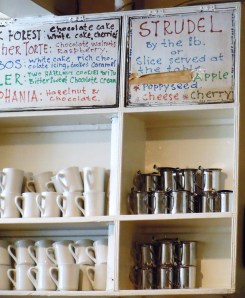
The menu at the Hungarian Pastry Shop

In New York I had coffee and lunch in cafes which I could have described in precisely the same terms. At Bubby’s in Brooklyn’s Dumbo, Tablespoon in the Flatiron District, and the City Bakery off Fifth Avenue I could have been anywhere. Of course, all of these restaurants say a great deal about New York, its gentrification and the role of food and restaurants in this process. The City Bakery was founded in 1990, at a time when the slow regeneration of Manhattan was nearing completion and when enthusiasm for artisan bread (best exemplified by the craze for sourdough in San Francisco) was beginning to peak. Bubby’s and Tablespoon – both of which emphasise the extent to which they source seasonal ingredients locally – ride on the City Bakery’s success. In a similar way, Skinny Legs and All is an indicator of the success of Cape Town’s central city improvement district, and also of the very, very slow emergence of a food-focussed South African green movement.

For all their localism, these restaurants are very similar: they serve similar food, they’re influenced by the same collection of chefs and food writers, their attitude towards cooking is based on an understanding of the value of seasonality, and they are influenced by global fashions in decor. Even the cafe I went to in achingly cool Williamsburg – populated by hipsters who conformed pleasingly to type with oversized sunglasses, topknots (for the girls), v-necked t-shirts (for the boys), and MacBooks – could as easily operate in Cape Town’s Woodstock, or in the trendier parts of east London.

Tablespoon in the Flatiron District

To note this similarity isn’t a criticism – it’s simply to point out that these cafes are local manifestations of a global phenomenon. But not all aspects of globalised eating are seen in such positive terms. Since the 1980s at least, there has been a heightened concern that globalisation is causing diets to become homogenised: that the international popularity of fast food chains, supremely McDonald’s, signals the end of discrete, local food cultures.

The apparent ubiquity of the golden arches seemed to indicate a kind of culinary ‘end of history’: as liberal democracy appeared to triumph with the collapse of the Soviet Union, so did the eating habits of the West. The opening of a branch of McDonald’s in Red Square in Moscow in 1990 was the final nail in communism’s coffin. I remember clearly going to eat at one of the first McDonald’s to open in South Africa after the end of the international business boycott. Eating there was as much an affirmation of South Africa’s re-entry into the world as was the country’s participation in the 1992 summer Olympics.

I think it’s fair to say, though, that McDonald’s no longer means these things – which isn’t to suggest that it’s not doing well. A recent article in the Economist predicts that McDonald’s and other budget chains, like Aldi, are set to profit out of a world in recession. However much revelations about the chain’s profoundly unhealthy products and poor environmental and labour practices have dented its apparent invincibility, it is still believed to be part of a broader shift in an international Westernisation of diet. This was confirmed, apparently, by Oxfam’s recent report on the global food crisis, Growing a Better Future, which claims that pasta is the world’s favourite food.

The City Bakery, off Fifth Avenue

But is this anything new? And it is possible for all of us, truly, to eat the same diet? As I wrote a few weeks ago, the survey on which Oxfam bases its report on favourite foods seems to be pretty dubious to me. It’s also worth noting that the success of global brands depends on their ability to ‘localise’ their products. McDonald’s has diversified its menu to appeal to local tastes, with a greater number of vegetarian options in Indian branches, smaller portions in Japan, rice products in Singapore and Taiwan, kebabs in Isreal, and pita bread in Greece. In other words, the success of McDonald’s lies not in the imposition of a foreign brand, but in its ability to make its products at once familiar and enticingly exotic.

Restaurants on the upper end of the scale use precisely the same strategy. Writing about the opening of a branch of Les Halles in Tokyo, Anthony Bourdain describes how he adapted his French bistro cuisine to suit Japanese tastes:

I…scale[d] down the portions and [prettied] up the presentations. …I rearranged plates to resemble smaller versions of what we were doing in New York: going more vertical, applying some new garnishes, and then observing customer reactions. I looked for and found ways to get more colour contrast on the plates, moved the salads off to separate receptacles, stuck sprigs of herb here than there.

At Gordon Ramsay’s restaurant Verre in Dubai, the head chef had to become accustomed to cooking halal meat, which is drained of much of its blood and can’t be aged. Jay Rayner writes:

Then there was local taste. Some ingredients simply didn’t sell. If he brought in pigeon, he told me, they would lie in the fridge for a week, neglected by the customers, until, in desperation, he would turn them into a terrine. ‘And then I would eat the terrine.’ He also found himself serving a lot of meat well done.

On a domestic scale, the middle classes have eaten strikingly similar things all over the world since at least the nineteenth century. The movement of people within the British Empire caused the same dishes and menus to be served up on at last four different continents. When Abbie Ferguson and Anna Bliss arrived at the Cape from Connecticut in 1873 to establish an elite girls’ school, they were pleased – and relieved – to find that their middle-class Dutch-Afrikaner hosts ate the same meals, and in the same way, as they had done in the United States. Bliss wrote to her mother:

thus far I have seen quite as well regulated families & as much attention paid to ‘propriety’ as in America. … Wherever I have taken a meal there has been a servant in the room to wait on table or one has come at the tap of the bell, & all done so quietly & orderly.

The circulation of recipe books and advice on cookery in newspapers and in private correspondence around the Empire demonstrates the extent to which these diets remained fairly similar. They were, as today, inflected by local tastes and produce. In the Cape, the American teachers commented on the colonial habit of eating ‘yellow rice’ (rice cooked with turmeric and raisins and flavoured with cinnamon and bay) with every meal – something introduced by slaves from southeast Asia during the seventeenth and eighteenth centuries.
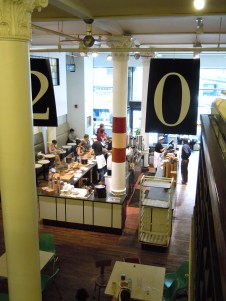
The City Bakery, New York

In other words, the diets of the wealthy have tended to be fairly globalised since international travel was made easier, and more common, from around the beginning of the nineteenth century. With the invention of the jet engine in the mid-twentieth century and, latterly, the internet, these trends have moved around the world more quickly and we’re also considerably more aware of them. It’s the poor – those whose diets we have an unfortunate tendency to romanticise – who have historically tended to eat a fairly limited range of things.

The difference now is that there are far more middle class people wanting to eat similar diets. Oxfam also notes that the newly-affluent Indian and Chinese middle classes consume more meat and dairy products than ever before. Exactly the same trend occurred in Europe during the 1950s and 1960s, but this was a shift on a far smaller scale and in a world where food systems were not as globalised as they are today.

How to find the City Bakery

I think that it’s misleading to suggest that diets are becoming progressively more Western. Rather, particular ingredients – meat and dairy above all – are increasingly popular in societies which, traditionally, have tended to eat more fish, vegetables, and other starches. Our planet simply can’t sustain meat- and dairy-heavy diets. Refocusing our attention to responding to the demand for these foodstuffs would be considerably more effective than simply bemoaning the Westernisation and homogenisation of global diets. This is an argument which not only draws an impossible distinction between ‘bad’ global and ‘good’ local diets, but also ignores a long history of global culinary exchange which has been mitigated by local tastes and preferences.

Further Reading

Texts quoted here:

Anthony Bourdain, Kitchen Confidential: Adventures in the Culinary Underbelly (London: Bloomsbury, [2000] 2001).

Sarah Emily Duff, ‘Head, Heart, and Hand: The Huguenot Seminary and College and the Construction of Middle-Class Afrikaner Femininity, 1873-1910’ (MA thesis, Stellenbosch University, 2006).

Jay Rayner, The Man Who Ate the World: In Search of the Perfect Dinner (London: Headline Review, 2008).

James L. Watson (ed.), Golden Arches East: McDonald’s in East Asia (Stanford: Stanford University Press, 1997).

Other sources:

Warren Belasco, Meals to Come: A History of the Future of Food (Berkeley: University of California Press, 2006).

Rick Fantasia, ‘Fast Food in France,’ Theory and Society 24 (1995), pp. 201-243.

Claude Fischer, ‘The “McDonaldisation” of Culture,’ in Food: A Culinary History from Antiquity to the Present, eds. Jean-Louis Flandrin and Massimo Montanari, English ed. by Albert Sonnenfeld (New York: Columbia University Press, 1999), pp. 530-547.

Brian Harrison, ‘The Kitchen Revolution,’ in Consuming Passions: Food in the Age of Anxiety, eds. Sian Griffiths and Jennifer Wallace (Manchester: Mandolin, 1998), pp. 139-149.

Harvey A. Levenstein, ‘The Perils of Abundance: Food, Health, and Morality in American History,’ in Food: A Culinary History from Antiquity to the Present, eds. Jean-Louis Flandrin and Massimo Montanari, English ed. by Albert Sonnenfeld (New York: Columbia University Press, 1999), pp. 516-529.

Creative Commons License Tangerine and Cinnamon by Sarah Duff is licensed under a Creative Commons Attribution-ShareAlike 3.0 Unported License.

Food Links, 25.05.2011

I think Lorraine Pascale is utterly fantastic.

Michael Pollan adds a few more food rules.

‘The world would be a better, safer place, freer and more democratic, if our cheese and onion crisps tasted better.’ Yes, well: on the science of tasting food.

Harriet Deacon writes about food nominations to the Intangible Heritage Convention.

The world’s top 50 restaurants were announced recently. This is an incredible video about the restaurant ranked 28 – Combal Zero in Italy.

The loquat harvest is about to begin in Los Angeles.

It’s lambing season in the northern hemisphere.

AA Gill talks about eating and reviewing food.

Food Links, 20.04.2011

Annia Ciezaldo investigates what a ‘Mediterranean diet’ really is, and asks if actually exists (particularly in the Mediterranean).

Jay Rayner reviews Gordon Ramsay’s revamped Savoy Grill.

Big food companies lobby the US government in the same way as the tobacco and gun industries. This article exposes the tactics of the American Beverage Association, the lobbying arm of the country’s softdrink companies.

Tom Philpott discusses the recent report by Bon Appetit on the conditions of farm labourers in the US.

Anna Lappe encourages consumers to pressure governments to fund sustainable, climate-friendly agriculture.

I’m fascinated by the American counter-culture movement’s enthusiasm for ‘whole’ food and sustainable agriculture during the 1960s and 1970s. Melissa Coleman has written what sounds like a riveting memoir of growing up on her parents’ pioneering organic farm. (Her father, Eliot Coleman, is something of an organic guru. Yes, I chose ‘guru’ deliberately.)

GOOD provides a useful guide to the best metaphors invented by British restaurant critics.

‘for all its monuments to material consumption, this town is a culinary desert or, perhaps more accurately, parking lot’ – Nic Dawes eviscerates the Joburg restaurant scene.

Be Modern: Worship Food?

On Monday evening I watched the first episode of the latest series of Australian MasterChef to be broadcast in South Africa. The previous series was so wildly popular here that I was interested to see what the fuss was about. Based on the latest incarnation of the MasterChef franchise in the UK, over the course of a few weeks the programme whittles down a group of fifty aspiring cooks to a four or five finalists who are put through a series of challenges – working a shift in a hotel kitchen, recreating a chef’s impossibly complicated signature dish (I hate the term) – until only one contestant emerges triumphant. It’s fun, self-important, and utterly ridiculous.

And then, towards the end of this first episode of season two, an audience of at least sixty intelligent adults applauded a pavlova.

A pudding consisting of egg whites, sugar, vinegar, and vanilla received a round of applause. I mean, I lecture three times a week and I’m never applauded.

Donna Hay's adored pavlova

I love pavlova and the MasterChef version – baked and unveiled by Donna Hay – looked fantastic, and I really don’t have much against reality TV shows (I can’t – I was once badly addicted to the second series of My Restaurant Rules.) And, to be fair, to accuse MasterChef of not being adequately realistic would be to miss the point. The British version is hosted and judged by two middle-aged men who yell things like ‘Cooking doesn’t get tougher than this!’ at the camera. It’s a competition and no attempt to train a new generation of chefs. But the round of applause and the reverence for a pudding struck me as being more than silly. It was, in fact, too serious.

MasterChef is like many other reality shows: it judges contestants on their ability at a particular skill. This skill can be anything – from fashion design to hairdressing – because it’s secondary to the format of the programme. It’s the vehicle for television series which are, essentially, talent shows, but on a more elaborate and glamorous scale. The adulation of the pavlova undermined this format. All of a sudden, the focus of that episode of MasterChef shifted from the contestants to the food.

Am I overreacting? Probably. But not without reason. Earlier that day I had read an article written by Angela Carter in 1984 for the London Review of Books, in which she reviewed The Official Foodie Handbook by Ann Barr and Paul Levy, Elizabeth David’s An Omelette and a Glass of Wine, and Alice Waters’s Chez Panisse Menu Cookbook. While she acknowledged that the Foodie Handbook was meant to lampoon middle-class ‘foodies’, it is was one of a series of guides – like the Sloan Ranger and Yuppie handbooks – to middle-class living which, she felt, walked an uneasy line between guide and satire. Writing about the Preppy Handbook she noted:

The book was an ill-disguised celebration of the snobbery it affected to mock and, under its thinly ironic surface, was nothing more nor less than an etiquette manual for a class newly emergent under Reaganomics. It instructed the nouveaux riches in the habits and manners of the vieux riches so that they could pass undetected amongst them. It sold like hot cakes.

Along with David and Waters, the authors of the Foodie Handbook elevate the preparation and eating of food to a rarefied art form only done ‘properly’ by those educated and sensitive enough truly to understand cooking. The book advised its readership: ‘Be modern: worship food!’ Carter was, like Jay Rayner and Anthony Bourdain, particularly scathing of Alice Waters:

Alice Waters [serves] a Franco-Californian cuisine of almost ludicrous refinement, in which the simplest item is turned into an object of mystification. A ripe melon, for example, is sought for as if it were a piece of the True Cross. Ms Waters applauds herself on serving one. ‘Anyone could have chosen a perfect melon, but unfortunately most people don’t take the time or make an effort to choose carefully and understand what that potentially sublime fruit should be.’ She talks as if selecting a melon were an existential choice of a kind to leave Jean-Paul Sartre stumped.

She concludes, gloriously:

Ms Waters has clearly lost her marbles through too great a concern with grub, so much so that occasionally ‘Alice Waters’ sounds like a pseudonym for S.J. Perelman. ‘I do think best while holding a tomato or a leg of lamb,’ she confides. For a person of my generation, there is also the teasing question: could she be the Alice, and ‘Chez Panisse’ the real Alice’s Restaurant, of the song by Arlo Guthrie? And if this is so, what does it prove?

Carter bases much of her criticism of the Foodie Handbook, Waters, and Elizabeth David on the grounds of insensitivity: how is it possible to be so precious about food, she asks, when so many people go without? I agree that there is something profoundly wrong with a world where some populations have so much food that they feel that they should spend a day searching for the perfect watermelon, while others starve or are reliant on the tender mercies of aid organisations.

We have, though, always imbued food with meaning. Food provides nourishment, but it also carries with it a range of assumptions, symbols, and signs which are occasionally as important as its primary function. When Spanish missionaries in sixteenth-century Mexico refused to celebrate communion using maize, instead of wheat, wafers, they did so purely on the grounds that wheat, an imported crop, represented Europe and, thus, civilisation. Similarly, when well-meaning lady food reformers attempted to ‘Americanise’ the cuisine of recent immigrants to the United States during the 1920s, they did so because the cooking of Italy, Poland, and Ireland was seen as less ‘civilised’ than that prepared by white, Protestant Americans.

Pears' Soap - The White Man's Burden

There is a difference, though, between the association of food with civilisation and cultural superiority and giving a round of applause to a pavlova – or, indeed, to a melon. In Imperial Leather: Race, Gender, and Sexuality in the Colonial Context (1995), Anne McClintock examines the ways in which Victorian advertisers used images of empire to sell their products. Pears, the soap manufacturers, produced a series of advertisements which implied that soap was somehow connected to the success of British imperialism. In one of their best known ads from the early 1890s, a sea captain – surrounded by images of travel and conquest – is depicted washing his hands in his ship. It’s captioned: ‘The first step towards lightening the white man’s burden is through teaching the virtues of cleanliness.’ Another titled ‘The Birth of Civilisation’ is of an African man holding aloft a bar of soap which has floated ashore after a shipwreck.

This campaign crudely linked cleanliness – long associated with being ‘civilised’ – with the civilising mission. Colonised people, suggested Pears, could be made European by a bath with Pears soap. In the first volume of Capital (1867), Karl Marx began to develop the idea of ‘commodity fetishism’ to explain the kind of ‘magical’ attraction and meaning which commodities – ordinary, manufactured objects – seem to exude. He argued that a range of meanings – which are socially and culturally inflected and which change over time – are attached to commodities. Capitalism encourages people to confuse the utility of the object and social meanings – this is what Marx called ‘commodity fetishism’. In other words, objects take on meanings to the extent that they assume a kind of independence from their utility. The purpose of soap was no longer to clean bodies and clothes, but, rather, to civilise.

Pears' Soap - the Birth of Civilisation

A similar process occurred with the pavlova on MasterChef: it was no longer simply a pudding, but, rather, representative of success and good taste. When one of the contestants in the final round produced what she thought would be a bad pavlova, she collapsed in tears and refused to continue. It was as if it was she – rather than her ability to bake a pudding – who was being tested. When Alice Waters hunted for the perfect melon, she was not only seeking out a fruit, but also an object which embodied what she believed to be her goodness and moral superiority.

I wouldn’t be writing this post if I thought that this strange affliction was limited to Californian chefs and anxious Australians. Look at food magazines and food programmes: aimed at middle-class audiences, they conflate being able to cook well and to eat good – whole, organic, humanely reared – food with being good, successful, and environmentally and socially responsible. I have absolutely nothing against farmers’ markets, artisan bakers, small-scale farmers, co-operative supermarkets, and organic grocers – in fact, I think that they’re helping to create new ways of thinking about food – but I am deeply concerned when their produce is no longer thought of simply as food, but becomes a marker of middle-class morality.

This form of commodity fetishism is limiting: it associates good food with class and wealth. It encourages those who consume this food to think only about the product which they buy, and not to consider the complex processes which brought that piece of cheese or that steak to their deli or supermarket. It also mystifies the production, preparation, and eating of food. If we are to become more careful eaters – and more aware of how our eating habits impact on the world around us – we need to see food as food: as a product which is fundamental to life and which all people have a right to eat.

Further Reading

Texts quoted here:

Donna R. Gabaccia, We are what we eat: Ethnic food and the making of Americans (Cambridge MA: Harvard University Press, 1998).

Karl Marx, Capital: Capital: A Critique of Political Economy, vol. I, trans. Ben Fowkes (New York: Penguin, [1867] 1990).

Anne McClintock, Imperial Leather: Race, Gender and Sexuality in the Colonial Context (New York and London: Routledge, 1995).

Jeffrey M. Pilcher, ¡Que vivan los tamales! Food and the Making of Mexican Identity (Albuquerque: University of New Mexico Press, 1998).

Other sources:

Timothy Burke, Lifebuoy Men, Lux Women: Commodification, Consumption, and Cleanliness in Modern Zimbabwe (London: Leicester University Press, 1996).

Hasia Diner, Hungering for America: Italian, Irish, and Jewish Foodways in the Age of Migration (Cambridge: Harvard University Press, 2001).

Yves Péhaut, ‘The Invasion of Foreign Foods,’ in Food: A Culinary History from Antiquity to the Present, eds. Jean-Louis Flandrin and Massimo Montanari, English ed. by Albert Sonnenfeld (New York: Columbia University Press, 1999), pp. 457-470.

<a rel=”license” href=”http://creativecommons.org/licenses/by-sa/3.0/”><img style=”border-width: 0;” src=”http://i.creativecommons.org/l/by-sa/3.0/88×31.png&#8221; alt=”Creative Commons License” /></a>
Tangerine and Cinnamon by <a rel=”cc:attributionURL” href=”https://tangerineandcinnamon.wordpress.com/”>Sarah Duff</a> is licensed under a <a rel=”license” href=”http://creativecommons.org/licenses/by-sa/3.0/”>Creative Commons Attribution-ShareAlike 3.0 Unported License</a>.

Creative Commons License
Tangerine and Cinnamon by Sarah Duff is licensed under a Creative Commons Attribution-ShareAlike 3.0 Unported License.

Food Links, 06.04.2011

Starting today, I’m going to post a weekly collection of interesting, food-related links. There’s simply so much around that I hope you’ll find this a useful digest. (So to speak.)

Robert Paarlberg disagrees that farm subsidies are connected to low food prices in the US, and argues that they’re not responsible for the country’s obesity crisis.

Civil Eats published this fantastic infographic mapping how much of its income the population of each country spends on food. (I discuss this post here too.)

It seems that Jamie Oliver’s excellent school dinners campaign is coming unstuck. I really, really don’t understand why spending money on feeding children good, nutritious food should be controversial.

After the Guardian‘s prank, this is my favourite April Fools Day post for 2011.

Mark Bittman fasts for four days.

Jay Rayner reviews Modernist Cooking by Nathan Myhrvold and Chris Young, and weighs up the usefulness of cooking sous vide.

The evidence that sustainable farming will be able to feed the world continues to grow.

And because this blog has developed something of a sheep fixation, lambing season has begun in the UK.