Skip to content

Food Links, 16.07.2014

  • The grotesque opulence of London’s restaurants.
  • The true cost of a burger.
  • America’s favourite foods. And Americans should eat more vegetables.
  • The value of school feeding programmes.
  • Why food in the US is becoming more expensive.
  • Will crickets be the next popular snack?
  • On Crumbs, a documentary about a South African bread cartel.
  • A sausage cartel.
  • There is a lot of sugar in soft drinks.
  • Will people switch to lab-grown meat?
  • The rise and rise of sour espresso?
  • Accidentally ingesting a poisonous plant.
  • A guide to African cuisines.
  • Baking with local flour.
  • Beenapping.
  • Silly restaurant names.
  • A secret sandwich loaf.
  • Culinary Canvas.
  • Testing chocolate hazelnut spread.
  • Cakes of bread.
  • A phone travels around the world in a shipment of grain.
  • Three pears.
  • A guide to summer fruit.
  • David Lebovitz on living in Paris.
  • Cosy apples.
  • A carpenter bee, covered in pollen.
  • How to confuse a tomato.
  • Recipe tattoos.
  • Brando and bacon.
  • How to grow liquorice.
  • The joy of British puddings.
  • The absinthe trail.
  • What was the ultimate medieval aphrodisiac?
  • Things to do with avocados.
  • Making Persian rice.
  • The women who have fed Austin.
  • How to make iced coffee.
  • ‘The crisp buoyed Britain in its darkest hour.’
  • Recipes from the Wellcome Library’s collections.
  • Byzantine rice pudding.
  • Photographs of street food in London.
  • Black battenberg.
  • ‘One British observer noted that the loss of coffee “afflicts the Confederates even more than the loss of spirits,” while an Alabama nurse joked that the fierce craving for caffeine would, somehow, be the Union’s “means of subjugating us.”’
  • A century of the fridge.
  • Thomas Jefferson’s recipe for vanilla ice cream.
  • Make your own vanilla extract.

Icing on the Cake

When I lived in London and commuted between Holloway Road and Goldsmiths in Lewisham, one of my favourite moments in my journey was when the train slowly rounded the bend into Cannon Street Station. On my right, the skyscrapers and churches of the City came into view, and if I looked quickly, I’d spot the spindly, delicately ornate spire of St Bride’s Church in Fleet Street, traditionally the spiritual home of Britain’s journalists.

I’ve been thinking of St Bride’s rather a lot recently. This is turning out to be a year of weddings: my best friend’s in Canada, my sister’s in February 2015, and at least two in-between. Although four very different weddings in terms of size, formality, and religiosity, I’ve been amused by how vehemently each of the couples has not wanted an old-fashioned wedding cake.

I have a dim memory of that kind of cake – comprised of dense fruit cake and covered in a thick layer of marzipan and royal icing so sturdy it could be used to plaster houses – from a cousin’s wedding in the late 1980s, where I was a not particularly successful flower girl. (I didn’t realise that my role was to hold the bride’s bouquet during the ceremony. And I refused to be in any of the photographs. I still have no idea why.)

Cake and sweet things have been eaten at weddings around the world for thousands of years, to symbolise fertility, wealth, and a sweet life for the couple. But the vogue for large, white wedding cakes is a more recent phenomenon. What we think of as traditional wedding cakes originated in Britain during the Victorian period, and was based on the sweet, fruit-heavy bride’s cake served at early modern weddings to ensure the luck and fertility of the bride. The myth is that William Rich, a baker apprenticed near Christopher Wren’s St Bride’s church with its tiered steeple, modelled his own multi-layered wedding cake on Wren’s design.

St Bride's Church, Fleet Street

St Bride’s Church, Fleet Street

To some extent, the British royal family popularised tall, ornately decorated cakes. Queen Victoria’s 1840 wedding cake seems to have been a consisted mainly of decorations:

This royal cake weighs nearly 300 lb. weight. It is three yards in circumference, and about fourteen inches in depth or thickness. It is covered with sugar of the purest white; on the top is seen the figure of Britannia in the act of blessing the illustrious bride and bridegroom, who are dressed somewhat incongruously in the costume of ancient Rome. These figures are not quite a foot in height; at the feet of his serene highness is the effigy of a dog, said to denote fidelity; and at the feet of the queen is a pair of turtle doves, denoting the felicities of the marriage state. A cupid is writing in a volume expanded on his knees the date of the day of the marriage, and various other cupids are sporting and enjoying themselves…

Simplified designs were copied by an emergent Victorian middle class, eager to show off their good taste and wealth through increasingly elaborate weddings. These cakes were expensive: white sugar cost more than the unrefined brown, and bakers needed to be trained in the art of piping royal icing, a fashion imported from the continent.

The double layer of marzipan and royal icing had a practical function too: not only were pieces of cake sent home with guests and to family and relations far away, but the top tier of the cake was kept for the christening of the couple’s first child, or to be eaten a year later for luck.

As the meanings of weddings and marriage have changed, so has the significance of wedding cake. At recent weddings, I have eaten carrot, chocolate, and red velvet cake. Although decorated elaborately, these are not cakes to be kept, but rather to be eaten as pudding at the end of the reception. But although couples are choosing to reinvent wedding cakes, these cakes are as full of meaning as they were in the nineteenth century.

As a recent report in the Atlantic argued, particularly in the West, marriage and weddings are an increasingly middle-class phenomenon – and I think that some of its arguments describe changes which have occurred beyond the West too. Olga Khazan explains:

Culturally, young adults of all social classes and income levels are less likely to think of marriage as the ‘cornerstone’ of their lives – that is, the first thing they do as adults. Instead, people now think of it as a ‘capstone’ – sort of a trophy for having earned a BA, obtained a job, and generally learned to live on their own for a while.

As a result of this, weddings are intended to express the likes and enthusiasms of the couple, from their clothes to the cake they serve at the reception. If anything, weddings have accrued more meaning as they occur later in couples’ lives and relationships.

The irony, though, is that the enormous wedding-industrial complex which has emerged in recent years to facilitate these increasingly elaborate middle-class weddings, has worked to settle a particular conformity on them: from the artfully posed engagement and wedding photos, to the matching outfits for attendants, and the painstaking attention to every detail from confetti to favours for the guests and the fonts used on the stationery.

My point is that wedding cakes are a particularly useful means of demonstrating how weddings are used to denote a range of meanings: from middle-class claims to respectability, wealth, and sophistication in the middle of the nineteenth century, to a marker of full entry into adulthood and financial independence in the early twenty-first century.

Creative Commons License
Tangerine and Cinnamon by Sarah Duff is licensed under a Creative Commons Attribution-ShareAlike 3.0 Unported License.

Food Links, 09.07.2014

  • ‘In 2012, fast-food CEOs earned 1,200 times as much as the average employee.’
  • Where all the world’s cattle, chickens, and pigs are.
  • ‘dietary greenhouse gas emissions in self-selected meat-eaters are approximately twice as high as those in vegans.’
  • The dietary crisis in China.
  • The politics of raw milk in the US.
  • The food stamps recipe book.
  • ‘”No added sugar” in fruit drinks will still deliver the equivalent of five teaspoons per 250ml.’
  • Michael Pollan on Big Food.
  • The growth of the Vietnamese chocolate industry.
  • A Starbucks map of the US.
  • Renaming kaffir lime leaves.
  • Race, politics, and vanilla ice cream in the American south.
  • Cooking with tinned food.
  • Terrible food photography.
  • Farming at the White House.
  • There is a bar in Sao Paulo named after Osama bin Laden.
  • How to choose gin.
  • Rethinking food packaging.
  • ‘Rising to the rafters and stretching 75 feet from paws to rump is a great sphinx, demure as her Egyptian cousin but glowing from a recent sugar coating.’
  • A tour of the Momofuko Culinary Lab’s Kaizen Trading Company.
  • So what is ‘curry‘?
  • Potentially deadly food.
  • What your coffee says about you.
  • A history of tea sandwiches.
  • The decline of the cupcake.
  • Rethinking tofu.
  • Cooking with computers.
  • Make your own yogurt.
  • Anissa Helou on bread in the Middle East.
  • People buy more books when they smell chocolate.
  • What to do with rhubarb.
  • America’s growing enthusiasm for squid.
  •  A review of the new Foyles cafe.
  • Lunch Poems by City Lights.
  • What Neanderthals really ate.
  • Things to make in a rice cooker.
  • Make your own pickles.
  • The difference between taste and flavour.
  • Pints in the Sun.
  • How to make paella.
  • The Case of the Unknown Lobsters.

Moving Goalposts

I returned to South Africa from the UK a month or so before the 2010 World Cup kicked off. Like a lot of South Africans, I had fairly mixed feelings about hosting the football: although much, if not all, of the infrastructure built for the event would turn out to be useful in the future, I and others were perturbed by the amount of money spent on preparations, and, above everything, by Fifa’s increasingly outlandish demands. Not only were small businesses penalised for using copyrighted words and images, but Fifa required special courts to run during the World Cup.

By the opening ceremony, Sepp Blatter was generally known as Septic Bladder. But, in the end and despite him and the (continuing) allegations of corruption levelled at Fifa’s leadership, there was something quite astonishingly wonderful about the World Cup. (John Oliver is particularly good on how it’s possible to love the game, but hate Fifa.) I had begun to suspect that it would be a few weeks of a particular kind of South African madness as I drove to my parents’ to watch the opening ceremony. While waiting at traffic lights, the driver of a hearse leading a funeral procession whipped out his vuvuzela, and blew it at passing traffic.

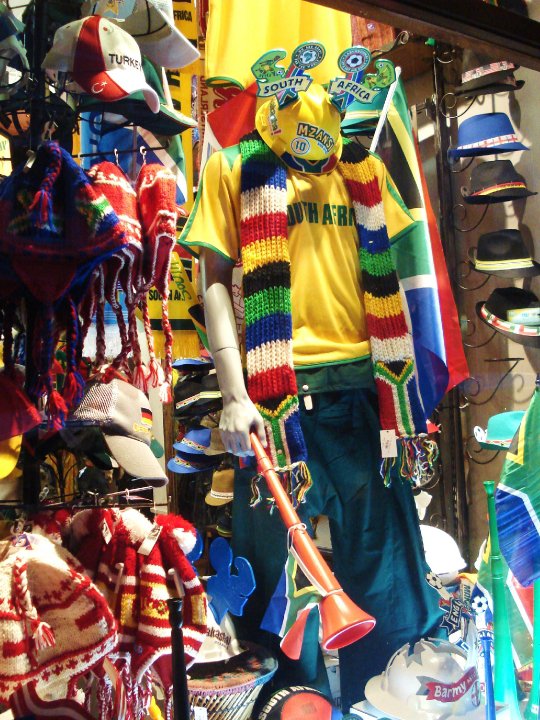
A supporters' shop in Cape Town's Long Street during the 2010 World Cup.

A supporters’ shop in Cape Town’s Long Street during the 2010 World Cup.

I wonder, though, what the legacy of the Brazil World Cup will be? Even more so than in the case of South Africa, it has shown up Fifa’s disregard for laws and the normal workings of democracy. (Will only countries with dubiously elected or appointed governments, like Qatar and Russia, be able to hold World Cups and Olympic games in the future?)

I think the best example of Fifa’s arrogance was its demand that Brazil lift its ban on drinking in stadiums for the World Cup. Instituted in 2003, this legislation was aimed at reducing violence between rival football clubs. As anyone who’s attended a World Cup match knows, the only beer (actually, ‘beer’) on sale at stadiums is Budweiser, one of Fifa’s official partners. And it was for this reason that Fifa requested that Brazil allow for the sale of beer at stadiums.

Unsurprisingly, very high levels of drunkenness have been reported at matches – so much so that even top ranking Fifa officials have noticed, and wondered if they went too far by not limiting beer sales.

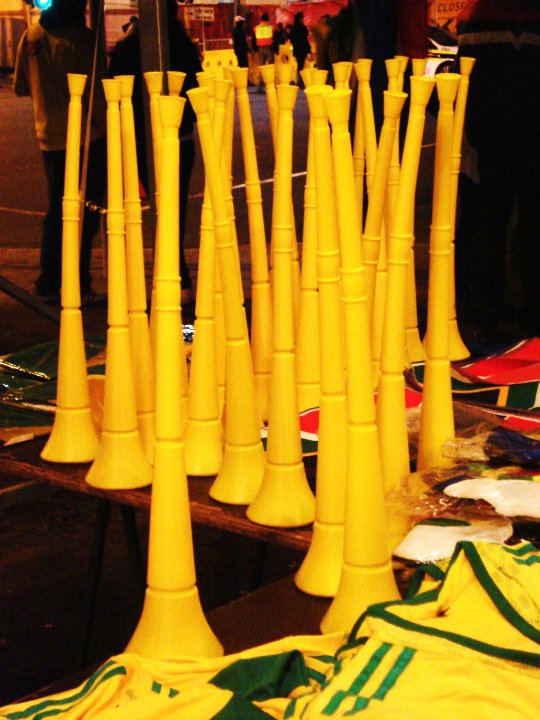
Vuvuzelas for sale in Cape Town during the 2010 World Cup.

Vuvuzelas for sale in Cape Town during the 2010 World Cup.

There has also been an outcry about Fifa’s partnership with Coca-Cola and McDonald’s. The Lancet argued recently:

The visibility and physical presence of these companies and their products is likely to be huge at the World Cup events and side events throughout Rio de Janeiro and Brazil. … Latin America is taking substantial measures to try to introduce healthy food laws to combat childhood obesity. Efforts in countries, including Brazil, have ranged from improving school food options to labelling regulations and advertising restrictions for unhealthy foods. The 2014 World Cup’s food and drink partners and sponsors represent a direct attack on these attempts to better child health.

When it is held in developing nations, the World Cup opens up new markets to Big Food.

The issue here is Fifa’s disregard for sovereignty. Because it refuses to pay taxes to host nations and demands preferential treatment for its partners, these companies have for a fairly long period of time a substantial advantage over not only local competitors, but over governments and organisations attempting to promote healthy eating. In a time of heightened social, political, and economic conflict – and when public health interventions have the potential to save developing nations millions in healthcare costs – it seems to me that the costs of hosting World Cups are beginning to outweigh the benefits.

Creative Commons License
Tangerine and Cinnamon by Sarah Duff is licensed under a Creative Commons Attribution-ShareAlike 3.0 Unported License.

Food Links, 25.06.2014

  • Facts about obesity.
  • South African farmers respond to a proposal to allow farm workers to own half of the land they work on.
  • Campaigning for a living wage at Tesco.
  • The rise and rise of Lidl.
  • ‘how, in good conscience, can the USDA recommend limiting visits to fast-food restaurants on the one hand – while helping those very restaurants sell more junk food on the other?’
  • A Coca-Cola plant in India has been closed for using too much water.
  • Artisinal foods made by prisoners in the US.
  • Farming is exceptionally dangerous.
  • The woman revolutionising the sale of camel milk in India.
  • England’s bee population has grown.
  • The gut microbiota of hunter-gatherers.
  • Think twice about low-carbohydrate, high fat diets.
  • Think twice about pomegranate juice.
  • What is ‘natural‘?
  • Jeannette Winterson makes people cross by cooking a rabbit.
  • Americans are not ready for lab-grown meat.
  • Food-shaming blogs.
  • What makes for a successful market?
  • How to use up maple syrup.
  • The viciousness of work in restaurant kitchens.
  • Why do Angus Steakhouses continue to thrive?
  • How to buy, keep, and prepare salad leaves.
  • Meals according to classical music tempo markings.
  • Eating catfish in Mississippi.
  • What do do with leftover kale stems.
  • Kosher crickets.
  • An interview with Fay Maschler.
  • A design ode to Turkish tea.
  • Making kaymak out of water buffalo milk.
  • Discovering Jamaican cuisine.
  • A better tomato sauce bottle.
  • How to make perfect toast.
  • How to use paper towels.
  • How to make dog biscuits.
  • Romagnola-style ragu.
  • Science tricks with eggs.
  • A brief history of bagels in London’s East End.
  • Diderot on chocolate.
  • No-cook summer eating.
  • The evolution of beer brewed by Trappist monks.
  • How to be a vegetarian in Stockholm.
  • Superbees.
  • You call this kale salad?
  • Hazelnut, brown sugar, and espresso biscotti.
  • Beef doves.
  • There are more museums in the US than there are Starbucks and McDonald’s.
  • A blogger drinking his way through Thomas Pynchon’s writing.
  • Slow cooked giant African land snails.
  • The connection between eugenics and keeping cake fresh.
  • New York speakeasies.
  • Normcore and sandwiches.
  • A guide to freezing baked goods.
  • Avocado toast on Instagram.
  • Snorting martini.
  • The summer of goats.

Youth must be served

This weekend the Observer predicted the demise of the hipster. Because markers of hipsterdom – like tattoos, beards, topknots, bunting, and cocktails in mason jars – have been increasingly widely adopted (moving from being exclusively hipster affectations, to being cool and then mainstream), the article asks if hipsterdom is at an end. The answer – as the piece acknowledges – is that what it means to be a hipster is evolving: that this group of young and young-ish people, most of them middle class and well educated, who seek to live in (some) ways which differ from social norms, will adopt new and different markers of their ‘otherness’.

Arts Cafe, Montreal

Arts Cafe, Montreal

Part of the problem with writing about hipsters is that they are so hard to define – which accounts, I think, for why there has been such a focus on what hipsters look like. Skinny jeans, brogues, and flat caps define hipsters more easily than a set of ideas or principles. Also, the stereotype of hipsters liking things before they were cool inevitably emphasises these ‘things’ rather than any set of reasons for liking those things. (I hope this makes sense.) With their thrift store shopping, and embrace of cooking, baking, and crafts, they have all the appearance of an enthusiasm for the handmade, the artisanal, and the environmentally friendly. But as Alex Posecznick observes:

hipsters are voracious consumers of a style that is constantly shifting desirability in order to promote endless consumption. A hidden shop selling vintage clothing is popular for a short time before it is made irrelevant the next day. They have turned consumption itself into an art, where the fine distinction of this hat over that invests cultural capital, and where although it is used and battered, it can be sold for four times the value of a new hat.

So are hipsters all show and no content? The Observer article’s distinction between proto-hipsters (those who originate what it means to be a hipster) and hipsters (those who follow, buying in to the aesthetic but not necessarily the ideals on which this outward manifestation is based) is useful here. Firstly, I would argue that what it means to be a hipster differs according to geographical context: it is different being a hipster in Johannesburg or Lagos than to being a hipster in Montreal or Melbourne or, even, Cape Town. Any suggestion that hipsters are going to disappear really is not borne out by my experiences of Joburg. Secondly, hipsters have certainly made an impact on some of the ways in which we live, particularly in cities.

Cafe Pamenar, Toronto

Cafe Pamenar, Toronto

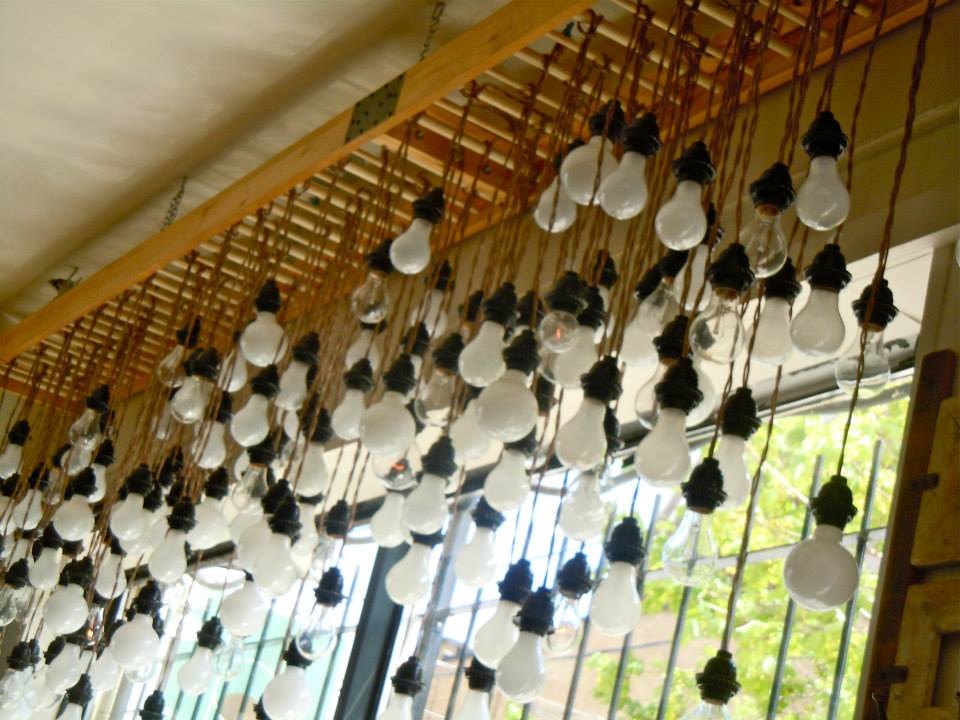
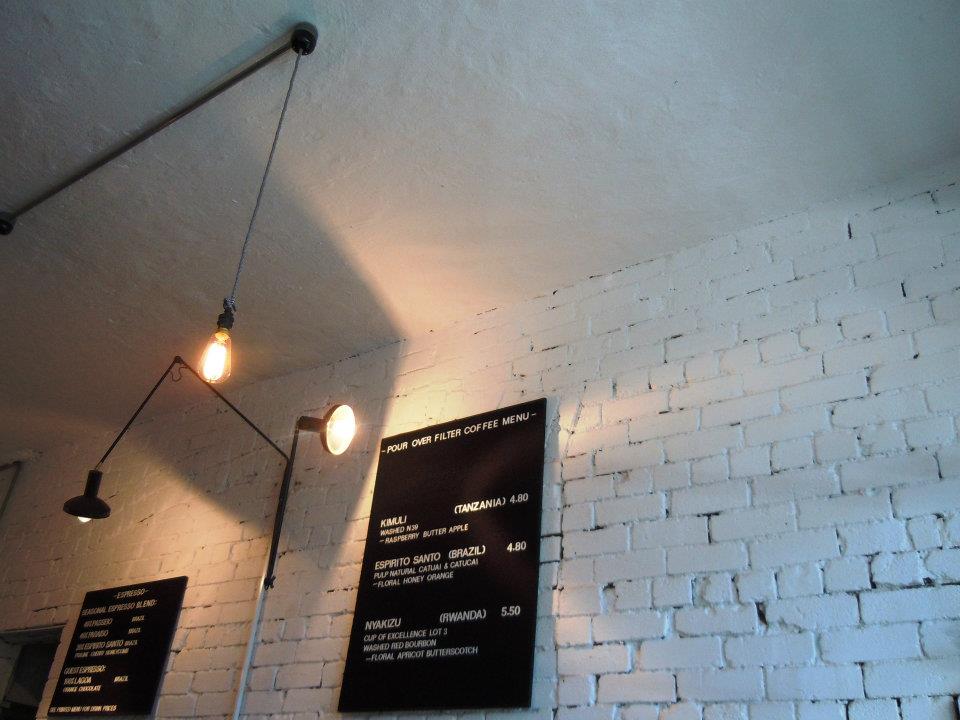
Despite my view that Joburg hipsters are really quite different from those in Brooklyn, there are some characteristics which travel quite easily over space. And one of these is the hipster café. I have eaten or drunk coffee in a series of small, independent, and fairly earnest eateries in Melbourne, Perth (yes, even Perth), London, New York, Montreal, Toronto, Cape Town, and Johannesburg which are, really, virtually interchangeable: they share the same incandescent light bulbs, wood panelling, metal stools, amazing coffee, homemade soft drinks in jam jars, and interesting food. Father in Braamfontein could just as easily change places with Café Pamenar in Toronto’s Kensington Market.

In Williamsburg, NYC.

In Williamsburg, NYC.

It is in these places that I think it’s possible to see the ideas which underpin hipsterdom, best played out: in their commitment to using organic and free range produce, in their interest in recovering and remaking old recipes, and in their enthusiasm for experimentation. Flat whites and drip and cold brew coffee originated in hipster-run cafes.

Market Lane Coffee, Melbourne

Market Lane Coffee, Melbourne

It’s difficult, though, not to have some sympathy with arguments that some hipsters are fairly clueless politically. Having witnessed the slow gentrification of lower Woodstock in Cape Town – one of the city’s most deprived and rundown areas – with hipsters opening cafes for other hipsters, and selling coffees which most of the suburb’s original inhabitants could never even dream of affording, I feel that these criticisms have a point. I was reminded of this point in an excellent review of Marc Spitz’s book Twee: The Gentle Revolution in Music, Books, Television, Fashion, and Film. A lot of the hipster aesthetic embraces twee, and this definition of twee could quite as easily apply to some iterations of hipsterdom:

twee is anti-greed and suspicious of an adult world that revolves around avarice. More importantly, twee is aware of humanity’s capacity for violence and evil, but chooses to be optimistic about human nature nonetheless. This could be a progressive stance – one that not only believes we’re capable of improvement but works toward it. In practice, though, twee politics too often prescribe escapism and isolation, allowing the privileged to respond to crises both global and personal by sticking their fingers in their ears and yelling, ‘Na na na, can’t hear you!’

The point about hipsters and their predecessors – beats, hippies – is that these are, largely but not exclusively, subcultures of the relatively wealthy and the privileged. The unthinking transformation of very poor parts of cities has certainly involved hipsters, but their social and cultural insensitivity is also closely connected to their own unawareness of their privilege rathern than to the fact that they’re hipsters. Instead of dismissing hipsters, I would suggest, rather, that like other youth subcultures before them, they have despite having no defined political programme and with a fairly flexible set of markers which define them, had a subtle influence over how food is thought about and consumed, particularly in urban areas. I think it is as interesting to consider the widespread dislike of hipsters, as it is trying to pin down hipsters themselves.

Creative Commons License
Tangerine and Cinnamon by Sarah Duff is licensed under a Creative Commons Attribution-ShareAlike 3.0 Unported License.

Food Links, 18.06.2014

  • Drought has dried up California’s honey supply.
  • What the Fork?!
  • Tipping is inherently unfair.
  • Using prison labour to make artisinal food.
  • Don’t wash raw chicken before cooking it.
  • Could palm oil production be made sustainable?
  • Super bananas.
  • Wheat and Norman Borlaug’s legacy.
  • Is pad Thai Chinese?
  • ‘They found characters on [cereal] boxes marketed to children made eye contact with kids at a downward angle, while boxes marketed to adults made eye contact with adult shoppers at a straight or slightly upward angle.’
  • Yaama Dhiyaan, a cookery school for at-risk Aboriginal youth.
  • The American lime crisis is over.
  • The fuss over aging cheese on wooden boards.
  • Eat broccoli to combat the effects of air pollution.
  • Dress codes for restaurants are pointless.
  • ‘Like a few olives too if they had them. Italian I prefer. Good glass of burgundy take away that. Lubricate. A nice salad, cool as a cucumber, Tom Kernan can dress. Puts gusto into it. Pure olive oil. Milly served me that cutlet with a sprig of parsley. Take one Spanish onion. God made food, the devil the cooks. Devilled crab.’
  • The health benefits of marinading meat in beer.
  • How to eat seven portions of fruit and veg per day.
  • Maya Angelou loved sherry.
  • What it’s like being a taster for fast food companies.
  • There is a Spam festival in Hawaii.
  • Restaurant reviews are influenced by the weather.
  • How to save an overspiced or -salted dish.
  • Meat substitutes are beginning to taste like meat.
  • A brief history of gin.
  • Cucumber ice cream.
  • ‘There are no new foods. There will be no new foods. There are only rediscovered foods.’
  • Why do we eat too much?
  • Will Self’s energy drink addiction.
  • Bread poetry.
  • ‘Maybe that’s another thing I like about a posh lunch in a nice place – mastery over the ancestral DNA nagging in my blood that I don’t belong here.’
  • Amazon Japan employs goat lawnmowers.
  • Coffee flour.
  • The joy of miso.
  • Eating hornets.
  • Still Diet.
  • How to become a kale professional.
  • Ribbons, Lambs, and Raspberry Jam.
  • Should we drink more red wine?
  • Recipes from Jane Austen’s novels and letters.
  • How to cut a pineapple beautifully.
  • ‘Female writers haven’t been immune to the lure of the bottle, nor to getting into the kinds of trouble – the fights and arrests, the humiliating escapades, the slow poisoning of friendships and familial relations – that have dogged their male colleagues.’
  • Dogs in pubs.
  • Hemingway‘s favourite cocktail.
  • The dieting supremacist.
  • How to preserve lemons.
  • Bach’s Coffee Cantata.
  • No-bake cakes.
  • World of Peanut Butter.

Breaking Bread

In Montreal, I ate bagels instead of poutine. I had planned on visiting Mile End – the suburb described as the city’s coolest quarter – because my friend Susan lives there, I wanted to go to Drawn and Quarterly, and I continue to add to my (as yet unwritten) international taxonomy of hipsters. If Mile End is supposed to be the hipster capital of Canada, then I needed to see it.

It was described to me as the Montreal equivalent of Williamsburg: a formerly poor and fairly run-down, largely immigrant suburb, popular with artists, slowly being encroached upon by students, young middle-class families in search of beautiful but affordable homes near the city centre, and hipsters. It also has a substantial population of Orthodox Jews.

My friend Carina and I took the bus from Westmount – where we were staying with our friend, the bride-to-be – and walked up St-Laurent, all the way up the Plateau. It was early on Saturday morning, so we arrived in Mile End in search of breakfast. Having heard about the wars between two rival bagel bakeries in the area, we bought breakfast at Fairmount Bagel. It was, incidentally, the place recommended to us as the superior bakery.
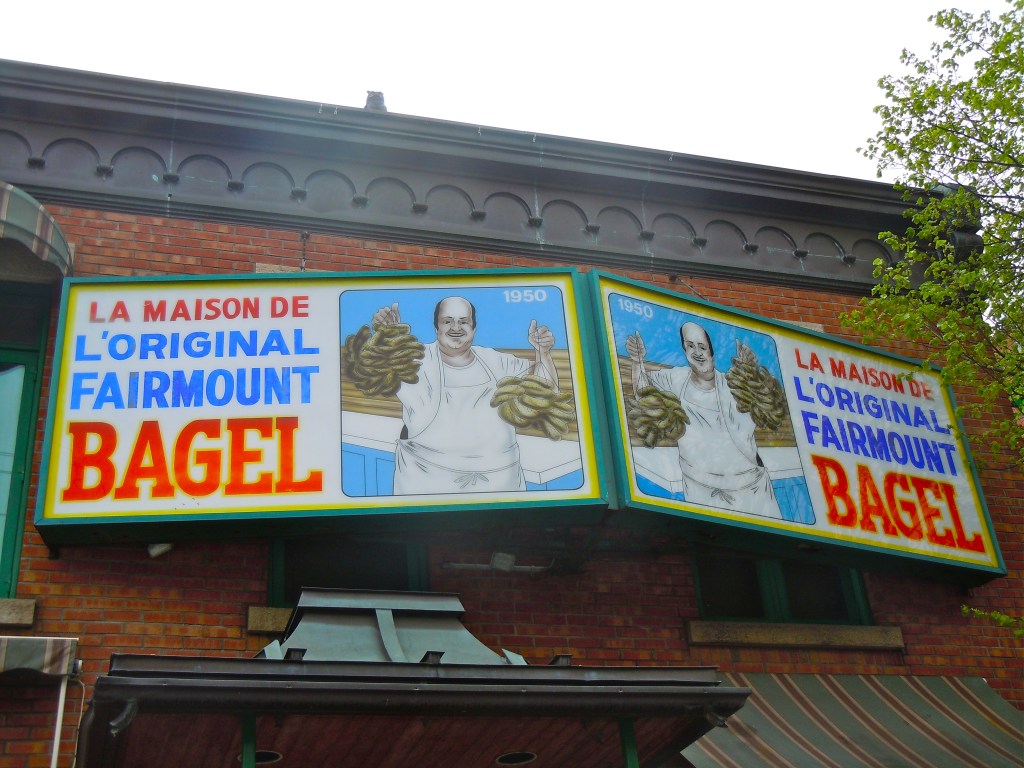
Fairmount Bagel.

Fairmount Bagel.

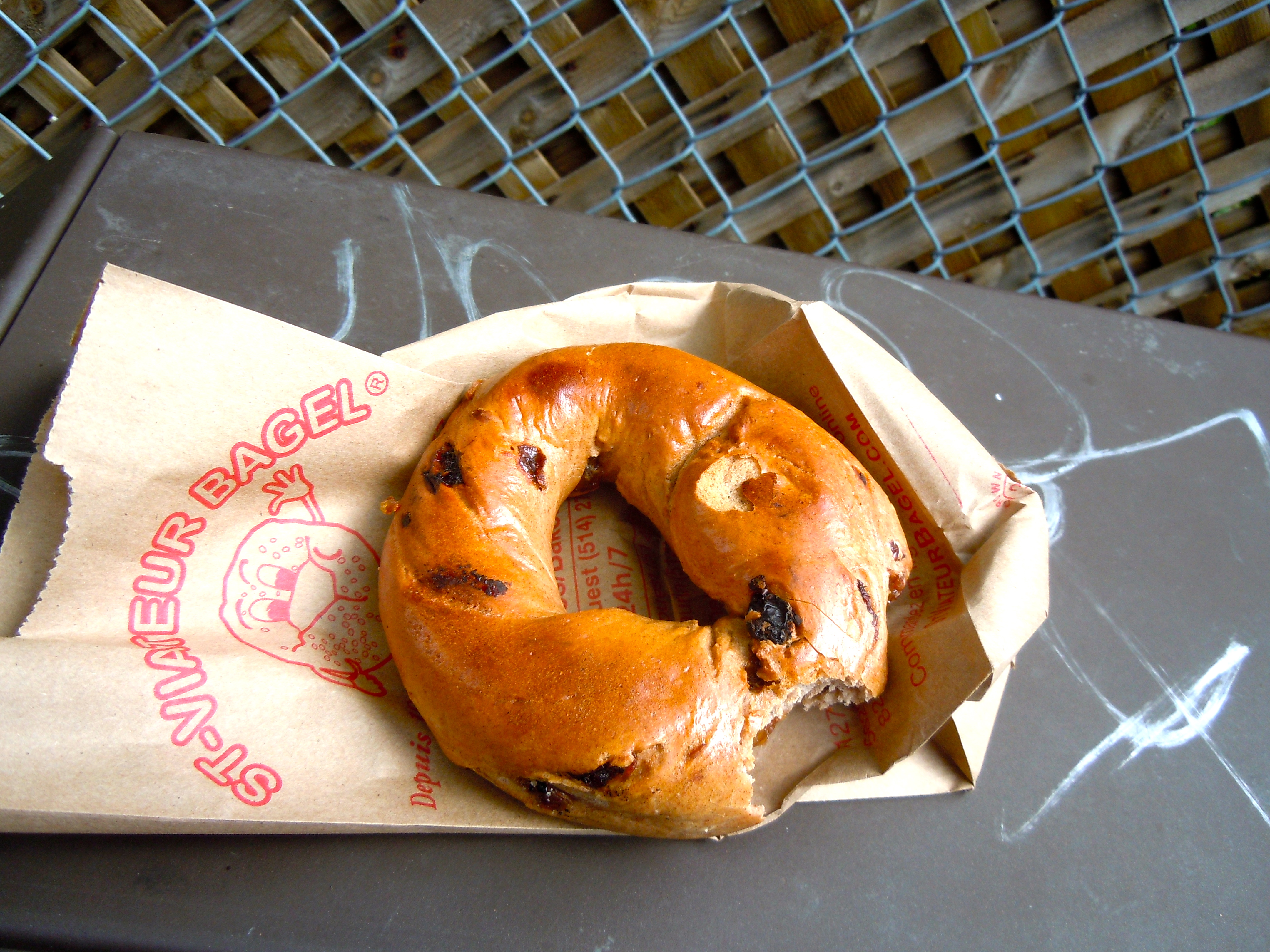
And the bagels were delicious. I now know that the traditional Montreal bagels are white (with sesame seeds) or black (with poppy seeds), but our cinnamon and raisin bagels, fresh from the oven, were some of the best I’ve ever had. I was also starving and frozen by the time, so that may also have influenced my verdict. In contrast, the bagel I tried a few hours later – for the purposes of science, you understand – from the rival St-Viateur bakery, seemed not as good. St-Viateur is also the subject of Donald Bell’s comic novel Saturday Night at the Bagel Factory (1973).

These Mile End institutions are testimony to the many groups of immigrants who settled in Canada, particularly during the early twentieth century. Jewish immigrants fleeing persecution in Central and Eastern Europe settled in Montreal partly because it offered jobs and security. The city’s Jewish population grew from around 7,000 in 1900, to nearly 64,000 in 1941, with many of them settling in Mile End and surrounds. The Orthodox Jewish community began to grow there during the 1980s.
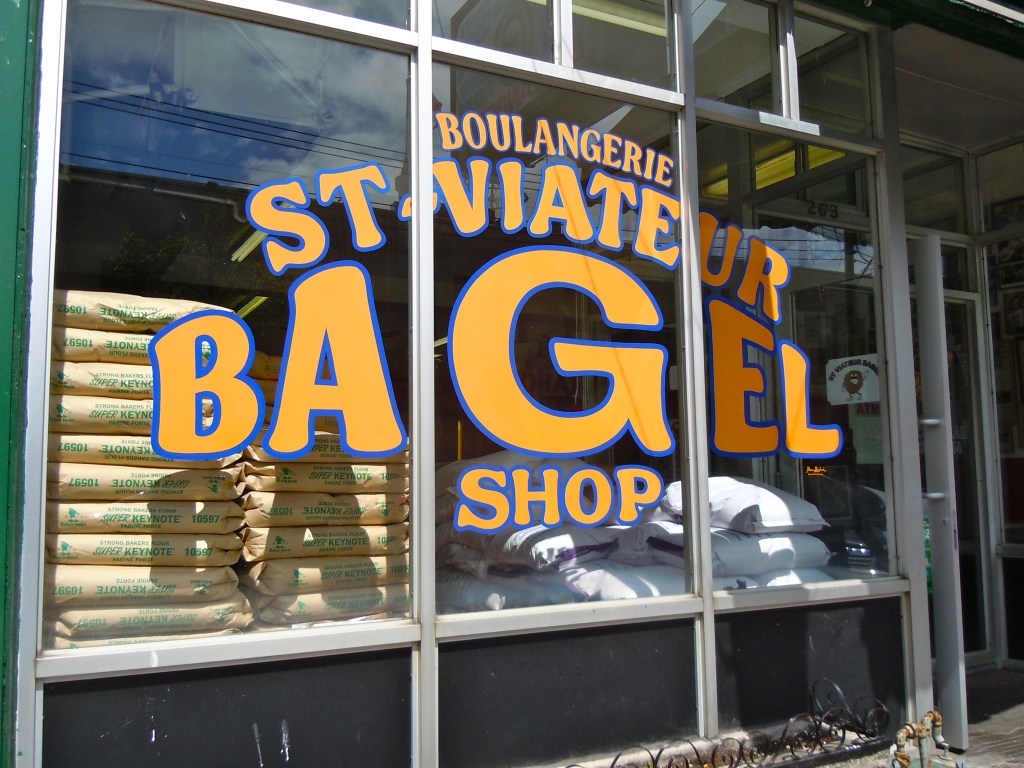
St-Viateur Bagel

St-Viateur Bagel

Until this visit, I didn’t know that Montreal bagels are distinct from other varieties: they are smaller, flatter, with bigger holes, and are baked in wood-fired ovens. They have a complex, sweeter flavour, and a drier, more chewy texture. In fact, there is now a restaurant in New York which sells Montreal bagels.

Alas, the slightly inferior bagel from the St-Viateur bakery. (I ate the one from Fairmount Bagel too quickly to photograph.)

Alas, the slightly inferior bagel from the St-Viateur bakery. (I ate the one from Fairmount Bagel too quickly to photograph.)

In her excellent We are what we eat: Ethnic Food and the Making of Modern Americans, Donna R. Gabaccia explores the evolution and changing of immigrant cuisines in the nineteenth- and twentieth-century United States. She traces the history of the bagel there: how it shifted from being made almost exclusively by Jewish delis for Jewish customers in the 1890s, to being a ubiquitous snack food available throughout the country by the 1970s and 1980s. She writes:

The bagel was not a central culinary icon for Jewish immigrants; even before Polish and Russian Jews left their ethnic enclaves or ghettoes, their memories exalted gefilte fish or chicken soup prepared by their mothers, but not the humble, hard rolls purchased from the immigrant baker. As eaters, Jewish immigrants were initially far more concerned with the purity of their kosher meat, their challah, and their matzos, and with the satisfactions of their Sabbath and holiday meals, than with their morning hard roll.

However, bagels found an enthusiastic audience among other immigrant communities, particularly in New York, where the bagel came gradually to symbolise the city. Eating cream cheese and smoked salmon on these bagels transformed them from being a part of a Jewish baking tradition, to signifying its multicultural heritage.

I wonder to what extent the same is true for Montreal? And it feels likely that this city in a country with an official policy of multiculturalism – although in a province which has a far more conflicted attitude towards this policy – would embrace this immigrant food as one symbol of what it means to be from Montreal. (In much the same way that a café near to these bakeries sells a souvlaki version of poutine.)
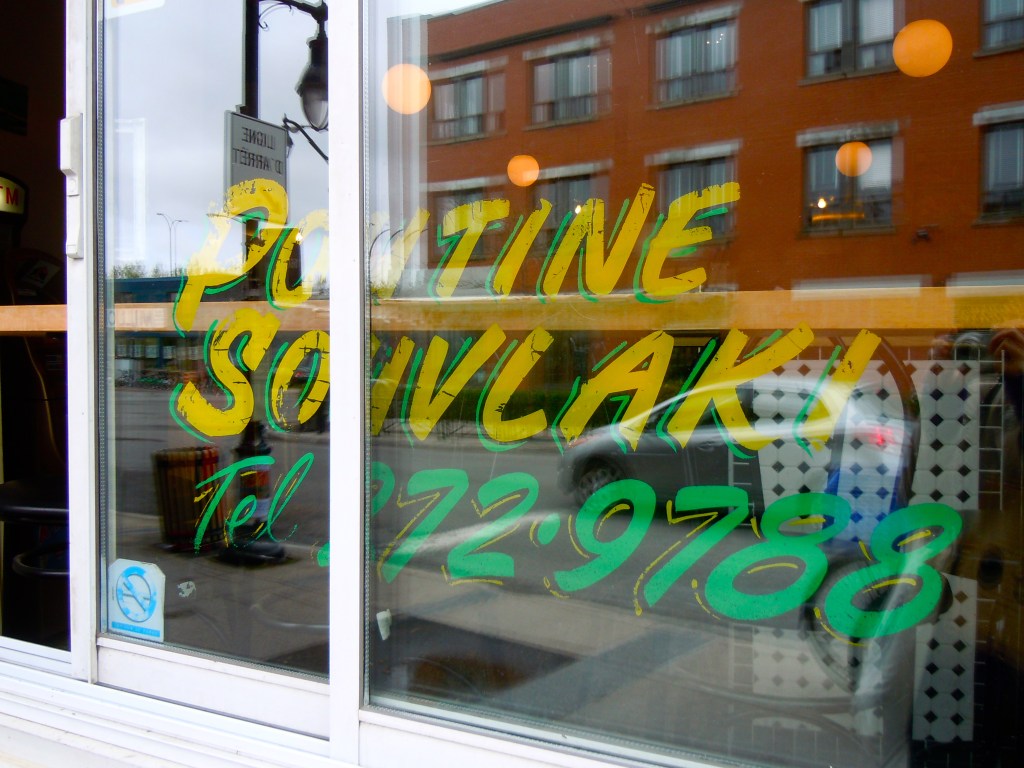
Multiculturalism?

Multiculturalism?

I think, though, that these bagels are also taking on a new meaning. Gabaccia notes that the mass production of bagels from the 1970s made them more widely available, but also turned them into an altogether softer, sweeter, and easier bread to snack on. Bagels made in factories by Kraft – and not hand-rolled in small bakeries – lacked the texture, crust, and savouriness of the product first made in the northeast.

Perhaps unsurprisingly, there has recently been a renewed enthusiasm for Jewish deli foods. Julia Moskin writes in the New York Times:

Artisanal gefilte fish. Slow-fermented bagels. Organic chopped liver. Sustainable schmaltz.

These aren’t punch lines to a fresh crop of Jewish jokes. They are real foods that recently arrived on New York City’s food scene. And they are proof of a sudden and strong movement among young cooks, mostly Jewish-Americans, to embrace and redeem the foods of their forebears. That’s why, at this moment in 21st-century New York, the cutting edge of cuisine is the beet-heavy, cabbage-friendly, herring-loving diet of 19th-century Jews in Eastern Europe.

Much of the recent enthusiasm around the rediscovery of the hand-made and the artisanal (whatever we may mean by that) has been driven by hipsters (whatever we may mean by them). In a series of posts about the anthropology of hipsters – and the hipsterdom of anthropologists – Alex Posecznick notes that one of the defining features of ‘the hipster population’ is a rejection of ‘mainstream, capitalist and individualist norms in favour of tactile crafts, free-trade coffee and styles that physically mark that rejection.’

For the hipsters of Mile End, the Fairmount and St-Viateur bakeries exemplify this refusal of the mass-produced, and the adoption of the local, the ethical, and the somehow ‘real.’ But, as Posecznick acknowledges, this never-ending search for cool in the form of the authentic can also been seen as representing no real break from other forms of capitalist consumption:

They have turned consumption itself into an art, where the fine distinction of this hat over that invests cultural capital, and where although it is used and battered, it can be sold for four times the value of a new hat.

My point is that the bagel’s meanings have changed once again: those produced in small quantities in small bakeries now suggest gritty, cool urban living, as well as a return to old-fashioned, wholesome ways of making food. The irony, though, is that this shift of meaning has occurred within the context of the gentrification of once-poor, often (Orthodox) Jewish, neighbourhoods, where rent increases have meant that their populations are becoming increasingly homogenous: largely middle-class, mostly white.

Creative Commons License
Tangerine and Cinnamon by Sarah Duff is licensed under a Creative Commons Attribution-ShareAlike 3.0 Unported License.

Food Links, 11.06.2014

  • Slavery is widespread in the Thai fishing industry.
  • The implications of the drought in California for the price of fruit and vegetables in the US. And why the disappearing fog is bad for farmers.
  • The number of Londoners using food banks has doubled in the last year.
  • Water wars in Texas. And a nineteenth-century warning against farming in the American west.
  • Another supermarket price war in the UK is bad news for agriculture.
  • A call for transparency in farming.
  • Mapping food production and consumption in the US.
  • The FDA declares war on cheese aged on wooden boards.
  • Why are South African MPs so fat?
  • Eat more vegetables.
  • From citrus to biofuel production.
  • Expired foods that are fine to eat. And the myth of ‘use by’ dates.
  • ‘it’s a lot more difficult to regulate how much marijuana is consumed through eating than through smoking or vaping.’
  • The next quinoa.
  • No-kill caviar.
  • Art Deco toasters.
  • ‘Too much fat is bad, too much protein is bad, and too much starch is bad. Everything is good, and everything is bad.’
  • A brief history of attacking politicians with food.
  • Gin and tonic cake.
  • Apricot and miso jam.
  • The joy of custard.
  • A day in the life of a sushi chef.
  • The stupendous heights of Victorian wedding cakes.
  • Understanding pica.
  • A hot sauce taste off.
  • How to cook on a boat.
  • A guide to citrus varieties.
  • The slow demise of Wimpy in the UK.
  • Making bread without yeast.
  • The best Brazilian restaurants in London.
  • Revisiting Claudia Roden’s Food of Italy.
  • Tomato plastic.
  • Competitive eating.
  • ‘A pretentious yet sensitive wine with a hint of snozzberry. Easy to down the whole bottle without realising. Great with fresh caviar.’
  • A list of films about food.
  • Growing lettuce in space.
  • But then this is Gordon Ramsay and I like to imagine that at the time he was sitting for a portrait, dressed as a beefeater with gold pantaloons.
  • Things wrapped in bacon.
  • What is a gravy boat?
  • Politicians pulling pints.
  • A dinosaur rolling pin.
  • How to tie a butcher’s knot.
  • Pork in poetry.
  • Depictions of cheese making in medieval manuscripts.
  • Beautiful teapots.
  • ‘Carrots are the new pork belly. Cauliflower is the new steak. Kale salad is the new burger.’
  • Recipes for ice cream.
  • The art of menu writing.
  • Why a packet of peanut butter M&Ms is lighter than the normal kind.
  • A brief history of doughnuts in America.
  • Michael Jackson and Paul McCartney doing the washing up.
  • Make your own sweet chilli jam.
  • Alan Rickman makes tea.

Sweet Talk

The language of maple syrup production is remarkably similar to that of drug dealing. Buyers try to make contact with dealers – who manufacture the syrup in deep, rural Ontario and Quebec – in search of the purest, most refined version of the product. I imagine the white middle-classes descending on isolated outposts of the countryside, in search of the good shit.

I spent most of May in Canada: mainly in Montreal, but also in Kingston for a wedding, and fleetingly in Toronto. I had a most fantastic and excellent time. (Except for the bit where I threw up every two hours on the trip from Toronto to Montreal. I could not recommend Via Rail’s bathrooms more highly.) Until this visit, my main exposure to Canadian cuisine had been in the form of Kraft dinner and poutine. A few years ago, a friend and I were locked in a basement kitchen and made to cook poutine for fifty homesick Canadians. If needs be, I may claim Canadian citizenship on the grounds of this experience. So with expectations suitably adjusted, I was curious about the food I would encounter.

In Toronto's Kensington Market.

In Toronto’s Kensington Market.

I ate exceptionally well and at such a range of cafes and restaurants, which is not surprising considering how multicultural some parts of Canada are. I was interested in the number of distinctly Canadian dishes I encountered: turtles, Nanaimo bars, and butter tarts. I would have tried a sugar pie in Quebec were I not concerned about early-onset diabetes.

A turtle at Olive & Gourmando.

A turtle at Olive & Gourmando in Montreal.

And while staying with my friend Jane’s parents in Kingston, I learned a great deal about maple syrup. (Not least via the medium of her mum Elva’s amazingly delicious maple syrup muffins.) I discovered:

–       It’s possible to freeze maple syrup.

–       Maple syrup is best stored in empty, but unrinsed, rum, whisky, or brandy bottles.

–       The syrup ages as it keeps.

–       Each vintage is unique.

–       A collection of maple trees tapped for resin is called a sugar bush.

Subsequently, my friend Theo mentioned the Strategic Maple Syrup Reserve. This really does exist and is not, as I first suspected, the basis of Canada’s counter-terrorism strategy (neutralising enemies with extreme sweetness). Theo explains:

Cartel logic. The reserve is there to maintain the ‘right’ balance of sales and prices year to year, maintaining predictability for the many, many small producers of maple syrup. They sell off the reserve if there are new markets or a bad frost reducing the supply, and they build up the reserve in years with good production. OPEC does the same thing with petrol.

Maple syrup is so important to the Canadian economy – Quebec alone produces three quarters of the world’s supply – that the reserve is essential for protecting both the nation’s income and individual suppliers’ livelihoods. This is why the 2012 heist, during which thieves made off with around $30 million worth of maple syrup, was such a calamity.

In Mile End, Montreal.

In Mile End, Montreal.

But maple syrup means more than money. One of my favourite accounts of a first visit to the motherland is an essay by Margaret Atwood. In ‘Tour-de-Farce’ she describes how this 1964 trip to Britain and ‘a dauntingly ambitious quest for cultural trophies,’ which was supposed to ‘improve’ both her and her writing, helped her to understand her own Canadian-ness. Or, rather, that the people she encountered abroad could not position her within a cultural context:

For the Europeans, there was a flag-shaped blank where my nationality should have been. What was visible to me was invisible to them; nor could I help them out by falling back on any internationally-famous architectural constructs. About all I had to offer as a referent was a troop of horsey policemen, which hardly seemed enough.

Canadian food historians have begun to do excellent work on how Canadian identities have been constructed around food, cooking, and eating – around Tim Horton’s, immigrant cuisines, vegetarianism – and have thought about the position of maple syrup within this national identity- and mythmaking. (In what other country is it possible to consume a national emblem at breakfast?)

Its origins are in the wilderness, it was produced first by First Nations people and then by settlers, particularly dairy farmers in need of income during long, freezing winters. It was the virtuous substitute for sugar among nineteenth-century abolitionists, and figured prominently in the country’s commitment to an imperial war effort during the Second World War. Maple syrup’s usefulness is that because it’s a product that is linked to Canada’s landscape – it is ‘natural’ and, thus, somehow pure – it is able to by-pass a range of concerns that upset ideas of a Canadian-ness constructed around goodness and sweetness. Like wild salmon, maple syrup can be sold as a kind of pure, depoliticised embodiment of all that is ‘Canadian.’

Further Reading

Atsuko Hashimoto and David J. Telfer, ‘Selling Canadian Culinary Tourism: Branding the Global and the Regional Product,’ Tourism Geographies: An International Journal of Tourism Space, Place and Environment, vol. 8, no. 1 (2006), pp. 31-55.

Franca Iacovetta, Valerie J. Korinek, and Marlene Epp (eds.), Edible Histories, Cultural Politics: Towards a Canadian Food History (Toronto: University of Toronto Press, 2012).

Carol I. Mason, ‘A Sweet Small Something: Maple Sugaring in the New World,’ in The Invented Indian: Cultural Fictions and Government Policies, ed. James A. Clifton (New Brunswick, NJ: Transaction Publishers, 2007), pp. 91-106.

Ian Mosby, Food will Win the War: The Politics, Culture, and Science of Food on Canada’s Home Front (Vermont: University of British Columbia Press, 2014).

Steve Penfold, The Donut: A Canadian History (Toronto: University of Toronto Press, 2008).

Creative Commons License
Tangerine and Cinnamon by Sarah Duff is licensed under a Creative Commons Attribution-ShareAlike 3.0 Unported License.